Multi-messenger and Multi-band Studies of Massive Black Holes: the Synergies Between LISA and SKAO
Pith reviewed 2026-06-25 22:32 UTC · model grok-4.3
The pith
LISA sources have radio counterparts whose numbers stay steady across jet models and SKA configurations.
A machine-rendered reading of the paper's core claim, the machinery that carries it, and where it could break.
Core claim
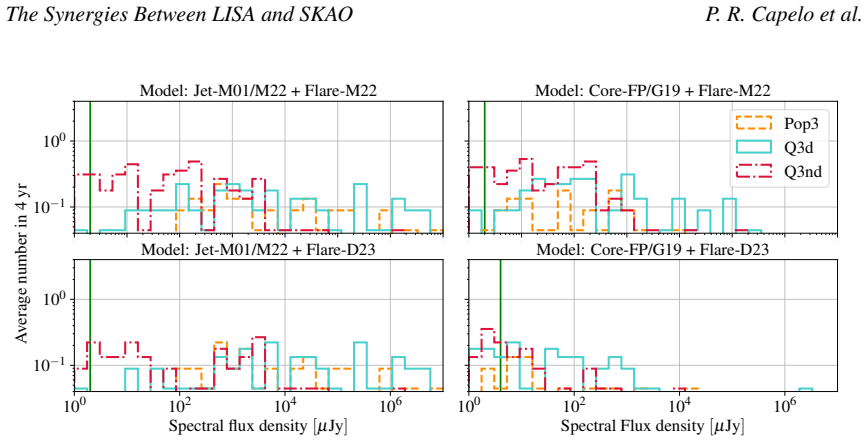
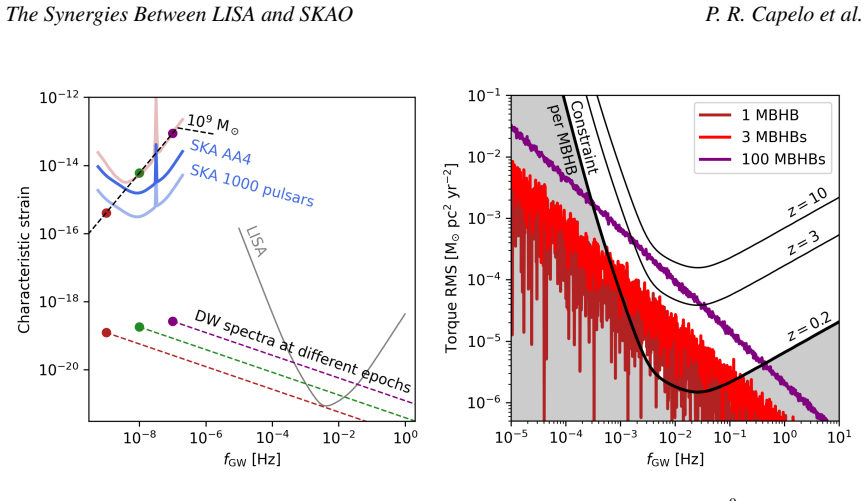
By employing identical underlying black hole binary populations from numerical simulations and mock catalogues, the analysis demonstrates that the number of radio counterparts of LISA sources is relatively insensitive to the jet or flare model employed and to whether SKA-Mid AA* or AA4 is assumed. Supermassive black hole binaries embedded in gas discs undergo hydrodynamical torques that generate additional small-amplitude higher-frequency gravitational waves; the primary carrier waves may be identified as deterministic signals by SKAO-era pulsar timing arrays while the harmonics appear as stochastic signals in LISA, so that correlating the two bands supplies constraints on the environments o
What carries the argument
The common black hole binary populations drawn from numerical simulations and mock catalogues, which serve as the shared foundation for both gravitational-wave and electromagnetic predictions.
If this is right
- Coincident millihertz gravitational-wave and radio detections of the same massive black hole binaries become feasible.
- The first low-frequency multi-band gravitational-wave detection of an individual object is possible when SKAO contributes to a pulsar timing array.
- Correlating the multi-band gravitational-wave signals yields constraints on the gas environments around the most massive black holes.
- Hydrodynamical torques in gas discs produce identifiable additional higher-frequency gravitational-wave components.
Where Pith is reading between the lines
- Joint detections could link electromagnetic signatures directly to the gravitational-wave inspiral phase, helping trace how gas influences binary evolution.
- The robustness to emission models reduces the modeling burden before SKAO can be used to follow up LISA localizations.
- Multi-band gravitational-wave observations may distinguish between different torque mechanisms that single-band data cannot separate.
Load-bearing premise
The black hole binary populations taken from numerical simulations and mock catalogues accurately represent the real systems that exist in the universe.
What would settle it
If the predicted number of radio counterparts changes by a large factor when a different jet or flare model is substituted, or if no higher-frequency gravitational wave harmonics correlated with pulsar-timing-array signals appear in LISA data, the central claims would be falsified.
Figures
read the original abstract
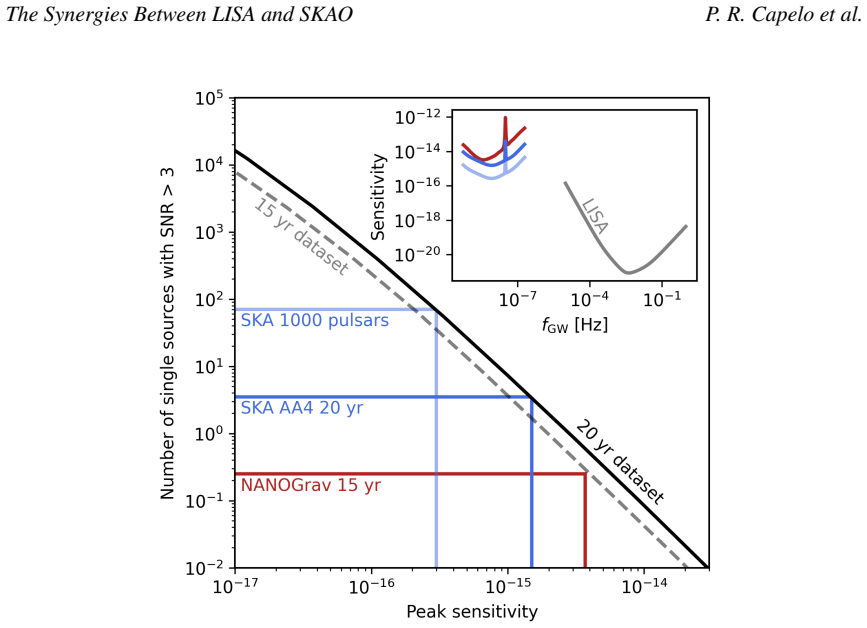
Depending on its mass, the same gas-embedded massive black hole (BH) binary can emit gravitational waves (GWs) in one or more bands (nHz and mHz) concurrently, along with electromagnetic (EM) waves over the entire spectrum. The Square Kilometre Array Observatory (SKAO), thanks to its unparalleled sensitivity, will be pivotal in achieving coincident GW-EM (mHz-radio) and GW-GW (nHz-mHz) detections. We review the state-of-the-art predictions - achieved by means of numerical simulations and mock catalogues - of the numbers of detectable coincident GW-EM signals when employing the Laser Interferometer Space Antenna (LISA) and SKA-Mid. By exploiting the same underlying BH binary populations, to allow for a fairer comparison, we then assess the importance of a variety of EM models for the radio flares and jets, finding that the number of radio counterparts of LISA sources is relatively insensitive to the jet/flare model employed and to whether SKA-Mid AA* or AA4 is assumed. Additionally, we describe how SKAO - as part of a pulsar timing array (PTA) - and LISA will provide the opportunity to detect the first low-frequency, multi-band (nHz-mHz) GW detection of the same object. Supermassive BH binaries embedded in gas discs are subjected to hydrodynamical torques, causing perturbations that produce additional small-amplitude, higher-frequency GWs. The main carrier GWs may thus be identifiable as a deterministic signal by SKAO-era PTAs, while the higher-frequency harmonics would shine in LISA as stochastic signals. Correlating these multi-band GWs would provide unprecedented constraints on the environment of the most massive BHs.
Editorial analysis
A structured set of objections, weighed in public.
Referee Report
Summary. The paper reviews predictions from numerical simulations and mock catalogues for coincident mHz GW (LISA) and radio (SKAO) detections of gas-embedded massive BH binaries, as well as nHz-mHz multi-band GW detections. Using the same underlying BH binary populations, it reports that the number of detectable radio counterparts is relatively insensitive to the choice of jet/flare EM models and to SKA-Mid AA* versus AA4 configurations. It further argues that hydrodynamical torques in gas discs generate higher-frequency GW harmonics that appear as stochastic signals in LISA while the main signal is detectable by SKAO-era PTAs, enabling the first multi-band GW detections of the same object.
Significance. If the simulation-based populations prove representative, the reported insensitivity to EM modeling choices would be a practical result for observation planning, and the multi-band GW synergy would offer a novel route to constrain the environments of the most massive BHs. The work usefully synthesizes LISA-SKAO synergies but does not introduce new derivations or falsifiable predictions beyond the reviewed simulation outputs.
major comments (2)
- [Abstract and population modeling sections] The central claims of model insensitivity for radio counterpart counts and the multi-band GW detection forecast both rest on the fidelity of the BH binary populations drawn from the cited numerical simulations and mock catalogues. No sensitivity analysis to variations in mass/redshift distributions, formation channels, or gas-disc physics is presented, so quantitative results may shift if those populations are revised.
- [Multi-band GW discussion] The description of hydrodynamical torques producing identifiable higher-frequency GW harmonics as stochastic LISA signals lacks quantitative details on amplitude thresholds, harmonic orders, or how the stochastic background is distinguished from other LISA noise sources; this is load-bearing for the multi-band claim.
minor comments (2)
- [Introduction] Notation for SKA-Mid configurations (AA* vs. AA4) should be defined at first use with a brief reference to the relevant SKAO technical document.
- [Results on radio counterparts] The manuscript would benefit from a table summarizing the different jet/flare models tested and the resulting counterpart counts for each SKA configuration.
Simulated Author's Rebuttal
We thank the referee for their constructive comments on our review of LISA-SKAO synergies. We address each major comment below, clarifying the scope of the work as a synthesis of existing simulation results rather than new modeling.
read point-by-point responses
-
Referee: [Abstract and population modeling sections] The central claims of model insensitivity for radio counterpart counts and the multi-band GW detection forecast both rest on the fidelity of the BH binary populations drawn from the cited numerical simulations and mock catalogues. No sensitivity analysis to variations in mass/redshift distributions, formation channels, or gas-disc physics is presented, so quantitative results may shift if those populations are revised.
Authors: We agree that all quantitative forecasts inherit uncertainties from the underlying BH binary populations. The manuscript is explicitly a review that compiles and compares predictions from multiple published numerical simulations and mock catalogues, using the same populations to enable direct comparison of EM models. No new populations or sensitivity analyses were generated, as that lies outside the review's scope. In the revised version we will add an explicit caveats subsection in the population modeling section that summarizes how variations in mass functions, formation channels, and gas-disc physics (as explored in the cited works) could affect the reported numbers, while retaining the finding that radio counterpart counts remain relatively insensitive within the range of models already published. revision: partial
-
Referee: [Multi-band GW discussion] The description of hydrodynamical torques producing identifiable higher-frequency GW harmonics as stochastic LISA signals lacks quantitative details on amplitude thresholds, harmonic orders, or how the stochastic background is distinguished from other LISA noise sources; this is load-bearing for the multi-band claim.
Authors: The multi-band GW paragraph is a concise qualitative outline of a mechanism already discussed in the hydrodynamics and PTA literature. We acknowledge that the current text does not include explicit amplitude thresholds or harmonic-order calculations. In revision we will expand the section with references to the specific torque-induced harmonic amplitudes and frequency ranges reported in the cited hydrodynamical studies, and we will briefly note how the higher-frequency stochastic component can be separated from LISA's instrumental noise and the galactic binary foreground using standard LISA data-analysis techniques already validated in the literature. revision: yes
Circularity Check
No significant circularity; claims rest on external simulations and mock catalogues
full rationale
The paper reviews predictions from numerical simulations and mock catalogues for BH binary populations, then varies EM models (jets/flares) on the same fixed populations for comparison. The insensitivity finding and multi-band GW discussion follow directly from those external inputs without self-definition, fitted parameters renamed as predictions, or load-bearing self-citations that collapse the chain. No equations or steps reduce by construction to the paper's own outputs.
Axiom & Free-Parameter Ledger
axioms (2)
- domain assumption Numerical simulations and mock catalogues provide representative BH binary populations for detection rate predictions.
- domain assumption Hydrodynamical torques in gas discs produce additional small-amplitude higher-frequency GWs identifiable as stochastic signals in LISA.
Reference graph
Works this paper leans on
-
[1]
The NANOGrav 15 yr Data Set: Evi- dence for a Gravitational-wave Background[J/OL]
G. Agazie et al.ApJL, 951(1):L8, July 2023a. doi: 10.3847/2041-8213/acdac6. G. Agazie et al.ApJL, 951(2):L50, July 2023b. doi: 10.3847/2041-8213/ace18a. G. Agazie et al.ApJL, 951(1):L10, July 2023c. doi: 10.3847/2041-8213/acda88. G. Agazie et al.ApJL, 952(2):L37, Aug. 2023d. doi: 10.3847/2041-8213/ace18b. P. Amaro-Seoane et al.Living Reviews in Relativity...
-
[2]
doi: 10.1007/ s41114-022-00041-y. F. Antonini, E. Barausse, and J. Silk.ApJL, 806(1):L8, June 2015a. doi: 10.1088/2041-8205/806/ 1/L8. F. Antonini, E. Barausse, and J. Silk.ApJ, 812(1):72, Oct. 2015b. doi: 10.1088/0004-637X/812/ 1/72. P. J. Armitage and P. Natarajan.ApJL, 567(1):L9–L12, Mar
-
[3]
doi: 10.1086/339770. Z. Arzoumanian et al.ApJL, 951(2):L28, July
-
[4]
doi: 10.3847/2041-8213/acdbc7. E. Barausse.MNRAS, 423(3):2533–2557, July
-
[5]
doi: 10.1111/j.1365-2966.2012.21057.x. E. Barausse, V. Cardoso, and P. Pani.Phys. Rev. D, 89(10):104059, May
-
[6]
doi: 10.1046/j.1365-8711.2002.05335.x. J. E. Barnes and L. E. Hernquist.ApJL, 370:L65, Apr
-
[7]
doi: 10.1086/185978. M. C. Begelman, R. D. Blandford, and M. J. Rees.Nature, 287(5780):307–309, Sept
-
[8]
doi: 10.1038/287307a0. R. D. Blandford and R. L. Znajek.MNRAS, 179:433–456, May
-
[9]
doi: 10.1093/mnras/179.3
-
[10]
doi: 10.1093/mnras/ sty1605. T. Bogdanović, M. C. Miller, and L. Blecha.Living Reviews in Relativity, 25(1):3, Dec
-
[11]
doi: 10.1007/s41114-022-00037-8. T. Bourke et al. Advancing astrophysics with the square kilometre array (aaska14),
-
[12]
doi: 10.1093/mnras/stw2872. P. R. Capelo et al.MNRAS, 447(3):2123–2143, Mar
-
[13]
doi: 10.1093/mnras/stu2500. P. R. Capelo et al.MNRAS, 469(4):4437–4454, Aug
-
[14]
doi: 10.1093/mnras/stx1067. P. R. Capelo, C. Feruglio, R. C. Hickox, and F. Tombesi. Black Hole-Galaxy Co-evolution and the Role of Feedback. InHandbook of X-ray and Gamma-ray Astrophysics, page
-
[15]
doi: 10.1007/978-981-16-4544-0_115-1. C. L. Carilli and S. Rawlings.New Astron. Rev., 48(11-12):979–984, Dec
-
[16]
Terwilliger algebras of direct and wreath products of association schemes
doi: 10.1016/j. newar.2004.09.001. S. K. Chakrabarti.ApJ, 411:610, July
work page doi:10.1016/j 2004
-
[17]
doi: 10.1086/172863. M. H. Cohen et al.ApJ, 658(1):232–244, Mar
-
[18]
doi: 10.1086/511063. M.Colpietal.arXive-prints,art.arXiv:2402.07571,Feb.2024. doi: 10.48550/arXiv.2402.07571. L.Copparonietal.Phys.Rev.D,111(10):104079,May2025. doi: 10.1103/PhysRevD.111.104079. D. J. Croton.MNRAS, 394(2):1109–1119, Apr
work page internal anchor Pith review Pith/arXiv arXiv doi:10.1086/511063 2024
-
[19]
doi: 10.1111/j.1365-2966.2009.14429.x. T. Dal Canton et al.ApJ, 886(2):146, Dec
-
[20]
doi: 10.3847/1538-4357/ab505a. A. De Rosa et al.New Astron. Rev., 86:101525, Dec
-
[21]
doi: 10.1016/j.newar.2020.101525. 21 The Synergies Between LISA and SKAO P. R. Capelo et al. P. F. Depta, V. Domcke, G. Franciolini, and M. Pieroni.Phys. Rev. D, 111(8):083039, Apr
-
[22]
doi: 10.1103/PhysRevD.111.083039. A. Derdzinski et al.MNRAS, 501(3):3540–3557, Mar
-
[23]
doi: 10.1093/mnras/staa3976. C. A. Dong-Páez et al.A&A, 676:A2, Aug. 2023a. doi: 10.1051/0004-6361/202346435. C. A. Dong-Páez et al.A&A, 673:A120, May 2023b. doi: 10.1051/0004-6361/202346295. D. J. D’Orazio and P. C. Duffell.ApJL, 914(1):L21, June
-
[24]
doi: 10.3847/2041-8213/ac0621. A. S. Eddington.MNRAS, 77:16–35, Nov
-
[25]
doi: 10.1093/mnras/77.1.16. A. Einstein.Sitzungsberichte der Königlich Preussischen Akademie der Wissenschaften, pages 688–696, Jan
-
[26]
doi: 10.1016/S0016-0032(37)90583-0. O. Fakhouri, C.-P. Ma, and M. Boylan-Kolchin.MNRAS, 406(4):2267–2278, Aug
-
[27]
doi: 10.1111/j.1365-2966.2010.16859.x. M. Falxa et al.MNRAS, 521(4):5077–5086, June
-
[28]
doi: 10.1093/mnras/stad812. E. Gallo, B. P. Miller, and R. Fender.MNRAS, 423(1):590–599, June
-
[29]
2009, MNRAS, 394, 1825, doi:10.1111/j
doi: 10.1111/j. 1365-2966.2012.20899.x. M. Garg et al.MNRAS, 517(1):1339–1354, Nov
work page doi:10.1111/j 2012
-
[30]
doi: 10.1093/mnras/stac2711. M. Garg et al.MNRAS, 532(4):4060–4074, Aug
-
[31]
doi: 10.1093/mnras/stae1764. K. Gültekin et al.ApJ, 706(1):404–416, Nov
-
[32]
doi: 10.1088/0004-637X/706/1/404. K. Gültekin et al.ApJL, 788(2):L22, June
-
[33]
doi: 10.1088/2041-8205/788/2/L22. K. Gültekin et al.ApJ, 871(1):80, Jan
-
[34]
doi: 10.3847/1538-4357/aaf6b9. K. Gültekin et al.MNRAS, 516(4):6123–6131, Nov
-
[35]
doi: 10.1093/mnras/stac2608. J. S. Hazboun, J. D. Romano, and T. L. Smith.Phys. Rev. D, 100(10):104028, Nov
-
[36]
P.F.HopkinsandE.Quataert.MNRAS,407(3):1529–1564,Sept.2010
doi: 10.1103/PhysRevD.100.104028. P.F.HopkinsandE.Quataert.MNRAS,407(3):1529–1564,Sept.2010. doi: 10.1111/j.1365-2966. 2010.17064.x. D.Izquierdo-Villalba, A.Sesana, S.Bonoli, andM.Colpi.MNRAS, 509(3):3488–3503, Jan.2022. doi: 10.1093/mnras/stab3239. D. Izquierdo-Villalba et al.arXiv e-prints, art. arXiv:2605.00092, Apr
-
[37]
doi: 10.22323/1.215.0037. A. Jenkins et al. InAdvancing Astrophysics with the SKA – II (AASKAII)
-
[38]
D.L.Kaplan,R.O’Shaughnessy,A.Sesana,andM.Volonteri.ApJL,734(2):L37,June2011
arXiv search: Report number AASKAII/Jenkins01. D.L.Kaplan,R.O’Shaughnessy,A.Sesana,andM.Volonteri.ApJL,734(2):L37,June2011. doi: 10.1088/2041-8205/734/2/L37. E. F. Keane et al.The Open Journal of Astrophysics, 8:54256, Dec
-
[40]
doi: 10.1093/mnras/stx1638. L. Z. Kelley et al. nanograv/holodeck: v1.5.2, Apr
-
[41]
doi: 10.1103/PhysRevD.93.024003. A. Kolmogorov.Akademiia Nauk SSSR Doklady, 30:301–305, Jan
-
[42]
E.-K.Lietal.ReportsonProgressinPhysics,88(5):056901,May2025
doi: 10.1017/pasa.2025.10120. E.-K.Lietal.ReportsonProgressinPhysics,88(5):056901,May2025. doi: 10.1088/1361-6633/ adc9be. L. London et al.Phys. Rev. Let., 120(16):161102, Apr
-
[43]
doi: 10.1103/PhysRevLett.120. 161102. G. Lops et al.MNRAS, 519(4):5962–5986, Mar
-
[44]
doi: 10.1093/mnras/stad058. J. Luo et al.Classical and Quantum Gravity, 33(3):035010, Feb
-
[46]
doi: 10.1093/ptep/ptaa083. M. Maggiore.Gravitational Waves: Volume 2: Astrophysics and Cosmology. Oxford University Press,
-
[47]
Relativistic Hydrodynamics[M/OL]
doi: 10.1093/oso/9780198570899.001.0001. A.Mangiaglietal.Phys.Rev.D,106(10):103017,Nov.2022. doi: 10.1103/PhysRevD.106.103017. L. Mayer.Classical and Quantum Gravity, 30(24):244008, Dec
-
[48]
doi: 10.1088/0264-9381/ 30/24/244008. A. M. Medling et al.ApJ, 784(1):70, Mar
-
[49]
doi: 10.1088/0004-637X/784/1/70. D. L. Meier.ApJL, 548(1):L9–L12, Feb
-
[50]
doi: 10.1086/318921. R. Narayan and I. Yi.ApJL, 428:L13, June
-
[51]
doi: 10.1086/187381. D. Neilsen et al.Proceedings of the National Academy of Science, 108(31):12641–12646, Aug
-
[52]
doi: 10.1073/pnas.1019618108. R. O’Shaughnessy, D. L. Kaplan, A. Sesana, and A. Kamble.ApJ, 743(2):136, Dec
-
[53]
doi: 10.1088/0004-637X/743/2/136. C. Palenzuela, L. Lehner, and S. L. Liebling.Science, 329(5994):927–930, Aug
-
[54]
doi: 10.1126/science.1191766. P. C. Peters.Physical Review, 136(4B):1224–1232, Nov
-
[55]
doi: 10.1103/PhysRev.136.B1224. V. Ravi. In E. Murphy, editor,Science with a Next Generation Very Large Array, volume 517 of Astronomical Society of the Pacific Conference Series, page 781, Dec
-
[56]
doi: 10.48550/ arXiv.1806.08446. C. Rodriguez et al.ApJ, 646(1):49–60, July
-
[57]
doi: 10.1086/504825. C. Roedig et al.A&A, 545:A127, Sept
-
[58]
doi: 10.1051/0004-6361/201219986. W.-H. Ruan, Z.-K. Guo, R.-G. Cai, and Y.-Z. Zhang.International Journal of Modern Physics A, 35(17):2050075, June
-
[59]
doi: 10.1142/S0217751X2050075X. A. Sesana, E. Barausse, M. Dotti, and E. M. Rossi.ApJ, 794(2):104, Oct
-
[60]
doi: 10.1093/mnras/sts026. R. M. Shannon et al.The Open Journal of Astrophysics, 8:54243, Dec
-
[61]
doi: 10.33232/001c. 154243. 23 The Synergies Between LISA and SKAO P. R. Capelo et al. R. M. Shannon et al. InAdvancing Astrophysics with the SKA – II (AASKAII)
-
[62]
doi: 10.1093/mnras/staa1381. M. Siwek, L. Z. Kelley, and L. Hernquist.MNRAS, 534(3):2609–2620, Nov
-
[63]
doi: 10.1051/0004-6361:200810383. R. Souza Lima et al.ApJ, 899(2):126, Aug
-
[64]
doi: 10.3847/1538-4357/aba624. J. Stegmann et al.Nature Astronomy, 8(10):1321–1331, Oct
-
[65]
doi: 10.1038/ s41550-024-02338-0. N. Tamanini et al.JCAP, 2016(4):002, Apr
2016
-
[66]
J.J.Thomson.ConductionofElectricityThroughGases
doi: 10.1088/1475-7516/2016/04/002. J.J.Thomson.ConductionofElectricityThroughGases. CambridgeUniversityPress,Cambridge,
-
[67]
doi: 10.1086/147861. M. Trebitsch et al.A&A, 653:A154, Sept
-
[68]
doi: 10.1051/0004-6361/202037698. R. J. Truant et al.A&A, 706:A115, Feb
-
[69]
doi: 10.1051/0004-6361/202554846. L. Zwick et al.MNRAS, 511(4):6143–6159, Apr
-
[70]
doi: 10.1093/mnras/stac299. L. Zwick, P. R. Capelo, and L. Mayer.MNRAS, 521(3):4645–4651, May
-
[71]
doi: 10.1103/PhysRevD.110.103005. L. Zwick et al.Phys. Rev. D, 112(8):083029, Oct
-
[72]
doi: 10.1103/qp2h-y4b2. 24
discussion (0)
Sign in with ORCID, Apple, or X to comment. Anyone can read and Pith papers without signing in.