Resonant Super-Earths Dancing With EKL Oscillations: TTV Phase Excitation and Resonance Disruption by EKL Interactions between a Cold Jupiter and Stellar Companion
Pith reviewed 2026-06-25 20:33 UTC · model grok-4.3
The pith
EKL interactions between a cold Jupiter and stellar companion can excite TTV phases and disrupt near-resonances in inner super-Earth pairs.
A machine-rendered reading of the paper's core claim, the machinery that carries it, and where it could break.
Core claim
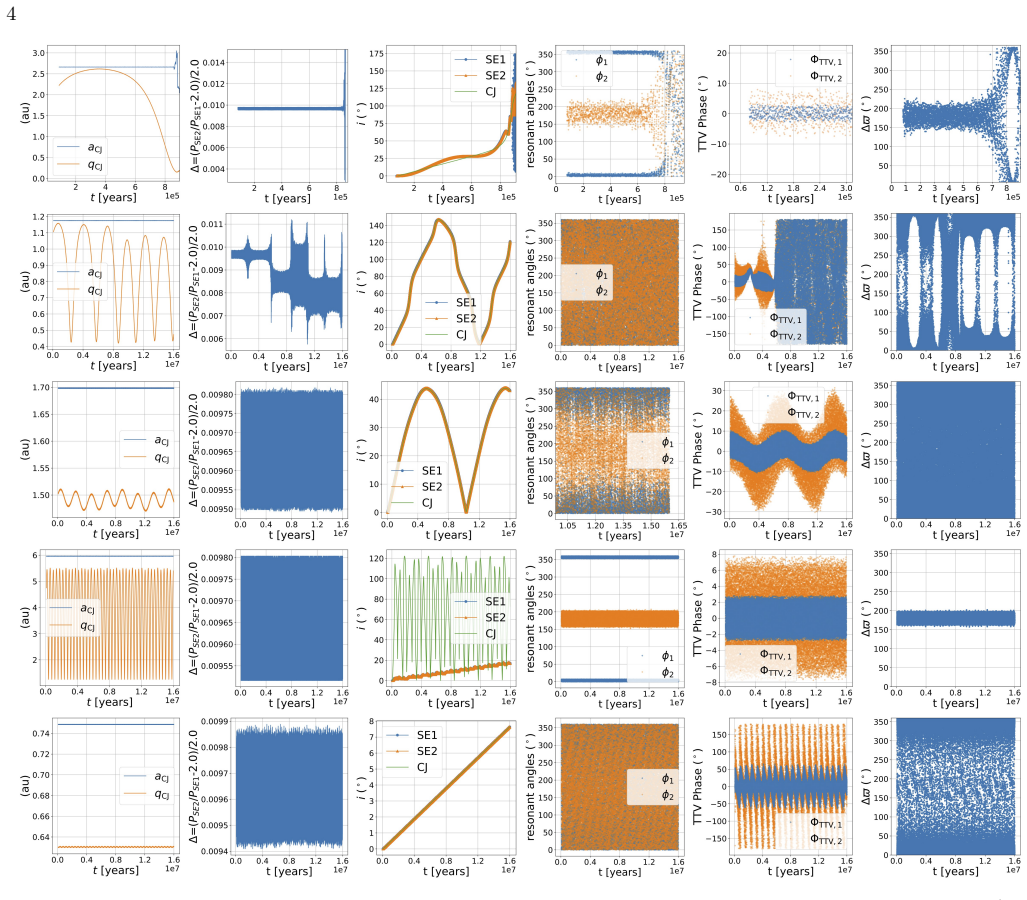
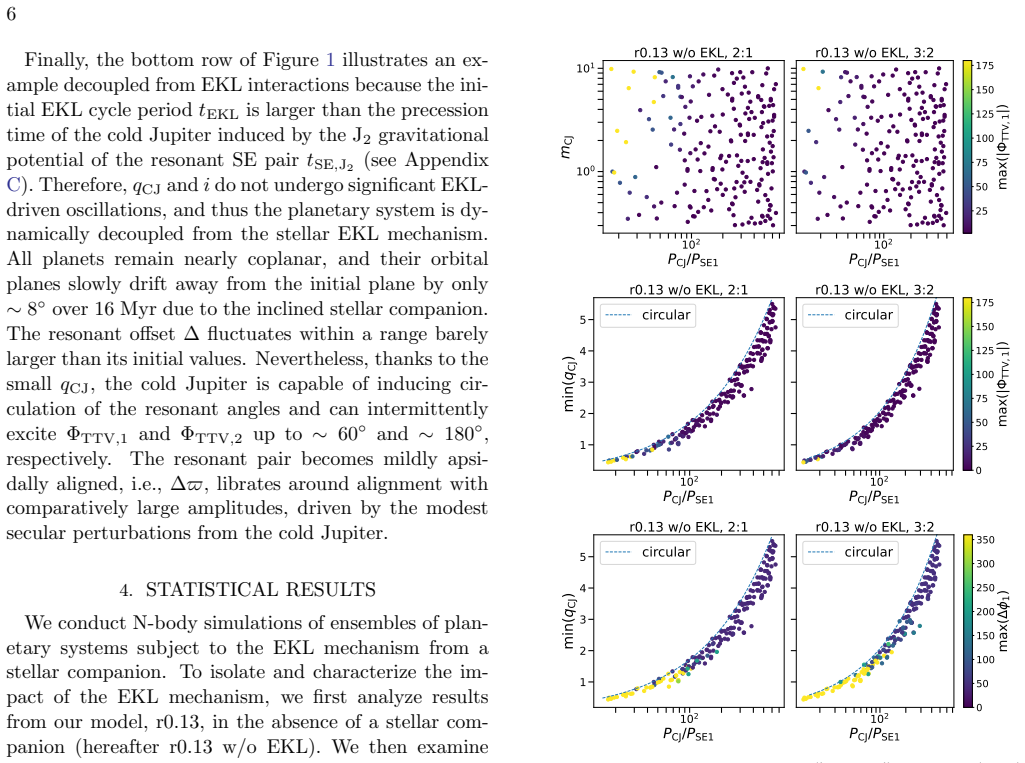
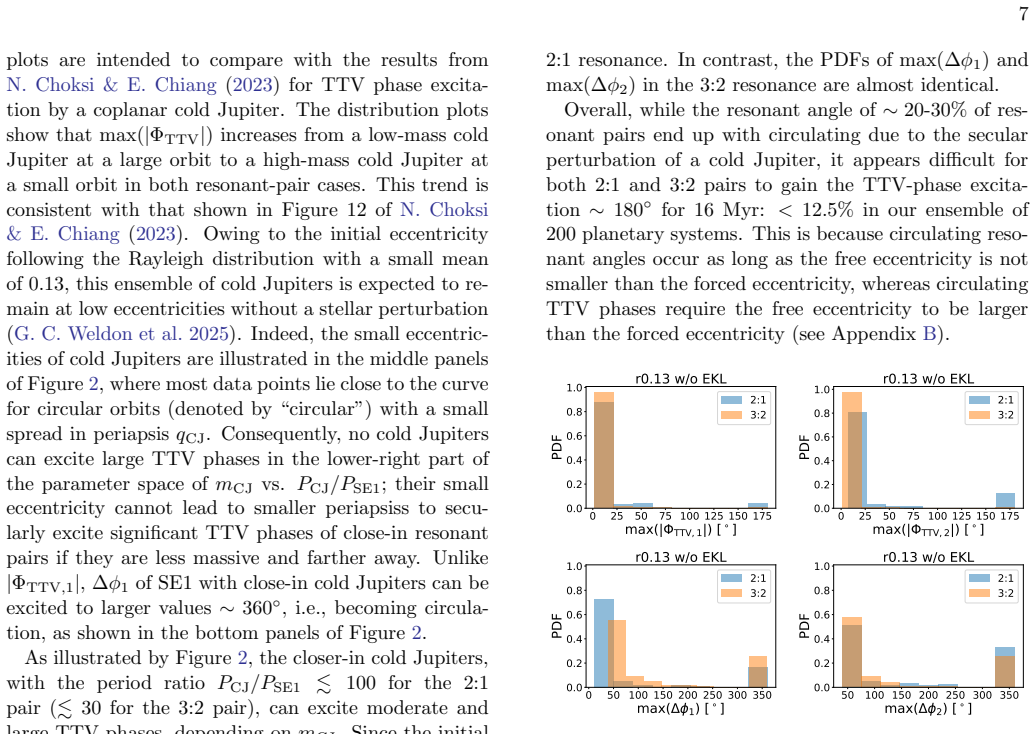
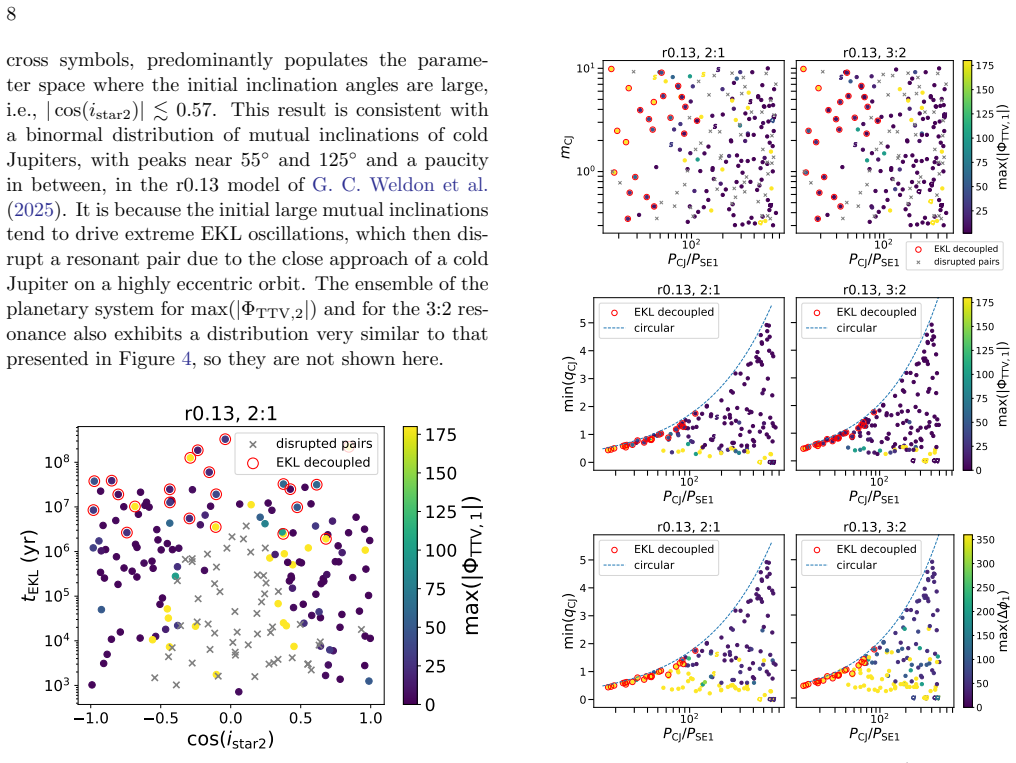
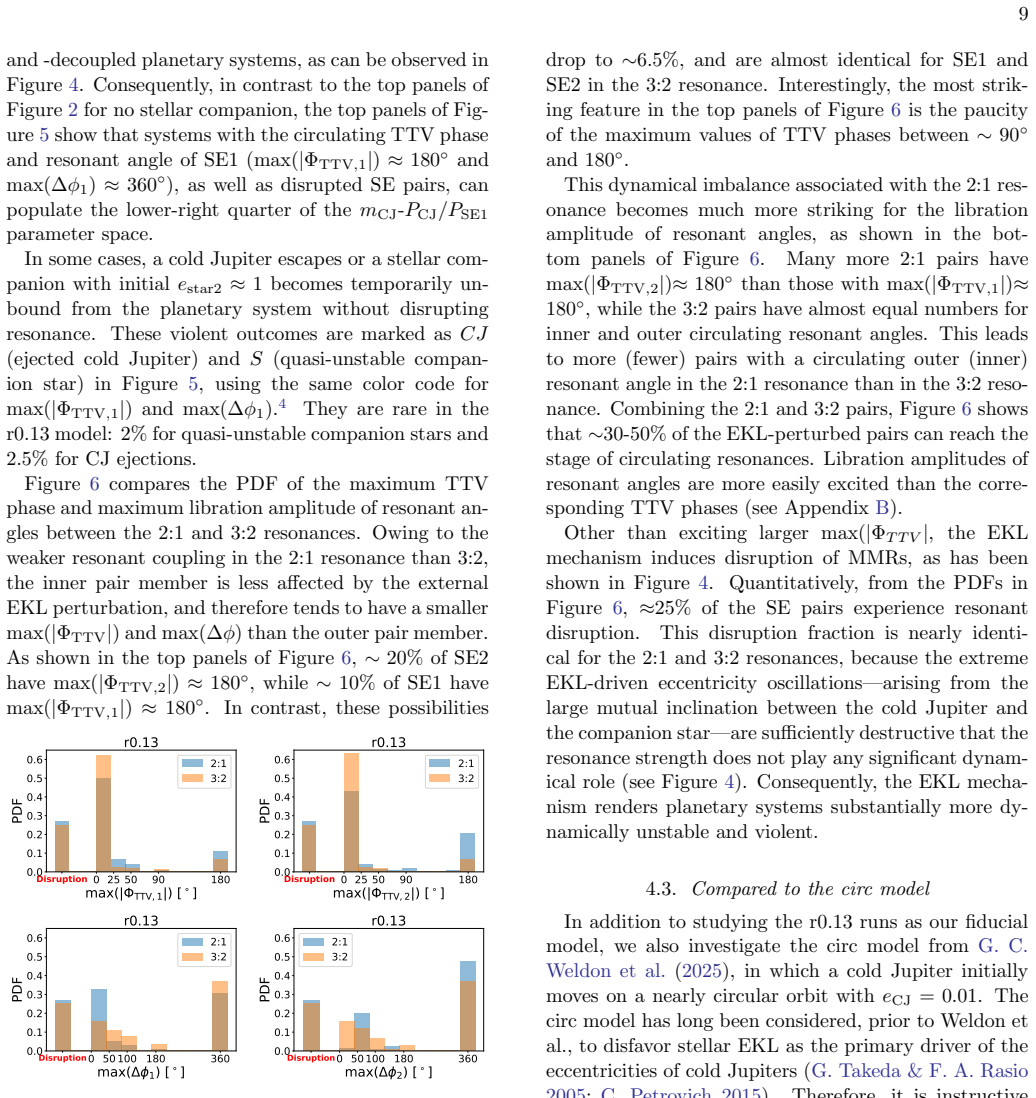
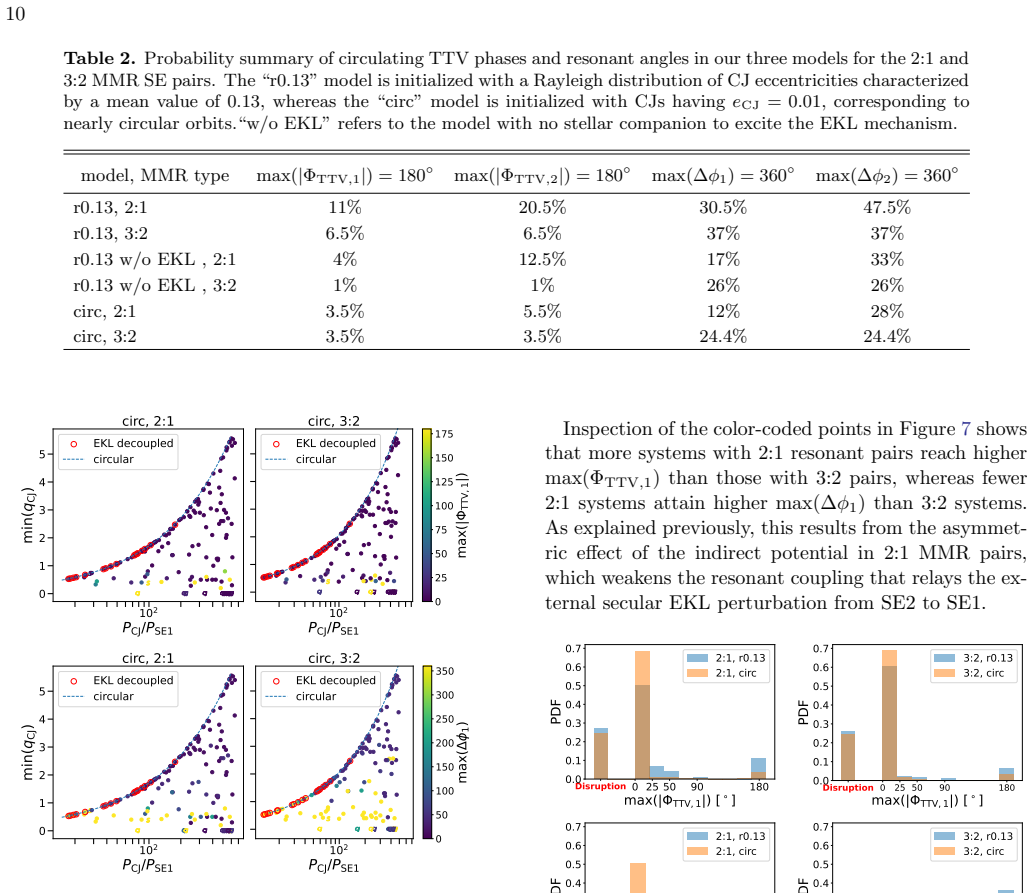
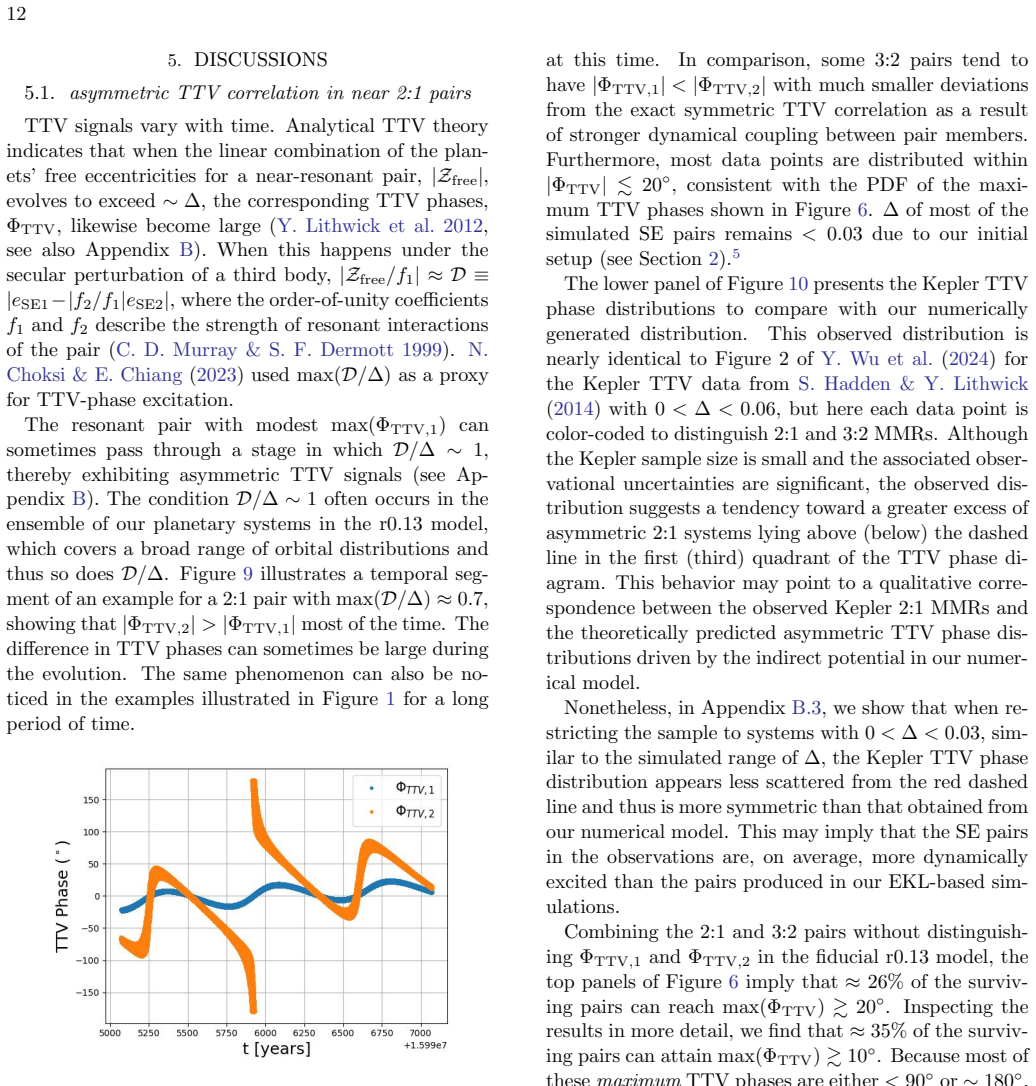
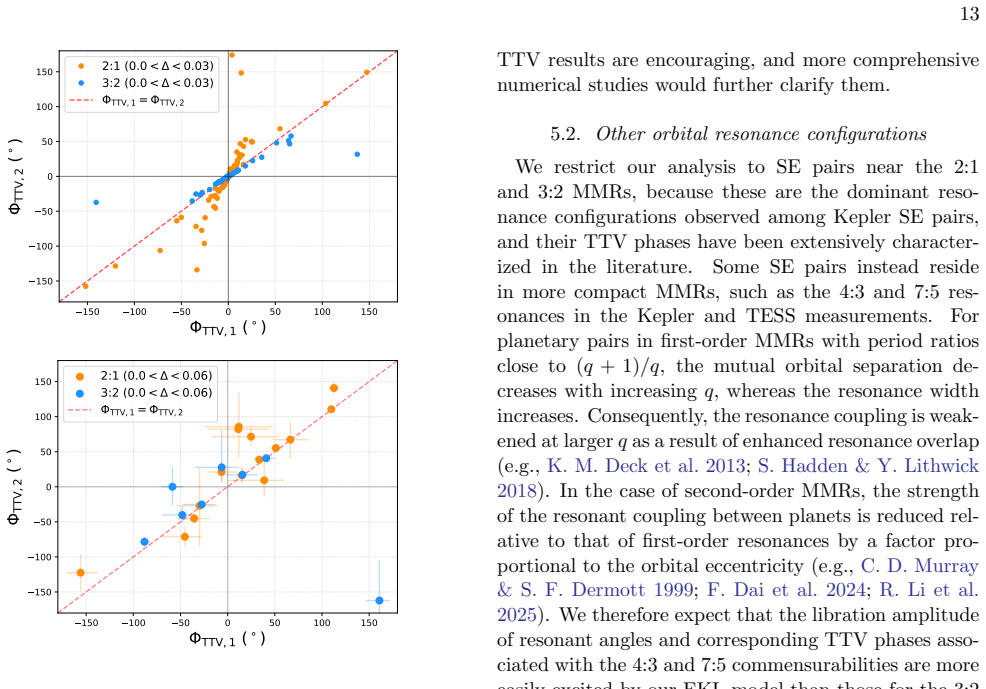
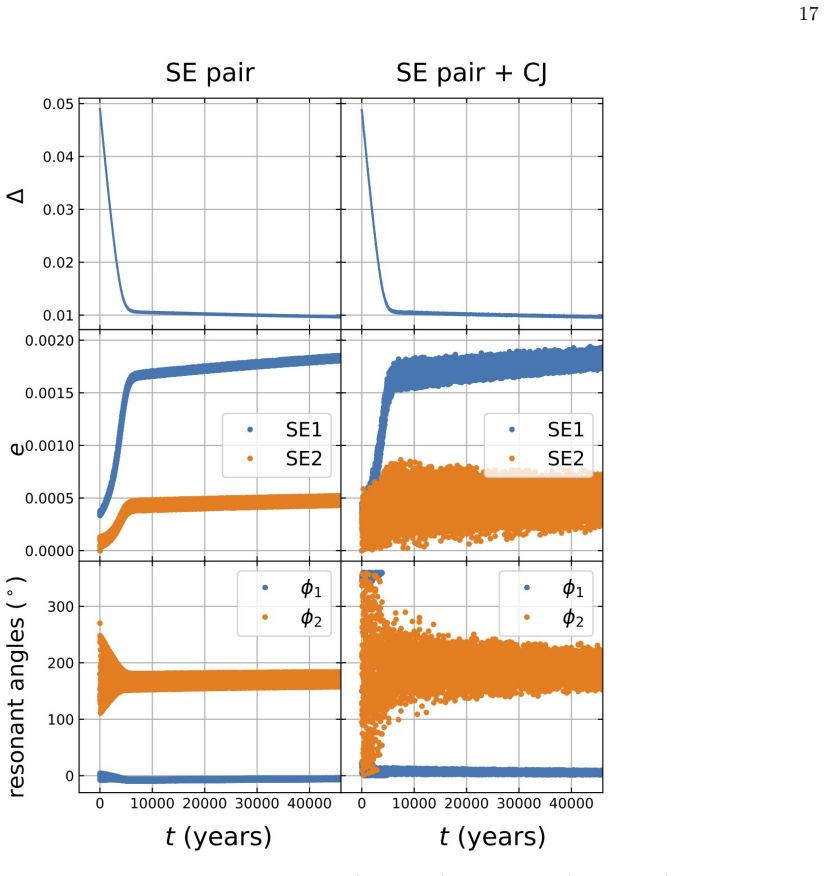
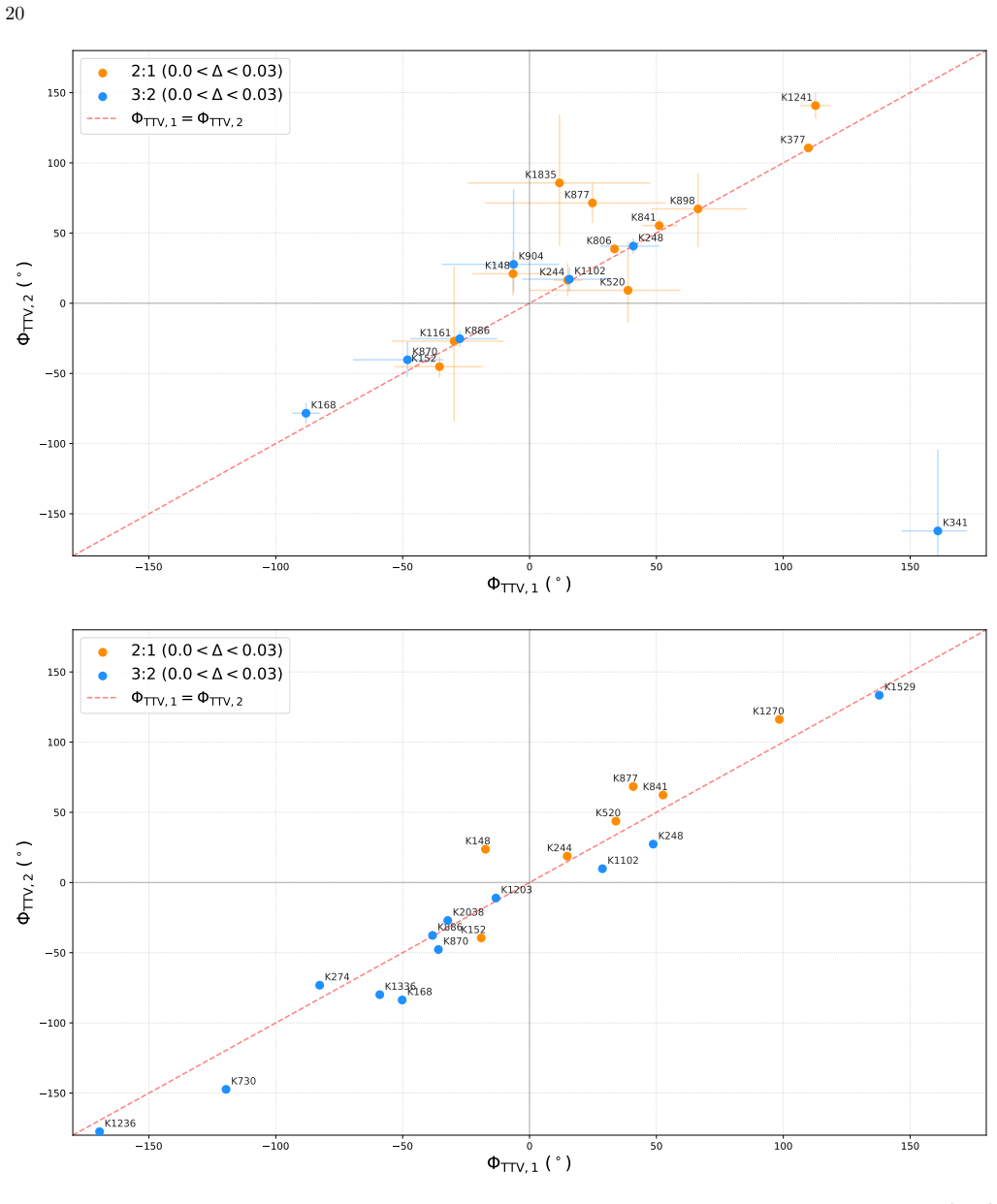
The EKL model that drives the observed eccentricity of cold Jupiters can also excite TTV phases, increase the libration amplitude of resonant angles away from ideal geometric alignment, and even disrupt them in a significant fraction of planetary systems in our simulated samples over 16 Myr. We also find that the TTV phases of the resonant pairs tend to be small (< 90 degrees), while the resonant angles are more easily elevated to become circulating during EKL excitation.
What carries the argument
The eccentric Kozai-Lidov (EKL) mechanism, in which a stellar companion induces eccentricity and inclination oscillations in a cold Jupiter that then perturbs the inner resonant super-Earth pair.
If this is right
- TTV phases tend to remain small, less than 90 degrees.
- Resonant angles are more readily driven to circulating states than TTV phases.
- Resonances are disrupted in a significant fraction of systems over 16 Myr.
- Close-in resonant pairs become dynamically hotter due to outer EKL excitation.
Where Pith is reading between the lines
- This mechanism may explain the observed trend that circulating near-resonant planets are more dynamically unstable.
- Systems with detected stellar companions and cold Jupiters could be checked for higher rates of resonance disruption.
- Longer integrations or varied initial conditions might reveal if disruption rates increase with time.
Load-bearing premise
The EKL-driven eccentricity oscillations of the cold Jupiter are the dominant perturbation on the inner resonant pair, and the initial conditions plus 16 Myr integration time represent real systems.
What would settle it
A survey finding no difference in TTV phase distributions or resonance libration amplitudes between near-resonant super-Earth systems that have cold Jupiters with stellar companions versus those that do not.
Figures
read the original abstract
Near-resonant Kepler planets are dynamically hot, as evidenced by nonzero transit timing variation (TTV) phases, indicating that free eccentricities are not damped. Recent observations suggest that circulating near-resonant planets tend to be dynamically unstable, and hence dynamically hot, likely representing an intermediate stage in the close-in super-Earth population at young ages. We investigate whether a cold Jupiter interacting with a stellar companion through the eccentric Kozai-Lidov mechanism (EKL) can excite TTV phases and increase the libration amplitude of resonant angles in close-in resonant pairs. We find that the EKL model that drives the observed eccentricity of cold Jupiters can also excite TTV phases, increase the libration amplitude of resonant angles away from ideal geometric alignment, and even disrupt them in a significant fraction of planetary systems in our simulated samples over 16 Myr. We also find that the TTV phases of the resonant pairs tend to be small (< 90 degrees), while the resonant angles are more easily elevated to become circulating during EKL excitation.
Editorial analysis
A structured set of objections, weighed in public.
Referee Report
Summary. The manuscript explores whether eccentric Kozai-Lidov (EKL) oscillations induced by a cold Jupiter interacting with a stellar companion can excite nonzero TTV phases, increase libration amplitudes of resonant angles, and disrupt near-resonant super-Earth pairs. Numerical simulations over 16 Myr are reported to show that EKL excitation produces TTV phases typically below 90 degrees, elevates resonant angles away from ideal alignment, and disrupts resonances in a significant fraction of the simulated systems, providing a dynamical link between outer architecture and inner-system excitation observed in Kepler near-resonant planets.
Significance. If the reported fractions and phase behaviors are robust, the work would connect established EKL models for cold-Jupiter eccentricities to the dynamical heating of close-in resonant pairs, offering a testable mechanism for the observed population of dynamically hot near-resonant planets at young ages. The result is potentially significant for understanding resonance survival and TTV statistics, though its impact depends on verification that EKL dominates over competing effects.
major comments (3)
- [Abstract] Abstract: the central claim that EKL 'can also excite TTV phases... and even disrupt them in a significant fraction' is presented without any reported sample size, disruption fraction, convergence tests, or quantitative error analysis, preventing assessment of whether the outcomes are robust or sensitive to initial conditions.
- [Abstract] Abstract and simulation description: the modeling choice that EKL eccentricity oscillations of the cold Jupiter are the dominant perturbation on the inner resonant pair is invoked to attribute TTV-phase excitation and resonance disruption to EKL, yet no tests against competing effects (tides, planet-planet coupling, or additional companions) or damping are described, leaving the attribution unverified.
- [Abstract] Abstract: the 16 Myr integration time is used to report outcomes, but no justification is given for why this duration is representative of typical system ages or sufficient to capture long-term resonance behavior, undermining the link between the simulated fractions and real-system implications.
minor comments (2)
- [Abstract] The abstract states that 'circulating near-resonant planets tend to be dynamically unstable' but provides no reference or prior result citation for this observational claim.
- [Abstract] Notation for resonant angles and TTV phases is introduced without explicit definitions or equations relating them to the EKL-driven eccentricity oscillations.
Simulated Author's Rebuttal
We thank the referee for the thoughtful comments. We address each major comment point by point below, indicating planned revisions where appropriate.
read point-by-point responses
-
Referee: [Abstract] Abstract: the central claim that EKL 'can also excite TTV phases... and even disrupt them in a significant fraction' is presented without any reported sample size, disruption fraction, convergence tests, or quantitative error analysis, preventing assessment of whether the outcomes are robust or sensitive to initial conditions.
Authors: We agree the abstract should be more quantitative and self-contained. The main text reports the sample size, the disruption fraction in the simulated ensemble, and the numerical setup used to assess robustness. We will revise the abstract to incorporate these details directly, along with a brief statement on the checks performed. revision: yes
-
Referee: [Abstract] Abstract and simulation description: the modeling choice that EKL eccentricity oscillations of the cold Jupiter are the dominant perturbation on the inner resonant pair is invoked to attribute TTV-phase excitation and resonance disruption to EKL, yet no tests against competing effects (tides, planet-planet coupling, or additional companions) or damping are described, leaving the attribution unverified.
Authors: The work isolates the EKL channel to demonstrate it is capable of producing the reported effects, consistent with the observed eccentricities of cold Jupiters. We do not claim exclusivity over all other mechanisms. We will add a dedicated paragraph in the discussion section that explicitly states the modeling assumptions, notes the absence of competing effects in the current runs, and outlines why a focused EKL study is a necessary first step. revision: partial
-
Referee: [Abstract] Abstract: the 16 Myr integration time is used to report outcomes, but no justification is given for why this duration is representative of typical system ages or sufficient to capture long-term resonance behavior, undermining the link between the simulated fractions and real-system implications.
Authors: The 16 Myr duration was selected to encompass multiple EKL cycles while remaining computationally tractable and relevant to the ages of observed young systems. We will revise the methods and abstract to include an explicit justification, supported by references to typical EKL timescales and the ages at which dynamical heating is inferred in the Kepler sample. revision: yes
Circularity Check
No circularity: outcomes emerge from numerical integrations
full rationale
The paper reports results from direct N-body simulations of EKL-driven eccentricity oscillations acting on inner resonant super-Earth pairs over 16 Myr. The claimed TTV phase excitation, libration amplitude growth, and resonance disruption are measured outputs of those integrations rather than quantities defined by the initial conditions, fitted parameters, or prior self-citations. The EKL mechanism itself is a standard, externally established dynamical process; the paper invokes it as an external driver without reducing its own predictions to a self-referential fit or renaming. No load-bearing step reduces by construction to the inputs.
Axiom & Free-Parameter Ledger
axioms (1)
- domain assumption EKL mechanism operates between the cold Jupiter and stellar companion and couples to the inner resonant planets
Reference graph
Works this paper leans on
-
[1]
Adams, F. C., Laughlin, G., & Bloch, A. M. 2008, ApJ, 683, 1117, doi: 10.1086/589986
-
[2]
Agol, E., & Fabrycky, D. C. 2018, in Handbook of Exoplanets, ed. H. J. Deeg & J. A. Belmonte, 7, doi: 10.1007/978-3-319-55333-7 7
-
[3]
Agol, E., Steffen, J., Sari, R., & Clarkson, W. 2005, MNRAS, 359, 567, doi: 10.1111/j.1365-2966.2005.08922.x
-
[4]
Antognini, J. M. O. 2015, MNRAS, 452, 3610, doi: 10.1093/mnras/stv1552
-
[5]
Artymowicz, P., & Lubow, S. H. 1994, ApJ, 421, 651, doi: 10.1086/173679
-
[6]
2026, ApJL, 999, L26, doi: 10.3847/2041-8213/ae41c3
Blunt, S., Wang, J., Murray-Clay, R., et al. 2026, ApJL, 999, L26, doi: 10.3847/2041-8213/ae41c3
-
[7]
S., Naponiello, L., Pezzetta, E., et al
Bonomo, A. S., Naponiello, L., Pezzetta, E., et al. 2025, A&A, 700, A126, doi: 10.1051/0004-6361/202452523
-
[8]
Bryan, M. L., & Lee, E. J. 2025, ApJL, 982, L7, doi: 10.3847/2041-8213/adb0bd
-
[9]
Chatterjee, S., & Ford, E. B. 2015, The Astrophysical Journal, 803, 33, doi: 10.1088/0004-637X/803/1/33
-
[10]
2025, MNRAS, 540, 1998, doi: 10.1093/mnras/staf867
Chen, Y.-X., Wu, Y., Li, Y.-P., et al. 2025, MNRAS, 540, 1998, doi: 10.1093/mnras/staf867
-
[11]
2020, MNRAS, 495, 4192, doi: 10.1093/mnras/staa1421
Choksi, N., & Chiang, E. 2020, MNRAS, 495, 4192, doi: 10.1093/mnras/staa1421
-
[12]
2023, MNRAS, 522, 1914, doi: 10.1093/mnras/stad835
Choksi, N., & Chiang, E. 2023, MNRAS, 522, 1914, doi: 10.1093/mnras/stad835
-
[13]
Cui, Z., Papaloizou, J. C. B., & Szuszkiewicz, E. 2021, ApJ, 921, 142, doi: 10.3847/1538-4357/ac17eb
-
[14]
2023, AJ, 165, 33, doi: 10.3847/1538-3881/aca327
Dai, F., Masuda, K., Beard, C., et al. 2023, AJ, 165, 33, doi: 10.3847/1538-3881/aca327
-
[15]
2024, AJ, 168, 239, doi: 10.3847/1538-3881/ad83a6
Dai, F., Goldberg, M., Batygin, K., et al. 2024, AJ, 168, 239, doi: 10.3847/1538-3881/ad83a6
-
[16]
Deck, K. M., Payne, M., & Holman, M. J. 2013, ApJ, 774, 129, doi: 10.1088/0004-637X/774/2/129
-
[17]
Duffell and Eugene Chiang , title =
Duffell, P. C., & Chiang, E. 2015, ApJ, 812, 94, doi: 10.1088/0004-637X/812/2/94
-
[18]
Eggleton, P. P. 1983, ApJ, 268, 368, doi: 10.1086/160960
-
[19]
, year = 2007, month = nov, volume =
Fabrycky, D., & Tremaine, S. 2007, ApJ, 669, 1298, doi: 10.1086/521702
-
[20]
Fabrycky, D. C., Lissauer, J. J., Ragozzine, D., et al. 2014, ApJ, 790, 146, doi: 10.1088/0004-637X/790/2/146
-
[21]
2022, arXiv e-prints, arXiv:2206.06693, doi: 10.48550/arXiv.2206.06693
Ge, J., Zhang, H., Zang, W., et al. 2022, arXiv e-prints, arXiv:2206.06693, doi: 10.48550/arXiv.2206.06693
-
[22]
2022, AJ, 163, 201, doi: 10.3847/1538-3881/ac5961
Goldberg, M., & Batygin, K. 2022, AJ, 163, 201, doi: 10.3847/1538-3881/ac5961
-
[23]
2023, ApJ, 948, 12, doi: 10.3847/1538-4357/acc9ae
Goldberg, M., & Batygin, K. 2023, ApJ, 948, 12, doi: 10.3847/1538-4357/acc9ae
-
[24]
2022, Icarus, 388, 115206, doi: 10.1016/j.icarus.2022.115206
Goldberg, M., Batygin, K., & Morbidelli, A. 2022, Icarus, 388, 115206, doi: 10.1016/j.icarus.2022.115206
-
[25]
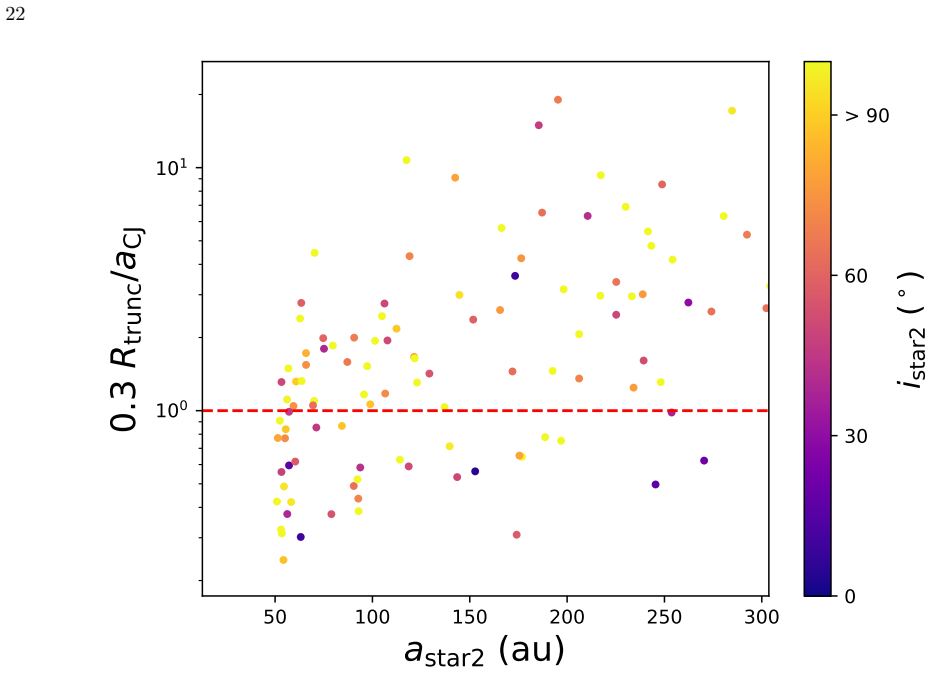
Guo, K., Huang, X., & Lai, D. 2026, ApJ, 1003, 45, doi: 10.3847/1538-4357/ae61a0 22 50 100 150 200 250 300 astar2 (au) 100 101 0.3 Rtrunc/aCJ 0 30 60 > 90 istar2 ( ) Figure 13.The ratio of 0.3R trunc to the initial values ofa CJ for the planetary systems in the r0.13 model. Only the cases with small binary separations,a star2 ≲300 au, are shown, as circum...
-
[26]
2014, ApJ, 787, 80, doi: 10.1088/0004-637X/787/1/80
Hadden, S., & Lithwick, Y. 2014, ApJ, 787, 80, doi: 10.1088/0004-637X/787/1/80
-
[27]
2017, AJ, 154, 5, doi: 10.3847/1538-3881/aa71ef
Hadden, S., & Lithwick, Y. 2017, AJ, 154, 5, doi: 10.3847/1538-3881/aa71ef
-
[28]
2018, AJ, 156, 95, doi: 10.3847/1538-3881/aad32c
Hadden, S., & Lithwick, Y. 2018, AJ, 156, 95, doi: 10.3847/1538-3881/aad32c
-
[29]
2026, arXiv e-prints, arXiv:2602.21349, doi: 10.48550/arXiv.2602.21349
Hadden, S., & Wu, Y. 2026, arXiv e-prints, arXiv:2602.21349, doi: 10.48550/arXiv.2602.21349
-
[30]
Hamer, J. H., & Schlaufman, K. C. 2024, AJ, 167, 55, doi: 10.3847/1538-3881/ad110e
-
[31]
2025, AJ, 169, 19, doi: 10.3847/1538-3881/ad944f
Tamayo, D. 2025, AJ, 169, 19, doi: 10.3847/1538-3881/ad944f
-
[32]
Hansen, B. M. S. 2017, MNRAS, 467, 1531, doi: 10.1093/mnras/stx182
-
[33]
Holman, M. J., & Murray, N. W. 2005, Science, 307, 1288, doi: 10.1126/science.1107822
-
[34]
2025, ApJ, 995, 206, doi: 10.3847/1538-4357/ae173c
Hu, Z., Dai, F., Zhu, W., et al. 2025, ApJ, 995, 206, doi: 10.3847/1538-4357/ae173c
-
[35]
X., Petrovich, C., & Deibert, E
Huang, C. X., Petrovich, C., & Deibert, E. 2017, AJ, 153, 210, doi: 10.3847/1538-3881/aa67fb
-
[36]
Hwang, H.-C., Ting, Y.-S., & Zakamska, N. L. 2022, MNRAS, 512, 3383, doi: 10.1093/mnras/stac675
-
[37]
Jeans, J. H. 1919, MNRAS, 79, 408, doi: 10.1093/mnras/79.6.408
-
[38]
Kane, S. R., & Wittenmyer, R. A. 2024, ApJL, 962, L21, doi: 10.3847/2041-8213/ad2463
-
[39]
Kouwenhoven, M. B. N., Goodwin, S. P., Parker, R. J., et al. 2010, MNRAS, 404, 1835, doi: 10.1111/j.1365-2966.2010.16399.x
-
[40]
, archivePrefix = "arXiv", eprint =
Lai, D., & Pu, B. 2017, AJ, 153, 42, doi: 10.3847/1538-3881/153/1/42
-
[41]
Lammers, C., & Winn, J. N. 2026, AJ, 171, 18, doi: 10.3847/1538-3881/ae21de
-
[42]
Li, J., O’Connor, C. E., & Rasio, F. A. 2026, ApJL, 998, L5, doi: 10.3847/2041-8213/ae3a9a
-
[43]
2025, AJ, 169, 323, doi: 10.3847/1538-3881/adce0c 23
Li, R., Chiang, E., Choksi, N., & Dai, F. 2025, AJ, 169, 323, doi: 10.3847/1538-3881/adce0c 23
-
[44]
2025, ApJ, 994, 123, doi: 10.3847/1538-4357/ae17cf
Lin, J., Dudiak, I., Hadden, S., & Tamayo, D. 2025, ApJ, 994, 123, doi: 10.3847/1538-4357/ae17cf
-
[45]
2012, ApJL, 756, L11, doi: 10.1088/2041-8205/756/1/L11
Lithwick, Y., & Wu, Y. 2012, ApJL, 756, L11, doi: 10.1088/2041-8205/756/1/L11
-
[46]
Lithwick, Y., Xie, J., & Wu, Y. 2012, ApJ, 761, 122, doi: 10.1088/0004-637X/761/2/122
-
[47]
Lubow, S. H., Martin, R. G., & Nixon, C. 2015, ApJ, 800, 96, doi: 10.1088/0004-637X/800/2/96
-
[48]
F., Tazzari, M., Long, F., et al
Manara, C. F., Tazzari, M., Long, F., et al. 2019, A&A, 628, A95, doi: 10.1051/0004-6361/201935964
-
[49]
Observing and data analysis systems, discovery and timing of 100 pulsars
Mardling, R. A., & Aarseth, S. J. 2001, MNRAS, 321, 398, doi: 10.1046/j.1365-8711.2001.03974.x Mart´ ın, E. L., Bouy, H., Mart´ ın, D., et al. 2023, arXiv e-prints, arXiv:2312.01903, doi: 10.48550/arXiv.2312.01903
-
[50]
2012, Icarus, 221, 624, doi: 10.1016/j.icarus.2012.08.032
Matsumoto, Y., Nagasawa, M., & Ida, S. 2012, Icarus, 221, 624, doi: 10.1016/j.icarus.2012.08.032
-
[51]
2020, ApJ, 893, 43, doi: 10.3847/1538-4357/ab7cd7
Matsumoto, Y., & Ogihara, M. 2020, ApJ, 893, 43, doi: 10.3847/1538-4357/ab7cd7
-
[52]
2015, MNRAS, 452, 2396, doi: 10.1093/mnras/stv1450
Miranda, R., & Lai, D. 2015, MNRAS, 452, 2396, doi: 10.1093/mnras/stv1450
-
[53]
Moe, M., & Di Stefano, R. 2017, ApJS, 230, 15, doi: 10.3847/1538-4365/aa6fb6
work page internal anchor Pith review doi:10.3847/1538-4365/aa6fb6 2017
-
[54]
doi:10.1017/CBO9781139174817 , adsurl =
Murray, C. D., & Dermott, S. F. 1999, Solar System Dynamics, doi: 10.1017/CBO9781139174817
-
[55]
Monthly Notices of the Royal Astronomical Society468(3), 3000–3023 (2017) https://doi
Mustill, A. J., Davies, M. B., & Johansen, A. 2017, MNRAS, 468, 3000, doi: 10.1093/mnras/stx693
-
[56]
2016, ARA&A, 54, 441, doi: 10.1146/annurev-astro-081915-023315
Naoz, S. 2016, ARA&A, 54, 441, doi: 10.1146/annurev-astro-081915-023315 Nesvorn´ y, D., & Vokrouhlick´ y, D. 2016, ApJ, 823, 72, doi: 10.3847/0004-637X/823/2/72
-
[57]
2026, A&A, 708, A38, doi: 10.1051/0004-6361/202557244
Nigioni, A., Venturini, J., Bolmont, E., et al. 2026, A&A, 708, A38, doi: 10.1051/0004-6361/202557244
-
[58]
Offner, S. S. R., Moe, M., Kratter, K. M., et al. 2023, in Astronomical Society of the Pacific Conference Series, Vol. 534, Protostars and Planets VII, ed. S. Inutsuka, Y. Aikawa, T. Muto, K. Tomida, & M. Tamura, 275, doi: 10.48550/arXiv.2203.10066
work page internal anchor Pith review Pith/arXiv arXiv doi:10.48550/arxiv.2203.10066 2023
-
[59]
2026, ApJ, 996, 91, doi: 10.3847/1538-4357/ae1d78
Ogihara, M., & Kunitomo, M. 2026, ApJ, 996, 91, doi: 10.3847/1538-4357/ae1d78
-
[60]
2023, in Astronomical Society of the Pacific Conference Series, Vol
Paardekooper, S., Dong, R., Duffell, P., et al. 2023, in Astronomical Society of the Pacific Conference Series, Vol. 534, Protostars and Planets VII, ed. S. Inutsuka, Y. Aikawa, T. Muto, K. Tomida, & M. Tamura, 685, doi: 10.48550/arXiv.2203.09595
-
[61]
The Astrophysical Journal , author =
Petrovich, C. 2015, ApJ, 799, 27, doi: 10.1088/0004-637X/799/1/27
-
[62]
A Survey of Stellar Families: Multiplicity of Solar-Type Stars
Raghavan, D., McAlister, H. A., Henry, T. J., et al. 2010, ApJS, 190, 1, doi: 10.1088/0067-0049/190/1/1
work page internal anchor Pith review doi:10.1088/0067-0049/190/1/1 2010
-
[63]
Rasio, F. A., & Ford, E. B. 1996, Science, 274, 954, doi: 10.1126/science.274.5289.954
-
[64]
REBOUND: An open-source multi-purpose N-body code for collisional dynamics
Rein, H., & Liu, S.-F. 2012, A&A, 537, A128, doi: 10.1051/0004-6361/201118085
work page internal anchor Pith review doi:10.1051/0004-6361/201118085 2012
-
[65]
Rein, H., & Spiegel, D. S. 2015, MNRAS, 446, 1424, doi: 10.1093/mnras/stu2164
-
[66]
Rota, A. A., Manara, C. F., Miotello, A., et al. 2022, A&A, 662, A121, doi: 10.1051/0004-6361/202141035
-
[67]
Rowe, J. F., Coughlin, J. L., Antoci, V., et al. 2015, ApJS, 217, 16, doi: 10.1088/0067-0049/217/1/16
-
[68]
Takeda, G., & Rasio, F. A. 2005, ApJ, 627, 1001, doi: 10.1086/430467
-
[69]
Tamayo, D., Rein, H., Shi, P., & Hernandez, D. M. 2020, MNRAS, 491, 2885, doi: 10.1093/mnras/stz2870
-
[70]
Tanaka, H., Takeuchi, T., & Ward, W. R. 2002, The Astrophysical Journal, 565, 1257, doi: 10.1086/324713
-
[71]
2026, AJ, 171, 135, doi: 10.3847/1538-3881/ae346d
Wang, M.-T., Dai, F., Liu, H.-G., et al. 2026, AJ, 171, 135, doi: 10.3847/1538-3881/ae346d
-
[72]
Weldon, G. C., Naoz, S., & Hansen, B. M. S. 2025, ApJL, 980, L31, doi: 10.3847/2041-8213/adb157
-
[73]
2024, ApJ, 971, 5, doi: 10.3847/1538-4357/ad5a09
Wu, Y., Malhotra, R., & Lithwick, Y. 2024, ApJ, 971, 5, doi: 10.3847/1538-4357/ad5a09
-
[74]
2003, ApJ, 589, 605, doi: 10.1086/374598
Wu, Y., & Murray, N. 2003, ApJ, 589, 605, doi: 10.1086/374598
-
[75]
2026, ApJ, 996, 59, doi: 10.3847/1538-4357/ae201b
Yang, E., & Su, Y. 2026, ApJ, 996, 59, doi: 10.3847/1538-4357/ae201b
-
[76]
Vorobyov, E. I. 2026, arXiv e-prints, arXiv:2603.02395, doi: 10.48550/arXiv.2603.02395
-
[77]
The Super Earth–Cold Jupiter Relations , volume=
Zhu, W., & Wu, Y. 2018, AJ, 156, 92, doi: 10.3847/1538-3881/aad22a
discussion (0)
Sign in with ORCID, Apple, or X to comment. Anyone can read and Pith papers without signing in.