Lattice non-invertible symmetry from non-commuting transfer matrices
Pith reviewed 2026-06-25 19:46 UTC · model grok-4.3
The pith
In the XXZ spin chain at roots of unity, a non-Abelian algebra of transfer matrices realizes the Onsager algebra and its duality automorphism as a matrix product operator obeying Tambara-Yamagami fusion rules.
A machine-rendered reading of the paper's core claim, the machinery that carries it, and where it could break.
Core claim
Using a non-Abelian algebra of transfer matrices governed by an unbalanced version of the Yang-Baxter/RLL relation, we construct an explicit lattice realization of the Onsager algebra and its duality automorphism. The duality is represented by a matrix product operator related to the transfer matrices of the τ₂ model. We show that this operator obeys ℤ_N Tambara-Yamagami fusion rules and therefore realizes on the lattice the topological defect lines of the free compactified boson conformal field theory. Our results identify non-Abelian integrability as a natural framework for the emergence of the Onsager symmetry and categorical dualities in lattice models.
What carries the argument
Non-Abelian algebra of transfer matrices from the unbalanced Yang-Baxter/RLL relation, which produces the Onsager algebra and its duality-representing matrix product operator.
If this is right
- The duality automorphism appears as an explicit lattice operator built from transfer matrices.
- This operator obeys the ℤ_N Tambara-Yamagami fusion rules.
- Non-Abelian integrability supplies a setting in which Onsager symmetry and categorical dualities arise together.
- The construction supplies a lattice model whose defects match those of the compactified boson CFT.
Where Pith is reading between the lines
- Similar constructions could apply to other integrable spin chains at roots of unity to generate non-invertible symmetries.
- The matrix product operator approach may allow numerical study of defect dynamics in finite-size systems.
- This framework might connect Onsager symmetry to other non-invertible symmetries studied in statistical mechanics.
- Extensions to higher dimensions or different algebras could be explored by modifying the transfer matrix relations.
Load-bearing premise
The unbalanced Yang-Baxter/RLL relation produces a non-Abelian algebra that admits an explicit matrix product operator realizing the duality automorphism with the stated fusion rules.
What would settle it
Direct verification for small N that the product of the duality operator with itself or with other operators reproduces the predicted Tambara-Yamagami fusion outcomes.
Figures
read the original abstract
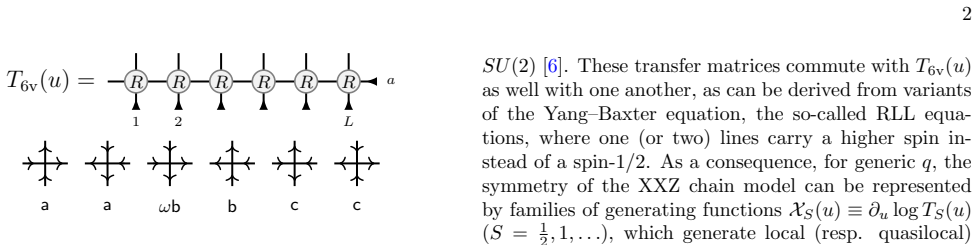
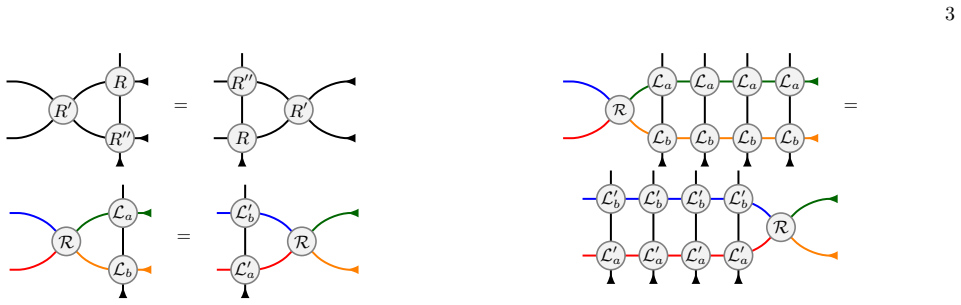
We establish a direct connection between Onsager symmetry, duality defects, and quantum integrability in the XXZ spin chain at roots of unity, $\Delta=(q+q^{-1})/2$ with $q^N=\pm1$. Using a non-Abelian algebra of transfer matrices governed by an unbalanced version of the Yang--Baxter/RLL relation, we construct an explicit lattice realization of the Onsager algebra and its duality automorphism. The duality is represented by a matrix product operator related to the transfer matrices of the $\tau_2$ model. We show that this operator obeys $\mathbb{Z}_N$ Tambara--Yamagami fusion rules and therefore realizes on the lattice the topological defect lines of the free compactified boson conformal field theory. Our results identify non-Abelian integrability as a natural framework for the emergence of the Onsager symmetry and categorical dualities in lattice models.
Editorial analysis
A structured set of objections, weighed in public.
Referee Report
Summary. The manuscript claims to establish a direct connection between Onsager symmetry, duality defects, and quantum integrability in the XXZ spin chain at roots of unity, Δ=(q+q^{-1})/2 with q^N=±1. Using a non-Abelian algebra of transfer matrices governed by an unbalanced version of the Yang-Baxter/RLL relation, the authors construct an explicit lattice realization of the Onsager algebra and its duality automorphism. The duality is represented by a matrix product operator related to the transfer matrices of the τ₂ model; this operator is shown to obey ℤ_N Tambara-Yamagami fusion rules and therefore realizes on the lattice the topological defect lines of the free compactified boson CFT.
Significance. If the explicit constructions and verifications hold, the work supplies a concrete lattice model in which non-Abelian integrability produces both the Onsager algebra and categorical (non-invertible) dualities, directly linking transfer-matrix algebras to CFT defect lines. The explicit MPO construction and fusion-rule verification constitute a substantive technical contribution.
minor comments (3)
- [Abstract] The abstract and introduction would benefit from a brief, self-contained statement of the precise form of the unbalanced RLL relation (e.g., the deviation from the standard YB equation) before the main construction is invoked.
- Notation for the MPO and the generators of the Onsager algebra should be introduced once with a clear table or diagram relating them to the τ₂ transfer matrices; repeated redefinitions in later sections reduce readability.
- The fusion-rule verification (presumably in the section containing the explicit MPO algebra) would be easier to follow if the authors include a short appendix tabulating the fusion coefficients for small N (e.g., N=3,4) alongside the CFT expectations.
Simulated Author's Rebuttal
We thank the referee for the positive assessment of our manuscript, the recognition of its technical contributions, and the recommendation for minor revision. No specific major comments were raised in the report.
Circularity Check
No significant circularity; explicit construction is self-contained
full rationale
The paper asserts an explicit construction of the non-Abelian transfer-matrix algebra via the unbalanced Yang-Baxter/RLL relation, followed by direct verification that the resulting MPO satisfies the Z_N Tambara-Yamagami fusion rules. No equations or claims in the abstract reduce a prediction to a fitted input, rename a known result, or rely on load-bearing self-citations whose content is unverified. The derivation chain consists of algebraic construction and explicit checking, which are independent of the target CFT interpretation. This matches the default expectation of a non-circular explicit lattice realization.
Axiom & Free-Parameter Ledger
Reference graph
Works this paper leans on
-
[1]
train argument
Phys- ically, they correspond to inserting a magnetic field in the one-dimensional ring where the spins live, leading to a non-vanishing phase for the spin exchange interaction. This simplifies the subsequent presentation; however, our main results also hold for periodic systems, with the two cases equivalent forLa multiple of 2N. By a simple unitary chan...
-
[2]
Yang, Some exact results for the many body prob- lems in one dimension with repulsive delta function in- teraction, Phys
C.-N. Yang, Some exact results for the many body prob- lems in one dimension with repulsive delta function in- teraction, Phys. Rev. Lett.19, 1312 (1967)
1967
-
[3]
R. J. Baxter, Partition function of the eight vertex lattice model, Annals Phys.70, 193 (1972)
1972
-
[4]
R. J. Baxter,Exactly solved models in statistical mechan- ics(Academic Press, 1982)
1982
-
[5]
L. D. Faddeev, How algebraic Bethe ansatz works for integrable model, inLes Houches School of Physics: As- trophysical Sources of Gravitational Radiation(1996) pp. pp. 149–219, arXiv:hep-th/9605187
Pith/arXiv arXiv 1996
-
[6]
T. Prosen, Open XXZ Spin Chain: Nonequilibrium Steady State and a Strict Bound on Ballistic Transport, Phys. Rev. Lett.106, 217206 (2011), arXiv:1103.1350 [cond-mat.str-el]
Pith/arXiv arXiv 2011
-
[7]
T. Prosen and E. Ilievski, Families of Quasilocal Con- servation Laws and Quantum Spin Transport, Phys. Rev. Lett.111, 057203 (2013), arXiv:1306.4498 [cond- mat.stat-mech]
Pith/arXiv arXiv 2013
-
[8]
E. Ilievski, J. De Nardis, B. Wouters, J.-S. Caux, F. H. L. Essler, and T. Prosen, Complete Generalized Gibbs En- sembles in an Interacting Theory, Phys. Rev. Lett.115, 6 157201 (2015), arXiv:1507.02993 [quant-ph]
Pith/arXiv arXiv 2015
-
[9]
E. Ilievski, M. Medenjak, T. Prosen, and L. Zadnik, Quasilocal charges in integrable lattice systems, J. Stat. Mech.1606, 064008 (2016), arXiv:1603.00440 [cond- mat.stat-mech]
Pith/arXiv arXiv 2016
-
[10]
D. Gaiotto, A. Kapustin, N. Seiberg, and B. Wil- lett, Generalized Global Symmetries, JHEP02, 172, arXiv:1412.5148 [hep-th]
-
[11]
E. P. Verlinde, Fusion Rules and Modular Transforma- tions in 2D Conformal Field Theory, Nucl. Phys. B300, 360 (1988)
1988
-
[12]
J. Frohlich, J. Fuchs, I. Runkel, and C. Schweigert, Du- ality and defects in rational conformal field theory, Nucl. Phys. B763, 354 (2007), arXiv:hep-th/0607247
Pith/arXiv arXiv 2007
-
[13]
D. Aasen, R. S. K. Mong, and P. Fendley, Topological Defects on the Lattice I: The Ising model, J. Phys. A49, 354001 (2016), arXiv:1601.07185 [cond-mat.stat-mech]
Pith/arXiv arXiv 2016
- [14]
-
[15]
C.-M. Chang, Y.-H. Lin, S.-H. Shao, Y. Wang, and X. Yin, Topological Defect Lines and Renormaliza- tion Group Flows in Two Dimensions, JHEP01, 026, arXiv:1802.04445 [hep-th]
-
[16]
Schafer-Nameki, ICTP lectures on (non-)invertible generalized symmetries, Phys
S. Schafer-Nameki, ICTP lectures on (non-)invertible generalized symmetries, Phys. Rept.1063, 1 (2024), arXiv:2305.18296 [hep-th]
Pith/arXiv arXiv 2024
-
[17]
S.-H. Shao, What’s Done Cannot Be Undone: TASI Lec- tures on Non-Invertible Symmetries, inTheoretical Ad- vanced Study Institute in Elementary Particle Physics 2023: Aspects of Symmetry(2023) arXiv:2308.00747 [hep-th]
Pith/arXiv arXiv 2023
-
[18]
Etingof, S
P. Etingof, S. Gelaki, D. Nikshych, and V. Ostrik,Ten- sor categories, Mathematical Surveys and Monographs, Vol. 205 (American Mathematical Society, Providence, RI, 2015) pp. xvi+343
2015
-
[19]
Z. Komargodski, K. Ohmori, K. Roumpedakis, and S. Seifnashri, Symmetries and strings of adjoint QCD 2, JHEP03, 103, arXiv:2008.07567 [hep-th]
arXiv 2008
-
[20]
L. Bhardwaj, L. E. Bottini, D. Pajer, and S. Schafer- Nameki, Categorical Landau Paradigm for Gapped Phases, Phys. Rev. Lett.133, 161601 (2024), arXiv:2310.03786 [cond-mat.str-el]
arXiv 2024
-
[21]
Chen, Essay: Generalized Landau Paradigm for Quan- tum Phases and Phase Transitions, Phys
X. Chen, Essay: Generalized Landau Paradigm for Quan- tum Phases and Phase Transitions, Phys. Rev. Lett.135, 250001 (2025), arXiv:2511.19793 [hep-th]
arXiv 2025
-
[22]
E. H. Lieb and F. Y. Wu, Two dimensional ferroelectric models, inPhase Transitions and Critical Phenomena, Vol. 1, edited by C. Domb and M. S. Green (Academic Press, London, 1972) pp. 321–490
1972
-
[23]
Lusztig, Modular representations and quantum groups, inClassical groups and related topics (Beijing, 1987), Contemp
G. Lusztig, Modular representations and quantum groups, inClassical groups and related topics (Beijing, 1987), Contemp. Math., Vol. 82 (Amer. Math. Soc., Providence, RI, 1989) pp. 59–77
1987
-
[24]
De Concini and V
C. De Concini and V. G. Kac, Representations of quan- tum groups at roots of 1, inOperator algebras, unitary representations, enveloping algebras, and invariant the- ory (Paris, 1989), Progr. Math., Vol. 92 (Birkh¨ auser Boston, Boston, MA, 1990) pp. 471–506
1989
-
[25]
Fabricius and B
K. Fabricius and B. M. McCoy, Bethe’s Equation Is In- complete for the XXZ Model at Roots of Unity, J. Stat. Phys.103, 647 (2001)
2001
-
[26]
Fabricius and B
K. Fabricius and B. M. McCoy, Completing Bethe’s Equations at Roots of Unity, J. Stat. Phys.104, 573 (2001)
2001
-
[27]
R. J. Baxter, Completeness of the Bethe ansatz for the six and eight-vertex models, J. Stat. Phys.108, 1 (2002)
2002
-
[28]
Y. Miao, J. Lamers, and V. Pasquier, On the Q operator and the spectrum of the XXZ model at root of unity, SciPost Phys.11, 067 (2021), arXiv:2012.10224 [cond- mat.stat-mech]
arXiv 2021
-
[29]
Onsager, Crystal Statistics
L. Onsager, Crystal Statistics. I. A Two-Dimensional Model with an Order-Disorder Transition, Phys. Rev.65, 117 (1944)
1944
-
[30]
Davies, Onsager’s algebra and superintegrability, J
B. Davies, Onsager’s algebra and superintegrability, J. Phys. A23, 2245–2261 (1990)
1990
-
[31]
O’Dea, F
N. O’Dea, F. Burnell, A. Chandran, and V. Khemani, From tunnels to towers: Quantum scars from lie algebras and q-deformed lie algebras, Physical Review Research2, 043305 (2020)
2020
-
[32]
Shibata, N
N. Shibata, N. Yoshioka, and H. Katsura, Onsager’s scars in disordered spin chains, Physical Review Letters124, 180604 (2020)
2020
-
[33]
Jones, A
N. Jones, A. Prakash, and P. Fendley, Pivoting through the chiral-clock family, SciPost Physics18, 094 (2025)
2025
-
[34]
Deguchi, K
T. Deguchi, K. Fabricius, and B. M. McCoy, Thesl2 Loop Algebra Symmetry of the Six-Vertex Model at Roots of Unity, J. Stat. Phys.102, 701 (2001)
2001
-
[35]
Korff, The twisted XXZ chain at roots of unity revis- ited, J
C. Korff, The twisted XXZ chain at roots of unity revis- ited, J. Phys. A37, 1681–1689 (2004)
2004
-
[36]
Deguchi, Regular XXZ bethe states at roots of unity as highest weight vectors of thesl 2 loop algebra, J
T. Deguchi, Regular XXZ bethe states at roots of unity as highest weight vectors of thesl 2 loop algebra, J. Phys. A40, 7473 (2007)
2007
-
[37]
E. Vernier, E. O’Brien, and P. Fendley, Onsager symme- tries inU(1)-invariant clock models, J. Stat. Mech.1904, 043107 (2019), arXiv:1812.09091 [cond-mat.stat-mech]
Pith/arXiv arXiv 1904
-
[38]
Y. Miao, Conjectures on Hidden Onsager Algebra Sym- metries in Interacting Quantum Lattice Models, SciPost Phys.11, 066 (2021), arXiv:2103.14569 [cond-mat.stat- mech]
arXiv 2021
-
[39]
However, The L(sl 2) generators in [33–35] only act on a sector of the entire Hilbert space of the spin chain
We remark that asl 2 loop algebra symmetry of XXZ spin chain at root of unity was proposed by [33, 35]. However, The L(sl 2) generators in [33–35] only act on a sector of the entire Hilbert space of the spin chain. On the con- trary, the Onsager generators in our paper act on the entire Hilbert space, and commute with the Hamiltonian over the entire Hilbe...
-
[40]
H. A. Kramers and G. H. Wannier, Statistics of the Two- Dimensional Ferromagnet. Part I, Phys. Rev.60, 252 (1941)
1941
-
[41]
H. A. Kramers and G. H. Wannier, Statistics of the Two- Dimensional Ferromagnet. Part II, Phys. Rev.60, 263 (1941)
1941
-
[42]
L. Lootens, C. Delcamp, G. Ortiz, and F. Verstraete, Dualities in One-Dimensional Quantum Lattice Mod- els: Symmetric Hamiltonians and Matrix Product Op- erator Intertwiners, PRX Quantum4, 020357 (2023), arXiv:2112.09091 [quant-ph]
arXiv 2023
-
[43]
L. Lootens, C. Delcamp, and F. Verstraete, Dual- ities in One-Dimensional Quantum Lattice Models: Topological Sectors, PRX Quantum5, 010338 (2024), arXiv:2211.03777 [quant-ph]
arXiv 2024
-
[44]
L. Li, M. Oshikawa, and Y. Zheng, Noninvertible duality transformation between symmetry-protected topological 7 and spontaneous symmetry breaking phases, Phys. Rev. B108, 214429 (2023), arXiv:2301.07899 [cond-mat.str- el]
arXiv 2023
-
[45]
W. Cao, L. Li, M. Yamazaki, and Y. Zheng, Subsystem non-invertible symmetry operators and defects, SciPost Phys.15, 155 (2023), arXiv:2304.09886 [cond-mat.str-el]
arXiv 2023
-
[46]
N. Seiberg and S.-H. Shao, Majorana chain and Ising model - (non-invertible) translations, anomalies, and emanant symmetries, SciPost Phys.16, 064 (2024), arXiv:2307.02534 [cond-mat.str-el]
arXiv 2024
-
[47]
Compared to the superintegrability in models with Yangian symmetry, such as the Calogero–Sutherland model [79], the non-Abelian conserved charges of the XXZ spin chain at roots of unity arelocalorquasilocal
-
[48]
E. Date, M. Jimbo, K. Miki, and T. Miwa, NewRMatri- ces Associated with Cyclic Representations ofU q(A(2) 2 ), Publ. Res. Inst. Math. Sci.27, 639–655 (1991)
1991
-
[49]
V. V. Bazhanov and Y. G. Stroganov, Chiral Potts model as a descendant of the six vertex model, J. Stat. Phys. 59, 799 (1990)
1990
-
[50]
Au-Yang, B
H. Au-Yang, B. M. McCoy, J. H. H. Perk, S. Tang, and M.-L. Yan, Commuting Transfer Matrices in the Chiral Potts Models: Solutions of Star Triangle Equations with Genus>1, Phys. Lett. A123, 219 (1987)
1987
-
[51]
R. J. Baxter, J. H. H. Perk, and H. Au-Yang, New Solu- tions of the Star Triangle Relations for the Chiral Potts Model, Phys. Lett. A128, 138 (1988)
1988
-
[52]
R. J. Baxter, V. V. Bazhanov, and J. H. H. Perk, Func- tional relations for transfer matrices of the chiral Potts model, Int. J. Mod. Phys. B4, 803 (1990)
1990
-
[53]
Roan, On the tau(2)-model in the chiral potts model and cyclic representation of the quantum group uq(sl2), Journal of Physics A: Mathematical and Theoretical42, 072003 (2009)
S.-s. Roan, On the tau(2)-model in the chiral potts model and cyclic representation of the quantum group uq(sl2), Journal of Physics A: Mathematical and Theoretical42, 072003 (2009)
2009
-
[54]
R. Weston, Cyclic Representations ofU q(ˆsl2) and its Borel Subalgebras at Roots of Unity and Q-operators, SciPost Phys. Core9, 016 (2026), arXiv:2412.14811 [math-ph]
arXiv 2026
-
[55]
Dolan and M
L. Dolan and M. Grady, Conserved charges from self- duality, Phys. Rev. D25, 1587 (1982)
1982
-
[56]
Tambara and S
D. Tambara and S. Yamagami, Tensor Categories with Fusion Rules of Self-Duality for Finite Abelian Groups, J. Algebra209, 692 (1998)
1998
-
[57]
S. D. Pace, A. Chatterjee, and S.-H. Shao, Lattice T- duality from non-invertible symmetries in quantum spin chains, SciPost Phys.18, 121 (2025), arXiv:2412.18606 [cond-mat.str-el]
arXiv 2025
-
[58]
R. Thorngren and Y. Wang, Fusion category symmetry. Part II. Categoriosities at c = 1 and beyond, JHEP07, 051, arXiv:2106.12577 [hep-th]
-
[59]
P. H. Ginsparg, Applied Conformal Field Theory, in Les Houches Summer School in Theoretical Physics: Fields, Strings, Critical Phenomena(1988) arXiv:hep- th/9108028
arXiv 1988
-
[60]
This connection appears unrelated to the appearance of theq-Onsager algebra in open XXZ chains [80]
-
[61]
Pasquier and H
V. Pasquier and H. Saleur, Common Structures Between Finite Systems and Conformal Field Theories Through Quantum Groups, Nucl. Phys. B330, 523 (1990)
1990
-
[62]
A. M. Gainutdinov, W. Hao, R. I. Nepomechie, and A. J. Sommese, Counting solutions of the Bethe equations of the quantum group invariant open XXZ chain at roots of unity, J. Phys. A48, 494003 (2015), arXiv:1505.02104 [math-ph]
Pith/arXiv arXiv 2015
-
[63]
A. M. Gainutdinov and R. I. Nepomechie, Algebraic Bethe ansatz for the quantum group invariant open XXZ chain at roots of unity, Nucl. Phys. B909, 796 (2016), arXiv:1603.09249 [math-ph]
Pith/arXiv arXiv 2016
-
[64]
T. Pinet and Y. Saint-Aubin, Spin Chains as Mod- ules over the Affine Temperley–Lieb Algebra, Algebr. Represent. Theory26, 2523 (2023), arXiv:2205.02649 [math.RT]
arXiv 2023
-
[65]
Y. Hu, F. Gerken, and T. Posske, Hidden Twisted Sectors and Exponential Degeneracy in Root-of-Unity XXZ Heisenberg Chains (2026), arXiv:2602.15098 [cond- mat.stat-mech]
arXiv 2026
-
[66]
J. G. Rubio and I. Kull, Gauging quantum states with nonanomalous matrix product operator symme- tries, Phys. Rev. B107, 075137 (2023), arXiv:2209.07355 [quant-ph]
arXiv 2023
-
[67]
Reshetikhin and V
N. Reshetikhin and V. G. Turaev, Invariants of 3- manifolds via link polynomials and quantum groups, In- vent. Math.103, 547 (1991)
1991
-
[68]
Witten, Quantum Field Theory and the Jones Poly- nomial, Commun
E. Witten, Quantum Field Theory and the Jones Poly- nomial, Commun. Math. Phys.121, 351 (1989)
1989
-
[69]
Yamazaki, New T-duality for Chern-Simons Theory, JHEP12, 090, arXiv:1904.04976 [hep-th]
M. Yamazaki, New T-duality for Chern-Simons Theory, JHEP12, 090, arXiv:1904.04976 [hep-th]
arXiv 1904
-
[70]
K. Costello, E. Witten, and M. Yamazaki, Gauge The- ory and Integrability, I, ICCM Not.06, 46 (2018), arXiv:1709.09993 [hep-th]
Pith/arXiv arXiv 2018
-
[71]
K. Costello, E. Witten, and M. Yamazaki, Gauge The- ory and Integrability, II, ICCM Not.06, 120 (2018), arXiv:1802.01579 [hep-th]
Pith/arXiv arXiv 2018
-
[72]
K. Costello and M. Yamazaki, Gauge Theory And Inte- grability, III (2019), arXiv:1908.02289 [hep-th]
arXiv 2019
-
[73]
S. F. Moosavian, M. Yamazaki, and Y. Zhou, Hy- perbolic Monopoles, (Semi-)Holomorphic Chern-Simons Theories, and Generalized Chiral Potts Models (2025), arXiv:2502.17545 [hep-th]
arXiv 2025
-
[74]
M. F. Atiyah and M. K. Murray, Monopoles and Yang– Baxter Equations, inFurther Advances in Twistor The- ory: Integrable Systems, Conformal Geometry and Grav- itation, Monographs and Surveys in Pure and Applied Mathematics, Vol. II, edited by L. J. Mason, L. P. Hugh- ston, and P. Z. Kobak (CRC Press, 1995) 1st ed., pp. 13–14
1995
-
[75]
Costello,Topological Strings, Twistors, and Skyrmions, Talk at the Western Hemisphere Collo- quium on Geometry and Physics (2020)
K. Costello,Topological Strings, Twistors, and Skyrmions, Talk at the Western Hemisphere Collo- quium on Geometry and Physics (2020)
2020
-
[76]
R. Bittleston and D. Skinner, Twistors, the ASD Yang– Mills Equations and 4d Chern–Simons Theory, J. High Energy Phys.02, 227, arXiv:2011.04638 [hep-th]
arXiv 2011
-
[77]
K. Costello and J. Yagi, Unification of Integrability in Su- persymmetric Gauge Theories, Adv. Theor. Math. Phys. 24, 1931 (2020), arXiv:1810.01970 [hep-th]
arXiv 1931
-
[78]
M. Ashwinkumar, M.-C. Tan, and Q. Zhao, Branes and Categorifying Integrable Lattice Models, Adv. Theor. Math. Phys.24, 1 (2020), arXiv:1806.02821 [hep-th]
arXiv 2020
-
[79]
El-Chaar, The Onsager Algebra (2012), arXiv:1205.5989 [math.RA]
C. El-Chaar, The Onsager Algebra (2012), arXiv:1205.5989 [math.RA]
Pith/arXiv arXiv 2012
-
[80]
M. Isachenkov and V. Schomerus, Superintegrability of d-dimensional Conformal Blocks, Phys. Rev. Lett.117, 071602 (2016), arXiv:1602.01858 [hep-th]
Pith/arXiv arXiv 2016
discussion (0)
Sign in with ORCID, Apple, or X to comment. Anyone can read and Pith papers without signing in.