Compact radio galaxies: the case of FR0s
Pith reviewed 2026-06-25 20:14 UTC · model grok-4.3
The pith
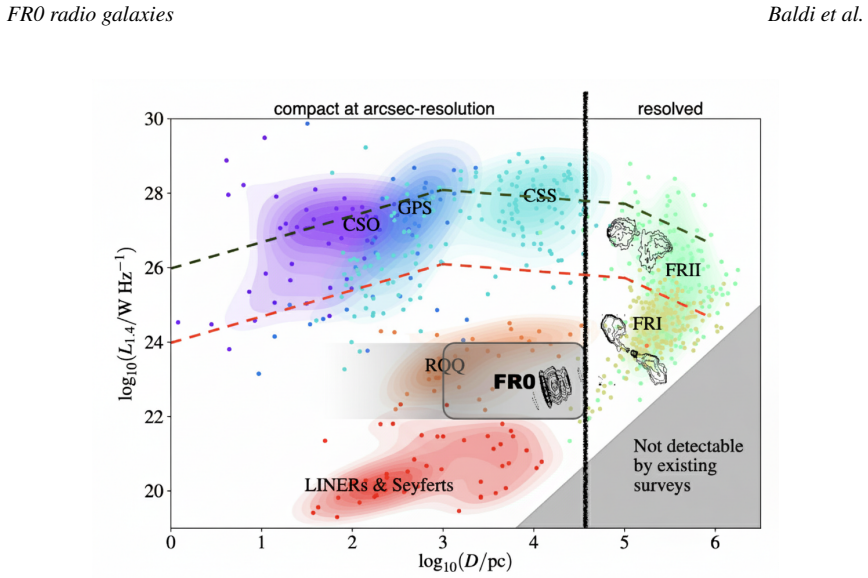
FR0 radio galaxies remain compact despite sharing host galaxies and black hole masses with extended FRI and FRII sources.
A machine-rendered reading of the paper's core claim, the machinery that carries it, and where it could break.
Core claim
FR0 radio galaxies present a significant challenge to our understanding of radio galaxy evolution. Unlike their more extended FRI and FRII counterparts, FR0s are characterized by compact radio morphologies with weak or absent large-scale jets, despite having optical host galaxy properties and central black hole masses similar to classical, more powerful radio galaxies. Their compactness and prevalence suggest they may represent an early stage of radio galaxy evolution or indicate a fundamentally different accretion and ejection mechanism.
What carries the argument
The FR0 classification, defined by compact radio morphology on parsec-to-kiloparsec scales together with the reported similarity in host-galaxy properties and black-hole masses to extended radio galaxies.
If this is right
- FR0s may mark an early evolutionary stage before radio jets expand to large scales.
- A distinct accretion-ejection process may operate in sources with otherwise similar black hole masses.
- Milliarcsecond VLBI imaging can reveal the parsec-scale jet structure and confinement physics.
- Wide-field continuum and polarization surveys can map how FR0 population properties vary with redshift relative to other radio galaxies.
Where Pith is reading between the lines
- If FR0s are young, some fraction should eventually develop extended jets, producing a detectable transition population.
- Environmental density or black hole spin could act as the switch that keeps jets compact in FR0s versus extended in others.
- Polarization data from SKA could test whether FR0 jets carry systematically lower power or different magnetic field geometry.
Load-bearing premise
FR0 radio galaxies share optical host galaxy properties and central black hole masses with classical FRI and FRII radio galaxies.
What would settle it
A measurement that finds statistically significant differences in black hole mass distributions or stellar population ages between FR0 hosts and those of extended radio galaxies would undermine the interpretation of shared evolutionary paths or mechanisms.
Figures
read the original abstract
Fanaroff-Riley type 0 (FR0) radio galaxies, a newly-identified and abundant population of low-power radio-loud active galactic nuclei, present a significant challenge to our understanding of radio galaxy evolution. Unlike their more extended FRI and FRII counterparts, FR0s are characterized by compact (from pc to a few kpc) radio morphologies with weak or absent large-scale jets, despite having optical host galaxy properties and central black hole masses similar to classical, more powerful radio galaxies. Their compactness and prevalence suggest they may represent an early stage of radio galaxy evolution or indicate a fundamentally different accretion and ejection mechanism. The Square Kilometre Array (SKA), with its continuum survey and VLBI capabilities, offers a transformative opportunity to study FR0 radio galaxies at unprecedented angular resolution and sensitivity. Milliarcsecond (mas) angular resolution VLBI observations will probe their parsec-scale structure, providing critical insights into the nature of their jets, accretion-ejection physics, and the interplay between nuclear activity and the surrounding environment. Continuum and polarization surveys will enable a systematic study of their population properties, distribution, and radio spectra across a wide range of redshifts in relation to other populations of radio galaxies.
Editorial analysis
A structured set of objections, weighed in public.
Referee Report
Summary. The manuscript is a perspective/review article on Fanaroff-Riley type 0 (FR0) radio galaxies. It claims that these abundant, low-power, compact (pc to few kpc) radio sources challenge standard radio galaxy evolutionary models because they exhibit weak or absent large-scale jets despite sharing optical host galaxy properties and central black hole masses with classical FRI and FRII galaxies; it suggests they may represent an early evolutionary stage or a distinct accretion/ejection mechanism, and argues that SKA continuum, polarization, and VLBI observations will be key to probing their parsec-scale jets, spectra, and population statistics.
Significance. If the cited literature establishing host/BH-mass similarity is robust, the perspective usefully frames an open question in AGN evolution and correctly identifies SKA's VLBI and survey capabilities as a timely observational path forward. As a synthesis rather than a source of new data, models, or derivations, its value is in highlighting population-level implications and observational priorities rather than in resolving the evolutionary status of FR0s.
major comments (1)
- Abstract: the central interpretive claim—that compactness indicates a distinct evolutionary stage or ejection mechanism rather than selection/environmental effects—rests on the premise of similarity in optical hosts and BH masses to FRI/FRII galaxies. No quantitative comparison, sample statistics, or error analysis is supplied in the abstract, and the manuscript (as a review) does not re-evaluate the strength of this premise from the cited works; this makes the challenge to evolutionary models dependent on external literature whose robustness is not assessed internally.
minor comments (1)
- Abstract and throughout: the text remains entirely qualitative. Adding even one or two concrete numbers (e.g., typical FR0 linear size range, fraction of the radio-loud population, or median BH mass offset) drawn from the cited studies would make the prevalence and compactness arguments more concrete without altering the review character.
Simulated Author's Rebuttal
We thank the referee for their thoughtful review of our perspective article. The single major comment is addressed point-by-point below. We agree that the presentation of the foundational premise can be strengthened for clarity.
read point-by-point responses
-
Referee: Abstract: the central interpretive claim—that compactness indicates a distinct evolutionary stage or ejection mechanism rather than selection/environmental effects—rests on the premise of similarity in optical hosts and BH masses to FRI/FRII galaxies. No quantitative comparison, sample statistics, or error analysis is supplied in the abstract, and the manuscript (as a review) does not re-evaluate the strength of this premise from the cited works; this makes the challenge to evolutionary models dependent on external literature whose robustness is not assessed internally.
Authors: We acknowledge the validity of this observation. As a perspective/review, the manuscript synthesizes results from the cited literature rather than re-deriving or meta-analyzing them. To address the concern, we will revise the abstract to explicitly note that the reported similarities in optical hosts and black hole masses are drawn from the referenced studies (e.g., Baldi et al. and others), and we will add a concise paragraph in the introduction summarizing the key quantitative findings, sample sizes, and any acknowledged limitations or scatter from those works. This will make the premise more self-contained without altering the review nature of the paper. revision: yes
Circularity Check
Review synthesis with no internal derivations or equations
full rationale
The manuscript is a perspective/review article that synthesizes existing literature on FR0 radio galaxies rather than presenting new observations, models, or derivations. The central claim—that FR0 compactness challenges evolutionary models despite similar host properties and BH masses—rests entirely on cited prior studies for the similarity premise. No internal equation, assumption, or logical step within the paper itself carries novel weight that could be internally inconsistent or falsified by re-derivation. No equations, fitted parameters, or self-referential derivations appear anywhere in the text.
Axiom & Free-Parameter Ledger
Reference graph
Works this paper leans on
-
[1]
New H _ 2 O masers in Seyfert and FIR bright galaxies. IV. Interferometric follow-ups. , keywords =. 2011. doi:10.1051/0004-6361/201014714 , archivePrefix =. 1008.4253 , primaryClass =
work page internal anchor Pith review Pith/arXiv arXiv doi:10.1051/0004-6361/201014714 2011
-
[2]
Accretion mode versus radio morphology in the LOFAR Deep Fields. , keywords =. doi:10.1093/mnras/stac140 , archivePrefix =. 2201.04433 , primaryClass =
-
[3]
The duty cycle of radio galaxies revealed by LOFAR: remnant and restarted radio source populations in the Lockman Hole. , keywords =. doi:10.1093/mnras/staa1172 , archivePrefix =. 2004.08979 , primaryClass =
-
[4]
The life cycle of radio galaxies in the LOFAR Lockman Hole field. , keywords =. doi:10.1051/0004-6361/201936955 , archivePrefix =. 2004.09118 , primaryClass =
-
[5]
Jets with a Twist: The Emergence of FR0 Jets in a 3D GRMHD Simulation of Zero-angular-momentum Black Hole Accretion. , keywords =. doi:10.3847/1538-4357/ad0974 , archivePrefix =. 2310.11487 , primaryClass =
-
[6]
Spine-sheath jet model for low-luminosity AGNs. arXiv e-prints , keywords =. doi:10.48550/arXiv.2308.10596 , archivePrefix =. 2308.10596 , primaryClass =
-
[7]
Characterizing the -ray Emission from FR0 Radio Galaxies. arXiv e-prints , keywords =. doi:10.48550/arXiv.2310.19888 , archivePrefix =. 2310.19888 , primaryClass =
-
[8]
2017, MNRAS, 465, 3291, doi: 10.1093/mnras/stw2944
Simulating galaxy formation with black hole driven thermal and kinetic feedback. , keywords =. doi:10.1093/mnras/stw2944 , archivePrefix =. 1607.03486 , primaryClass =
work page internal anchor Pith review Pith/arXiv arXiv doi:10.1093/mnras/stw2944
-
[9]
The Cosmic Lens All-Sky Survey - I. Source selection and observations. , keywords =. doi:10.1046/j.1365-8711.2003.06256.x , archivePrefix =. astro-ph/0211073 , primaryClass =
-
[10]
Spectral Energy Distribution of Radio Sources in Nearby Clusters of Galaxies: Implications for Sunyaev-Zel'Dovich Effect Surveys. , keywords =. doi:10.1088/0004-637X/694/2/992 , archivePrefix =. 0805.1750 , primaryClass =
work page internal anchor Pith review Pith/arXiv arXiv doi:10.1088/0004-637x/694/2/992
-
[11]
A New Catalog of 53,522 4.85 GHz Sources. , keywords =. doi:10.1086/191529 , adsurl =
-
[12]
A Unified Catalog of Radio Objects Detected by NVSS, FIRST, WENSS, GB6, and SDSS
A Unified Catalog of Radio Objects Detected by NVSS, First, WENSS, GB6, and SDSS. , keywords =. doi:10.1088/0004-6256/136/2/684 , archivePrefix =. 0806.0650 , primaryClass =
work page internal anchor Pith review Pith/arXiv arXiv doi:10.1088/0004-6256/136/2/684
-
[13]
Hot Accretion Flows Around Black Holes
Hot Accretion Flows Around Black Holes. , keywords =. doi:10.1146/annurev-astro-082812-141003 , archivePrefix =. 1401.0586 , primaryClass =
work page internal anchor Pith review Pith/arXiv arXiv doi:10.1146/annurev-astro-082812-141003
-
[14]
, year = 1963, month = mar, volume =
3C 273 : A Star-Like Object with Large Red-Shift. , year = 1963, month = mar, volume =. doi:10.1038/1971040a0 , adsurl =
-
[15]
The Activation of Galactic Nuclei and Their Accretion Rates Are Linked to the Star Formation Rates and Bulge-types of Their Host Galaxies. , keywords =. doi:10.3847/1538-4357/ab5fe1 , archivePrefix =. 1912.03633 , primaryClass =
-
[16]
Blandford-Znajek jets in galaxy formation simulations: method and implementation. , keywords =. doi:10.1093/mnras/stab804 , archivePrefix =. 2011.10580 , primaryClass =
-
[17]
The Bulk Lorentz Factor Crisis of TeV Blazars: Evidence for an Inhomogeneous Pileup Energy Distribution?. , keywords =. doi:10.1086/500039 , archivePrefix =. astro-ph/0511610 , primaryClass =
work page internal anchor Pith review Pith/arXiv arXiv doi:10.1086/500039
-
[18]
Faint $\gamma$-ray sources at low-redshift: the radio galaxy IC 1531
Faint -ray sources at low redshift: the radio galaxy IC 1531. , keywords =. doi:10.1093/mnras/sty2622 , archivePrefix =. 1810.02668 , primaryClass =
work page internal anchor Pith review Pith/arXiv arXiv doi:10.1093/mnras/sty2622
-
[19]
Radio-loud AGN: is there a link between luminosity and cluster environment?
Radio-loud Active Galactic Nucleus: Is There a Link between Luminosity and Cluster Environment?. , keywords =. doi:10.1088/0004-637X/770/2/136 , archivePrefix =. 1305.1050 , primaryClass =
work page internal anchor Pith review Pith/arXiv arXiv doi:10.1088/0004-637x/770/2/136
-
[20]
The link between accretion mode and environment in radio-loud active galaxies
The link between accretion mode and environment in radio-loud active galaxies. , keywords =. doi:10.1093/mnras/stv1807 , archivePrefix =. 1508.01033 , primaryClass =
work page internal anchor Pith review Pith/arXiv arXiv doi:10.1093/mnras/stv1807
-
[21]
Galaxy And Mass Assembly (GAMA): The environments of high- and low- excitation radio galaxies
Galaxy And Mass Assembly (GAMA): the environments of high- and low-excitation radio galaxies. , keywords =. doi:10.1093/mnras/stx1173 , archivePrefix =. 1705.04502 , primaryClass =
work page internal anchor Pith review Pith/arXiv arXiv doi:10.1093/mnras/stx1173
-
[22]
The radio loudness of SDSS quasars from the LOFAR Two-metre Sky Survey: ubiquitous jet activity and constraints on star formation. , keywords =. doi:10.1093/mnras/stab1998 , archivePrefix =. 2107.09141 , primaryClass =
-
[23]
Monthly Notices of the Royal Astronomical Society , volume =
The environmental dependence of radio-loud AGN activity and star formation in the 2dFGRS. , keywords =. doi:10.1111/j.1365-2966.2004.07752.x , archivePrefix =. astro-ph/0402523 , primaryClass =
-
[24]
An X-ray survey of the 2Jy sample. I: is there an accretion mode dichotomy in radio-loud AGN?
An X-ray survey of the 2 Jy sample - I. Is there an accretion mode dichotomy in radio-loud AGN?. , keywords =. doi:10.1093/mnras/stu263 , archivePrefix =. 1402.1770 , primaryClass =
work page internal anchor Pith review Pith/arXiv arXiv doi:10.1093/mnras/stu263
-
[25]
A stratified jet model for AGN emission in the two-flow paradigm
A stratified jet model for AGN emission in the two-flow paradigm. , keywords =. doi:10.1051/0004-6361/201731899 , archivePrefix =. 1810.01718 , primaryClass =
work page internal anchor Pith review Pith/arXiv arXiv doi:10.1051/0004-6361/201731899
-
[26]
Two-flow model for extragalactic radio jets. , keywords =. doi:10.1093/mnras/237.2.411 , adsurl =
-
[27]
Structured jets in TeV BL Lac objects and radiogalaxies
Structured jets in TeV BL Lac objects and radiogalaxies. Implications for the observed properties. , keywords =. doi:10.1051/0004-6361:20041404 , archivePrefix =. astro-ph/0406093 , primaryClass =
work page internal anchor Pith review Pith/arXiv arXiv doi:10.1051/0004-6361:20041404
-
[28]
Linking radio and gamma ray emission in Ap Librae
Linking radio and gamma-ray emission in Ap Librae. , keywords =. doi:10.1051/0004-6361/201425330 , archivePrefix =. 1503.01377 , primaryClass =
work page internal anchor Pith review Pith/arXiv arXiv doi:10.1051/0004-6361/201425330
-
[29]
The multifrequency emission of Mrk 501. From radio to TeV gamma-rays. , keywords =. doi:10.1051/0004-6361:20000538 , adsurl =
-
[30]
Shock heating in the nearby radio galaxy NGC 3801
Shock Heating in the Nearby Radio Galaxy NGC 3801. , keywords =. doi:10.1086/513500 , archivePrefix =. astro-ph/0702094 , primaryClass =
work page internal anchor Pith review Pith/arXiv arXiv doi:10.1086/513500
-
[31]
Numerical modelling of the lobes of radio galaxies in cluster environments
Numerical modelling of the lobes of radio galaxies in cluster environments. , keywords =. doi:10.1093/mnras/sts564 , archivePrefix =. 1301.2531 , primaryClass =
work page internal anchor Pith review Pith/arXiv arXiv doi:10.1093/mnras/sts564
-
[32]
The MASSIVE Survey. IV. The X-ray Halos of the Most Massive Early-type Galaxies in the Nearby Universe. , keywords =. doi:10.3847/0004-637X/826/2/167 , archivePrefix =. 1604.01764 , primaryClass =
work page internal anchor Pith review Pith/arXiv arXiv doi:10.3847/0004-637x/826/2/167
-
[33]
On the Baryon Fractions in Clusters and Groups of Galaxies
On the Baryon Fractions in Clusters and Groups of Galaxies. , keywords =. doi:10.1088/0004-637X/719/1/119 , archivePrefix =. 0911.2230 , primaryClass =
work page internal anchor Pith review Pith/arXiv arXiv doi:10.1088/0004-637x/719/1/119
-
[34]
Hot gas in groups: NGC 5328 and the intriguing case of NGC 4756 with XMM-Newton
Hot gas in groups: NGC 5328 and the intriguing case of NGC 4756 with XMM-Newton. , keywords =. doi:10.1051/0004-6361/201219775 , archivePrefix =. 1208.1408 , primaryClass =
work page internal anchor Pith review Pith/arXiv arXiv doi:10.1051/0004-6361/201219775
-
[35]
, year = 2007, month = feb, volume =
Feedback from radio-loud AGN. , year = 2007, month = feb, volume =. doi:10.1016/j.newar.2006.11.014 , adsurl =
-
[36]
Ionization, shocks and evolution of the emission-line gas of distant 3CR radio galaxies. , keywords =. doi:10.1046/j.1365-8711.2000.03028.x , archivePrefix =. astro-ph/9908211 , primaryClass =
-
[37]
Galaxies , year = 2022, month = apr, volume =
Radio Galaxies at TeV Energies. Galaxies , year = 2022, month = apr, volume =. doi:10.3390/galaxies10030061 , adsurl =
-
[38]
Grand unification of AGN activity in the CDM cosmology. , keywords =. doi:10.1111/j.1365-2966.2010.17427.x , archivePrefix =. 0911.1128 , primaryClass =
-
[39]
The e-MERLIN legacy survey of nearby galaxies
LeMMINGs - II. The e-MERLIN legacy survey of nearby galaxies. The deepest radio view of the Palomar sample on parsec scale. , keywords =. doi:10.1093/mnras/staa3519 , archivePrefix =. 2011.03062 , primaryClass =
-
[40]
LeMMINGs III. The e-MERLIN legacy survey of the Palomar sample: exploring the origin of nuclear radio emission in active and inactive galaxies through the [O III] - radio connection. , keywords =. doi:10.1093/mnras/stab2613 , archivePrefix =. 2109.06205 , primaryClass =
-
[41]
, year = 1968, month = feb, volume =
Space Distribution and Luminosity Functions of Quasi-Stellar Radio Sources. , year = 1968, month = feb, volume =. doi:10.1086/149446 , adsurl =
-
[42]
The 1.4 GHz Luminosity Function and Its Evolution. , keywords =. doi:10.1086/167176 , adsurl =
-
[43]
Luminosity function, sizes and FR dichotomy of radio-loud AGN. , keywords =. doi:10.1111/j.1365-2966.2007.12350.x , archivePrefix =. 0708.3733 , primaryClass =
-
[44]
The Wide-field Infrared Survey Explorer (WISE): Mission Description and Initial On-orbit Performance
The Wide-field Infrared Survey Explorer (WISE): Mission Description and Initial On-orbit Performance. , keywords =. doi:10.1088/0004-6256/140/6/1868 , archivePrefix =. 1008.0031 , primaryClass =
work page internal anchor Pith review Pith/arXiv arXiv doi:10.1088/0004-6256/140/6/1868
-
[45]
The eMERLIN and EVN View of FR 0 Radio Galaxies. Galaxies , keywords =. doi:10.3390/galaxies9040106 , archivePrefix =. 2111.09899 , primaryClass =
-
[46]
The Cosmic Density of Massive Black Holes from Galaxy Velocity Dispersions
The Cosmic Density of Massive Black Holes from Galaxy Velocity Dispersions. , keywords =. doi:10.1086/344484 , archivePrefix =. astro-ph/0210573 , primaryClass =
work page internal anchor Pith review Pith/arXiv arXiv doi:10.1086/344484
-
[47]
Why do many early-type galaxies lack emission lines? I. Fossil clues
Why do many early-type galaxies lack emission lines? I. Fossil clues. , keywords =. doi:10.1093/mnras/sty2391 , archivePrefix =. 1808.10405 , primaryClass =
work page internal anchor Pith review Pith/arXiv arXiv doi:10.1093/mnras/sty2391
-
[48]
The Systematic Properties of the Warm Phase of Starburst-Driven Galactic Winds
The Systematic Properties of the Warm Phase of Starburst-Driven Galactic Winds. , keywords =. doi:10.1088/0004-637X/809/2/147 , archivePrefix =. 1507.05622 , primaryClass =
work page internal anchor Pith review Pith/arXiv arXiv doi:10.1088/0004-637x/809/2/147
-
[49]
Physics of Coevolution of Galaxies and Supermassive Black Holes
Physics of Coevolution of Galaxies and Supermassive Black Holes. , keywords =. doi:10.1088/0004-637X/755/1/28 , archivePrefix =. 1102.0262 , primaryClass =
work page internal anchor Pith review Pith/arXiv arXiv doi:10.1088/0004-637x/755/1/28
-
[50]
Enhanced star formation rates in AGN hosts with respect to inactive galaxies from PEP-Herschel observations. , keywords =. doi:10.1051/0004-6361/201118266 , archivePrefix =. 1201.4394 , primaryClass =
work page internal anchor Pith review Pith/arXiv arXiv doi:10.1051/0004-6361/201118266
-
[51]
BAT AGN spectroscopic survey - XV: the high frequency radio cores of ultra-hard X-ray selected AGN. , keywords =. doi:10.1093/mnras/stz3608 , archivePrefix =. 2001.00877 , primaryClass =
-
[52]
doi:10.1111/j.1365-2966.2012.20901.x , eprint =
Jet-induced star formation in gas-rich galaxies. , keywords =. doi:10.1111/j.1365-2966.2012.21479.x , archivePrefix =. 1111.4478 , primaryClass =
-
[53]
Universal Transition Diagram from Dormant to Actively Accreting Supermassive Black Holes. , keywords =. doi:10.3847/1538-4357/ab8569 , archivePrefix =. 2001.11032 , primaryClass =
-
[54]
Fundamental Reference AGN Monitoring Experiment (FRAMEx). I. Jumping Out of the Plane with the VLBA. , keywords =. doi:10.3847/1538-4357/abca3c , archivePrefix =. 2011.06570 , primaryClass =
-
[55]
Radio morphology-accretion mode link in Fanaroff-Riley type II low-excitation radio galaxies. , keywords =. doi:10.1093/mnras/staa560 , archivePrefix =. 2002.09360 , primaryClass =
-
[56]
Jet-Accretion System in the Nearby mJy Radio Galaxies. , keywords =. doi:10.3847/1538-4357/abe776 , archivePrefix =. 2102.08922 , primaryClass =
-
[57]
Mass Functions of Supermassive Black Holes Across Cosmic Time
Mass Functions of Supermassive Black Holes across Cosmic Time. Advances in Astronomy , keywords =. doi:10.1155/2012/970858 , archivePrefix =. 1112.1430 , primaryClass =
work page internal anchor Pith review Pith/arXiv arXiv doi:10.1155/2012/970858 2012
-
[58]
Powerful Jets from Radiatively Efficient Disks, a Decades-Old Unresolved Problem in High Energy Astrophysics. Galaxies , keywords =. doi:10.3390/galaxies9010010 , archivePrefix =. 2102.05636 , primaryClass =
-
[59]
Nowhere to Hide: Radio-faint AGN in GOODS-N field. I. Initial catalogue and radio properties. , keywords =. doi:10.1051/0004-6361/201833399 , archivePrefix =. 1808.04296 , primaryClass =
work page internal anchor Pith review Pith/arXiv arXiv doi:10.1051/0004-6361/201833399
-
[60]
The e-MERGE Survey (e-MERLIN Galaxy Evolution Survey): overview and survey description. , keywords =. doi:10.1093/mnras/staa1279 , archivePrefix =. 2005.02407 , primaryClass =
-
[61]
Unveiling the 100 pc scale nuclear radio structure of NGC 6217 with e-MERLIN and the VLA
Unveiling the 100 pc scale nuclear radio structure of NGC 6217 with e-MERLIN and the VLA. , keywords =. doi:10.1093/mnras/stz1135 , archivePrefix =. 1904.10259 , primaryClass =
work page internal anchor Pith review Pith/arXiv arXiv doi:10.1093/mnras/stz1135 1904
-
[63]
The Super CLuster Assisted Shear Survey: Project overview and Data Release 1
SuperCLASS -- I. The Super CLuster Assisted Shear Survey: Project overview and Data Release 1. arXiv e-prints , keywords =
-
[64]
Accretion properties and jet mechanisms for the low-excitation radio galaxies. , keywords =. doi:10.1051/0004-6361/202453260 , archivePrefix =. 2503.23607 , primaryClass =
-
[65]
Jet-Feedback on kpc scales: a review. arXiv e-prints , keywords =. doi:10.48550/arXiv.2506.03888 , archivePrefix =. 2506.03888 , primaryClass =
-
[66]
arXiv e-prints , keywords =
CASA on the fringe: VLBI data processing in the CASA software package. arXiv e-prints , keywords =. 2019
2019
-
[67]
Monthly Notices of the Royal Astronomical Society , volume =
Towards a unified model for black hole X-ray binary jets. , keywords =. doi:10.1111/j.1365-2966.2004.08384.x , archivePrefix =. astro-ph/0409360 , primaryClass =
-
[68]
Hunting for Supermassive Black Holes in Nearby Galaxies with the Hobby-Eberly Telescope
Hunting for Supermassive Black Holes in Nearby Galaxies With the Hobby-Eberly Telescope. , keywords =. 2015. doi:10.1088/0067-0049/218/1/10 , archivePrefix =. 1502.00632 , primaryClass =
work page internal anchor Pith review Pith/arXiv arXiv doi:10.1088/0067-0049/218/1/10 2015
-
[69]
Observational constraints on growth of massive black holes. , keywords =. doi:10.1046/j.1365-8711.2002.05532.x , archivePrefix =. astro-ph/0203082 , primaryClass =
-
[70]
Inflation of 430-parsec bipolar radio bubbles in the Galactic Centre by an energetic event. , keywords =. doi:10.1038/s41586-019-1532-5 , archivePrefix =. 1909.05534 , primaryClass =
-
[71]
arXiv e-prints , keywords =
SOFIA/FORCAST Galactic Center Legacy Survey: Overview. arXiv e-prints , keywords =
-
[72]
Parsec-scale radio structure of 14 Fanaroff-Riley type 0 radio galaxies
Parsec-scale Radio Structure of 14 Fanaroff-Riley Type 0 Radio Galaxies. , keywords =. doi:10.3847/1538-4357/aad22c , archivePrefix =. 1807.02505 , primaryClass =
work page internal anchor Pith review Pith/arXiv arXiv doi:10.3847/1538-4357/aad22c
-
[73]
Parsec-scale properties of eight Fanaroff-Riley type 0 radio galaxies. , keywords =. doi:10.1093/mnras/stab1388 , archivePrefix =. 2105.05396 , primaryClass =
-
[74]
Optical Star-Formation Rate Indicators
Optical Star Formation Rate Indicators. , keywords =. doi:10.1086/500964 , archivePrefix =. astro-ph/0511730 , primaryClass =
work page internal anchor Pith review Pith/arXiv arXiv doi:10.1086/500964
-
[75]
Ionised gas abundances in barred spiral galaxies
Ionised gas abundances in barred spiral galaxies. , keywords =. 2012. doi:10.1051/0004-6361/201118292 , archivePrefix =. 1204.6212 , primaryClass =
work page internal anchor Pith review Pith/arXiv arXiv doi:10.1051/0004-6361/201118292 2012
-
[76]
Journal of Astrophysics and Astronomy , keywords =
Jets in radio galaxies and quasars: an observational perspective. Journal of Astrophysics and Astronomy , keywords =. doi:10.1007/s12036-022-09863-2 , archivePrefix =. 2206.05803 , primaryClass =
-
[77]
15-GHz radio emission from nearby low-luminosity active galactic nuclei
15-GHz radio emission from nearby low-luminosity active galactic nuclei. , keywords =. doi:10.1051/0004-6361/201833233 , archivePrefix =. 1805.06696 , primaryClass =
work page internal anchor Pith review Pith/arXiv arXiv doi:10.1051/0004-6361/201833233
-
[78]
1.4 GHz on the Fundamental Plane of Black Hole Activity
1.4 GHz on the Fundamental Plane of black hole activity. , keywords =. doi:10.1093/mnras/sty754 , archivePrefix =. 1803.07286 , primaryClass =
work page internal anchor Pith review Pith/arXiv arXiv doi:10.1093/mnras/sty754
-
[79]
An optical spectroscopic survey of the 3CR sample of radio galaxies with z < 0.3 . II. Spectroscopic classes and accretion modes in radio-loud AGN. , archivePrefix = "arXiv", eprint =. doi:10.1051/0004-6361/200913290 , adsurl =
-
[80]
Activity in normal galactic nuclei
An optical and radio survey of the nuclei of bright galaxies. Activity in normal galactic nuclei. , keywords =
-
[81]
, keywords =
An optical and radio survey of the nuclei of bright galaxies: sample selection and observations. , keywords =. 1980
1980
discussion (0)
Sign in with ORCID, Apple, or X to comment. Anyone can read and Pith papers without signing in.