Electroweak corrections to Higgs boson pair production: The quark channel
Pith reviewed 2026-06-25 20:05 UTC · model grok-4.3
The pith
The quark-antiquark channel for Higgs pair production receives mixed QCD-electroweak corrections that reach +10 percent near threshold.
A machine-rendered reading of the paper's core claim, the machinery that carries it, and where it could break.
Core claim
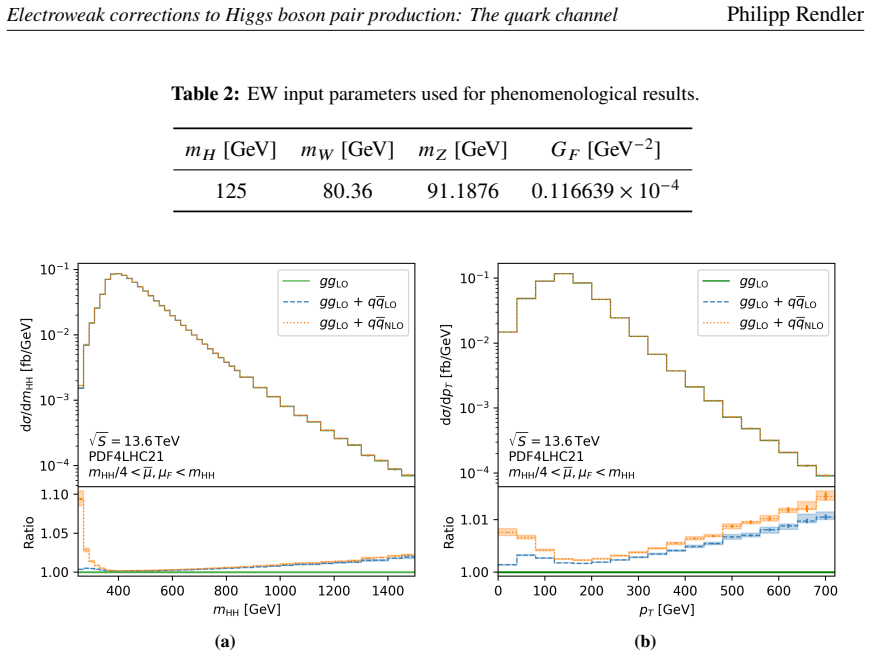
The mixed QCD-electroweak corrections to Higgs boson pair production in the quark-antiquark channel are computed fully analytically. The virtual amplitudes are obtained using the method of differential equations, with integration constants fixed by matching to the large mass expansion. When implemented in the POWHEG-BOX, these corrections impact the shapes of differential cross sections, reaching up to +10% for the invariant mass distribution of the Higgs boson pair near the production threshold.
What carries the argument
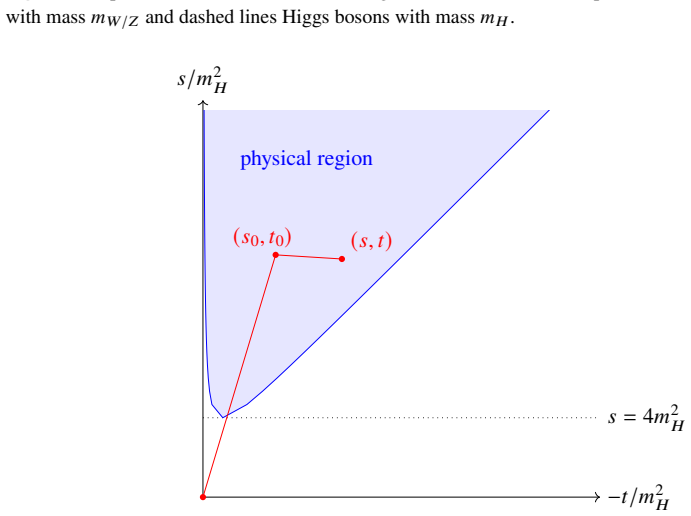
Analytic evaluation of the virtual amplitudes via the method of differential equations, with integration constants fixed through matching to the large-mass expansion limit of the canonical integrals.
If this is right
- The quark-antiquark channel must now be included to obtain complete next-to-leading-order electroweak predictions for Higgs pair production.
- The Higgs-pair invariant mass distribution receives shape distortions of up to ten percent near threshold.
- Phenomenological predictions generated with POWHEG-BOX incorporate these corrections for collider observables.
- This supplies the previously missing quark-initiated contribution at the present perturbative order.
Where Pith is reading between the lines
- These corrections could shift the extracted value of the Higgs trilinear coupling when pair-production data are interpreted.
- The same differential-equation technique may be reusable for other mixed-correction calculations involving top-quark loops.
- Threshold enhancements suggest that soft-gluon resummation could further improve accuracy in that region.
- Omitting the channel in uncertainty estimates would leave an unquantified theoretical error in Higgs pair production rates.
Load-bearing premise
The integration constants obtained by matching to the large mass expansion correctly determine the amplitudes throughout the relevant kinematic regions.
What would settle it
An independent numerical evaluation of the virtual amplitudes near the Higgs-pair production threshold that differs from the analytic expressions beyond the stated precision.
Figures
read the original abstract
We present the mixed QCD-electroweak corrections to Higgs boson pair production in the quark-antiquark channel. The virtual amplitudes are computed fully analytically using the method of differential equations. We determine the integration constants by matching our expressions to the large mass expansion limit of the canonical integrals. We implement the results in the POWHEG-BOX framework for phenomenological studies. The corrections are found to have a significant impact on the shapes of differential cross sections, reaching up to +10% for the invariant mass distribution of the Higgs boson pair near the production threshold. This channel has not been considered before in calculations of the next-to-leading order electroweak corrections to Higgs boson pair production.
Editorial analysis
A structured set of objections, weighed in public.
Referee Report
Summary. The manuscript computes the mixed QCD-electroweak corrections to Higgs boson pair production in the quark-antiquark channel. Virtual amplitudes are obtained analytically via the differential-equation method for master integrals; integration constants are fixed exclusively by matching the canonical integrals to their large-mass expansion. The results are implemented in POWHEG-BOX and used for phenomenological studies, which report corrections that distort differential distributions by up to +10 % near the HH production threshold. The calculation is presented as the first NLO EW treatment of this channel.
Significance. If the amplitudes are correct, the work supplies the previously missing NLO EW piece for the qqbar channel, which is relevant for precision LHC predictions of Higgs-pair production and the extraction of the trilinear coupling. The analytic differential-equation approach and public Monte-Carlo implementation are positive features. The reported 10 % shape effect near threshold would be phenomenologically important if confirmed.
major comments (1)
- [Computation of virtual amplitudes (differential equations and matching)] The integration constants of the differential-equation solution are determined solely by matching to the large-mass expansion of the canonical integrals. The phenomenological results, however, are evaluated near the HH threshold (m_HH ≈ 2 m_H), a regime whose mass hierarchy is distinct from the large-mass limit used for the boundary condition. It is not shown whether this single matching point captures all independent constants or whether analytic continuation across branch cuts introduces additional terms. Because the quoted +10 % correction to the invariant-mass distribution rests directly on these amplitudes, an independent verification (numerical evaluation at a benchmark point or matching to a second kinematic limit) is required.
minor comments (1)
- A short comparison of the new qqbar corrections with existing results for the gluon-fusion channel would help place the size of the reported effect in context.
Simulated Author's Rebuttal
We thank the referee for the careful reading of our manuscript and the constructive comment. We address the major point regarding the determination of integration constants below.
read point-by-point responses
-
Referee: [Computation of virtual amplitudes (differential equations and matching)] The integration constants of the differential-equation solution are determined solely by matching to the large-mass expansion of the canonical integrals. The phenomenological results, however, are evaluated near the HH threshold (m_HH ≈ 2 m_H), a regime whose mass hierarchy is distinct from the large-mass limit used for the boundary condition. It is not shown whether this single matching point captures all independent constants or whether analytic continuation across branch cuts introduces additional terms. Because the quoted +10 % correction to the invariant-mass distribution rests directly on these amplitudes, an independent verification (numerical evaluation at a benchmark point or matching to a second kinematic limit) is required.
Authors: We thank the referee for highlighting this important aspect of the calculation. In the differential-equation approach, the canonical basis yields a system whose solution depends on a finite number of integration constants equal to the number of master integrals. These constants are fixed by matching the full analytic solution to the independently computed large-mass expansion, which supplies a sufficient number of independent conditions through its series coefficients. The resulting expression is then valid throughout the kinematic plane; the differential equations themselves govern the analytic continuation, with branch cuts properly incorporated via the imaginary parts of the iterated integrals. We have confirmed that the solution satisfies the original differential equations at sample points in the threshold region. To address the concern explicitly, we will add a short explanatory paragraph in the revised manuscript detailing the number of master integrals and the matching procedure, together with a statement confirming the validity of the continuation to the threshold kinematics. revision: partial
Circularity Check
No circularity: standard DE solution with external large-mass matching
full rationale
The derivation solves differential equations for canonical integrals and fixes constants via matching to the independent large-mass expansion limit. This boundary condition is external to the target kinematics and does not reduce any result to a self-defined quantity, fitted subset, or self-citation chain. No load-bearing self-citations, uniqueness theorems, or ansatze imported from prior author work appear in the abstract or described method. The computation is self-contained against external benchmarks.
Axiom & Free-Parameter Ledger
Reference graph
Works this paper leans on
-
[1]
S. Borowka, N. Greiner, G. Heinrich, S. P. Jones, M. Kerner, J. Schlenk, U. Schubert and T. Zirke,Higgs Boson Pair Production in Gluon Fusion at Next-to-Leading Order with Full Top-Quark Mass Dependence,Phys. Rev. Lett.117(2016) 012001, [1604.06447]
Pith/arXiv arXiv 2016
-
[2]
6 Electroweak corrections to Higgs boson pair production: The quark channelPhilipp Rendler
S.Borowka, N.Greiner, G.Heinrich, S.P.Jones, M.Kerner, J.SchlenkandT.Zirke,Fulltop quark mass dependence in Higgs boson pair production at NLO,JHEP10(2016) 107, [1608.04798]. 6 Electroweak corrections to Higgs boson pair production: The quark channelPhilipp Rendler
Pith/arXiv arXiv 2016
-
[3]
J. Baglio, F. Campanario, S. Glaus, M. Mühlleitner, M. Spira and J. Streicher,Gluon fusion into Higgs pairs at NLO QCD and the top mass scheme,Eur. Phys. J. C79(2019) 459, [1811.05692]
Pith/arXiv arXiv 2019
- [4]
- [5]
-
[6]
G. Heinrich, S. P. Jones, M. Kerner, G. Luisoni and E. Vryonidou,NLO predictions for Higgs boson pair production with full top quark mass dependence matched to parton showers,JHEP08(2017) 088, [1703.09252]
Pith/arXiv arXiv 2017
-
[7]
S. Jones and S. Kuttimalai,Parton Shower and NLO-Matching uncertainties in Higgs Boson Pair Production,JHEP02(2018) 176, [1711.03319]
Pith/arXiv arXiv 2018
-
[8]
G. Heinrich, S. P. Jones, M. Kerner, G. Luisoni and L. Scyboz,Probing the trilinear Higgs boson coupling in di-Higgs production at NLO QCD including parton shower effects,JHEP 06(2019) 066, [1903.08137]
Pith/arXiv arXiv 2019
-
[9]
E. Bagnaschi, G. Degrassi and R. Gröber,Higgs boson pair production at NLO in the POWHEG approach and the top quark mass uncertainties,Eur. Phys. J. C83(2023) 1054, [2309.10525]
arXiv 2023
- [10]
- [11]
-
[12]
M. Grazzini, G. Heinrich, S. Jones, S. Kallweit, M. Kerner, J. M. Lindert and J. Mazzitelli, Higgs boson pair production at NNLO with top quark mass effects,JHEP05(2018) 059, [1803.02463]
Pith/arXiv arXiv 2018
-
[13]
D. de Florian, M. Grazzini, C. Hanga, S. Kallweit, J. M. Lindert, P. Maierhöfer, J. Mazzitelli and D. Rathlev,Differential Higgs Boson Pair Production at Next-to-Next-to-Leading Order in QCD,JHEP09(2016) 151, [1606.09519]
Pith/arXiv arXiv 2016
-
[14]
J. Grigo, J. Hoff and M. Steinhauser,Higgs boson pair production: top quark mass effects at NLO and NNLO,Nucl. Phys. B900(2015) 412–430, [1508.00909]
Pith/arXiv arXiv 2015
-
[15]
L.-B. Chen, H. T. Li, H.-S. Shao and J. Wang,Higgs boson pair production via gluon fusion at N3LO in QCD,Phys. Lett. B803(2020) 135292, [1909.06808]. 7 Electroweak corrections to Higgs boson pair production: The quark channelPhilipp Rendler
arXiv 2020
-
[16]
L.-B. Chen, H. T. Li, H.-S. Shao and J. Wang,The gluon-fusion production of Higgs boson pair: N3LO QCD corrections and top-quark mass effects,JHEP03(2020) 072, [1912.13001]
arXiv 2020
-
[17]
A. A H and H.-S. Shao,N3LO+N3LL QCD improved Higgs pair cross sections,JHEP02 (2023) 067, [2209.03914]
arXiv 2023
- [18]
-
[19]
S. Jaskiewicz, S. Jones, R. Szafron and Y. Ulrich,The structure of quark mass corrections in the gg→HH amplitude at high-energy,JHEP09(2025) 015, [2501.00587]
arXiv 2025
- [20]
- [21]
-
[22]
S. Borowka, C. Duhr, F. Maltoni, D. Pagani, A. Shivaji and X. Zhao,Probing the scalar potential via double Higgs boson production at hadron colliders,JHEP04(2019) 016, [1811.12366]
Pith/arXiv arXiv 2019
-
[23]
M. Mühlleitner, J. Schlenk and M. Spira,Top-Yukawa-induced corrections to Higgs pair production,JHEP10(2022) 185, [2207.02524]
arXiv 2022
- [24]
- [25]
- [26]
-
[27]
G. Heinrich, S. Jones, M. Kerner, T. Stone and A. Vestner,Electroweak corrections to Higgs boson pair production: the top-Yukawa and self-coupling contributions,JHEP11(2024) 040, [2407.04653]
arXiv 2024
- [28]
-
[29]
M. Bonetti, P. Rendler and W. J. Torres Bobadilla,Two-loop light-quark Electroweak corrections to Higgs boson pair production in gluon fusion,JHEP07(2025) 024, [2503.16620]. 8 Electroweak corrections to Higgs boson pair production: The quark channelPhilipp Rendler
arXiv 2025
-
[30]
A. Bhattacharya, F. Campanario, S. Carlotti, J. Chang, J. Mazzitelli, M. Mühlleitner, J. Ronca and M. Spira,Higgs-Pair Production via Gluon Fusion: Top-Yukawa- and light-quark-induced electroweak Corrections,2512.14823
- [31]
-
[32]
M. Bonetti, G. Heinrich, P. Rendler and W. J. Torres Bobadilla,NLO QCD corrections to the electroweak production of a Higgs boson pair in the quark-antiquark channel,JHEP04 (2026) 131, [2601.16924]. [34]GoSamcollaboration, G. Cullen, N. Greiner, G. Heinrich, G. Luisoni, P. Mastrolia, G. Ossola, T. Reiter and F. Tramontano,Automated One-Loop Calculations w...
arXiv 2026
- [33]
-
[34]
Nogueira,Automatic Feynman Graph Generation,J
P. Nogueira,Automatic Feynman Graph Generation,J. Comput. Phys.105(1993) 279–289
1993
- [35]
- [36]
-
[37]
J. C. Romao and J. P. Silva,A resource for signs and Feynman diagrams of the Standard Model,Int. J. Mod. Phys. A27(2012) 1230025, [1209.6213]
Pith/arXiv arXiv 2012
-
[38]
M. S. Chanowitz, M. Furman and I. Hinchliffe,The Axial Current in Dimensional Regularization,Nucl. Phys. B159(1979) 225–243
1979
-
[39]
A. von Manteuffel and C. Studerus,Reduze 2 - Distributed Feynman Integral Reduction, 1201.4330
-
[40]
P. Maierhöfer, J. Usovitsch and P. Uwer,Kira—A Feynman integral reduction program, Comput. Phys. Commun.230(2018) 99–112, [1705.05610]
Pith/arXiv arXiv 2018
-
[41]
J. Klappert and F. Lange,Reconstructing rational functions with FireFly,Comput. Phys. Commun.247(2020) 106951, [1904.00009]
arXiv 2020
-
[42]
J. Klappert, F. Lange, P. Maierhöfer and J. Usovitsch,Integral reduction with Kira 2.0 and finite field methods,Comput. Phys. Commun.266(2021) 108024, [2008.06494]. 9 Electroweak corrections to Higgs boson pair production: The quark channelPhilipp Rendler
Pith/arXiv arXiv 2021
-
[43]
J. Klappert, S. Y. Klein and F. Lange,Interpolation of dense and sparse rational functions and other improvements in FireFly,Comput. Phys. Commun.264(2021) 107968, [2004.01463]
arXiv 2021
- [44]
-
[45]
J. M. Henn,Multiloop integrals in dimensional regularization made simple,Phys. Rev. Lett. 110(2013) 251601, [1304.1806]
Pith/arXiv arXiv 2013
-
[46]
J. Henn, B. Mistlberger, V. A. Smirnov and P. Wasser,Constructing d-log integrands and computing master integrals for three-loop four-particle scattering,JHEP04(2020) 167, [2002.09492]
arXiv 2020
-
[47]
W. Flieger and W. J. Torres Bobadilla,Landau and leading singularities in arbitrary space-time dimensions,Eur. Phys. J. Plus139(2024) 1022, [2210.09872]
arXiv 2024
-
[48]
R. N. Lee,Presenting LiteRed: a tool for the Loop InTEgrals REDuction,1212.2685
-
[49]
T. Peraro,FiniteFlow: multivariate functional reconstruction using finite fields and dataflow graphs,JHEP07(2019) 031, [1905.08019]
Pith/arXiv arXiv 2019
-
[50]
Effortless: Efficient generation of odd letters with multiple roots as leading singularities
A. Matijašić and J. Miczajka, “Effortless: Efficient generation of odd letters with multiple roots as leading singularities.” In preparation
-
[51]
D. Chicherin, V. Sotnikov and S. Zoia,Pentagon functions for one-mass planar scattering amplitudes,JHEP01(2022) 096, [2110.10111]
arXiv 2022
-
[52]
T. Gehrmann, J. Henn, P. Jakubčík, J. Lim, C. C. Mella, N. Syrrakos, L. Tancredi and W. J. Torres Bobadilla,Graded transcendental functions: an application to four-point amplitudes with one off-shell leg,JHEP12(2024) 215, [2410.19088]
arXiv 2024
-
[53]
Catani,The Singular behavior of QCD amplitudes at two loop order,Phys
S. Catani,The Singular behavior of QCD amplitudes at two loop order,Phys. Lett. B427 (1998) 161–171, [hep-ph/9802439]
Pith/arXiv arXiv 1998
-
[54]
M. Hidding,DiffExp, a Mathematica package for computing Feynman integrals in terms of one-dimensional series expansions,Comput. Phys. Commun.269(2021) 108125, [2006.05510]
arXiv 2021
-
[55]
X. Liu, Y.-Q. Ma and C.-Y. Wang,A Systematic and Efficient Method to Compute Multi-loop Master Integrals,Phys. Lett. B779(2018) 353–357, [1711.09572]
Pith/arXiv arXiv 2018
-
[56]
X. Liu and Y.-Q. Ma,AMFlow: A Mathematica package for Feynman integrals computation via auxiliary mass flow,Comput. Phys. Commun.283(2023) 108565, [2201.11669]
arXiv 2023
-
[57]
P. Nason,A New method for combining NLO QCD with shower Monte Carlo algorithms, JHEP11(2004) 040, [hep-ph/0409146]. 10 Electroweak corrections to Higgs boson pair production: The quark channelPhilipp Rendler
Pith/arXiv arXiv 2004
-
[58]
S. Frixione, P. Nason and C. Oleari,Matching NLO QCD computations with Parton Shower simulations: the POWHEG method,JHEP11(2007) 070, [0709.2092]
Pith/arXiv arXiv 2007
-
[59]
S. Alioli, P. Nason, C. Oleari and E. Re,A general framework for implementing NLO calculations in shower Monte Carlo programs: the POWHEG BOX,JHEP06(2010) 043, [1002.2581]. 11
Pith/arXiv arXiv 2010
discussion (0)
Sign in with ORCID, Apple, or X to comment. Anyone can read and Pith papers without signing in.