Transforming X-ray Binary Astrophysics with SKA+VLBI
Pith reviewed 2026-06-26 04:02 UTC · model grok-4.3
The pith
The phased SKA-Mid as a VLBI element will transform radio studies of X-ray binaries via improved sensitivity, astrometry and rapid response.
A machine-rendered reading of the paper's core claim, the machinery that carries it, and where it could break.
Core claim
The phased SKA-Mid operating as a single ultra-sensitive VLBI element will transform radio studies of XRBs primarily through its time-domain capabilities: substantially improved sensitivity on VLBI baselines that include SKA-Mid in Bands 2 and 5, together with connected-element SKA-Mid imaging extending down to 0.35-1 GHz, microarcsecond-precision astrometry for bright systems, high-fidelity polarimetry for the most strongly polarized sources, and rapid target-of-opportunity response. In synergy with global VLBI networks, SKA+VLBI will track the evolution of compact ejecta and compact jets on AU scales, measure frequency-dependent core shifts to infer magnetic field strengths and gradients,
What carries the argument
The phased SKA-Mid functioning as an ultra-sensitive VLBI element in synergy with global VLBI networks, delivering time-domain high-resolution radio observations of XRBs.
If this is right
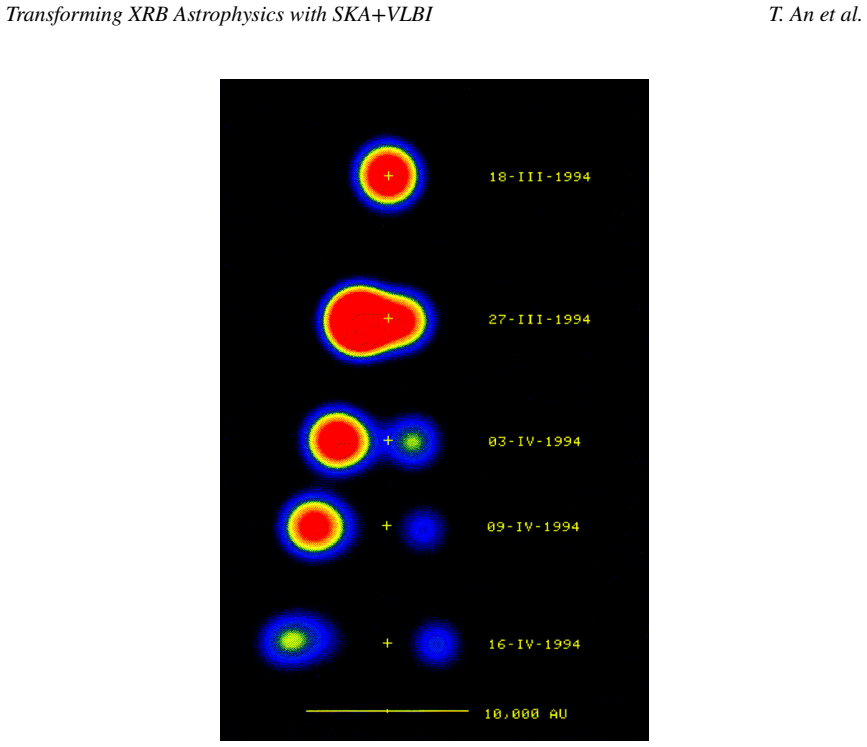
- Track the evolution of compact ejecta and jets on astronomical-unit scales in the first days of outbursts.
- Measure frequency-dependent core shifts to determine magnetic field strengths and gradients inside the jets.
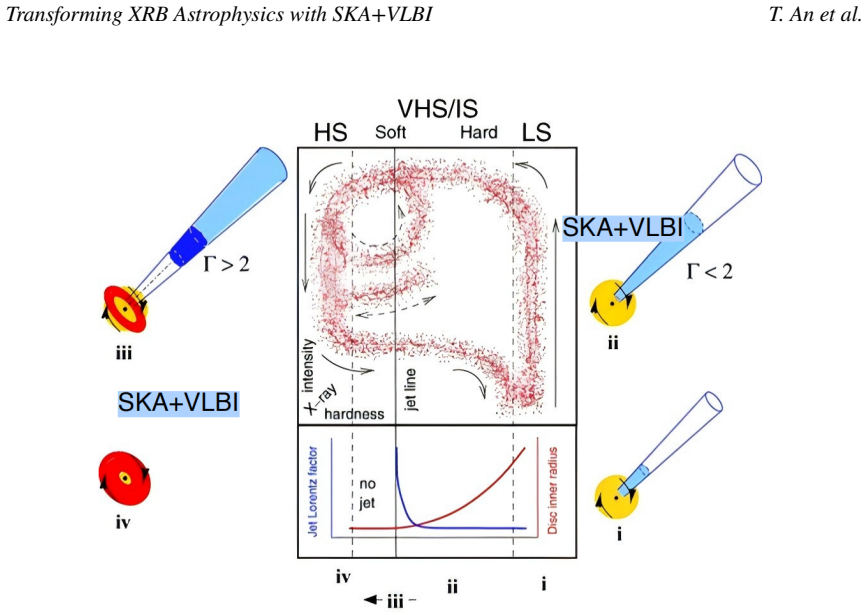
- Resolve disk-jet coupling during state transitions in real time with cadenced multi-frequency VLBI movies.
- Determine precise distances and natal kicks for X-ray binaries through parallaxes and proper motions in an astrometric census.
- Provide strictly simultaneous multi-band constraints on accretion-ejection physics and jet composition when combined with future X-ray and optical telescopes.
Where Pith is reading between the lines
- The same microphysical jet measurements could be compared directly with observations of active galactic nuclei to test whether the same launching and propagation physics operate across eight orders of magnitude in black-hole mass.
- An XRB astrometric census might uncover previously undetected natal kicks or orbital parameters that current lower-sensitivity arrays cannot reach.
- Rapid ToO response combined with the outlined core-shift survey could capture rare, short-lived jet features whose magnetic-field evolution has never been mapped before.
Load-bearing premise
The SKA-Mid will be built and operated with the stated sensitivity, frequency bands, rapid target-of-opportunity response, and ability to operate as a phased VLBI element alongside existing global networks.
What would settle it
If SKA-Mid phased-array observations fail to produce measurable sensitivity gains on VLBI baselines to X-ray binaries or cannot deliver the expected microarcsecond astrometric precision, the claimed transformation would not occur.
Figures
read the original abstract
X-ray binaries (XRBs) are unique laboratories where accretion, jets, strong gravity and magnetic fields can be probed on humanly tractable timescales. The phased SKA-Mid operating as a single, ultra-sensitive Very Long Baseline Interferometry (VLBI) element will transform radio studies of XRBs primarily through its time-domain capabilities: substantially improved sensitivity on VLBI baselines that include SKA-Mid in Bands 2 and 5, together with connected-element SKA-Mid imaging extending down to 0.35--1 GHz (Band 1), microarcsecond-precision astrometry for bright systems, high-fidelity polarimetry for the most strongly polarized sources, and rapid target-of-opportunity response. In synergy with global VLBI networks, SKA+VLBI will track the evolution of compact ejecta and compact jets on astronomical unit (AU) scales, measure frequency-dependent core shifts to infer magnetic field strengths and gradients, resolve disk--jet coupling during state transitions in real time, and determine precise distances and natal kicks via parallaxes and proper motions. Joint campaigns with future X-ray and optical telescopes will enable strictly simultaneous, multi-band constraints on accretion--ejection physics and on jet composition. We outline a quantitative program for \aastar\ and AA4, including cadenced, multi-frequency VLBI ``movies'' of jets over the first days of outbursts, an XRB astrometric census, and a core-shift survey, and we provide representative detection rates, magnetic field measurements and distance accuracies. These outcomes will set the microphysical foundation for jet physics across the mass scale from stellar-mass black holes and neutron stars to active galactic nuclei, and will establish SKA+VLBI as the definitive facility for time-domain, high-resolution XRB astrophysics.
Editorial analysis
A structured set of objections, weighed in public.
Referee Report
Summary. The manuscript is a perspective paper projecting that the phased SKA-Mid, functioning as an ultra-sensitive VLBI element, will transform X-ray binary (XRB) studies via enhanced time-domain capabilities: improved sensitivity on VLBI baselines in Bands 2 and 5, connected-element imaging down to Band 1 (0.35-1 GHz), microarcsecond astrometry for bright sources, high-fidelity polarimetry, and rapid ToO response. In synergy with global VLBI networks, this will enable AU-scale tracking of ejecta and jets, frequency-dependent core-shift measurements to infer magnetic fields, real-time disk-jet coupling during state transitions, and precise parallaxes/proper motions for distances and natal kicks. The paper outlines a quantitative program for AA* and AA4 phases, including cadenced multi-frequency VLBI 'movies', an XRB astrometric census, and core-shift surveys, with representative detection rates, B-field measurements, and distance accuracies. These are framed as setting the microphysical foundation for jet physics across mass scales and establishing SKA+VLBI as the definitive high-resolution time-domain facility, with synergies for joint X-ray/optical campaigns.
Significance. If the stated SKA-Mid specifications are realized, the projections identify concrete pathways for resolving accretion-ejection physics on human timescales in XRBs and scaling those insights to AGN. The inclusion of quantitative estimates (detection rates, measurement precisions) makes the case more actionable and falsifiable against future operations. The emphasis on strictly simultaneous multi-band observations and the explicit linkage to jet composition and magnetic field gradients adds value by highlighting unique parameter space not accessible with current facilities.
minor comments (1)
- Abstract: the string "\aastar" is an unreplaced LaTeX command and should be rendered as "AA*" for readability.
Simulated Author's Rebuttal
We thank the referee for their positive and constructive review. The assessment accurately captures the manuscript's focus on the time-domain capabilities of phased SKA-Mid as a VLBI element and the quantitative projections for XRB jet tracking, astrometry, and core-shift measurements. We are pleased with the recommendation to accept.
Circularity Check
No significant circularity
full rationale
This perspective paper contains no derivations, equations, fitted parameters, or quantitative predictions derived from internal data or models. All listed capabilities (sensitivity gains, astrometry, polarimetry, ToO response) are explicitly conditional on external instrument specifications for SKA-Mid that are stated as assumptions, not derived within the text. No self-citations, ansatzes, or uniqueness theorems are invoked to support any derivation chain. The content is forward-looking description of projected outcomes once the instrument parameters are granted; the derivation chain is empty by construction.
Axiom & Free-Parameter Ledger
Reference graph
Works this paper leans on
-
[1]
doi: 10.1093/mnras/stx898. G.E.Andersonetal. InAdvancingAstrophysicswiththeSKA–II(AASKAII).2026. arXivsearch: Report number AASKAII/GemmaAnderson01. J. J. Andrews, K. Breivik, and S. Chatterjee.ApJ, 886(1):68, Nov
-
[3]
doi: 10.1093/mnras/stz2335. P. Atri et al.MNRAS, 493(1):L81–L86, Mar
-
[4]
doi: 10.1093/mnrasl/slaa010. P. Atri et al.A&A, 696:A223, Apr
-
[5]
doi: 10.1051/0004-6361/202452837. W. A. Baan and T. An.ApJ, 980(1):119, Feb
-
[6]
doi: 10.3847/1538-4357/ada9ea. M. Bachetti et al.Nature, 514(7521):202–204, Oct
-
[7]
doi: 10.1038/nature13791. T. M. Belloni, S. E. Motta, and T. Muñoz-Darias.Bulletin of the Astronomical Society of India, 39 (3):409–428, Sept
-
[8]
doi: 10.48550/arXiv.1109.3388. A. Beri et al. InAdvancing Astrophysics with the SKA – II (AASKAII)
work page internal anchor Pith review Pith/arXiv arXiv doi:10.48550/arxiv.1109.3388
-
[9]
doi: 10.1086/157262. R.D.BlandfordandD.G.Payne.MNRAS,199:883–903,June1982.doi: 10.1093/mnras/199.4.883. R. D. Blandford and R. L. Znajek.MNRAS, 179:433–456, May
-
[10]
doi: 10.1093/mnras/179.3
-
[12]
doi: 10.1038/s41550-020-1023-5. C. Brocksopp et al.MNRAS, 432(2):931–943, June
-
[13]
doi: 10.1093/mnras/stt493. A. Burrows, T. Wang, and D. Vartanyan.ApJ, 987(2):164, July
-
[14]
doi: 10.3847/1538-4357/ addd04. P. Charlot et al.A&A, 644:A159, Dec
-
[15]
doi: 10.1051/0004-6361/202038368. H. Q. Cheng et al.ApJL, 991(2):L41, Oct
-
[16]
doi: 10.3847/2041-8213/adf104. S. Corbel et al.ApJ, 632(1):504–513, Oct
-
[17]
doi: 10.1086/432499. S. Corbel et al.MNRAS, 421(4):2947–2955, Apr
-
[18]
doi: 10.1111/j.1365-2966.2012.20517.x. S. Corbel et al.MNRAS, 431:L107–L111, Apr
-
[19]
doi: 10.1093/mnrasl/slt018. M. Coriat et al.MNRAS, 414(1):677–690, June
-
[20]
doi: 10.1111/j.1365-2966.2011.18433.x. D. Cseh et al.MNRAS, 439:L1–L5, Mar
-
[21]
doi: 10.1093/mnrasl/slt166. D. Cseh et al.MNRAS, 452(1):24–31, Sept
-
[22]
doi: 10.1093/mnras/stv1308. L. Cui et al.ApJ, 983(2):147, Apr
-
[23]
doi: 10.3847/1538-4357/adc0f7. A. Della Croce et al.A&A, 690:A179, Oct
-
[24]
doi: 10.1051/0004-6361/202450954. V. Dhawan, I. F. Mirabel, and L. F. Rodríguez.ApJ, 543(1):373–385, Nov
-
[25]
doi: 10.1086/520111. C. Done, M. Gierliński, and A. Kubota.A&ARv, 15(1):1–66, Dec
-
[26]
doi: 10.1086/300537. E. Egron et al.ApJ, 906(1):10, Jan
-
[27]
doi: 10.3847/1538-4357/abc5b1. S. Fabrika.Astrophys. Space Phys. Rev., 12:1–152, Jan
-
[28]
doi: 10.48550/arXiv.astro-ph/ 0603390. H. Falcke, E. Körding, and S. Markoff.A&A, 414:895–903, Feb
-
[29]
doi: 10.1051/0004-6361: 20031683. R. Fender and T. Belloni.ARA&A, 42(1):317–364, Sept
-
[30]
doi: 10.1146/annurev.astro.42. 053102.134031. R. Fender and E. Gallo.Space Sci. Rev., 183(1-4):323–337, Sept
-
[31]
doi: 10.1086/312128. R. P. Fender and S. E. Motta.Nature Astronomy, Sept
-
[32]
doi: 10.1038/s41550-025-02665-w. R. P. Fender et al.MNRAS, 336(1):39–46, Oct. 2002a. doi: 10.1046/j.1365-8711.2002.05701.x. R.P.Fenderetal.MNRAS,330(1):212–218,Feb.2002b. doi: 10.1046/j.1365-8711.2002.05072.x. R. P. Fender, T. M. Belloni, and E. Gallo.MNRAS, 355(4):1105–1118, Dec
-
[33]
Computer Graphics Forum31(5), 1735–1744 (2012) https://doi.org/10.1111/j
doi: 10.1111/j. 1365-2966.2004.08384.x. R.P.Fender,J.Homan,andT.M.Belloni.MNRAS,396(3):1370–1382,July2009. doi: 10.1111/j. 1365-2966.2009.14841.x. G. Fragione, A. Loeb, and F. A. Rasio.ApJL, 918(2):L38, Sept
work page doi:10.1111/j 2004
-
[34]
doi: 10.3847/2041-8213/ ac225a. T. Fragos et al.ApJ, 697:1057–1070, June
-
[35]
doi: 10.1088/0004-637X/697/2/1057. C. L. Fryer.New Astron. Rev., 50(7-8):492–495, Oct
-
[36]
doi: 10.1016/j.newar.2006.06.052. E. Gallo, R. P. Fender, and G. G. Pooley.MNRAS, 344(1):60–72, Sept
-
[38]
doi: 10.1038/nature03879. S. Heinz.A&A, 388:L40–L43, June
-
[39]
doi: 10.1051/0004-6361:20020402. S. Heinz.MNRAS, 355(3):835–844, Dec
-
[40]
doi: 10.1111/j.1365-2966.2004.08361.x. S. Heinz.ApJ, 636(1):316–322, Jan
-
[41]
doi: 10.1086/497954. S. Heinz and R. A. Sunyaev.MNRAS, 343(3):L59–L64, Aug
-
[42]
doi: 10.1046/j.1365-8711. 2003.06918.x. R.M.HjellmingandM.P.Rupen.Nature,375(6531):464–468,June1995. doi: 10.1038/375464a0. G. Hobbs, D. R. Lorimer, A. G. Lyne, and M. Kramer.MNRAS, 360(3):974–992, July
-
[43]
doi: 10.1111/j.1365-2966.2005.09087.x. R. M. Jeffrey, K. M. Blundell, S. A. Trushkin, and A. J. Mioduszewski.MNRAS, 461(1):312–320, Sept
-
[44]
doi: 10.1093/mnras/stw1322. P. Kaaret, S. Corbel, A. H. Prestwich, and A. Zezas.Science, 299(5605):365–368, Jan
-
[45]
doi: 10.1126/science.1079610. P. Kaaret, H. Feng, and T. P. Roberts.ARA&A, 55(1):303–341, Aug
-
[46]
doi: 10.1093/mnras/stw2002. L. Z. Kelley et al.ApJL, 725:L91–L96, Dec
-
[47]
E.Körding,H.Falcke,andS.Corbel.A&A,456(2):439–450,Sept.2006
doi: 10.1088/2041-8205/725/1/L91. E.Körding,H.Falcke,andS.Corbel.A&A,456(2):439–450,Sept.2006. doi: 10.1051/0004-6361: 20054144. C. C. Lang, P. Kaaret, S. Corbel, and A. Mercer.ApJ, 666(1):79–85, Sept
-
[48]
doi: 10.48550/arXiv.astro-ph/9712132. I. Mandel and B. Müller.MNRAS, 499(3):3214–3221, Dec
work page internal anchor Pith review Pith/arXiv arXiv doi:10.48550/arxiv.astro-ph/9712132
-
[49]
doi: 10.1093/mnras/staa3043. B. Marcote et al. InAdvancing Astrophysics with the SKA – II (AASKAII)
-
[50]
doi: 10.1051/0004-6361/202556290. A. Marino et al.ApJL, 980(2):L36, Feb
-
[51]
doi: 10.3847/2041-8213/ad9580. S. Markoff, H. Falcke, P. L. Biermann, and R. P. Fender. In M. M. Shapiro, T. Stanev, and J. P. Wefel, editors,Astrophysical Sources of High Energy Particles and Radiation, volume 44, page 135, Jan
-
[52]
S.Markoff,M.A.Nowak,andJ.Wilms.ApJ,635(2):1203–1216,Dec.2005. doi: 10.1086/497628. S. Markoff et al.ApJL, 812(2):L25, Oct
-
[53]
doi: 10.1088/2041-8205/812/2/L25. I. Martí-Vidal, A. Roy, J. Conway, and A. J. Zensus.A&A, 587:A143, Mar
-
[55]
doi: 10.1046/j. 1365-2966.2003.07017.x. M. J. Middleton et al.Nature, 493(7431):187–190, Jan
work page doi:10.1046/j 2003
-
[56]
doi: 10.1038/nature11697. J. C. A. Miller-Jones.PASA, 31:e016, Mar
-
[57]
doi: 10.1017/pasa.2014.7. J. C. A. Miller-Jones et al.MNRAS, 388(4):1751–1758, Aug
-
[58]
doi: 10.1111/j.1365-2966. 2008.13495.x. J. C. A. Miller-Jones et al.ApJL, 706(2):L230–L234, Dec
-
[59]
doi: 10.1088/0004-637X/706/2/ L230. J. C. A. Miller-Jones et al.MNRAS, 419(1):L49–L53, Jan
-
[60]
doi: 10.1111/j.1745-3933.2011. 01176.x. J. C. A. Miller-Jones et al.Nature, 569(7756):374–377, Apr
-
[61]
doi: 10.1126/science. abb3363. I. F. Mirabel and L. F. Rodríguez.Nature, 371(6492):46–48, Sept
-
[62]
I.F.MirabelandL.F.Rodríguez.ARA&A,37:409–443, Jan.1999
doi: 10.1038/371046a0. I.F.MirabelandL.F.Rodríguez.ARA&A,37:409–443, Jan.1999. doi: 10.1146/annurev.astro.37. 1.409. I. F. Mirabel et al.Nature, 413(6852):139–141, Sept
-
[63]
doi: 10.1038/35093060. S. E. Motta et al.A&A, 696:A222, Apr
-
[64]
21 Transforming XRB Astrophysics with SKA+VLBI T
doi: 10.1051/0004-6361/202452838. 21 Transforming XRB Astrophysics with SKA+VLBI T. An et al. P.NagarajanandK.El-Badry.PASP,137(3):034203,Mar.2025. doi: 10.1088/1538-3873/adb6d6. S. Naoz, Z. Haiman, E. Quataert, and L. Holzknecht.ApJL, 992(1):L12, Oct
-
[65]
doi: 10.3847/ 2041-8213/ae0a20. T. N. O’Doherty et al.MNRAS, 521(2):2504–2524, May
2041
-
[66]
doi: 10.1093/mnras/stad680. M. W. Pakull, R. Soria, and C. Motch.Nature, 466(7303):209–212, July
-
[67]
doi: 10.48550/arXiv.astro-ph/9907169. Z. Paragi et al. InAdvancing Astrophysics with the Square Kilometre Array (AASKA14), page 143, Apr
work page internal anchor Pith review Pith/arXiv arXiv doi:10.48550/arxiv.astro-ph/9907169
-
[68]
doi: 10.22323/1.215.0143. M. Pathak et al. InAdvancing Astrophysics with the SKA – II (AASKAII)
-
[69]
doi: 10.1093/mnras/stab644. J. Poutanen et al.Science, 375(6583):874–876, Feb
-
[70]
doi: 10.1126/science.abl4679. S. Prabu et al.MNRAS, 525(3):4426–4436, Nov
-
[71]
doi: 10.1093/mnras/stad2570. M. J. Reid et al.ApJ, 742(2):83, Dec
-
[72]
doi: 10.1088/0004-637X/742/2/83. R. A. Remillard and J. E. McClintock.ARA&A, 44(1):49–92, Sept
-
[73]
doi: 10.1146/annurev. astro.44.051905.092532. M.Riojaetal. InAdvancingAstrophysicswiththeSKA–II(AASKAII).2026. arXivsearch: Report number AASKAII/Rioja01. M. J. Rioja et al.AJ, 153(3):105, Mar
work page internal anchor Pith review Pith/arXiv arXiv doi:10.1146/annurev 2026
-
[74]
D.M.RussellandT.Shahbaz.MNRAS,438(3):2083–2096,Mar.2014.doi: 10.1093/mnras/stt2330
doi: 10.3847/1538-3881/153/3/105. D.M.RussellandT.Shahbaz.MNRAS,438(3):2083–2096,Mar.2014.doi: 10.1093/mnras/stt2330. D. M. Russell, R. P. Fender, E. Gallo, and C. R. Kaiser.MNRAS, 376(3):1341–1349, Apr
-
[75]
doi: 10.1111/j.1365-2966.2007.11539.x. T. D. Russell et al.MNRAS, 439(2):1390–1402, Apr
-
[76]
doi: 10.1093/mnras/stt2498. T. D. Russell et al.ApJ, 883(2):198, Oct
-
[77]
doi: 10.3847/1538-4357/ab3d36. R. Sharma, M. Massi, and G. Torricelli-Ciamponi.A&A, 660:A58, Apr
-
[78]
doi: 10.1093/mnrasl/sls044. K. V. Sokolovsky, Y. Y. Kovalev, A. B. Pushkarev, and A. P. Lobanov.A&A, 532:A38, Aug
-
[79]
doi: 10.1051/0004-6361/201016072. R. Soria et al.MNRAS, 409(2):541–551, Dec
-
[80]
doi: 10.1111/j.1365-2966.2010.17360.x. T. Sukhbold et al.ApJ, 821(1):38, Apr
-
[81]
doi: 10.3847/0004-637X/821/1/38. A. Tchekhovskoy, R. Narayan, and J. C. McKinney.MNRAS, 418(1):L79–L83, Nov
work page internal anchor Pith review doi:10.3847/0004-637x/821/1/38
-
[82]
doi: 10.1111/j.1745-3933.2011.01147.x. S. J. Tingay et al.Nature, 374(6518):141–143, Mar
-
[83]
doi: 10.1038/374141a0. V. Tudose et al.MNRAS, 375(1):L11–L15, Feb
-
[84]
doi: 10.1111/j.1745-3933.2006.00264.x. F. Verbunt, A. Igoshev, and E. Cator.A&A, 608:A57, Dec
discussion (0)
Sign in with ORCID, Apple, or X to comment. Anyone can read and Pith papers without signing in.