Odd transport in a two-temperature Brownian dimer
Pith reviewed 2026-06-26 02:45 UTC · model grok-4.3
The pith
Odd mobility in a two-temperature Brownian dimer generates handed correlations between the particles and increases thermal conductance while leaving net heat current unchanged under reversal.
A machine-rendered reading of the paper's core claim, the machinery that carries it, and where it could break.
Core claim
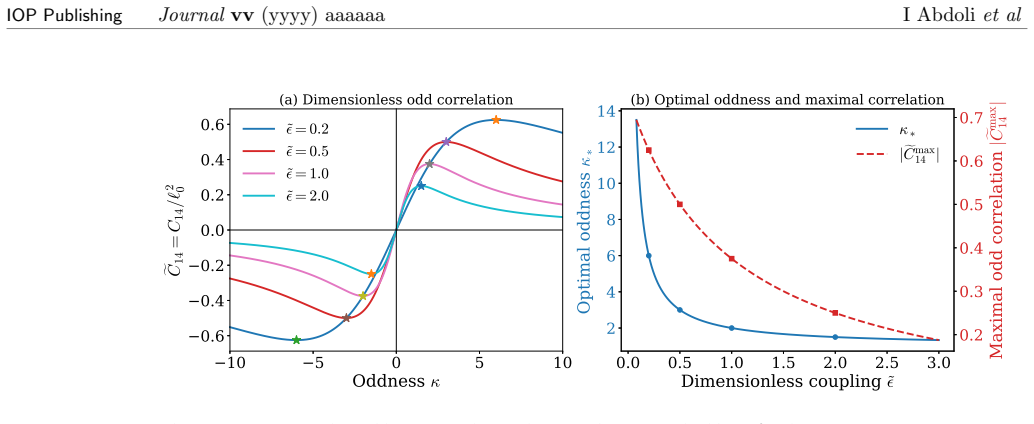
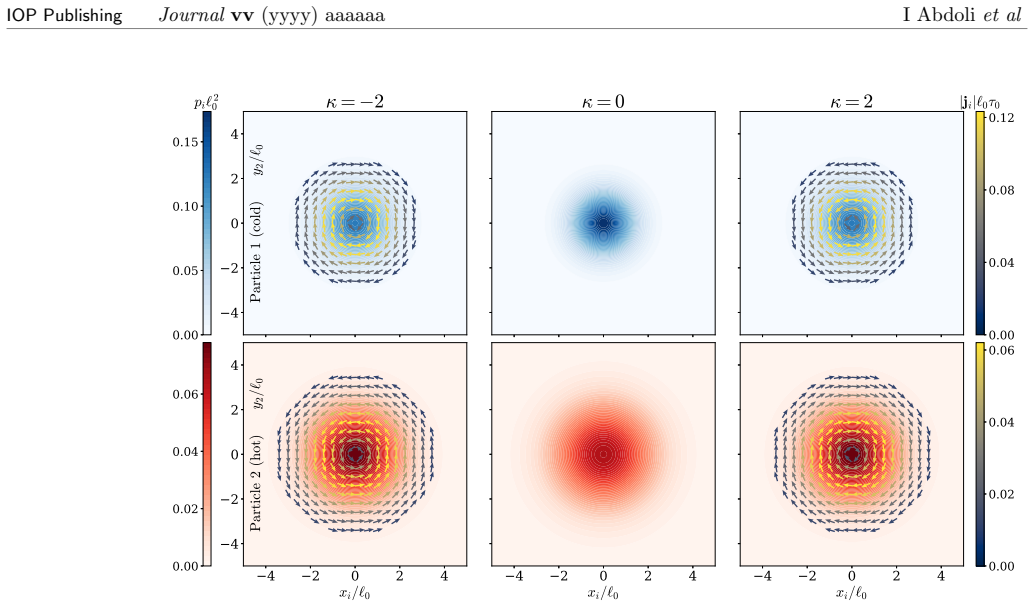
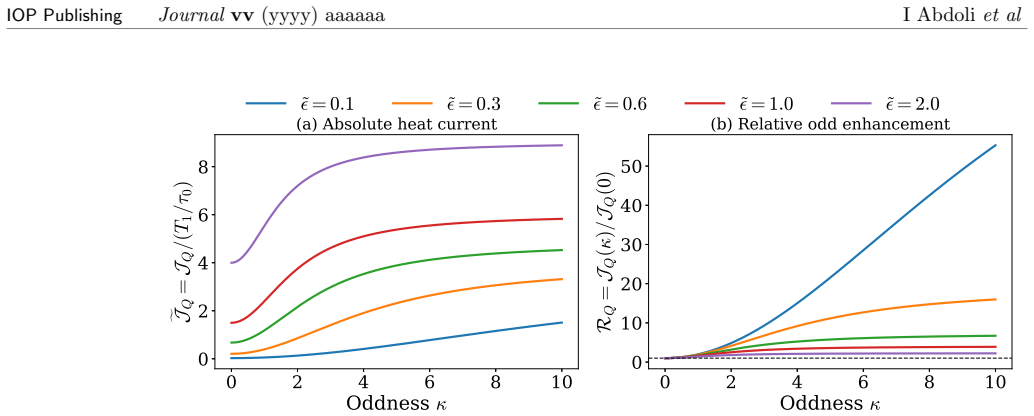
Our exact solution shows that odd mobility creates handed correlations between the two particles while leaving the individual particle distributions isotropic. These correlations arise only when temperature imbalance, elastic coupling, and odd mobility act together, and their handedness reverses when the odd response is reversed. The steady probability current contains two distinct parts: the ordinary irreversible current of a two-temperature dimer and an additional handed contribution generated by odd mobility. When projected onto the motion of each particle, this handed contribution becomes a pair of counter-rotating circulating currents inside the traps. We show that odd mobility enhances
What carries the argument
The odd mobility term, an antisymmetric addition to the mobility matrix in the overdamped Langevin equations that converts conservative forces into transverse velocity components.
If this is right
- Handed correlations between the particles exist only when temperature difference, spring coupling, and odd mobility are simultaneously present.
- The steady-state probability current acquires an extra handed component on top of the usual irreversible flow of the two-temperature dimer.
- Thermal conductance between the two reservoirs increases with the magnitude of the odd mobility.
- Reversing the sign of the odd mobility reverses the handedness of correlations and currents but leaves the net heat current and total dissipation invariant.
Where Pith is reading between the lines
- The same odd-mobility mechanism could be implemented in colloidal experiments via position-dependent feedback forces to test the predicted chiral currents.
- The selective boost in conductance without net-flow asymmetry suggests a route to directional heat control in microscopic systems that avoids explicit breaking of time-reversal symmetry in the driving.
- The separation of the probability current into ordinary and handed parts may generalize to larger particle networks or active-matter models where antisymmetric transport coefficients appear.
Load-bearing premise
An odd mobility term with antisymmetric coefficients can be inserted directly into the overdamped Langevin equations without requiring a microscopic Hamiltonian derivation or further consistency constraints.
What would settle it
Compute the cross-correlation functions of the two particle positions and check whether a nonzero antisymmetric (handed) component appears precisely when the odd mobility coefficient is nonzero, and whether reversing its sign increases measured conductance while leaving net heat flow unchanged.
Figures
read the original abstract
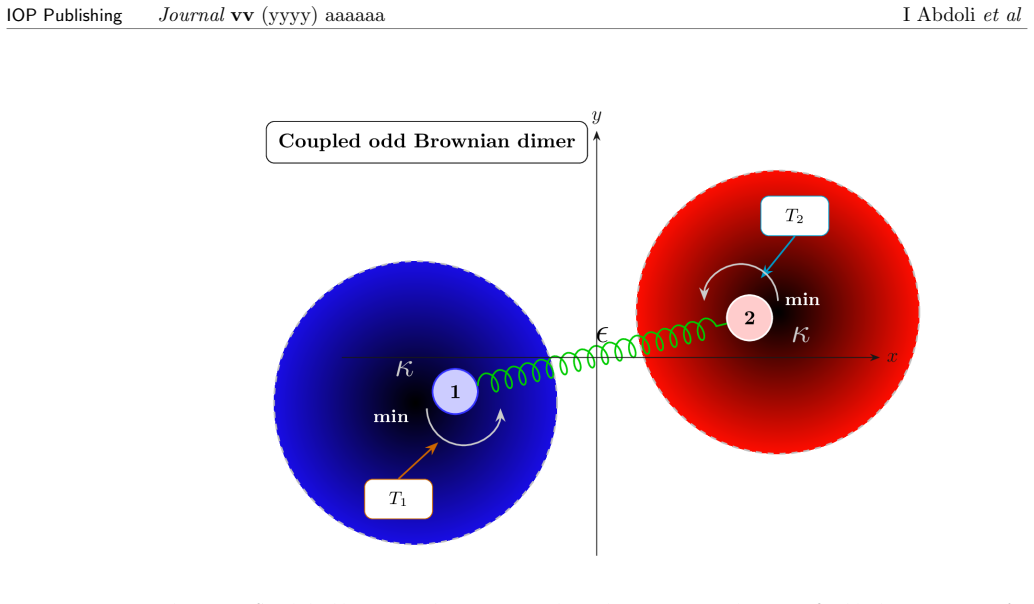
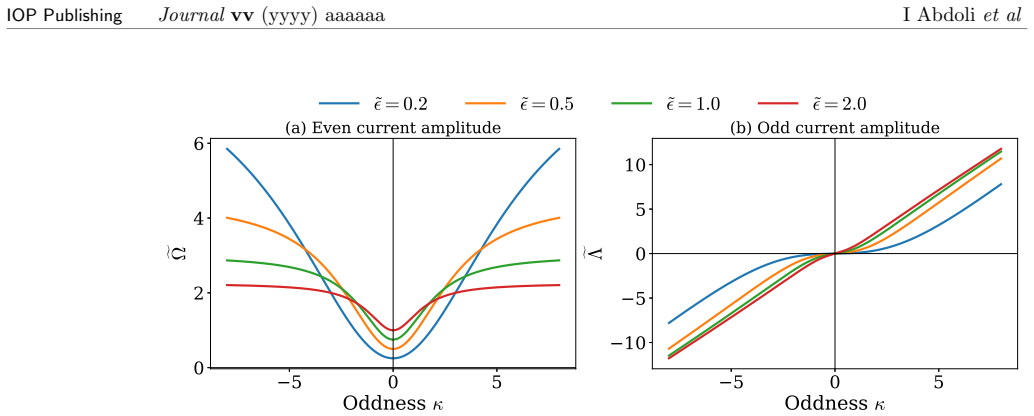
We investigate a two-temperature Brownian dimer with odd mobility, characterized by antisymmetric transport coefficients, as a controlled paradigm for odd nonequilibrium dynamics. The system is made of two harmonically confined particles coupled by an elastic spring and connected to reservoirs at different temperatures. Odd mobility converts conservative forces into transverse motion, linking heat exchange to circulating probability currents without requiring external torques, spatial anisotropy, or nonconservative driving. Our exact solution shows that odd mobility creates handed correlations between the two particles while leaving the individual particle distributions isotropic. These correlations arise only when temperature imbalance, elastic coupling, and odd mobility act together, and their handedness reverses when the odd response is reversed. The steady probability current contains two distinct parts: the ordinary irreversible current of a two-temperature dimer and an additional handed contribution generated by odd mobility. When projected onto the motion of each particle, this handed contribution becomes a pair of counter-rotating circulating currents inside the traps. Based on the currents we compute the heat transfer and entropy production analytically. We show that odd mobility enhances thermal conductance between the reservoirs, while the net heat current and total dissipation remain unchanged under reversal of the odd handedness.
Editorial analysis
A structured set of objections, weighed in public.
Referee Report
Summary. The manuscript investigates a two-temperature Brownian dimer with odd mobility (antisymmetric transport coefficients) added to the overdamped Langevin equations. It claims an exact solution yielding analytical expressions for steady-state currents (split into irreversible and handed parts), heat transfer, and entropy production. Key results are that odd mobility generates handed particle correlations (reversing with odd handedness) while keeping individual distributions isotropic, and that it enhances thermal conductance between reservoirs without changing net heat current or total dissipation under reversal.
Significance. If the modeling assumptions hold, the work supplies a solvable paradigm linking temperature imbalance, elastic coupling, and odd mobility to circulating currents and modified conductance, with explicit analytical expressions for observables. The exact solvability and the reversal-invariance result are notable strengths that could serve as a benchmark for odd nonequilibrium transport.
major comments (2)
- [Model definition] Model section (overdamped Langevin equations with antisymmetric mobility matrix): the direct insertion of the odd mobility term for particles coupled to distinct heat baths requires explicit verification that the resulting Fokker-Planck operator remains consistent with the position-dependent diffusion matrix and admits a normalizable stationary density whose probability currents can be unambiguously decomposed. No microscopic derivation from an underdamped Hamiltonian or check against local detailed balance is supplied; this assumption is load-bearing for all subsequent exact-solution claims.
- [Results on currents and heat transfer] Current decomposition and conductance calculation (results section): the claim that the handed current component enhances thermal conductance while leaving net heat current and total dissipation invariant under reversal must be shown to survive the two-temperature diffusion matrix; the abstract and reader's summary indicate the partition is performed, but the consistency of the decomposition with the antisymmetric mobility in the presence of unequal temperatures needs explicit demonstration (e.g., via the explicit form of the stationary current or entropy-production formula).
minor comments (2)
- [Notation and model] Clarify the precise definition and units of the odd mobility coefficient and its relation to the symmetric mobility matrix in the two-particle system.
- [Introduction or model] Add a brief statement on the range of validity of the overdamped approximation when odd mobility is present.
Simulated Author's Rebuttal
We thank the referee for the careful reading and constructive comments on our manuscript. We address the two major comments point by point below, clarifying the model construction and the explicit demonstrations in our exact solution. Where appropriate, we indicate revisions that will be incorporated in the revised version.
read point-by-point responses
-
Referee: [Model definition] Model section (overdamped Langevin equations with antisymmetric mobility matrix): the direct insertion of the odd mobility term for particles coupled to distinct heat baths requires explicit verification that the resulting Fokker-Planck operator remains consistent with the position-dependent diffusion matrix and admits a normalizable stationary density whose probability currents can be unambiguously decomposed. No microscopic derivation from an underdamped Hamiltonian or check against local detailed balance is supplied; this assumption is load-bearing for all subsequent exact-solution claims.
Authors: The model is introduced phenomenologically as an overdamped Langevin system with a constant antisymmetric mobility matrix added to the standard two-temperature setup. The Fokker-Planck operator follows directly from the Langevin equations; because the mobility (and thus diffusion) matrix is position-independent and the confining potentials are harmonic, the operator is linear with constant coefficients. The stationary density is the explicit multivariate Gaussian obtained by solving the Lyapunov equation for the covariance matrix, which is always normalizable for positive temperatures. The probability currents are then constructed unambiguously from this density and the drift vector, allowing the decomposition into irreversible and handed components shown in the results. While a microscopic derivation from an underdamped Hamiltonian is not supplied, the overdamped model is internally consistent, as verified by the existence and uniqueness of the stationary solution and the well-defined currents. We will add a short paragraph and footnote in the model section confirming the FP operator structure and Gaussian stationarity. revision: partial
-
Referee: [Results on currents and heat transfer] Current decomposition and conductance calculation (results section): the claim that the handed current component enhances thermal conductance while leaving net heat current and total dissipation invariant under reversal must be shown to survive the two-temperature diffusion matrix; the abstract and reader's summary indicate the partition is performed, but the consistency of the decomposition with the antisymmetric mobility in the presence of unequal temperatures needs explicit demonstration (e.g., via the explicit form of the stationary current or entropy-production formula).
Authors: The current decomposition is performed explicitly after obtaining the exact stationary covariance from the two-temperature diffusion matrix (which incorporates the unequal temperatures via the diagonal diffusion blocks). The antisymmetric mobility enters the drift, and the resulting stationary current is split into the standard irreversible part (driven by temperature difference) and the additional handed part (proportional to the odd mobility coefficient). Substituting these currents into the heat-flow and entropy-production expressions yields the stated invariance under odd-mobility reversal, because the handed contribution is odd under that reversal while the net heat current and total dissipation are even. These relations are derived analytically in the results section using the explicit covariance and current formulas. To make the consistency with the two-temperature matrix fully transparent, we will add one intermediate equation showing the stationary current vector before the decomposition. revision: partial
Circularity Check
No significant circularity; exact solution derived directly from stated Langevin equations without reduction to fitted inputs or self-referential definitions.
full rationale
The paper introduces the model by writing overdamped Langevin equations that include an explicit antisymmetric odd-mobility matrix acting on the harmonic forces, then solves the resulting Fokker-Planck equation analytically to obtain the steady-state density, probability currents, handed correlations, and heat conductance. No parameter is fitted to a data subset and then relabeled as a prediction, no self-citation supplies a uniqueness theorem or ansatz that the present work merely renames, and the reported enhancements and reversal invariances are computed consequences of the joint presence of temperature imbalance, spring coupling, and the added odd term rather than tautological redefinitions of the inputs.
Axiom & Free-Parameter Ledger
free parameters (1)
- odd mobility coefficient
axioms (1)
- domain assumption Particle motion obeys overdamped Langevin dynamics augmented by an odd mobility tensor that converts forces into perpendicular velocities.
Reference graph
Works this paper leans on
-
[1]
Fruchart M, Scheibner C and Vitelli V 2023Annu. Rev. Condens. Matter Phys.14471–510
-
[2]
Hargus C, Epstein J M and Mandadapu K K 2021Phys. Rev. Lett.127178001
-
[3]
Poggioli A R and Limmer D T 2023Phys. Rev. Lett.130158201
-
[4]
Phys.28063501
Faedi F, Kalz E, Metzler R and Sharma A 2026New J. Phys.28063501
-
[5]
W´ ojcik J and Kalz E 2026arXiv preprint arXiv:2602.09920
-
[6]
Vuijk H D, Brader J M and Sharma A 2019J. Stat. Mech.: Theory Exp.2019063203
-
[7]
Abdoli I, Vuijk H D, Sommer J U, Brader J M and Sharma A 2020Phys. Rev. E101012120
-
[8]
Phys.5256
Vega Reyes F, L´ opez-Casta˜ no M A and Rodr´ ıguez-Rivas´A 2022Commun. Phys.5256
-
[9]
Abdoli I, Wittmann R and L¨ owen H 2026J. Phys. Chem. B1304672–4682
-
[10]
Caprini L, Marconi U M B, Liebchen B and L¨ owen H 2025arXiv preprint arXiv:2509.05053
-
[11]
Czopnik R and Garbaczewski P 2001Phys. Rev. E63021105
-
[12]
Chun H M, Durang X and Noh J D 2018Phys. Rev. E97032117
-
[13]
Abdoli I, Vuijk H D, Wittmann R, Sommer J U, Brader J M and Sharma A 2020Phys. Rev. Res.2023381
-
[14]
Abdoli I 2023Odd Dynamics in Diffusion SystemsPhd thesis Technische Universit¨ at Dresden Dresden, Germany URLhttps://nbn-resolving.org/urn:nbn:de:bsz:14-qucosa2-962765
-
[15]
Wittmann R, Abdoli I, Sharma A and Brader J M 2025Phys. Rev. E111025412
-
[16]
Sch¨ utte C, Iwasaki J, Rosch A and Nagaosa N 2014Phys. Rev. B90174434
-
[17]
Phys.351850–856
Troncoso R E and N´ u˜ nez´A S 2014Ann. Phys.351850–856
-
[18]
Reichhardt C, Ray D and Reichhardt C O 2015Phys. Rev. Lett.114217202
-
[19]
Phys.13170–175
Litzius K, Lemesh I, Kr¨ uger B, Bassirian P, Caretta L, Richter K, B¨ uttner F, Sato K, Tretiakov O A, F¨ orster Jet al.2017Nat. Phys.13170–175
-
[20]
Fert A, Reyren N and Cros V 2017Nat. Rev. Mater.217031
-
[21]
Rep.84464 15 IOP PublishingJournalvv(yyyy) aaaaaa I Abdoliet al
B¨ uttner F, Lemesh I and Beach G S 2018Sci. Rep.84464 15 IOP PublishingJournalvv(yyyy) aaaaaa I Abdoliet al
-
[22]
Weißenhofer M, R´ ozsa L and Nowak U 2021Phys. Rev. Lett.127047203
-
[23]
Van Teeffelen S and L¨ owen H 2008Phys. Rev. E78020101
-
[24]
K¨ ummel F, Ten Hagen B, Wittkowski R, Buttinoni I, Eichhorn R, Volpe G, L¨ owen H and Bechinger C 2013Phys. Rev. Lett.110198302
-
[25]
DiLuzio W R, Turner L, Mayer M, Garstecki P, Weibel D B, Berg H C and Whitesides G M 2005Nature4351271–1274
-
[26]
Marcos, Fu H C, Powers T R and Stocker R 2012PNAS1094780–4785
-
[27]
Petroff A P, Wu X L and Libchaber A 2015Phys. Rev. Lett.114158102
-
[28]
Drescher K, Leptos K C, Tuval I, Ishikawa T, Pedley T J and Goldstein R E 2009Phys. Rev. Lett.102168101
-
[29]
Muzzeddu P L, Vuijk H D, L¨ owen H, Sommer J U and Sharma A 2022J. Chem. Phys.157
-
[30]
Caprini L, Abdoli I, Marconi U M B and L¨ owen H 2025Newton1100253
-
[31]
Phys.28064401
Marini Bettolo Marconi U, Petrini A, Maire R and Caprini L 2026New J. Phys.28064401
-
[32]
Commun.81573
Banerjee D, Souslov A, Abanov A G and Vitelli V 2017Nat. Commun.81573
-
[33]
Phys.171260–1269
Han M, Fruchart M, Scheibner C, Vaikuntanathan S, De Pablo J J and Vitelli V 2021Nat. Phys.171260–1269
-
[34]
Markovich T and Lubensky T C 2021Phys. Rev. Lett.127048001
-
[35]
Phys.16 475–480
Scheibner C, Souslov A, Banerjee D, Sur´ owka P, Irvine W T and Vitelli V 2020Nat. Phys.16 475–480
-
[36]
Braverman L, Scheibner C, VanSaders B and Vitelli V 2021Phys. Rev. Lett.127268001
-
[37]
Banerjee D, Vitelli V, J¨ ulicher F and Sur´ owka P 2021Phys. Rev. Lett.126138001
-
[38]
Lier R, Armas J, Bo S, Duclut C, J¨ ulicher F and Sur´ owka P 2022Phys. Rev. E105054607
-
[39]
Huang Z F, te Vrugt M, Wittkowski R and L¨ owen H 2025PNAS122e2511350122
-
[40]
Kalz E, Vuijk H D, Abdoli I, Sommer J U, L¨ owen H and Sharma A 2022Phys. Rev. Lett.129 090601
-
[41]
Kalz E, Vuijk H D, Sommer J U, Metzler R and Sharma A 2024Phys. Rev. Lett.132057102
-
[42]
Phys.27 033025
Luigi Muzzeddu P, Kalz E, Gambassi A, Sharma A and Metzler R 2025New J. Phys.27 033025
-
[43]
Phys.151188–1194
Soni V, Bililign E S, Magkiriadou S, Sacanna S, Bartolo D, Shelley M J and Irvine W T 2019 Nat. Phys.151188–1194
2019
-
[44]
Massana-Cid H, Levis D, Hern´ andez R J H, Pagonabarraga I and Tierno P 2021Phys. Rev. Res.3L042021
-
[45]
Phys.18212–218
Bililign E S, Balboa Usabiaga F, Ganan Y A, Poncet A, Soni V, Magkiriadou S, Shelley M J, Bartolo D and Irvine W T 2022Nat. Phys.18212–218
-
[46]
Tan T H, Mietke A, Li J, Chen Y, Higinbotham H, Foster P J, Gokhale S, Dunkel J and Fakhri N 2022Nature607287–293
-
[47]
Mecke J, Nketsiah J O, Li R and Gao Y 2024NSO320230086
-
[48]
Goerlich R, Antonov A P, Olsen K S, Caprini L, Scholz C, L¨ owen H and Roichman Y 2026 arXiv preprint arXiv:2605.25136
Pith/arXiv arXiv 2026
-
[49]
Grosberg A Y and Joanny J F 2015Phys. Rev. E92032118
-
[50]
Lett.10760004
B´ erut A, Petrosyan A and Ciliberto S 2014Europhys. Lett.10760004
-
[51]
B´ erut A, Imparato A, Petrosyan A and Ciliberto S 2016Phys. Rev. Lett.116068301 16 IOP PublishingJournalvv(yyyy) aaaaaa I Abdoliet al
-
[52]
Core6056
Dotsenko V S, Imparato A, Viot P and Oshanin G 2023SciPost Phys. Core6056
-
[53]
Stenhammar J, Wittkowski R, Marenduzzo D and Cates M E 2015Phys. Rev. Lett.114 018301
-
[54]
Weber S N, Weber C A and Frey E 2016Phys. Rev. Lett.116058301
-
[55]
Ilker E and Joanny J F 2020Phys. Rev. Res.2023200
-
[56]
McCarthy E, Manna R K, Damavandi O and Manning M L 2024Phys. Rev. Lett.132098301
-
[57]
Phys.22093057
Abdoli I, Kalz E, Vuijk H D, Wittmann R, Sommer J U, Brader J M and Sharma A 2020New J. Phys.22093057
-
[58]
Rep.12 13405
Abdoli I, Wittmann R, Brader J M, Sommer J U, L¨ owen H and Sharma A 2022Sci. Rep.12 13405
-
[59]
Filliger R and Reimann P 2007Phys. Rev. Lett.99230602
-
[60]
Abdoli I and L¨ owen H 2026npj Soft Matter25
-
[61]
Lett.)9240007
Lichtner K and Klapp S H 2010EPL (Europhys. Lett.)9240007
-
[62]
Gernert R and Klapp S H 2015Phys. Rev. E92022132
-
[63]
Gernert R, Loos S A, Lichtner K and Klapp S H 2016 Feedback control of colloidal transport Control of Self-Organizing Nonlinear Systems(Springer) pp 375–392 17
2016
discussion (0)
Sign in with ORCID, Apple, or X to comment. Anyone can read and Pith papers without signing in.