A particle-resolved rheological study of chirality transfer and odd transport
Pith reviewed 2026-06-29 23:35 UTC · model grok-4.3
The pith
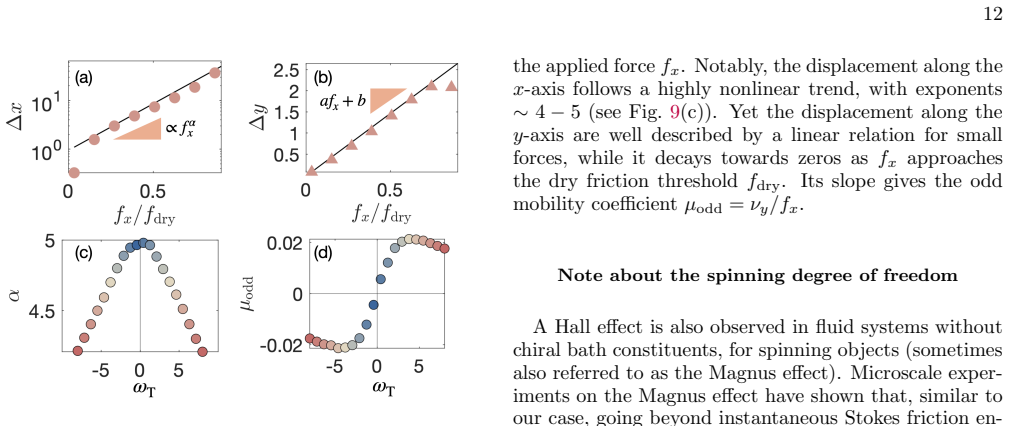
Collisions with a chiral active bath transfer circular motion to a passive tracer and produce transverse drift under constant force, with nonlinear friction rectifying the fluctuations into odd transport.
A machine-rendered reading of the paper's core claim, the machinery that carries it, and where it could break.
Core claim
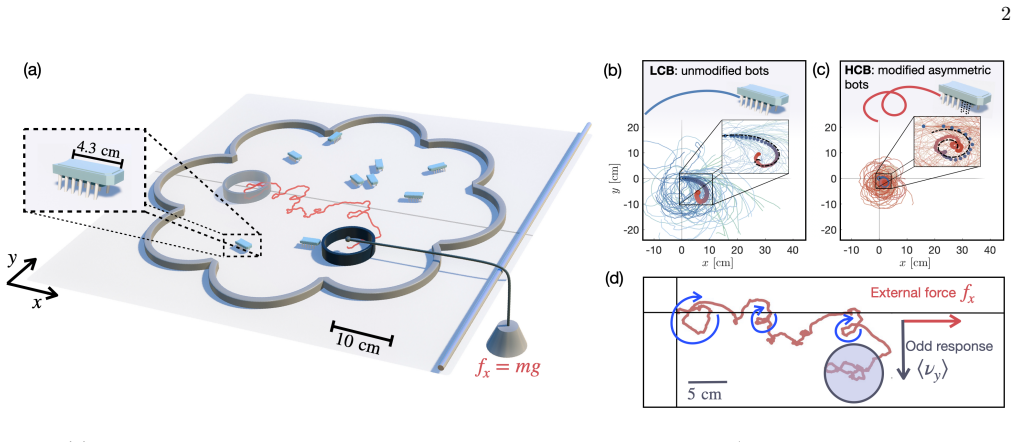
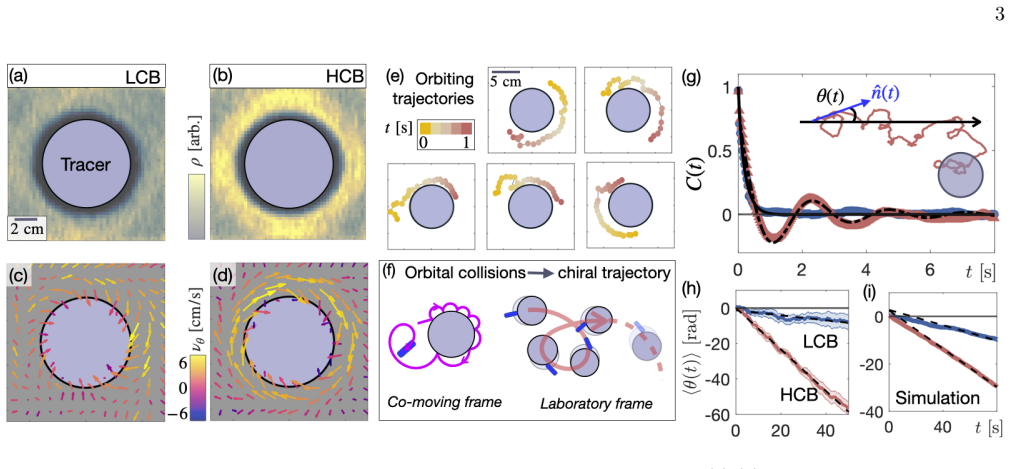
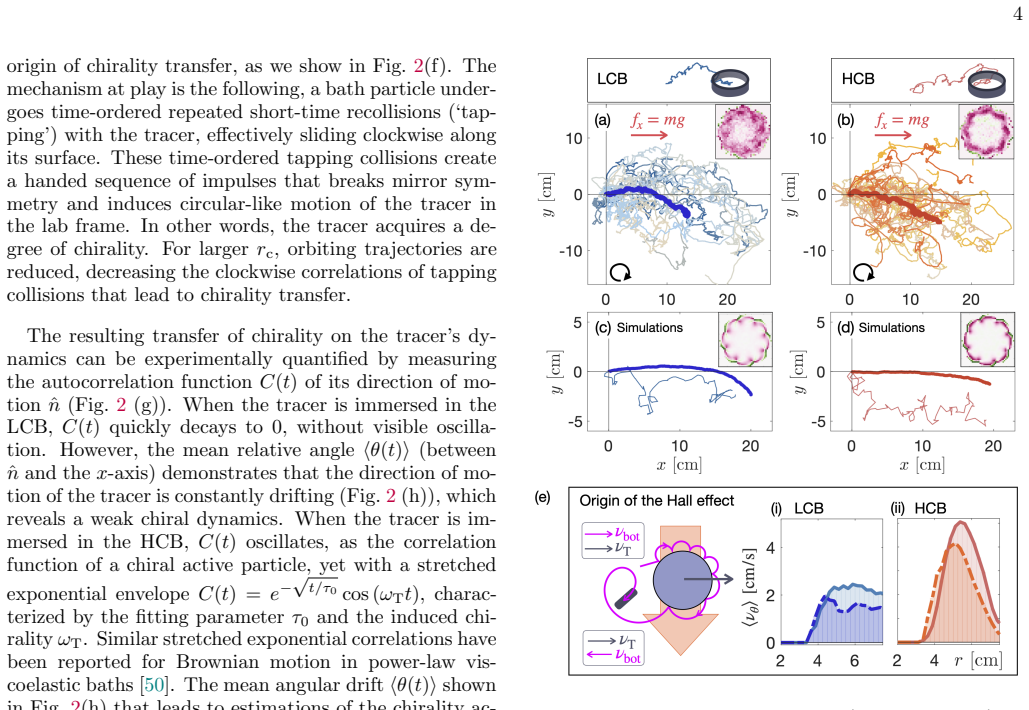
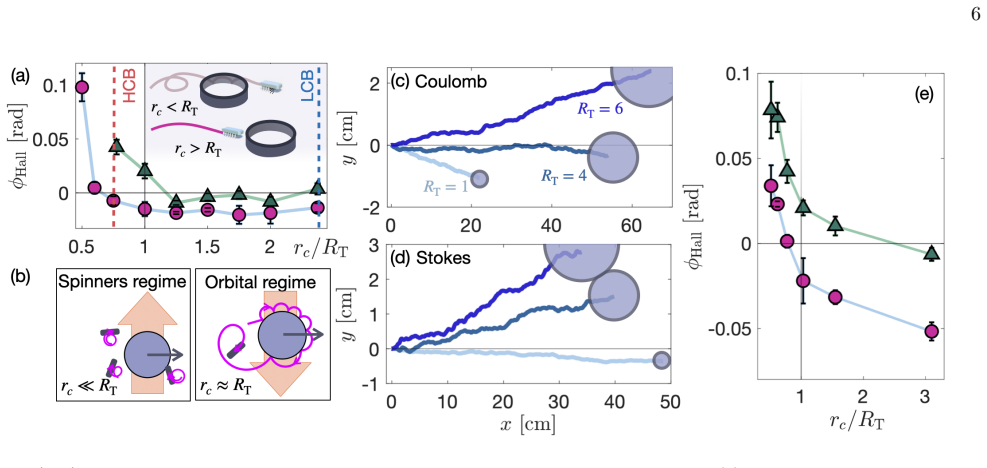
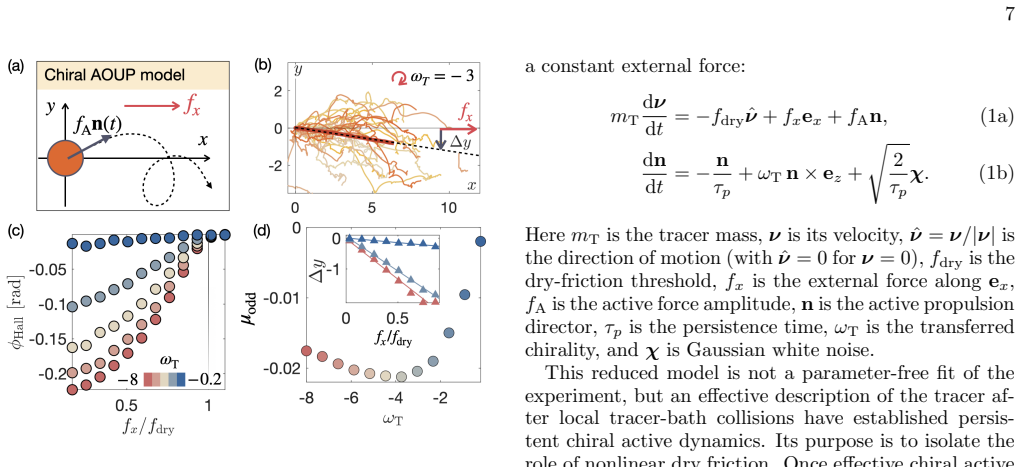
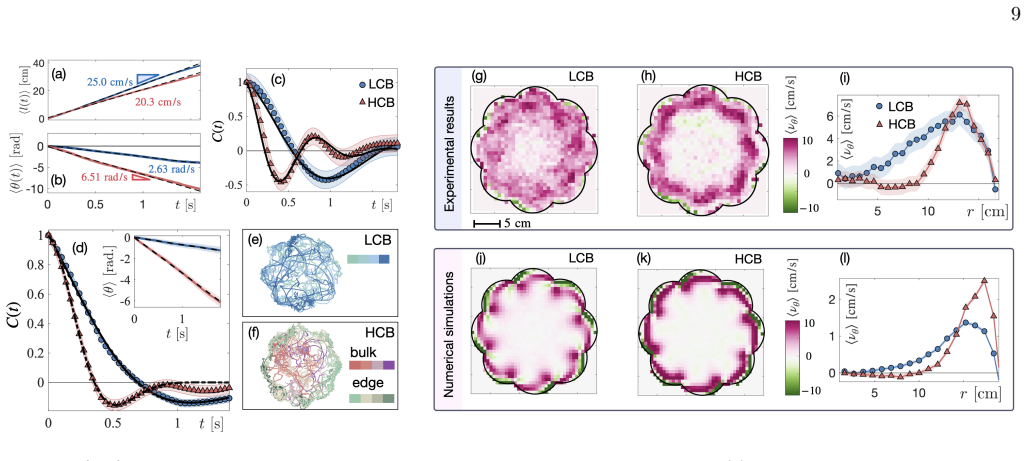
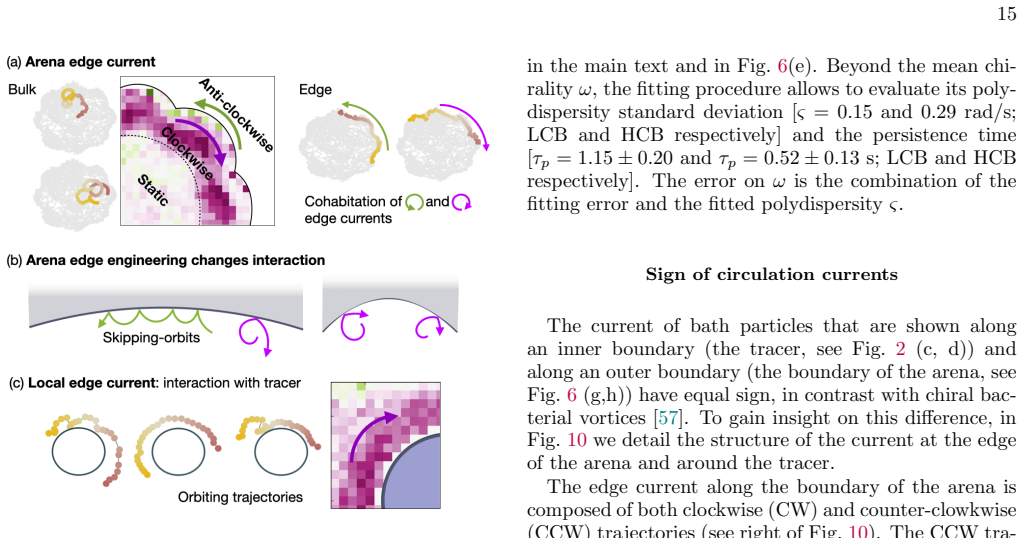
In a rheological experiment a passive tracer is driven through collisions with particles in a chiral active bath. These collisions transfer the bath's chiral dynamics, so the tracer executes circular paths even though it has no intrinsic torque. The same collisions yield a transverse drift velocity when a constant external force pulls the tracer. Nonlinear friction rectifies the transferred chiral fluctuations into this net odd response; without it the fluctuations average to zero and no systematic transverse transport appears.
What carries the argument
Local collisions that transfer chiral active fluctuations from bath particles to the tracer, rectified by nonlinear friction into a net odd (transverse) response.
If this is right
- The tracer exhibits circular trajectories solely from collisions, without any external torque or asymmetry in the tracer itself.
- A constant pulling force produces a perpendicular drift whose direction is set by the bath chirality.
- The odd response disappears if the friction law is linearized, confirming that rectification by nonlinearity is required.
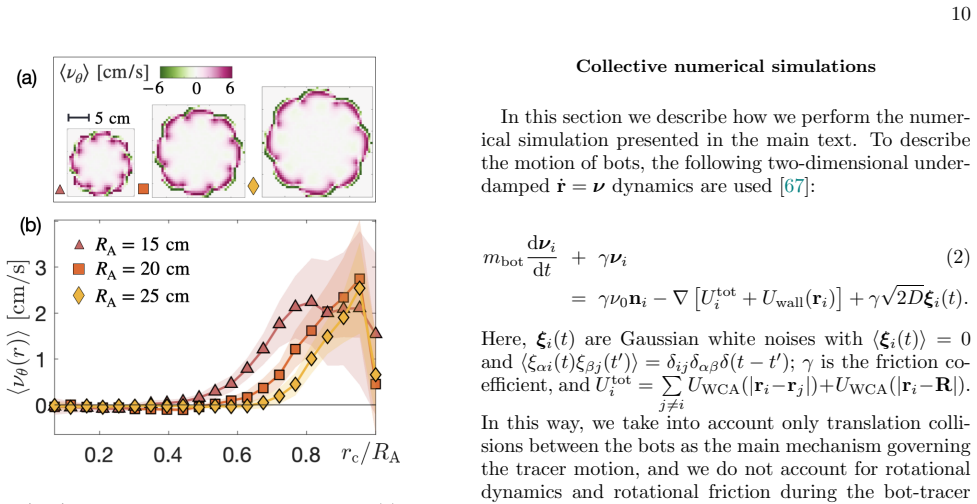
- The mechanism operates at the scale of individual particle collisions and does not rely on collective ordering of the bath.
- The same collision process accounts for both the free circular motion and the force-induced transverse drift.
Where Pith is reading between the lines
- The collision-plus-nonlinear-friction route could be tested in other active baths whose chirality is tunable by external fields.
- Varying bath density or activity strength should produce a monotonic increase in the radius of the induced circular orbits until saturation.
- The same rectification principle may operate when a chiral bath acts on an extended object rather than a point tracer, potentially generating net rotation or lift forces.
- Embedding multiple tracers could reveal whether the transferred chirality produces collective odd responses among the tracers themselves.
Load-bearing premise
Nonlinear friction is required to turn the transferred chiral fluctuations into a nonzero net transverse drift instead of letting them average to zero.
What would settle it
Simulations or experiments that replace nonlinear friction with linear friction and still observe a clear transverse drift would falsify the claim that nonlinear friction is the necessary rectifying step.
Figures
read the original abstract
Chirality, or the breaking of mirror symmetry, appears across all scales in nature, from molecular conformations to the dynamics of bacterial collectives. Environments composed of such symmetry-breaking constituents can give rise to emergent physical phenomena, particularly in the transport and response of embedded tracers. Yet it remains unclear how chiral environments influence such tracers and through which microscopic mechanisms anomalous responses emerge. Here, we present a particle-resolved study of these systems, demonstrating chirality transfer and odd transport of an object embedded in a chiral active bath. In a rheological experiment, a symmetric passive tracer is driven through collisions with the particles of a non-equilibrium chiral bath. Combining table-top experiments, many-body simulations, and a reduced coarse-grained theory, we demonstrate that local collisions transfer chiral active dynamics to the tracer, which displays circular trajectories. We show that the same mechanism gives rise to a systematic transverse drift under a constant pulling force. Crucially, we identify nonlinear friction as an essential factor that rectifies these transferred chiral active fluctuations into a macroscopic odd response. Our results reveal a microscopic mechanism for odd transport in chiral active matter and provide general insights into transverse transport in driven non-equilibrium systems.
Editorial analysis
A structured set of objections, weighed in public.
Referee Report
Summary. The manuscript presents a combined experimental, simulation, and theoretical investigation of a passive symmetric tracer embedded in a chiral active bath. It claims that local collisions transfer chiral dynamics to the tracer, producing circular trajectories, and that the same mechanism yields a systematic transverse (odd) drift under constant external force, with nonlinear friction identified as the essential rectifying factor that converts transferred chiral fluctuations into a macroscopic response.
Significance. If the central claims hold, the work supplies a particle-resolved microscopic mechanism for chirality transfer and odd transport in active matter, with potential relevance to transverse responses in driven non-equilibrium systems more broadly. The integration of table-top rheology, many-body simulations, and a reduced coarse-grained theory constitutes a strength that allows direct comparison across scales.
major comments (1)
- [Abstract] Abstract: The statement that nonlinear friction is 'crucially' the essential rectifying factor is load-bearing for the odd-transport claim. The manuscript must either derive analytically that linear drag forces the time-integrated transverse force to zero or provide an explicit control (identical chiral bath, linear friction only) demonstrating that the net transverse drift vanishes; without this comparison the necessity of nonlinearity remains an untested modeling premise rather than a demonstrated requirement.
minor comments (1)
- The abstract states that experiments, simulations, and theory 'demonstrate' the claims but supplies no quantitative metrics, error bars, or exclusion criteria; the main text should include these in the results sections to allow assessment of robustness.
Simulated Author's Rebuttal
We thank the referee for the detailed and constructive report. The single major comment raises a valid point about strengthening the evidence for the role of nonlinear friction. We address it below and will revise the manuscript accordingly.
read point-by-point responses
-
Referee: [Abstract] Abstract: The statement that nonlinear friction is 'crucially' the essential rectifying factor is load-bearing for the odd-transport claim. The manuscript must either derive analytically that linear drag forces the time-integrated transverse force to zero or provide an explicit control (identical chiral bath, linear friction only) demonstrating that the net transverse drift vanishes; without this comparison the necessity of nonlinearity remains an untested modeling premise rather than a demonstrated requirement.
Authors: We agree that an explicit demonstration is needed to establish that nonlinearity is required rather than merely assumed. In the revised manuscript we will add an analytical argument in the theory section showing that, under linear drag, the time-integrated transverse force from the chiral fluctuations averages to zero by symmetry (the odd component of the noise is uncorrelated with the linear response kernel). We will also include a direct numerical control: identical chiral bath parameters but with linear friction only, confirming that the net transverse drift vanishes within statistical error. These additions will appear in the main text (new subsection) and supplementary information, with the abstract statement softened to reflect the new evidence. revision: yes
Circularity Check
No circularity: claims emerge from collisions and simulations without definitional reduction
full rationale
The abstract and provided text present chirality transfer and odd transport as outcomes of local collisions in experiments and simulations, with nonlinear friction identified as a rectifying factor from those dynamics. No equations, fitted parameters, or self-citations are quoted that would reduce any prediction to an input by construction. The mechanism is described as discovered through particle-resolved study rather than presupposed or renamed from prior results. This satisfies the default expectation of a self-contained derivation chain.
Axiom & Free-Parameter Ledger
Forward citations
Cited by 2 Pith papers
-
Designing topological edge currents in chiral active matter
A chirality-switching model of 2D active particles produces robust topological edge currents in confinement and at phase-separation interfaces, distinct from standard motility-induced phase separation.
-
Odd transport in a two-temperature Brownian dimer
Odd mobility in a two-temperature Brownian dimer produces handed correlations between particles and increases thermal conductance without altering net heat flow or dissipation under handedness reversal.
Reference graph
Works this paper leans on
-
[1]
Nagaosa, J
N. Nagaosa, J. Sinova, S. Onoda, A. H. MacDonald, and N. P. Ong, Anomalous Hall effect, Rev. Mod. Phys.82, 1539 (2010)
2010
-
[2]
E. H. Hall, On a new action of the magnet on electric currents, Am. J. Math2, 287 (1879)
-
[3]
Glattli, E
D. Glattli, E. Andrei, G. Deville, J. Poitrenaud, and F. Williams, Dynamical Hall effect in a two-dimensional classical plasma, Phys. Rev. Lett.54, 1710 (1985)
1985
-
[4]
Hulsman, E
H. Hulsman, E. Van Waasdijk, A. Burgmans, H. Knaap, and J. Beenakker, Transverse momentum transport in polyatomic gases under the influence of a magnetic field, Physica50, 53 (1970)
1970
-
[5]
X. Cao, D. Das, N. Windbacher, F. Ginot, M. Kr¨ uger, and C. Bechinger, Memory-induced Magnus effect, Nat. Phys.19, 1904 (2023)
1904
-
[6]
A. R. Poggioli and D. T. Limmer, Odd Mobility of a Passive Tracer in a Chiral Active Fluid, Phys. Rev. Lett. 130, 158201 (2023)
2023
-
[7]
Hargus, J
C. Hargus, J. M. Epstein, and K. K. Mandadapu, Odd Diffusivity of Chiral Random Motion, Phys. Rev. Lett. 127, 178001 (2021)
2021
-
[8]
Elgeti, R
J. Elgeti, R. G. Winkler, and G. Gompper, Physics of microswimmers – single particle motion and collective behavior: a review, Rep. Prog. Phys.78, 56601 (2015)
2015
-
[9]
M. C. Marchetti, J.-F. Joanny, S. Ramaswamy, T. B. Liverpool, J. Prost, M. Rao, and R. A. Simha, Hydrody- namics of soft active matter, Rev. Mod. Phys.85, 1143 (2013)
2013
-
[10]
Bechinger, R
C. Bechinger, R. Di Leonardo, H. L¨ owen, C. Reichhardt, G. Volpe, and G. Volpe, Active particles in complex and crowded environments, Rev. Mod. Phys.88, 045006 (2016)
2016
-
[11]
L¨ owen, Chirality in microswimmer motion: From cir- cle swimmers to active turbulence, Eur
H. L¨ owen, Chirality in microswimmer motion: From cir- cle swimmers to active turbulence, Eur. Phys. J. Spec. Top.225, 2319 (2016)
2016
-
[12]
Liebchen and D
B. Liebchen and D. Levis, Chiral active matter, EPL119, 058002 (2017)
2017
-
[13]
Van Teeffelen and H
S. Van Teeffelen and H. L¨ owen, Dynamics of a Brownian circle swimmer, Phys. Rev. E78, 020101 (2008)
2008
-
[14]
Siebers, R
F. Siebers, R. Bebon, A. Jayaram, and T. Speck, Collec- tive Hall current in chiral active fluids: Coupling of phase and mass transport through traveling bands, Proc. Natl. Acad. Sci.121, e2320256121 (2024)
2024
-
[15]
Caprini, B
L. Caprini, B. Liebchen, and H. L¨ owen, Self-reverting vortices in chiral active matter, Commun. Phys.7, 153 (2024)
2024
-
[16]
G. Pisegna and S. Saha, Spinning mixtures: nonreciproc- ity transfers chirality across scales in scalar densities, arXiv:2509.07630 (2025)
-
[17]
E. Kalz, A. Sharma, and R. Metzler, Field theory of ac- tive chiral hard disks: a first-principles approach to steric interactions, J. Phys. A57, 265002 (2024)
2024
-
[18]
Lauga, W
E. Lauga, W. R. DiLuzio, G. M. Whitesides, and H. A. Stone, Swimming in circles: motion of bacteria near solid 13 boundaries, Biophys. J.90, 400 (2005)
2005
-
[19]
J. Xu, A. Van Keymeulen, N. M. Wakida, P. Carlton, M. W. Berns, and H. R. Bourne, Polarity reveals intrinsic cell chirality, Proc. Nat. Acad. Sci.104, 9296 (2007)
2007
-
[20]
Huang, W
M. Huang, W. Hu, S. Yang, Q.-X. Liu, and H. Zhang, Circular swimming motility and disordered hyperuniform state in an algae system, Proc. Nat. Acad. Sci.118, e2100493118 (2021)
2021
-
[21]
T. H. Tan, A. Mietke, J. Li, Y. Chen, H. Higinbotham, P. J. Foster, S. Gokhale, J. Dunkel, and N. Fakhri, Odd dynamics of living chiral crystals, Nature607, 287 (2022)
2022
-
[22]
A. L. R. Thomas, The aerodynamic costs of asymmetry in the wings and tail of birds: asymmetric birds can’t fly round tight corners, Proc. R. Soc. Lond. B Biol. Sci.254, 181 (1993)
1993
-
[23]
B. S. Obst, W. M. Hamner, P. P. Hamner, E. Wolanski, M. Rubega, and B. Littlehales, Kinematics of phalarope spinning, Nature384, 121 (1996)
1996
-
[24]
J. L. Souman, I. Frissen, M. N. Sreenivasa, and M. O. Ernst, Walking straight into circles, Curr. Biol.19, 1538 (2009)
2009
-
[25]
F. Gu, B. Guiselin, N. Bain, I. Zuriguel, and D. Bar- tolo, Emergence of collective oscillations in massive hu- man crowds, Nature638, 112 (2025)
2025
-
[26]
Barois, J.-F
T. Barois, J.-F. Boudet, J. S. Lintuvuori, and H. Kellay, Sorting and extraction of self-propelled chiral particles by polarized wall currents, Phys. Rev. Lett.125, 238003 (2020)
2020
- [27]
-
[28]
Caprini, I
L. Caprini, I. Abdoli, U. M. B. Marconi, and H. L¨ owen, Spontaneous self-wrapping in chiral active polymers, Newton1, 100253 (2025)
2025
-
[29]
V. Soni, E. S. Bililign, S. Magkiriadou, S. Sacanna, D. Bartolo, M. J. Shelley, and W. T. Irvine, The odd free surface flows of a colloidal chiral fluid, Nat. Phys. 15, 1188 (2019)
2019
-
[30]
Scholz, M
C. Scholz, M. Engel, and T. P¨ oschel, Rotating robots move collectively and self-organize, Nat. Commun.9, 931 (2018)
2018
-
[31]
Arora, A
P. Arora, A. Sood, and R. Ganapathy, Emergent stere- oselective interactions and self-recognition in polar chiral active ellipsoids, Sci. Adv.7, eabd0331 (2021)
2021
-
[32]
M. A. L´ opez-Casta˜ no, A. M´ arquez Seco, A. M´ arquez Seco, ´A. Rodr´ ıguez-Rivas, and F. V. Reyes, Chirality transitions in a system of active flat spinners, Phys. Rev. Res.4, 033230 (2022)
2022
-
[33]
Reichhardt and C
C. Reichhardt and C. J. O. Reichhardt, Active microrhe- ology, Hall effect, and jamming in chiral fluids, Phys. Rev. E100, 012604 (2019)
2019
-
[34]
Hargus, F
C. Hargus, F. Ghimenti, J. Tailleur, and F. van Wij- land, Odd Dynamics of Passive Objects in a Chiral Ac- tive Bath, Phys. Rev. Lett.135, 167102 (2025)
2025
-
[35]
Banerjee, A
D. Banerjee, A. Souslov, A. G. Abanov, and V. Vitelli, Odd viscosity in chiral active fluids, Nat. Commun.8, 1573 (2017)
2017
-
[36]
X. Lou, Q. Yang, Y. Ding, P. Liu, K. Chen, X. Zhou, F. Ye, R. Podgornik, and M. Yang, Odd viscosity-induced hall-like transport of an active chiral fluid, Proc. Natl. Acad. Sci.119, e2201279119 (2022)
2022
-
[37]
E. Kalz, S. Ravichandir, J. Birkenmeier, R. Metzler, and A. Sharma, Reversal of tracer advection and Hall drift in an interacting chiral fluid, Phys. Rev. E113, L042104 (2025)
2025
-
[38]
M. J. Bowick, N. Fakhri, M. C. Marchetti, and S. Ra- maswamy, Symmetry, thermodynamics, and topology in active matter, Phys. Rev. X12, 010501 (2022)
2022
-
[39]
Mecke, J
J. Mecke, J. O. Nketsiah, R. Li, and Y. Gao, Emergent phenomena in chiral active matter, NSO3, 20230086 (2024)
2024
-
[40]
Vega Reyes, M
F. Vega Reyes, M. A. L´ opez-Casta˜ no, and´A. Rodr´ ıguez- Rivas, Diffusive regimes in a two-dimensional chiral fluid, Commun. Phys.5, 256 (2022)
2022
-
[41]
X. Yang, C. Ren, K. Cheng, and H. P. Zhang, Robust boundary flow in chiral active fluid, Phys. Rev. E101, 022603 (2020)
2020
- [42]
-
[44]
Dauchot and V
O. Dauchot and V. D´ emery, Dynamics of a self-propelled particle in a harmonic trap, Phys. Rev. Lett.122, 068002 (2019)
2019
-
[45]
O. Chor, A. Sohachi, R. Goerlich, E. Rosen, S. Rahav, and Y. Roichman, Many-body Szil´ ard engine with giant number fluctuations, Phys. Rev. Res.5, 043193 (2023)
2023
-
[46]
Boriskovsky, B
D. Boriskovsky, B. Lindner, and Y. Roichman, The fluctuation–dissipation relation holds for a macroscopic tracer in an active bath, Soft Matter20, 8017 (2024)
2024
-
[47]
V. B. Shenoy, D. Tambe, A. Prasad, and J. A. The- riot, A kinematic description of the trajectories of Liste- ria monocytogenes propelled by actin comet tails, Proc. Natl. Acad. Sci.104, 8229 (2007)
2007
-
[48]
K¨ ummel, B
F. K¨ ummel, B. Ten Hagen, R. Wittkowski, I. Buttinoni, R. Eichhorn, G. Volpe, H. L¨ owen, and C. Bechinger, Circular motion of asymmetric self-propelling particles, Phys. Rev. Lett.110, 198302 (2013)
2013
-
[49]
Kiechl, A
T. Kiechl, A. Altshuler, A. L¨ uders, Y. Roichman, and T. Franosch, Free chiral self-propelled robots compared to active brownian circle swimmers, Phys. Rev. E113, 045409 (2026)
2026
- [50]
-
[51]
Sharma, E
V. Sharma, E. Azar, A. P. Schroder, C. M. Marques, and A. Stocco, Active colloids orbiting giant vesicles, Soft Matter17, 4275 (2021)
2021
-
[52]
Caprini, A
L. Caprini, A. Ldov, R. K. Gupta, H. Ellenberg, R. Wittmann, H. L¨ owen, and C. Scholz, Emergent mem- ory from tapping collisions in active granular matter, Commun. Phys.7, 52 (2024)
2024
-
[53]
Sajeesh and A
P. Sajeesh and A. K. Sen, Particle separation and sorting in microfluidic devices: a review, Microfluid. Nanofluidics 17, 1 (2013)
2013
-
[54]
Tkachenko and E
G. Tkachenko and E. Brasselet, Optofluidic sorting of material chirality by chiral light, Nat. Commun.5, 3577 (2014)
2014
-
[55]
Meinhardt, J
S. Meinhardt, J. Smiatek, R. Eichhorn, and F. Schmid, Separation of chiral particles in micro-or nanofluidic channels, Phys. Rev. Lett.108, 214504 (2012). 14
2012
-
[56]
Genet, Chiral light–chiral matter interactions: an op- tical force perspective, ACS Photonics9, 319 (2022)
C. Genet, Chiral light–chiral matter interactions: an op- tical force perspective, ACS Photonics9, 319 (2022)
2022
-
[57]
H. Li, H. Chat´ e, M. Sano, X.-q. Shi, and H. P. Zhang, Ro- bust Edge Flows in Swarming Bacterial Colonies, Phys. Rev. X14, 041006 (2024)
2024
-
[58]
Caprini and U
L. Caprini and U. M. B. Marconi, Active chiral particles under confinement: surface currents and bulk accumula- tion phenomena, Soft Matter15, 2627 (2019)
2019
-
[59]
Manacorda, A
A. Manacorda, A. Puglisi, and A. Sarracino, Coulomb friction driving Brownian motors, Commun. Theor. Phys. 62, 505 (2014)
2014
-
[60]
Gnoli, A
A. Gnoli, A. Petri, F. Dalton, G. Pontuale, G. Gradenigo, A. Sarracino, and A. Puglisi, Brownian Ratchet in a Thermal Bath Driven by Coulomb Friction, Phys. Rev. Lett.110, 120601 (2013)
2013
-
[61]
Fruchart, C
M. Fruchart, C. Scheibner, and V. Vitelli, Odd viscosity and odd elasticity, Annu. Rev. Condens. Matter Phys. 14, 471 (2023)
2023
-
[62]
D. Hu, S. Phonekeo, E. Altshuler, and F. Brochard- Wyart, Entangled active matter: From cells to ants, Eur. Phys. J.: Spec. Top.225, 629 (2016)
2016
-
[63]
C. Behn, F. Schale, I. Zeidis, K. Zimmermann, and N. Bolotnik, Dynamics and motion control of a chain of particles on a rough surface, Mech. Syst. Signal Process. 89, 3 (2016)
2016
-
[64]
O. L. Bonomo, I. Shitrit, and S. Reuveni, Sokoban perco- lation on the Bethe lattice, J. Phys. A57, 33LT01 (2024)
2024
-
[65]
Wioland, F
H. Wioland, F. G. Woodhouse, J. Dunkel, J. O. Kessler, and R. E. Goldstein, Confinement stabilizes a bacterial suspension into a spiral vortex, Phys. Rev. Lett.110, 268102 (2013)
2013
- [66]
-
[67]
Caprini, D
L. Caprini, D. Breoni, A. Ldov, C. Scholz, and H. L¨ owen, Dynamical clustering and wetting phenomena in inertial active matter, Commun. Phys.7, 343 (2024)
2024
-
[68]
Hahn, The phase diagram of an ensemble of Lennard- Jones particles with flexible shape, Mol
J. Hahn, The phase diagram of an ensemble of Lennard- Jones particles with flexible shape, Mol. Phys.96, 979 (1999)
1999
-
[69]
A. P. Antonov, M. Musacchio, H. L¨ owen, and L. Caprini, Self-sustained frictional cooling in active matter, Nat. Commun.16, 7235 (2025)
2025
-
[70]
Musacchio, A
M. Musacchio, A. P. Antonov, H. L¨ owen, and L. Caprini, Self-alignment and anti-self-alignment suppress motility- induced phase separation in active systems, J. Chem. Phys.162, 244902 (2025)
2025
-
[71]
Baconnier, D
P. Baconnier, D. Shohat, C. H. L´ opez, C. Coulais, V. D´ emery, G. D¨ uring, and O. Dauchot, Selective and collective actuation in active solids, Nat. Phys.18, 1234 (2022)
2022
-
[72]
A. P. Antonov, L. Caprini, A. Ldov, C. Scholz, and H. L¨ owen, Inertial Active Matter with Coulomb Friction, Phys. Rev. Lett.133, 198301 (2024)
2024
-
[73]
Kumar, M
S. Kumar, M. Dhiman, and K. A. Reddy, Magnus effect in granular media, Phys. Rev. E99, 012902 (2019). SUPPLEMENTARY INFORMATION Impact of self-alignment on the collisions between bristle-bots and tracer The self-alignment parameterκis determined from a controlled single-collision experiment between a single bot and a passive tracer. Experimentally,κis est...
2019
discussion (0)
Sign in with ORCID, Apple, or X to comment. Anyone can read and Pith papers without signing in.