Rate-2/3 Girth-8 (3,18)-Regular Quantum LDPC Codes from Two-Branch Finite-Field Bases and CPM Lifts
Pith reviewed 2026-06-26 04:36 UTC · model grok-4.3
The pith
A (3,18)-regular two-branch finite-field base with CPM lift of degree 101 produces a rate-2/3 CSS quantum LDPC code with parameters [[34542,23032,d≤310]].
A machine-rendered reading of the paper's core claim, the machinery that carries it, and where it could break.
Core claim
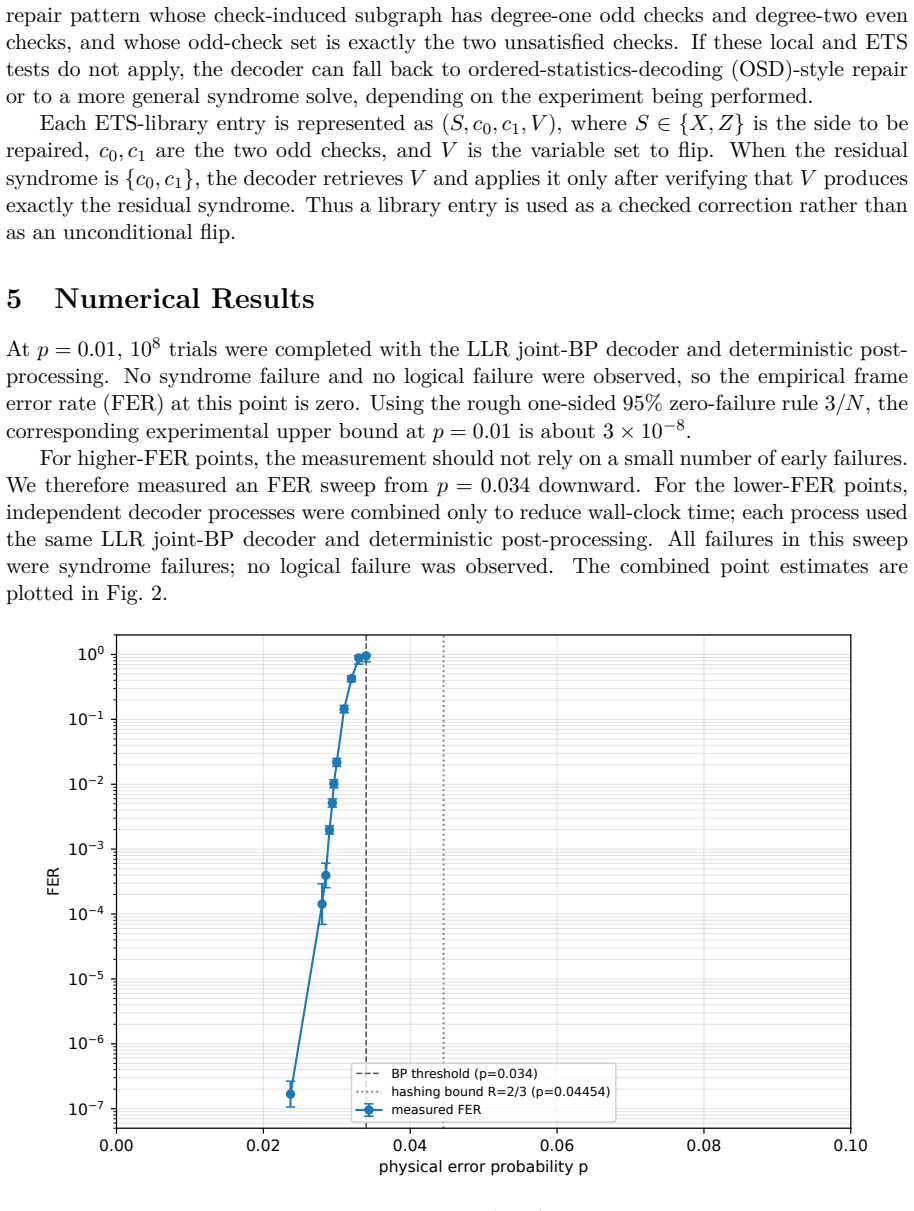
We construct a rate-2/3 quantum low-density parity-check (LDPC) code from a (3,18)-regular two-branch finite-field base and a circulant-permutation-matrix (CPM) lift of degree P=101. The resulting code is a Calderbank-Shor-Steane (CSS) code with parameters [[34542,23032,d≤310]]. The construction has row weight 18 and column weight 3, and the Tanner graphs of H_X and H_Z separately have girth 8. Decoder experiments with log-likelihood-ratio (LLR) joint belief propagation (BP) and deterministic post-processing show no failures in 10^8 trials at p=0.01, and a finite-length frame error rate (FER) sweep estimates the transition near p=0.029.
What carries the argument
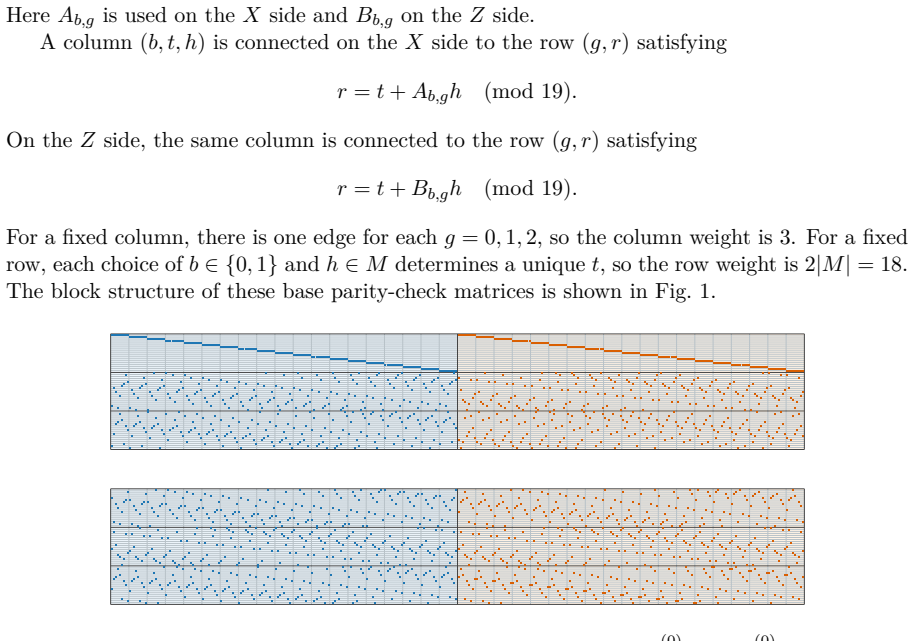
Two-branch finite-field base lifted by circulant-permutation-matrix of degree 101, which produces separate girth-8 Tanner graphs for H_X and H_Z while satisfying the CSS orthogonality condition.
Load-bearing premise
The two-branch finite-field base is (3,18)-regular and the CPM lift of degree 101 produces separate girth-8 Tanner graphs for H_X and H_Z that satisfy the CSS condition.
What would settle it
A single decoding failure in 10^8 trials at p=0.01 or identification of a logical operator of weight below the reported upper bound of 310 would contradict the stated performance and distance claims.
Figures
read the original abstract
We construct a rate-$2/3$ quantum low-density parity-check (LDPC) code from a $(3,18)$-regular two-branch finite-field base and a circulant-permutation-matrix (CPM) lift of degree $P=101$. The resulting code is a Calderbank-Shor-Steane (CSS) code with parameters $[[34542,23032,d\le 310]]$. We do not regard this upper bound as an estimate of the true minimum distance; rather, $d\le310$ is the tightest upper bound currently obtained from structural lifts and decoder-produced logical errors. The construction has row weight 18 and column weight 3, and the Tanner graphs of $H_X$ and $H_Z$ separately have girth 8. Decoder experiments with log-likelihood-ratio (LLR) joint belief propagation (BP) and deterministic post-processing show no failures in $10^8$ trials at $p=0.01$, and a finite-length frame error rate (FER) sweep estimates the transition near $p=0.029$.
Editorial analysis
A structured set of objections, weighed in public.
Referee Report
Summary. The manuscript constructs a rate-2/3 girth-8 (3,18)-regular quantum LDPC code from a two-branch finite-field base and a CPM lift of degree P=101, yielding the CSS code [[34542,23032,d≤310]] with separate girth-8 Tanner graphs for H_X and H_Z. Decoder trials with LLR joint BP plus post-processing report zero failures in 10^8 trials at p=0.01 and an FER transition near p=0.029; d≤310 is explicitly an upper bound from structural lifts and observed logical errors, not a distance estimate.
Significance. If the algebraic construction and girth/CSS properties hold, the work supplies one of the largest explicit high-rate quantum LDPC codes with column weight 3 and girth 8, together with concrete Monte-Carlo evidence of strong finite-length performance. Explicit constructions of this scale are useful benchmarks and potential building blocks for quantum error correction.
major comments (2)
- [Construction] Construction paragraph / base definition: the two-branch finite-field base must be stated explicitly (field, branch matrices, or generator) so that the claimed (3,18)-regularity, the CSS condition H_X H_Z^T=0 after the P=101 CPM lift, and the exact block length 34542 can be independently verified.
- [Results] Results / distance paragraph: the upper bound d≤310 is obtained from structural lifts and decoder-produced logical errors; the precise logical operators or lift argument that establishes this bound (and why it is tightest) must be given to support the stated claim.
minor comments (2)
- [Abstract] Abstract: the FER transition estimate near p=0.029 should be accompanied by the number of Monte-Carlo trials and any error bars or confidence intervals used.
- [Decoder experiments] Decoder section: the joint BP + deterministic post-processing procedure should be described with sufficient pseudocode or parameter settings (e.g., iteration limit, post-processing rule) to allow reproduction.
Simulated Author's Rebuttal
We thank the referee for the positive assessment and recommendation for minor revision. We address each major comment below.
read point-by-point responses
-
Referee: Construction paragraph / base definition: the two-branch finite-field base must be stated explicitly (field, branch matrices, or generator) so that the claimed (3,18)-regularity, the CSS condition H_X H_Z^T=0 after the P=101 CPM lift, and the exact block length 34542 can be independently verified.
Authors: We agree that an explicit statement of the two-branch finite-field base will improve independent verification. The revised manuscript will add the specific finite field, the two branch matrices (or generator), and the precise parameters used to construct the base. This addition will directly confirm the (3,18)-regularity, the CSS orthogonality after the degree-101 CPM lift, and the resulting block length of 34542. revision: yes
-
Referee: Results / distance paragraph: the upper bound d≤310 is obtained from structural lifts and decoder-produced logical errors; the precise logical operators or lift argument that establishes this bound (and why it is tightest) must be given to support the stated claim.
Authors: We will expand the distance paragraph in the revision to include a concise description of the structural-lift argument and the specific decoder-observed logical errors that yield the upper bound d≤310, together with a short explanation of why this is the tightest bound obtained so far. The manuscript already states that d≤310 is an upper bound rather than a distance estimate; the added text will make the supporting argument explicit without altering that characterization. revision: yes
Circularity Check
No significant circularity; explicit algebraic construction
full rationale
The paper describes a direct constructive procedure: select a (3,18)-regular two-branch finite-field base matrix and apply a CPM lift of degree 101 to obtain explicit parity-check matrices H_X and H_Z satisfying the CSS orthogonality condition, girth-8 property, and the stated length/rate. No equations redefine outputs in terms of fitted inputs, no predictions are made from subsets of the same data, and no load-bearing uniqueness or ansatz is imported via self-citation. The reported parameters and decoder performance follow immediately from the algebraic definition of the lift; the derivation chain is self-contained and does not reduce to its own inputs.
Axiom & Free-Parameter Ledger
free parameters (1)
- lift degree P =
101
axioms (2)
- domain assumption Finite fields admit two-branch bases yielding (3,18)-regular bipartite graphs suitable for quantum CSS codes
- domain assumption CPM lifts of the base preserve column/row weights and produce girth-8 Tanner graphs for both H_X and H_Z
Reference graph
Works this paper leans on
-
[1]
Low-density parity-check codes,
R. Gallager, “Low-density parity-check codes,”IRE Transactions on Information Theory, vol. 8, no. 1, pp. 21–28, 1962
1962
-
[2]
A recursive approach to low complexity codes,
R. M. Tanner, “A recursive approach to low complexity codes,”IEEE Transactions on Information Theory, vol. 27, no. 5, pp. 533–547, 1981
1981
-
[3]
Good quantum error-correcting codes exist,
A. R. Calderbank and P. W. Shor, “Good quantum error-correcting codes exist,”Physical Review A, vol. 54, no. 2, pp. 1098–1105, 1996. 10
1996
-
[4]
Multiple-particle interference and quantum error correction,
A. M. Steane, “Multiple-particle interference and quantum error correction,”Proceedings of the Royal Society of London A, vol. 452, no. 1954, pp. 2551–2577, 1996
1954
-
[5]
Sparse-graph codes for quantum error correction,
D. J. C. MacKay, G. Mitchison, and P. L. McFadden, “Sparse-graph codes for quantum error correction,”IEEE Transactions on Information Theory, vol. 50, no. 10, pp. 2315– 2330, 2004
2004
-
[6]
Quantum LDPC codes with positive rate and minimum dis- tance proportional to the square root of the blocklength,
J.-P. Tillich and G. Zemor, “Quantum LDPC codes with positive rate and minimum dis- tance proportional to the square root of the blocklength,”IEEE Transactions on Informa- tion Theory, vol. 60, no. 2, pp. 1193–1202, 2014
2014
-
[7]
Balanced product quantum codes,
N. P. Breuckmann and J. N. Eberhardt, “Balanced product quantum codes,”IEEE Trans- actions on Information Theory, vol. 67, no. 10, pp. 6653–6674, 2021
2021
-
[8]
Quantum LDPC codes with almost linear minimum dis- tance,
P. Panteleev and G. Kalachev, “Quantum LDPC codes with almost linear minimum dis- tance,”IEEE Transactions on Information Theory, vol. 68, no. 1, pp. 213–229, 2022
2022
-
[9]
Asymptotically good quantum and locally testable classical LDPC codes,
——, “Asymptotically good quantum and locally testable classical LDPC codes,” inPro- ceedings of the 54th Annual ACM SIGACT Symposium on Theory of Computing, 2022, pp. 375–388
2022
-
[10]
Quantum tanner codes,
A. Leverrier and G. Zemor, “Quantum tanner codes,” in2022 IEEE 63rd Annual Sympo- sium on Foundations of Computer Science, 2022, pp. 872–883
2022
-
[11]
Fault-tolerant quantum computation with constant overhead,
D. Gottesman, “Fault-tolerant quantum computation with constant overhead,”Quantum Information and Computation, vol. 14, no. 15–16, pp. 1338–1371, 2014
2014
-
[12]
Quantum low-density parity-check codes,
N. P. Breuckmann and J. N. Eberhardt, “Quantum low-density parity-check codes,”PRX Quantum, vol. 2, no. 4, p. 040101, 2021
2021
-
[13]
Towards Ultra-High-Rate Quantum Error Correction with Reconfigurable Atom Arrays
C. Zhao, C. Duckering, A. Gu, N. Maskara, and H. Zhou, “Towards ultra-high-rate quan- tum error correction with reconfigurable atom arrays,” arXiv:2604.16209, 2026
work page internal anchor Pith review Pith/arXiv arXiv 2026
-
[14]
Degenerate quantum LDPC codes with good finite length performance,
P. Panteleev and G. Kalachev, “Degenerate quantum LDPC codes with good finite length performance,”Quantum, vol. 5, p. 585, 2021
2021
-
[15]
Decoding across the quantum low- density parity-check code landscape,
J. Roffe, D. R. White, S. Burton, and E. Campbell, “Decoding across the quantum low- density parity-check code landscape,”Physical Review Research, vol. 2, p. 043423, 2020
2020
-
[16]
Soft-decision decoding of linear block codes based on ordered statistics,
M. P. C. Fossorier and S. Lin, “Soft-decision decoding of linear block codes based on ordered statistics,”IEEE Transactions on Information Theory, vol. 41, no. 5, pp. 1379–1396, 1995
1995
-
[17]
Trapping sets of quantum LDPC codes,
N. Raveendran and B. Vasić, “Trapping sets of quantum LDPC codes,”Quantum, vol. 5, p. 562, 2021
2021
-
[18]
Quantum error correction near the coding theoretical bound,
D. Komoto and K. Kasai, “Quantum error correction near the coding theoretical bound,” npj Quantum Information, vol. 11, p. 154, 2025
2025
-
[19]
Efficient mitigation of error floors in quantum error correction using non-binary low-density parity-check codes,
K. Kasai, “Efficient mitigation of error floors in quantum error correction using non-binary low-density parity-check codes,” in2025 IEEE International Symposium on Information Theory (ISIT), 2025, pp. 2789–2794
2025
-
[20]
Sharp error-rate transitions in quantum QC-LDPC codes under joint BP decoding,
D. Komoto and K. Kasai, “Sharp error-rate transitions in quantum QC-LDPC codes under joint BP decoding,” arXiv:2507.11534, 2025
-
[21]
K. Kasai, “Breaking the orthogonality barrier in quantum LDPC codes,” arXiv:2601.08824, 2026. 11
-
[22]
High-Girth Regular Quantum LDPC Codes from Affine-Coset Structures
K. Okada and K. Kasai, “High-girth regular quantum LDPC codes from affine-coset struc- tures,” arXiv:2604.20838, 2026
work page internal anchor Pith review Pith/arXiv arXiv 2026
-
[23]
High-Girth Regular Quantum LDPC Codes from Square-Base Hypergraph Products via CPM Lifts
——, “High-girth regular quantum LDPC codes from square-base hypergraph products via CPM lifts,” arXiv:2604.27817, 2026
work page internal anchor Pith review Pith/arXiv arXiv 2026
-
[24]
A Two-Branch Finite-Field Construction for Regular CSS LDPC Bases
——, “A two-branch finite-field construction for regular CSS LDPC bases,” arXiv:2605.23894, 2026
work page internal anchor Pith review Pith/arXiv arXiv 2026
-
[25]
Kenta Kasai’s homepage,
K. Kasai, “Kenta Kasai’s homepage,” https://kasai.ict.eng.isct.ac.jp/
-
[26]
A Factor-Graph Formulation of CSS Syndrome Decoding: Joint BP and Four-State BP
——, “A factor-graph formulation of CSS syndrome decoding: joint BP and four-state BP,” arXiv:2605.05132, 2026. 12
work page internal anchor Pith review Pith/arXiv arXiv 2026
discussion (0)
Sign in with ORCID, Apple, or X to comment. Anyone can read and Pith papers without signing in.