Revisiting the picture of circumbinary disc truncation
Pith reviewed 2026-06-29 01:29 UTC · model grok-4.3
The pith
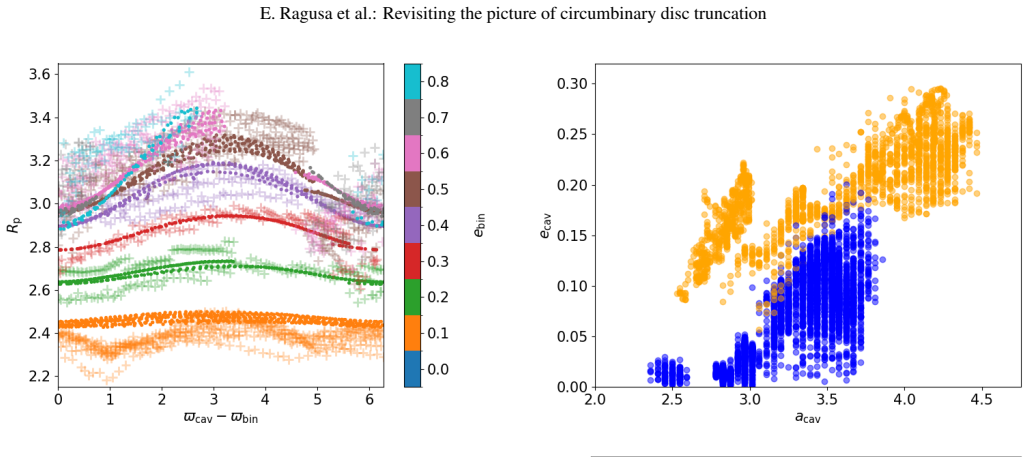
Cavity truncation in circumbinary discs depends on the cavity's own eccentricity and apsidal alignment with the binary.
A machine-rendered reading of the paper's core claim, the machinery that carries it, and where it could break.
Core claim
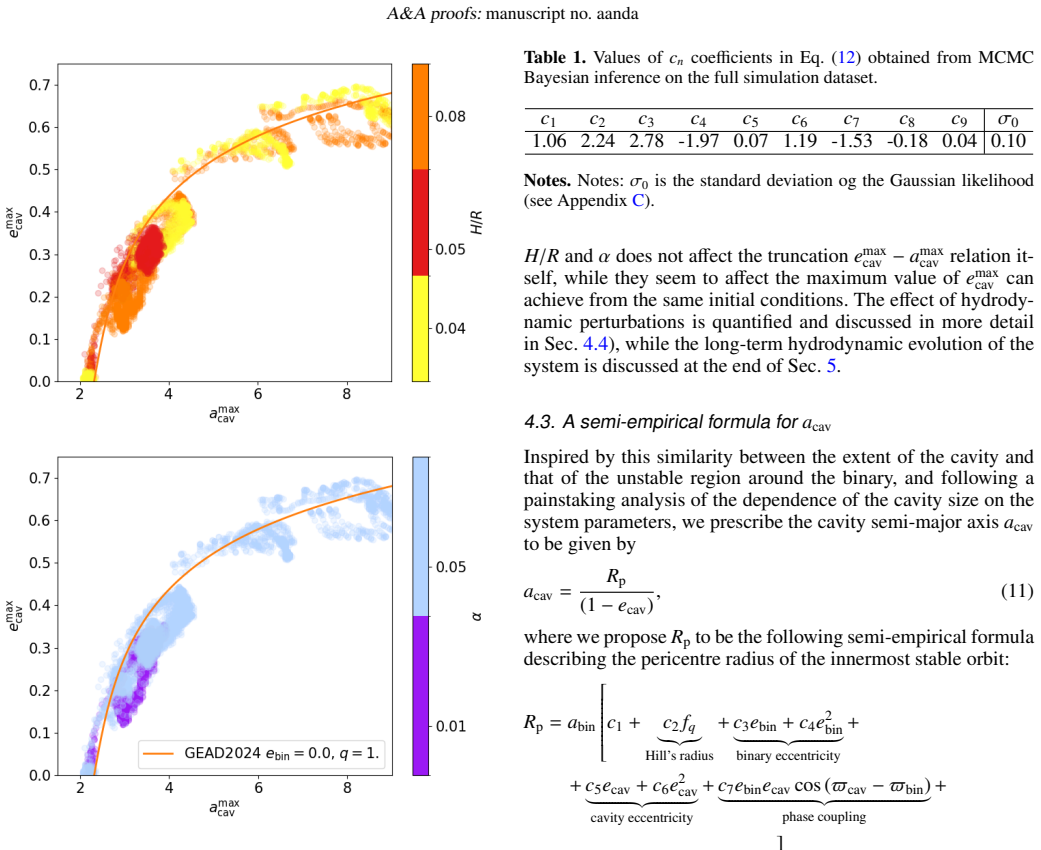
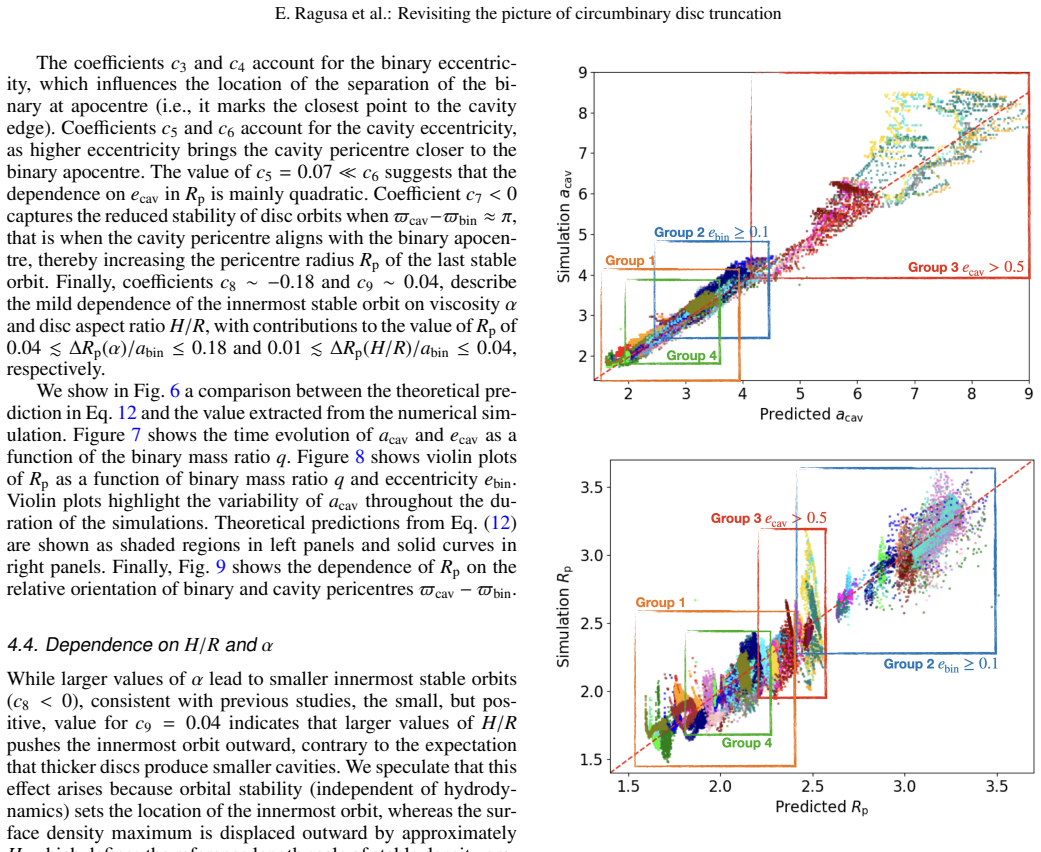
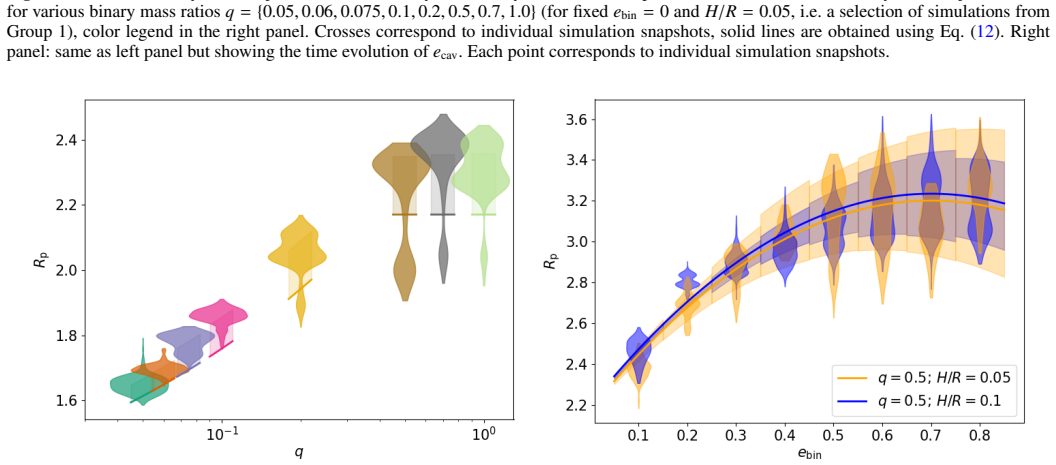
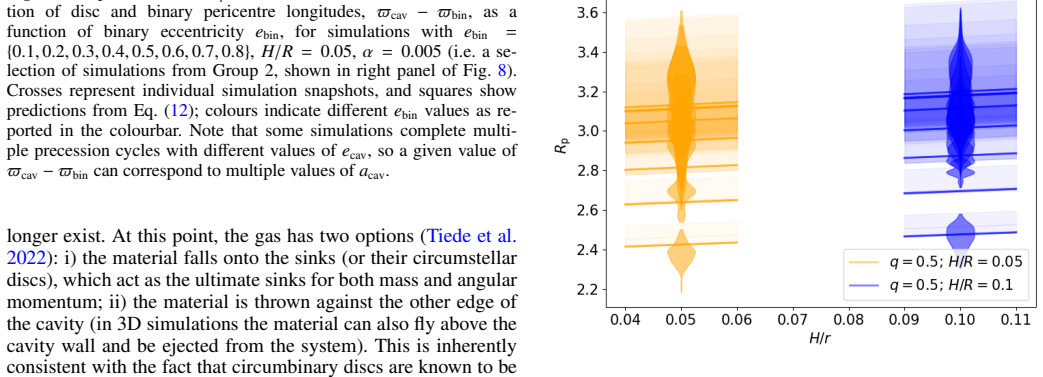
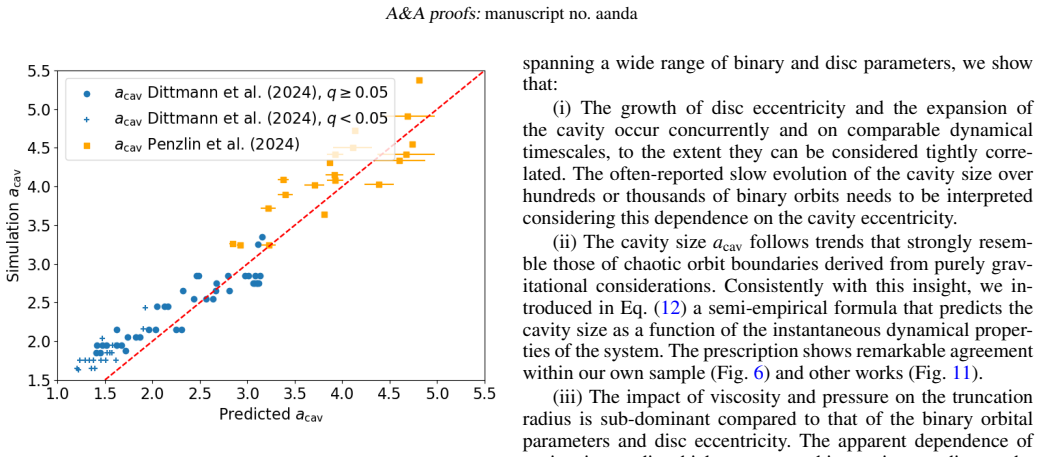
Tidal truncation is controlled by the pericentre distance Rp of the innermost stable disc orbit, which is jointly set by the binary parameters a_bin, e_bin, q and the current disc state e_cav, ϖ_bin−ϖ_cav in a manner analogous to stability limits in the restricted three-body problem. Hydrodynamical quantities H and α produce only mild secondary shifts. A semi-analytical prescription for Rp and a_cav is given that remains valid once q exceeds 0.05 and that is independent of the evolutionary stage of the cavity.
What carries the argument
The pericentre Rp of the innermost stable disc orbit, fixed by the combination of binary properties and the instantaneous cavity eccentricity plus apsidal offset.
If this is right
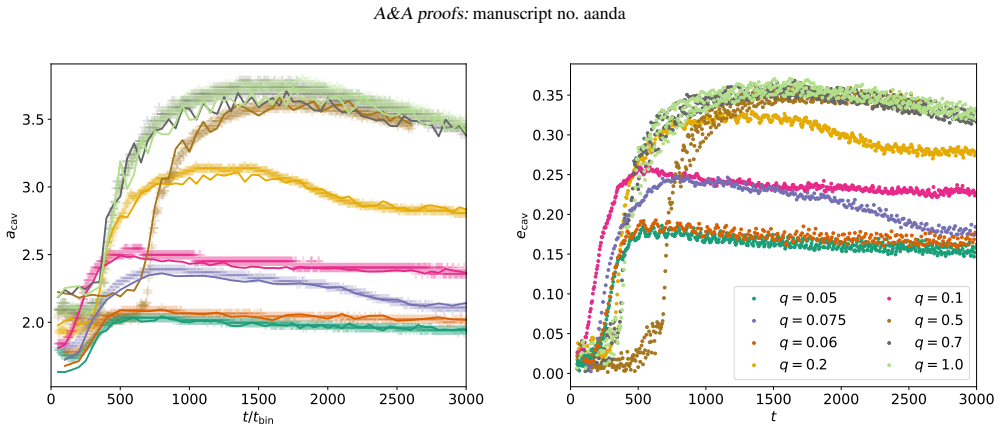
- Cavity size can change even when the binary is unchanged, simply because the disc's eccentricity and alignment evolve.
- For mass ratios above 0.05 the truncation process is dominated by the disc's orbital state rather than binary properties alone.
- The supplied prescription gives a truncation radius that does not require the system to have reached a steady state.
- Hydrodynamic corrections from disc thickness and viscosity remain secondary but can be added on top of the gravitational prediction.
Where Pith is reading between the lines
- Observers measuring cavity sizes around binaries could in principle back out the current dynamical state of the disc if the prescription is accurate.
- Planet-migration and accretion models in circumbinary systems would need to track the time-varying cavity edge rather than assume a fixed truncation radius.
- The analogy with three-body stability suggests that similar orbital-mechanics arguments might apply to other truncated disc problems such as those around eccentric stars or planets.
Load-bearing premise
The eighty simulations sample the full relevant range of cavity eccentricity and apsidal offset without the measured dependence being produced by the chosen starting conditions or grid resolution.
What would settle it
A controlled simulation that holds binary parameters fixed while varying only e_cav and ϖ_bin−ϖ_cav and finds a different Rp than the prescription predicts would falsify the claim.
Figures
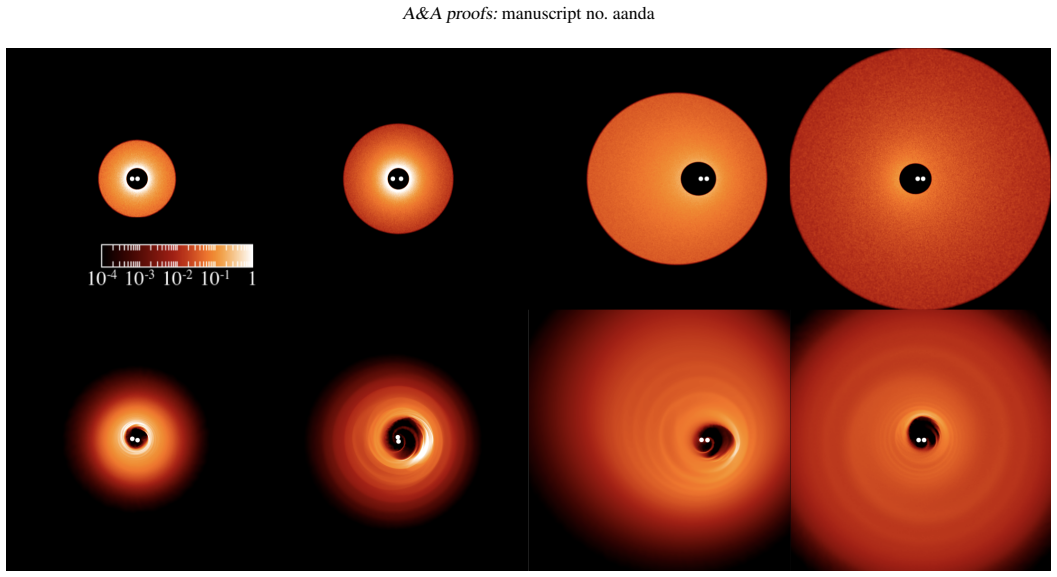
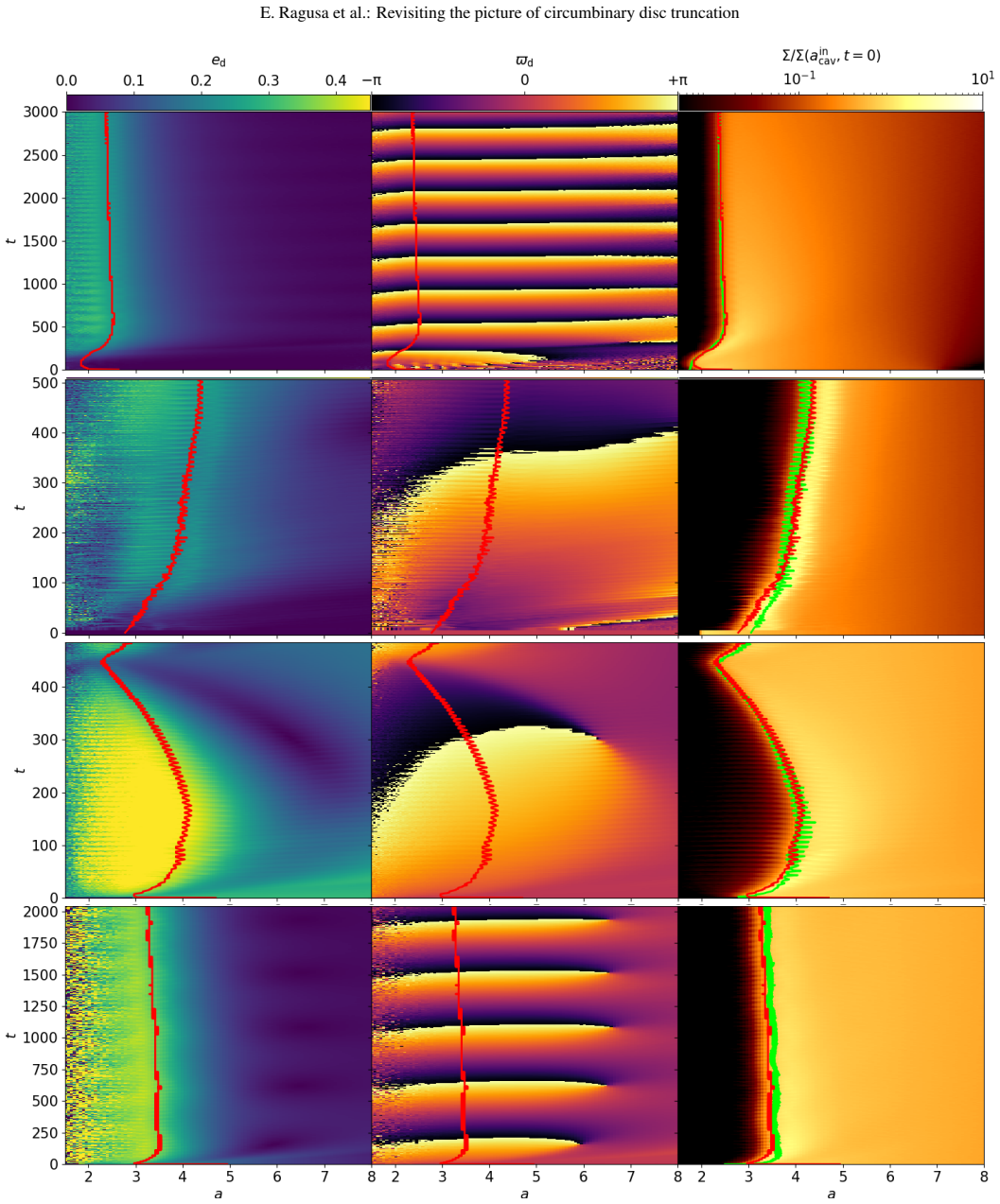
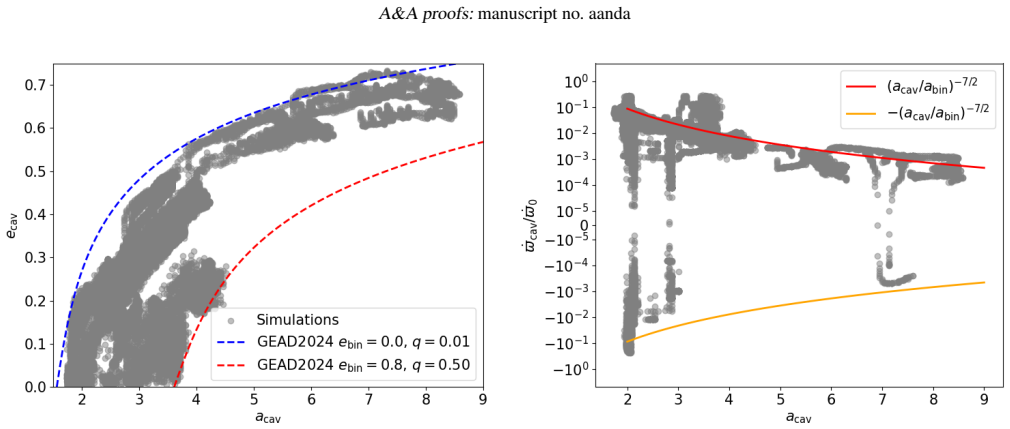
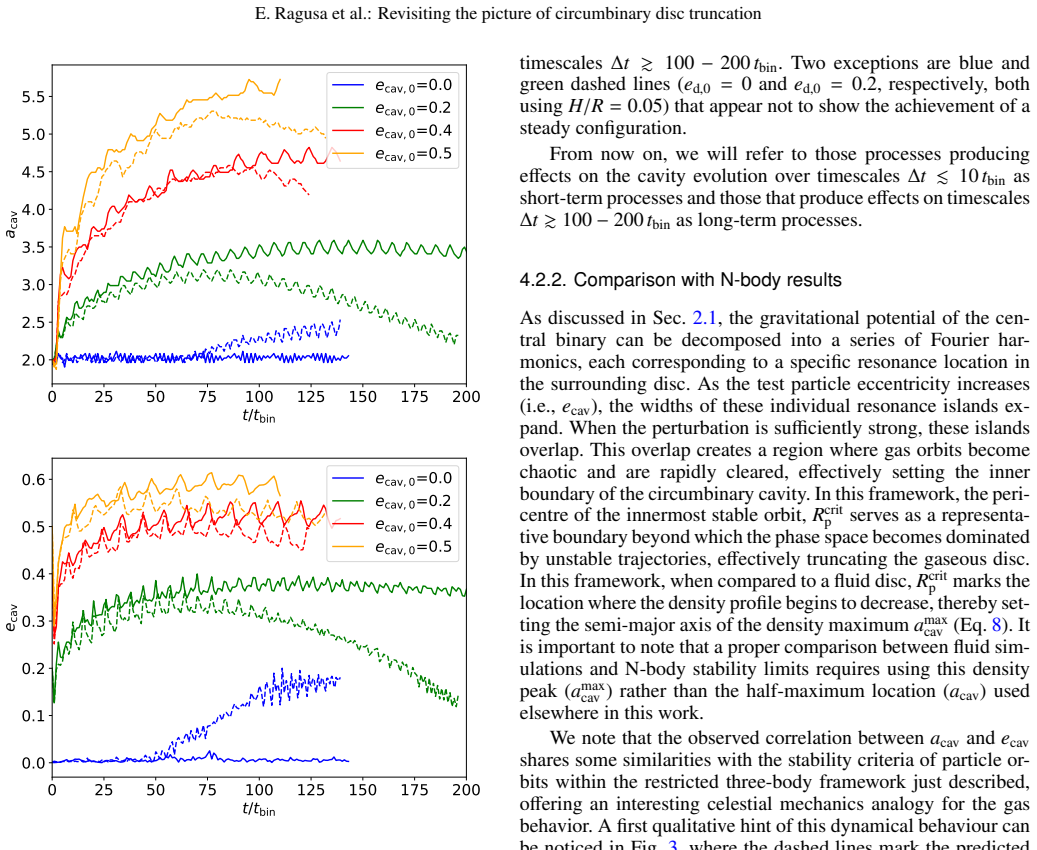
read the original abstract
Circumbinary discs are observed to develop central cavities carved by the gravitational influence of the binary. Analytical estimates of cavity sizes predict truncation at $\sim 2 \textrm{--} 3$ binary separations, depending on the binary properties. However, numerical studies show only qualitative agreement with these predictions: cavity sizes often evolve on long timescales and can exceed substantially the analytically predicted values. In this work, we revise this paradigm, suggesting that tidal truncation in circumbinary discs responds to additional dynamical parameters that have so far been neglected. We analyse a suite of 80 numerical simulations of circumbinary discs to re-examine the physical mechanism responsible for cavity truncation and to provide a prescription for the cavity size independent of the state of evolution of the system. We find that truncation depends not only on the binary parameters $a_{\rm bin}$, $e_{\rm bin}$, and mass ratio $q$, but also on the instantaneous cavity eccentricity $e_{\rm cav}$ and the relative apsidal orientation $\varpi_{\rm bin}-\varpi_{\rm cav}$. These quantities jointly determine the pericentre of the innermost stable disc orbit $R_{\rm p}$, in a way that shares some similarities with orbital stability in the restricted three body problem. Hydrodynamical effects introduce secondary corrections, with the disc scale height $H$ and viscosity $\alpha$ mildly shifting the cavity edge relative to the purely gravitational prediction. We introduce a semi-analytical prescription that captures these dependences for $R_{\rm p}$ and cavity semi-major axis $a_{\rm cav}$. We conclude that cavity truncation for binaries with mass ratios $q>0.05$ is a process where the instantaneous orbital properties of the disc ($e_{\rm cav}$, $\varpi_{\rm cav}$) play a fundamental role and should be taken into account to accurately evaluate the truncation efficiency.
Editorial analysis
A structured set of objections, weighed in public.
Referee Report
Summary. The manuscript analyzes a suite of 80 hydrodynamical simulations of circumbinary discs and claims that tidal truncation depends on binary parameters a_bin, e_bin, q together with the instantaneous cavity eccentricity e_cav and relative apsidal angle ϖ_bin−ϖ_cav. These jointly set the pericentre Rp of the innermost stable disc orbit; a semi-analytical prescription for Rp and a_cav is derived that is stated to be independent of evolutionary state, with secondary corrections from disc scale height H and viscosity α.
Significance. If the claimed dependence on e_cav and ϖ is shown to be independent of binary parameters and robust to changes in initial conditions or resolution, the work would revise the standard analytic picture of circumbinary truncation radii and supply a practical fitting formula usable in population synthesis or observational modeling. The strength of the result would lie in the size of the simulation suite and the attempt to separate gravitational from hydrodynamical effects.
major comments (3)
- [§3] §3 (simulation suite description): the manuscript does not demonstrate that e_cav and ϖ_bin−ϖ_cav are sampled independently of a_bin, e_bin and q. Without a table or scatter-plot matrix showing the joint distribution of these quantities across the 80 runs, it remains possible that the apparent additional dependence is induced by the same tidal forcing that sets the binary-driven cavity, undermining the claim of a new dynamical degree of freedom.
- [§4] §4 (semi-analytical prescription): the functional form for Rp is obtained by fitting the same 80 simulations used to identify the dependence; the paper must state whether the functional form was chosen a priori from restricted three-body considerations or adjusted post-hoc, and whether any cross-validation or held-out runs were performed to test predictive power.
- [Results] Results section (comparison of gravitational vs hydrodynamical runs): the statement that H and α produce only mild shifts is central to the claim that truncation is primarily gravitational. Quantitative evidence (e.g., ΔRp values or residual plots for different α and H at fixed binary and cavity parameters) is required to substantiate that these corrections remain secondary across the explored range.
minor comments (3)
- [Abstract] Abstract: the restriction to q>0.05 should be justified with a brief statement or reference to the low-q behaviour observed in the simulations.
- [Notation] Notation: ensure that the definition of Rp (pericentre of the innermost stable orbit) is stated explicitly the first time it appears and used consistently in all figures and equations.
- [Figures] Figures: any plot comparing the prescription to simulation data should include residuals or a quantitative measure of fit quality rather than visual agreement alone.
Simulated Author's Rebuttal
We thank the referee for their constructive feedback. We address each of the major comments in turn and will make the necessary revisions to the manuscript.
read point-by-point responses
-
Referee: [§3] §3 (simulation suite description): the manuscript does not demonstrate that e_cav and ϖ_bin−ϖ_cav are sampled independently of a_bin, e_bin and q. Without a table or scatter-plot matrix showing the joint distribution of these quantities across the 80 runs, it remains possible that the apparent additional dependence is induced by the same tidal forcing that sets the binary-driven cavity, undermining the claim of a new dynamical degree of freedom.
Authors: We agree with the referee that an explicit demonstration of the sampling is required. In the revised version, we will include a scatter-plot matrix (or corner plot) displaying the joint distributions of a_bin, e_bin, q, e_cav, and ϖ_bin−ϖ_cav across all 80 simulations. The simulations were designed by varying binary parameters over a grid while allowing the disc cavity to evolve from varied initial conditions, resulting in e_cav and ϖ values that span a range not strictly dictated by the binary parameters alone. This addition will substantiate that the dependence on cavity properties represents an independent dynamical degree of freedom. revision: yes
-
Referee: [§4] §4 (semi-analytical prescription): the functional form for Rp is obtained by fitting the same 80 simulations used to identify the dependence; the paper must state whether the functional form was chosen a priori from restricted three-body considerations or adjusted post-hoc, and whether any cross-validation or held-out runs were performed to test predictive power.
Authors: The functional form was selected a priori, drawing from the known dependence of orbital stability limits on eccentricity and apsidal orientation in the restricted three-body problem, as noted in the manuscript. The specific coefficients in the prescription were then fitted to the simulation results. No cross-validation or held-out runs were conducted, as the 80 simulations constitute the entire suite used to develop the model. We will update §4 to clearly state the a priori basis for the form and the post-fitting procedure, and acknowledge the absence of cross-validation as a point for future work. revision: partial
-
Referee: Results section (comparison of gravitational vs hydrodynamical runs): the statement that H and α produce only mild shifts is central to the claim that truncation is primarily gravitational. Quantitative evidence (e.g., ΔRp values or residual plots for different α and H at fixed binary and cavity parameters) is required to substantiate that these corrections remain secondary across the explored range.
Authors: We will strengthen the Results section by adding quantitative evidence, including tables of ΔRp values and residual plots comparing different H and α at fixed binary parameters (a_bin, e_bin, q) and cavity parameters (e_cav, ϖ). These will show that the hydrodynamical corrections are indeed secondary, with shifts typically smaller than those induced by changes in the main parameters. This will be incorporated in the revised manuscript. revision: yes
Circularity Check
No circularity: empirical prescription openly derived from simulation suite
full rationale
The paper states it analyses 80 simulations to identify dependences on a_bin, e_bin, q, e_cav and ϖ_bin−ϖ_cav, then introduces a semi-analytical prescription that captures those dependences. No equations or claims reduce a derived quantity to a fitted parameter by construction, no load-bearing self-citations are invoked to justify uniqueness, and the prescription is presented as an empirical fit rather than an independent first-principles prediction tested on the same data. The derivation chain is therefore self-contained against external benchmarks (the hydro runs themselves).
Axiom & Free-Parameter Ledger
axioms (1)
- domain assumption The gravitational potential of the binary dominates the truncation; hydrodynamic effects only provide secondary corrections.
Reference graph
Works this paper leans on
-
[1]
1980, ApJ, 241, 425, doi: 10.1086/158356
Disk-satellite interactions. , keywords =. doi:10.1086/158356 , adsurl =
-
[2]
Massive black hole binaries in active galactic nuclei. , keywords =. doi:10.1038/287307a0 , adsurl =
-
[3]
, archivePrefix = "arXiv", eprint =
Electromagnetic Signals Following Stellar-mass Black Hole Mergers. , archivePrefix = "arXiv", eprint =. doi:10.3847/2041-8213/aa67f3 , adsurl =
-
[4]
Simulations of tidally driven eccentric instabilities with application to superhumps. , keywords =. doi:10.1086/170648 , adsurl =
-
[5]
Formation of Galactic Nuclei. , eprint =. doi:10.1086/323830 , adsurl =
-
[6]
doi:10.1088/0004-637X/749/2/118 , Eid =. arXiv , Author =:1110.4866 , Journal =
work page internal anchor Pith review Pith/arXiv arXiv doi:10.1088/0004-637x/749/2/118
-
[7]
doi:10.1088/0004-637X/775/1/17 , Eid =. arXiv , Arxivurl =:1307.3770 , Journal =
work page internal anchor Pith review Pith/arXiv arXiv doi:10.1088/0004-637x/775/1/17
-
[8]
, archivePrefix = "arXiv", eprint =
Binary Black Hole Accretion from a Circumbinary Disk: Gas Dynamics inside the Central Cavity. , archivePrefix = "arXiv", eprint =. doi:10.1088/0004-637X/783/2/134 , adsurl =
-
[9]
Asymmetric transition disks: Vorticity or eccentricity?
doi:10.1051/0004-6361/201321125 , Eid =. arXiv , Arxivurl =:1304.1736 , Journal =
work page internal anchor Pith review Pith/arXiv arXiv doi:10.1051/0004-6361/201321125
-
[10]
, archivePrefix = "arXiv", eprint =
Characteristic signatures in the thermal emission from accreting binary black holes. , archivePrefix = "arXiv", eprint =. doi:10.1093/mnrasl/slu160 , adsurl =
-
[11]
, archivePrefix = "arXiv", eprint =
The Migration of Gap-opening Planets is Not Locked to Viscous Disk Evolution. , archivePrefix = "arXiv", eprint =. doi:10.1088/2041-8205/792/1/L10 , adsurl =
-
[12]
Supermassive Black Hole Binaries: The Search Continues
Supermassive Black Hole Binaries: The Search Continues. Gravitational Wave Astrophysics , year = 2015, series =. doi:10.1007/978-3-319-10488-1_9 , adsurl =. arXiv:1406.5193 , primaryClass = "astro-ph.HE", editor =
work page internal anchor Pith review Pith/arXiv arXiv doi:10.1007/978-3-319-10488-1_9 2015
-
[13]
Evolution of Giant Planets in Eccentric Disks. , eprint =. doi:10.1086/508451 , adsurl =
-
[14]
Physical Review Letters , archivePrefix = "arXiv", eprint =
Properties of the Binary Black Hole Merger GW150914. Physical Review Letters , archivePrefix = "arXiv", eprint =. doi:10.1103/PhysRevLett.116.241102 , adsurl =
-
[15]
, archivePrefix = "arXiv", eprint =
On the evolution of eccentric and inclined protoplanets embedded in protoplanetary disks. , archivePrefix = "arXiv", eprint =. doi:10.1051/0004-6361:20077666 , adsurl =
-
[16]
Stellar irradiated discs and implications on migration of embedded planets. I. Equilibrium discs. , archivePrefix = "arXiv", eprint =. doi:10.1051/0004-6361/201220159 , adsurl =
-
[17]
Highly inclined and eccentric massive planets. I. Planet-disc interactions. , archivePrefix = "arXiv", eprint =. doi:10.1051/0004-6361/201220310 , adsurl =
-
[18]
1: Resonances and disk gap sizes
Dynamics of binary-disk interaction. 1: Resonances and disk gap sizes. , keywords =. doi:10.1086/173679 , adsurl =
-
[19]
Tidal torques on accretion discs in binary systems with extreme mass ratios. , keywords =. doi:10.1093/mnras/186.4.799 , adsurl =
-
[20]
2001, MNRAS, 322, 231, doi: 10.1046/j.1365-8711.2001.04022.x
Episodic accretion in magnetically layered protoplanetary discs. , eprint =. doi:10.1046/j.1365-8711.2001.04356.x , adsurl =
-
[21]
, archivePrefix = "arXiv", eprint =
The (w)hole survey: An unbiased sample study of transition disk candidates based on Spitzer catalogs. , archivePrefix = "arXiv", eprint =. doi:10.1051/0004-6361/201628075 , adsurl =
-
[22]
, archivePrefix = "arXiv", eprint =
Flows of gas through a protoplanetary gap. , archivePrefix = "arXiv", eprint =. doi:10.1038/nature11769 , adsurl =
-
[23]
large dust grains in transitional disks: do different cavity sizes indicate a planet?
Small vs. large dust grains in transitional disks: do different cavity sizes indicate a planet?. SAO 206462 (HD 135344B) in polarized light with VLT/NACO. , archivePrefix = "arXiv", eprint =. doi:10.1051/0004-6361/201322429 , adsurl =
-
[24]
2015, MNRAS, 451, 3941, doi: 10.1093/mnras/stv1214
Spin alignment and differential accretion in merging black hole binaries. , archivePrefix = "arXiv", eprint =. doi:10.1093/mnras/stv1214 , adsurl =
-
[25]
Alignment of the Spins of Supermassive Black Holes Prior to Coalescence. , eprint =. doi:10.1086/518769 , adsurl =
-
[26]
, archivePrefix = "arXiv", eprint =
The origin of the eccentricity of the hot Jupiter in CI Tau. , archivePrefix = "arXiv", eprint =. doi:10.1093/mnrasl/slw184 , adsurl =
-
[27]
, archivePrefix = "arXiv", eprint =
Orbital evolution of eccentric planets in radiative discs. , archivePrefix = "arXiv", eprint =. doi:10.1051/0004-6361/201014414 , adsurl =
-
[28]
, archivePrefix = "arXiv", eprint =
Eccentric Jupiters via Disk-Planet Interactions. , archivePrefix = "arXiv", eprint =. doi:10.1088/0004-637X/812/2/94 , adsurl =
-
[29]
The origin of the eccentricities of the rings of Uranus. , keywords =. doi:10.1086/158671 , adsurl =
-
[30]
Saturation of the Corotation Resonance in a Gaseous Disk. , eprint =. doi:10.1086/368178 , adsurl =
-
[31]
ArXiv e-prints , archivePrefix = "arXiv", eprint =
Evolution of eccentricity and inclination of hot protoplanets embedded in radiative discs. ArXiv e-prints , archivePrefix = "arXiv", eprint =
-
[32]
Origins of Eccentric Extrasolar Planets: Testing the Planet-Planet Scattering Model. , eprint =. doi:10.1086/590926 , adsurl =
-
[33]
Eccentricity Evolution for Planets in Gaseous Disks. , eprint =. doi:10.1086/346202 , adsurl =
-
[34]
Disk eccentricity and embedded planets. , eprint =. doi:10.1051/0004-6361:20053914 , adsurl =
-
[35]
Gas Flow across Gaps in Protoplanetary Disks. , eprint =. doi:10.1086/500356 , adsurl =
-
[36]
, archivePrefix = "arXiv", eprint =
On the Origins of Eccentric Close-In Planets. , archivePrefix = "arXiv", eprint =. doi:10.1086/592818 , adsurl =
-
[37]
, archivePrefix = "arXiv", eprint =
Modelling accretion in transitional disks. , archivePrefix = "arXiv", eprint =. doi:10.1051/0004-6361/201322503 , adsurl =
-
[38]
, archivePrefix = "arXiv", eprint =
Secular evolution of eccentricity in protoplanetary discs with gap-opening planets. , archivePrefix = "arXiv", eprint =. doi:10.1093/mnras/stx426 , adsurl =
-
[39]
, archivePrefix = "arXiv", eprint =
Growth of eccentric modes in disc-planet interactions. , archivePrefix = "arXiv", eprint =. doi:10.1093/mnras/stw521 , adsurl =
-
[40]
, archivePrefix = "arXiv", eprint =
Shedding Light on the Eccentricity Valley: Gap Heating and Eccentricity Excitation of Giant Planets in Protoplanetary Disks. , archivePrefix = "arXiv", eprint =. doi:10.1088/0004-637X/782/2/113 , adsurl =
-
[41]
2001, MNRAS, 322, 231, doi: 10.1046/j.1365-8711.2001.04022.x
Dynamical relaxation and massive extrasolar planets. , eprint =. doi:10.1046/j.1365-8711.2001.04386.x , adsurl =
-
[42]
, archivePrefix = "arXiv", eprint =
Secular Orbital Evolution of Compact Planet Systems. , archivePrefix = "arXiv", eprint =. doi:10.1088/0004-637X/778/1/6 , adsurl =
-
[43]
Observational appearance
Black holes in binary systems. Observational appearance. , year = 1973, volume = 24, pages =
1973
-
[44]
Exoplanet Orbit Database. II. Updates to Exoplanets.org. , archivePrefix = "arXiv", eprint =. doi:10.1086/678447 , adsurl =
-
[45]
High Orbital Eccentricities of Extrasolar Planets Induced by the Kozai Mechanism. , eprint =. doi:10.1086/430467 , adsurl =
-
[46]
1997, Nature, 386, 254, doi: 10.1038/386254a0
Chaotic variations in the eccentricity of the planet orbiting 16 Cygni B. , year = 1997, month = mar, volume = 386, pages =. doi:10.1038/386254a0 , adsurl =
-
[47]
, archivePrefix = "arXiv", eprint =
The Eccentric Kozai-Lidov Effect and Its Applications. , archivePrefix = "arXiv", eprint =. doi:10.1146/annurev-astro-081915-023315 , adsurl =
-
[48]
Dynamical instabilities and the formation of extrasolar planetary systems. Science , keywords =. doi:10.1126/science.274.5289.954 , adsurl =
-
[49]
Dynamical Origin of Extrasolar Planet Eccentricity Distribution. , eprint =. doi:10.1086/590047 , adsurl =
-
[50]
, archivePrefix = "arXiv", eprint =
The effects of external planets on inner systems: multiplicities, inclinations and pathways to eccentric warm Jupiters. , archivePrefix = "arXiv", eprint =. doi:10.1093/mnras/stx693 , adsurl =
-
[51]
Orbital eccentricity growth through disc-companion tidal interaction. , keywords =. doi:10.1051/0004-6361:20000011 , adsurl =
-
[52]
, archivePrefix = "arXiv", eprint =
Planet-Disk Interaction and Orbital Evolution. , archivePrefix = "arXiv", eprint =. doi:10.1146/annurev-astro-081811-125523 , adsurl =
-
[53]
On the orbital evolution and growth of protoplanets embedded in a gaseous disc. , eprint =. doi:10.1046/j.1365-8711.2000.03466.x , adsurl =
-
[54]
, archivePrefix = "arXiv", eprint =
A Candidate Young Massive Planet in Orbit around the Classical T Tauri Star CI Tau. , archivePrefix = "arXiv", eprint =. doi:10.3847/0004-637X/826/2/206 , adsurl =
-
[55]
, archivePrefix = "arXiv", eprint =
A limit on eccentricity growth from global 3D simulations of disc-planet interactions. , archivePrefix = "arXiv", eprint =. doi:10.1093/mnras/sts254 , adsurl =
-
[56]
2001, MNRAS, 322, 231, doi: 10.1046/j.1365-8711.2001.04022.x
Non-linear fluid dynamics of eccentric discs. , eprint =. doi:10.1046/j.1365-8711.2001.04416.x , adsurl =
-
[57]
A Planetesimal Accretion Zone in a Circumbinary Disk. , keywords =. doi:10.1086/421342 , adsurl =
-
[58]
Mean-motion resonances in satellite-disc interactions. , eprint =. doi:10.1111/j.1365-2966.2006.11141.x , adsurl =
-
[59]
, archivePrefix = "arXiv", eprint =
Circumbinary discs: Numerical and physical behaviour. , archivePrefix = "arXiv", eprint =. doi:10.1051/0004-6361/201730666 , adsurl =
-
[60]
The effect of an external disk on the orbital elements of a central binary. , keywords =. doi:10.1086/185971 , adsurl =
-
[61]
A model for tidally driven eccentric instabilities in fluid disks. , keywords =. doi:10.1086/170647 , adsurl =
-
[62]
On the width and shape of gaps in protoplanetary disks. , eprint =. doi:10.1016/j.icarus.2005.10.007 , adsurl =
-
[63]
Solar system dynamics by C.D
Solar system dynamics. Solar system dynamics by C.D. Murray and S.F. McDermott. (Cambridge, UK: Cambridge University Press), ISBN 0-521-57295-9 (hc.), ISBN 0-521-57297-4 (pbk.). , year = 1999, adsurl =
1999
-
[64]
Satellites in discs: regulating the accretion luminosity. , eprint =. doi:10.1093/mnras/277.3.758 , adsurl =
-
[65]
1999, MNRAS, 309, 447, doi: 10.1046/j.1365-8711.1999.02853.x
The evolution of a supermassive binary caused by an accretion disc. , eprint =. doi:10.1046/j.1365-8711.1999.02623.x , adsurl =
-
[66]
Catalog of Nearby Exoplanets. , eprint =. doi:10.1086/504701 , adsurl =
-
[67]
, archivePrefix = "arXiv", eprint =
FARGO3D: A New GPU-oriented MHD Code. , archivePrefix = "arXiv", eprint =. doi:10.3847/0067-0049/223/1/11 , adsurl =
-
[68]
, archivePrefix = "arXiv", eprint =
Migration of massive planets in accreting disks. , archivePrefix = "arXiv", eprint =. doi:10.1051/0004-6361/201424837 , adsurl =
-
[69]
High-Resolution Submillimeter Constraints on Circumstellar Disk Structure. , eprint =. doi:10.1086/511741 , adsurl =
-
[70]
Computing in Science and Engineering , keywords =
Matplotlib: A 2D Graphics Environment. Computing in Science and Engineering , keywords =. doi:10.1109/MCSE.2007.55 , adsurl =
-
[71]
, archivePrefix = "arXiv", eprint =
On the origin of horseshoes in transitional discs. , archivePrefix = "arXiv", eprint =. doi:10.1093/mnras/stw2456 , adsurl =
-
[72]
, archivePrefix = "arXiv", eprint =
Suppression of the accretion rate in thin discs around binary black holes. , archivePrefix = "arXiv", eprint =. doi:10.1093/mnras/stw1081 , adsurl =
-
[73]
doi:10.1093/mnras/stw792 , Journal =
-
[74]
arXiv , Arxivurl =:1602.06523 , Journal =
-
[75]
Possible planet-forming regions on submillimetre images. , archivePrefix = "arXiv", eprint =. doi:10.1111/j.1365-2966.2011.19834.x , adsurl =
-
[76]
, archivePrefix = "arXiv", eprint =
Accretion into the central cavity of a circumbinary disc. , archivePrefix = "arXiv", eprint =. doi:10.1093/mnras/stt1787 , adsurl =
-
[77]
Eccentricity of Supermassive Black Hole Binaries Coalescing from Gas-rich Mergers. , eprint =. doi:10.1086/497108 , adsurl =
-
[78]
Mass Flow through Gaps in Circumbinary Disks. , keywords =. doi:10.1086/310200 , adsurl =
-
[79]
Physics of Fluids , year = 1960, month = may, volume = 3, pages =
Variation Principles of Hydrodynamics. Physics of Fluids , year = 1960, month = may, volume = 3, pages =. doi:10.1063/1.1706053 , adsurl =
-
[80]
Smoothed particle hydrodynamics. , keywords =. doi:10.1146/annurev.aa.30.090192.002551 , adsurl =
discussion (0)
Sign in with ORCID, Apple, or X to comment. Anyone can read and Pith papers without signing in.