From Young to Older Disks: JWST/MIRI Evidence for Fading Molecular Emission and Hints for Elevated C/O in Upper Scorpius
Pith reviewed 2026-06-29 01:09 UTC · model grok-4.3
The pith
Older protoplanetary disks show lower molecular line luminosities and higher C to O ratios than younger ones.
A machine-rendered reading of the paper's core claim, the machinery that carries it, and where it could break.
Core claim
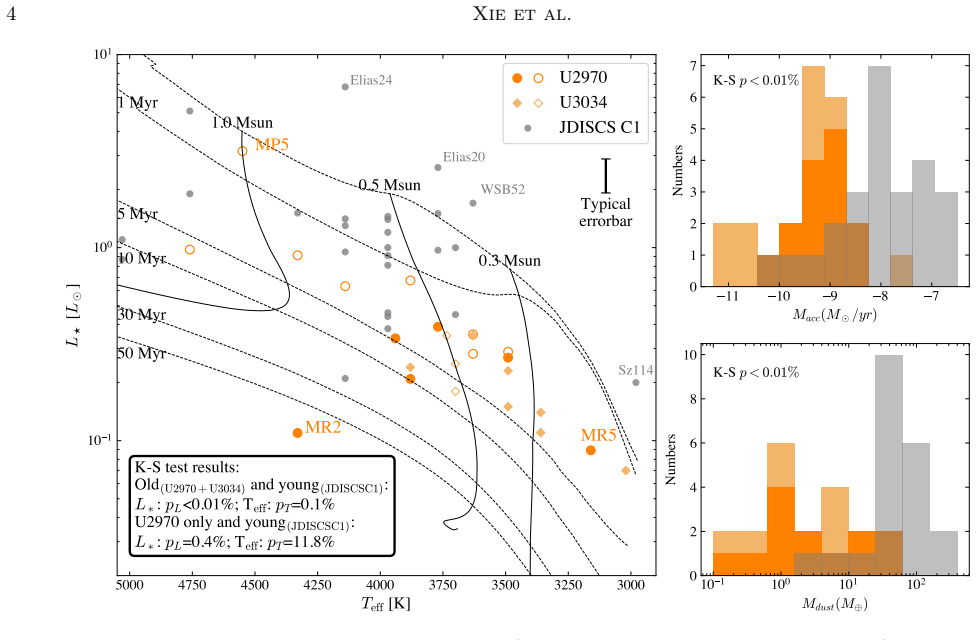
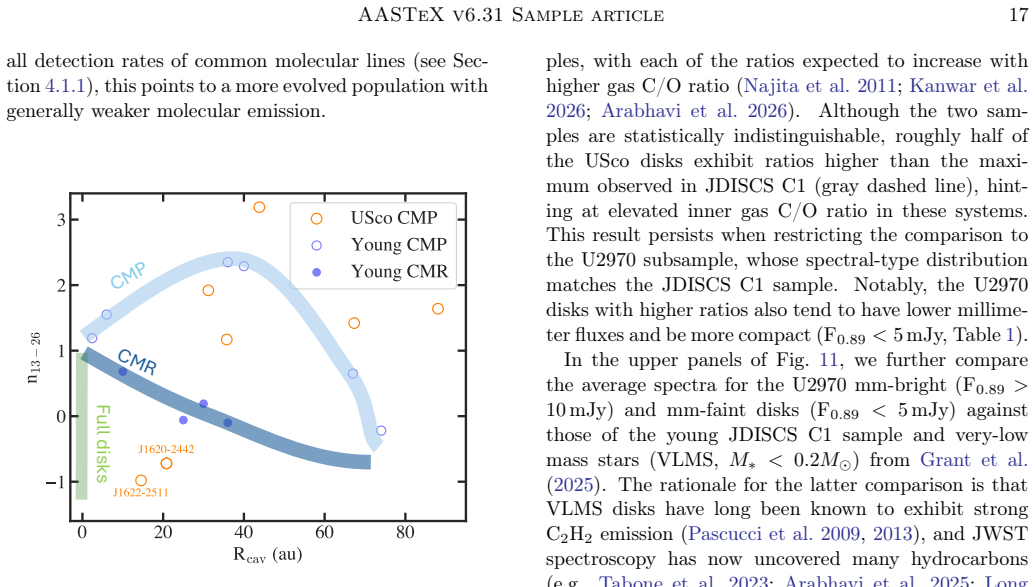
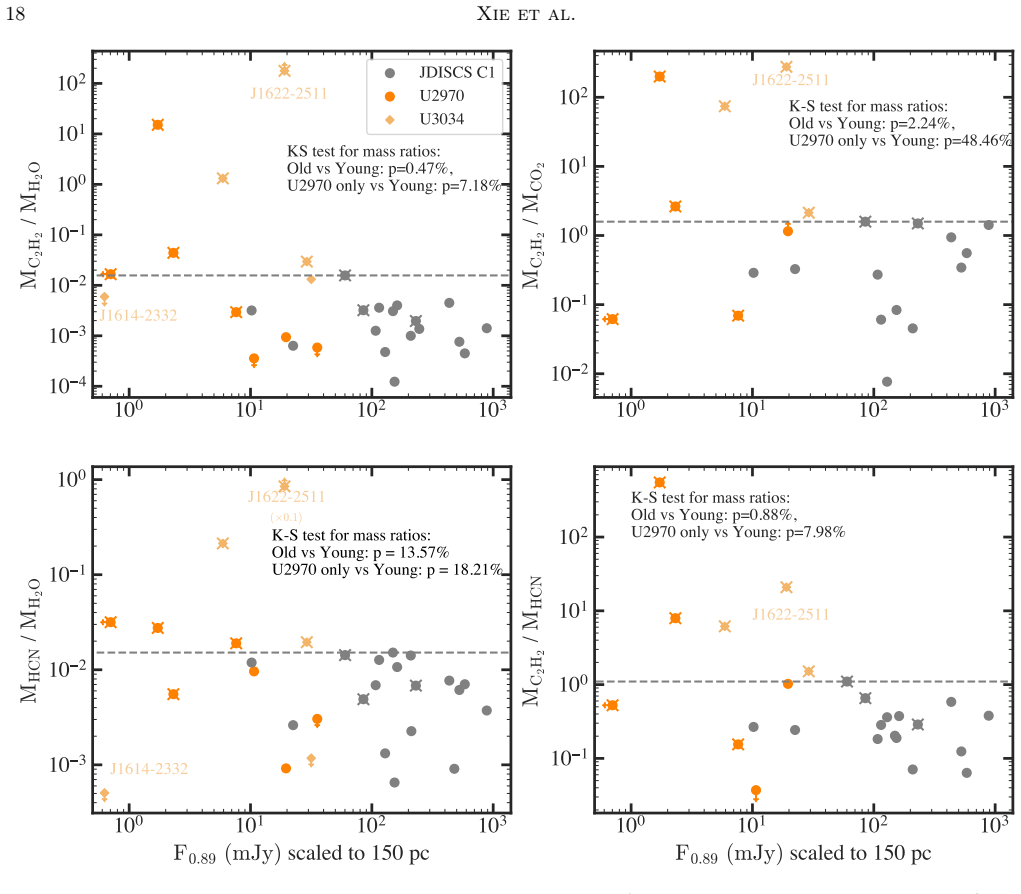
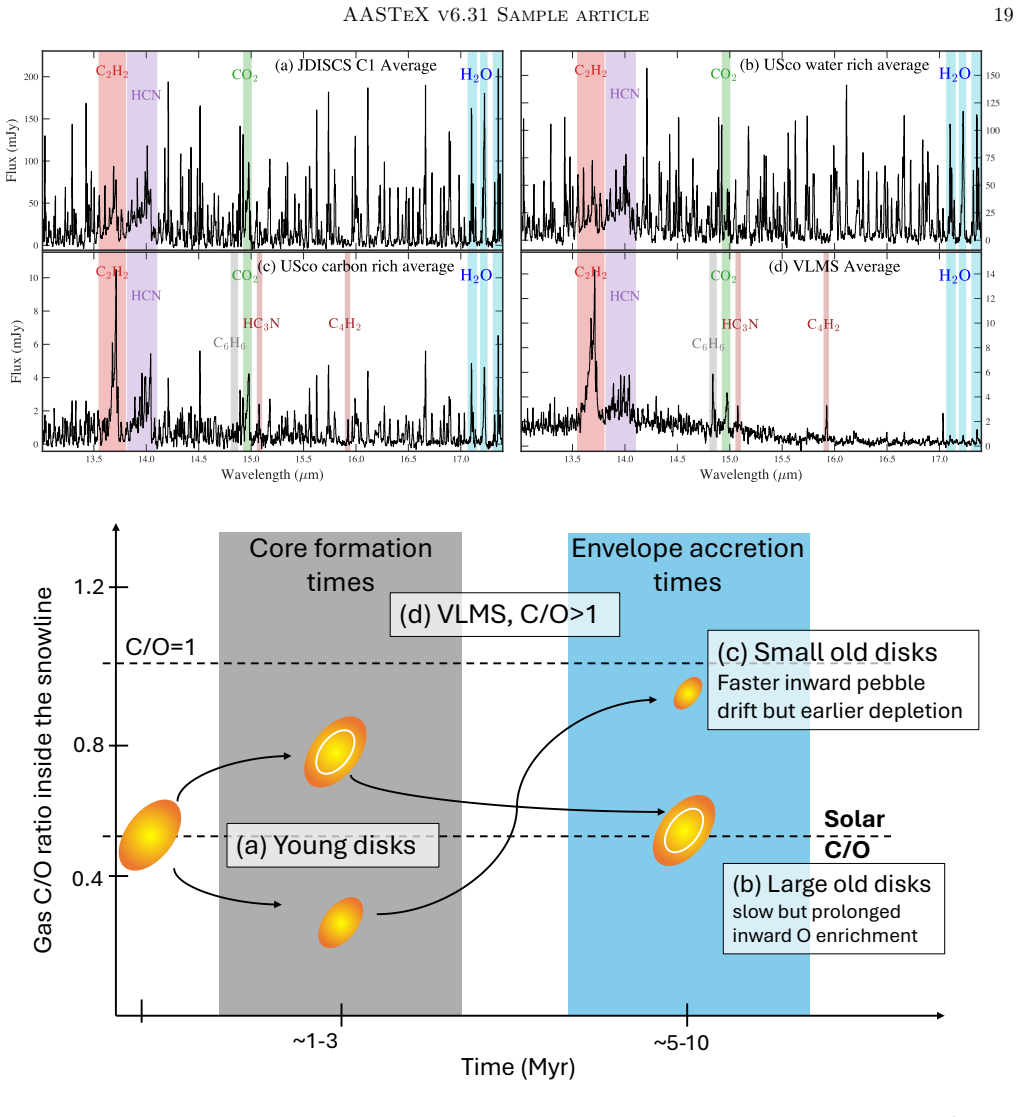
Analysis of the JWST/MIRI spectra with local thermal equilibrium slab models shows that Upper Scorpius disks have reduced inner-disk molecular gas masses, cooler emitting layers, and higher inner gas C/O ratios relative to the younger JDISCS sample; these differences are consistent with pebble drift and together indicate chemical evolution of inner disk gas between 1-3 and 5-10 Myr.
What carries the argument
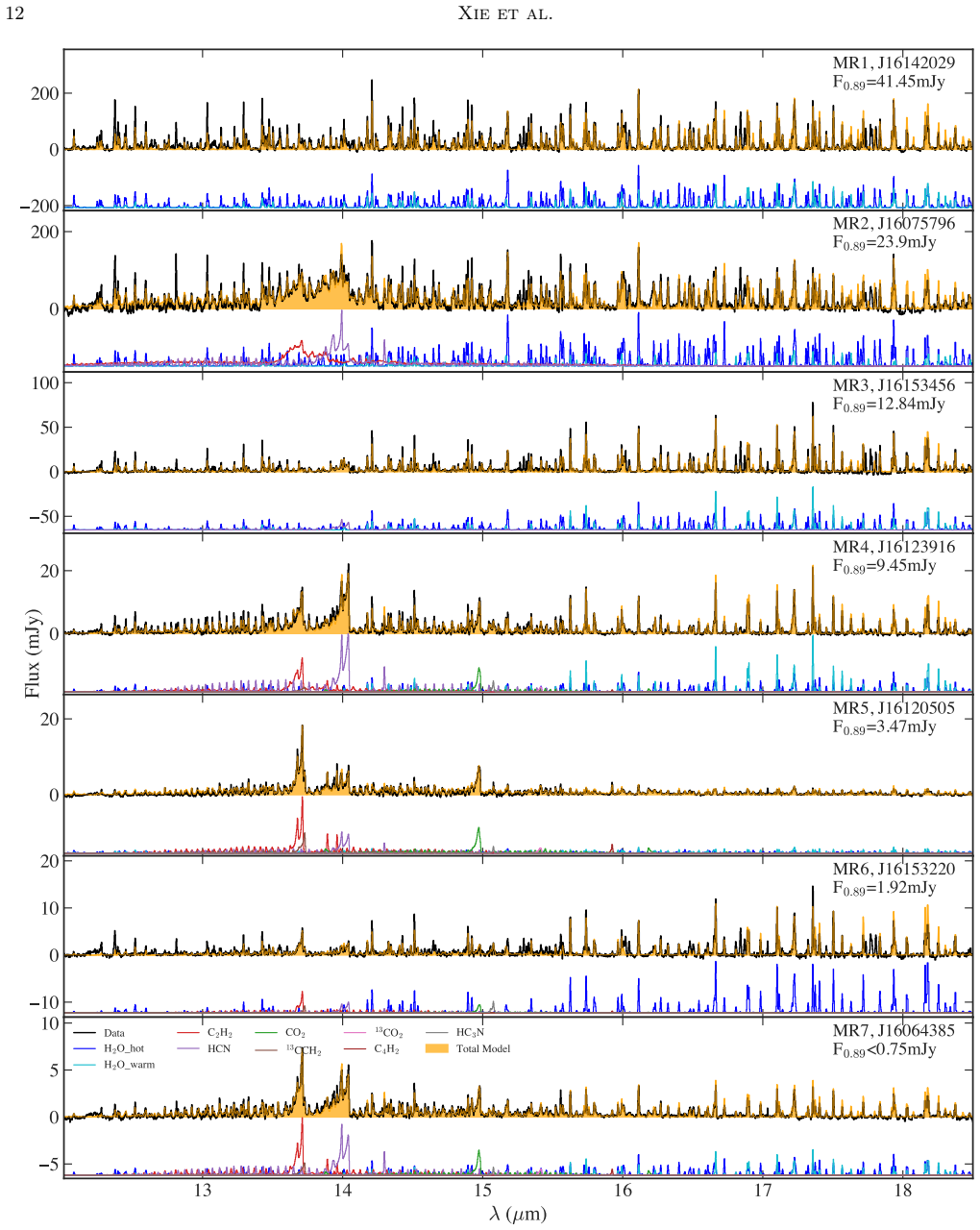
Local thermal equilibrium slab models fitted to the mid-infrared emission lines to derive molecular column densities, temperatures, and C- to O-bearing molecule mass ratios, then compared across age groups at matched accretion luminosity.
If this is right
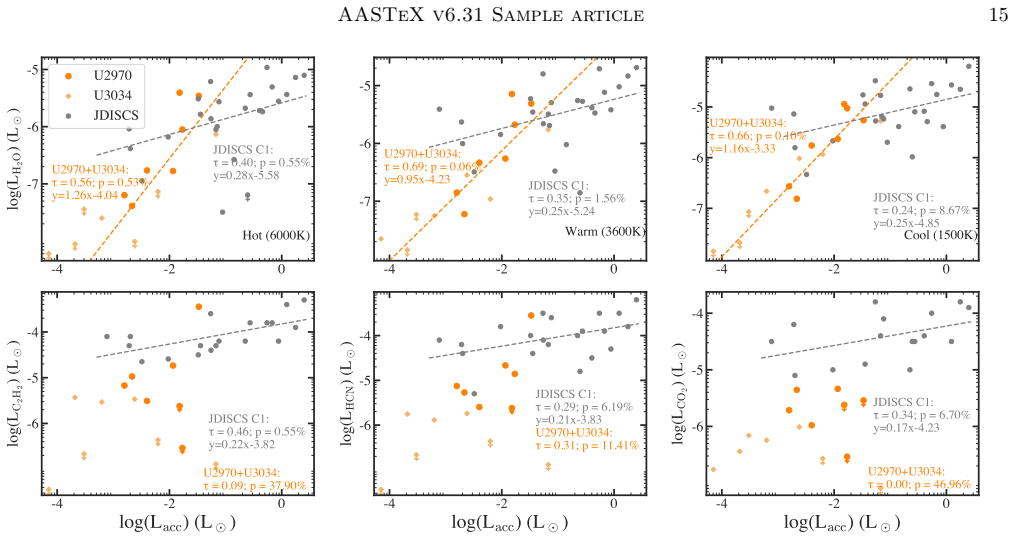
- Molecular line luminosities are systematically lower in older disks at any given accretion luminosity and follow different scaling relations.
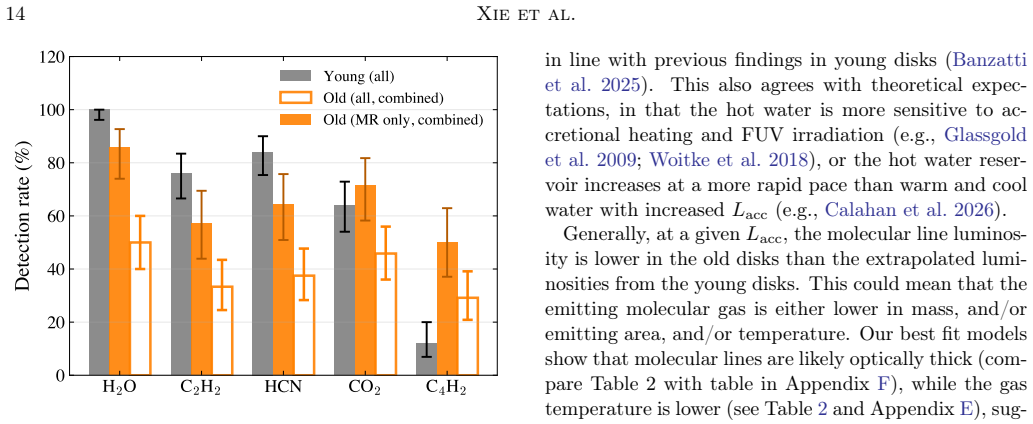
- Rarer C-bearing molecules such as C4H2 are detected more often in the older population.
- Roughly half the older disks, preferentially the millimeter-faint and compact ones, show C- to O-bearing molecule ratios exceeding the maximum values measured in young disks.
- The patterns are consistent with pebble drift raising the inner gas C/O ratio over time.
- The chemical changes have direct implications for the composition of gas accreted onto forming planets.
Where Pith is reading between the lines
- If pebble drift drives the C/O rise, then the timing of that rise should correlate with millimeter disk size and radial drift timescales in larger samples.
- Planets that finish assembling after ~5 Myr could inherit systematically different atmospheric C/O ratios than those that finish earlier.
- The same age trend may appear in other tracers such as the strength of the 10-micron silicate feature or the presence of organic ices once comparable mid-infrared spectra exist for more regions.
- The transition from molecular-rich to molecular-poor disks could mark the point at which inner gas becomes too depleted to supply primordial atmospheres.
Load-bearing premise
The LTE slab model yields directly comparable gas properties across the young and older samples and differences in detection rates and luminosities are not dominated by selection effects in disk size, inclination, or stellar properties.
What would settle it
A larger sample of young and old disks matched in millimeter flux, size, and inclination showing identical molecular line luminosities and C/O ratios at given accretion luminosity would falsify the claimed chemical evolution.
Figures
read the original abstract
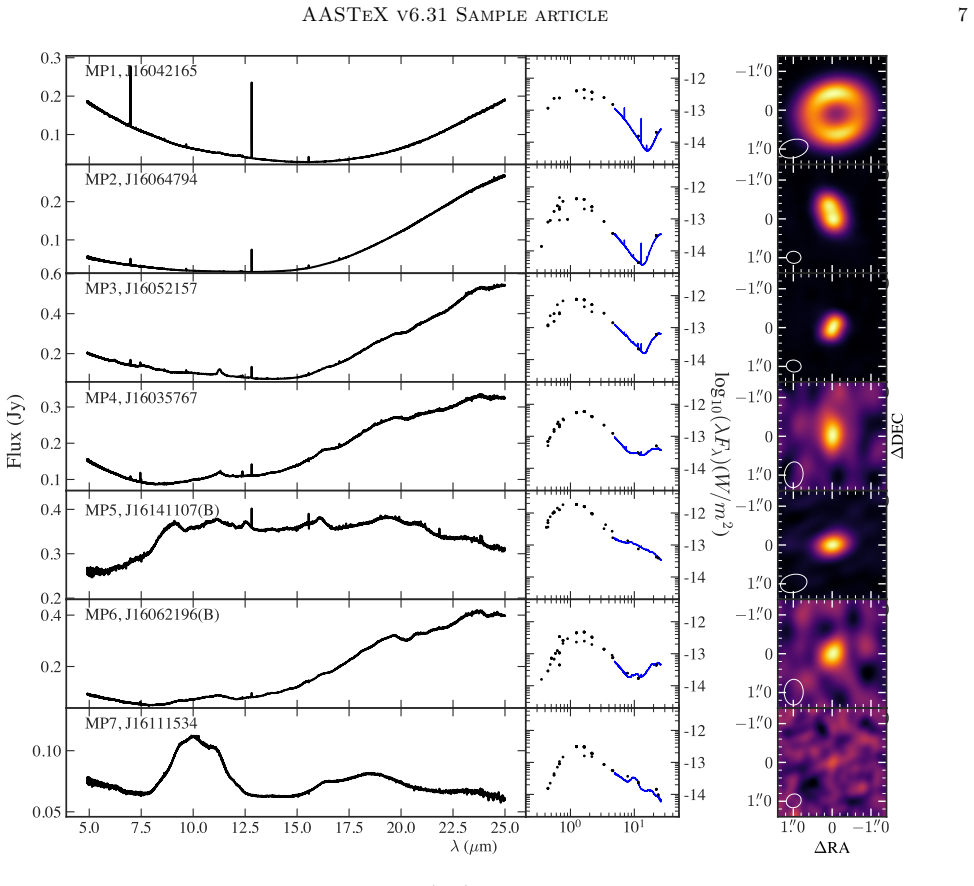
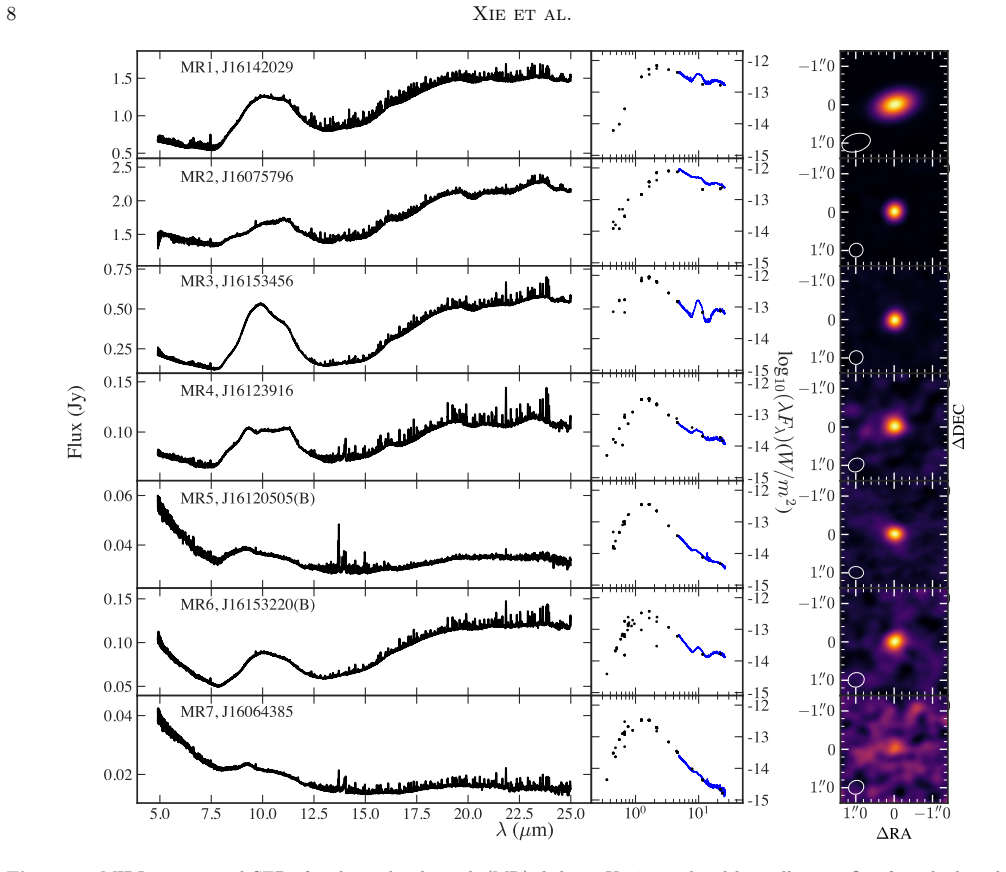
We present JWST/MIRI spectroscopy of 14 disks in the older (~5-10 Myr) Upper Scorpius (USco) association and use slab of gas in local thermal equilibrium to infer basic gas properties. We find that half of these disks are molecular rich, with detections of H$_2$O, CO$_2$, HCN, C$_2$H$_2$, and H$_2$, while the other half are molecular poor, showing no molecular emission other than H$_2$. We further combine this sample with 10 other USco disks from the AGE-PRO program and compare the combined older sample to young (~1-3 Myr) JDISCS Cycle~1 systems, which are analyzed in a similar manner. We find that USco disks have lower detection rates of major molecular species but a significantly higher detection rate of rarer C-bearing molecules such as C$_4$H$_2$. At a given accretion luminosity, molecular line luminosities are systematically lower in USco than in young disks, and the scaling relations with accretion luminosity differ between the two populations. Moreover, we find that about half of the older disks, preferentially the millimeter faint, and likely more compact disks, have observable mass ratios of C- to O-bearing molecules that are higher than the maximum values in the young sample. These results point to reduced inner-disk molecular gas masses, cooler emitting layers, and higher inner gas C/O ratios in older disks, the latter being consistent with pebble drift. Taken together, our findings provide evidence for chemical evolution of inner disk gas from young to older systems, with important implications for the accretion of primordial planetary atmospheres.
Editorial analysis
A structured set of objections, weighed in public.
Referee Report
Summary. The paper presents JWST/MIRI spectroscopy of 14 Upper Scorpius disks (~5-10 Myr) analyzed with LTE slab models, combined with 10 AGE-PRO USco disks, and compared to young (~1-3 Myr) JDISCS systems. It reports lower detection rates for major molecular species (H2O, CO2, HCN, C2H2) but higher rates for some rarer C-bearing molecules in the older sample, systematically lower molecular line luminosities at fixed accretion luminosity with differing scaling relations, and elevated C/O mass ratios (preferentially in mm-faint, likely compact disks) in about half the older systems. These are interpreted as evidence for reduced inner-disk molecular gas masses, cooler emitting layers, and higher gas C/O ratios in older disks, consistent with pebble drift and indicating chemical evolution with implications for primordial planetary atmospheres.
Significance. If the evolutionary interpretation holds after addressing sample comparability, the work supplies new empirical constraints on the time evolution of inner-disk molecular gas using uniform JWST/MIRI slab modeling across age bins. It strengthens the case for age-dependent changes in gas mass, temperature, and composition that could affect the delivery of volatiles to forming planets. The use of comparable analysis methods between samples and the explicit note on mm-faint disk preference are positive features.
major comments (2)
- [Abstract] Abstract: The central claim that lower line luminosities, lower detection rates, and elevated C/O ratios reflect true evolutionary changes in inner-disk gas requires that the USco and JDISCS samples are comparable after controlling for accretion luminosity. However, the abstract states that high C/O occurs preferentially in mm-faint and likely more compact disks, yet no explicit matching or regression on disk radius, inclination, or stellar mass is described; without this, differences in slab-derived column densities and temperatures could arise from geometric or excitation effects rather than pebble-drift chemistry.
- [Abstract] Abstract and implied Methods: The LTE slab model is used to infer directly comparable gas properties (T, N_col) across samples, but the abstract-only description provides no error budgets, data-selection criteria, or tests for how detection thresholds or disk compactness affect the reported C/O mass ratios and line-luminosity scalings; this assumption is load-bearing for the chemical-evolution conclusion.
Simulated Author's Rebuttal
We thank the referee for the constructive comments on sample comparability and the description of our modeling approach. We address each point below and have revised the manuscript accordingly.
read point-by-point responses
-
Referee: [Abstract] Abstract: The central claim that lower line luminosities, lower detection rates, and elevated C/O ratios reflect true evolutionary changes in inner-disk gas requires that the USco and JDISCS samples are comparable after controlling for accretion luminosity. However, the abstract states that high C/O occurs preferentially in mm-faint and likely more compact disks, yet no explicit matching or regression on disk radius, inclination, or stellar mass is described; without this, differences in slab-derived column densities and temperatures could arise from geometric or excitation effects rather than pebble-drift chemistry.
Authors: We agree that controlling for additional parameters strengthens the evolutionary interpretation. Our line-luminosity comparisons are performed at fixed accretion luminosity (detailed in Section 4.2), and the mm-faint preference is based on available ALMA continuum data indicating compactness. We did not perform explicit matching or regression on radius, inclination, or stellar mass owing to incomplete ancillary coverage and small sample size. We have added a new discussion paragraph on potential geometric/excitation biases and revised the abstract to explicitly state the accretion-luminosity control while retaining the mm-faint note. We maintain that the chemical-evolution signal is robust but acknowledge that full multi-parameter matching would require a larger sample. revision: partial
-
Referee: [Abstract] Abstract and implied Methods: The LTE slab model is used to infer directly comparable gas properties (T, N_col) across samples, but the abstract-only description provides no error budgets, data-selection criteria, or tests for how detection thresholds or disk compactness affect the reported C/O mass ratios and line-luminosity scalings; this assumption is load-bearing for the chemical-evolution conclusion.
Authors: The full manuscript (Sections 3.2–3.4 and 5.1–5.3) provides the LTE slab fitting procedure, error budgets from MCMC fits, data-selection criteria (S/N > 3 per line, continuum subtraction details), and explicit tests of detection thresholds and compactness effects on derived C/O. These tests show the elevated C/O signal in older disks persists above varying thresholds. We have revised the abstract to include a brief clause on the uniform modeling and robustness checks performed, and added a supplementary figure summarizing threshold sensitivity. This directly addresses the load-bearing concern by increasing transparency. revision: yes
Circularity Check
No circularity: direct LTE slab fits and empirical sample comparisons
full rationale
The paper fits LTE slab models to JWST/MIRI spectra to extract detection rates, line luminosities, temperatures, column densities, and C/O-bearing molecule ratios, then performs direct statistical comparisons between the USco older sample and JDISCS young disks at fixed accretion luminosity. No step reduces a claimed prediction or derived quantity to its own fitted inputs by construction, nor does any load-bearing premise rest on a self-citation chain or imported uniqueness theorem. The pebble-drift consistency is stated as interpretive agreement rather than a quantitative derivation from the data. The analysis is self-contained against external spectral benchmarks.
Axiom & Free-Parameter Ledger
free parameters (1)
- LTE slab parameters (T, N_col for each species)
axioms (1)
- domain assumption Gas emission can be modeled as a single-temperature slab in local thermal equilibrium
Reference graph
Works this paper leans on
-
[1]
Models and observational predictions of dust traps in protoplanetary discs. , keywords =. doi:10.1007/s10509-025-04530-8 , archivePrefix =. 2601.02486 , primaryClass =
-
[2]
Theoretical spectra of photoevaporating protoplanetary discs: an atlas of atomic and low-ionization emission lines. , keywords =. doi:10.1111/j.1365-2966.2010.16798.x , archivePrefix =. 1004.1203 , primaryClass =
-
[3]
Evidence for Systematically Larger Dust Grains in Upper Scorpius Relative to Taurus Disks
Evidence for Systematically Larger Dust Grains in Upper Scorpius Relative to Taurus Disks. , keywords =. doi:10.3847/1538-4357/ae6a94 , archivePrefix =. 2605.26736 , primaryClass =
work page internal anchor Pith review Pith/arXiv arXiv doi:10.3847/1538-4357/ae6a94
-
[4]
Protostars and Planets VII , year = 2023, editor =
Accretion Variability as a Guide to Stellar Mass Assembly. Protostars and Planets VII , year = 2023, editor =. doi:10.48550/arXiv.2203.11257 , archivePrefix =. 2203.11257 , primaryClass =
-
[5]
A Hard X-Ray Test of HCN Enhancements As a Tracer of Embedded Black Hole Growth. , keywords =. doi:10.3847/1538-4357/ab8015 , archivePrefix =. 2004.02884 , primaryClass =
-
[6]
Large Myr-old Disks Are Not Severely Depleted of Gas-phase CO or Carbon. , keywords =. doi:10.3847/1538-4357/ace4bf , archivePrefix =. 2307.02704 , primaryClass =
-
[7]
The volatile content and C/O ratio of old disks: constraints on young planet atmospheres
-
[8]
CLIcK: a Continuum and Line fItting Kit for circumstellar disks
CLIcK: a Continuum and Line fItting Kit for circumstellar disks. , keywords =. doi:10.1051/0004-6361/201834418 , archivePrefix =. 1902.03891 , primaryClass =
work page internal anchor Pith review Pith/arXiv arXiv doi:10.1051/0004-6361/201834418 1902
-
[9]
The Evolution of the Water Distribution in a Viscous Protoplanetary Disk
The evolution of the water distribution in a viscous protoplanetary disk. , keywords =. doi:10.1016/j.icarus.2005.11.009 , archivePrefix =. astro-ph/0511372 , primaryClass =
work page internal anchor Pith review Pith/arXiv arXiv doi:10.1016/j.icarus.2005.11.009 2005
-
[10]
Planet-forming material in a protoplanetary disc: the interplay between chemical evolution and pebble drift. , keywords =. doi:10.1093/mnras/stz1488 , archivePrefix =. 1905.12639 , primaryClass =
work page internal anchor Pith review Pith/arXiv arXiv doi:10.1093/mnras/stz1488 1905
-
[11]
Probing stellar accretion with mid-infrared hydrogen lines
Probing Stellar Accretion with Mid-infrared Hydrogen Lines. , keywords =. doi:10.1088/0004-637X/801/1/31 , archivePrefix =. 1501.06210 , primaryClass =
work page internal anchor Pith review Pith/arXiv arXiv doi:10.1088/0004-637x/801/1/31
-
[12]
UV excess measures of accretion onto young very low-mass stars and brown dwarfs
UV Excess Measures of Accretion onto Young Very Low Mass Stars and Brown Dwarfs. , keywords =. doi:10.1086/586728 , archivePrefix =. 0801.3525 , primaryClass =
work page internal anchor Pith review Pith/arXiv arXiv doi:10.1086/586728
-
[13]
JWST MIRI MRS Images of Disk Winds, Water, and CO in an Edge-on Protoplanetary Disk. , keywords =. doi:10.3847/2041-8213/ad35c9 , archivePrefix =. 2402.12256 , primaryClass =
-
[14]
Coordinated Space- and Ground-based Monitoring of Accretion Bursts in a Protoplanetary Disk: Establishing Mid-infrared Hydrogen Lines as Accretion Diagnostics for JWST/MIRI. , keywords =. doi:10.3847/1538-4357/adcc23 , archivePrefix =. 2504.08029 , primaryClass =
-
[15]
Volatiles in protoplanetary disks
Volatiles in Protoplanetary Disks. Protostars and Planets VI , year = 2014, editor =. doi:10.2458/azu_uapress_9780816531240-ch016 , archivePrefix =. 1401.2423 , primaryClass =
work page internal anchor Pith review Pith/arXiv arXiv doi:10.2458/azu_uapress_9780816531240-ch016 2014
-
[16]
JWST Reveals Carbon-rich Chemistry in a Transitional Disk. arXiv e-prints , keywords =. doi:10.48550/arXiv.2511.08816 , archivePrefix =. 2511.08816 , primaryClass =
-
[17]
Far-ultraviolet and X-ray irradiated protoplanetary disks: a grid of models. I. The disk structure. , keywords =. doi:10.1051/0004-6361/201219863 , archivePrefix =. 1208.4959 , primaryClass =
work page internal anchor Pith review Pith/arXiv arXiv doi:10.1051/0004-6361/201219863
-
[18]
Explaining millimeter-sized particles in brown dwarf disks
Explaining millimeter-sized particles in brown dwarf disks. , keywords =. doi:10.1051/0004-6361/201220875 , archivePrefix =. 1304.6638 , primaryClass =
work page internal anchor Pith review Pith/arXiv arXiv doi:10.1051/0004-6361/201220875
-
[19]
The effect of dust settling on the appearance of protoplanetary disks
The effect of dust settling on the appearance of protoplanetary disks. , keywords =. doi:10.1051/0004-6361:20040284 , archivePrefix =. astro-ph/0405226 , primaryClass =
work page internal anchor Pith review Pith/arXiv arXiv doi:10.1051/0004-6361:20040284
-
[20]
JWST/MIRI Detection of a Carbon-rich Chemistry in the Disk of a Solar Nebula Analog. , keywords =. doi:10.3847/1538-4357/ad8b4f , archivePrefix =. 2410.18187 , primaryClass =
-
[21]
Carbon-rich Sub-Neptune Interiors Are Compatible with JWST Observations. , keywords =. doi:10.3847/2041-8213/adfcc8 , archivePrefix =. 2508.15117 , primaryClass =
-
[22]
Soot Planets Instead of Water Worlds. , keywords =. doi:10.3847/2041-8213/ae29a6 , archivePrefix =. 2508.16781 , primaryClass =
-
[23]
Line Emission from Gas in Optically Thick Dust Disks around Young Stars
Line Emission from Gas in Optically Thick Dust Disks around Young Stars. , keywords =. doi:10.1086/589616 , archivePrefix =. 0804.3381 , primaryClass =
work page internal anchor Pith review Pith/arXiv arXiv doi:10.1086/589616
-
[24]
Photoevaporation of Circumstellar Disks by FUV, EUV and X-ray Radiation from the Central Star
Photoevaporation of Circumstellar Disks By Far-Ultraviolet, Extreme-Ultraviolet and X-Ray Radiation from the Central Star. , keywords =. doi:10.1088/0004-637X/690/2/1539 , archivePrefix =. 0809.1494 , primaryClass =
work page internal anchor Pith review Pith/arXiv arXiv doi:10.1088/0004-637x/690/2/1539
-
[25]
MINDS. Hydrocarbons detected by JWST/MIRI in the inner disk of Sz28 consistent with a high C/O gas-phase chemistry. , keywords =. doi:10.1051/0004-6361/202450078 , archivePrefix =. 2407.14362 , primaryClass =
-
[26]
Carbon and oxygen elemental abundances
Molecular diagnostics for the mid-infrared emission of planet-forming disks. Carbon and oxygen elemental abundances. arXiv e-prints , keywords =
-
[27]
Astropy: A Community Python Package for Astronomy
Astropy: A community Python package for astronomy. , keywords =. doi:10.1051/0004-6361/201322068 , archivePrefix =. 1307.6212 , primaryClass =
work page internal anchor Pith review Pith/arXiv arXiv doi:10.1051/0004-6361/201322068
-
[28]
The Astropy Project: Building an inclusive, open-science project and status of the v2.0 core package
The Astropy Project: Building an Open-science Project and Status of the v2.0 Core Package. , keywords =. doi:10.3847/1538-3881/aabc4f , archivePrefix =. 1801.02634 , primaryClass =
work page internal anchor Pith review Pith/arXiv arXiv doi:10.3847/1538-3881/aabc4f
-
[29]
Fonnesbeck and Maxim Kochurov and Ravin Kumar and Junpeng Lao and Christian C
Oriol Abril-Pla and Virgile Andreani and Colin Carroll and Larry Dong and Christopher J. Fonnesbeck and Maxim Kochurov and Ravin Kumar and Junpeng Lao and Christian C. Luhmann and Osvaldo A. Martin and Michael Osthege and Ricardo Vieira and Thomas Wiecki and Robert Zinkov , journal =. doi:10.7717/peerj-cs.1516 , year =
-
[30]
Optical and Infrared Interferometry and Imaging V , year = 2016, editor =
Overview of LBTI: a multipurpose facility for high spatial resolution observations. Optical and Infrared Interferometry and Imaging V , year = 2016, editor =. doi:10.1117/12.2233795 , adsurl =
-
[31]
Optical and Infrared Interferometry and Imaging VII , year = 2020, editor =
Overview and prospects of the LBTI beyond the completed HOSTS survey. Optical and Infrared Interferometry and Imaging VII , year = 2020, editor =. doi:10.1117/12.2561849 , adsurl =
-
[32]
Ground-based and Airborne Instrumentation for Astronomy IX , year = 2022, editor =
On-sky performance and results of the recently upgraded ALES integral field spectrograph. Ground-based and Airborne Instrumentation for Astronomy IX , year = 2022, editor =. doi:10.1117/12.2630308 , adsurl =
-
[33]
High-contrast Thermal Infrared Spectroscopy with ALES: The 3-4 m Spectrum of Andromedae b. , keywords =. doi:10.3847/1538-3881/abbef3 , archivePrefix =. 2010.02928 , primaryClass =
-
[34]
Revisiting empirical relations to measure accretion luminosity
PENELLOPE: VII. Revisiting empirical relations to measure accretion luminosity. , keywords =. doi:10.1051/0004-6361/202556603 , archivePrefix =. 2509.21078 , primaryClass =
-
[35]
The Structure and Emission of the Accretion Shock in T Tauri Stars. II. The Ultraviolet-Continuum Emission. , keywords =. doi:10.1086/317253 , archivePrefix =. astro-ph/0008203 , primaryClass =
work page internal anchor Pith review Pith/arXiv arXiv doi:10.1086/317253
-
[36]
Exoplanet Volatile Carbon Content as a Natural Pathway for Haze Formation. , keywords =. doi:10.3847/2041-8213/acd377 , archivePrefix =. 2305.05056 , primaryClass =
-
[37]
Evidence for a correlation between mass accretion rates onto young stars and the mass of their protoplanetary disks. , keywords =. doi:10.1051/0004-6361/201628549 , archivePrefix =. 1605.03050 , primaryClass =
work page internal anchor Pith review Pith/arXiv arXiv doi:10.1051/0004-6361/201628549
-
[38]
Chemistry in Protoplanetary Disks
Chemistry in Protoplanetary Disks. Chemical Reviews , keywords =. doi:10.1021/cr400128p , archivePrefix =. 1310.3151 , primaryClass =
work page internal anchor Pith review Pith/arXiv arXiv doi:10.1021/cr400128p
-
[39]
The Spitzer Space Telescope Mission
The Spitzer Space Telescope Mission. , keywords =. doi:10.1086/422992 , archivePrefix =. astro-ph/0406223 , primaryClass =
work page internal anchor Pith review Pith/arXiv arXiv doi:10.1086/422992
-
[40]
Hydrocarbon chemistry in the inner regions of planet-forming disks. , keywords =. doi:10.1051/0004-6361/202346262 , archivePrefix =. 2310.04505 , primaryClass =
-
[41]
The Mid-Infrared Instrument for the James Webb Space Telescope I: Introduction
The Mid-Infrared Instrument for the James Webb Space Telescope, I: Introduction. , keywords =. doi:10.1086/682252 , archivePrefix =. 1508.02294 , primaryClass =
work page internal anchor Pith review Pith/arXiv arXiv doi:10.1086/682252
-
[42]
The Mid-Infrared Instrument for JWST, II: Design and Build
The Mid-Infrared Instrument for the James Webb Space Telescope, II: Design and Build. , keywords =. doi:10.1086/682253 , archivePrefix =. 1508.02333 , primaryClass =
work page internal anchor Pith review Pith/arXiv arXiv doi:10.1086/682253
-
[43]
The Mid-infrared Instrument for JWST and Its In-flight Performance. , keywords =. doi:10.1088/1538-3873/acbe66 , adsurl =
-
[44]
The Mid-Infrared Instrument for the James Webb Space Telescope, VI: The Medium Resolution Spectrometer. , keywords =. doi:10.1086/682281 , archivePrefix =. 1508.03070 , primaryClass =
work page internal anchor Pith review Pith/arXiv arXiv doi:10.1086/682281
-
[45]
Mid-infrared spectra of T Tauri disks: Modeling the effects of a small inner cavity on CO _ 2 and H _ 2 O emission. , keywords =. doi:10.1051/0004-6361/202348224 , archivePrefix =. 2311.12445 , primaryClass =
-
[46]
Tracking the Chemical Evolution of Hydrocarbons Through Carbon Grain Supply in Protoplanetary Disks. , keywords =. doi:10.3847/1538-4357/adaeae , archivePrefix =. 2502.01765 , primaryClass =
-
[47]
A Chemical Mismatch Between Young Stars and Their Inner Disks
A Chemical Mismatch between Young Stars and Their Inner Disks. , keywords =. doi:10.3847/2041-8213/ae5b7c , archivePrefix =. 2604.05221 , primaryClass =
work page internal anchor Pith review Pith/arXiv arXiv doi:10.3847/2041-8213/ae5b7c 2041
-
[48]
The physical properties of cluster chains. , keywords =. doi:10.1051/0004-6361/202451312 , archivePrefix =. 2410.18080 , primaryClass =
-
[49]
The ALMA Survey of Gas Evolution of PROtoplanetary Disks (AGE-PRO). VIII. The Impact of External Photoevaporation on Disk Masses and Radii in Upper Scorpius. , keywords =. doi:10.3847/1538-4357/adb587 , archivePrefix =. 2506.10743 , primaryClass =
-
[50]
JWST-DECO: The Impact of Accretion on Mid-Infrared Observable Water in Planet-forming Disks
JWST-DECO: The Impact of Accretion on Mid-Infrared Observable Water in Planet-forming Disks. arXiv e-prints , keywords =. doi:10.48550/arXiv.2605.22926 , archivePrefix =. 2605.22926 , primaryClass =
work page internal anchor Pith review Pith/arXiv arXiv doi:10.48550/arxiv.2605.22926
-
[51]
The Impact of External Radiation on the Inner Disk Chemistry of Planet Formation. , keywords =. doi:10.3847/1538-4357/adfa09 , archivePrefix =. 2508.06613 , primaryClass =
-
[52]
Advances in Space Research , year = 2010, month = jul, volume =
The soot line : Destruction of presolar polycyclic aromatic hydrocarbons in the terrestrial planet-forming region of disks. Advances in Space Research , year = 2010, month = jul, volume =. doi:10.1016/j.asr.2010.02.004 , adsurl =
-
[53]
MINDS: Strong oxygen depletion in the inner regions of a very low-mass star disk?. , keywords =. doi:10.1051/0004-6361/202451844 , archivePrefix =. 2508.11761 , primaryClass =
-
[54]
The James Webb Space Telescope Mission. , keywords =. doi:10.1088/1538-3873/acd1b5 , archivePrefix =. 2304.04869 , primaryClass =
-
[55]
MINDS: The Very Low-mass Star and Brown Dwarf Sample Hidden Water in Carbon-dominated Protoplanetary Disks. , keywords =. doi:10.3847/2041-8213/adc692 , archivePrefix =. 2504.11425 , primaryClass =
-
[56]
EX Lupi from Quiescence to Outburst: Exploring the LTE Approach in Modeling Blended H _ 2 O and OH Mid-infrared Emission. , keywords =. doi:10.1088/0004-637X/745/1/90 , archivePrefix =. 1111.2697 , primaryClass =
work page internal anchor Pith review Pith/arXiv arXiv doi:10.1088/0004-637x/745/1/90
-
[57]
Probing disk settling, dust properties, and dust-gas interplay with JWST/MIRI
MINDS: The very low-mass star and brown dwarf sample: II. Probing disk settling, dust properties, and dust-gas interplay with JWST/MIRI. , keywords =. doi:10.1051/0004-6361/202556193 , archivePrefix =. 2509.16004 , primaryClass =
-
[58]
Breeding Super-Earths and Birthing Super-Puffs in Transitional Disks
Breeding Super-Earths and Birthing Super-puffs in Transitional Disks. , keywords =. doi:10.3847/0004-637X/817/2/90 , archivePrefix =. 1510.08855 , primaryClass =
work page internal anchor Pith review Pith/arXiv arXiv doi:10.3847/0004-637x/817/2/90
-
[59]
Proceedings of the 9th Python in Science Conference (SciPy 2010) , year =
Seabold, Skipper and Perktold, Josef , title =. Proceedings of the 9th Python in Science Conference (SciPy 2010) , year =
2010
-
[60]
The molecular composition of the planet-forming regions of protoplanetary disks across the luminosity regime. , keywords =. doi:10.1051/0004-6361/201526751 , archivePrefix =. 1507.08544 , primaryClass =
work page internal anchor Pith review Pith/arXiv arXiv doi:10.1051/0004-6361/201526751
-
[61]
FUV Irradiation and the Heat Signature of Accretion in Protoplanetary Disk Atmospheres
FUV Irradiation and the Heat Signature of Accretion in Protoplanetary Disk Atmospheres. , keywords =. doi:10.3847/1538-4357/aa8632 , archivePrefix =. 1709.00420 , primaryClass =
work page internal anchor Pith review Pith/arXiv arXiv doi:10.3847/1538-4357/aa8632
-
[62]
The First JWST View of a 30-Myr-old Protoplanetary Disk Reveals a Late-stage Carbon-rich Phase. , keywords =. doi:10.3847/2041-8213/ad99d2 , archivePrefix =. 2412.05535 , primaryClass =
-
[63]
FUV Irradiated Disk Atmospheres: Ly$\alpha$ and the Origin of Hot H$_2$ Emission
FUV Irradiated Disk Atmospheres: Ly and the Origin of Hot H _ 2 Emission. , keywords =. doi:10.3847/0004-637X/817/1/82 , archivePrefix =. 1512.04425 , primaryClass =
work page internal anchor Pith review Pith/arXiv arXiv doi:10.3847/0004-637x/817/1/82
-
[64]
The Atomic and Molecular Content of Disks Around Very Low-mass Stars and Brown Dwarfs
The Atomic and Molecular Content of Disks around Very Low-mass Stars and Brown Dwarfs. , keywords =. doi:10.1088/0004-637X/779/2/178 , archivePrefix =. 1311.1228 , primaryClass =
work page internal anchor Pith review Pith/arXiv arXiv doi:10.1088/0004-637x/779/2/178
-
[65]
Extending the ALMA Census of Circumstellar Disks in the Upper Scorpius OB Association. , keywords =. doi:10.3847/1538-4357/ad8ebc , archivePrefix =. 2410.21598 , primaryClass =
-
[66]
ALMA Observations of Circumstellar Disks in the Upper Scorpius OB Association
ALMA Observations of Circumstellar Disks in the Upper Scorpius OB Association. , keywords =. doi:10.3847/0004-637X/827/2/142 , archivePrefix =. 1605.05772 , primaryClass =
work page internal anchor Pith review Pith/arXiv arXiv doi:10.3847/0004-637x/827/2/142
-
[67]
A High-resolution Optical Survey of Upper Sco: Evidence for Coevolution of Accretion and Disk Winds. , keywords =. doi:10.3847/1538-4357/acb2c9 , archivePrefix =. 2301.09240 , primaryClass =
-
[68]
LMFIT: Non-Linear Least-Square Minimization and Curve-Fitting for Python. doi:10.5281/zenodo.11813 , version =
-
[69]
M., Salyk, C., Banzatti, A., et al
High-contrast JWST-MIRI Spectroscopy of Planet-forming Disks for the JDISC Survey. , keywords =. doi:10.3847/1538-4357/ad20f0 , archivePrefix =. 2311.17020 , primaryClass =
-
[70]
doi:10.5281/zenodo.10870758 , abstract =
JWST Calibration Pipeline. doi:10.5281/zenodo.10870758 , version =
-
[71]
Water in Protoplanetary Disks with JWST-MIRI: Spectral Excitation Atlas and Radial Distribution from Temperature Diagnostic Diagrams and Doppler Mapping. , keywords =. doi:10.3847/1538-3881/ada962 , archivePrefix =. 2409.16255 , primaryClass =
-
[72]
doi:10.5281/zenodo.10369000 , publisher =
iris (InfraRed Isothermal Slabs). doi:10.5281/zenodo.10369000 , publisher =
-
[73]
Retrieval of Thermally Resolved Water Vapor Distributions in Disks Observed with JWST-MIRI. , keywords =. doi:10.3847/1538-4357/ad769e , archivePrefix =. 2409.03831 , primaryClass =
-
[74]
The effects of snowlines on C/O in planetary atmospheres
The Effects of Snowlines on C/O in Planetary Atmospheres. , keywords =. doi:10.1088/2041-8205/743/1/L16 , archivePrefix =. 1110.5567 , primaryClass =
work page internal anchor Pith review Pith/arXiv arXiv doi:10.1088/2041-8205/743/1/l16 2041
-
[75]
Burned to ashes: How the thermal decomposition of refractory organics in the inner protoplanetary disc impacts the gas-phase C/O ratio. , keywords =. doi:10.1051/0004-6361/202555164 , archivePrefix =. 2505.20427 , primaryClass =
-
[76]
Understanding JWST water spectra: What can thermochemical models tell us about the (cold) water in protoplanetary disks?. , keywords =. doi:10.1051/0004-6361/202555809 , archivePrefix =. 2509.06494 , primaryClass =
-
[77]
The Disk Substructures at High Angular Resolution Project (DSHARP). I. Motivation, Sample, Calibration, and Overview. , keywords =. doi:10.3847/2041-8213/aaf741 , archivePrefix =. 1812.04040 , primaryClass =
work page internal anchor Pith review Pith/arXiv arXiv doi:10.3847/2041-8213/aaf741 2041
-
[78]
MINDS: The very low-mass star and brown dwarf sample: Detections and trends in the inner disk gas. , keywords =. doi:10.1051/0004-6361/202554109 , archivePrefix =. 2506.02748 , primaryClass =
-
[79]
X-shooter spectroscopy of young stellar objects. II. Impact of chromospheric emission on accretion rate estimates. , keywords =. doi:10.1051/0004-6361/201220921 , archivePrefix =. 1301.3058 , primaryClass =
work page internal anchor Pith review Pith/arXiv arXiv doi:10.1051/0004-6361/201220921
-
[80]
FitteR for Accretion ProPErties of T Tauri stars (FRAPPE): A new approach to use class III spectra to derive stellar and accretion properties. , keywords =. doi:10.1051/0004-6361/202450885 , archivePrefix =. 2407.11866 , primaryClass =
discussion (0)
Sign in with ORCID, Apple, or X to comment. Anyone can read and Pith papers without signing in.