Dynamics of Relativistic Binaries in Structured and Stochastic Environments: A Lagrange-Fourier-Hansen Framework
Pith reviewed 2026-06-29 00:54 UTC · model grok-4.3
The pith
The Lagrange-Fourier-Hansen framework reduces perturbations on relativistic binaries to resonant spectral projections yielding coupled ODEs for orbital elements.
A machine-rendered reading of the paper's core claim, the machinery that carries it, and where it could break.
Core claim
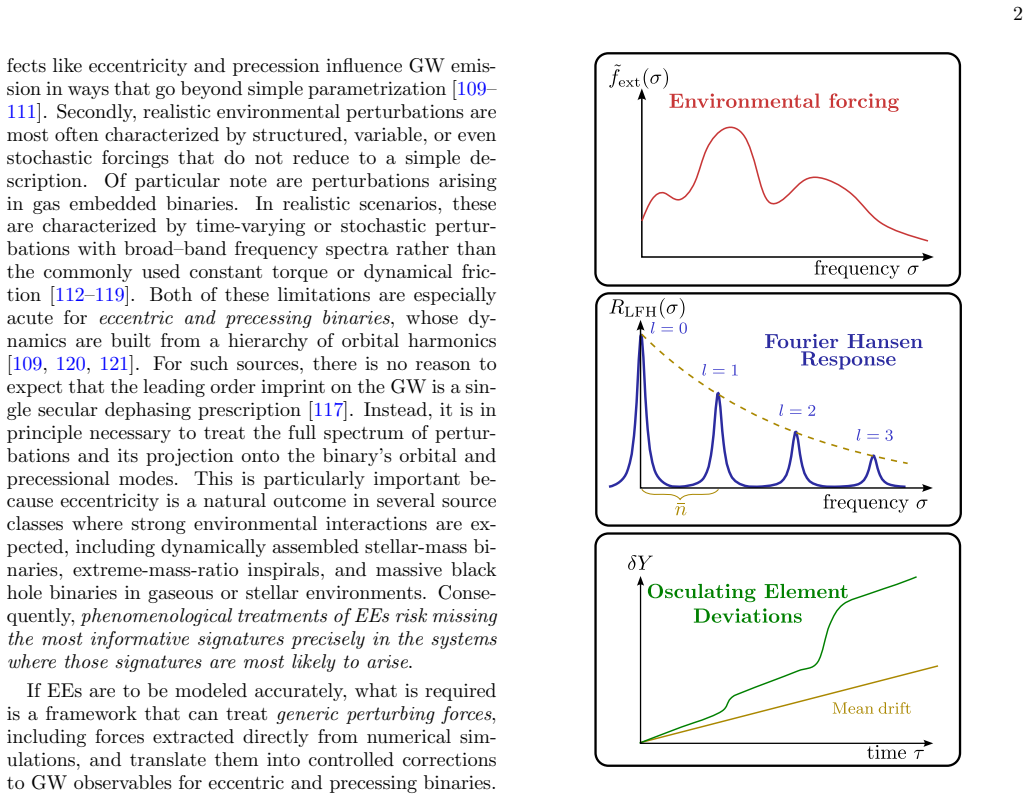
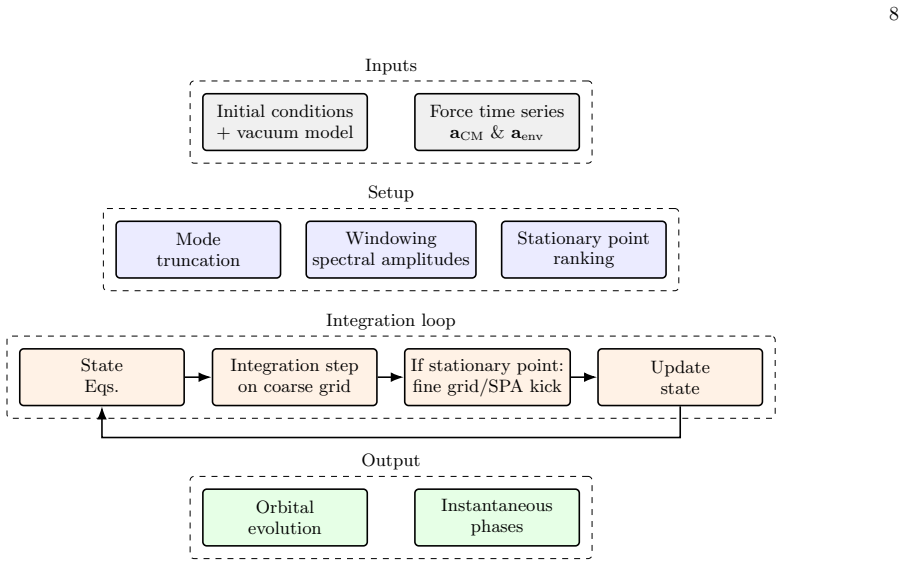
We develop a general framework to characterize non-vacuum perturbations to relativistic binaries in the gravitational-wave driven regime. The effect of smooth, structured and stochastic perturbations to the binary's motion is reduced to a resonant spectral projection defined on a rolling averaging window, with weights given by Hansen coefficients. This is combined with practical criteria for identifying and evaluating the corresponding dynamical response to perturbations, starting from either analytical models or numerical simulations of binaries in environments. The result is a set of coupled ODEs for the orbital elements that capture epi-cyclic, apsidal and nodal resonances, consistently i
What carries the argument
Resonant spectral projection on a rolling averaging window weighted by Hansen coefficients, which converts environmental perturbations into responses of the orbital elements.
If this is right
- Produces coupled ODEs incorporating radiation reaction feedback for orbital elements.
- Applicable to compact binaries in variable tidal fields and extreme-mass-ratio inspirals in accretion disks.
- Enables modeling of environmental effects in GW templates for eccentric and precessing sources.
- Bridges phenomenological prescriptions with realistic environment models for binary dynamics.
Where Pith is reading between the lines
- If accurate, the framework would permit direct incorporation of numerical environment simulations into analytical GW models without full re-integration.
- Similar projection techniques might apply to other resonant orbital systems affected by stochastic forces.
- Testing the ODEs against full N-body or hydrodynamical simulations of specific environments could validate the reduction step.
Load-bearing premise
Arbitrary environmental perturbations can be mapped to the resonant spectral projection and resulting ODEs without significant loss of accuracy or requiring case-by-case adjustments.
What would settle it
Compare the time evolution of orbital elements from the coupled ODEs against a high-fidelity numerical integration of a binary in a known structured environment like an accretion disk, checking for agreement in resonance capture and inspiral rates.
Figures
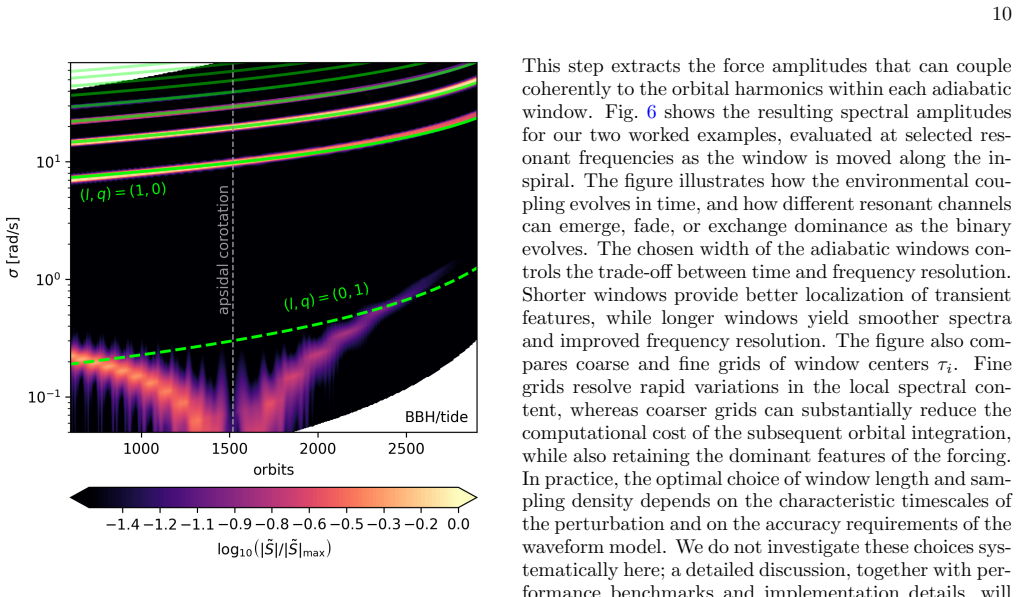
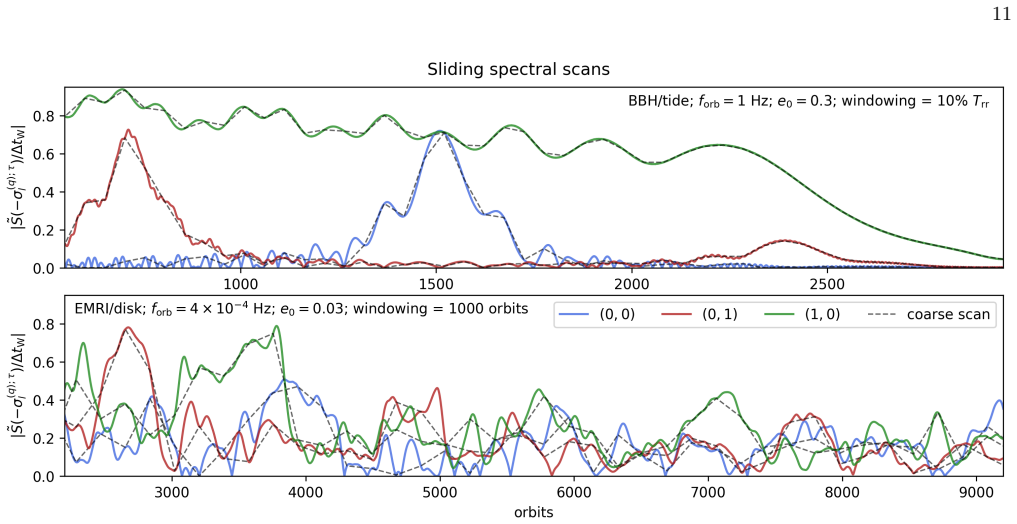
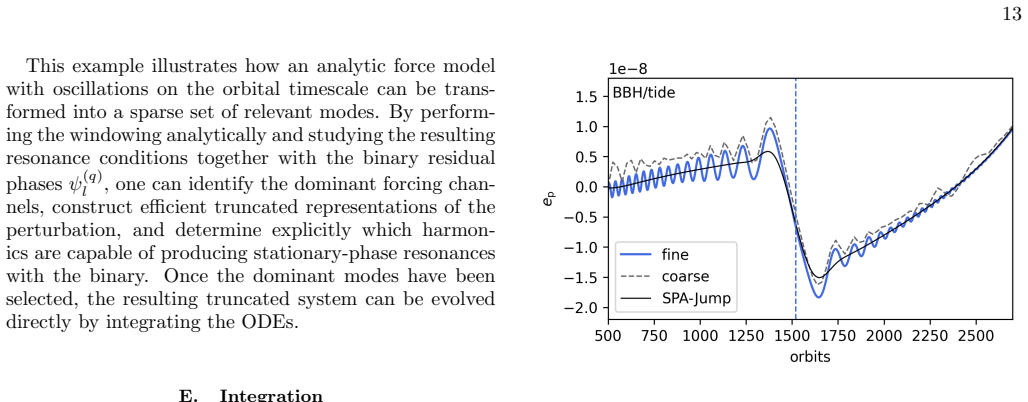
read the original abstract
We develop a general framework to characterize non-vacuum perturbations to relativistic binaries in the gravitational-wave (GW) driven regime, for use in GW parameter estimation studies. The effect of smooth, structured and stochastic perturbations to the binary's motion is reduced to a resonant spectral projection defined on a rolling averaging window, with weights given by Hansen coefficients. This is combined with practical criteria for identifying and evaluating the corresponding dynamical response to perturbations, starting from either analytical models or numerical simulations of binaries in environments. The result is a set of coupled ODEs for the orbital elements that capture epi-cyclic, apsidal and nodal resonances, consistently incorporate feedback from radiation reaction and can be solved efficiently on a coarse time grid. We demonstrate the practical application of the framework in two representative astrophysical scenarios: a compact binary in a variable tidal field and an extreme-mass-ratio inspiral in an accretion disk. We propose the Lagrange-Fourier-Hansen framework as a unified tool for modeling environmental effects in GW templates for eccentric and precessing binary sources, and particularly for bridging the gap between phenomenological prescriptions and realistic models of binaries in environments.
Editorial analysis
A structured set of objections, weighed in public.
Referee Report
Summary. The paper develops a Lagrange-Fourier-Hansen framework that reduces the effects of smooth, structured, and stochastic perturbations on relativistic binaries in the GW-driven regime to a resonant spectral projection on a rolling averaging window, weighted by Hansen coefficients. This yields a closed set of coupled ODEs for the orbital elements that capture epi-cyclic, apsidal, and nodal resonances while incorporating radiation-reaction feedback. The framework is demonstrated on two deterministic cases (variable tidal field; EMRI in an accretion disk) and is proposed as a tool for environmental effects in GW templates for eccentric and precessing binaries.
Significance. If the reduction can be shown to hold with controlled error for stochastic forcing, the framework would provide an efficient, unified approach for incorporating environmental perturbations into GW parameter estimation, bridging phenomenological prescriptions and realistic environmental models.
major comments (2)
- [demonstrations (variable tidal field and EMRI in accretion disk)] The central claim requires that arbitrary smooth/structured/stochastic perturbations can be mapped to the resonant Hansen-weighted projection and resulting ODEs without significant loss of accuracy or case-by-case recalibration. The two demonstrations are both deterministic and structured; no quantitative error estimate or comparison between the projected ODE solution and the underlying perturbed trajectory is supplied for genuinely stochastic forcing.
- [framework derivation and reduction to ODEs] The reduction implicitly assumes that non-resonant and broadband stochastic components average to zero or are absorbed into the resonant coefficients. No error bounds, convergence analysis, or counterexample tests are provided to delineate when this holds, which is load-bearing for the claim that the method produces faithful coupled ODEs from arbitrary environments.
minor comments (1)
- The abstract states that the framework starts from either analytical models or numerical simulations, but the manuscript would benefit from an explicit statement of the input data format required for the rolling-window projection.
Simulated Author's Rebuttal
We thank the referee for the detailed and constructive report. The comments correctly identify that the current demonstrations are limited to deterministic cases and that formal error analysis for stochastic forcing is absent. We address each point below and commit to revisions that strengthen the presentation without overstating the existing results.
read point-by-point responses
-
Referee: [demonstrations (variable tidal field and EMRI in accretion disk)] The central claim requires that arbitrary smooth/structured/stochastic perturbations can be mapped to the resonant Hansen-weighted projection and resulting ODEs without significant loss of accuracy or case-by-case recalibration. The two demonstrations are both deterministic and structured; no quantitative error estimate or comparison between the projected ODE solution and the underlying perturbed trajectory is supplied for genuinely stochastic forcing.
Authors: The two demonstrations were chosen to illustrate the framework on concrete, reproducible astrophysical models where direct comparison to the underlying equations of motion is straightforward. The general derivation in Sections 3 and 4 applies the same resonant projection to stochastic perturbations via the rolling-window Fourier-Hansen decomposition. We agree that explicit stochastic validation with quantitative error metrics is missing and would strengthen the central claim. In the revised manuscript we will add a third demonstration using a stochastic component (e.g., a colored-noise torque in the accretion-disk model) together with direct numerical integration comparisons and reported L2 trajectory errors over the averaging window. revision: yes
-
Referee: [framework derivation and reduction to ODEs] The reduction implicitly assumes that non-resonant and broadband stochastic components average to zero or are absorbed into the resonant coefficients. No error bounds, convergence analysis, or counterexample tests are provided to delineate when this holds, which is load-bearing for the claim that the method produces faithful coupled ODEs from arbitrary environments.
Authors: The reduction follows from the orthogonality properties of the Hansen coefficients combined with the finite rolling average, which mathematically suppresses non-resonant Fourier modes. We acknowledge that the manuscript supplies neither rigorous error bounds nor a convergence proof for arbitrary broadband stochastic forcing. We will revise the discussion (new subsection in Section 5) to state the averaging assumptions explicitly, derive a heuristic error estimate based on the window length and the spectral decay of the Hansen coefficients, and include a simple counterexample test that shows the residual when a purely non-resonant stochastic drive is applied. revision: partial
Circularity Check
No circularity: derivation uses standard Lagrange planetary equations, Fourier analysis and Hansen coefficients on external inputs
full rationale
The paper presents the Lagrange-Fourier-Hansen framework as a methodological reduction of arbitrary smooth/structured/stochastic perturbations to resonant spectral projections (weighted by Hansen coefficients on a rolling window) that yields coupled ODEs for orbital elements. This reduction is described as starting from independent analytical models or numerical simulations of binaries in environments, with two deterministic demonstrations provided as applications rather than self-referential validations. No equations or claims in the abstract reduce the central result to fitted parameters, self-citations, or ansatzes imported from the authors' prior work; the approach is framed as a unification of established celestial-mechanics tools (Lagrange equations, Hansen coefficients) applied to GW-driven binaries. The derivation chain therefore remains self-contained against external benchmarks and does not exhibit any of the enumerated circularity patterns.
Axiom & Free-Parameter Ledger
Reference graph
Works this paper leans on
-
[1]
We re- quire an efficient method to evaluate the evolution equa- tions for cases where the environmental phase is chang- ing rapidly and the resonances are sharp
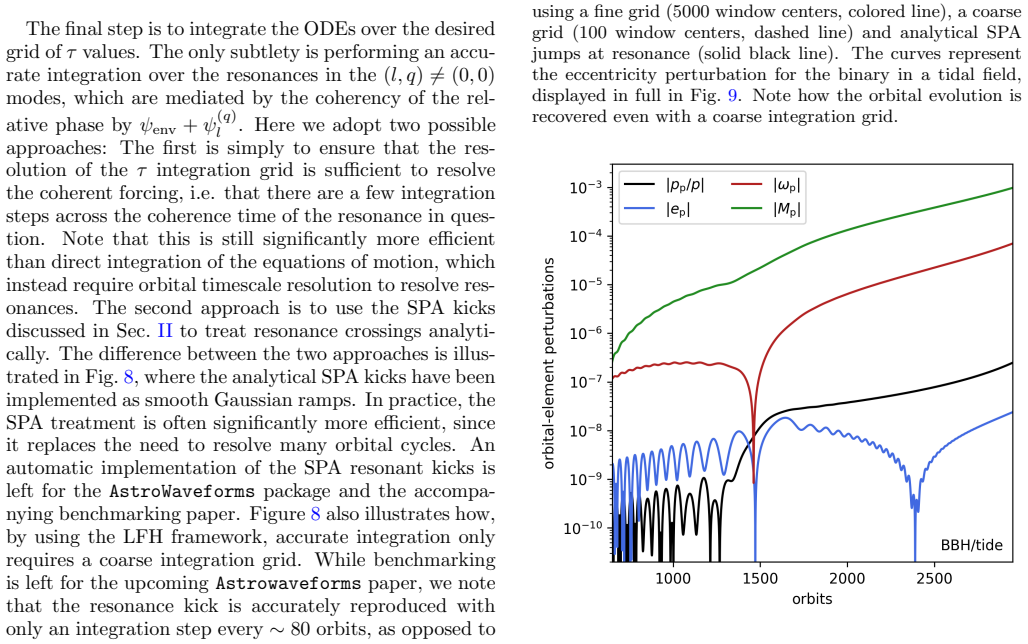
Integration over resonances The final step is to connect the local, window-averaged response to the long-term evolution of the binary. We re- quire an efficient method to evaluate the evolution equa- tions for cases where the environmental phase is chang- ing rapidly and the resonances are sharp. As shown in Appendix A 5, this can be achieved using the st...
-
[2]
dry” and “wet
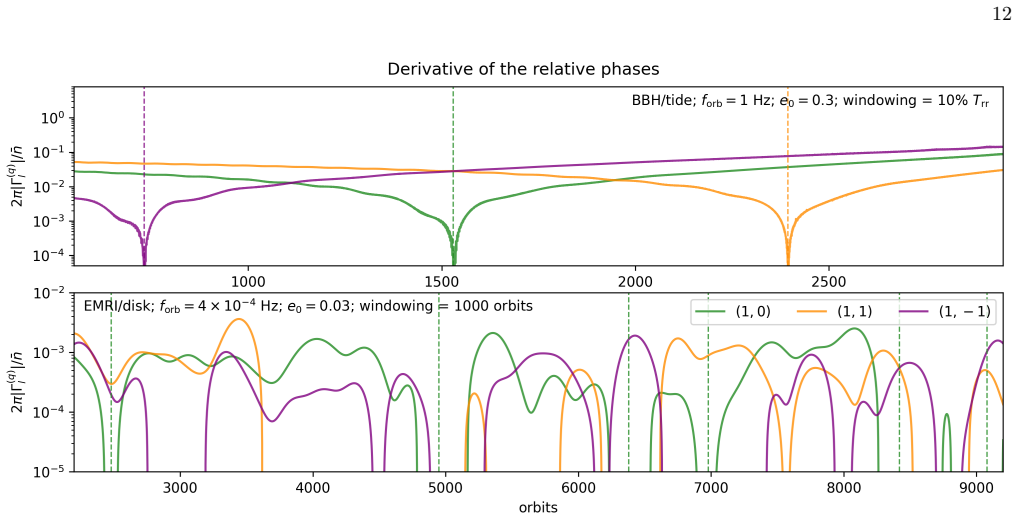
and their corresponding coherence times are given by the second derivative of this phase in Eq. (37). Figure 7 illustrates the coherency of the relative phase for our two worked examples, where in particular the binary in a tidal field showcases three clear stationary points in the displayed modes. Instead, for our EMRI forcing ex- ample, we observe that ...
2024
-
[3]
VIL53101) and the DNRF Chair program (grant no
CD acknowledges support by VILLUM Foundation (grant no.VIL37766 and no. VIL53101) and the DNRF Chair program (grant no. DNRF162) by the Danish Na- tional Research Foundation. JS is supported by the Vil- lum Fonden grant No. 29466, and by the ERC Starting Grant no. 101043143 – Black- HoleMergs. LLMs were used for formatting, coding and for ideation. Append...
-
[4]
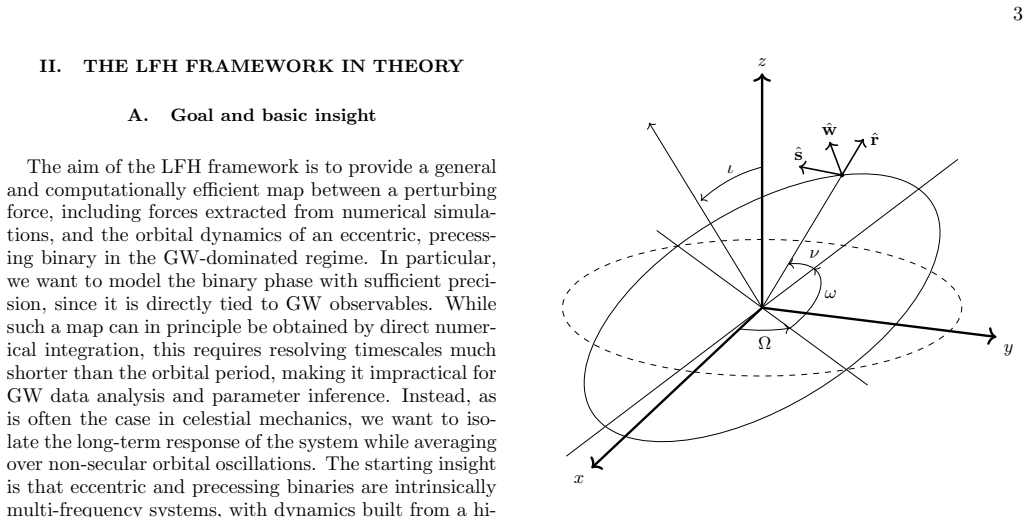
Adiabatic window, precessing carrier orbit, and Lagrange planetary equations Our first task is to identify the response of a relativistic binary to weak environmental perturbations. We work within a local adiabatic time window: Iτ ≡ τ− ∆tW 2 , τ+ ∆tW 2 , T orb ≪∆t W ≪T rr,(A1) whereT orb is a characteristic orbital timescale andT rr is the radiation-react...
-
[5]
Fourier–Hansen decomposition of the forcing problem Working within an adiabatic window we introduce a local Fourier decomposition of the projected environmental force: aenv(t)≈ 1 2π Z ∞ −∞ ˜WI(σ) ˜aenv(τ;σ)e iσt dσ,(A17) 18 with local spectral amplitudes: ˜aenv(τ;σ)≡ Z dt′WI(t′)aenv(t′)e −iσt′ dt′,(A18) whereW I denotes an appropriate windowing kernel tha...
-
[6]
S0,1 l ˜R −σ(0) l ;τ + C0,1 l +e c ac pc X1,0 l + ac pc C1,1 l ˜S −σ(0) l ;τ # eiψ(0) l (τ) ,(A46) ⟨˙ιp⟩res I ≃ ac 2pc∆tW r pc Gm X l
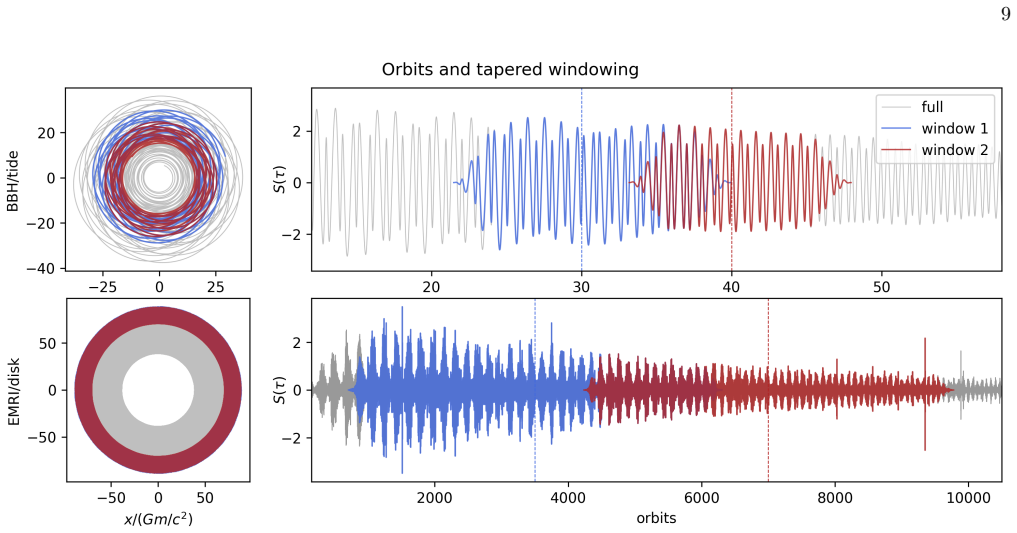
Selection of the resonant modes via window averaging The results above are expressed as sums overl-harmonics and integrals over Fourier modes inσ. For any orbital elementx p or its time derivative ˙xp, we define the local average over the adiabatic intervalI τ as: ⟨˙xp⟩I(τ)≡ 1 ∆tW Z Iτ ˙xp(t)dt.(A38) Following the phase linearization of Eq. A35, we substi...
-
[7]
Response of the binary’s mean anomaly We now close the system by deriving the perturbation of the intrinsic fast orbital phase, which we take to be the mean anomalyM. The LPE for the mean anomaly is: ˙M= ¯n− 2r ¯na2 R+ p 1−e 2 ˙ω+ cosι ˙Ω ,(A51) The first term describes the Keplerian sweep along the osculating orbit, the second term is a direct radial for...
-
[8]
renormalised
Integration over radiation reaction timescales a. The carrier over radiation reaction timescales Over the radiation-reaction timescaleT rr, the assumption of a conservative carrier orbit fails. Instead, we treat the unperturbed carrier as a dynamical reference trajectory that shrinks and circularizes according to orbit-averaged radiation reaction. The car...
-
[9]
ODEs a. Final ODEs Collecting the results above, the secular evolution of the physical binary is governed by the following coupled system: ˙p= ˙prr(p, e) +⟨˙pp⟩res I (A76) ˙e= ˙err(p, e) +⟨˙ep⟩res I (A77) ˙ι= ˙ιPN(p, e) +⟨˙ιp⟩res I ,(A78) ˙Ω = ˙ΩPN(p, e) +⟨ ˙Ωp⟩res I ,(A79) ˙ω= ˙ωPN(p, e) +⟨˙ωp⟩res I ,(A80) ˙M= ¯n(p, e) +⟨ ˙Mp⟩dir I +⟨ ˙Mp⟩geom I .(A81) A...
-
[10]
Damour and N
T. Damour and N. Deruelle, Ann. Inst. Henri Poincar´ e Phys. Th´ eor43, 107 (1985)
1985
-
[11]
Damour, M
T. Damour, M. Soffel, and C. Xu, Phys. Rev. D43, 3273 (1991)
1991
-
[12]
3rd post-Newtonian higher order Hamilton dynamics for two-body point-mass systems
P. Jaranowski and G. Sch¨ afer, Phys. Rev. D57, 7274 (1998), arXiv:gr-qc/9712075 [gr-qc]
work page internal anchor Pith review Pith/arXiv arXiv 1998
-
[13]
P. Jaranowski and G. Sch¨ afer, Phys. Rev. D60, 124003 (1999), arXiv:gr-qc/9906092 [gr-qc]
work page internal anchor Pith review Pith/arXiv arXiv 1999
-
[14]
Effective one-body approach to general relativistic two-body dynamics
A. Buonanno and T. Damour, Phys. Rev. D59, 084006 (1999), arXiv:gr-qc/9811091 [gr-qc]
work page internal anchor Pith review Pith/arXiv arXiv 1999
-
[15]
T. Damour, Phys. Rev. D64, 124013 (2001), arXiv:gr- qc/0103018 [gr-qc]
-
[16]
L. Barack, T. Damour, and N. Sago, Phys. Rev. D82, 084036 (2010), arXiv:1008.0935 [gr-qc]
work page internal anchor Pith review Pith/arXiv arXiv 2010
-
[17]
S. Akcay, L. Barack, T. Damour, and N. Sago, Phys. Rev. D86, 104041 (2012), arXiv:1209.0964 [gr- qc]
work page internal anchor Pith review Pith/arXiv arXiv 2012
-
[18]
Y. Pan, A. Buonanno, A. Taracchini, L. E. Kid- der, A. H. Mrou´ e, H. P. Pfeiffer, M. A. Scheel, and B. Szil´ agyi, Phys. Rev. D89, 084006 (2014), arXiv:1307.6232 [gr-qc]
work page internal anchor Pith review Pith/arXiv arXiv 2014
-
[19]
S. Ossokineet al., Phys. Rev. D102, 044055 (2020), arXiv:2004.09442 [gr-qc]
-
[20]
T. C. Quinn and R. M. Wald, Phys. Rev. D56, 3381 (1997), arXiv:gr-qc/9610053 [gr-qc]
work page internal anchor Pith review Pith/arXiv arXiv 1997
-
[21]
Y. Mino, M. Sasaki, and T. Tanaka, Phys. Rev. D55, 3457 (1997), arXiv:gr-qc/9606018 [gr-qc]
work page internal anchor Pith review Pith/arXiv arXiv 1997
-
[22]
The self-consistent gravitational self-force
A. Pound, Phys. Rev. D81, 024023 (2010), arXiv:0907.5197 [gr-qc]
work page internal anchor Pith review Pith/arXiv arXiv 2010
-
[23]
Gravitational self-force on generic bound geodesics in Kerr spacetime
M. van de Meent, Phys. Rev. D97, 104033 (2018), arXiv:1711.09607 [gr-qc]
work page internal anchor Pith review Pith/arXiv arXiv 2018
-
[24]
B. Wardell, A. Pound, N. Warburton, J. Miller, L. Durkan, and A. Le Tiec, Phys. Rev. Lett.130, 241402 (2023), arXiv:2112.12265 [gr-qc]
-
[25]
Evolution of Binary Black Hole Spacetimes
F. Pretorius, Phys. Rev. Lett.95, 121101 (2005), arXiv:gr-qc/0507014 [gr-qc]
work page internal anchor Pith review Pith/arXiv arXiv 2005
-
[26]
Inspiral-merger-ringdown waveforms for black-hole binaries with non-precessing spins
P. Ajithet al., Phys. Rev. Lett.106, 241101 (2011), arXiv:0909.2867 [gr-qc]
work page internal anchor Pith review Pith/arXiv arXiv 2011
-
[27]
Frequency domain reduced order models for gravitational waves from aligned-spin compact binaries
M. P¨ urrer, Classical and Quantum Gravity31, 195010 (2014), arXiv:1402.4146 [gr-qc]
work page internal anchor Pith review Pith/arXiv arXiv 2014
-
[28]
B. Szil´ agyi, J. Blackman, A. Buonanno, A. Taracchini, H. P. Pfeiffer, M. A. Scheel, T. Chu, L. E. Kidder, and Y. Pan, Phys. Rev. Lett.115, 031102 (2015), arXiv:1502.04953 [gr-qc]
work page internal anchor Pith review Pith/arXiv arXiv 2015
-
[29]
J. Aasiet al.(LIGO Scientific), Class. Quant. Grav.32, 074001 (2015), arXiv:1411.4547 [gr-qc]
work page internal anchor Pith review Pith/arXiv arXiv 2015
-
[30]
B. P. Abbott, R. Abbott, T. D. Abbott, M. R. Aber- nathy, F. Acernese, K. Ackley, C. Adams, T. Adams, P. Addesso, R. X. Adhikari, and et al., ApJ818, L22 (2016), arXiv:1602.03846 [astro-ph.HE]
work page internal anchor Pith review Pith/arXiv arXiv 2016
-
[31]
B. P. Abbott, R. Abbott, T. D. Abbott, F. Acernese, K. Ackley, C. Adams, T. Adams, P. Addesso, R. X. Adhikari, V. B. Adya, and et al., ApJ848, L12 (2017), arXiv:1710.05833 [astro-ph.HE]
work page internal anchor Pith review Pith/arXiv arXiv 2017
-
[32]
B. P. Abbott, R. Abbott, T. D. Abbott, M. R. Aber- nathy, F. Acernese, K. Ackley, C. Adams, T. Adams, P. Addesso, R. X. Adhikari, and et al., Physical Review Letters116, 241103 (2016), arXiv:1606.04855 [gr-qc]
work page internal anchor Pith review Pith/arXiv arXiv 2016
-
[33]
Abbottet al.(LIGO Scientific, Virgo), Phys
R. Abbottet al.(LIGO Scientific, Virgo), Phys. Rev. D 102, 043015 (2020), arXiv:2004.08342 [astro-ph.HE]
-
[34]
The population of merging compact binaries inferred using gravitational waves through GWTC-3
R. Abbottet al.(KAGRA, VIRGO, LIGO Scientific), Phys. Rev. X13, 011048 (2023), arXiv:2111.03634 [astro-ph.HE]
work page internal anchor Pith review Pith/arXiv arXiv 2023
-
[35]
K. Belczynski, V. Kalogera, and T. Bulik, ApJ572, 407 (2002), arXiv:astro-ph/0111452 [astro-ph]
work page internal anchor Pith review Pith/arXiv arXiv 2002
- [36]
-
[37]
The Total Merger Rate of Compact Object Binaries In The Local Universe
A. Sadowski, K. Belczynski, T. Bulik, N. Ivanova, F. A. Rasio, and R. O’Shaughnessy, ApJ676, 1162 (2008), arXiv:0710.0878 [astro-ph]
work page internal anchor Pith review Pith/arXiv arXiv 2008
-
[38]
Merging black hole binaries in galactic nuclei: implications for advanced-LIGO detections
F. Antonini and F. A. Rasio, ApJ831, 187 (2016), arXiv:1606.04889 [astro-ph.HE]. 25
work page internal anchor Pith review Pith/arXiv arXiv 2016
-
[39]
Use of gravitational waves to probe the formation channels of compact binaries
S. Vitale, R. Lynch, R. Sturani, and P. Graff, Classical and Quantum Gravity34, 03LT01 (2017), arXiv:1503.04307 [gr-qc]
work page internal anchor Pith review Pith/arXiv arXiv 2017
- [40]
- [42]
-
[43]
C. Kimballet al., Astrophys. J. Lett.915, L35 (2021), arXiv:2011.05332 [astro-ph.HE]
-
[44]
A. Santini, D. Gerosa, R. Cotesta, and E. Berti, Phys. Rev. D108, 083033 (2023), arXiv:2308.12998 [astro-ph.HE]
-
[45]
S. F. Portegies Zwart and S. L. W. McMillan, ApJ528, L17 (2000), arXiv:astro-ph/9910061 [astro-ph]
work page internal anchor Pith review Pith/arXiv arXiv 2000
-
[46]
W. H. Lee, E. Ramirez-Ruiz, and G. van de Ven, As- trophys. J.720, 953 (2010), arXiv:0909.2884 [astro- ph.HE]
work page internal anchor Pith review Pith/arXiv arXiv 2010
-
[47]
Stellar-mass black holes in star clusters: implications for gravitational wave radiation
S. Banerjee, H. Baumgardt, and P. Kroupa, MNRAS 402, 371 (2010), arXiv:0910.3954 [astro-ph.SR]
work page internal anchor Pith review Pith/arXiv arXiv 2010
-
[48]
A. Tanikawa, MNRAS435, 1358 (2013), arXiv:1307.6268
work page internal anchor Pith review Pith/arXiv arXiv 2013
-
[49]
Y.-B. Bae, C. Kim, and H. M. Lee, MNRAS440, 2714 (2014), arXiv:1308.1641 [astro-ph.HE]
work page internal anchor Pith review Pith/arXiv arXiv 2014
-
[50]
C. L. Rodriguez, M. Morscher, B. Pattabiraman, S. Chatterjee, C.-J. Haster, and F. A. Rasio, Phys. Rev. Lett.115, 051101 (2015), arXiv:1505.00792 [astro-ph.HE]
work page internal anchor Pith review Pith/arXiv arXiv 2015
-
[51]
E. Ramirez-Ruiz, M. Trenti, M. MacLeod, L. F. Roberts, W. H. Lee, and M. I. Saladino-Rosas, ApJ802, L22 (2015), arXiv:1410.3467
work page internal anchor Pith review Pith/arXiv arXiv 2015
-
[52]
C. L. Rodriguez, S. Chatterjee, and F. A. Rasio, Phys. Rev. D93, 084029 (2016), arXiv:1602.02444 [astro-ph.HE]
work page internal anchor Pith review Pith/arXiv arXiv 2016
-
[53]
C. L. Rodriguez, C.-J. Haster, S. Chatterjee, V. Kalogera, and F. A. Rasio, ApJ824, L8 (2016), arXiv:1604.04254 [astro-ph.HE]
work page internal anchor Pith review Pith/arXiv arXiv 2016
-
[54]
MOCCA-SURVEY Database I: Coalescing Binary Black Holes Originating From Globular Clusters
A. Askar, M. Szkudlarek, D. Gondek-Rosi´ nska, M. Giersz, and T. Bulik, MNRAS464, L36 (2017), arXiv:1608.02520 [astro-ph.HE]
work page internal anchor Pith review Pith/arXiv arXiv 2017
-
[55]
D. Park, C. Kim, H. M. Lee, Y.-B. Bae, and K. Bel- czynski, MNRAS469, 4665 (2017), arXiv:1703.01568 [astro-ph.HE]
work page internal anchor Pith review Pith/arXiv arXiv 2017
-
[56]
Eccentric Black Hole Mergers Forming in Globular Clusters
J. Samsing, Phys. Rev. D97, 103014 (2018), arXiv:1711.07452 [astro-ph.HE]
work page internal anchor Pith review Pith/arXiv arXiv 2018
-
[57]
J. Samsing and D. J. D’Orazio, MNRAS 10.1093/mn- ras/sty2334 (2018), arXiv:1804.06519 [astro-ph.HE]
work page internal anchor Pith review Pith/arXiv arXiv doi:10.1093/mn- 2018
-
[58]
J. Samsing, D. J. D’Orazio, K. Kremer, C. L. Ro- driguez, and A. Askar, Phys. Rev. D101, 123010 (2020), arXiv:1907.11231 [astro-ph.HE]
- [59]
-
[60]
S. Naoz, B. Kocsis, A. Loeb, and N. Yunes, ApJ773, 187 (2013), arXiv:1206.4316 [astro-ph.SR]
work page internal anchor Pith review Pith/arXiv arXiv 2013
-
[61]
G. Li, S. Naoz, B. Kocsis, and A. Loeb, ApJ785, 116 (2014), arXiv:1310.6044 [astro-ph.EP]
work page internal anchor Pith review Pith/arXiv arXiv 2014
-
[62]
Black hole mergers and blue stragglers from hierarchical triples formed in globular clusters
F. Antonini, S. Chatterjee, C. L. Rodriguez, M. Morscher, B. Pattabiraman, V. Kalogera, and F. A. Rasio, ApJ816, 65 (2016), arXiv:1509.05080
work page internal anchor Pith review Pith/arXiv arXiv 2016
-
[63]
J. M. O. Antognini and T. A. Thompson, MNRAS456, 4219 (2016), arXiv:1507.03593 [astro-ph.SR]
work page internal anchor Pith review Pith/arXiv arXiv 2016
-
[64]
Lidov-Kozai Cycles with Gravitational Radiation: Merging Black Holes in Isolated Triple Systems
K. Silsbee and S. Tremaine, ApJ836, 39 (2017), arXiv:1608.07642 [astro-ph.HE]
work page internal anchor Pith review Pith/arXiv arXiv 2017
-
[65]
An Analytical Portrait of Binary Mergers in Hierarchical Triple Systems
L. Randall and Z.-Z. Xianyu, ApJ864, 134 (2018), arXiv:1802.05718 [gr-qc]
work page internal anchor Pith review Pith/arXiv arXiv 2018
- [66]
- [67]
- [68]
-
[69]
Rapid and Bright Stellar-mass Binary Black Hole Mergers in Active Galactic Nuclei
I. Bartos, B. Kocsis, Z. Haiman, and S. M´ arka, ApJ 835, 165 (2017), arXiv:1602.03831 [astro-ph.HE]
work page internal anchor Pith review Pith/arXiv arXiv 2017
-
[70]
N. C. Stone, B. D. Metzger, and Z. Haiman, MNRAS 464, 946 (2017), arXiv:1602.04226
work page internal anchor Pith review Pith/arXiv arXiv 2017
-
[71]
On stellar-mass black hole mergers in AGN disks detectable with LIGO
B. Mckernanet al., Astrophys. J.866, 66 (2018), arXiv:1702.07818 [astro-ph.HE]
work page internal anchor Pith review Pith/arXiv arXiv 2018
- [72]
-
[73]
J. Samsing, I. Bartos, D. J. D’Orazio, Z. Haiman, B. Kocsis, N. W. C. Leigh, B. Liu, M. E. Pessah, and H. Tagawa, Nature603, 237 (2022), arXiv:2010.09765 [astro-ph.HE]
- [74]
- [75]
-
[76]
P. Amaro-Seoane, J. R. Gair, M. Freitag, M. C. Miller, I. Mandel, C. J. Cutler, and S. Babak, Classi- cal and Quantum Gravity24, R113 (2007), arXiv:astro- ph/0703495 [astro-ph]
-
[77]
Science with the space-based interferometer LISA. V: Extreme mass-ratio inspirals
S. Babak, J. Gair, A. Sesana, E. Barausse, C. F. Sop- uerta, C. P. L. Berry, E. Berti, P. Amaro-Seoane, A. Pe- titeau, and A. Klein, Phys. Rev. D95, 103012 (2017), arXiv:1703.09722 [gr-qc]
work page internal anchor Pith review Pith/arXiv arXiv 2017
-
[78]
Laser Interferometer Space Antenna
P. Amaro-Seoaneet al., arXiv e-prints , arXiv:1702.00786 (2017), arXiv:1702.00786 [astro- ph.IM]
work page internal anchor Pith review Pith/arXiv arXiv 2017
-
[79]
The Laser Interferometer Space Antenna: Unveiling the Millihertz Gravitational Wave Sky
J. Bakeret al., inBulletin of the American Astronomical Society, Vol. 51 (2019) p. 77, arXiv:1907.06482 [astro- ph.IM]
work page internal anchor Pith review Pith/arXiv arXiv 2019
-
[80]
P. A. Seoaneet al.(LISA), Living Rev. Rel.26, 2 (2023), arXiv:2203.06016 [gr- qc]
work page internal anchor Pith review Pith/arXiv arXiv 2023
-
[81]
M. Colpiet al.(LISA), LISA Definition Study Report (2024), arXiv:2402.07571 [astro-ph.CO]
work page internal anchor Pith review Pith/arXiv arXiv 2024
discussion (0)
Sign in with ORCID, Apple, or X to comment. Anyone can read and Pith papers without signing in.