REVIEW 2 major objections 1 minor 70 references
What Was That Again? Certified Robustness for Automatic Speech Recognition
T0 review · 2 major / 1 minor · reviewed 2026-07-02 · grok-4.3
Pith's one-line read A dual-gate certification pipeline reduces word error rates in speech recognition by up to 55 percent while certifying tokens and excluding attacks without knowing the true transcription.
desk verdict The dual-gate audit and tournament for ASR certification without oracle transcriptions is the new piece, but the statistical details needed to back the certificates are not visible. read the letter →
The pith
A machine-rendered reading of the paper's core claim, the machinery that carries it, and where it could break.
The reading
What carries the argument
dual-gate diagnostic pipeline consisting of a Two-Sided Atomic Audit for statistical certification of token presence and attack exclusion plus a Rank-Based Tournament for sequence selection
What would settle it
Running the pipeline on adversarial speech examples and observing no reduction in word error rate or incorrect certifications of token existence would falsify the claim.
Extended reading notes
Core claim
The paper claims that a Two-Sided Atomic Audit accumulates statistical wealth to certify both token existence and adversarial exclusion, while a Rank-Based Tournament selects the winning transcription sequence; together these steps produce up to a 55 percent relative drop in word error rate, higher recall, lower Spearman correlation between confidence and error, and granular word- and sentence-level certifications.
Load-bearing premise
The statistical wealth gathered by the Two-Sided Atomic Audit is sufficient to certify both correct token existence and adversarial exclusion without any oracle knowledge of the true transcription.
Editorial extensions
If this is right
- Up to 55 percent relative reduction in word error rate across four architectures.
- Increased recall of problematic tokens or sequences.
- Lower Spearman correlation between model confidence and actual word error rate.
- Granular word-level and sentence-level certifications that enhance acoustic security.
Reading between the lines
- The same audit-and-tournament structure could be tested on other sequence tasks such as machine translation where ground truth is also unavailable at inference time.
- Integration with streaming ASR could allow continuous certification of partial outputs in real time.
- The method might reduce reliance on adversarial training by shifting effort to post-hoc statistical checks.
- Applications in voice-controlled safety systems could use the certifications to trigger fallback behaviors when evidence is weak.
Editorial analysis
A structured set of objections, weighed in public.
Referee Report
Summary. The paper claims that a certification-inspired dual-gate diagnostic pipeline for ASR—comprising a Two-Sided Atomic Audit that accumulates statistical wealth to certify both token existence and adversarial exclusion, plus a Rank-Based Tournament for selecting the winning sequence—can achieve up to 55% relative WER reduction, increased recall, decreased Spearman correlation between confidence and WER, and granular word-/sentence-level certifications across four architectures, all without requiring oracle transcriptions.
Significance. If the statistical certifications prove valid, the approach could meaningfully advance acoustic security for deployed ASR systems by enabling verifiable robustness guarantees in the absence of ground-truth transcriptions.
major comments (2)
- [Abstract / Method description] The load-bearing claim that the Two-Sided Atomic Audit can accumulate sufficient statistical wealth to certify both token existence and adversarial exclusion without oracle knowledge of the true transcription lacks any specification of the test statistic, sampling procedure, independence assumptions, or decision thresholds (abstract and method description). Without these, it is impossible to determine whether the reported WER reductions arise from valid certification or post-hoc selection.
- [Abstract / Evaluations] The empirical claims of 55% relative WER reduction, recall gains, and decorrelation are presented without error bars, dataset descriptions, or details on architecture selection and evaluation protocol (abstract and evaluations section). This undermines verification of whether the dual-gate pipeline's performance improvements are robust.
minor comments (1)
- [Abstract] The abstract would be clearer with a one-sentence overview of the statistical wealth accumulation process before stating the performance numbers.
Simulated Author's Rebuttal
We thank the referee for their constructive comments, which highlight areas where the manuscript requires greater clarity and rigor. We address each major comment below and will revise the paper accordingly.
read point-by-point responses
-
Referee: [Abstract / Method description] The load-bearing claim that the Two-Sided Atomic Audit can accumulate sufficient statistical wealth to certify both token existence and adversarial exclusion without oracle knowledge of the true transcription lacks any specification of the test statistic, sampling procedure, independence assumptions, or decision thresholds (abstract and method description). Without these, it is impossible to determine whether the reported WER reductions arise from valid certification or post-hoc selection.
Authors: We agree that the current description does not provide sufficient statistical detail on the Two-Sided Atomic Audit. The revised manuscript will explicitly define the test statistic for accumulating statistical wealth, the sampling procedure for generating and auditing candidate tokens, the independence assumptions (e.g., conditional independence of tokens given the input audio), and the decision thresholds calibrated to target certification levels. These additions will clarify how certifications for both token existence and adversarial exclusion are obtained without oracle transcriptions and will distinguish the approach from post-hoc selection. revision: yes
-
Referee: [Abstract / Evaluations] The empirical claims of 55% relative WER reduction, recall gains, and decorrelation are presented without error bars, dataset descriptions, or details on architecture selection and evaluation protocol (abstract and evaluations section). This undermines verification of whether the dual-gate pipeline's performance improvements are robust.
Authors: We agree that the empirical results require more complete reporting to support verification. The revised manuscript will include error bars on all metrics (computed via multiple runs or bootstrap resampling), full dataset descriptions (sizes, sources, and preprocessing steps), rationale for selecting the four architectures, and a detailed evaluation protocol (including splits, hyperparameters, and statistical testing). These changes will allow readers to assess the robustness of the reported WER reductions, recall improvements, and decorrelation effects. revision: yes
Circularity Check
No circularity detected; method claims rest on statistical audit without self-referential reduction
full rationale
The provided abstract and text describe a dual-gate pipeline (Two-Sided Atomic Audit accumulating statistical wealth for token existence and adversarial exclusion, plus Rank-Based Tournament) that is claimed to reduce WER and improve recall. No equations, parameter-fitting steps, self-citations, or uniqueness theorems are quoted or referenced that would make any prediction equivalent to its inputs by construction. The central statistical claim is presented as an independent mechanism rather than a renaming or self-definition. This is the expected non-finding for a methods paper whose derivation chain is not exhibited in the given source.
Assumptions & free parameters
Cite this review
Pith. "Pith review of What Was That Again? Certified Robustness for Automatic Speech Recognition." pith.science (2026). https://pith.science/paper/NK4MYUW3
@misc{pith2026260627698,
  author       = {Pith},
  title        = {Pith review of: What Was That Again? Certified Robustness for Automatic Speech Recognition},
  year         = {2026},
  howpublished = {\url{https://pith.science/paper/NK4MYUW3}},
  note         = {Machine review of arXiv:2606.27698}
}
read the original abstract
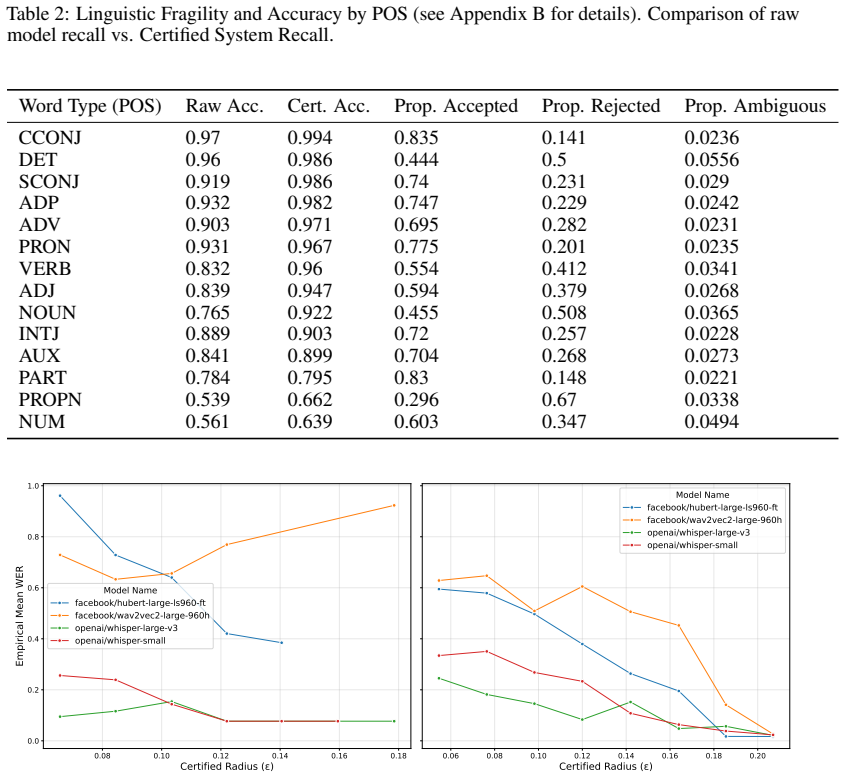
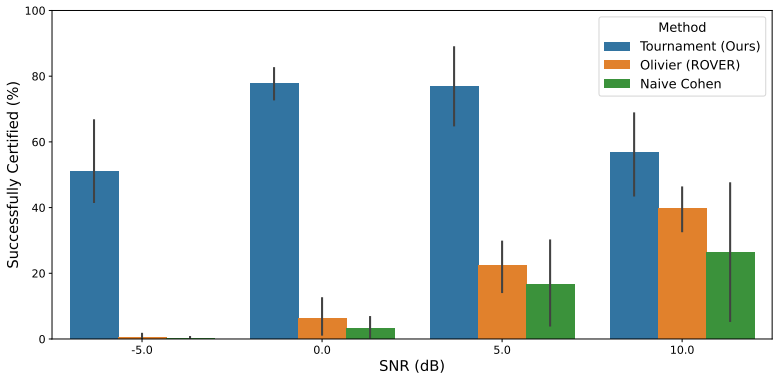
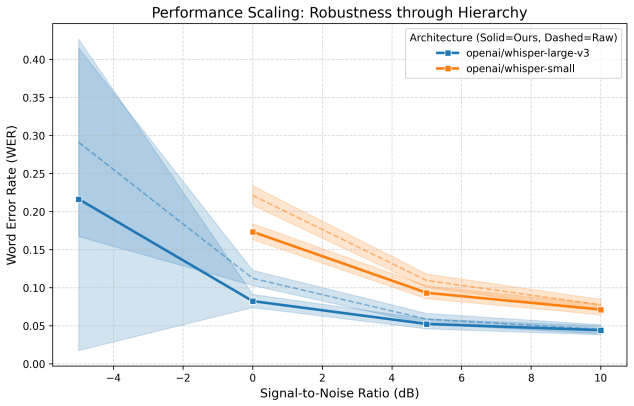
Automatic Speech Recognition systems are notoriously both sensitive to adversarial and benign perturbations. While this has been repeatedly demonstrated using reference datasets, detecting such behaviors in deployed systems is incredibly challenging, due to the absence of oracle knowledge of the true transcription. We demonstrate that employing a certification-inspired mechanism can significantly decrease WER, increase recall, and decrease the Spearman correlation between confidence and WER. We achieve this through a dual-gate diagnostic pipeline: a Two-Sided Atomic Audit that accumulates statistical wealth to certify both token existence and adversarial exclusion, and a Rank-Based Tournament that selects the winning sequence. Our evaluations across four diverse architectures demonstrate up to a 55% relative reduction in Word Error Rate, while also providing granular word- and sentence-level certifications to enhance acoustic security.
Figures
Figures from the paper (1 more)
Reference graph
Works this paper leans on
-
[1]
Szegedy, Christian and Zaremba, Wojciech and Sutskever, Ilya and Bruna, Joan and Erhan, Dumitru and Goodfellow, Ian and Fergus, Rob , journal =
-
[2]
Goodfellow, Ian J and Shlens, Jonathon and Szegedy, Christian , journal =
-
[3]
Aleksander Madry and Aleksandar Makelov and Ludwig Schmidt and Dimitris Tsipras and Adrian Vladu , booktitle =
-
[4]
Cullen, Andrew Craig and Montague, Paul and Erfani, Sarah Monazam and Rubinstein, Benjamin I. P. , booktitle =
-
[5]
Cohen, Jeremy and Rosenfeld, Elan and Kolter, Zico , booktitle =
- [6]
-
[7]
and Montague, Paul and Liu, Shijie and Erfani, Sarah M
Cullen, Andrew C. and Montague, Paul and Liu, Shijie and Erfani, Sarah M. and Rubinstein, Benjamin I.P. , journal=. Double
- [8]
Show all 70 references
-
[9]
Clopper, Charles J and Pearson, Egon S , journal=. The. 1934 , publisher=
1934
-
[10]
Regularity
Doob, Joseph L , journal=. Regularity
-
[11]
Ville, Jean , volume=. Etude. 1939 , publisher=
1939
-
[12]
, journal=
Brent, Richard P. , journal=. An. 1971 , publisher=
1971
-
[13]
Krichevsky, Raphail and Trofimov, Victor , journal=. The. 1981 , publisher=
1981
-
[14]
Asymptotic
Xie, Qun and Barron, Andrew R , journal=. Asymptotic
-
[15]
Shafer, Glenn and Vovk, Vladimir , year=. Game-
-
[16]
Ramdas, Aaditya and Gr. Game-. Statistical Science , volume=. 2023 , publisher=
2023
-
[17]
Estimating
Waudby-Smith, Ian and Ramdas, Aaditya , journal=. Estimating. 2024 , pages=
2024
-
[18]
Gr. Safe. 2020 Information. 2020 , organization=
2020
-
[19]
E-values:
Vovk, Vladimir and Wang, Ruodu , journal=. E-values:. 2021 , publisher=
2021
-
[20]
Salman, Hadi and Yang, Greg and Zhang, Huan and Hsieh, Cho-Jui and Zhang, Pengchuan , booktitle=. A
-
[21]
Differentiable
Mirman, Matthew and Gehr, Timon and Vechev, Martin , booktitle=. Differentiable. 2018 , organization=
2018
-
[22]
Weng, Lily and Zhang, Huan and Chen, Hongge and Song, Zhao and Hsieh, Cho-Jui and Daniel, Luca and Boning, Duane and Dhillon, Inderjit , booktitle=. Towards. 2018 , organization=
2018
-
[23]
Efficient
Zhang, Huan and Weng, Tsui-Wei and Chen, Pin-Yu and Hsieh, Cho-Jui and Daniel, Luca , booktitle =. Efficient. 2018 , publisher =
2018
-
[24]
Efficient
Zhang, Huan and Weng, Tsui-Wei and Chen, Pin-Yu and Hsieh, Cho-Jui and Daniel, Luca , booktitle=. Efficient
-
[25]
Singh, Gagandeep and Gehr, Timon and P. An. Proceedings of the ACM on Programming Languages , volume=. 2019 , publisher=
2019
-
[26]
Mohapatra, Jeet and Weng, Tsui-Wei and Chen, Pin-Yu and Liu, Sijia and Daniel, Luca , booktitle=. Towards
-
[27]
Lyu, Zhaoyang and Guo, Minghao and Wu, Tong and Xu, Guodong and Zhang, Kehuan and Lin, Dahua , booktitle=. Towards
-
[28]
Automatic
Xu, Kaidi and Shi, Zhouxing and Zhang, Huan and Wang, Yihan and Chang, Kai-Wei and Huang, Minlie and Kailkhura, Bhavya and Lin, Xue and Hsieh, Cho-Jui , journal=. Automatic
-
[29]
Wang, Shiqi and Zhang, Huan and Xu, Kaidi and Lin, Xue and Jana, Suman and Hsieh, Cho-Jui and Kolter, J Zico , journal=. Beta-
-
[30]
Certified
Chiang, Ping-yeh and Ni, Renkun and Abdelkader, Ahmed and Zhu, Chen and Studer, Christoph and Goldstein, Tom , journal=. Certified
-
[31]
Levine, Alexander and Feizi, Soheil , journal=. (De)
-
[32]
International Conference on Learning Representations , year=
Boosting Randomized Smoothing with Variance Reduced Classifiers , author=. International Conference on Learning Representations , year=
-
[33]
Chen, Ruoxin and Li, Jie and Yan, Junchi and Li, Ping and Sheng, Bin , booktitle=. Input-
-
[34]
The Annals of Statistics , volume=
Time-uniform, nonparametric, nonasymptotic confidence sequences , author=. The Annals of Statistics , volume=. 2021 , publisher=
2021
-
[35]
Advances in Neural Information Processing Systems , pages =
Bai Li and Changyou Chen and Wenlin Wang and Lawrence Carin , title =. Advances in Neural Information Processing Systems , pages =. 2019 , organization=
2019
-
[36]
Calibrating
Dwork, Cynthia and McSherry, Frank and Nissim, Kobbi and Smith, Adam , booktitle=. Calibrating. 2006 , organization=
2006
-
[37]
Shi, Zhouxing and Jin, Qirui and Zhang, Huan and Kolter, Zico and Jana, Suman and Hsieh, Cho-Jui , booktitle=. Formal
-
[38]
Hein, Matthias and Andriushchenko, Maksym , booktitle =. Formal. 2017 , volume=
2017
-
[39]
Lipschitz-
Tsuzuku, Yusuke and Sato, Issei and Sugiyama, Masashi , booktitle=. Lipschitz-. 2018 , volume=
2018
-
[40]
Globally-
Leino, Klas and Wang, Zifan and Fredrikson, Matt , booktitle=. Globally-. 2021 , organization=
2021
-
[41]
Provably
Salman, Hadi and Li, Jerry and Razenshteyn, Ilya and Zhang, Pengchuan and Zhang, Huan and Bubeck, Sebastien and Yang, Greg , booktitle =. Provably. 2019 , volume=
2019
-
[42]
Peeking at
Johari, Ramesh and Koomen, Pete and Pekelis, Leonid and Walsh, David , booktitle=. Peeking at
-
[43]
, title =
Hannun, Awni and Case, Carl and Casper, Jared and Catanzaro, Bryan and Diamos, Greg and Elsen, Erich and Prenger, Ryan and Satheesh, Sanjeev and Sengupta, Shubho and Coates, Adam and Ng, Andrew Y. , title =. arXiv preprint , year =
-
[44]
Advances in Neural Information Processing Systems (NeurIPS) , year =
Baevski, Alexei and Zhou, Henry and Mohamed, Abdelrahman and Auli, Michael , title =. Advances in Neural Information Processing Systems (NeurIPS) , year =
-
[45]
Radford, Alec and Kim, Jong Wook and Xu, Tao and Brockman, Greg and McLeavey, Christine and Sutskever, Ilya , booktitle =. Robust. 2023 , pages =
2023
-
[46]
IEEE Security and Privacy Workshops (SPW) , year =
Carlini, Nicholas and Wagner, David , title =. IEEE Security and Privacy Workshops (SPW) , year =
-
[47]
Proceedings of the 36th International Conference on Machine Learning (ICML) , year =
Qin, Yao and Carlini, Nicholas and Goodfellow, Ian and Cottrell, Garrison and Raffel, Colin , title =. Proceedings of the 36th International Conference on Machine Learning (ICML) , year =
-
[48]
arXiv preprint , year =
Olivier, Romain and Raj, Bhiksha , title =. arXiv preprint , year =
-
[49]
Adversarial
Sch. Adversarial. Network and Distributed System Security Symposium (NDSS) , year =
-
[50]
Cybersecurity , year =
Sun, Qibin and Chen, Shun and Zhai, Yingbin and Liu, Yang and Zhong, Zhisheng , title =. Cybersecurity , year =
-
[51]
Proceedings of Interspeech , year =
Jung, Jee-weon and Heo, Ha-Jin and Tak, Hee-Soo and Yu, Hong-Goo , title =. Proceedings of Interspeech , year =
-
[52]
IEEE International Conference on Acoustics, Speech and Signal Processing (ICASSP) , year =
Chan, William and Jaitly, Navdeep and Le, Quoc and Vinyals, Oriol , title =. IEEE International Conference on Acoustics, Speech and Signal Processing (ICASSP) , year =
-
[53]
Zico , title =
Szurley, Joseph and Kolter, J. Zico , title =. arXiv preprint , year =
-
[54]
Hussain, Shehzeen and Neekhara, Paarth and Dubnov, Shlomo and McAuley, Julian and Koushanfar, Farinaz , title =. 30th. 2021 , pages =
2021
-
[55]
Fiscus, Jonathan G , booktitle=. A. 1997 , organization=
1997
-
[56]
Mangu, Lidia and Brill, Eric and Stolcke, Andreas , journal=. Finding. 2000 , publisher=
2000
-
[57]
Sequential
Olivier, Raphael and Raj, Bhiksha , booktitle=. Sequential
-
[58]
Cullen, Andrew C and Liu, Shijie and Montague, Paul and Erfani, Sarah M and Rubinstein, Benjamin IP , booktitle=. Et
-
[59]
Journal of the Royal Statistical Society: Series B (Methodological) , volume=
Controlling the false discovery rate: a practical and powerful approach to multiple testing , author=. Journal of the Royal Statistical Society: Series B (Methodological) , volume=. 1995 , publisher=
1995
-
[60]
Journal of the Royal Statistical Society Series B: Statistical Methodology , volume=
False discovery rate control with e-values , author=. Journal of the Royal Statistical Society Series B: Statistical Methodology , volume=. 2022 , publisher=
2022
-
[61]
An Efficient Multistage
Haihua, Xu and Jie, Zhu and Wu, Guanyong , booktitle=. An Efficient Multistage. 2009 , organization=
2009
-
[62]
Huang, Zhuoqun and Marchant, Neil G and Lucas, Keane and Bauer, Lujo and Ohrimenko, Olga and Rubinstein, Benjamin , journal=
-
[63]
Assessing and
Olivier, Rapha. Assessing and. 2023 , school=
2023
-
[64]
Huang, Zhuoqun and Marchant, Neil G and Ohrimenko, Olga and Rubinstein, Benjamin IP , booktitle=
-
[65]
Librispeech:
Panayotov, Vassil and Chen, Guoguo and Povey, Daniel and Khudanpur, Sanjeev , booktitle=. Librispeech:. 2015 , organization=
2015
-
[66]
Ardila, Rosana and Branson, Megan and Davis, Kelly and Kohler, Michael and Meyer, Josh and Henretty, Michael and Morais, Reuben and Saunders, Lindsay and Tyers, Francis and Weber, Gregor , booktitle=. Common
-
[67]
International conference on machine learning , pages=
Robust speech recognition via large-scale weak supervision , author=. International conference on machine learning , pages=. 2023 , organization=
2023
-
[68]
Hsu, Wei-Ning and Bolte, Benjamin and Tsai, Yao-Hung Hubert and Lakhotia, Kushal and Salakhutdinov, Ruslan and Mohamed, Abdelrahman , journal=. Hu. 2021 , publisher=
2021
-
[69]
wav2vec 2.0:
Baevski, Alexei and Zhou, Yuhao and Mohamed, Abdelrahman and Auli, Michael , journal=. wav2vec 2.0:
-
[70]
Honnibal, Matthew and Montani, Ines and Van Landeghem, Sofie and Boyd, Adriane and others , year=
Reviewed July 2, 2026 · model on record in the stance chip above.
Discussion (0). Sign in to comment.