REVIEW 2 major objections 2 minor 46 references
Room for Error: Large-Scale Simulation of Over-the-Air Acoustic Attacks
T0 review · 2 major / 2 minor · reviewed 2026-07-02 · grok-4.3
Pith's one-line read A simulation framework for over-the-air acoustic attacks shows that acoustic awareness raises word error rates by up to 94.5% in models like Whisper.
desk verdict The simulation framework and Dual-Form SNR metric address a gap in acoustic adversarial work, but the results hinge on unverified simulator fidelity to real propagation. read the letter →
The pith
A machine-rendered reading of the paper's core claim, the machinery that carries it, and where it could break.
The reading
What carries the argument
The high-throughput reality simulation framework that incorporates acoustic geometry and detectability factors, together with the Dual-Form Signal to Noise Ratio metric.
What would settle it
Running the identical set of adversarial examples through physical loudspeakers and microphones in controlled rooms and measuring whether the observed word error rates match the simulated values would settle whether the framework's predictions hold.
Extended reading notes
Core claim
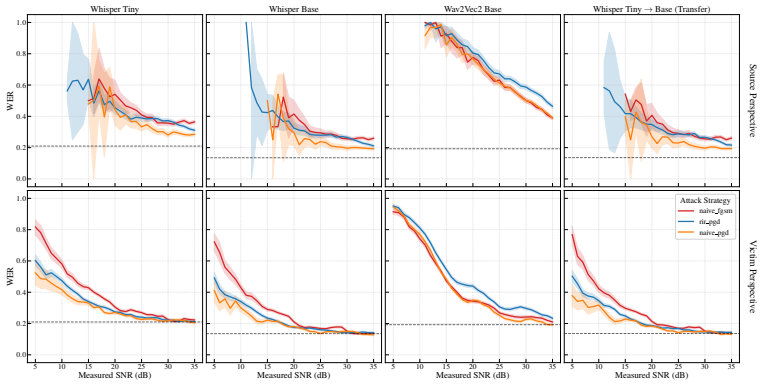
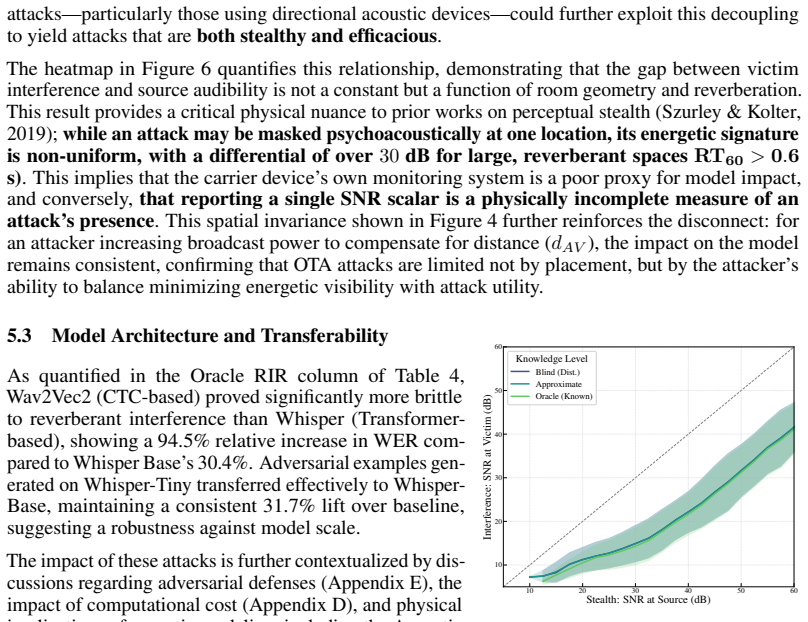
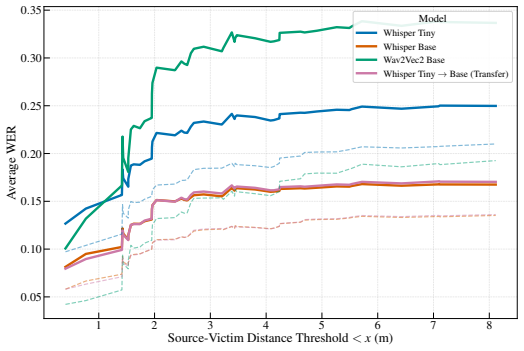
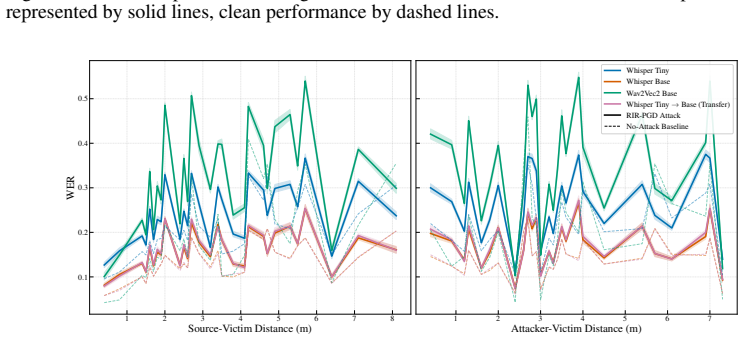
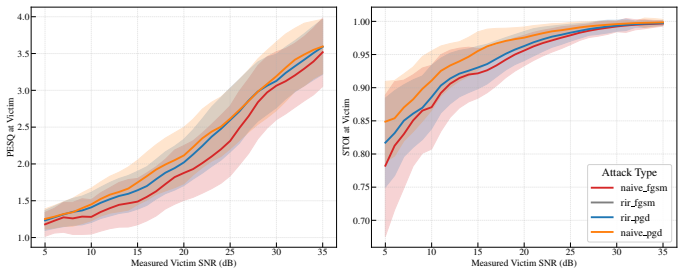
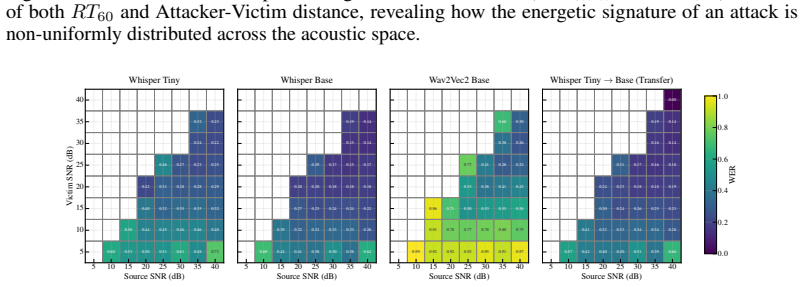
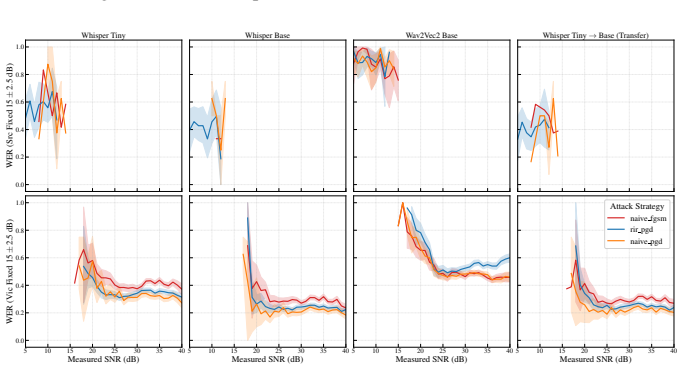
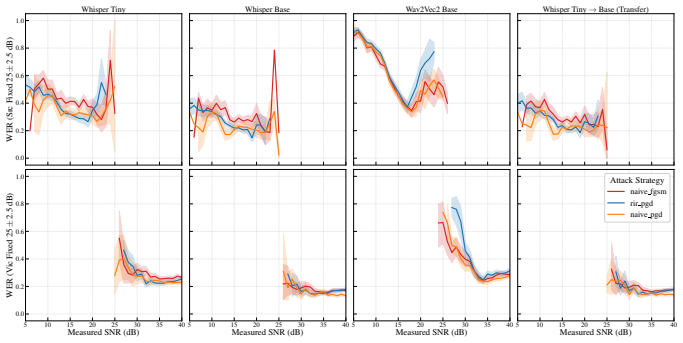
By running over eight million evaluations inside a novel high-throughput reality simulation framework, the authors show that acoustic awareness in over-the-air attacks yields relative Word Error Rate increases of up to 94.5 percent under Whisper and wav2vec, while the framework operationalizes a Dual-Form Signal to Noise Ratio that decouples source stealth from victim attack efficacy.
Load-bearing premise
The simulation framework accurately captures the key acoustic factors affecting detectability and geometry influence in real-world over-the-air attacks.
Editorial extensions
If this is right
- Voice recognition systems face substantially higher risk from physical attacks once room acoustics and geometry are included in evaluations.
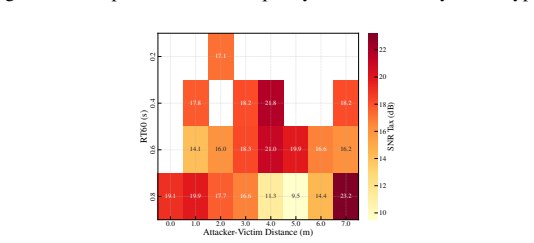
- The Dual-Form SNR metric allows separate measurement of attack stealth and attack success, removing a prior limitation in the field.
- Researchers can now conduct repeatable, large-scale tests of acoustic attacks without the logistical barriers of physical experiments.
- Prior risk assessments that ignored acoustic variables systematically underestimate the effectiveness of over-the-air attacks.
Reading between the lines
- Defenses for voice AI may need to incorporate countermeasures that account for how sound travels through specific room shapes and surfaces.
- The simulation method could be applied to other audio interfaces such as smart-home devices or automotive voice systems to assess similar risks.
- Validation experiments that compare simulated results against matched physical recordings would clarify how much the framework can be trusted for real deployments.
Signed reviews
Editorial analysis
A structured set of objections, weighed in public.
Referee Report
Summary. The manuscript presents a high-throughput simulation framework for over-the-air acoustic adversarial attacks on ASR systems (Whisper, wav2vec). It reports results from over 8 million evaluations showing that acoustic awareness produces relative WER increases of up to 94.5%, and introduces a Dual-Form SNR metric to separate source stealth from attack efficacy. The work combines real-world testing, conceptual discussion, and large-scale simulation to argue that prior digital-only workflows abstract away critical acoustic factors.
Significance. If the simulator's fidelity holds, the scale of the evaluation and the new SNR formulation would provide a concrete advance for repeatable physical-world attack assessment, moving beyond the abstractions criticized in the introduction. The empirical WER numbers and the decoupling metric are the primary contributions.
major comments (2)
- [Validation / Results] Validation section (or equivalent methods/results subsection describing the 8 M evaluations): the headline relative WER increases (up to 94.5 %) and the Dual-Form SNR rest on the claim that the simulator faithfully reproduces the acoustic factors (room impulse responses, geometry, microphone directivity) that govern real transfer. The abstract states real-world testing occurred, yet no quantitative side-by-side comparison (Pearson correlation, rank agreement, or error bars on matched simulated vs. measured WER for the same waveforms) is reported. This is load-bearing for the central risk claims.
- [Dual-Form SNR definition] Definition of Dual-Form SNR (section introducing the metric): the operationalization must be shown to be independent of the simulation parameters that already encode attack success; otherwise the claimed decoupling of stealth from efficacy is tautological by construction. A concrete formula or pseudocode and an ablation on its sensitivity to room/geometry parameters would be required.
minor comments (2)
- [Abstract] Abstract: the sentence claiming 'real-world testing' should quantify how many physical trials were run and whether they were used for simulator calibration or only for qualitative illustration.
- [Figures] Figure captions and axis labels for any WER-vs-SNR plots should explicitly state whether the plotted points are simulated or measured.
Simulated Author's Rebuttal
We thank the referee for the constructive and detailed report. The two major comments identify important areas for strengthening the validation and metric presentation. We respond point-by-point below and are prepared to revise the manuscript accordingly.
read point-by-point responses
-
Referee: [Validation / Results] Validation section (or equivalent methods/results subsection describing the 8 M evaluations): the headline relative WER increases (up to 94.5 %) and the Dual-Form SNR rest on the claim that the simulator faithfully reproduces the acoustic factors (room impulse responses, geometry, microphone directivity) that govern real transfer. The abstract states real-world testing occurred, yet no quantitative side-by-side comparison (Pearson correlation, rank agreement, or error bars on matched simulated vs. measured WER for the same waveforms) is reported. This is load-bearing for the central risk claims.
Authors: We agree that a quantitative side-by-side validation is essential to support the simulator's fidelity claims. While the manuscript references real-world testing to motivate the framework, it does not include the requested matched comparisons (Pearson correlation, rank agreement, or error bars). In revision we will add a dedicated validation subsection reporting these metrics on the real-world waveforms we collected, thereby directly addressing the load-bearing concern for the reported WER increases. revision: yes
-
Referee: [Dual-Form SNR definition] Definition of Dual-Form SNR (section introducing the metric): the operationalization must be shown to be independent of the simulation parameters that already encode attack success; otherwise the claimed decoupling of stealth from efficacy is tautological by construction. A concrete formula or pseudocode and an ablation on its sensitivity to room/geometry parameters would be required.
Authors: We accept the need for explicit operationalization. The Dual-Form SNR is constructed from two distinct signal formulations—one evaluated at the source location and one at the victim microphone—that are deliberately separated from the adversarial perturbation parameters used to compute WER. In the revised manuscript we will insert the full mathematical definition, accompanying pseudocode, and a sensitivity ablation across room and geometry parameters to demonstrate that the metric remains stable and non-tautological with respect to attack success. revision: yes
Circularity Check
No circularity: empirical results from simulation and real-world testing stand independently
full rationale
The paper reports results from a novel high-throughput simulation framework applied to 8 million evaluations, combined with real-world testing, to show WER increases and to define/operationalize a Dual-Form SNR. No load-bearing step reduces by construction to its inputs, no fitted parameter is relabeled as a prediction, and no uniqueness theorem or ansatz is imported via self-citation. The central claims rest on the framework's outputs against external ASR models rather than tautological re-derivation.
Assumptions & free parameters
Cite this review
Pith. "Pith review of Room for Error: Large-Scale Simulation of Over-the-Air Acoustic Attacks." pith.science (2026). https://pith.science/paper/DUSCWWIA
@misc{pith2026260627701,
  author       = {Pith},
  title        = {Pith review of: Room for Error: Large-Scale Simulation of Over-the-Air Acoustic Attacks},
  year         = {2026},
  howpublished = {\url{https://pith.science/paper/DUSCWWIA}},
  note         = {Machine review of arXiv:2606.27701}
}
read the original abstract
While voice control is rapidly becoming a ubiquitous vector of human-AI communication, the risks facing these systems remain poorly understood. This is, in part, a product of the difficulties in scaling strictly digital adversarial workflows to the physical world. These scale barriers have led the community to abstract away key acoustic factors relating to detectability and the influence of geometry on acoustics. These methodological and metrological shortcomings undermine our understanding of risk. We illuminate these issues through real-world testing, conceptual discussions, and a novel, high-throughput reality simulation framework. By testing over 8 million adversarial evaluations, we demonstrate that acoustic awareness yields relative Word Error Rate increases of up to 94.5\% under Whisper and wav2vec. We employ this framework to explore a formalize and operationalize a Dual-Form Signal to Noise Ratio to decouple source stealth from victim attack efficacy, resolving a crucial limitation in current works. This lays the groundwork for repeatable, verifiable research that embraces, rather than abstracts, the acoustic environment.
Figures
Figures from the paper (6 more)
Reference graph
Works this paper leans on
-
[1]
Hadi Abdullah and Muhammad Sajidur Rahman and Washington Garcia and Kevin Warren and Anurag Swarnim Yadav and Tom Shrimpton and Patrick Traynor , booktitle =
-
[2]
Hadi Abdullah and Kevin Warren and Vincent Bindschaedler and Nicolas Papernot and Patrick Traynor , booktitle =
- [3]
-
[4]
Alzantot, Moustafa and Balaji, Bharathan and Srivastava, Mani , booktitle =
-
[5]
Athalye, Anish and Engstrom, Logan and Ilyas, Andrew and Kwok, Kevin , booktitle =
-
[6]
Baevski, Alexei and Zhou, Yuhao and Mohamed, Abdelrahman and Auli, Michael , journal =. wav2vec 2.0:
-
[7]
Carlini, Nicholas and Wagner, David , booktitle =
-
[8]
Chen, Yuxuan and Yuan, Xuejing and Zhang, Jiangshan and Zhao, Yue and Zhang, Shengzhi and Chen, Kai and Wang, XiaoFeng , booktitle =
Show all 46 references
-
[9]
Chen, Meng and Lu, Li and Yu, Jiadi and Ba, Zhongjie and Lin, Feng and Ren, Kui , journal =
-
[10]
Delabie, Daan and Buyle, Chesney and Cox, Bert and Van der Perre, Liesbet and De Strycker, Lieven , booktitle =
-
[11]
Dijkman, Luc and Hoekstra, Niels and Hornikx, Maarten , booktitle =
-
[12]
Farina, Angelo , journal =
-
[13]
Goodfellow and Jonathon Shlens and Christian Szegedy , booktitle =
Ian J. Goodfellow and Jonathon Shlens and Christian Szegedy , booktitle =
-
[14]
Hussain, Shehzeen and Neekhara, Paarth and Dubnov, Shlomo and McAuley, Julian and Koushanfar, Farinaz , booktitle =. \
-
[15]
Jeub, Marco and Schafer, Magnus and Vary, Peter , booktitle =
-
[16]
Kinoshita, Keisuke and Delcroix, Marc and Yoshioka, Takuya and Nakatani, Tomohiro and Habets, Emanuel and Haeb-Umbach, Reinhold and Leutnant, Volker and Sehr, Armin and Kellermann, Walter and Maas, Roland and Gannot, Sharon and Raj, Bhiksha , booktitle =
-
[17]
and Brunskog, Jonas and Jeong, Cheol-Ho and Jacobsen, Finn , journal =
Koutsouris, Georgios I. and Brunskog, Jonas and Jeong, Cheol-Ho and Jacobsen, Finn , journal =
-
[18]
Li, Zhuohang and Wu, Yi and Liu, Jian and Chen, Yingying and Yuan, Bo , booktitle =
-
[19]
Aleksander Madry and Aleksandar Makelov and Ludwig Schmidt and Dimitris Tsipras and Adrian Vladu , booktitle =
-
[20]
arXiv preprint arXiv:2510.23141 , title =
Mullins, Sarabeth S and G. arXiv preprint arXiv:2510.23141 , title =
-
[21]
Nakamura, Satoshi and Hiyane, Kazuo and Asano, Futoshi and Nishiura, Takanobu and Yamada, Takeshi , booktitle =
-
[22]
Olivier, Raphael and Raj, Bhiksha , booktitle =
-
[23]
Panayotov, Vassil and Chen, Guoguo and Povey, Daniel and Khudanpur, Sanjeev , booktitle =
-
[24]
Qin, Yao and Carlini, Nicholas and Goodfellow, Ian and Cottrell, Garrison and Raffel, Colin , booktitle =
-
[25]
Radford, Alec and Kim, Jong Wook and Xu, Tao and Brockman, Greg and McLeavey, Christine and Sutskever, Ilya , booktitle =
-
[26]
Raghuvanshi, Nikunj and Narain, Rahul and Lin, Ming C , journal =
-
[27]
Sabine, Wallace Clement , publisher =
-
[28]
Saini, Shivam and Peissig, Juergen , booktitle =
-
[29]
Savioja, Lauri and Svensson, U Peter , journal =
-
[30]
2018 IEEE International Conference on Acoustics, Speech and Signal Processing (ICASSP) , organization =
Scheibler, Robin and Bezzam, Eric and Dokmani. 2018 IEEE International Conference on Acoustics, Speech and Signal Processing (ICASSP) , organization =
2018
-
[31]
Network and Distributed System Security Symposium (NDSS) , title =
Lea Sch. Network and Distributed System Security Symposium (NDSS) , title =
-
[32]
Si, Chen and Wu, Qianyi and Amballa, Chaitanya and Choudhury, Romit Roy , journal =
-
[33]
Stan, Guy-Bart and Embrechts, Jean Jacques and Archambeau, Dominique , journal =
-
[34]
Szurley, Joseph and Kolter, J Zico , journal =
-
[35]
doi:10.24963/ijcai.2019/741 , month =
Yakura, Hiromu and Sakuma, Jun , booktitle =. doi:10.24963/ijcai.2019/741 , month =
2019 doi
-
[36]
Yuan, Xuejing and Chen, Yuxuan and Zhao, Yue and Long, Yunhui and Liu, Xiaokang and Chen, Kai and Zhang, Shengzhi and Huang, Heqing and Wang, Xiaofeng and Gunter, Carl A , booktitle =
-
[37]
Wang, Li and Li, Jiaqi and Luo, Yuhao and Zheng, Jiahao and Wang, Lei and Li, Hao and Xu, Ke and Fang, Chengfang and Shi, Jie and Wu, Zhizheng , booktitle =
-
[38]
Young, William Henry , journal=. On the. 1912 , publisher=
1912
-
[39]
Proceedings of the 40th International Conference on Machine Learning (ICML) , year =
Robust Speech Recognition via Large-Scale Weak Supervision , author =. Proceedings of the 40th International Conference on Machine Learning (ICML) , year =
-
[40]
Advances in Neural Information Processing Systems (NeurIPS) , year =
Baevski, Alexei and Zhou, Henry and Mohamed, Abdelrahman and Auli, Michael , title =. Advances in Neural Information Processing Systems (NeurIPS) , year =
-
[41]
Clinical
Draper, Thomas C and Cox, Timothy and Lamb-Riddell, Kathryn and Moretti, Luigi Andrea and McCormick, John and Trowell, Stephen and Kiely, Janice and Luxton, Richard , journal =. Clinical. 2025 , doi =
2025
-
[42]
33rd USENIX Security Symposium (USENIX Security 24) , year =
Guoming Zhang and Xiaohui Ma and Huiting Zhang and Zhijie Xiang and Xiaoyu Ji and Yanni Yang and Xiuzhen Cheng and Pengfei Hu , title =. 33rd USENIX Security Symposium (USENIX Security 24) , year =
-
[43]
Carlini, Nicholas and Wagner, David , booktitle=. Towards. 2017 , organization=
2017
-
[44]
Adversarial
Sch. Adversarial. Network and Distributed System Security Symposium (
-
[45]
Cybersecurity , year =
Sun, Qibin and Chen, Shun and Zhai, Yingbin and Liu, Yang and Zhong, Zhisheng , title =. Cybersecurity , year =
-
[46]
Proceedings of the 2024
Cheng, Peng and Wang, Yuwei and Huang, Peng and Ba, Zhongjie and Lin, Xiaodong and Lin, Feng and Lu, Li and Ren, Kui , title =. Proceedings of the 2024
2024
Reviewed July 2, 2026 · model on record in the stance chip above.
Discussion (0). Continue with ORCID to comment.