Simulating the Dynamics of Markovian Quantum Processes by Quantum Collision Models on Quantum Computers
Pith reviewed 2026-06-29 04:40 UTC · model grok-4.3
The pith
Hardware-specific collision models simulate Markovian quantum dynamics up to 13 qubits and 40 steps on both ion-trap and superconducting platforms.
A machine-rendered reading of the paper's core claim, the machinery that carries it, and where it could break.
Core claim
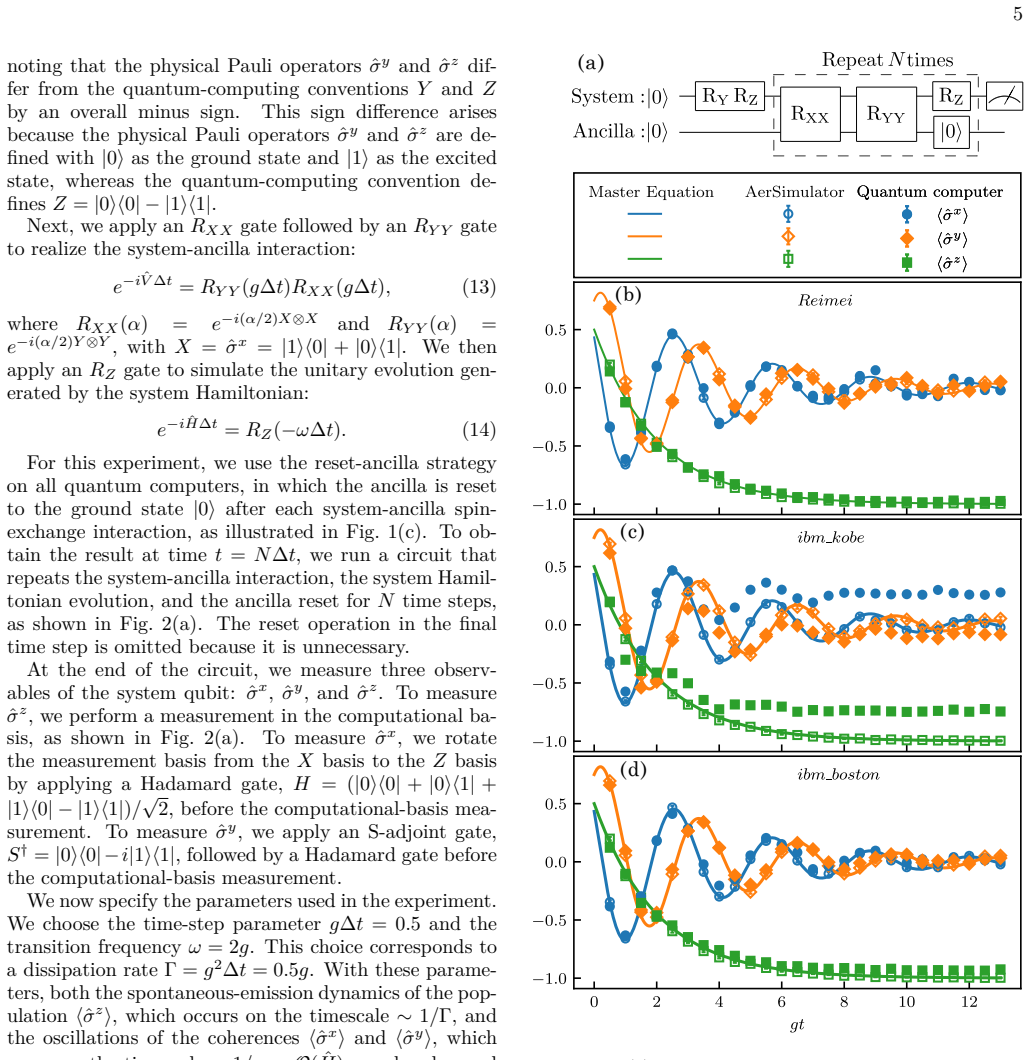
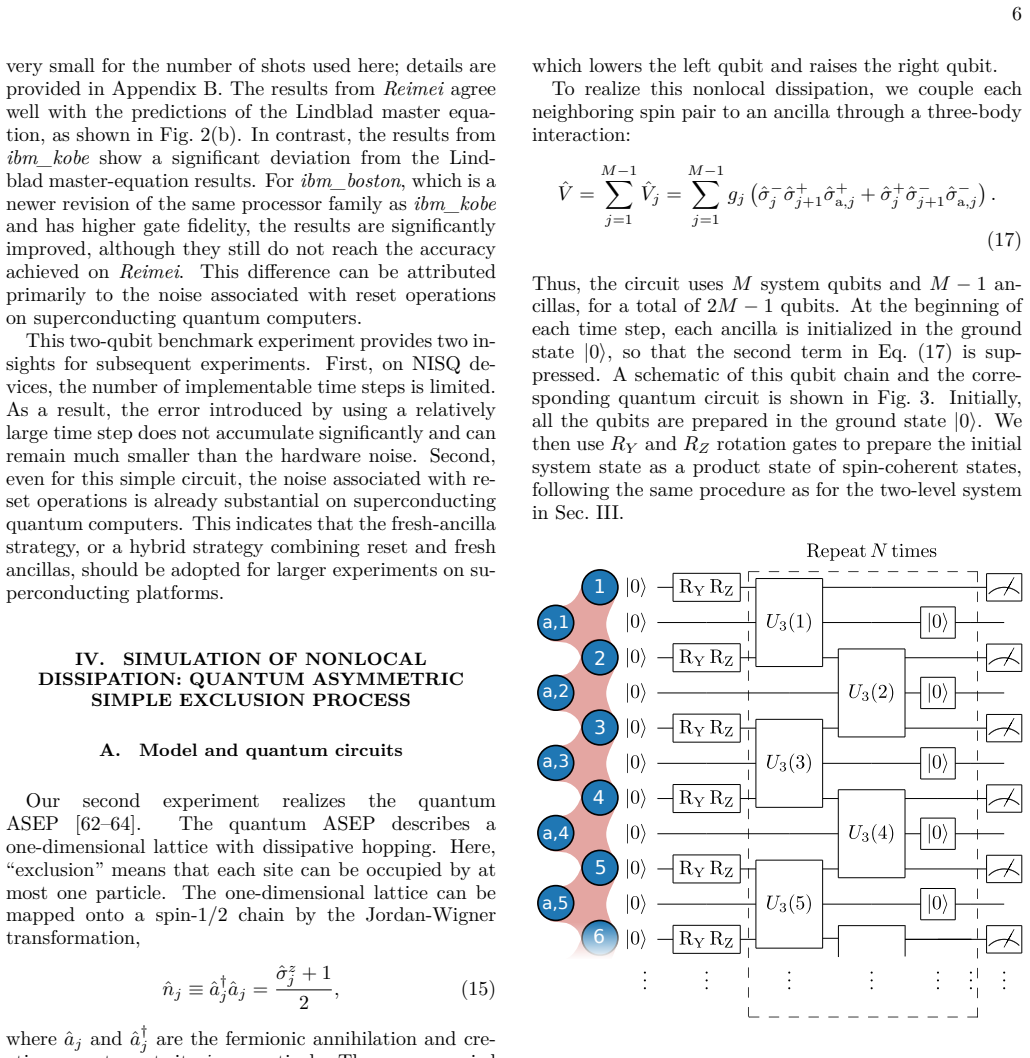
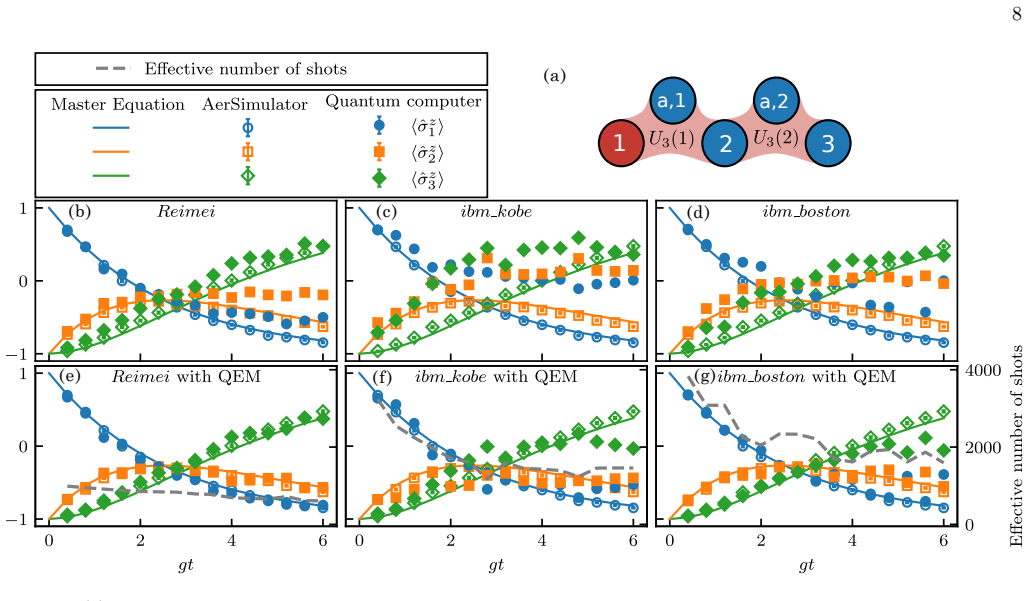
We experimentally simulate Markovian quantum processes with local and nonlocal dissipation on both trapped-ion and superconducting quantum computers. By employing hardware-specific ancilla strategies, we realize simulations with up to seven system qubits, corresponding to 13 qubits in total, and 40 time steps. Our results demonstrate that, even for the same physical model, the optimal implementation strategy depends strongly on the hardware characteristics of the quantum computer.
What carries the argument
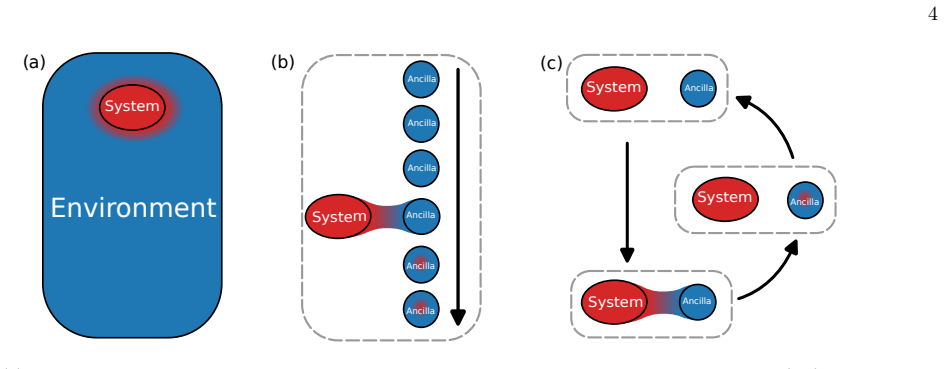
Quantum collision models that induce dissipation by repeated coupling of the system to fresh ancillas followed by ancilla reset and tracing out.
If this is right
- Markovian open-system simulations become practical at the scale of seven system qubits on present devices.
- Local and nonlocal dissipation channels can both be realized within the same collision framework.
- The best ancilla-reset protocol must be chosen according to the specific quantum hardware rather than applied uniformly.
- Simulations can sustain 40 discrete time steps before noise dominates.
Where Pith is reading between the lines
- The same collision-model structure could be adapted to approximate non-Markovian dynamics by reusing ancillas instead of resetting them.
- Platform-dependent optimization may become a standard step when porting open-system simulations between different quantum processors.
- Error rates in the ancilla resets set a practical limit on the longest reliable simulation time for a given hardware.
Load-bearing premise
The ancilla resets and partial traces produce dynamics that match the target Markovian master equation without large uncontrolled errors from noise or leftover entanglement.
What would settle it
Running the circuits and observing that the measured system density matrix deviates significantly from the numerical solution of the corresponding Lindblad master equation at long times.
Figures
read the original abstract
Hamiltonian dynamics have been widely implemented on noisy intermediate-scale quantum devices in recent years. In contrast, experimental demonstrations of Markovian quantum dynamics remain limited, because implementing nonunitary evolution on quantum computers is challenging. Quantum collision models provide a natural approach to this problem by coupling the system to ancillas to realize dissipation. However, previous implementations of quantum collision models on quantum computers have typically been restricted to one or two system qubits and fewer than 12 time steps, owing to noise, circuit depth, the overhead of ancilla reset, and limited qubit resources. In this work, we experimentally simulate Markovian quantum processes with local and nonlocal dissipation on both trapped-ion and superconducting quantum computers. By employing hardware-specific ancilla strategies, we realize simulations with up to seven system qubits, corresponding to 13 qubits in total, and 40 time steps. Our results demonstrate that, even for the same physical model, the optimal implementation strategy depends strongly on the hardware characteristics of the quantum computer.
Editorial analysis
A structured set of objections, weighed in public.
Referee Report
Summary. The manuscript experimentally implements quantum collision models to simulate Markovian open-system dynamics (local and nonlocal dissipation) on trapped-ion and superconducting quantum computers. It reports scaling to seven system qubits (13 total) and 40 time steps by using hardware-specific ancilla strategies and reset protocols, and concludes that the optimal implementation depends on platform characteristics.
Significance. If the reported dynamics faithfully reproduce the target Lindblad evolution, the work extends collision-model simulations of Markovian processes well beyond prior 1-2 qubit, <12-step limits and supplies concrete hardware-dependent guidance for NISQ open-system simulation. The dual-platform comparison is a concrete strength.
major comments (2)
- [Results section] Results section (and associated figures/tables): the central claim of faithful Markovian simulation up to 7 qubits/40 steps requires quantitative validation that repeated ancilla coupling + reset + partial trace reproduces the target master equation. No process tomography, trace-distance bounds, or direct comparison to analytic Lindblad solutions with error bars are reported to bound deviations from residual entanglement or platform noise, leaving the weakest assumption untested.
- [Methods/Implementation subsections] Methods/Implementation subsections on ancilla reset: the manuscript does not specify reset fidelity, residual system-ancilla correlation after reset, or any error-mitigation protocol used to suppress non-Markovian contributions; these quantities are load-bearing for the claim that the implemented channel matches the ideal collision model.
minor comments (2)
- Figure captions and axis labels should explicitly state the number of experimental shots, post-selection criteria, and any error bars or statistical uncertainties.
- The abstract and introduction should cite the specific prior collision-model experiments (1-2 qubits, <12 steps) that are being surpassed, with quantitative comparison of scale.
Simulated Author's Rebuttal
We thank the referee for their careful reading and constructive comments on our manuscript. We address the major comments point by point below, agreeing that additional quantitative details will strengthen the presentation of the results.
read point-by-point responses
-
Referee: [Results section] Results section (and associated figures/tables): the central claim of faithful Markovian simulation up to 7 qubits/40 steps requires quantitative validation that repeated ancilla coupling + reset + partial trace reproduces the target master equation. No process tomography, trace-distance bounds, or direct comparison to analytic Lindblad solutions with error bars are reported to bound deviations from residual entanglement or platform noise, leaving the weakest assumption untested.
Authors: We agree that quantitative validation is essential to substantiate the claim of faithful reproduction of the target Lindblad evolution. While the experimental figures demonstrate qualitative agreement with expected Markovian behavior, we will revise the Results section to include direct comparisons to analytic solutions of the Lindblad master equation, with error bars obtained from repeated experimental runs. Trace-distance bounds will be added for smaller system sizes where full process tomography is feasible, and subsystem-based bounds will be provided for the seven-qubit case using noise characterization data. These additions will be made in the revised manuscript. revision: yes
-
Referee: [Methods/Implementation subsections] Methods/Implementation subsections on ancilla reset: the manuscript does not specify reset fidelity, residual system-ancilla correlation after reset, or any error-mitigation protocol used to suppress non-Markovian contributions; these quantities are load-bearing for the claim that the implemented channel matches the ideal collision model.
Authors: We acknowledge that explicit details on ancilla reset are necessary. The revised Methods section will report the measured reset fidelities on both the trapped-ion and superconducting platforms, along with estimates of residual system-ancilla correlations derived from calibration experiments. We will also describe the error-mitigation protocols employed to minimize non-Markovian contributions, such as optimized reset sequences and any post-processing steps. These additions will directly support the connection between the implemented protocol and the ideal collision model. revision: yes
Circularity Check
Experimental demonstration with no derivation chain
full rationale
This is an experimental paper reporting hardware executions of collision-model simulations of Markovian dynamics on trapped-ion and superconducting devices. No mathematical derivations, fitted parameters, or first-principles predictions are claimed; the central results are direct measurements of system evolution under repeated ancilla collisions and resets. The abstract and reader's summary confirm the absence of any load-bearing theoretical steps that could reduce to self-definition or self-citation. Therefore the paper is self-contained against external benchmarks and receives score 0.
Axiom & Free-Parameter Ledger
axioms (1)
- domain assumption Repeated system-ancilla interactions followed by tracing out the ancillas can approximate Markovian open-system dynamics.
Reference graph
Works this paper leans on
-
[1]
Arute, K
F. Arute, K. Arya, R. Babbush, D. Bacon, J. C. Bardin, R. Barends, R. Biswas, S. Boixo, F. G. S. L. Brandao, D. A. Buell, B. Burkett, Y. Chen, Z. Chen, B. Chiaro, R. Collins, W. Courtney, A. Dunsworth, E. Farhi, B. Foxen, A. Fowler, C. Gidney, M. Giustina, R. Graff, K. Guerin, S. Habegger, M. P. Harrigan, 16 0.0 2.5 5.0 7.5 10.0 12.5 15.0 gt 0 50 100 150 ...
2019
-
[2]
Y. Kim, A. Eddins, S. Anand, K. X. Wei, E. van den Berg, S. Rosenblatt, H. Nayfeh, Y. Wu, M. Zaletel, K. Temme, and A. Kandala, Evidence for the utility of quantum computing before fault tolerance, Nature 618, 500 (2023)
2023
- [3]
-
[4]
Helios: A 98-qubit trapped-ion quantum computer
A. Ransford, M. S. Allman, J. Arkinstall, J. P. C. III, S. F. Cooper, R. D. Delaney, J. M. Dreiling, B. Estey, C. Figgatt, A. Hall, A. A. Husain, A. Isanaka, C. J. Kennedy, N. Kotibhaskar, I. S. Madjarov, K. Mayer, A. R. Milne, A. J. Park, A. P. Reed, R. Ancona, M. P. Andersen, P. Andres-Martinez, W. Angenent, L. Ar- gueta, B. Arkin, L. Ascarrunz, W. Bake...
work page internal anchor Pith review Pith/arXiv arXiv 2025
-
[5]
A fault-tolerant neutral-atom ar- chitecture for universal quantum computation,
D. Bluvstein, A. A. Geim, S. H. Li, S. J. Evered, J. P. Bonilla Ataides, G. Baranes, A. Gu, T. Manovitz, M. Xu, M. Kalinowski, S. Majidy, C. Kokail, N. Maskara, E. C. Trapp, L. M. Stewart, S. Hollerith, H. Zhou, M. J. Gullans, S. F. Yelin, M. Greiner, V. Vuletić, M. Cain, and M. D. Lukin, A fault-tolerant neutral-atom ar- chitecture for universal quantum ...
-
[6]
N.-C. Chiu, E. C. Trapp, J. Guo, M. H. Abobeih, L. M. Stewart, S. Hollerith, P. L. Stroganov, M. Kalinowski, A. A. Geim, S. J. Evered, S. H. Li, X. Lyu, L. M. Peters, D. Bluvstein, T. T. Wang, M. Greiner, V. Vuletić, and M. D. Lukin, Continuous operation of a coherent 3,000- qubit system, Nature 646, 1075 (2025)
2025
-
[7]
S. J. Evered, M. Kalinowski, A. A. Geim, T. Manovitz, D. Bluvstein, S. H. Li, N. Maskara, H. Zhou, S. Ebadi, M. Xu, J. Campo, M. Cain, S. Ostermann, S. F. Yelin, S. Sachdev, M. Greiner, V. Vuletić, and M. D. Lukin, Probing the kitaev honeycomb model on a neutral-atom quantum computer, Nature 645, 341 (2025)
2025
-
[8]
Aghaee Rad, T
H. Aghaee Rad, T. Ainsworth, R. N. Alexander, B. Al- tieri, M. F. Askarani, R. Baby, L. Banchi, B. Q. Baragiola, J. E. Bourassa, R. S. Chadwick, I. Cha- rania, H. Chen, M. J. Collins, P. Contu, N. D’Arcy, G. Dauphinais, R. De Prins, D. Deschenes, I. Di Luch, S. Duque, P. Edke, S. E. Fayer, S. Ferracin, H. Fer- retti, J. Gefaell, S. Glancy, C. González-Arc...
2025
-
[9]
Bravyi, A
S. Bravyi, A. W. Cross, J. M. Gambetta, D. Maslov, P. Rall, and T. J. Yoder, High-threshold and low- overhead fault-tolerant quantum memory, Nature 627, 778 (2024)
2024
-
[10]
Acharya, D
R. Acharya, D. A. Abanin, L. Aghababaie-Beni, I. Aleiner, T. I. Andersen, M. Ansmann, F. Arute, K. Arya, A. Asfaw, N. Astrakhantsev, J. Atalaya, R. Babbush, D. Bacon, B. Ballard, J. C. Bardin, J. Bausch, A. Bengtsson, A. Bilmes, S. Blackwell, S. Boixo, G. Bortoli, A. Bourassa, J. Bovaird, L. Brill, M. Broughton, D. A. Browne, B. Buchea, B. B. Buck- ley, D...
2025
-
[11]
Tindall and M
J. Tindall and M. Fishman, Gauging tensor networks with belief propagation, SciPost Phys. 15, 222 (2023)
2023
-
[12]
Tindall, M
J. Tindall, M. Fishman, E. M. Stoudenmire, and D. Sels, Efficient tensor network simulation of ibm’s eagle kicked ising experiment, PRX Quantum 5, 010308 (2024)
2024
-
[13]
Begušić, J
T. Begušić, J. Gray, and G. K.-L. Chan, Fast and con- verged classical simulations of evidence for the utility of quantum computing before fault tolerance, Science Ad- vances 10, eadk4321 (2024)
2024
-
[14]
Schirber, A moving target for quantum advantage, Physics 17, 13 (2024)
M. Schirber, A moving target for quantum advantage, Physics 17, 13 (2024)
2024
-
[15]
P. S. Mundada, A. Barbosa, S. Maity, Y. Wang, T. Merkh, T. Stace, F. Nielson, A. R. Carvalho, M. Hush, M. J. Biercuk, and Y. Baum, Experimental bench- marking of an automated deterministic error-suppression workflow for quantum algorithms, Phys. Rev. Appl. 20, 024034 (2023)
2023
-
[16]
G. A. L. White, C. D. Hill, F. A. Pollock, L. C. L. Hol- lenberg, and K. Modi, Demonstration of non-markovian process characterisation and control on a quantum pro- cessor, Nature Communications 11, 6301 (2020)
2020
-
[17]
White, F
G. White, F. Pollock, L. Hollenberg, K. Modi, and C. Hill, Non-markovian quantum process tomography, PRX Quantum 3, 020344 (2022)
2022
-
[18]
G. A. L. White, F. A. Pollock, L. C. L. Hollenberg, C. D. Hill, and K. Modi, What can unitary sequences tell us about multi-time physics?, Quantum 9, 1695 (2025)
2025
-
[19]
Viola and S
L. Viola and S. Lloyd, Dynamical suppression of deco- herence in two-state quantum systems, Phys. Rev. A 58, 2733 (1998)
1998
-
[20]
Ezzell, B
N. Ezzell, B. Pokharel, L. Tewala, G. Quiroz, and D. A. Lidar, Dynamical decoupling for superconducting qubits: A performance survey, Phys. Rev. Appl. 20, 064027 (2023)
2023
-
[21]
Cai, Multi-exponential error extrapolation and com- bining error mitigation techniques for nisq applications, npj Quantum Information 7, 80 (2021)
Z. Cai, Multi-exponential error extrapolation and com- bining error mitigation techniques for nisq applications, npj Quantum Information 7, 80 (2021)
2021
-
[22]
S. Endo, Z. Cai, S. C. Benjamin, and X. Yuan, Hybrid quantum-classical algorithms and quantum error mitiga- tion, Journal of the Physical Society of Japan 90, 032001 (2021), https://doi.org/10.7566/JPSJ.90.032001
-
[23]
Vovrosh, K
J. Vovrosh, K. E. Khosla, S. Greenaway, C. Self, M. S. Kim, and J. Knolle, Simple mitigation of global depolar- izing errors in quantum simulations, Phys. Rev. E 104, 035309 (2021)
2021
-
[24]
Bharti, A
K. Bharti, A. Cervera-Lierta, T. H. Kyaw, T. Haug, S. Alperin-Lea, A. Anand, M. Degroote, H. Heimonen, J. S. Kottmann, T. Menke, W.-K. Mok, S. Sim, L.-C. Kwek, and A. Aspuru-Guzik, Noisy intermediate-scale quantum algorithms, Rev. Mod. Phys. 94, 015004 (2022)
2022
-
[25]
Z. Cai, R. Babbush, S. C. Benjamin, S. Endo, W. J. Hug- gins, Y. Li, J. R. McClean, and T. E. O’Brien, Quantum error mitigation, Rev. Mod. Phys. 95, 045005 (2023)
2023
-
[26]
Q-CTRL, Fire Opal, https://q-ctrl.com/fire-opal (2025), 18 [Online]
2025
-
[27]
Ippoliti, K
M. Ippoliti, K. Kechedzhi, R. Moessner, S. Sondhi, and V. Khemani, Many-body physics in the nisq era: Quan- tum programming a discrete time crystal, PRX Quantum 2, 030346 (2021)
2021
-
[28]
X. Mi, M. Ippoliti, C. Quintana, A. Greene, Z. Chen, J. Gross, F. Arute, K. Arya, J. Atalaya, R. Bab- bush, J. C. Bardin, J. Basso, A. Bengtsson, A. Bilmes, A. Bourassa, L. Brill, M. Broughton, B. B. Buck- ley, D. A. Buell, B. Burkett, N. Bushnell, B. Chiaro, R. Collins, W. Courtney, D. Debroy, S. Demura, A. R. Derk, A. Dunsworth, D. Eppens, C. Erickson, ...
2022
-
[29]
P. Frey and S. Rachel, Realization of a discrete time crystal on 57 qubits of a quantum com- puter, Science Advances 8, eabm7652 (2022) , https://www.science.org/doi/pdf/10.1126/sciadv.abm7652
-
[30]
Shinjo, K
K. Shinjo, K. Seki, T. Shirakawa, R.-Y. Sun, and S. Yunoki, Unveiling clean two-dimensional discrete time crystals on a digital quantum computer, npj Quantum Information 12, 41 (2026)
2026
-
[31]
H. Qian, M. Gong, J. Zhang, S. Guo, C. Zha, F. Chen, Y. Ye, Y. Wu, S. Cao, C. Ying, Q. Zhu, H.-L. Huang, Y. Zhao, S. Li, J. Yu, D. Fan, D. Wu, H. Su, H. Deng, H. Rong, Y. Li, K. Zhang, T.-H. Chung, F. Liang, J. Lin, Y. Xu, C. Guo, N. Li, K. Yan, F.-F. Su, G. Wu, Y.-H. Huo, C.-Z. Peng, C.-Y. Lu, F. Mei, S. Jia, X. Zhu, and J.-W. Pan, Programmable higher-or...
-
[32]
E. Granet, S.-H. Lin, K. Hémery, R. Hagshenas, P. Andres-Martinez, D. T. Stephen, A. Ransford, J. Arkinstall, M. S. Allman, P. Campora, S. F. Cooper, R. D. Delaney, J. M. Dreiling, B. Estey, C. Figgatt, C. Foltz, J. P. Gaebler, A. Hall, A. Husain, A. Isanaka, C. J. Kennedy, N. Kotibhaskar, M. Mills, A. R. Milne, A. J. Park, A. P. Reed, B. Neyenhuis, J. G....
-
[33]
X. Mi, M. Sonner, M. Y. Niu, K. W. Lee, B. Foxen, R. Acharya, I. Aleiner, T. I. Andersen, F. Arute, K. Arya, A. Asfaw, J. Atalaya, J. C. Bardin, J. Basso, A. Bengts- son, G. Bortoli, A. Bourassa, L. Brill, M. Broughton, B. B. Buckley, D. A. Buell, B. Burkett, N. Bushnell, Z. Chen, B. Chiaro, R. Collins, P. Conner, W. Courtney, A. L. Crook, D. M. Debroy, S...
2022
-
[34]
McArdle, S
S. McArdle, S. Endo, A. Aspuru-Guzik, S. C. Benjamin, and X. Yuan, Quantum computational chemistry, Rev. Mod. Phys. 92, 015003 (2020)
2020
-
[35]
J. Robledo-Moreno, M. Motta, H. Haas, A. Javadi- Abhari, P. Jurcevic, W. Kirby, S. Martiel, K. Sharma, S. Sharma, T. Shirakawa, I. Sitdikov, R.-Y. Sun, K. J. Sung, M. Takita, M. C. Tran, S. Yunoki, and A. Mezzacapo, Chemistry beyond the scale of exact diagonalization on a quantum-centric su- percomputer, Science Advances 11, eadu9991 (2025) , https://www....
-
[36]
T. Shirakawa, J. Robledo-Moreno, T. Itoko, V. Tripathi, K. Ueda, Y. Kawashima, L. Broers, W. Kirby, H. Pathak, H. Paik, M. Tsuji, Y. Kodama, M. Sato, C. Evangelinos, S. Seelam, R. Walkup, S. Yunoki, M. Motta, P. Jurce- vic, H. Horii, and A. Mezzacapo, Closed-loop calcula- tions of electronic structure on a quantum processor and a classical supercomputer a...
-
[37]
K. M. Merz, Jr., A. Shajan, D. Kaliakin, F. Liang, Y. Otsuka, T. Shirakawa, L. Broers, H. Xu, M. Tsuji, M. Sato, S. Yunoki, R. Wakizaka, Y. Kawashima, J. Doi, T. Itoko, H. Horii, T. Pellegrini, J. Robledo Moreno, K. J. Sung, E. Fejer, R. Walkup, S. Seelam, and M. Motta, Crossing the 12,000-atom barrier with het- erogeneous quantum-classical supercomputing...
work page internal anchor Pith review Pith/arXiv arXiv 2026
-
[38]
Breuer and F
H.-P. Breuer and F. Petruccione, The theory of open quantum systems , 1st ed. (Clarendon Press, Oxford, 2009)
2009
-
[39]
Campaioli, J
F. Campaioli, J. H. Cole, and H. Hapuarachchi, Quan- tum master equations: Tips and tricks for quantum op- tics, quantum computing, and beyond, PRX Quantum 5, 020202 (2024)
2024
-
[40]
L. H. Delgado-Granados, T. J. Krogmeier, L. M. Sager-Smith, I. A vdic, Z. Hu, M. Sajjan, M. Abbasi, S. E. Smart, P. Narang, S. Kais, A. W. Schlimgen, 19 K. Head-Marsden, and D. A. Mazziotti, Quantum al- gorithms and applications for open quantum systems, Chemical Reviews 125, 1823 (2025) , pMID: 39903697, https://doi.org/10.1021/acs.chemrev.4c00428
-
[41]
Motta, C
M. Motta, C. Sun, A. T. K. Tan, M. J. O’Rourke, E. Ye, A. J. Minnich, F. G. S. L. Brandão, and G. K.-L. Chan, Determining eigenstates and thermal states on a quan- tum computer using quantum imaginary time evolution, Nature Physics 16, 205 (2020)
2020
-
[42]
Kamakari, S.-N
H. Kamakari, S.-N. Sun, M. Motta, and A. J. Minnich, Digital quantum simulation of open quantum systems us- ing quantum imaginary–time evolution, PRX Quantum 3, 010320 (2022)
2022
-
[43]
McArdle, T
S. McArdle, T. Jones, S. Endo, Y. Li, S. C. Benjamin, and X. Yuan, Variational ansatz-based quantum simula- tion of imaginary time evolution, npj Quantum Informa- tion 5, 75 (2019)
2019
-
[44]
T. M. Watad and N. H. Lindner, Variational quantum algorithms for simulation of lindblad dynamics, Quantum Science and Technology 9, 025015 (2024)
2024
-
[45]
R. Shen, T. Chen, B. Yang, and C. H. Lee, Observa- tion of the non-hermitian skin effect and fermi skin on a digital quantum computer, Nature Communications 16, 1340 (2025)
2025
-
[46]
X. Mi, A. A. Michailidis, S. Shabani, K. C. Miao, P. V. Klimov, J. Lloyd, E. Rosenberg, R. Acharya, I. Aleiner, T. I. Andersen, M. Ansmann, F. Arute, K. Arya, A. As- faw, J. Atalaya, J. C. Bardin, A. Bengtsson, G. Bortoli, A. Bourassa, J. Bovaird, L. Brill, M. Broughton, B. B. Buckley, D. A. Buell, T. Burger, B. Burkett, N. Bush- nell, Z. Chen, B. Chiaro,...
-
[47]
B. Tirado, J. Fraxanet, A. Juan-Delgado, J. Aizpurua, and R. Esteban, Utility-scale quantum experiments us- ing dynamic circuits to address collective dissipation in interacting qubits (2026), arXiv:2605.25830 [quant-ph]
work page internal anchor Pith review Pith/arXiv arXiv 2026
-
[48]
Lorenzo, F
S. Lorenzo, F. Ciccarello, and G. M. Palma, Compos- ite quantum collision models, Phys. Rev. A 96, 032107 (2017)
2017
-
[49]
Ciccarello, S
F. Ciccarello, S. Lorenzo, V. Giovannetti, and G. M. Palma, Quantum collision models: Open system dynam- ics from repeated interactions, Physics Reports 954, 1 (2022)
2022
-
[50]
J. T. Barreiro, M. Müller, P. Schindler, D. Nigg, T. Monz, M. Chwalla, M. Hennrich, C. F. Roos, P. Zoller, and R. Blatt, An open-system quantum simulator with trapped ions, Nature 470, 486 (2011)
2011
-
[51]
Schindler, M
P. Schindler, M. Müller, D. Nigg, J. T. Barreiro, E. A. Martinez, M. Hennrich, T. Monz, S. Diehl, P. Zoller, and R. Blatt, Quantum simulation of dynamical maps with trapped ions, Nature Physics 9, 361 (2013)
2013
-
[52]
Cuevas, A
Á. Cuevas, A. Geraldi, C. Liorni, L. D. Bonavena, A. De Pasquale, F. Sciarrino, V. Giovannetti, and P. Mataloni, All-optical implementation of collision- based evolutions of open quantum systems, Scientific Re- ports 9, 3205 (2019)
2019
-
[53]
H. Wang, S. Ashhab, and F. Nori, Quantum algorithm for simulating the dynamics of an open quantum system, Phys. Rev. A 83, 062317 (2011)
2011
-
[54]
Cattaneo, G
M. Cattaneo, G. De Chiara, S. Maniscalco, R. Zambrini, and G. L. Giorgi, Collision models can efficiently simulate any multipartite markovian quantum dynamics, Phys. Rev. Lett. 126, 130403 (2021)
2021
-
[55]
K. Garg, Z. Ahmed, S. Mitra, and S. Chakraborty, Sim- ulating quantum collision models with hamiltonian sim- ulations using early fault-tolerant quantum computers, Phys. Rev. A 112, 022425 (2025)
2025
-
[56]
M. Pocrnic, D. Segal, and N. Wiebe, Quantum simulation of lindbladian dynamics via repeated interactions (2025), arXiv:2312.05371 [quant-ph]
-
[57]
García-Pérez, M
G. García-Pérez, M. A. C. Rossi, and S. Maniscalco, Ibm q experience as a versatile experimental testbed for simu- lating open quantum systems, npj Quantum Information 6, 1 (2020)
2020
-
[58]
Cattaneo, M
M. Cattaneo, M. A. Rossi, G. García-Pérez, R. Zam- brini, and S. Maniscalco, Quantum simulation of dissipa- tive collective effects on noisy quantum computers, PRX Quantum 4, 010324 (2023)
2023
-
[59]
X. Li, Y. Li, and Y. Yan, Signatures of environment- induced quantum synchronization transitions via two- body dissipator engineering, Chinese Physics Letters 43, 020302 (2026)
2026
-
[60]
Cohen-Tannoudji, J
C. Cohen-Tannoudji, J. Dupont-Roc, and G. Grynberg, Atom-photon interactions: basic processes and applica- tions (Wiley, New York, 1992)
1992
-
[61]
A. Javadi-Abhari, M. Treinish, K. Krsulich, C. J. Wood, J. Lishman, J. Gacon, S. Martiel, P. D. Nation, L. S. Bishop, A. W. Cross, B. R. Johnson, and J. M. Gambetta, Quantum computing with Qiskit (2024), arXiv:2405.08810 [quant-ph]
work page internal anchor Pith review Pith/arXiv arXiv 2024
-
[62]
Robertson and F
J. Robertson and F. H. L. Essler, Exact solution of a quantum asymmetric exclusion process with particle cre- ation and annihilation, Journal of Statistical Mechanics: Theory and Experiment 2021, 103102 (2021)
2021
-
[63]
de Leeuw, C
M. de Leeuw, C. Paletta, and B. Pozsgay, Constructing 20 integrable lindblad superoperators, Phys. Rev. Lett. 126, 240403 (2021)
2021
-
[64]
Ishiguro and J
Y. Ishiguro and J. Sato, Exact steady states in the asym- metric simple exclusion process beyond one dimension, Phys. Rev. Res. 6, 033030 (2024)
2024
-
[65]
E. Smith, M. G. Davis, J. Larson, E. Younis, L. B. Of- telie, W. Lavrijsen, and C. Iancu, Leap: Scaling numer- ical optimization based synthesis using an incremental approach, ACM Transactions on Quantum Computing 4, 10.1145/3548693 (2023)
-
[66]
Quantinuum nexus (2024)
2024
-
[67]
G. S. Hartnett, K. S. Najafi, A. Khindanov, H. Liao, M. Schutzman, M. R. Hush, M. J. Biercuk, and Y. Baum, Fast, accurate, high-resolution simulation of large-scale fermi-hubbard models on a digital quantum processor (2026), arXiv:2605.04025 [quant-ph]
work page internal anchor Pith review Pith/arXiv arXiv 2026
-
[68]
Lambert, E
N. Lambert, E. Giguère, P. Menczel, B. Li, P. Hopf, G. Suárez, M. Gali, J. Lishman, R. Gadhvi, R. Agarwal, A. Galicia, N. Shammah, P. Nation, J. R. Johansson, S. Ahmed, S. Cross, A. Pitchford, and F. Nori, Qutip 5: The quantum toolbox in Python, Physics Reports 1153, 1 (2026)
2026
discussion (0)
Sign in with ORCID, Apple, or X to comment. Anyone can read and Pith papers without signing in.