Which Saddles Contribute? The South-East Rule for Multidimensional Integrals
Pith reviewed 2026-06-29 01:57 UTC · model grok-4.3
The pith
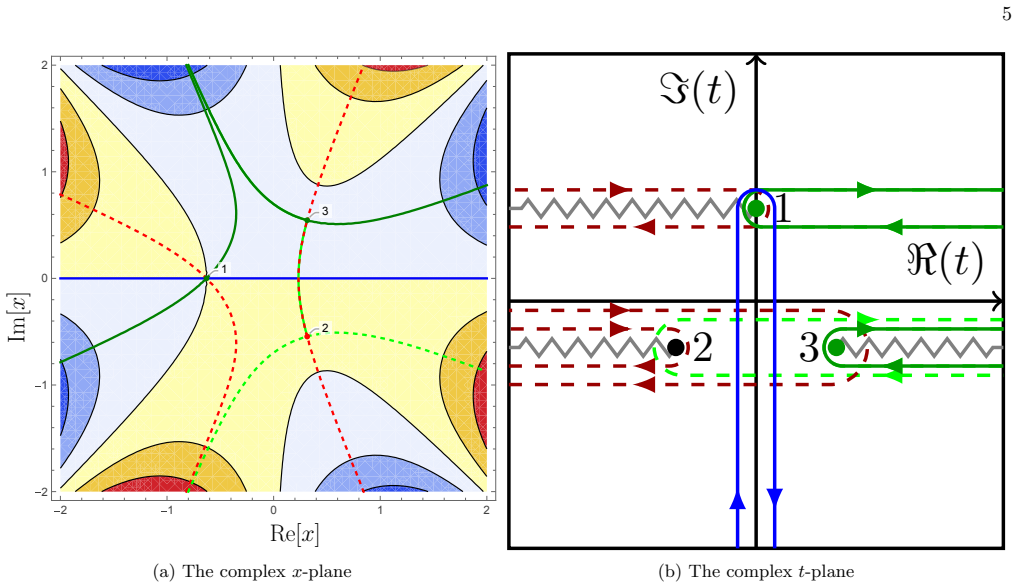
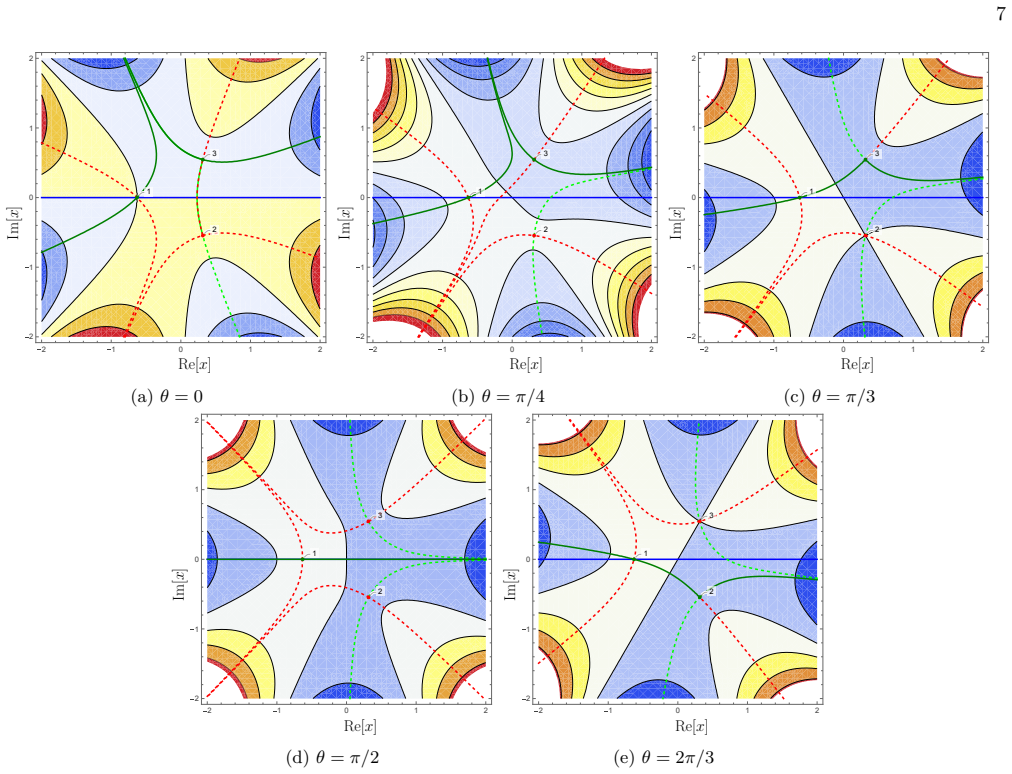
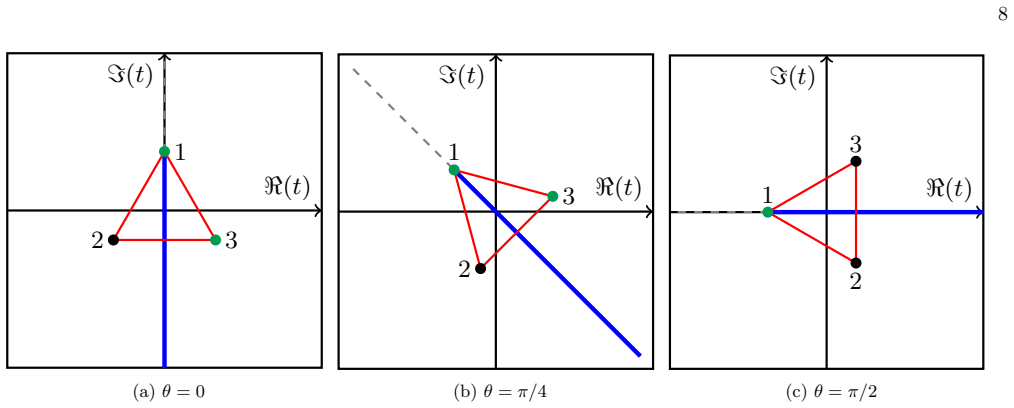
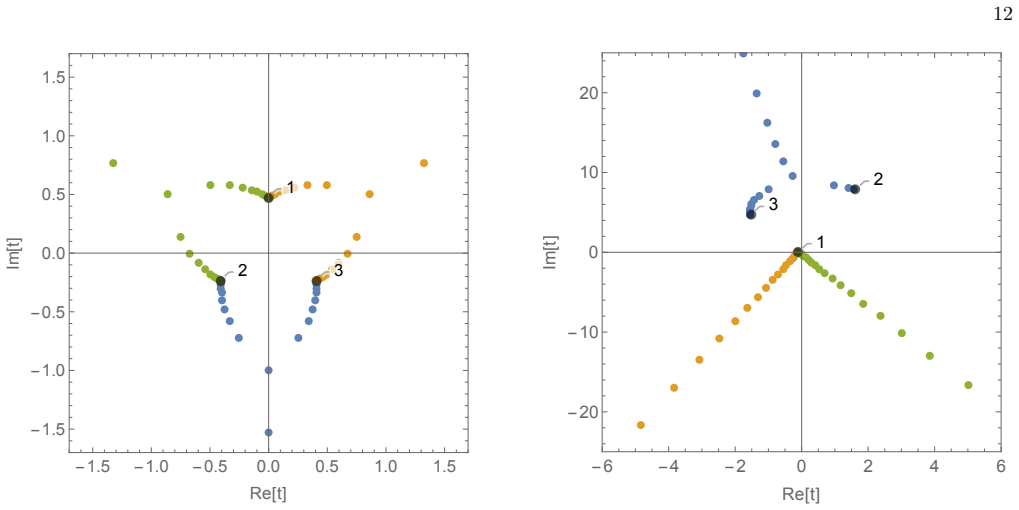
A geometric South-East rule in the Borel plane selects which critical points contribute to the asymptotics of multidimensional integrals without computing complex gradient flows.
A machine-rendered reading of the paper's core claim, the machinery that carries it, and where it could break.
Core claim
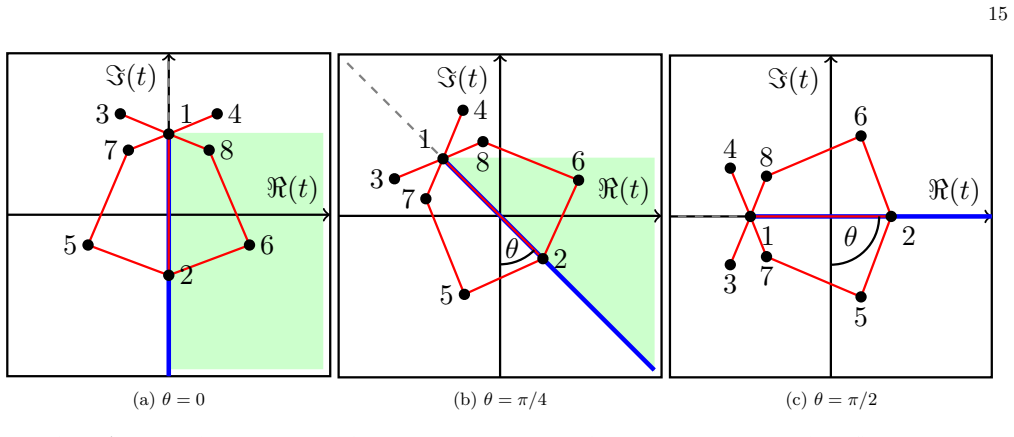
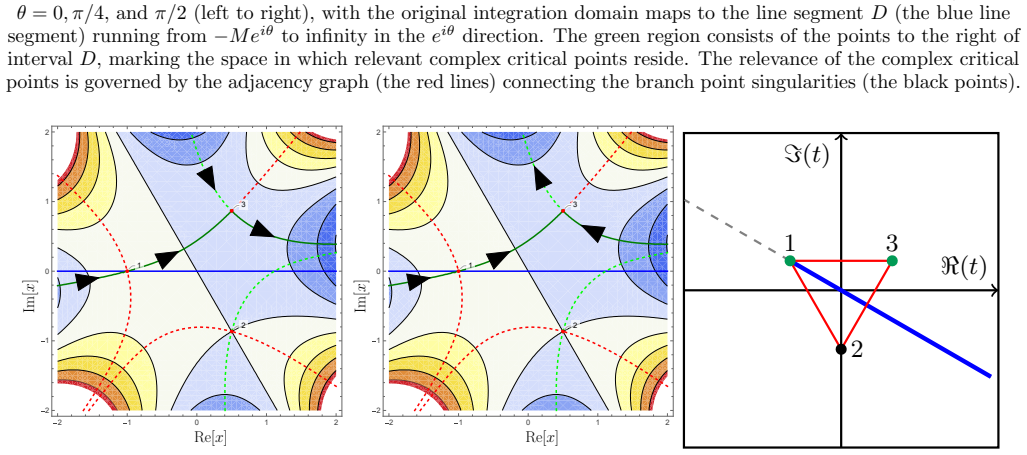
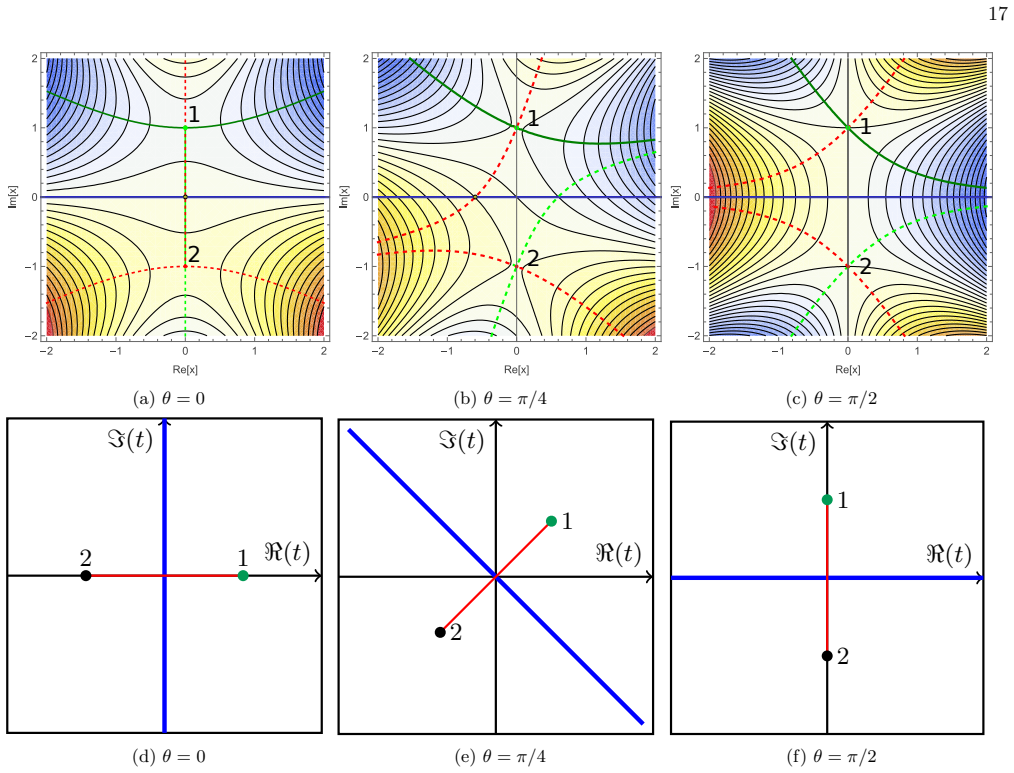
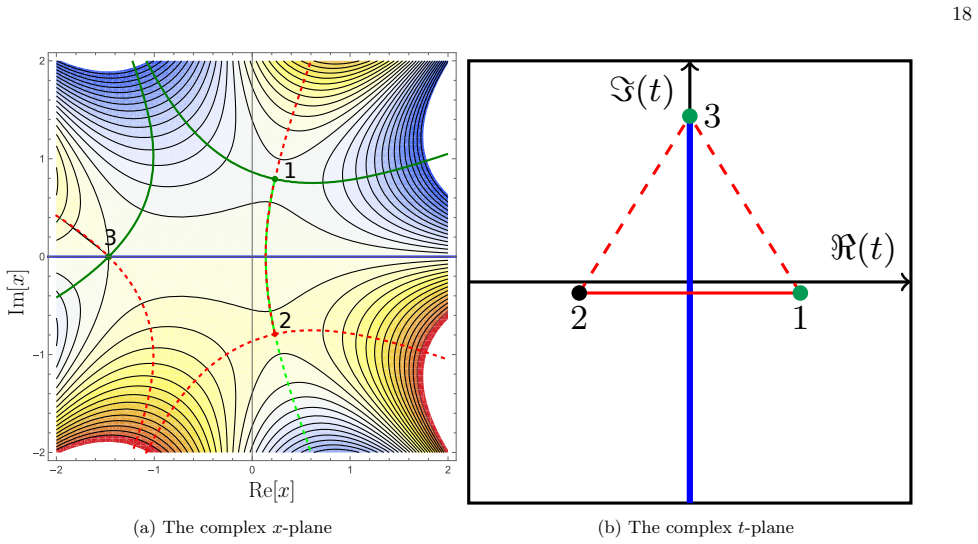
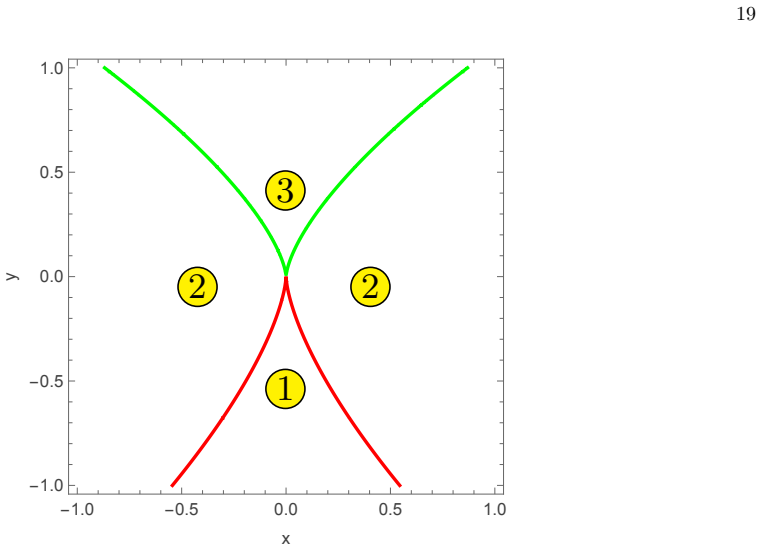
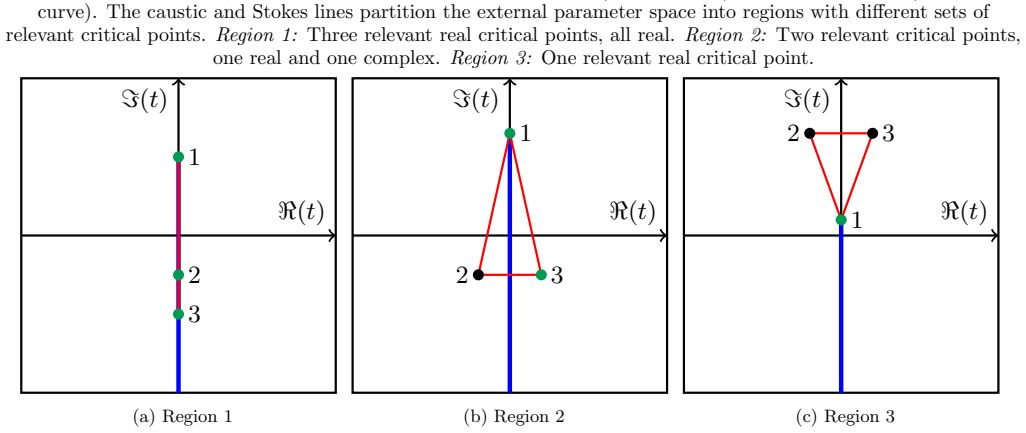
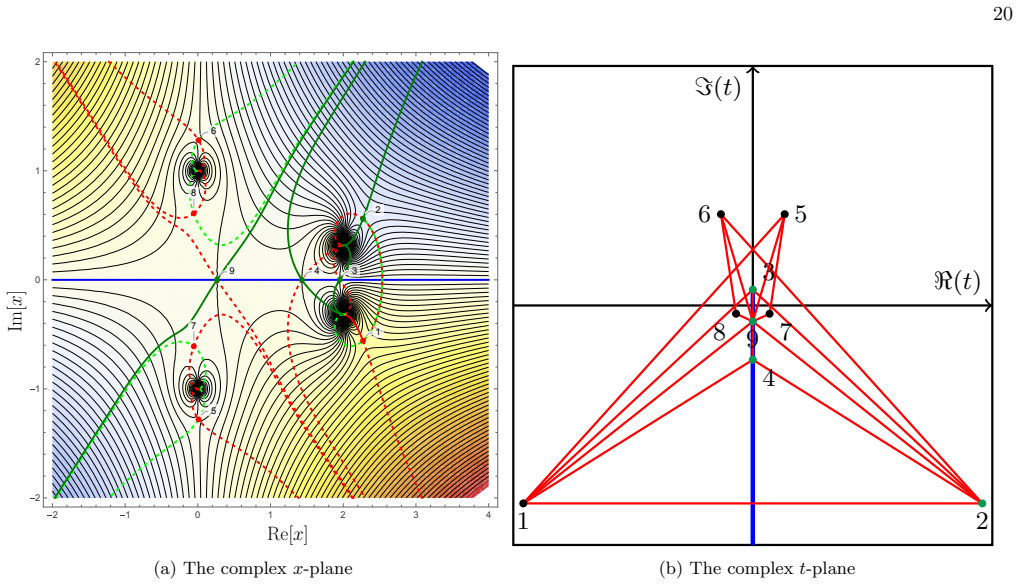
The combination of the values of f at all the critical points plotted in the complex Borel plane, the concept of adjacency between such points derived from algebraic resurgence/hyperasymptotic approaches and the new result here of a geometric South-East rule determines which critical points contribute to the asymptotic evaluation without computing the flows of -Re(i ∇f) in C^d.
What carries the argument
The South-East rule, a geometric test applied to the positions of critical values in the complex Borel plane that selects contributing saddles when combined with adjacency data.
If this is right
- The algorithm removes the computational step of tracking gradient flows in complex space when evaluating multidimensional oscillatory integrals.
- The method applies equally to functions that remain bounded and those that do not on the real integration domain.
- It supplies a route to identifying which instantons contribute in real-time path integrals.
- It addresses difficulties that arise when performing Wick rotations for such integrals.
Where Pith is reading between the lines
- The rule may allow direct comparison between algebraic and geometric resurgence pictures in dimensions where flow tracking becomes impractical.
- It suggests a way to test resurgence-based predictions against explicit contour deformations in low-dimensional cases.
- If the rule holds, it could be checked by verifying that the selected saddles reproduce known asymptotic series for standard examples such as Airy or Pearcey integrals.
Load-bearing premise
The adjacency relations between critical points taken from algebraic resurgence methods remain valid when used together with the geometric South-East test for any analytic f.
What would settle it
A concrete analytic f in two or more variables where the saddles chosen by the South-East rule plus adjacency differ from those selected by explicit computation of the flows of -Re(i ∇f).
Figures
read the original abstract
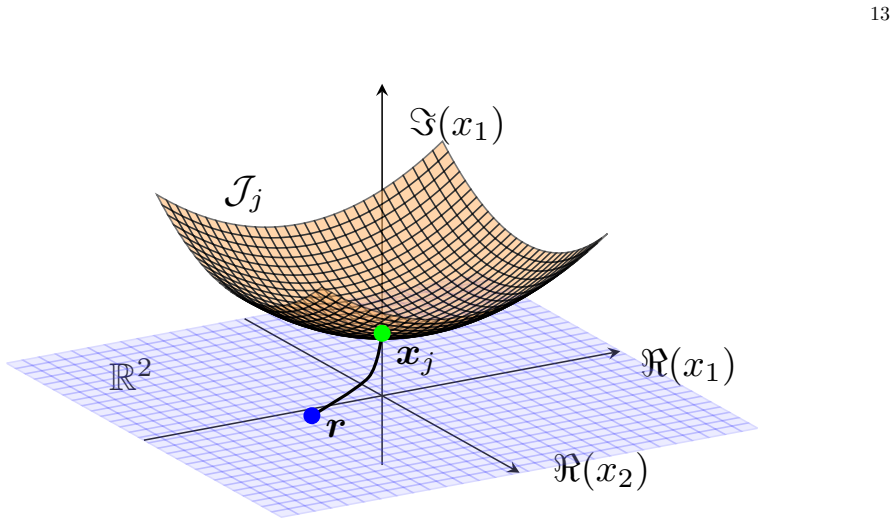
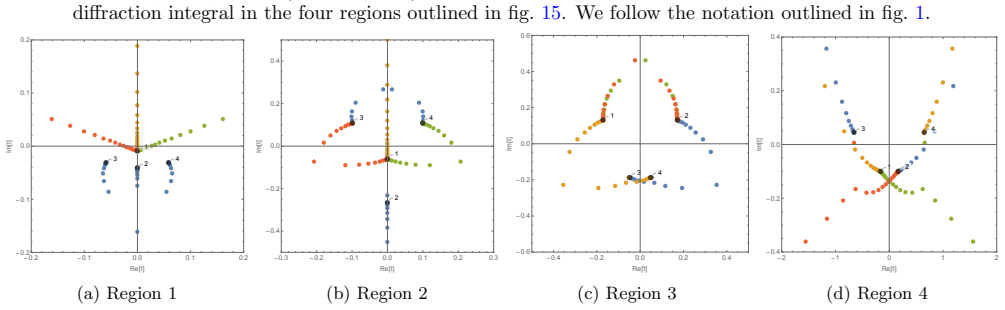
In this paper, we introduce and demonstrate a simple geometric algorithm to determine which critical points, both complex as well as real, contribute to the asymptotic evaluation of multiple integrals with exponential integrands of the form $e^{ikf(\boldsymbol{x})}$ over $\mathbb R^d$, for finite $d\ge 1$ and $f$ is analytic. In so doing, the algorithm removes the need to compute the flows of $-\text{Re} (i\nabla f)$ in $\mathbb C^d$ that is required to identify such relevant critical points in Picard-Lefschetz approaches to the derivation of such asymptotic expansions. By contrast, our algorithm relies on the combination of three simple features: the values of $f$ at all the critical points plotted in the complex Borel plane, the concept of adjacency between such points derived from algebraic resurgence/hyperasymptotic approaches and the new result here of a geometric "South-East" rule. The algorithm incorporates functions $f$ that remain bounded or unbounded on $\mathbb R^d$. We illustrate this new approach with both pedagogical and advanced examples, and draw conclusions as to its importance for resolving issues associated with Wick rotations and its implications for path integrals. This is a significant step towards a systematic way of identifying instanton contributions in real-time path integrals.
Editorial analysis
A structured set of objections, weighed in public.
Referee Report
Summary. The paper introduces a geometric 'South-East' rule, combined with values of f at critical points in the complex Borel plane and adjacency relations from algebraic resurgence/hyperasymptotics, to select which saddles contribute to the asymptotics of integrals ∫_{R^d} exp(ik f(x)) dx (f analytic) without computing flows of -Re(i ∇f) in C^d. The algorithm applies to bounded and unbounded f; it is illustrated on pedagogical and advanced examples and discussed for implications on Wick rotations and path integrals.
Significance. If the rule and its supporting assumptions hold, the approach offers a practical geometric shortcut for identifying contributing critical points in multi-dimensional oscillatory integrals, extending resurgence techniques and potentially aiding systematic treatment of instantons in real-time path integrals. The combination of Borel-plane plotting, pre-existing adjacency data, and the new rule is a concrete algorithmic contribution.
major comments (2)
- [Sections describing the algorithm and its justification (around the statement of the South-East rule and its combination] The load-bearing step is the assumption that adjacency relations derived from 1D algebraic resurgence remain exactly the relevant Stokes connections when lifted to the steepest-descent geometry of -Re(i ∇f) in C^d for arbitrary analytic f. The manuscript demonstrates agreement on specific low-dimensional examples but provides no general argument or counter-example search showing why additional multidimensional Stokes phenomena or non-adjacent but still connected saddles cannot appear; this directly affects the claim that the three-feature combination suffices without flow computations.
- [Examples section (pedagogical and advanced illustrations)] The examples section must include at least one higher-dimensional case (d ≥ 2) constructed so that the Picard-Lefschetz flow would reveal an extra connection not predicted by 1D adjacency; without such a test the generality of the rule remains unverified.
minor comments (2)
- Provide an explicit mathematical statement (theorem or proposition) of the South-East rule, including the precise geometric criterion in the Borel plane.
- Ensure all Borel-plane plots label the real and imaginary axes clearly and indicate which points are real versus complex critical values.
Simulated Author's Rebuttal
We thank the referee for the careful reading and constructive suggestions. We respond point-by-point to the major comments below.
read point-by-point responses
-
Referee: [Sections describing the algorithm and its justification] The load-bearing step is the assumption that adjacency relations derived from 1D algebraic resurgence remain exactly the relevant Stokes connections when lifted to the steepest-descent geometry of -Re(i ∇f) in C^d for arbitrary analytic f. The manuscript demonstrates agreement on specific low-dimensional examples but provides no general argument or counter-example search showing why additional multidimensional Stokes phenomena or non-adjacent but still connected saddles cannot appear.
Authors: We agree this is the central assumption. The adjacency data are taken from the local Borel-plane singularity structure of f, which is determined by the analytic germ at each critical point and is therefore dimension-independent. The South-East rule then filters these adjacencies using only the ordering of the Borel values. While the manuscript verifies consistency on the examples provided, we do not claim a general theorem excluding all possible higher-dimensional Stokes phenomena. We will add an explicit paragraph in the discussion section stating the assumption, its scope, and the absence of a general proof. revision: partial
-
Referee: [Examples section] The examples section must include at least one higher-dimensional case (d ≥ 2) constructed so that the Picard-Lefschetz flow would reveal an extra connection not predicted by 1D adjacency; without such a test the generality of the rule remains unverified.
Authors: The manuscript already contains illustrations in d=2 and d=3. None of these were deliberately engineered to produce an extra multi-dimensional Stokes connection beyond 1D adjacency. We accept the referee’s point that a targeted test case would strengthen the claim. We will revise the examples section to include (or describe the construction of) such a d=2 example, or to explain why locating an analytic counter-example is non-trivial. revision: yes
- A general theorem proving that 1D resurgence adjacencies lift without modification or additional multi-dimensional Stokes connections for arbitrary analytic f.
Circularity Check
No circularity: new geometric South-East rule is independent of inputs
full rationale
The paper presents a novel geometric South-East rule as its central contribution for selecting contributing critical points in multidimensional integrals, explicitly combining it with externally derived adjacency concepts from algebraic resurgence. No equations or steps reduce by construction to fitted parameters, self-definitions, or self-citation chains; the algorithm is described as removing the need for explicit flow computations via this independent geometric test. Demonstrations on examples do not indicate that the rule itself is forced by prior inputs. The derivation chain remains self-contained against external benchmarks.
Axiom & Free-Parameter Ledger
axioms (2)
- domain assumption f is analytic
- domain assumption Adjacency relations from algebraic resurgence correctly capture relevant connections between critical points
Reference graph
Works this paper leans on
-
[1]
Schneider, J
P. Schneider, J. Ehlers, and E. E. Falco,Gravitational Lenses(1992)
1992
-
[2]
Feldbrugge, U.-L
J. Feldbrugge, U.-L. Pen, and N. Turok, Annals of Physics451, 169255 (2023)
2023
- [3]
-
[4]
J. Feldbrugge and N. Turok, arXiv e-prints , arXiv:2008.01154 (2020), arXiv:2008.01154 [gr-qc]
arXiv 2008
-
[5]
Balian, G
R. Balian, G. Parisi, and A. Voros, Phys. Rev. Lett.41, 1141 (1978)
1978
-
[6]
P. Sali` eres, B. Carr´ e, L. L. D´ eroff, F. Grasbon, G. G. Paulus, H. Walther, R. Kopold, W. Becker, D. B. Miloˇ sevi´ c, A. Sanpera, and M. Lewenstein, Science292, 902 (2001), https://www.science.org/doi/pdf/10.1126/science.108836
-
[7]
E. Pisanty, M. F. Ciappina, and M. Lewenstein, Journal of Physics: Photonics2, 034013 (2020), arXiv:2003.00277 [quant-ph]
arXiv 2020
-
[8]
D. B. Miloˇ sevi´ c, A. S. Jaˇ sarevi´ c, D. Habibovi´ c, E. Hasovi´ c, A.ˇCerki´ c, and W. Becker, J. Phys. A Math. Theor.57, 393001 (2024)
2024
-
[9]
R. P. Feynman, Reviews of Modern Physics20, 367 (1948)
1948
-
[10]
R. P. Feynman and A. R. Hibbs,Quantum mechanics and path integrals, International series in pure and applied physics (McGraw-Hill, New York, NY, 1965)
1965
-
[11]
Jones and K
D. Jones and K. M, Journal of Mathematics and Physics37, 1 (1958)
1958
-
[12]
Bleistein N., Handlesman, Journal of Mathematical Analysis and Applications27, 434 (1969)
R. Bleistein N., Handlesman, Journal of Mathematical Analysis and Applications27, 434 (1969)
1969
-
[13]
Ursell, Math
F. Ursell, Math. Proc. Camb. Phil. Soc.87, 249 (1980)
1980
-
[14]
M. V. Fedoryuk,Metod perevala(Nauka, Moscow, 1977)
1977
-
[15]
V. A. Vasiliev,Ramified Integrals(Birkh¨ auser, Boston, 1995). 28
1995
-
[16]
V. I. Arnold, A. N. Varchenko, and S. M. Gusein-Zade,Singularities of Differentiable Maps, Volume I(Birkh¨ auser, 1985)
1985
-
[17]
V. I. Arnold, A. N. Varchenko, and S. M. Gusein-Zade,Singularities of Differentiable Maps, Volume II(Birkh¨ auser, 1988)
1988
-
[18]
Wong,Asymptotic Approximations of Integrals(Academic Press, Boston, 1989)
R. Wong,Asymptotic Approximations of Integrals(Academic Press, Boston, 1989)
1989
-
[19]
Benaissa and C
A. Benaissa and C. Roger, Compte Rendus de l’Acad ’emie des Sci´ ences333, 17 (2001)
2001
-
[20]
A. Benaissa and C. Roger, Proc. Roy. Soc. Lond. A469(2013), 10.1098/rspa.2013.0109
-
[21]
N. G. de Bruijn,Asymptotic Methods in Analysis(North-Holland, Amsterdam, 1958)
1958
-
[22]
E. T. Copson,Asymptotic Expansions, Cambridge Tracts in Mathematics, Vol. 55 (Cambridge University Press, Cambridge, 1965)
1965
-
[23]
M. V. Berry and C. J. Howls, Proceedings of the Royal Society of London Series A434, 657 (1991)
1991
-
[24]
Bennett, C
T. Bennett, C. J. Howls, G. Nemes, and A. B. Olde Daalhuis, SIAM Journal on Mathematical Analysis50, 2144 (2018)
2018
-
[25]
Pham, Bulletin de la Soci´ et´ e Math´ ematique de France93, 333 (1965)
F. Pham, Bulletin de la Soci´ et´ e Math´ ematique de France93, 333 (1965)
1965
-
[26]
C. J. Howls, Proceedings of the Royal Society A: Mathematical, Physical and Engineering Sciences453, 2271 (1997), https://royalsocietypublishing.org/rspa/article-pdf/453/1966/2271/633855/rspa.1997.0122.pdf
arXiv 1997
-
[27]
Delabaere and C
E. Delabaere and C. J. Howls, Duke Mathematical Journal112, 199 (2002)
2002
-
[28]
J. Feldbrugge, J.-L. Lehners, and N. Turok, Phys. Rev. D95, 103508 (2017), arXiv:1703.02076 [hep-th]
Pith/arXiv arXiv 2017
-
[29]
F. J. Dyson, Physical Review85, 631 (1952)
1952
-
[30]
Dingle,Asymptotic Expansions: Their Derivation and Interpretation(Academic Press, 1973)
R. Dingle,Asymptotic Expansions: Their Derivation and Interpretation(Academic Press, 1973)
1973
-
[31]
´Ecalle,Les Fonctions R´ esurgentes(Publications Math´ ematiques d’Orsay, 1981) vol
J. ´Ecalle,Les Fonctions R´ esurgentes(Publications Math´ ematiques d’Orsay, 1981) vol. 1: 81-05, Vol. 2: 81-06, Vol. 3: 85-05 (published in 1981 and 1985)
1981
-
[32]
M. V. Berry and C. J. Howls, Proceedings of the Royal Society of London Series A430, 653 (1990)
1990
-
[33]
´Ecalle, inBifurcations and periodic orbits of vector fields(Springer, 1993) pp
J. ´Ecalle, inBifurcations and periodic orbits of vector fields(Springer, 1993) pp. 75–184
1993
-
[34]
A. O. Daalhuis, Journal of Computational and Applied Mathematics76, 255 (1996)
1996
-
[35]
A. O. Daalhuis, Journal of Computational and Applied Mathematics89, 87 (1998)
1998
-
[36]
Daalhuis, Research Institute for Mathematical Sciences, Kyoto University1088, 68 (1999)
A. Daalhuis, Research Institute for Mathematical Sciences, Kyoto University1088, 68 (1999)
1999
-
[37]
C. J. Howls, Proceedings of the Royal Society of London. Series A: Mathematical and Physical Sciences439, 373 (1992)
1992
-
[38]
Kaminski, Methods and Applications of Analysis1, 44 (1994)
D. Kaminski, Methods and Applications of Analysis1, 44 (1994)
1994
- [39]
-
[40]
Y. Shoji and K. Trailovi´ c, Physics Letters B873, 140198 (2026), arXiv:2510.06334 [hep-th]
arXiv 2026
-
[41]
A. B. O. Daalhuis, Proceedings: Mathematical, Physical and Engineering Sciences454, 1 (1998)
1998
-
[42]
A. B. O. Daalhuis, Proceedings of the Royal Society A: Mathematical, Physical and Engineering Sciences454, 1 (1998), https://royalsocietypublishing.org/rspa/article-pdf/454/1968/1/633921/rspa.1998.0145.pdf
arXiv 1998
-
[43]
I. Aniceto, B. Meiring, J. Jankowski, and M. Spali´ nski, JHEP02, 073 (2019), arXiv:1810.07130 [hep-th]
Pith/arXiv arXiv 2019
-
[44]
C. J. Lustri, I. Aniceto, and P. G. Kevrekidis, “Borel-pad´ e exponential asymptotics for the discrete nonlinear schr¨ odinger model with next-to-nearest neighbour interactions,” (2025), arXiv:2506.21120 [nlin.PS]
arXiv 2025
-
[45]
O. Costin and G. V. Dunne, J. Phys. A52, 445205 (2019), arXiv:1904.11593 [hep-th]
arXiv 2019
-
[46]
Costin and G
O. Costin and G. V. Dunne, The European Physical Journal Special Topics230, 2679 (2021)
2021
-
[47]
M. Serone, G. Spada, and G. Villadoro, Journal of High Energy Physics2017, 56 (2017), arXiv:1702.04148 [hep-th]
Pith/arXiv arXiv 2017
-
[48]
R. C. Assier, A. V. Shanin, and A. I. Korolkov, arXiv e-prints , arXiv:2204.02729 (2022), arXiv:2204.02729 [math.AP]
arXiv 2022
-
[49]
A. V. Shanin, A. I. Korolkov, N. M. Artemov, and R. C. Assier, arXiv e-prints , arXiv:2412.02481 (2024), arXiv:2412.02481 [math-ph]
arXiv 2024
-
[50]
Kaminski and R
D. Kaminski and R. B. Paris, SIAM Review39, 503 (1997)
1997
-
[51]
Kaminski and R
D. Kaminski and R. B. Paris, Proceedings of the Royal Society of London. Series A: Mathematical, Physical and Engineering Sciences453, 2695 (1997)
1997
-
[52]
J. Feldbrugge and N. Turok, Annals of Physics454, 169315 (2023), arXiv:2207.12798 [hep-th]
arXiv 2023
-
[53]
Pham,Singularities of integrals: Homology, hyperfunctions and microlocal analysis, Universitext (Springer Science & Business Media, 2011)
F. Pham,Singularities of integrals: Homology, hyperfunctions and microlocal analysis, Universitext (Springer Science & Business Media, 2011)
2011
-
[54]
Howls, P
C. Howls, P. Langman, and A. Olde Daalhuis, Proceedings of the Royal Society of London. Series A: Mathematical, Physical and Engineering Sciences460, 2285 (2004)
2004
-
[55]
§36.2 definitions and basic properties,
NIST Digital Library of Mathematical Functions, “§36.2 definitions and basic properties,”https://dlmf.nist.gov/36.2 (2025), equation 36.2.10, Release 1.2.4 of 2025-03-15
2025
-
[56]
I. Aniceto, G. Basar, and R. Schiappa, Phys. Rept.809, 1 (2019), arXiv:1802.10441 [hep-th]
arXiv 2019
-
[57]
Nemes, Constr
G. Nemes, Constr. Approx.38, 471–487 (2013)
2013
-
[58]
J. Feldbrugge, S. Crew, and U.-L. Pen, arXiv e-prints , arXiv:2602.21493 (2026), arXiv:2602.21493 [astro-ph.CO]
arXiv 2026
-
[59]
D. S. Gaunt and A. J. Gutmann, Physics Reports3, 181 (1974)
1974
-
[60]
Henrici,Applied and Computational Complex Analysis, Vol
P. Henrici,Applied and Computational Complex Analysis, Vol. 1 (Wiley, New York, 1977)
1977
-
[61]
A. B. Olde Daalhuis and F. W. J. Olver, Methods and Applications of Analysis2, 173 (1995)
1995
-
[62]
Introduction to 1-summability and resurgence,
D. Sauzin, “Introduction to 1-summability and resurgence,” (2014), arXiv:1405.0356 [math.DS]
Pith/arXiv arXiv 2014
-
[63]
Voros, Annales de l’I.H.P
A. Voros, Annales de l’I.H.P. Physique th´ eorique39, 211 (1983)
1983
-
[64]
U. D. Jentschura and G. Soff, J. Phys. A: Math. Gen.34, 1451 (2001)
2001
-
[65]
Caliceti, M
E. Caliceti, M. Meyer-Hermann, P. Ribeca, A. Surzhykov, and U. D. Jentschura, Phys. Rep.446, 1 (2007)
2007
-
[66]
Pad´ e approximants, encyclopedia of mathematics,
P. Graves-Morris and G. Baker, “Pad´ e approximants, encyclopedia of mathematics,” (1981)
1981
-
[67]
G. W. Gibbons, S. W. Hawking, and M. J. Perry, Nuclear Physics B138, 141 (1978). 29
1978
-
[68]
S. W. Hawking, inGeneral Relativity: An Einstein centenary survey, edited by S. W. Hawking and W. Israel (1979) pp. 746–789
1979
-
[69]
P. O. Mazur and E. Mottola, Nuclear Physics B341, 187 (1990)
1990
-
[70]
E. Y. Loh, Jr., J. E. Gubernatis, R. T. Scalettar, S. R. White, D. J. Scalapino, and R. L. Sugar, Phys. Rev. B41, 9301 (1990)
1990
-
[71]
T. D. Kieu and C. J. Griffin, Phys. Rev. E49, 3855 (1994), arXiv:hep-lat/9311072 [hep-lat]
Pith/arXiv arXiv 1994
- [72]
-
[73]
NIST Digital Library of Mathematical Functions,
DLMF, “NIST Digital Library of Mathematical Functions,”https://dlmf.nist.gov/, Release 1.2.6 of 2026-03-15, f. W. J. Olver, A. B. Olde Daalhuis, D. W. Lozier, B. I. Schneider, R. F. Boisvert, C. W. Clark, B. R. Miller, B. V. Saunders, H. S. Cohl, and M. A. McClain, eds
2026
-
[74]
M. V. Berry and C. J. Howls, Nonlinearity3, 281 (1990)
1990
-
[75]
G. V. Dunne and M. ¨Unsal, Journal of High Energy Physics2012, 170 (2012), arXiv:1210.2423 [hep-th]
Pith/arXiv arXiv 2012
-
[76]
G. Basar, G. V. Dunne, and M. ¨Unsal, Journal of High Energy Physics2017, 87 (2017), arXiv:1701.06572 [hep-th]
Pith/arXiv arXiv 2017
-
[77]
M. Mari˜ no and T. Reis, (2019), 10.1088/1742-5468/ab4802, arXiv:1905.09569 [hep-th]
-
[78]
T. Fujimori, M. Honda, S. Kamata, T. Misumi, N. Sakai, and T. Yoda, PTEP2021, 103B04 (2021), arXiv:2103.13654 [hep-th]
arXiv 2021
- [79]
-
[80]
R. Schiappa, M. Schwick, and N. Tamarin, SciPost Phys.20, 135 (2026), arXiv:2301.05214 [hep-th]
Pith/arXiv arXiv 2026
discussion (0)
Sign in with ORCID, Apple, or X to comment. Anyone can read and Pith papers without signing in.