Excitation of Collective Modes in a Chiral Superfluid by Thermal Quench
Pith reviewed 2026-06-29 01:40 UTC · model grok-4.3
The pith
Rapid cooling through the superfluid transition in 3He-A excites collective bosonic modes inside the forming chiral domains in addition to Kibble-Zurek defects.
A machine-rendered reading of the paper's core claim, the machinery that carries it, and where it could break.
Core claim
Time-dependent Ginzburg-Landau simulations with Gaussian space-time white noise show that rapid cooling through the second-order transition into 3He-A produces a highly excited inhomogeneous condensate. In addition to the topological defects generated by the Kibble-Zurek mechanism, the quench excites collective bosonic modes of the chiral domains. For thermal states the power spectral density of each mode onsets sharply at the mode mass frequency and decays as 1/ω when damping is weak. After a quench the coarsening dynamics yield Kibble-Zurek scaling exponents whose dynamical exponent z changes smoothly from 1 to 2 with increasing damping while the correlation-length exponent remains ν ≈ 1/2
What carries the argument
Time-dependent Ginzburg-Landau field theory with added Gaussian space-time white noise, used to generate the order-parameter evolution and to extract Fourier-component spectra during quenches and coarsening.
Load-bearing premise
The time-dependent Ginzburg-Landau equation supplemented by Gaussian space-time white noise accurately reproduces the collective-mode excitations and the coarsening that occur during rapid temperature quenches in 3He-A.
What would settle it
An experiment or higher-resolution simulation that finds the power spectral density of the collective modes lacks the predicted sharp onset at the mode mass frequency for weak damping, or that the dynamical exponent z does not vary with damping in the observed range of quench rates.
Figures
read the original abstract
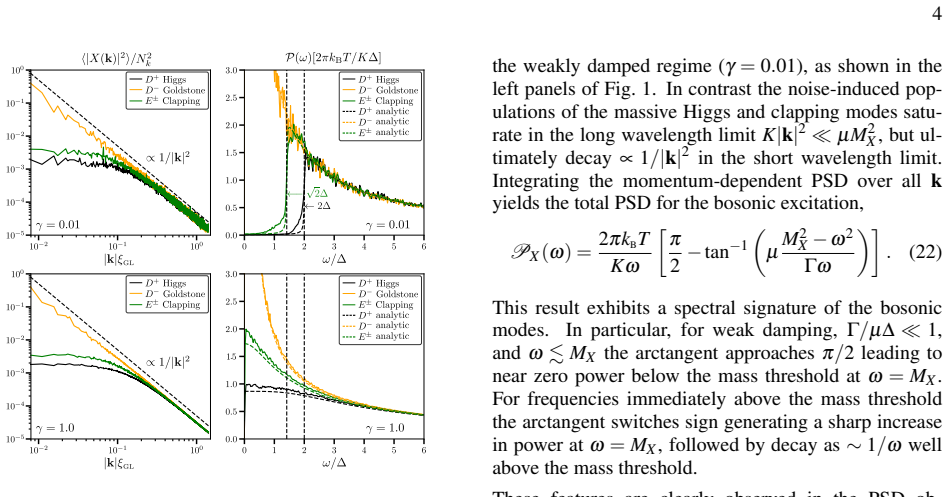
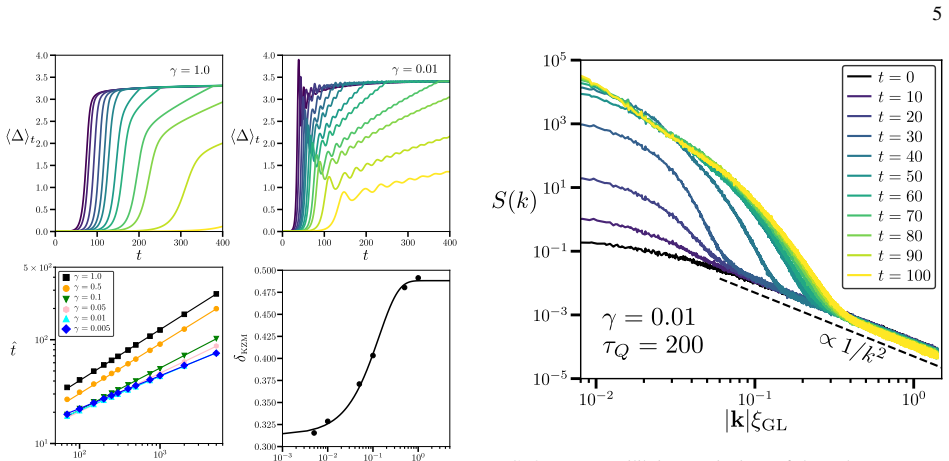
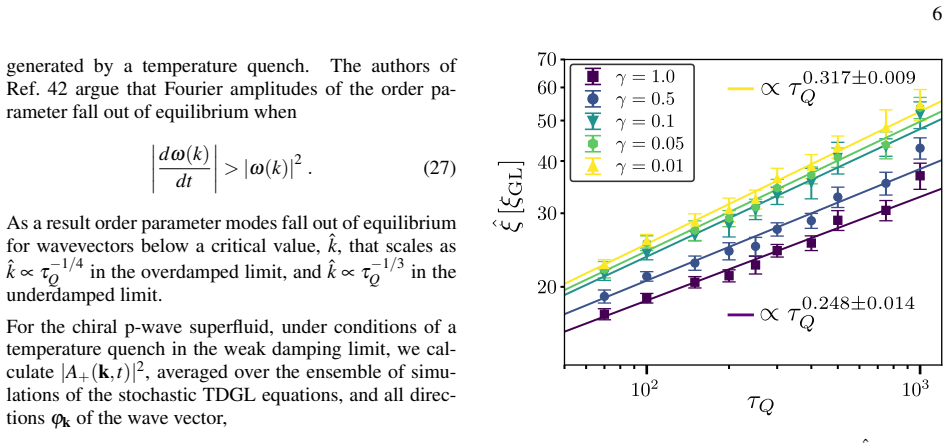
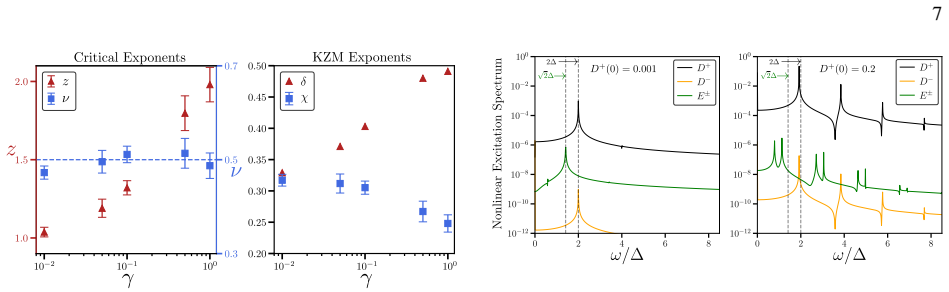
Based on time-dependent Ginzburg-Landau field theory we show that rapid cooling through the second-order phase transition into superfluid \Hea\ excites collective modes of newly formed chiral domains, in addition to topological defects that are formed via the Kibble-Zurek mechanism. Simulations of temperature quenches in the presence of Gaussian space-time white noise generate a highly excited inhomogeneous condensate. Large-scale simulations exhibit a complex network of domain walls and vortices. We report results for the excitation of bosonic collective modes by thermal noise as well as nonequilibrium temperature quenches, followed by coarsening dynamics tracked in terms of the Fourier components of the order parameter amplitudes. For thermal states, the spectrum of bosonic excitations is defined by a power spectral density (PSD) for each mode, which is sensitive to the Langevin damping. For weak damping the PSD onsets sharply at the frequency corresponding to the mass of the bosonic mode, then decays as $1/\omega$. We also track the dynamics of the order parameter following a temperature quench. We report results for the scaling exponents of Kibble-Zurek freeze-out time and correlation length as a function of quench rate for several damping rates. The dynamical exponent $z$ is shown to transition smoothly from $z=1$ to $z=2$ as the damping is increased, while the correlation length exponent, $\nu\approx 1/2$, is independent of damping.
Editorial analysis
A structured set of objections, weighed in public.
Referee Report
Summary. The manuscript uses numerical simulations of the time-dependent Ginzburg-Landau equations with additive Gaussian space-time white noise to model rapid temperature quenches into superfluid 3He-A. It claims that such quenches excite collective bosonic modes within newly formed chiral domains, in addition to topological defects generated by the Kibble-Zurek mechanism. Reported results include damping-sensitive power spectral densities (PSD) for thermal excitations (sharp onset at mode mass followed by 1/ω decay for weak damping) and post-quench scaling where the dynamical exponent z crosses over from 1 to 2 with increasing damping while the correlation-length exponent remains ν ≈ 1/2 independent of damping.
Significance. If the simulations are robustly validated, the work extends the Kibble-Zurek picture by identifying an additional channel for collective-mode excitation during quenches in a chiral superfluid. The reported damping-driven crossover in z and the PSD functional forms are standard expectations within the stochastic TDGL class, and the explicit tracking of Fourier components of the order-parameter amplitudes during coarsening provides concrete, falsifiable signatures that could be compared with NMR or ultrasound experiments in 3He-A.
major comments (2)
- [Results section on quench dynamics (near the paragraph reporting scaling exponents)] The central scaling results (z crossover and ν ≈ 1/2) rest on fits to post-quench data whose details—system sizes, discretization scheme, number of independent noise realizations, and explicit fitting windows—are not provided; without these the claimed damping independence of ν and the smooth z transition cannot be assessed for robustness.
- [Thermal-states PSD paragraph] The PSD is stated to onset sharply at the bosonic mode mass and decay as 1/ω for weak damping, yet no quantitative comparison to the analytic expectation for the damped stochastic oscillator or error bands on the extracted onset frequency is shown; this is load-bearing for the claim that the spectrum is “sensitive to the Langevin damping.”
minor comments (2)
- [Abstract] The abstract mentions “several damping rates” but does not list the numerical values or the range explored; adding this would improve reproducibility.
- [Coarsening-dynamics paragraph] The precise definition of the order-parameter amplitudes whose Fourier components are tracked should be restated explicitly when the coarsening analysis is introduced.
Simulated Author's Rebuttal
We thank the referee for the detailed and constructive report. The two major comments identify important omissions in the presentation of numerical details and quantitative PSD analysis. We address each point below and will incorporate the requested information in a revised manuscript to strengthen the robustness of the reported scaling and spectral results.
read point-by-point responses
-
Referee: [Results section on quench dynamics (near the paragraph reporting scaling exponents)] The central scaling results (z crossover and ν ≈ 1/2) rest on fits to post-quench data whose details—system sizes, discretization scheme, number of independent noise realizations, and explicit fitting windows—are not provided; without these the claimed damping independence of ν and the smooth z transition cannot be assessed for robustness.
Authors: We agree that these methodological details are required to evaluate the reliability of the extracted exponents. In the revised manuscript we will add a new subsection (or expand the existing Methods paragraph) that explicitly states: (i) the lattice sizes employed for the scaling runs, (ii) the finite-difference discretization and time-stepping scheme, (iii) the number of independent noise realizations (typically 50–200 depending on quench rate), and (iv) the precise temporal windows and functional forms used for the power-law fits to the freeze-out time and correlation length. With these additions the damping independence of ν ≈ 1/2 and the smooth crossover in z can be directly assessed by readers. revision: yes
-
Referee: [Thermal-states PSD paragraph] The PSD is stated to onset sharply at the bosonic mode mass and decay as 1/ω for weak damping, yet no quantitative comparison to the analytic expectation for the damped stochastic oscillator or error bands on the extracted onset frequency is shown; this is load-bearing for the claim that the spectrum is “sensitive to the Langevin damping.”
Authors: The comment is correct: the present manuscript shows only the simulated PSD curves and notes the qualitative features without a direct overlay of the analytic damped-oscillator spectrum or error bands. In revision we will (i) include a brief analytic derivation or reference to the expected PSD form for the stochastic TDGL oscillator, (ii) overlay the analytic curve on the numerical data for at least one damping value, and (iii) add shaded error bands obtained from the ensemble of independent realizations. These changes will make the damping sensitivity of the onset frequency quantitatively demonstrable. revision: yes
Circularity Check
No significant circularity
full rationale
The paper's results are obtained by direct numerical integration of the TDGL equations with added space-time white noise. Reported quantities (PSD shapes, dynamical exponent z crossover, correlation-length exponent ν) are computed outputs of these simulations for given damping rates and quench protocols. No parameters are fitted to subsets of data and then relabeled as predictions, no self-citations close a load-bearing loop, and no ansatz or uniqueness theorem is smuggled in. The derivation chain is therefore the simulation itself and remains self-contained within the stated phenomenological model.
Axiom & Free-Parameter Ledger
free parameters (2)
- Langevin damping coefficient
- quench rate
axioms (1)
- domain assumption Time-dependent Ginzburg-Landau theory with Gaussian space-time white noise describes the order-parameter dynamics of 3He-A across the second-order transition
Reference graph
Works this paper leans on
-
[1]
Vilenkin \ and\ author E
author author A. Vilenkin \ and\ author E. P. S. \ Shellard ,\ @noop title Cosmic Strings and Other Topological Defects \ ( publisher Cambridge University Press ,\ address Cambridge, UK ,\ year 1994 ) NoStop
1994
-
[2]
Vollhardt \ and\ author P
author author D. Vollhardt \ and\ author P. W\"olfle ,\ @noop title The Superfluid Phases of ^3 He \ ( publisher Taylor & Francis ,\ address New York ,\ year 1990 ) NoStop
1990
-
[3]
author author M. Hindmarsh , author J. A. \ Sauls , author K. Zhang , \ and\ author et al. ,\ AB Transition in Superfluid and Cosmological Phase Transitions title AB Transition in Superfluid and Cosmological Phase Transitions ,\ 10.1007/s10909-024-03151-9 journal journal J. Low Temp. Phys. \ volume 215 ,\ pages 495 ( year 2024 ) NoStop
-
[4]
author author T. W. B. \ Kibble ,\ Topology of Cosmic Domains and Strings title Topology of Cosmic Domains and Strings ,\ 10.1088/0305-4470/9/8/029 journal journal Journal of Physics A: Mathematical and General \ volume 9 ,\ pages 1387 ( year 1976 ) NoStop
-
[5]
author author T. W. B. \ Kibble ,\ Some Implications of a Cosmological Phase Transition title Some Implications of a Cosmological Phase Transition ,\ 10.1016/0370-1573(80)90091-5 journal journal Physics Reports \ volume 67 ,\ pages 183 ( year 1980 ) NoStop
-
[6]
author author W. H. \ Zurek ,\ Cosmological Experiments in Superfluid Helium? title Cosmological Experiments in Superfluid Helium? \ 10.1038/382296a0 journal journal Nature \ volume 317 ,\ pages 505 ( year 1985 ) NoStop
-
[7]
author author C. Bäuerle , author Y. M. \ Bunkov , author S. N. \ Fisher , author H. Godfrin , \ and\ author G. R. \ Pickett ,\ Laboratory Simulation of Cosmic String Formation in the Early Universe Using Superfluid ^3 He title Laboratory Simulation of Cosmic String Formation in the Early Universe Using Superfluid ^3 He ,\ 10.1038/382332a0 journal journal...
-
[8]
author author V. M. H. \ Ruutu , author V. B. \ Eltsov , author A. J. \ Gill , author T. W. B. \ Kibble , author M. Krusius , author Y. G. \ Makhlin , author B. Plaçais , author G. E. \ Volovik , \ and\ author W. Xu ,\ Vortex Formation in Neutron-Irradiated Superfluid ^3 He as an Analogue of Cosmological Defect Formation title Vortex Formation in Neutron-...
-
[9]
author author V. M. \ Ruutu , author V. B. \ Eltsov , author M. Krusius , author Y. G. \ Makhlin , author B. Plaçais , \ and\ author G. E. \ Volovik ,\ Defect Formation in Quench-Cooled Superfluid Phase Transition title Defect Formation in Quench-Cooled Superfluid Phase Transition ,\ 10.1103/PhysRevLett.80.1465 journal journal Phys. Rev. Lett. \ volume 80...
-
[10]
author author S. Autti , author V. V. \ Dmitriev , author J. T. \ M\"akinen , author A. A. \ Soldatov , author G. E. \ Volovik , author A. N. \ Yudin , author V. V. \ Zavjalov , \ and\ author V. B. \ Eltsov ,\ Observation of Half-Quantum Vortices in Topological Superfluid ^3 He title Observation of Half-Quantum Vortices in Topological Superfluid ^3 He ,\ ...
-
[11]
author author J. Rysti , author J. T. \ M\"akinen , author S. Autti , author T. Kamppinen , author G. E. \ Volovik , \ and\ author V. B. \ Eltsov ,\ Suppressing the Kibble-Zurek Mechanism by a Symmetry-Violating Bias title Suppressing the Kibble-Zurek Mechanism by a Symmetry-Violating Bias ,\ 10.1103/PhysRevLett.127.115702 journal journal Phys. Rev. Lett....
-
[12]
author author C. N. \ Weiler , author T. W. \ Neely , author D. R. \ Scherer , author A. S. \ Bradley , author M. J. \ Davis , \ and\ author B. P. \ Anderson ,\ Spontaneous Vortices in the Formation of Bose–Einstein Condensates title Spontaneous Vortices in the Formation of Bose–Einstein Condensates ,\ 10.1038/nature07334 journal journal Nature \ volume 4...
-
[13]
author author G. Lamporesi , author S. Donadello , author S. Serafini , author F. Dalfovo , \ and\ author G. Ferrari ,\ Spontaneous Creation of Kibble–Zurek Solitons in a Bose–Einstein Condensate title Spontaneous Creation of Kibble–Zurek Solitons in a Bose–Einstein Condensate ,\ 10.1038/nphys2734 journal journal Nature Physics \ volume 9 ,\ pages 656 ( y...
-
[14]
author author K. Lee , author S. Kim , author T. Kim , \ and\ author Y. Shin ,\ Universal Kibble-Zurek scaling in an atomic Fermi superfluid title Universal Kibble-Zurek scaling in an atomic Fermi superfluid ,\ 10.1103/PhysRevLett.121.200601 journal journal Nat. Phys. \ ( year 2024 ),\ 10.1103/PhysRevLett.121.200601 NoStop
-
[15]
author author I. Chuang , author R. Durrer , author N. Turok , \ and\ author B. Yurke ,\ Cosmology in the Laboratory: Defect Dynamics in Liquid Crystals title Cosmology in the Laboratory: Defect Dynamics in Liquid Crystals ,\ 10.1126/science.251.4999.1336 journal journal Science \ volume 251 ,\ pages 1336 ( year 1991 ) NoStop
-
[16]
author author M. J. \ Bowick , author L. Chandar , author E. A. \ Schiff , \ and\ author A. M. \ Srivastava ,\ The Cosmological Kibble Mechanism in the Laboratory: String Formation in Liquid Crystals title The Cosmological Kibble Mechanism in the Laboratory: String Formation in Liquid Crystals ,\ 10.1126/science.263.5149.943 journal journal Science \ volu...
-
[17]
author author S.-H. \ Shinn , author M. Massaro , author M. Thudiyangal , \ and\ author A. del Campo ,\ Spontaneous Quantum Turbulence in a Newborn Bose-Einstein Condensate via the Kibble-Zurek Mechanism title Spontaneous Quantum Turbulence in a Newborn Bose-Einstein Condensate via the Kibble-Zurek Mechanism ,\ 10.48550/arXiv.2506.21670 journal journal ar...
-
[18]
author author J. A. \ Sauls ,\ Generation of Quantum Turbulence by Neutrino Cooling in Neutron Stars title Generation of Quantum Turbulence by Neutrino Cooling in Neutron Stars ,\ 10.48550/arXiv.2605.22768 journal journal arXiv \ volume 2605.22768 ,\ pages 1 ( year 2026 ) NoStop
work page internal anchor Pith review Pith/arXiv arXiv doi:10.48550/arxiv.2605.22768 2026
-
[19]
author author A. B. \ Vorontsov \ and\ author J. A. \ Sauls ,\ Crystalline Order in Superfluid ^3 He Films title Crystalline Order in Superfluid ^3 He Films ,\ 10.1103/PhysRevLett.98.045301 journal journal Phys. Rev. Lett. \ volume 98 ,\ pages 045301 ( year 2007 ) NoStop
-
[20]
author author P. J. \ Heikkinen , author L. V. \ Levitin , author X. Rojas , author A. Singh , author N. Eng , author A. Casey , author J. Saunders , author A. Vorontsov , author N. Zhelev , author A. T. \ Sebastian , \ and\ author J. M. \ Parpia ,\ Chiral Superfluid Helium-3 in the Quasi-Two-Dimensional Limit title Chiral Superfluid Helium-3 in the Quasi...
-
[21]
author author J. J. \ Wiman \ and\ author J. A. \ Sauls ,\ Strong-Coupling and the Stripe Phase of ^3 He title Strong-Coupling and the Stripe Phase of ^3 He ,\ 10.1007/s10909-016-1632-7 journal journal J. Low Temp. Phys. \ volume 184 ,\ pages 1054 ( year 2016 ) NoStop
-
[22]
note We set =1 in the main text unless noted otherwise. Stop
-
[23]
author author N. Gluscevich \ and\ author J. A. \ Sauls ,\ Kibble-Zurek Dynamics and Statistics of Topological Defects in Chiral Superfluid Films title Kibble-Zurek Dynamics and Statistics of Topological Defects in Chiral Superfluid Films ,\ 10.1103/tlv7-bvkh journal journal Phys. Rev. B \ volume 111 ,\ pages 214526 ( year 2025 ) ,\ note Editor's selection NoStop
-
[24]
author author J. A. \ Sauls , author H. Wu , \ and\ author S. B. \ Chung ,\ Anisotropy and Strong-Coupling Effects on the Collective Mode Spectrum of Chiral Superconductors: Application to Sr _2 RuO _4 title Anisotropy and Strong-Coupling Effects on the Collective Mode Spectrum of Chiral Superconductors: Application to Sr _2 RuO _4 ,\ 10.3389/fphy.2015.00...
-
[25]
author author J. A. \ Sauls \ and\ author T. Mizushima ,\ On the Nambu Fermion-Boson Relations for Superfluid ^3 He title On the Nambu Fermion-Boson Relations for Superfluid ^3 He ,\ 10.1103/PhysRevB.95.094515 journal journal Phys. Rev. B \ volume 95 ,\ pages 094515 ( year 2017 ) NoStop
-
[26]
author author R. C. \ Regan , author J. J. \ Wiman , \ and\ author J. A. \ Sauls ,\ The Vortex Phase Diagram of Rotating Superfluid ^3 He-B title The Vortex Phase Diagram of Rotating Superfluid ^3 He-B ,\ 10.1103/PhysRevB.101.024517 journal journal Phys. Rev. B \ volume 101 ,\ pages 024517 ( year 2020 ) NoStop
-
[27]
author author J. Wiman ,\ title Quantitative Superfluid He-Three from Confinement to Bulk ,\ https://search.proquest.com/docview/2164903630?pq-origsite=gscholar Ph.D. thesis ,\ school Northwestern University , address Evanston, Illinois ( year 2019 ) NoStop
arXiv 2019
-
[28]
author author P. W. \ Higgs ,\ Broken Symmetries and the Masses of Gauge Bosons title Broken Symmetries and the Masses of Gauge Bosons ,\ 10.1103/PhysRevLett.13.508 journal journal Phys. Rev. Lett. \ volume 13 ,\ pages 508 ( year 1964 ) NoStop
-
[29]
author author P. Littlewood \ and\ author C. Varma ,\ Gauge-Invariant Theory of the Dynamical Interaction of Charge Density Waves and Superconductivity title Gauge-Invariant Theory of the Dynamical Interaction of Charge Density Waves and Superconductivity ,\ 10.1103/PhysRevLett.47.811 journal journal Phys. Rev. Lett. \ volume 47 ,\ pages 811 ( year 1981 ) NoStop
-
[30]
@citealpnum sau15
note In anisotropic chiral superconductors the degeneracy of the E^ modes is lifted by anisotropy of the Fermi surface and pairing basis functions as discussed in Ref. @citealpnum sau15 . Stop
-
[31]
We expect to decrease with temperature below T_c and to increase with increasing pressure
note The temperature and pressure dependence of the noise and damping rate has not been systematically investigated. We expect to decrease with temperature below T_c and to increase with increasing pressure. Stop
-
[32]
author author F. Suzuki \ and\ author W. H. \ Zurek ,\ Deconstructing dynamics of symmetry breaking title Deconstructing dynamics of symmetry breaking ,\ 10.1073/pnas.2523903122 journal journal Proc. Nat. Acad. Sci. \ volume 122 ( year 2025 ),\ 10.1073/pnas.2523903122 NoStop
-
[33]
author author G. Bussi \ and\ author M. Parrinello ,\ Accurate sampling using Langevin dynamics title Accurate sampling using Langevin dynamics ,\ 10.1103/PhysRevE.75.056707 journal journal Phys. Rev. E \ volume 75 ,\ pages 056707 ( year 2007 ) NoStop
-
[34]
author author S. A. \ Orszag ,\ Numerical Methods for the Simulation of Turbulence title Numerical Methods for the Simulation of Turbulence ,\ 10.1063/1.1692445 journal journal The Physics of Fluids \ volume 12 ,\ pages II–250–II–257 ( year 1969 ) NoStop
-
[35]
author author D. Gottlieb \ and\ author S. A. \ Orszag ,\ 10.1137/1.9781611970425 title Numerical Analysis of Spectral Methods: Theory and Applications \ ( publisher Society for Industrial and Applied Mathematics ,\ year 1977 ) NoStop
-
[36]
Press , author B
author author W. Press , author B. Flannery , author S. Teucholsky , \ and\ author W. Vetterling ,\ @noop title Numerical Recipes \ ( publisher Cambridge University Press ,\ year 1986 ) NoStop
1986
-
[37]
Kardar ,\ @noop title Statistical Physics of Fields \ ( publisher Cambridge University Press ,\ address Cambridge, UK ,\ year 2007 ) NoStop
author author M. Kardar ,\ @noop title Statistical Physics of Fields \ ( publisher Cambridge University Press ,\ address Cambridge, UK ,\ year 2007 ) NoStop
2007
-
[38]
author author M. C. \ Wang \ and\ author G. E. \ Uhlenbeck ,\ On the Theory of Brownian Motion II title On the Theory of Brownian Motion II ,\ 10.1103/RevModPhys.17.323 journal journal Rev. Mod. Phys. \ volume 17 ,\ pages 323 ( year 1945 ) NoStop
-
[39]
author author N. D. \ Antunes , author L. M. A. \ Bettencourt , \ and\ author W. H. \ Zurek ,\ Vortex String Formation in a 3D U(1) Temperature Quench title Vortex String Formation in a 3D U(1) Temperature Quench ,\ 10.1103/PhysRevLett.82.2824 journal journal Phys. Rev. Lett. \ volume 82 ,\ pages 2824 ( year 1999 ) NoStop
-
[40]
author author W. Kirkby , author H. Salman , author T. Gasenzer , \ and\ author L. Chomaz ,\ Kibble-Zurek scaling of the superfluid-supersolid transition in an elongated dipolar gas title Kibble-Zurek scaling of the superfluid-supersolid transition in an elongated dipolar gas ,\ 10.1103/x51r-vdyf \ volume 7 ,\ pages 023248 ( year 2025 ) NoStop
-
[41]
author author P. Laguna \ and\ author W. H. \ Zurek ,\ Density of Kinks after a Quench: When Symmetry Breaks, How Big are the Pieces? title Density of Kinks after a Quench: When Symmetry Breaks, How Big are the Pieces? \ 10.1103/PhysRevLett.78.2519 journal journal Phys. Rev. Lett. \ volume 78 ,\ pages 2519 ( year 1997 ) NoStop
-
[42]
author author M. Hindmarsh \ and\ author A. Rajantie ,\ Defect Formation and Local Gauge Invariance title Defect Formation and Local Gauge Invariance ,\ 10.1103/PhysRevLett.85.4660 journal journal Phys. Rev. Lett. \ volume 85 ,\ pages 4660 ( year 2000 ) NoStop
-
[43]
author author J. J. \ Wiman \ and\ author J. A. \ Sauls ,\ Spontaneous Helical Order of a Chiral p -Wave Superfluid Confined in Nano-Scale Channels title Spontaneous Helical Order of a Chiral p -Wave Superfluid Confined in Nano-Scale Channels ,\ 10.1103/PhysRevLett.121.045301 journal journal Phys. Rev. Lett. \ volume 121 ,\ pages 045301 ( year 2018 ) NoStop
-
[44]
author author D. S. \ Greywall ,\ ^3 He Specific Heat and Thermometry at Millikelvin Temperatures title ^3 He Specific Heat and Thermometry at Millikelvin Temperatures ,\ 10.1103/PhysRevB.33.7520 journal journal Phys. Rev. B \ volume 33 ,\ pages 7520 ( year 1986 ) NoStop
discussion (0)
Sign in with ORCID, Apple, or X to comment. Anyone can read and Pith papers without signing in.