A Query-Driven Communication-Efficient Digital Twins Design for Autonomous Driving
Pith reviewed 2026-06-30 10:51 UTC · model grok-4.3
The pith
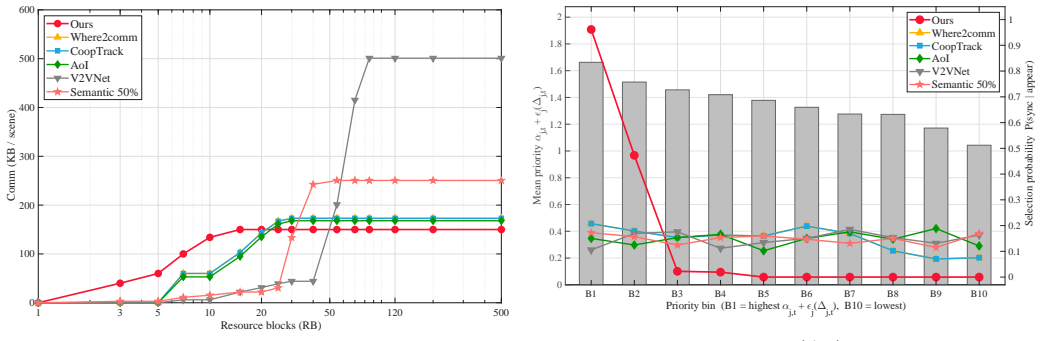
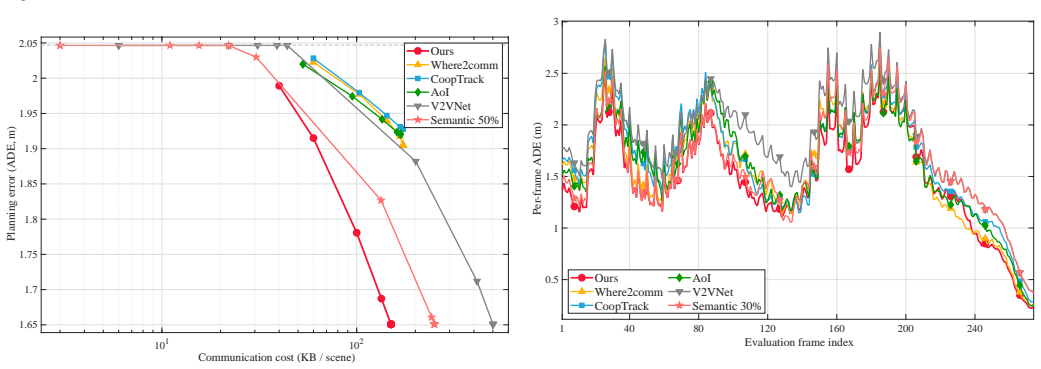
A query-driven digital twin for autonomous driving reduces position error by 24 percent while cutting communication overhead by 40 percent.
A machine-rendered reading of the paper's core claim, the machinery that carries it, and where it could break.
Core claim
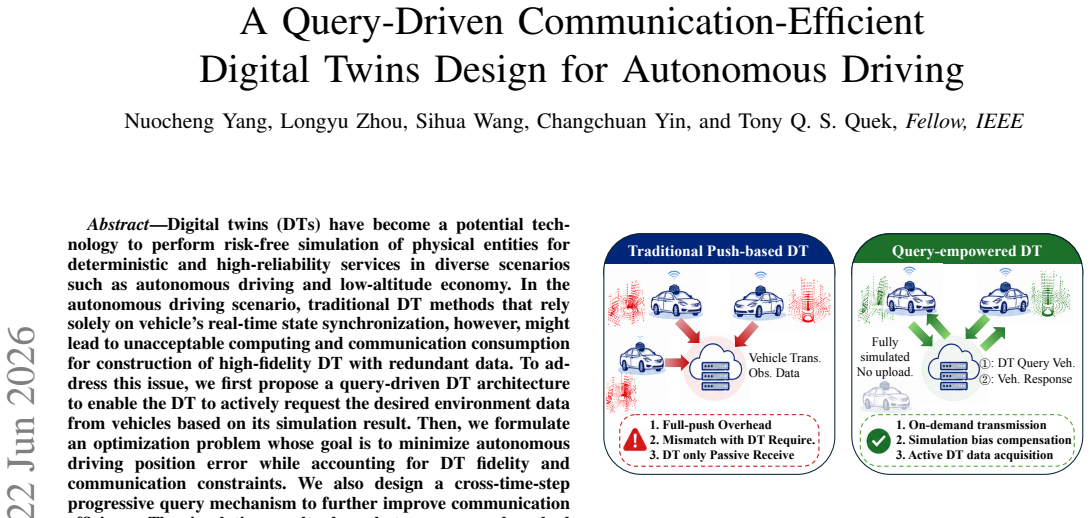
By making the digital twin query vehicles for specific data rather than receiving continuous updates, the system maintains high-fidelity representations with substantially lower communication costs and achieves more accurate autonomous driving plans.
What carries the argument
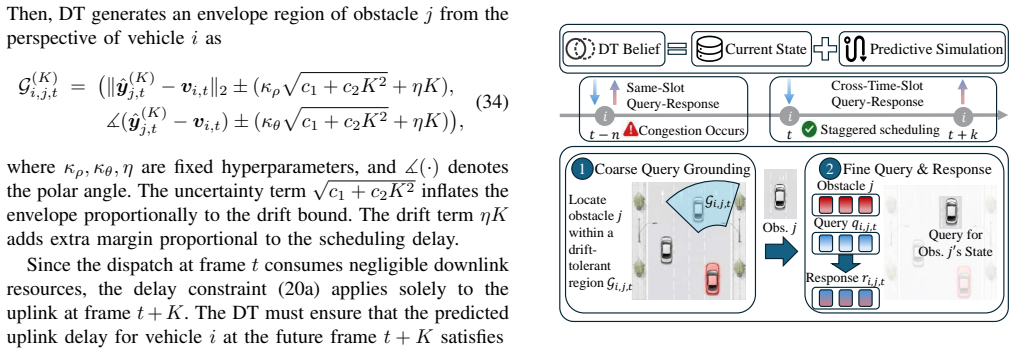
The query-driven DT architecture, in which the twin actively requests environment data from vehicles according to simulation results, combined with an optimization formulation and cross-time-step progressive querying.
If this is right
- Autonomous vehicles can achieve safer planning with less network load.
- Digital twins become feasible in bandwidth-constrained environments.
- The optimization allows explicit trade-offs between accuracy, fidelity, and communication.
- Progressive querying reduces redundant data over multiple time steps.
Where Pith is reading between the lines
- Similar query mechanisms could extend to other simulation-heavy applications such as robotics or traffic management.
- Real-time implementation might require careful handling of query latency not addressed in the simulations.
Load-bearing premise
The simulation environment accurately represents real-world vehicle behavior and communication conditions.
What would settle it
A field test in which the query-driven method shows no improvement or worse position error than traditional synchronization.
Figures



read the original abstract
Digital twins (DTs) have become a potential technology to perform risk-free simulation of physical entities for deterministic and high-reliability services in diverse scenarios such as autonomous driving and low-altitude economy. In the autonomous driving scenario, traditional DT methods that rely solely on vehicle's real-time state synchronization, however, might lead to unacceptable computing and communication consumption for construction of high-fidelity DT with redundant data. To address this issue, we first propose a query-driven DT architecture to enable the DT to actively request the desired environment data from vehicles based on its simulation result. Then, we formulate an optimization problem whose goal is to minimize autonomous driving position error while accounting for DT fidelity and communication constraints. We also design a cross-time-step progressive query mechanism to further improve communication efficiency. The simulation results show that our proposed method achieves a 24% reduction in planning position error compared to traditional methods, while reducing communication overhead by 40%.
Editorial analysis
A structured set of objections, weighed in public.
Referee Report
Summary. The manuscript proposes a query-driven digital twin (DT) architecture for autonomous driving scenarios. Instead of full real-time state synchronization, the DT actively queries vehicles for environment data based on its own simulation outcomes. An optimization problem is formulated to minimize planning position error subject to constraints on DT fidelity and communication overhead. A cross-time-step progressive query mechanism is added to improve efficiency. Simulation results are reported to show a 24% reduction in planning position error and a 40% reduction in communication overhead relative to traditional DT methods.
Significance. If the simulation results hold under realistic conditions, the query-driven design and constrained optimization could meaningfully reduce redundant data exchange in DT-enabled autonomous driving systems while preserving planning accuracy. The approach targets a practical trade-off between fidelity and resource use that is relevant to scalable DT deployments.
major comments (2)
- [Optimization Problem Formulation] The optimization problem (formulated to minimize position error subject to fidelity and communication constraints) implicitly assumes the DT can perfectly anticipate which future environment observations will be required. This assumption is load-bearing for the claimed 24% error reduction; the skeptic note correctly flags that sensor noise, prediction error, or partial observability would likely erode both the error and communication savings.
- [Simulation Results / Evaluation] The simulation results (reporting 24% position-error reduction and 40% communication reduction) provide no details on experimental setup, baselines, statistical significance testing, vehicle dynamics model, or sensitivity to idealized assumptions such as noise-free data and perfect synchronization. Without these, it is impossible to determine whether the gains are robust or artifacts of the simulation choices.
minor comments (1)
- [Abstract] The abstract states performance numbers but omits any mention of the simulation environment or number of runs; adding one sentence on these would improve clarity.
Simulated Author's Rebuttal
We thank the referee for the constructive feedback. We address the two major comments below and will revise the manuscript to improve clarity on assumptions and evaluation details.
read point-by-point responses
-
Referee: [Optimization Problem Formulation] The optimization problem (formulated to minimize position error subject to fidelity and communication constraints) implicitly assumes the DT can perfectly anticipate which future environment observations will be required. This assumption is load-bearing for the claimed 24% error reduction; the skeptic note correctly flags that sensor noise, prediction error, or partial observability would likely erode both the error and communication savings.
Authors: The formulation uses the DT's current simulation outcomes to select queries, with the progressive mechanism allowing iterative refinement across time steps rather than a single perfect anticipation. We agree the ideal prediction assumption is a limitation that could be affected by noise or partial observability in practice. In revision we will add an explicit limitations subsection discussing this assumption and include sensitivity analysis to prediction errors. revision: yes
-
Referee: [Simulation Results / Evaluation] The simulation results (reporting 24% position-error reduction and 40% communication reduction) provide no details on experimental setup, baselines, statistical significance testing, vehicle dynamics model, or sensitivity to idealized assumptions such as noise-free data and perfect synchronization. Without these, it is impossible to determine whether the gains are robust or artifacts of the simulation choices.
Authors: We agree the evaluation section lacks necessary detail. The revised manuscript will expand the simulation section to specify the vehicle dynamics model, simulation platform and parameters, exact baselines (full real-time synchronization DT), number of runs, statistical tests (means, std devs, significance), and sensitivity results under added noise and imperfect synchronization. revision: yes
Circularity Check
No significant circularity; derivation is self-contained
full rationale
The paper defines a query-driven DT architecture, formulates an optimization problem minimizing position error subject to fidelity and communication constraints, and introduces a cross-time-step query mechanism. Performance metrics (24% error reduction, 40% comms savings) are reported as direct simulation outputs under this formulation. No step reduces by construction to a fitted input, self-citation chain, or renamed ansatz; the optimization and simulation are independent of the target results. The derivation chain does not exhibit any of the enumerated circular patterns.
Axiom & Free-Parameter Ledger
Reference graph
Works this paper leans on
-
[1]
Digital Twin Technology for Intelligent V ehicles and Transportation Systems: A Survey on Applications, Challenges and Future Directions,
X. Gu, W. Duan, G. Zhang, J. Hou, L. Peng, M. Wen, F. Gao, M. Chen, and P .-H. Ho, “Digital Twin Technology for Intelligent V ehicles and Transportation Systems: A Survey on Applications, Challenges and Future Directions,” IEEE Commun. Surveys Tuts. , vol. 28, pp. 3235– 3271, June 2026
2026
-
[2]
V AD: V ectorized scene representation for efficient autonomous driving,
B. Jiang, S. Chen, Q. Xu, B. Liao, J. Chen, H. Zhou, Q. Zhang, W. Liu, C. Huang, and X. Wang, “V AD: V ectorized scene representation for efficient autonomous driving,” Proc. IEEE/CVF Int. Conf. Comput. Vision (ICCV), 2023
2023
-
[3]
Planning-oriented autonomous driving,
Y . Hu, J. Y ang, L. Chen, K. Li, C. Sima, X. Zhu, S. Chai, S. Du, T. Lin, W. Wang et al. , “Planning-oriented autonomous driving,” Proc. IEEE/CVF Conf. Comput. Vision Pattern Recognit. (CVPR) , 2023
2023
-
[4]
V2X-ViT: V ehicle-to-Everything Cooperative Perception with Vision Transformer,
R. Xu, H. Xiang, Z. Tu, X. Xia, M.-H. Y ang, and J. Ma, “V2X-ViT: V ehicle-to-Everything Cooperative Perception with Vision Transformer,” in Proc. Eur . Conf. Comput. Vis. (ECCV), ser. Lecture Notes in Computer Science, vol. 13699. Springer, 2022, pp. 107–124
2022
-
[5]
Where2comm: Communication-efficient collaborative perception via spatial confidence maps,
Y . Hu, S. Fang, Z. Lei, Y . Zhong, and S. Chen, “Where2comm: Communication-efficient collaborative perception via spatial confidence maps,” in Proc. Adv. Neural Inf. Process. Syst. (NeurIPS) , vol. 35. Curran Associates, Inc., 2022, pp. 4874–4886
2022
-
[6]
Low-overhead scheduling for synchronization in large-scale heterogeneous digital twin systems,
Z. Zhou, J. Steiger, Y . Sun, and B. Li, “Low-overhead scheduling for synchronization in large-scale heterogeneous digital twin systems,” in Proc. IEEE INFOCOM , 2026
2026
-
[7]
AoI-Aware, Digital Twin-Empowered IoT Query Services in Mobile Edge Computing,
J. Li, S. Guo, W. Liang, J. Wu, Q. Chen, Z. Xu, W. Xu, and J. Wang, “AoI-Aware, Digital Twin-Empowered IoT Query Services in Mobile Edge Computing,” IEEE/ACM Trans. Netw. , vol. 32, no. 4, pp. 3636– 3650, May 2024
2024
-
[8]
Toward Efficient Deployment and Syn- chronization in Digital Twins-Empowered Networks,
H. Farag and C. Stefanovic, “Toward Efficient Deployment and Syn- chronization in Digital Twins-Empowered Networks,” arXiv preprint arXiv:2604.00566, 2026
-
[9]
Optimizing Wireless Resource Management and Synchronization in Digital Twin Networks,
H. Y u, Y . Liu, Z. Y ang, H. Sun, and M. Chen, “Optimizing Wireless Resource Management and Synchronization in Digital Twin Networks,” IEEE Internet Things J. , vol. 12, no. 15, pp. 29 152–29 163, Feb. 2025
2025
-
[10]
Continual reinforcement learning for digital twin synchronization opti- mization,
H. Tong, M. Chen, J. Zhao, Y . Hu, Z. Y ang, Y . Liu, and C. Yin, “Continual reinforcement learning for digital twin synchronization opti- mization,” IEEE Trans. Mobile Comput. , vol. 24, no. 8, pp. 6843–6857, 2025
2025
-
[11]
Y olo-based semantic communication with generative ai-aided resource allocation for digital twins construction,
B. Du, H. Du, H. Liu, D. Niyato, P . Xin, J. Y u, M. Qi, and Y . Tang, “Y olo-based semantic communication with generative ai-aided resource allocation for digital twins construction,” IEEE Internet Things J. , vol. 11, no. 5, pp. 7664–7678, March. 2024
2024
-
[12]
Goal-Oriented Semantic Communication for Robot Arm Reconstruction in Digital Twin: Feature and Temporal Selections,
S. Chen, E. Spyrakos-Papastavridis, Y . Jin, and Y . Deng, “Goal-Oriented Semantic Communication for Robot Arm Reconstruction in Digital Twin: Feature and Temporal Selections,” IEEE J. Sel. Areas Commun. , vol. 43, no. 9, pp. 3072–3087, 2025
2025
-
[13]
Active Digital Twins via Active Inference,
M. Torzoni, D. Maisto, A. Manzoni, F. Donnarumma, G. Pezzulo, and A. Corigliano, “Active Digital Twins via Active Inference,” Eng. Appl. Artif. Intell. , vol. 174, p. 114519, 2026
2026
-
[14]
Digital Twin Assisted Proactive Management in Zero Touch Networks,
T. K, D. Das, K. Sharma, J. Bapat, and D. Das, “Digital Twin Assisted Proactive Management in Zero Touch Networks,” in IEEE Future Networks World F orum (FNWF), Bangalore, India, Nov. 2025, pp. 1–6
2025
-
[15]
Pull-based query scheduling for goal-oriented semantic communication,
P . Agheli, N. Pappas, and M. Kountouris, “Pull-based query scheduling for goal-oriented semantic communication,” IEEE Trans. Commun. , vol. 74, pp. 3845–3857, 2026
2026
-
[16]
A survey of world models for autonomous driving
V arious, “A survey of world models for autonomous driving,” arXiv preprint arXiv:2501.11260 , 2025
-
[17]
BEVFormer: Learning bird’s-eye-view representation from multi-camera images via spatiotemporal transformers,
Z. Li, W. Wang, H. Li, E. Xie, C. Sima, T. Lu, Y . Qiao, and J. Dai, “BEVFormer: Learning bird’s-eye-view representation from multi-camera images via spatiotemporal transformers,” Proc. Eur . Conf. Comput. Vision (ECCV) , 2022
2022
-
[18]
Uncertainty-guided and reliable collaborative perception for open het- erogeneous systems,
Y . Tian, X. Zhang, S. Zhuo, D. Zhang, Z. Tian, Y . Liu, and S. Du, “Uncertainty-guided and reliable collaborative perception for open het- erogeneous systems,” Pattern Recognit. Lett. , vol. 204, pp. 127–133, 2026
2026
-
[19]
V2vnet: V ehicle-to-vehicle communication for joint perception and prediction,
T. Wang, S. Manivasagam, M. Liang, B. Y ang, W. Zeng, and R. Urtasun, “V2vnet: V ehicle-to-vehicle communication for joint perception and prediction,” in Proc. Eur . Conf. Comput. Vis. (ECCV) , Cham, 2020
2020
-
[20]
Where2comm: Communication-efficient collaborative perception via spatial confidence maps,
Y . Hu, S. Fang, Z. Lei, Y . Zhong, and S. Chen, “Where2comm: Communication-efficient collaborative perception via spatial confidence maps,” in Proc. Adv. Neural Inf. Process. Syst. (NeurIPS) , 2022
2022
-
[21]
Cooptrack: Exploring End-to-End Learning for Efficient Cooperative Sequential Per- ception,
J. Zhong, J. Wang, J. Xu, X. Li, Z. Nie, and H. Y u, “Cooptrack: Exploring End-to-End Learning for Efficient Cooperative Sequential Per- ception,” in Proc. IEEE/CVF Int. Conf. Comput. Vis. (ICCV) , Honolulu, USA, Oct. 2025
2025
-
[22]
Digital twin-empowered com- munications: A new frontier of wireless networks,
L. Bariah, H. Sari, and M. Debbah, “Digital twin-empowered com- munications: A new frontier of wireless networks,” arXiv preprint arXiv:2307.00973, 2023
-
[23]
Smart mobility digital twin based automated vehicle navigation system: A proof of concept,
K. Wang, Z. Li, K. Nonomura, T. Y u, K. Sakaguchi, O. Hashash, and W. Saad, “Smart mobility digital twin based automated vehicle navigation system: A proof of concept,” IEEE Trans. Intell. V eh., 2024
2024
-
[24]
Joint optimization of vehicular sensing and vehicle digital twins deployment for DT-assisted IoVs,
L. Tang, Z. Cheng, J. Dai, H. Zhang, and Q. Chen, “Joint optimization of vehicular sensing and vehicle digital twins deployment for DT-assisted IoVs,” IEEE Trans. V eh. Technol., 2024
2024
-
[25]
Goal-Oriented Access Optimization for ISAC-Enabled Digital Twins
F. Saggese, F. Chiariotti, S. Raj Pandey, H. Wymeersch, L. Sanguinetti, and P . Popovski, “Goal-Oriented Access Optimization for ISAC-Enabled Digital Twins,” arXiv preprint arXiv:2603.01781 , Mar. 2026
work page internal anchor Pith review Pith/arXiv arXiv 2026
-
[26]
MapTR: Structured modeling and learning for online vectorized HD map construction,
B. Liao, S. Chen, X. Wang, T. Cheng, Q. Zhang, W. Liu, and C. Huang, “MapTR: Structured modeling and learning for online vectorized HD map construction,” in Proc. Int. Conf. Learn. Representations (ICLR) , 2023
2023
-
[27]
Attention is all you need,
A. V aswani, N. Shazeer, N. Parmar, J. Uszkoreit, L. Jones, A. N. Gomez, L. Kaiser, and I. Polosukhin, “Attention is all you need,” in Proc. Adv. Neural Inf. Process. Syst. (NeurIPS) , vol. 30, 2017
2017
-
[28]
A Survey on Trajectory-Prediction Methods for Autonomous Driving,
Y . Huang, J. Du, Z. Y ang, Z. Zhou, L. Zhang, and H. Chen, “A Survey on Trajectory-Prediction Methods for Autonomous Driving,” IEEE Trans. Intell. V eh., vol. 7, no. 3, pp. 652–674, Sep. 2022
2022
-
[29]
Set-based predirobust safety for mixed- autonomy traffic with delays and disturbancesction of traffic participants on arbitrary road networks,
M. Althoff and S. Magdici, “Set-based predirobust safety for mixed- autonomy traffic with delays and disturbancesction of traffic participants on arbitrary road networks,” IEEE Trans. Intell. V eh., vol. 1, no. 2, pp. 187–202, Oct. 2016
2016
-
[30]
J. Zhou, B. Olofsson, and E. Frisk, “Interaction-aware motion planning for autonomous vehicles with multi-modal obstacle uncertainty predic- tions,” arXiv preprint arXiv:2212.11819 , Sep. 2023
-
[31]
Learning Interaction-Aware Guidance for Trajectory Optimization in Dense Traffic Scenarios,
B. Brito, A. Agarwal, and J. Alonso-Mora, “Learning Interaction-Aware Guidance for Trajectory Optimization in Dense Traffic Scenarios,” IEEE Trans. Intell. Transp. Syst., vol. 23, no. 10, pp. 18 808–18 821, Oct. 2022
2022
-
[32]
Robust Safety for Mixed-Autonomy Traffic With Delays and Disturbances,
C. Zhao and H. Y u, “Robust Safety for Mixed-Autonomy Traffic With Delays and Disturbances,” IEEE Trans. Intell. Transp. Syst. , vol. 25, no. 11, pp. 16 522–16 535, Nov. 2024
2024
-
[33]
Autonomous V ehicle Control: A Nonconvex Approach for Obstacle Avoidance,
U. Rosolia, S. De Bruyne, and A. G. Alleyne, “Autonomous V ehicle Control: A Nonconvex Approach for Obstacle Avoidance,” IEEE Trans. Control Syst. Technol. , vol. 25, no. 2, pp. 469–484, June 2017
2017
-
[34]
Experimental vali- dation of safe mpc for autonomous driving in uncertain environments,
I. Batkovic, A. Gupta, M. Zanon, and P . Falcone, “Experimental vali- dation of safe mpc for autonomous driving in uncertain environments,” IEEE Trans. Control Syst. Technol. , vol. 31, no. 5, pp. 2027–2042, Sep. 2023
2027
-
[35]
Deep Learning Enabled Semantic Communication Systems,
H. Xie, Z. Qin, G. Y . Li, and B.-H. Juang, “Deep Learning Enabled Semantic Communication Systems,” IEEE Trans. Signal Process. , Apr. 2021
2021
-
[36]
V2x-sim: A virtual collaborative perception dataset for autonomous driving,
Y . Li, Z. An, Z. Wang, Y . Zhong, S. Chen, and C. Feng, “V2x-sim: A virtual collaborative perception dataset for autonomous driving,” arXiv preprint arXiv:2202.08449 , 2022
-
[37]
W. Fong, R. Mohan, J. Hurtado, L. Zhou, H. Caesar, O. Beijbom, and A. V alada, “Panoptic nuScenes: A Large-Scale Benchmark for LiDAR Panoptic Segmentation and Tracking,” arXiv preprint arXiv:2109.03805, 2021
-
[38]
Wireless image transmission using deep source channel coding with attention modules,
J. Xu, B. Ai, W. Chen, A. Y ang, P . Sun, and M. Rodrigues, “Wireless image transmission using deep source channel coding with attention modules,” IEEE Trans. Circuits Syst. Video Technol. , vol. 32, no. 4, pp. 2315–2328, 2021. APPENDIX A. Proof of Lemma 1 Proof. Assume the bound holds at frame τ for staleness ∆j,τ = k. Consider frame τ + 1 where obstacle...
2021
-
[39]
, N, we obtain the per-obstacle trajectory sensitivity as NX i=1 E ˆτi,t − ˜τ (p⋆ 1 ,...,p⋆ Mt ) i,t 2 2 ≤ Mt MtX j=1 NX i=1 PX p=1 ˆπp j,t ˆτ (j,p) i,t − ˆτi,t 2 ≜ Mt MtX j=1 αj,t
(53) Summing over all vehicles i = 1 , . . . , N, we obtain the per-obstacle trajectory sensitivity as NX i=1 E ˆτi,t − ˜τ (p⋆ 1 ,...,p⋆ Mt ) i,t 2 2 ≤ Mt MtX j=1 NX i=1 PX p=1 ˆπp j,t ˆτ (j,p) i,t − ˆτi,t 2 ≜ Mt MtX j=1 αj,t. (54) Then, we analyze term B in (50), which measures the planning error induced solely by stale state, assuming ground- truth mode...
-
[40]
(57) Summing over all vehicles i = 1,
(56) Then, by applying Lemma 1 to each obstacle, we have ˆzagg j,t − ˆzagg,∗ j,t 2 2 ≤ ηQR + ∆j,t · δ2 mode. (57) Summing over all vehicles i = 1, . . . , N, we can obtain: NX i=1 ˜τ (p⋆ 1 ,...,p⋆ Mt ) i,t − τ ∗ i,t 2 2 ≤ NX i=1 L2 plan MtX j=1 2ηQR+ 2∆2 j,t·δ2 mode = N L2 plan MtX j=1 2ηQR + 2∆2 j,t · δ2 mode ≜ MtX j=1 ε(∆j,t), (58) where ε(∆j,t) ≜ N L2 ...
discussion (0)
Sign in with ORCID, Apple, or X to comment. Anyone can read and Pith papers without signing in.