Stellar discs and intermediate-mass black holes in galactic nuclei I. Fragmenting the disc in an isotropic stellar potential
Pith reviewed 2026-06-30 00:51 UTC · model grok-4.3
The pith
A retrograde IMBH of two-thirds the disc mass fragments a single stellar disc into three distinct angular-momentum components.
A machine-rendered reading of the paper's core claim, the machinery that carries it, and where it could break.
Core claim
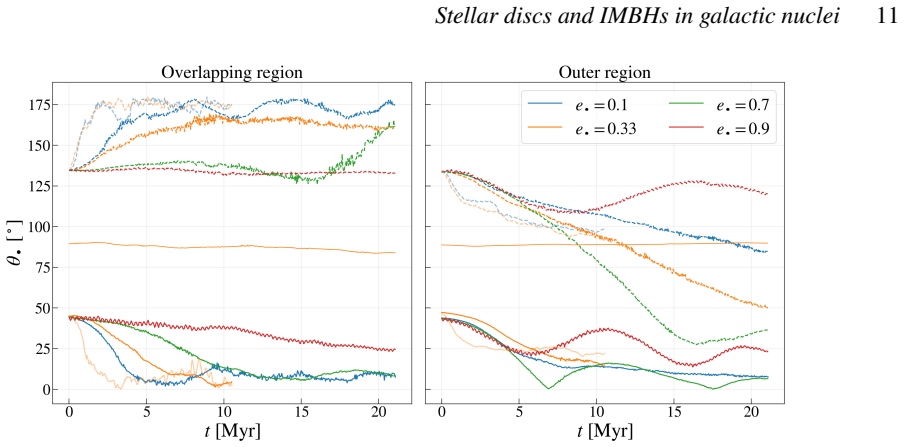
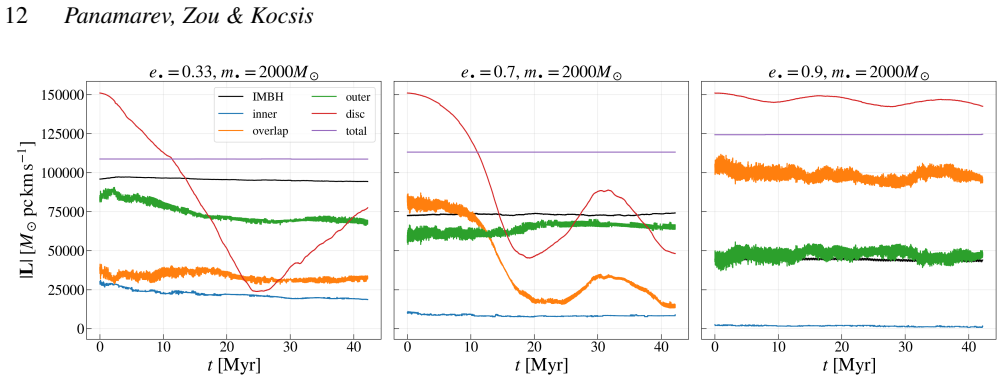
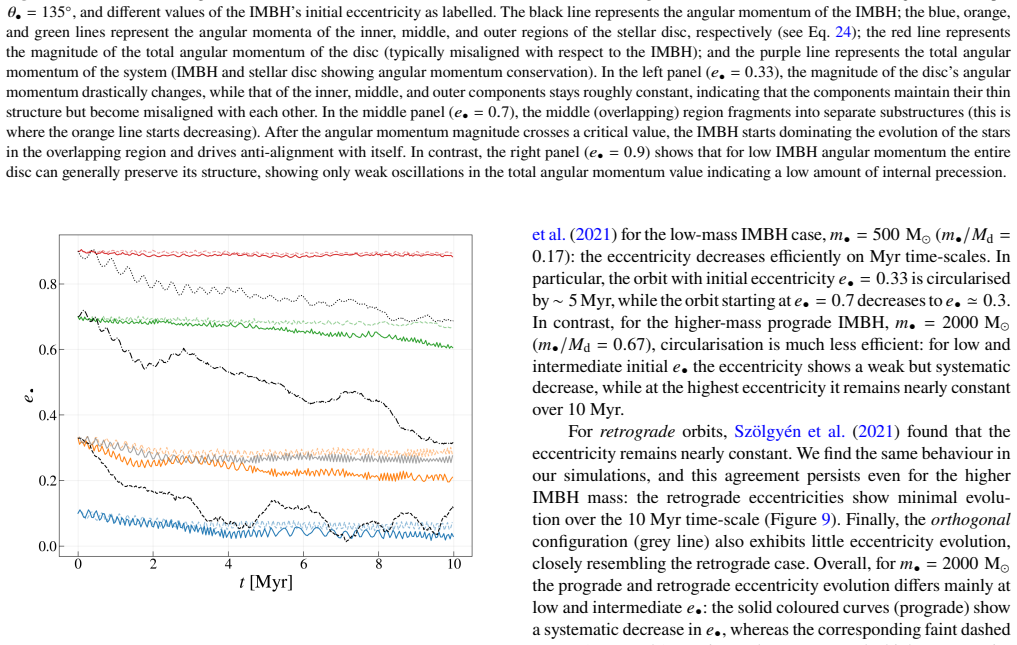
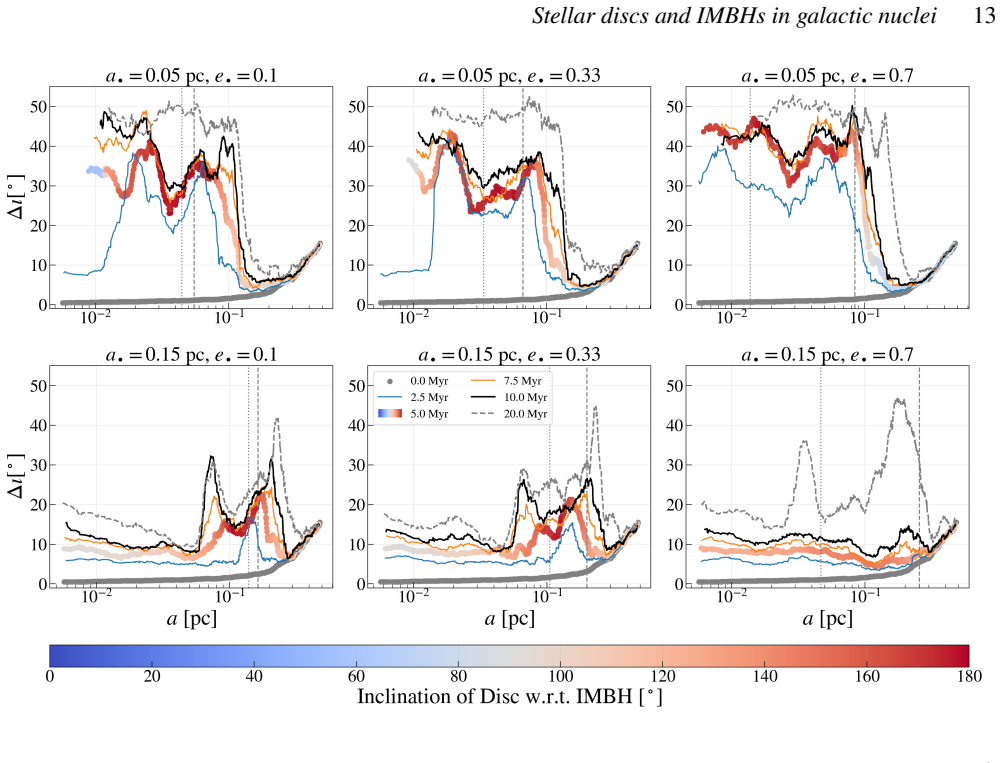
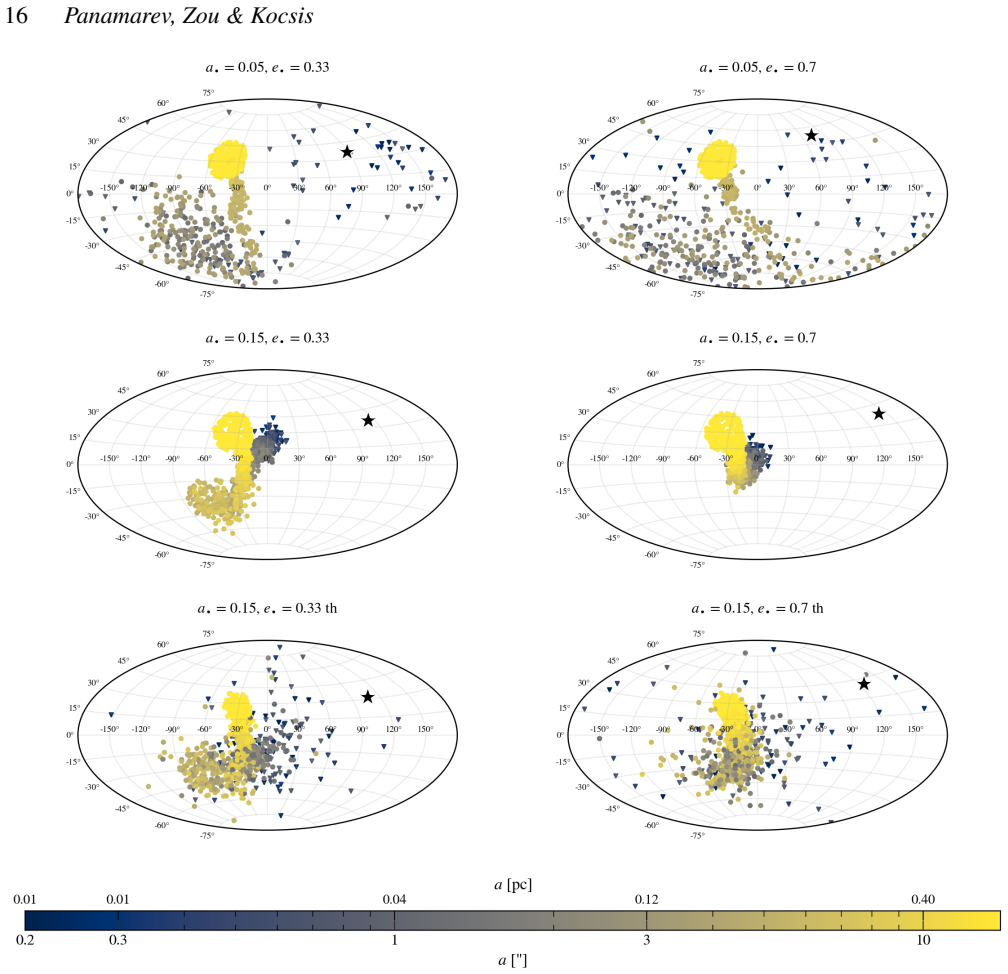
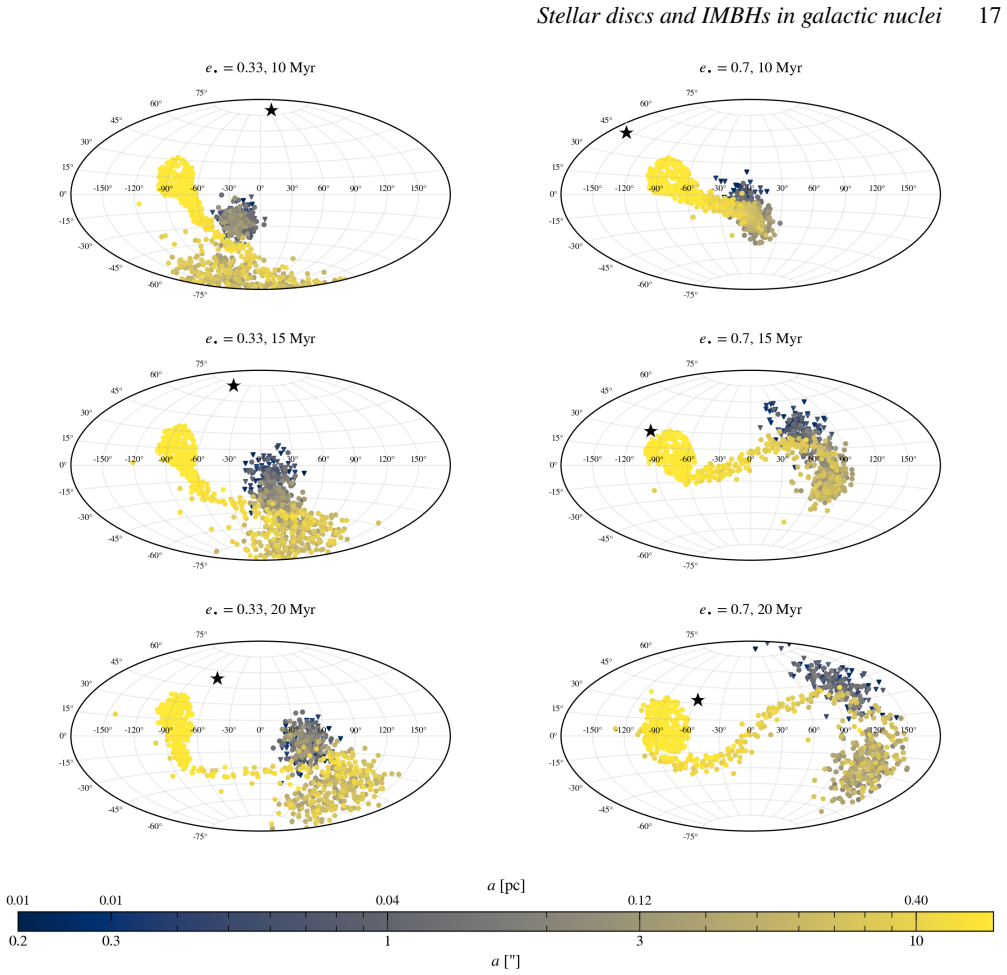
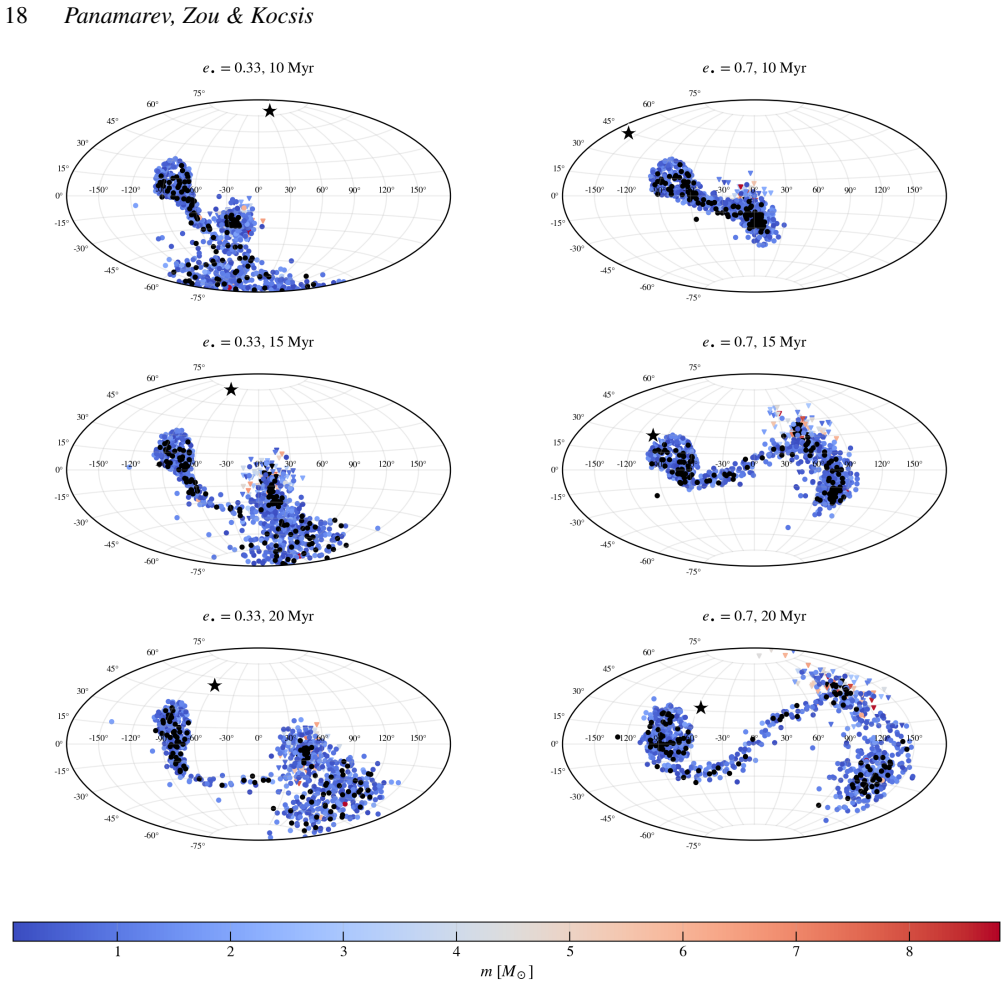
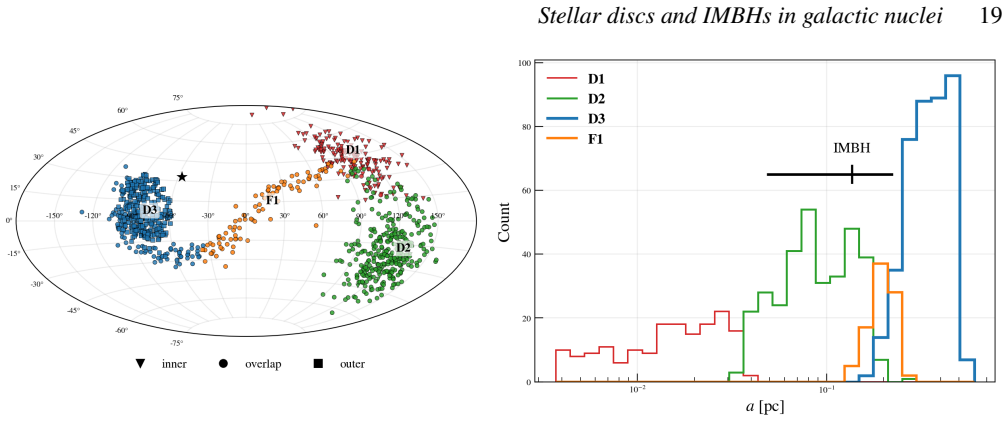
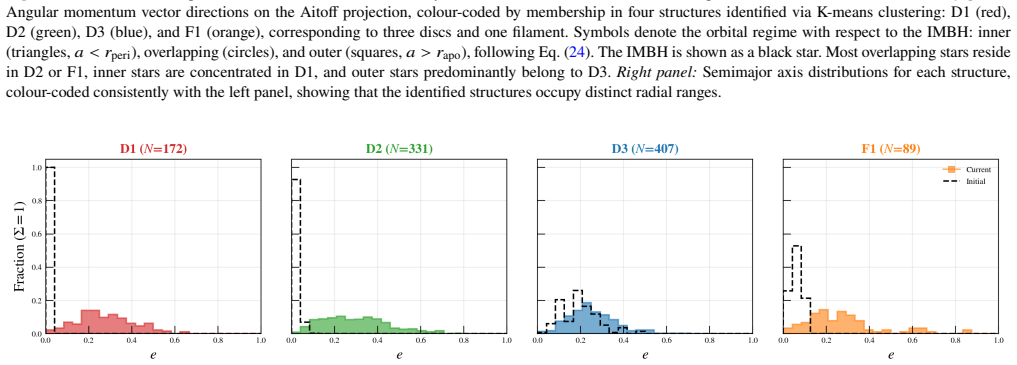
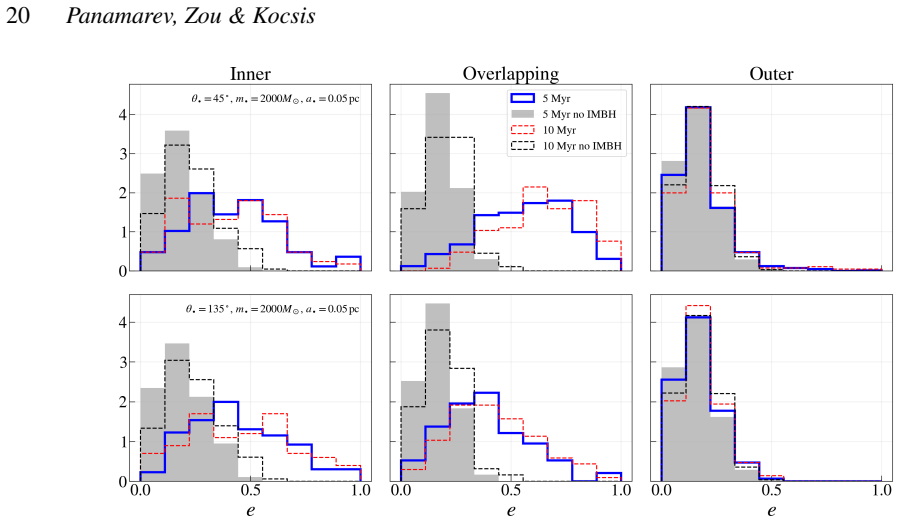
A massive retrograde IMBH (m_• ≃ 0.67 M_d) anti-aligns relative to the radially overlapping stars and efficiently fragments the original disc into three components in angular-momentum space: an inner disc, a misaligned overlapping region, and an unperturbed outer disc. The IMBH also excites eccentricities in the overlapping region. These features emerge for an IMBH mass of 2000 M_⊙ and a disc mass of 3000 M_⊙ within 10--20 Myr.
What carries the argument
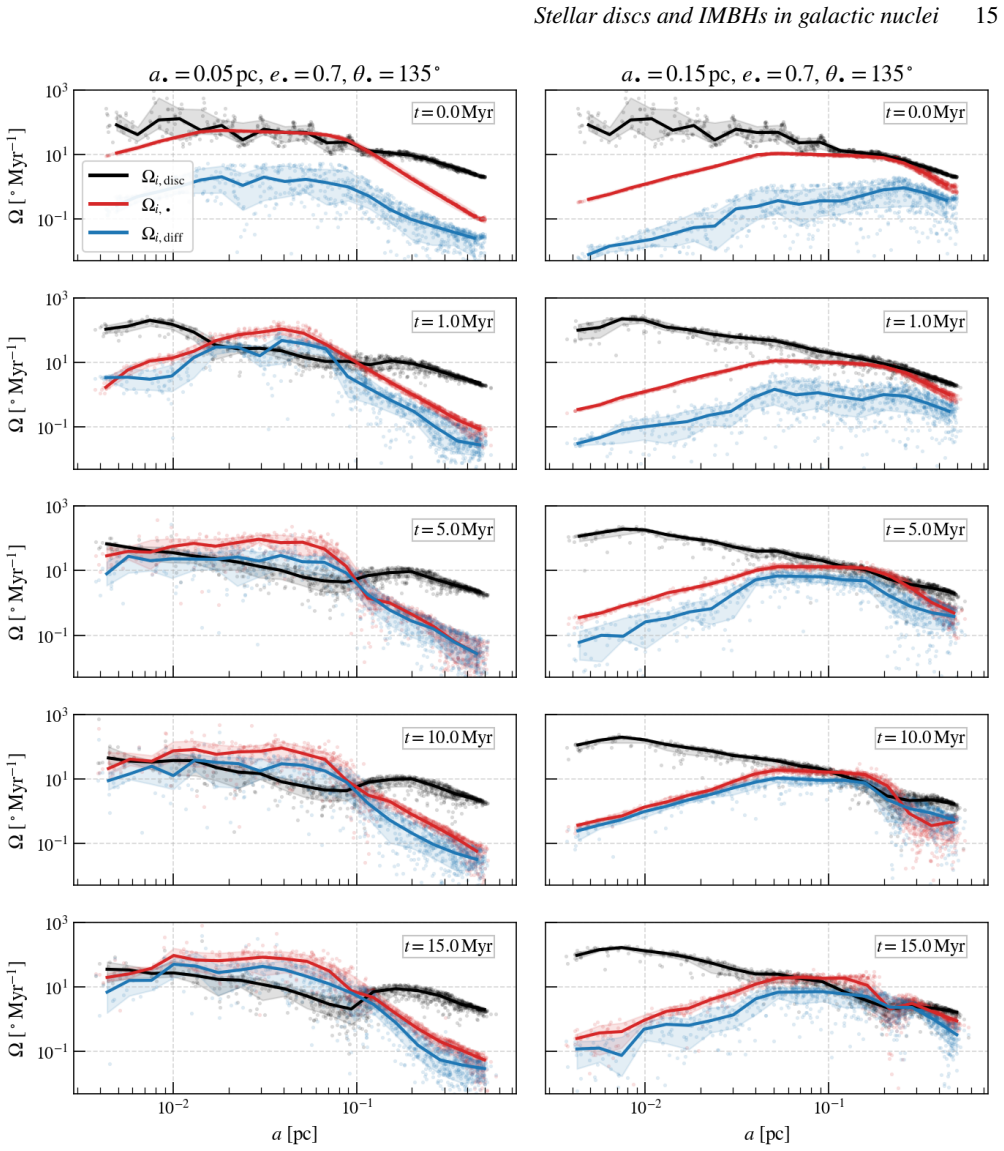
The gravitational torque from an inclined retrograde IMBH that overcomes the disc's self-torque and drives fragmentation in angular-momentum space.
If this is right
- A single formation episode plus one IMBH suffices to produce the observed multiple orbital planes and warped geometry.
- Eccentricity excitation is strongest in the misaligned overlapping region and leaves the inner and outer discs largely circular.
- Prograde IMBHs align with the disc instead of fragmenting it, so only retrograde orbits produce the three-component structure.
- The process completes on a timescale comparable to the age of the young stellar population, so the features should already be visible today.
- The outcome depends on the precise mass ratio and orbital inclination of the IMBH relative to the disc.
Where Pith is reading between the lines
- If the mechanism operates, IMBHs in this mass range may be detectable through their long-term imprint on stellar kinematics rather than direct imaging.
- The same torque-driven splitting could apply to young discs in other galactic nuclei where multiple orbital planes are observed.
- Including gas drag or a non-isotropic stellar background might change the mass threshold or the number of fragments produced.
- Future N-body runs with varying initial disc thicknesses could test how sensitive the three-component outcome is to the starting conditions.
Load-bearing premise
The young stars began as one single coherently rotating disc whose later evolution occurs inside an isotropic stellar potential.
What would settle it
High-resolution observations or simulations showing that the young Galactic-centre stars do not occupy three distinct angular-momentum regions with eccentricity excitation confined to the middle zone would rule out this fragmentation channel.
Figures
read the original abstract
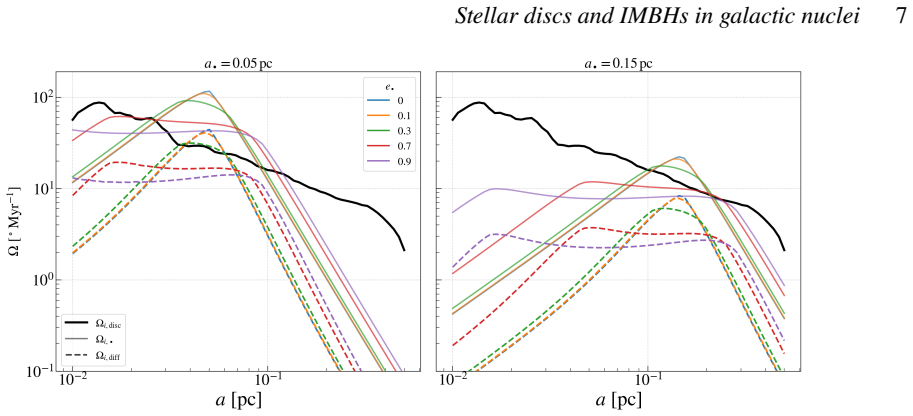
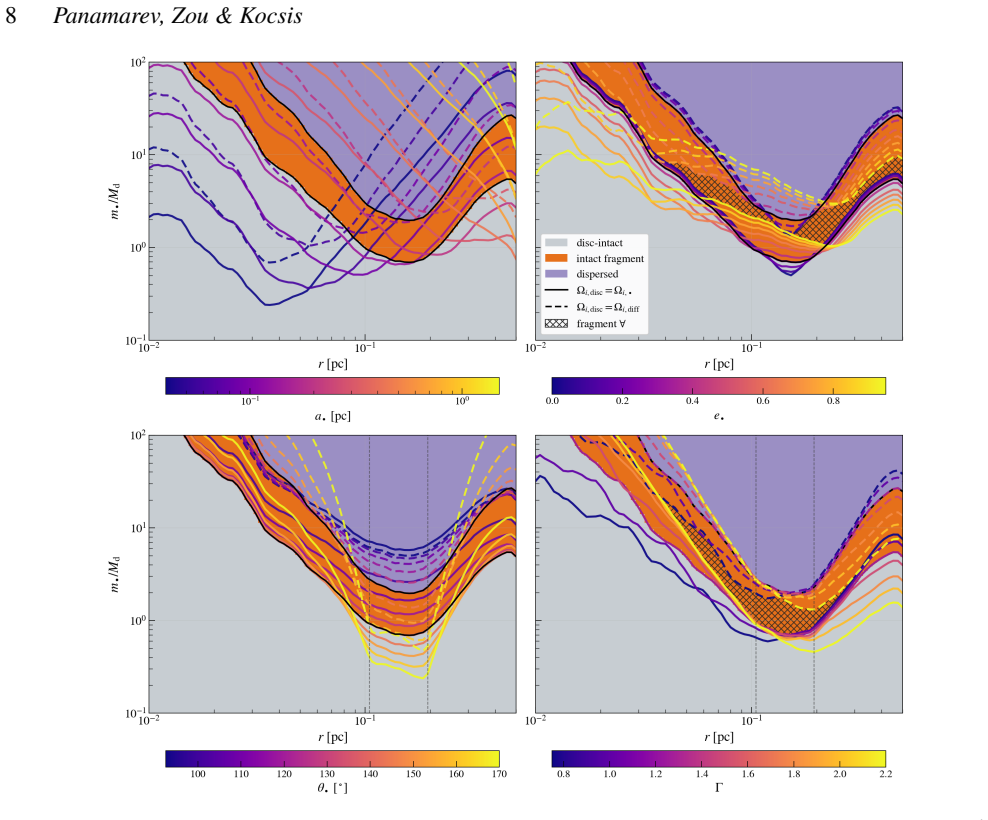
The origin of the complex orbital structure of young massive stars at the Galactic centre remains an open question. If these stars formed in a single episode from a gaseous accretion disc, they may initially have constituted a single, coherently rotating stellar disc. We investigate whether perturbations from an unseen intermediate-mass black hole (IMBH) could fragment and/or disrupt such a disc into the multiple orbital components observed today. First, we derive a theoretical criterion for when and where the IMBH's torque overcomes the disc's self-torque and tears it apart. We then test this picture with direct $N$-body simulations of a stellar disc interacting with an inclined IMBH around a central supermassive black hole. We find that the outcome depends strongly on the IMBH's orbit and mass. A prograde IMBH rapidly aligns with the stellar disc, while a massive retrograde IMBH ($m_{\bullet} \simeq 0.67\,M_{\rm d}$) anti-aligns relative to the radially overlapping stars and efficiently fragments the original disc into three components in angular-momentum space: an inner disc, a misaligned overlapping region, and an unperturbed outer disc. The IMBH also excites eccentricities in the overlapping region, driving stars away from initially circular orbits. These features emerge for an IMBH mass of $2000\,{\rm M}_{\odot}$ and a disc mass of $3000\,{\rm M}_{\odot}$ within 10--20 Myr, a timescale comparable to the age of the young Galactic centre stellar population, and provide a plausible explanation for the observed multiple orbital planes, warped geometry, and broad eccentricity distribution.
Editorial analysis
A structured set of objections, weighed in public.
Referee Report
Summary. The paper claims that an unseen intermediate-mass black hole (IMBH) can fragment an initially coherent stellar disc into multiple orbital components observed in the Galactic Centre young stars. It first derives an analytic torque criterion for when the IMBH overcomes the disc's self-torque, then validates the picture with direct N-body simulations of a disc around a central SMBH. For a retrograde IMBH with m_• ≃ 0.67 M_d (specifically 2000 M_⊙ vs. 3000 M_⊙ disc), the simulations show anti-alignment, fragmentation into an inner disc, misaligned overlapping region, and unperturbed outer disc, plus eccentricity excitation, all within 10–20 Myr.
Significance. If the result holds, the work supplies a concrete dynamical channel for the observed multi-plane, warped, and eccentric young stellar population at the Galactic Centre on a timescale matching the stellar ages. The explicit combination of a derived torque criterion with direct N-body integration (rather than fitted parameters) is a methodological strength that yields falsifiable predictions for IMBH mass and orbit.
major comments (2)
- [§3] §3 (torque criterion derivation): the transition from the analytic tearing condition to the N-body initial conditions is not shown explicitly; it is unclear whether the adopted disc surface density and velocity dispersion profiles satisfy the self-torque dominance assumed in the criterion, which is load-bearing for the fragmentation claim.
- [Simulation results] Simulation results paragraph (corresponding to the 10–20 Myr fragmentation): only a single retrograde mass ratio (0.67) is reported in detail; without a control run at lower mass or prograde cases shown quantitatively, it is difficult to confirm that the three-component structure is uniquely tied to the retrograde massive IMBH rather than generic relaxation.
minor comments (2)
- [Methods] The abstract states the IMBH mass and disc mass explicitly; the corresponding section should tabulate the full set of initial orbital elements and softening lengths used in the N-body runs for reproducibility.
- [Figures] Figure captions for the angular-momentum distributions should state the time snapshot and the exact definition of the three components (e.g., L_z thresholds) rather than leaving them to the text.
Simulated Author's Rebuttal
We thank the referee for their constructive review and recommendation for minor revision. We address each major comment below and have revised the manuscript to improve the explicit connection between the analytic criterion and simulations as well as to provide additional quantitative comparisons.
read point-by-point responses
-
Referee: [§3] §3 (torque criterion derivation): the transition from the analytic tearing condition to the N-body initial conditions is not shown explicitly; it is unclear whether the adopted disc surface density and velocity dispersion profiles satisfy the self-torque dominance assumed in the criterion, which is load-bearing for the fragmentation claim.
Authors: We agree that an explicit verification strengthens the manuscript. In the revised version we will add a dedicated paragraph in §3 that evaluates the disc self-torque (using the adopted Σ(r) ∝ r^{-1} and σ(r) profiles) against the IMBH torque for the exact N-body initial conditions, confirming self-torque dominance in the relevant radial range prior to IMBH insertion. revision: yes
-
Referee: [Simulation results] Simulation results paragraph (corresponding to the 10–20 Myr fragmentation): only a single retrograde mass ratio (0.67) is reported in detail; without a control run at lower mass or prograde cases shown quantitatively, it is difficult to confirm that the three-component structure is uniquely tied to the retrograde massive IMBH rather than generic relaxation.
Authors: The text already states that outcomes depend strongly on orbit and mass, with prograde IMBHs aligning rapidly. To address the request for quantitative controls, the revised manuscript will include an additional figure and accompanying text comparing a lower-mass retrograde case (mass ratio ~0.3) and a prograde run, demonstrating that the three-component fragmentation and anti-alignment are specific to the massive retrograde configuration on the 10–20 Myr timescale. revision: yes
Circularity Check
No significant circularity; results from direct N-body integrations
full rationale
The paper first derives a torque criterion analytically from first principles (IMBH torque vs. disc self-torque) and then validates the fragmentation outcome via direct N-body simulations of the stated initial conditions (single coherent disc in isotropic potential). No step reduces a prediction to a fitted parameter, self-citation chain, or definitional equivalence; the reported three-component structure and eccentricity excitation emerge numerically for the given mass ratio and timescale. The initial disc setup is the explicit scenario under test rather than an unexamined premise. This is the most common honest finding for simulation-driven papers.
Axiom & Free-Parameter Ledger
free parameters (1)
- IMBH-to-disc mass ratio for fragmentation =
~0.67
axioms (2)
- domain assumption Stellar potential is isotropic
- domain assumption Young stars formed as a single coherently rotating disc
invented entities (1)
-
Intermediate-mass black hole
no independent evidence
Reference graph
Works this paper leans on
-
[1]
Initial conditions for disc galaxies. MNRAS , eprint =. doi:10.1111/j.1365-2966.2007.11753.x , adsurl =
-
[2]
Mon Not R Astron Soc , keywords =
Kroupa, Pavel , doi =. Mon Not R Astron Soc , keywords =
-
[3]
Kouwenhoven, M. B. N. and Brown, A. G. A. and. Astronomy and Astrophysics , keywords =. doi:10.1051/0004-6361:20077719 , file =
-
[4]
and Pols, Onno R
Hurley, Jarrod R. and Pols, Onno R. and Tout, Christopher a. , doi =. MNRAS , keywords =. arXiv , arxivId =:0001295 , file =
-
[5]
and Pols, Onno R
Hurley, Jarrod R. and Pols, Onno R. and Tout, Christopher a. , doi =. MNRAS , keywords =
-
[6]
ApJ , number =
Belczynski, Krzysztof and Kalogera, Vassiliki and Bulik, Tomasz , doi =. ApJ , number =. arXiv , arxivId =:0111452 , file =
-
[7]
Star distribution around a massive black hole in a globular cluster. ApJ , keywords =. doi:10.1086/154711 , adsurl =
-
[8]
Bahcall, J. N. and Wolf, R. A. , doi =. ApJ , pages =
-
[9]
ApJ , keywords =
Psaltis, Dimitrios and Wex, Norbert and Kramer, Michael , doi =. ApJ , keywords =
-
[10]
, archivePrefix = "arXiv", eprint =
The Influence of Gas Dynamics on Measuring the Properties of the Black Hole in the Center of the Milky Way with Stellar Orbits and Pulsars. , archivePrefix = "arXiv", eprint =. doi:10.1088/0004-637X/759/2/130 , adsurl =
-
[11]
Confusing binaries: the role of stellar binaries in biasing disk properties in the Galactic Center
Confusing Binaries: The Role of Stellar Binaries in Biasing Disk Properties in the Galactic Center. , keywords =. doi:10.3847/2041-8213/aaa6bf , archivePrefix =. 1801.03934 , primaryClass =
work page internal anchor Pith review Pith/arXiv arXiv doi:10.3847/2041-8213/aaa6bf 2041
-
[12]
arXiv , arxivId =:1703.09118 , file =
Eckart, Andreas and Huettemann, Andreas and Kiefer, Claus and Britzen, Silke and Zajacek, Michal and Laemmerzahle, Claus and Stockler, Manfred and Valencia-S., Monica and Karas, Vladimir and Garcia-Marin, Macarena , doi =. arXiv , arxivId =:1703.09118 , file =
-
[13]
Ponti, G. and Morris, M. R. and Terrier, R. and Haberl, F. and Sturm, R. and Clavel, M. and Soldi, S. and Goldwurm, A. and Predehl, P. and Nandra, K. and B??langer, G. and Warwick, R. S. and Tatischeff, V. , doi =. MNRAS , keywords =. arXiv , arxivId =:1508.04445 , file =
-
[14]
ApJ , archivePrefix = "arXiv", eprint =
Enhanced Accretion Rates of Stars on Supermassive Black Holes by Star-Disk Interactions in Galactic Nuclei. ApJ , archivePrefix = "arXiv", eprint =. doi:10.1088/0004-637X/758/1/51 , adsurl =
-
[15]
, archivePrefix = "arXiv", eprint =
Star-disc interaction in galactic nuclei: orbits and rates of accreted stars. , archivePrefix = "arXiv", eprint =. doi:10.1093/mnras/stw908 , adsurl =
-
[16]
Accretion of stars on to a massive black hole: a realistic diffusion model and numerical studies. MNRAS , eprint =. doi:10.1111/j.1365-2966.2004.07956.x , adsurl =
-
[17]
doi:10.1046/j.1365-8711.2001.04606.x , adsurl =
The loss-cone problem in dense nuclei. MNRAS , eprint =. doi:10.1046/j.1365-8711.2001.04799.x , adsurl =
-
[18]
MNRAS , keywords =
Effects of massive central black holes on dense stellar systems. MNRAS , keywords =
-
[19]
Performance analysis of direct N-body algorithms on special-purpose supercomputers. , eprint =. doi:10.1016/j.newast.2006.11.003 , adsurl =
-
[20]
Physical Processes in Star-Gas Systems. PASA , eprint =. doi:10.1071/AS04028 , adsurl =
-
[21]
The star capture model for fueling quasar accretion disks
The star capture model for fueling quasar accretion disks. IAU Symposium , year = 2011, series =. doi:10.1017/S1743921311017893 , adsurl =. arXiv:1008.5152 , primaryClass = "astro-ph.GA", editor =
work page internal anchor Pith review Pith/arXiv arXiv doi:10.1017/s1743921311017893 2011
-
[22]
Star Captures by Quasar Accretion Disks: A Possible Explanation of the M- Relation. ApJ , keywords =. doi:10.1086/426467 , adsurl =
-
[23]
ApJ , year = 1972, month = may, volume = 173, pages =
Galactic Shocks in an Interstellar Medium with Two Stable Phases. ApJ , year = 1972, month = may, volume = 173, pages =. doi:10.1086/151444 , adsurl =
-
[24]
Dynamical Friction in a Gaseous Medium. ApJ , eprint =. doi:10.1086/306858 , adsurl =
-
[25]
ARA&A , year = 1995, volume = 33, pages =
Inward Bound---The Search For Supermassive Black Holes In Galactic Nuclei. ARA&A , year = 1995, volume = 33, pages =. doi:10.1146/annurev.aa.33.090195.003053 , adsurl =
-
[26]
Nature , eprint =
Supermassive black holes and the evolution of galaxies. Nature , eprint =
-
[28]
MNRAS , keywords =
Masses of quasars. MNRAS , keywords =
-
[29]
MNRAS , keywords =
The formation of nuclei in newly formed galaxies and the evolution of the quasar population. MNRAS , keywords =
-
[30]
Observational constraints on growth of massive black holes. MNRAS , eprint =. doi:10.1046/j.1365-8711.2002.05532.x , adsurl =
-
[31]
MNRAS , year = 1990, month = oct, volume = 246, pages =
Massive Thin Accretion Discs - Part Three - Comparison with the Observations. MNRAS , year = 1990, month = oct, volume = 246, pages =
1990
-
[32]
Fitting improved accretion disk models to the multiwavelength continua of quasars and active galactic nuclei. ApJ , keywords =. doi:10.1086/167986 , adsurl =
-
[33]
Thermal continuum from acretion disks in quasars. Nature , keywords =. doi:10.1038/272706a0 , adsurl =
-
[34]
Abramowicz, M. A. and Straub, O. , TITLE =. Scholarpedia , VOLUME = 9, NUMBER = 8, PAGES = 2408, NOTE =
-
[35]
Black Holes (Les Astres Occlus) , year = 1973, editor =
Astrophysics of black holes. Black Holes (Les Astres Occlus) , year = 1973, editor =
1973
-
[36]
Possible power source of Seyfert galaxies and QSOs. Nature , keywords =. doi:10.1038/254295a0 , adsurl =
-
[37]
Geomagnetism and Aeronomia , year = 1964, volume = 4, pages =
1964
-
[38]
The star distribution around a massive black hole in a globular cluster. II Unequal star masses. ApJ , keywords =. doi:10.1086/155534 , adsurl =
-
[39]
Soviet Astronomy Letters , keywords =
A model for the 'atmosphere' of stars around a massive black hole. Soviet Astronomy Letters , keywords =
-
[40]
Soviet Astronomy Letters , keywords =
Distribution of stars in the vicinity of a massive black hole. Soviet Astronomy Letters , keywords =
-
[41]
ApJ , archivePrefix = "arXiv", eprint =
Extreme Coronal Line Emitters: Tidal Disruption of Stars by Massive Black Holes in Galactic Nuclei?. ApJ , archivePrefix = "arXiv", eprint =. doi:10.1088/0004-637X/749/2/115 , adsurl =
-
[42]
ApJL , archivePrefix = "arXiv", eprint =
Tidal Disruption Flares from Recoiling Supermassive Black Holes. ApJL , archivePrefix = "arXiv", eprint =. doi:10.1086/591420 , adsurl =
-
[43]
Reviews in Modern Astronomy , year = 2002, series =
Ludwig Biermann Award Lecture: X-ray Evidence for Supermassive Black Holes at the Centers of Nearby, Non-Active Galaxies. Reviews in Modern Astronomy , year = 2002, series =. astro-ph/0209007 , editor =
Pith/arXiv arXiv 2002
-
[44]
Large-Amplitude X-Ray Outbursts from Galactic Nuclei: A Systematic Survey using ROSAT Archival Data. AJ , eprint =. doi:10.1086/342280 , adsurl =
-
[45]
Rates of tidal disruption of stars by massive central black holes. MNRAS , eprint =. doi:10.1046/j.1365-8711.1999.02853.x , adsurl =
-
[46]
Massive Perturber-driven Interactions between Stars and a Massive Black Hole. ApJ , eprint =. doi:10.1086/510377 , adsurl =
-
[47]
Loss Cone Refilling Rates in Galactic Nuclei. ApJL , eprint =. doi:10.1086/429272 , adsurl =
-
[48]
Dynamical evolution of rotating dense stellar systems with embedded black holes. MNRAS , keywords =. doi:10.1111/j.1365-2966.2010.16479.x , adsurl =
-
[49]
Evolution of growing black holes in axisymmetric galaxy cores. MNRAS , archivePrefix = "arXiv", eprint =. doi:10.1111/j.1365-2966.2011.19670.x , adsurl =
-
[50]
ApJ , archivePrefix = "arXiv", eprint =
Perturbations of Intermediate-mass Black Holes on Stellar Orbits in the Galactic Center. ApJ , archivePrefix = "arXiv", eprint =. doi:10.1088/0004-637X/705/1/361 , adsurl =
-
[51]
ApJ , archivePrefix = "arXiv", eprint =
Interaction of Recoiling Supermassive Black Holes with Stars in Galactic Nuclei. ApJ , archivePrefix = "arXiv", eprint =. doi:10.1088/0004-637X/748/1/65 , adsurl =
-
[53]
Collisional Stellar Dynamics around Massive Black Holes in Active Galactic Nuclei. ApJ , keywords =. doi:10.1086/306953 , adsurl =
-
[54]
MNRAS , keywords =
Dynamical evolution of star clusters around a rotating black hole with an accretion disc. MNRAS , keywords =
-
[55]
Star-disc interactions in a galactic centre and oblateness of the inner stellar cluster. MNRAS , eprint =. doi:10.1111/j.1365-2966.2004.08276.x , adsurl =
-
[56]
A&A , eprint =
An orbiter crossing an accretion disc. A&A , eprint =
-
[57]
Stellar dynamics in a galactic centre surrounded by a massive accretion disc - I. Newtonian description. MNRAS , eprint =. doi:10.1046/j.1365-8711.1998.01564.x , adsurl =
-
[58]
Star trapping and metallicity enrichment in quasars and active galactic nuclei. ApJ , keywords =. doi:10.1086/172690 , adsurl =
-
[59]
MNRAS , keywords =
Star-disc interactions near a massive black hole. MNRAS , keywords =
-
[60]
The Problem of Motion in Einstein's Gravitation Theory , year = 1981, pages =
Evolution of the orbits of stars passing through a massive accretion disc. The Problem of Motion in Einstein's Gravitation Theory , year = 1981, pages =
1981
-
[61]
Soviet Astronomy Letters , year = 1983, month = apr, volume = 9, pages =
Dissipative Capture of Stars by an Active Object in the Nucleus of a Galaxy. Soviet Astronomy Letters , year = 1983, month = apr, volume = 9, pages =
1983
-
[62]
Long-Term Evolution of Massive Black Hole Binaries. II. Binary Evolution in Low-Density Galaxies. ApJ , eprint =. doi:10.1086/491598 , adsurl =
-
[63]
Towards a fully consistent Milky Way disc model - I. The local model based on kinematic and photometric data. MNRAS , archivePrefix = "arXiv", eprint =. doi:10.1111/j.1365-2966.2009.15893.x , adsurl =
-
[64]
Pure and Applied Mathematics, New York: Interscience, 1948 , year = 1948, adsurl =
Supersonic flow and shock waves. Pure and Applied Mathematics, New York: Interscience, 1948 , year = 1948, adsurl =
1948
-
[65]
Galactic Dynamics: Second Edition, by James Binney and Scott Tremaine
Galactic Dynamics: Second Edition. Galactic Dynamics: Second Edition, by James Binney and Scott Tremaine. ISBN 978-0-691-13026-2 (HB). Published by Princeton University Press, Princeton, NJ USA, 2008. , year = 2008, publisher =
2008
-
[66]
MNRAS , year = 1911, month = mar, volume = 71, pages =
On the problem of distribution in globular star clusters. MNRAS , year = 1911, month = mar, volume = 71, pages =
1911
-
[67]
The distribution and consumption rate of stars around a massive, collapsed object. ApJ , keywords =. doi:10.1086/154925 , adsurl =
-
[68]
The Environment of Active Galactic Nuclei in the Sloan Digital Sky Survey. ApJ , eprint =. doi:10.1086/378383 , adsurl =
-
[69]
Massive Black Holes in Star Clusters. I. Equal-Mass Clusters. ApJ , eprint =. doi:10.1086/423298 , adsurl =
-
[70]
Massive Black Holes in Star Clusters. II. Realistic Cluster Models. , eprint =. doi:10.1086/423299 , adsurl =
-
[71]
Stellar Disk in the Galactic Center: A Remnant of a Dense Accretion Disk?. ApJL , eprint =. doi:10.1086/376675 , adsurl =
-
[72]
The Two Young Star Disks in the Central Parsec of the Galaxy: Properties, Dynamics, and Formation. ApJ , eprint =. doi:10.1086/503273 , adsurl =
-
[73]
Princeton, NJ, Princeton University Press, 1987, 191 p
Dynamical evolution of globular clusters. Princeton, NJ, Princeton University Press, 1987, 191 p. , year = 1987, publisher =
1987
-
[74]
, archivePrefix = "arXiv", eprint =
Migration Traps in Disks around Supermassive Black Holes. , archivePrefix = "arXiv", eprint =. doi:10.3847/2041-8205/819/2/L17 , adsurl =
-
[75]
Baruteau, C. and Cuadra, J. and Lin, D. N. C. , doi =. arXiv , arxivId =:1011.0360 , file =
-
[76]
, archivePrefix = "arXiv", eprint =
Can Star-Disk Collisions Explain the Missing Red Giants Problem in the Galactic Center?. , archivePrefix = "arXiv", eprint =. doi:10.3847/0004-637X/823/2/155 , adsurl =
-
[77]
, archivePrefix = "arXiv", eprint =
Properties of the Remnant Clockwise Disk of Young Stars in the Galactic Center. , archivePrefix = "arXiv", eprint =. doi:10.1088/0004-637X/783/2/131 , adsurl =
-
[78]
, eprint =
Chen, Xian and Amaro-seoane, P. , eprint =
-
[80]
ArXiv e-prints , archivePrefix = "arXiv", eprint =
On stellar-mass black hole mergers in AGN disks detectable with LIGO. ArXiv e-prints , archivePrefix = "arXiv", eprint =
-
[81]
, archivePrefix = "arXiv", eprint =
Revisiting the Unified Model of Active Galactic Nuclei. , archivePrefix = "arXiv", eprint =. doi:10.1146/annurev-astro-082214-122302 , adsurl =
work page internal anchor Pith review doi:10.1146/annurev-astro-082214-122302
-
[82]
Alexander, Tal , doi =. ARA&A , keywords =. arXiv , arxivId =:1507.05135 , file =
-
[83]
, archivePrefix = "arXiv", eprint =
Evidence for Warped Disks of Young Stars in the Galactic Center. , archivePrefix = "arXiv", eprint =. doi:10.1088/0004-637X/697/2/1741 , adsurl =
discussion (0)
Sign in with ORCID, Apple, or X to comment. Anyone can read and Pith papers without signing in.