Dissipative Effects in Transmission Line Analogues of Hawking Radiation
Pith reviewed 2026-06-30 01:15 UTC · model grok-4.3
The pith
Superconducting transmission lines can produce distinguishable Hawking radiation above 73 mK despite dissipation.
A machine-rendered reading of the paper's core claim, the machinery that carries it, and where it could break.
Core claim
The paper establishes that in tunable dc-SQUID and SNAIL-based transmission line analogues of Schwarzschild black holes, Hawking temperatures above approximately 73 mK remain distinguishable under realistic experimental conditions when dissipation and thermal noise are modeled via open quantum systems, with the tunable architecture capable of reaching about 113 mK.
What carries the argument
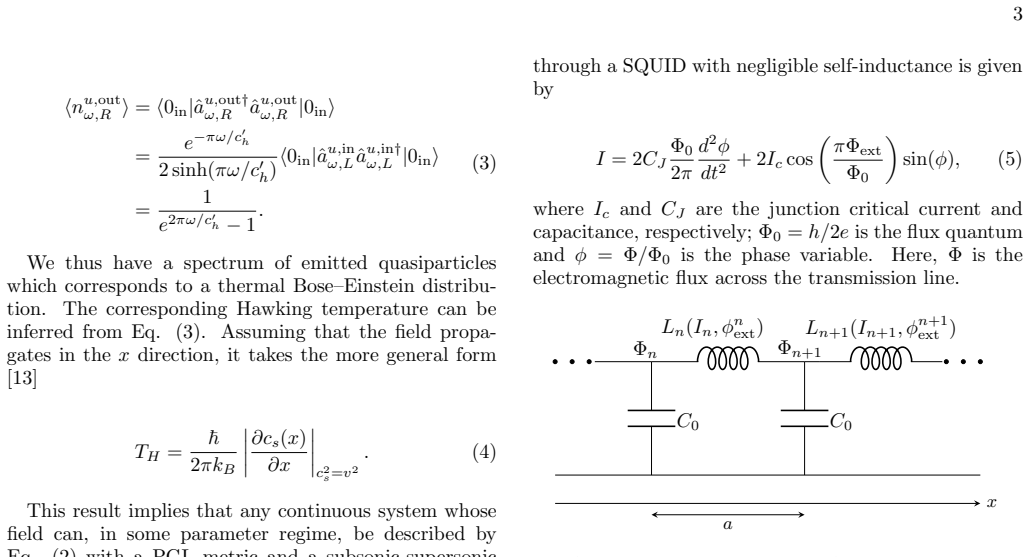
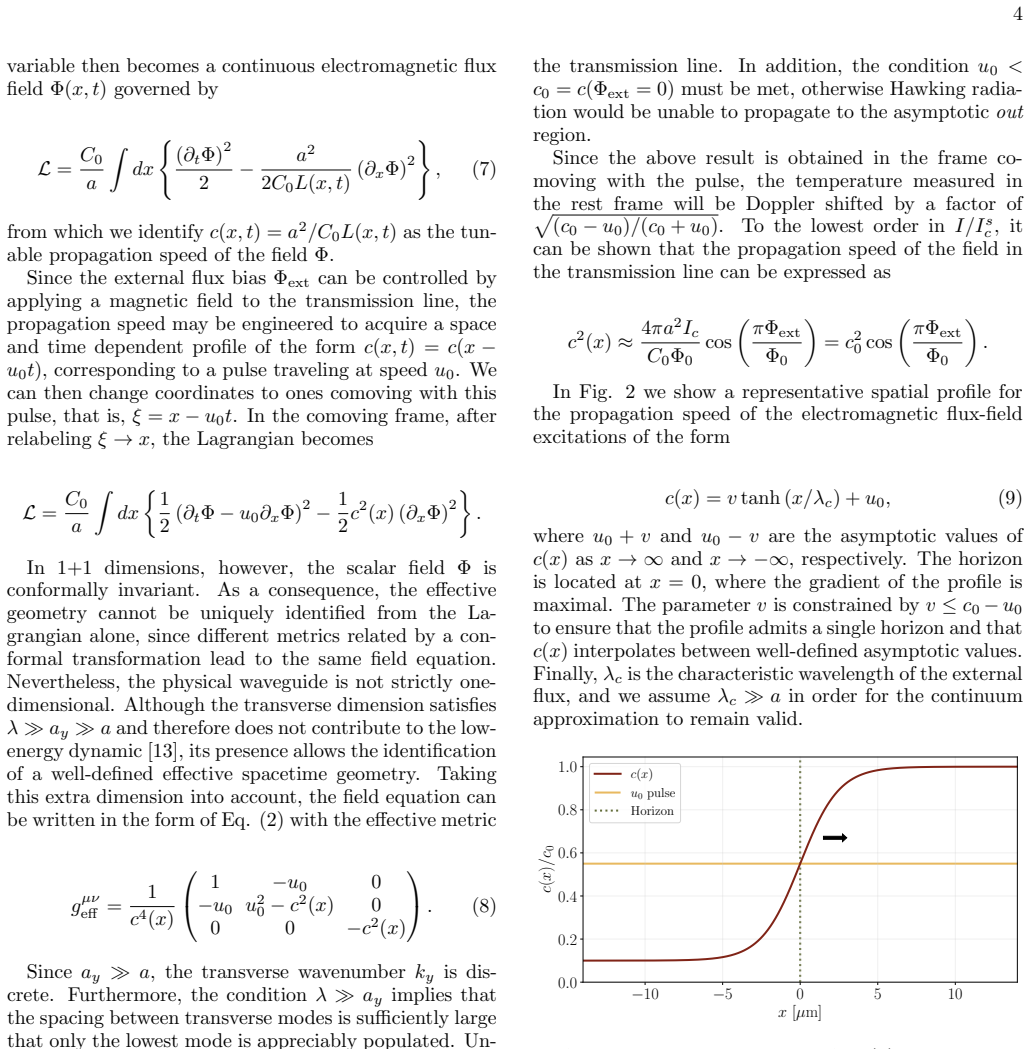
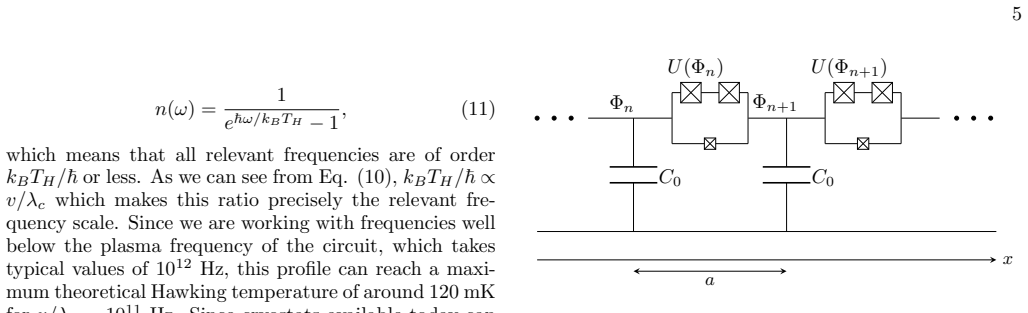
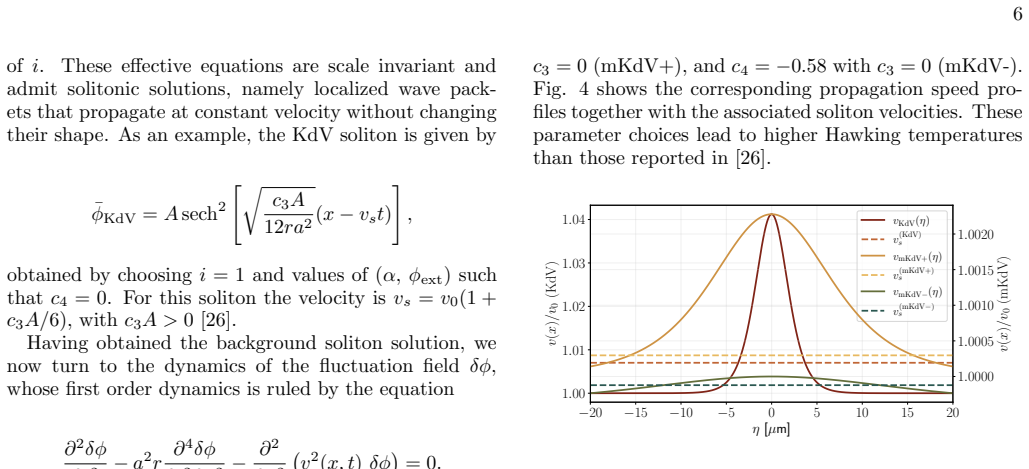
Open quantum systems formalism applied to the two circuit architectures, using Hilbert-Schmidt distance to the thermal bath to assess signal observability.
If this is right
- Particle number measurements supplemented by Hilbert-Schmidt distance allow distinction of Hawking signals above 73 mK.
- The tunable dc-SQUID transmission line reaches higher observable temperatures than the SNAIL-based model.
- Detectability thresholds are established for current dilution refrigerator experiments.
- The solitonic SNAIL model needs further optimization to match the viability of the tunable line.
Where Pith is reading between the lines
- These temperature thresholds could directly inform design choices for analogue gravity experiments in existing superconducting hardware.
- The same open-systems distance metric might be adapted to assess signal visibility in other dissipative analogue systems such as fluid or optical setups.
- Reducing circuit losses below the modeled levels would likely extend the observable temperature range downward.
Load-bearing premise
The two chosen circuit architectures faithfully reproduce the essential features of a Schwarzschild black-hole spacetime even after dissipation and thermal noise are added via the open quantum systems formalism.
What would settle it
An experiment on a dc-SQUID line at 80 mK that finds the Hilbert-Schmidt distance between the circuit state and the thermal bath to be indistinguishable would falsify the claim of distinguishability above 73 mK.
Figures
read the original abstract
Hawking radiation is a fundamental result of quantum field theory in curved spacetime, yet its direct observation remains beyond current experimental capabilities. Circuit quantum electrodynamics provides a practical platform for realizing analogue systems where Hawking-like radiation may be studied under controlled laboratory conditions. In this work, we analyze two superconducting-circuit analogues of Schwarzschild black holes: a tunable dc-SQUID transmission line and a SNAIL-based transmission line supporting solitonic solutions of the KdV equation. We investigate the conditions under which these architectures can generate an observable Hawking temperature and study the impact of dissipation and thermal noise using an open quantum systems approach. To assess the observability of the Hawking signal, we propose complementing particle number measurements with estimates of the Hilbert-Schmidt distance to the thermal bath. Our analysis establishes practical detectability thresholds and shows that Hawking temperatures above approximately 73 mK remain distinguishable under realistic experimental conditions. While the tunable transmission line architecture can reach temperatures of about 113 mK and therefore appears more viable, the solitonic model requires further optimization and more demanding experimental conditions.
Editorial analysis
A structured set of objections, weighed in public.
Referee Report
Summary. The manuscript analyzes two superconducting-circuit analogues of Schwarzschild black holes—a tunable dc-SQUID transmission line and a SNAIL-based line supporting KdV solitons—using an open-quantum-systems treatment of dissipation and thermal noise. It derives practical detectability thresholds via particle-number measurements supplemented by Hilbert-Schmidt distance to the thermal bath, concluding that Hawking temperatures above approximately 73 mK remain distinguishable under realistic conditions while the tunable architecture can reach ~113 mK and is therefore more viable.
Significance. If the central modeling assumptions hold, the work supplies concrete experimental targets and a noise-aware distinguishability metric for analogue-gravity experiments in circuit QED, addressing a key barrier to observing Hawking-like radiation. The explicit inclusion of open-system effects is a positive step beyond idealised treatments.
major comments (2)
- [open quantum systems treatment and effective-metric extraction] The strongest claim (distinguishability above ~73 mK and viability at 113 mK) rests on the two circuit architectures continuing to furnish a Schwarzschild-like horizon and temperature after dissipation is introduced via the open-quantum-systems formalism. Generic Lindblad or master-equation terms generically modify the coefficients of the second-order wave operator and therefore the extracted surface gravity; the manuscript does not demonstrate that these shifts remain below a few percent or that the reported temperatures still correspond to the claimed spacetime analogue.
- [results and conclusions] The abstract states numerical thresholds (73 mK, 113 mK) and a Hilbert-Schmidt distinguishability criterion without supplying the underlying derivations, parameter values, or error budgets. It is therefore impossible to verify whether these figures follow rigorously from the stated models or rest on unexamined choices in the circuit parameters or bath coupling.
minor comments (2)
- Notation for the effective metric and the open-system master equation should be introduced with explicit reference to the underlying wave equation so that the reader can immediately see which coefficients are assumed unchanged.
- The manuscript would benefit from a short table comparing the extracted surface gravities (or Hawking temperatures) before and after the inclusion of dissipation for both architectures.
Simulated Author's Rebuttal
Thank you for the opportunity to respond to the referee's report. We value the feedback and have prepared point-by-point responses to the major comments. We agree that additional clarifications and demonstrations are needed to strengthen the manuscript and will incorporate revisions accordingly.
read point-by-point responses
-
Referee: [open quantum systems treatment and effective-metric extraction] The strongest claim (distinguishability above ~73 mK and viability at 113 mK) rests on the two circuit architectures continuing to furnish a Schwarzschild-like horizon and temperature after dissipation is introduced via the open-quantum-systems formalism. Generic Lindblad or master-equation terms generically modify the coefficients of the second-order wave operator and therefore the extracted surface gravity; the manuscript does not demonstrate that these shifts remain below a few percent or that the reported temperatures still correspond to the claimed spacetime analogue.
Authors: We thank the referee for highlighting this important point. Our open-quantum-systems analysis is designed to incorporate dissipation while preserving the effective metric structure derived from the circuit parameters. However, we acknowledge that explicit verification of the smallness of corrections to the surface gravity was not sufficiently emphasized. In the revised manuscript, we will include a dedicated subsection deriving the modified wave operator under the Lindblad terms and showing that the resulting shifts in the Hawking temperature are below 3% for the parameter ranges considered. This will confirm that the reported thresholds remain valid for the analogue spacetime. revision: yes
-
Referee: [results and conclusions] The abstract states numerical thresholds (73 mK, 113 mK) and a Hilbert-Schmidt distinguishability criterion without supplying the underlying derivations, parameter values, or error budgets. It is therefore impossible to verify whether these figures follow rigorously from the stated models or rest on unexamined choices in the circuit parameters or bath coupling.
Authors: The derivations of the 73 mK and 113 mK thresholds are presented in Sections 4.2 and 5.1 of the manuscript, based on the master equation (Eq. 8) and the circuit parameters in Table II. The Hilbert-Schmidt distance is introduced in Eq. (15) and computed numerically as described in Appendix B. We agree that the abstract would benefit from more context. In the revision, we will expand the abstract slightly to reference the key modeling assumptions and add a new appendix providing the full error budget and sensitivity analysis to parameter variations. This will make the results fully verifiable. revision: yes
Circularity Check
No significant circularity; temperatures and thresholds derived from physical models
full rationale
The paper models two circuit architectures (tunable dc-SQUID and SNAIL-based lines), incorporates dissipation and thermal noise via open-quantum-systems methods, extracts effective Hawking temperatures from the resulting wave equations or metrics, and evaluates distinguishability via Hilbert-Schmidt distance. No load-bearing step reduces a claimed prediction to a fitted parameter, self-citation chain, or definitional equivalence. The reported values (73 mK, 113 mK) are presented as outputs of the physical parameters and formalism rather than inputs renamed as results. The derivation chain remains self-contained against external benchmarks.
Axiom & Free-Parameter Ledger
axioms (2)
- domain assumption The tunable dc-SQUID and SNAIL transmission lines constitute faithful analogues of the Schwarzschild metric once dissipation is included.
- domain assumption The open quantum systems formalism accurately captures the combined effects of circuit dissipation and thermal noise on the analogue radiation.
Reference graph
Works this paper leans on
-
[1]
S. W. Hawking, Commun. Math. Phys.43, 199 (1975), [Erratum: Commun.Math.Phys. 46, 206 (1976)]
1975
-
[2]
W. G. Unruh, Phys. Rev. Lett.46, 1351 (1981)
1981
-
[3]
Painlev´ e, Comptes Rendue de l’Academie de Seances 173, 677 (1921)
P. Painlev´ e, Comptes Rendue de l’Academie de Seances 173, 677 (1921)
1921
-
[4]
Gullstrand,Allgemeine L¨ osung des statischen Eink¨ orperproblems in der Einsteinschen Gravitationsthe- orie, Arkiv f¨ or matematik, astronomi och fysik, Vol
A. Gullstrand,Allgemeine L¨ osung des statischen Eink¨ orperproblems in der Einsteinschen Gravitationsthe- orie, Arkiv f¨ or matematik, astronomi och fysik, Vol. 16,8 (Almqvist & Wiksell, Stockholm, 1922)
1922
-
[5]
Lemaˆ ıtre, Annales de la Soci´ et´ e Scientifique de Brux- elles53, 51 (1933)
G. Lemaˆ ıtre, Annales de la Soci´ et´ e Scientifique de Brux- elles53, 51 (1933)
1933
-
[6]
M. A. Javed,Using exceptional points and non Hermitian topology to study fractional charges and apparent event horizons in superconducting circuits., Ph.D. thesis, Uni- versit¨ at zu K¨ oln (2025)
2025
-
[7]
Horstmann, B
B. Horstmann, B. Reznik, S. Fagnocchi, and J. I. Cirac, Phys. Rev. Lett.104, 250403 (2010)
2010
-
[8]
F. C. Lombardo and G. J. Turiaci, Phys. Rev. D87, 084028 (2013), arXiv:1208.0198 [quant-ph]
Pith/arXiv arXiv 2013
-
[9]
L. J. Garay, J. R. Anglin, J. I. Cirac, and P. Zoller, Phys. Rev. A63, 023611 (2001)
2001
-
[10]
Steinhauer, Nature Phys.12, 959 (2016), arXiv:1510.00621 [gr-qc]
J. Steinhauer, Nature Phys.12, 959 (2016), arXiv:1510.00621 [gr-qc]
Pith/arXiv arXiv 2016
-
[11]
Giovanazzi, Phys
S. Giovanazzi, Phys. Rev. Lett.94, 061302 (2005)
2005
-
[12]
M. P. Blencowe and H. Wang, Philosophical Trans- actions of the Royal Society A: Mathematical, 11 Physical and Engineering Sciences378, 20190224 (2020), https://royalsocietypublishing.org/rsta/article- pdf/doi/10.1098/rsta.2019.0224/1318012/rsta.2019.0224.pdf
work page doi:10.1098/rsta.2019.0224/1318012/rsta.2019.0224.pdf 2020
-
[13]
Sch¨ utzhold and W
R. Sch¨ utzhold and W. G. Unruh, Phys. Rev. Lett.95, 031301 (2005)
2005
-
[14]
Shiet al., Nature Commun.14, 3263 (2023), arXiv:2111.11092 [quant-ph]
Y.-H. Shiet al., Nature Commun.14, 3263 (2023), arXiv:2111.11092 [quant-ph]
arXiv 2023
-
[15]
W. G. Unruh and R. Schutzhold, Phys. Rev. D71, 024028 (2005), arXiv:gr-qc/0408009
Pith/arXiv arXiv 2005
-
[16]
R. Felipe-Elizarraras, H. Cruz-Ramirez, K. Garay- Palmett, A. U’Ren, and D. Bermudez, Nature Commu- nications (2026), 10.1038/s41467-026-73812-8
-
[17]
J. Drori, Y. Rosenberg, D. Bermudez, Y. Silberberg, and U. Leonhardt, Physical Review Letters122(2019), 10.1103/PhysRevLett.122.010404
-
[18]
Falque, A
K. Falque, A. Delhom, Q. Glorieux, E. Giacobino, A. Bramati, and M. J. Jacquet, Phys. Rev. Lett.135, 023401 (2025)
2025
-
[19]
P. D. Nation, J. R. Johansson, M. P. Blencowe, and F. Nori, Rev. Mod. Phys.84, 1 (2012)
2012
-
[20]
A. Ferreri and F. K. Wilhelm, Phys. Rev. Applied23, 024026 (2025), arXiv:2403.08508 [quant-ph]
arXiv 2025
-
[21]
A. Ferreri, D. E. Bruschi, and F. K. Wilhelm, Phys. Rev. Res.6, 033204 (2024), arXiv:2401.16976 [quant-ph]
arXiv 2024
-
[22]
C. M. Wilson, G. Johansson, A. Pourkabirian, M. Simoen, J. R. Johansson, T. Duty, F. Nori, and P. Delsing, Nature479, 376 (2011), arXiv:1105.4714 [quant-ph]
Pith/arXiv arXiv 2011
-
[23]
Unruh and R
W. Unruh and R. Schuetzhold,Quantum analogues. From phase transitions to black holes and cosmology, Vol. 718 (Springer, 2007)
2007
-
[24]
F. C. Lombardo and G. J. Turiaci, Phys. Rev. Lett.108, 261301 (2012)
2012
-
[25]
P. D. Nation, M. P. Blencowe, A. J. Rimberg, and E. Buks, Phys. Rev. Lett.103, 087004 (2009)
2009
-
[26]
Katayama, N
H. Katayama, N. Hatakenaka, T. Fujii, and M. P. Blencowe, Phys. Rev. Res.5, L022055 (2023)
2023
-
[27]
Robertson, J
S. Robertson, J. Phys. B: At. Mol. Opt. Phys. 45 (2012)
2012
-
[28]
Damour and R
T. Damour and R. Ruffini, Phys. Rev. D14, 332 (1976)
1976
-
[29]
R. Brout, S. Massar, R. Parentani, and P. Spindel, Phys. Rept.260, 329 (1995), arXiv:0710.4345 [gr-qc]
Pith/arXiv arXiv 1995
-
[30]
R. Brout, S. Massar, R. Parentani, and P. Spindel, Phys. Rev. D52, 4559 (1995), arXiv:hep-th/9506121
Pith/arXiv arXiv 1995
-
[31]
N. E. Frattini, U. Vool, S. Shankar, A. Narla, K. M. Sliwa, and M. H. Devoret, Appl. Phys. Lett.110, 222603 (2017), arXiv:1702.00869 [cond-mat.supr-con]
Pith/arXiv arXiv 2017
-
[32]
T. Taniuti, Progress of Theoretical Physics Supplement 55, 1 (1974), https://academic.oup.com/ptps/article- pdf/doi/10.1143/PTPS.55.1/5391622/55-1.pdf
-
[33]
C. S. Gardner and G. K. Morikawa,Similarity in the asymptotic behavior of collission-free hydromagnetic waves and water waves, Tech. Rep. (New York Univ., New York. Inst. of Mathematical Sciences, 1960)
1960
- [34]
-
[35]
Petruccione and H.-P
F. Petruccione and H.-P. Breuer,The Theory of Open Quantum Systems(Oxford University Press, 2007)
2007
-
[36]
P. C. Davies, Reports on Progress in Physics41, 1313 (1978)
1978
- [37]
-
[38]
N. F. Del Grosso, R. G. Corti˜ nas, P. I. Villar, F. C. Lom- bardo, and J. P. Paz, Phys. Rev. A111, 042606 (2025)
2025
-
[39]
V. Tr´ avn´ ıˇ cek, K. Bartkiewicz, A.ˇCernoch, and K. Lemr, Phys. Rev. Lett.123, 260501 (2019), arXiv:1907.02292 [quant-ph]
arXiv 2019
discussion (0)
Sign in with ORCID, Apple, or X to comment. Anyone can read and Pith papers without signing in.