MammoFlow: Multiview Mammogram Synthesis with Anatomically Consistent Flow Matching
Pith reviewed 2026-06-30 01:24 UTC · model grok-4.3
The pith
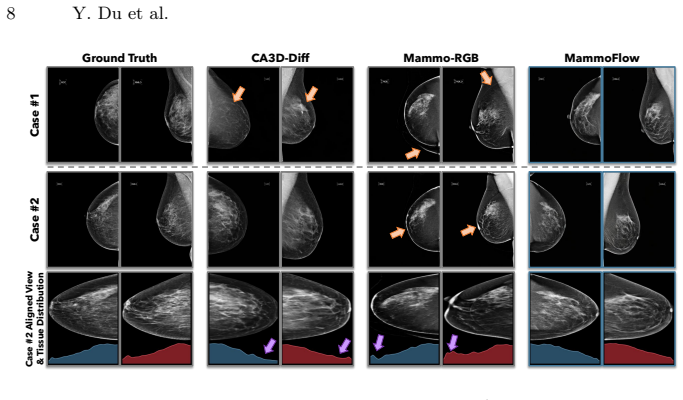
MammoFlow generates paired CC and MLO mammogram views that share consistent tissue distributions along the anteroposterior axis.
A machine-rendered reading of the paper's core claim, the machinery that carries it, and where it could break.
Core claim
By integrating an alignment module that optimizes a 2D affine transformation to match anatomical correspondence and a pixel-space self-consistency loss using the Earth Mover's Distance on anteroposterior tissue histograms, the MammoFlow model generates multiview mammogram pairs that respect implicit three-dimensional geometric relationships between the two standard projections.
What carries the argument
An alignment module searching a 2D affine transformation subspace together with an EMD loss on 1D AP-axis tissue distributions, applied inside a flow matching generator to enforce shared tissue distributions from chest wall to nipple.
If this is right
- Generated image pairs achieve higher visual quality than prior synthesis methods.
- Expert radiologists rate the synthesized pairs as realistic.
- Using the generated pairs raises AUC on a downstream classification task by 5%.
- The method is the first to guide generation explicitly with geometric tissue correspondence.
Where Pith is reading between the lines
- The consistency mechanism might extend to other paired medical projections such as CT or MRI views.
- Ablation studies could isolate whether the affine search or the EMD term contributes most to the AUC gain.
- If the 1D histogram matching truly captures 3D anatomy, the same loss could regularize single-view generators.
- Real-world deployment would still require validation on diverse patient populations beyond the training distribution.
Load-bearing premise
That searching a 2D affine transformation subspace plus an EMD loss on 1D AP-axis tissue histograms is sufficient to enforce implicit 3D anatomical consistency between generated CC and MLO views.
What would settle it
Remove the EMD consistency loss and re-train; if the reported 5% AUC gain on downstream classification disappears, the geometric consistency mechanism is not responsible for the performance lift.
Figures


read the original abstract
Multiview mammography relies on paired craniocaudal (CC) and mediolateral oblique (MLO) views to provide complementary projections of a 3D breast volume, enabling precise anomaly localization. However, acquiring high-quality, balanced datasets remains challenging for deep learning applications. We propose a novel method to synthesize multiview mammograms by leveraging the inherent geometric relationship between CC and MLO views. To enforce an implicit 3D consistency prior during generation, we develop an alignment module that searches a 2D affine transformation subspace to establish optimal anatomical correspondence. Leveraging this alignment, we introduce a pixel-space self-consistency loss based on the Earth Mover's Distance (EMD) between the 1D anteroposterior (AP) axis tissue distributions of the generated images. Integrated into a pretrained flow matching model, MammoFlow forces synthesized pairs to share physically plausible tissue distributions from the chest wall to the nipple. To our knowledge, this is the first work to guide multiview mammogram generation using implicit geometric tissue correspondence. Our method demonstrates superior image quality, passes expert radiologist evaluation, and generates physically consistent pairs that improve downstream classification AUC by 5%. Code is available at https://github.com/XYPB/MammoFlow
Editorial analysis
A structured set of objections, weighed in public.
Referee Report
Summary. The paper proposes MammoFlow, a flow-matching model for synthesizing paired CC and MLO mammogram views. It introduces an alignment module that searches a 2D affine transformation subspace to establish anatomical correspondence, combined with a pixel-space self-consistency loss using Earth Mover's Distance (EMD) on 1D anteroposterior (AP) axis tissue histograms. This is integrated into a pretrained flow matching model to enforce implicit 3D consistency, with claims of superior image quality, radiologist approval, and a 5% improvement in downstream classification AUC. Code is provided.
Significance. If the consistency mechanism is shown to produce anatomically faithful pairs that generalize beyond the proxy losses, the approach could meaningfully mitigate data scarcity and imbalance issues in multiview mammography for downstream deep learning tasks. The novelty of guiding generation via implicit geometric tissue correspondence is potentially valuable for medical image synthesis.
major comments (2)
- [Abstract] Abstract: The central claim that the alignment module and EMD loss 'enforce an implicit 3D consistency prior' and generate 'physically consistent pairs' rests on a 2D affine subspace search plus EMD on 1D AP-axis histograms. This proxy does not model 3D-to-2D projective geometry, compression, or out-of-plane tissue overlap, so many non-corresponding 3D configurations can share the same 1D marginals; this directly undermines the 'physically plausible tissue distributions' assertion and the reported 5% AUC gain.
- [Abstract] Abstract: The 5% AUC improvement, radiologist evaluation, and 'superior image quality' are stated without any baselines, dataset sizes, error bars, statistical tests, or ablation of the alignment/EMD components, preventing verification of whether the consistency loss contributes beyond standard flow matching.
minor comments (1)
- [Abstract] Abstract: No equations are provided for the alignment module, self-consistency loss, or how EMD is computed on the 1D histograms, which would aid immediate technical assessment.
Simulated Author's Rebuttal
We thank the referee for the constructive comments on our work. We address each major comment below and have revised the manuscript to improve clarity and precision where the feedback identifies opportunities to strengthen the presentation.
read point-by-point responses
-
Referee: [Abstract] Abstract: The central claim that the alignment module and EMD loss 'enforce an implicit 3D consistency prior' and generate 'physically consistent pairs' rests on a 2D affine subspace search plus EMD on 1D AP-axis histograms. This proxy does not model 3D-to-2D projective geometry, compression, or out-of-plane tissue overlap, so many non-corresponding 3D configurations can share the same 1D marginals; this directly undermines the 'physically plausible tissue distributions' assertion and the reported 5% AUC gain.
Authors: We agree that the proposed alignment module and EMD loss constitute a 2D proxy rather than an explicit model of 3D projective geometry, breast compression, or out-of-plane overlap. The method focuses on establishing correspondence along the anteroposterior axis via affine search and matching 1D tissue histograms, which we argue provides a practical implicit prior for the specific geometry of CC/MLO pairs. While this does not capture all possible 3D configurations, the resulting pairs show improved anatomical plausibility in radiologist assessments and downstream tasks. We have revised the abstract to describe the contribution more precisely as an implicit consistency prior obtained through 2D geometric alignment and tissue-distribution matching, avoiding stronger claims of full physical 3D consistency. revision: yes
-
Referee: [Abstract] Abstract: The 5% AUC improvement, radiologist evaluation, and 'superior image quality' are stated without any baselines, dataset sizes, error bars, statistical tests, or ablation of the alignment/EMD components, preventing verification of whether the consistency loss contributes beyond standard flow matching.
Authors: The abstract is a concise summary; the full manuscript reports the requested details in the Experiments section, including quantitative comparisons against standard flow-matching baselines, dataset characteristics, standard deviations across multiple runs, statistical significance testing, and ablations isolating the alignment module and EMD loss. These results indicate that the proposed components contribute measurably beyond the pretrained flow model. We have updated the abstract to reference these experimental validations and to note that the reported AUC gain is supported by the ablations and statistical analysis presented in the paper. revision: yes
Circularity Check
No circularity: method uses independent loss design on generated outputs
full rationale
The provided abstract and description define a flow-matching generator augmented by an explicit alignment search over 2D affine transforms followed by an EMD loss on 1D marginal histograms. This loss is computed on the synthesized images themselves and is not shown to be mathematically identical to any fitted parameter or input distribution. No equations are supplied that would allow reduction of the claimed 3D consistency to a tautology. No self-citations are invoked as load-bearing uniqueness theorems, and the central claim rests on the empirical effect of the added loss term rather than on renaming or self-referential fitting. The derivation chain is therefore self-contained against external benchmarks.
Axiom & Free-Parameter Ledger
axioms (2)
- domain assumption Earth Mover’s Distance between 1D tissue distributions is a meaningful proxy for 3D anatomical consistency
- domain assumption A 2D affine transformation subspace is sufficient to align CC and MLO views for correspondence
Reference graph
Works this paper leans on
-
[1]
Sensors24(7), 2076 (2024)
Montoya-del Angel, R., Sam-Millan, K., Vilanova, J.C., Martí, R.: Mam-e: Mam- mographic synthetic image generation with diffusion models. Sensors24(7), 2076 (2024)
2076
-
[2]
com/competitions/rsna-breast-cancer-detection(2022), kaggle
Carr, C., FelipeKitamura, MD, P., Partridge, G., inversion, Kalpathy-Cramer, J., Mongan, J., Andriole, K., Lavender, Vazirabad, M., Riopel, M., Ball, R., Dane, S., Chen, Y.: Rsna screening mammography breast cancer detection.https://kaggle. com/competitions/rsna-breast-cancer-detection(2022), kaggle
2022
-
[3]
Nature Communications 16(1), 2248 (2025)
Chang, Y.W., Ryu, J.K., An, J.K., Choi, N., Park, Y.M., Ko, K.H., Han, K.: Artificial intelligence for breast cancer screening in mammography (ai-stream): pre- liminary analysis of a prospective multicenter cohort study. Nature Communications 16(1), 2248 (2025)
2025
-
[4]
In: International Conference on Medical Image Computing and Computer-Assisted Intervention
Du, Y., Chen, L., Dvornek, N.C.: Geometry-guided local alignment for multi- view visual language pre-training in mammography. In: International Conference on Medical Image Computing and Computer-Assisted Intervention. pp. 299–310. Springer (2025)
2025
-
[5]
In: Forty-first international conference on machine learning (2024)
Esser, P., Kulal, S., Blattmann, A., Entezari, R., Müller, J., Saini, H., Levi, Y., Lorenz, D., Sauer, A., Boesel, F., et al.: Scaling rectified flow transformers for high-resolution image synthesis. In: Forty-first international conference on machine learning (2024)
2024
-
[6]
Frontiers in oncology12, 1044496 (2023)
Garrucho, L., Kushibar, K., Osuala, R., Diaz, O., Catanese, A., Del Riego, J., Bobowicz, M., Strand, F., Igual, L., Lekadir, K.: High-resolution synthesis of high- density breast mammograms: Application to improved fairness in deep learning based mass detection. Frontiers in oncology12, 1044496 (2023)
2023
-
[7]
arXiv preprint arXiv:2511.22759 (2025)
Garza-Abdala, J.A., Fumagal-González, G.A., Avendano, D., Cardona, S., Hussain, S., de Avila-Armenta, E., Toscano-Martínez, J.H., Gurmendi, D.S., Pedro-Pérez, A.A., Tamez-Pena, J.G.: Mammorgb: Dual-view mammogram synthesis using denoising diffusion probabilistic models. arXiv preprint arXiv:2511.22759 (2025)
-
[8]
In: International conference on medical image computing and computer-assisted intervention
Ghosh, S., Poynton, C.B., Visweswaran, S., Batmanghelich, K.: Mammo-clip: A vision language foundation model to enhance data efficiency and robustness in mammography. In: International conference on medical image computing and computer-assisted intervention. pp. 632–642. Springer (2024) 10 Y. Du et al
2024
-
[9]
Artificial Intelligence Review58(2), 39 (2024)
Heng, Y., Yinghua, M., Khan, F.G., Khan, A., Ali, F., AlZubi, A.A., Hui, Z.: Survey: application and analysis of generative adversarial networks in medical images. Artificial Intelligence Review58(2), 39 (2024)
2024
-
[10]
Auto-Encoding Variational Bayes
Kingma, D.P., Welling, M.: Auto-encoding variational bayes. arXiv preprint arXiv:1312.6114 (2013)
work page internal anchor Pith review Pith/arXiv arXiv 2013
-
[11]
Konz, N., Osuala, R., Verma, P., Chen, Y., Gu, H., Dong, H., Chen, Y., Marshall, A., Garrucho, L., Kushibar, K., Lang, D.M., Kim, G.S., Grimm, L.J., Lewin, J.M., Duncan, J.S., Schnabel, J.A., Diaz, O., Lekadir, K., Mazurowski, M.A.: Fréchet radiomic distance (frd): A versatile metric for comparing medical imaging datasets. Medical Image Analysis110, 10394...
-
[12]
arXiv preprint arXiv:2510.04947 (2025)
Li, X., Yang, K., Li, Q., Wang, Z.: Bidirectional mammogram view translation with column-aware and implicit 3d conditional diffusion. arXiv preprint arXiv:2510.04947 (2025)
-
[13]
Flow Matching for Generative Modeling
Lipman, Y., Chen, R.T., Ben-Hamu, H., Nickel, M., Le, M.: Flow matching for generative modeling. arXiv preprint arXiv:2210.02747 (2022)
work page internal anchor Pith review Pith/arXiv arXiv 2022
-
[14]
Flow Straight and Fast: Learning to Generate and Transfer Data with Rectified Flow
Liu, X., Gong, C., Liu, Q.: Flow straight and fast: Learning to generate and transfer data with rectified flow. arXiv preprint arXiv:2209.03003 (2022)
work page internal anchor Pith review Pith/arXiv arXiv 2022
-
[15]
Scientific Data10(1), 277 (2023)
Nguyen, H.T., Nguyen, H.Q., Pham, H.H., Lam, K., Le, L.T., Dao, M., Vu, V.: Vindr-mammo: A large-scale benchmark dataset for computer-aided diagnosis in full-field digital mammography. Scientific Data10(1), 277 (2023)
2023
-
[16]
Ieee access10, 77723–77731 (2022)
Petrini, D.G., Shimizu, C., Roela, R.A., Valente, G.V., Folgueira, M.A.A.K., Kim, H.Y.: Breast cancer diagnosis in two-view mammography using end-to-end trained efficientnet-based convolutional network. Ieee access10, 77723–77731 (2022)
2022
-
[17]
Seitzer, M.: pytorch-fid: FID Score for PyTorch.https://github.com/mseitzer/ pytorch-fid(August 2020), version 0.3.0
2020
-
[18]
arXiv preprint arXiv:2112.01330 (2021)
Sorkhei, M., Liu, Y., Azizpour, H., Azavedo, E., Dembrower, K., Ntoula, D., Zouzos, A., Strand, F., Smith, K.: Csaw-m: An ordinal classification dataset for benchmarking mammographic masking of cancer. arXiv preprint arXiv:2112.01330 (2021)
-
[19]
Strand, F.: CSAW-CC (mammography) – a dataset for AI research to improve screening, diagnostics and prognostics of breast cancer (2022).https://doi.org/ 10.5878/45vm-t798,https://doi.org/10.5878/45vm-t798
-
[20]
CA: a cancer journal for clinicians71(3), 209–249 (2021)
Sung, H., Ferlay, J., Siegel, R.L., Laversanne, M., Soerjomataram, I., Jemal, A., Bray, F.: Global cancer statistics 2020: Globocan estimates of incidence and mortality worldwide for 36 cancers in 185 countries. CA: a cancer journal for clinicians71(3), 209–249 (2021)
2020
-
[21]
The British journal of radiology91(1082), 20170611 (2018)
Sweeney, R.J.I., Lewis, S.J., Hogg, P., McEntee, M.F.: A review of mammographic positioning image quality criteria for the craniocaudal projection. The British journal of radiology91(1082), 20170611 (2018)
2018
-
[22]
In: International conference on machine learning
Tan, M., Le, Q.: Efficientnet: Rethinking model scaling for convolutional neural networks. In: International conference on machine learning. pp. 6105–6114. PMLR (2019)
2019
-
[23]
Diagnostics13(1), 67 (2022)
Walsh, R., Tardy, M.: A comparison of techniques for class imbalance in deep learning classification of breast cancer. Diagnostics13(1), 67 (2022)
2022
-
[24]
arXiv preprint arXiv:2306.10676 (2023)
Wang, Z., Xian, J., Liu, K., Li, X., Li, Q., Yang, X.: Dual-view correlation hybrid attention network for robust holistic mammogram classification. arXiv preprint arXiv:2306.10676 (2023)
-
[25]
Applied Sciences12(23), 12206 (2022)
Yamazaki, A., Ishida, T.: Two-view mammogram synthesis from single-view data using generative adversarial networks. Applied Sciences12(23), 12206 (2022)
2022
discussion (0)
Sign in with ORCID, Apple, or X to comment. Anyone can read and Pith papers without signing in.