The NANOGrav 15 yr Data Set: Impacts of Customized Chromatic Noise Models on Gravitational Wave Analyses
Pith reviewed 2026-06-30 00:39 UTC · model grok-4.3
The pith
Customized chromatic noise models raise the Bayes factor for Hellings-Downs correlations eightfold in pulsar timing data.
A machine-rendered reading of the paper's core claim, the machinery that carries it, and where it could break.
Core claim
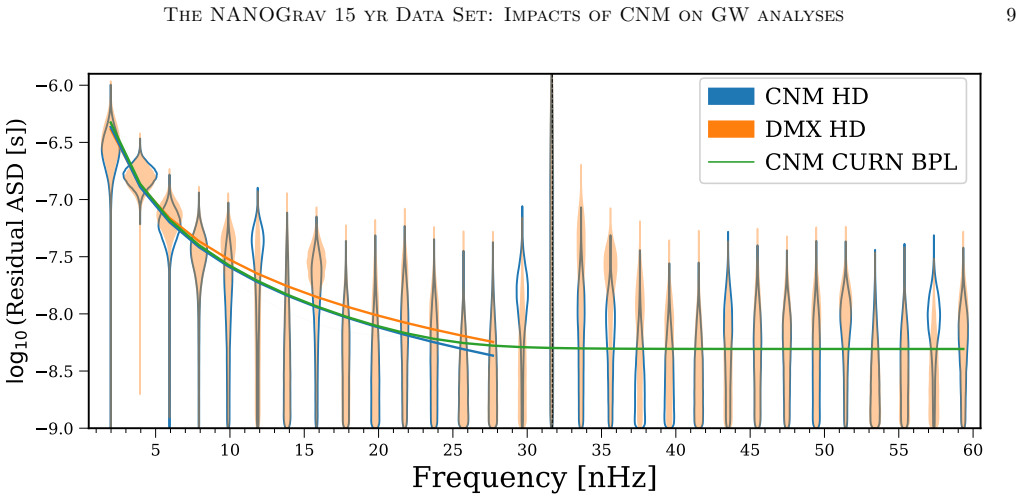
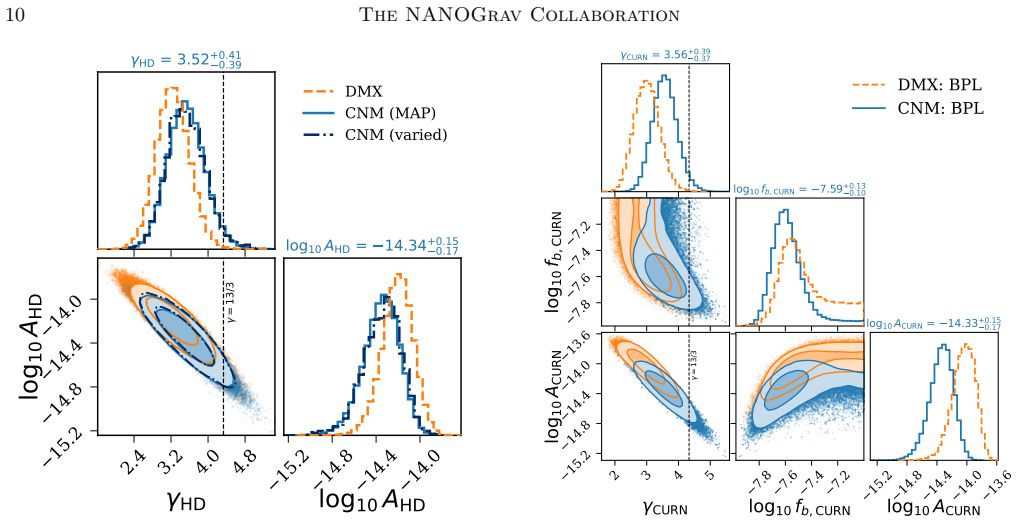
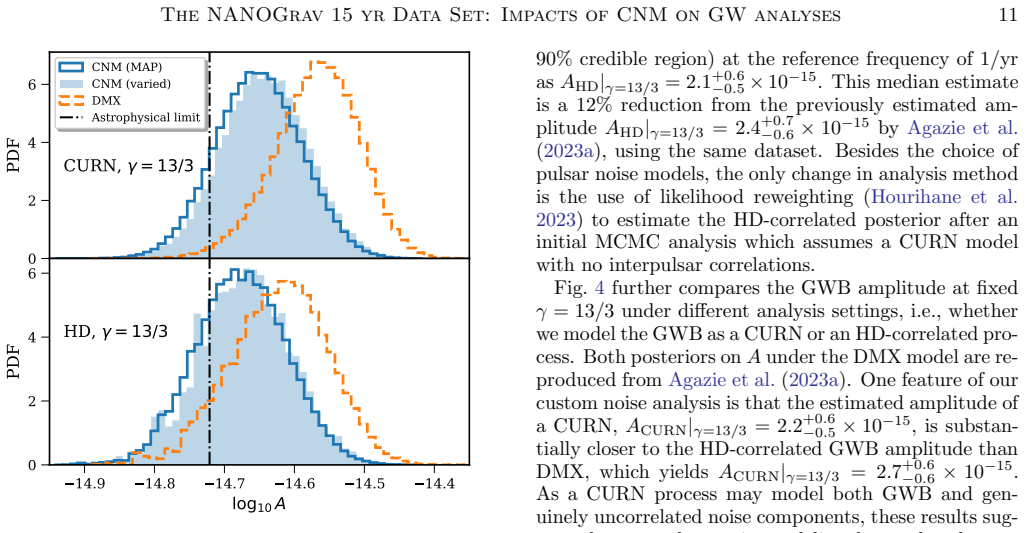
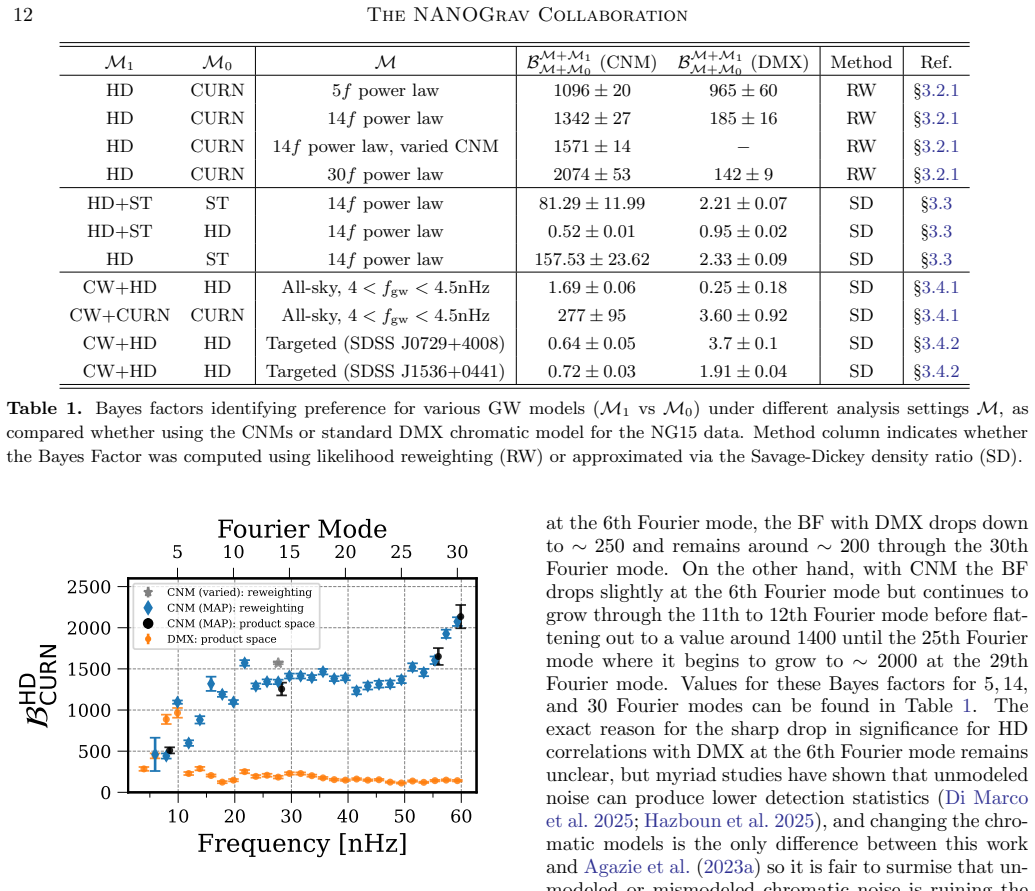
Use of the customized chromatic noise models on the fifteen-year dataset increases the Bayes factor for Hellings-Downs correlations over an uncorrelated red-noise process to 1571 using a power-law spectrum with fourteen Fourier modes, an eightfold rise over earlier results, while lowering the background amplitude to 2.1 times 10 to the minus fifteen at fixed index and raising the free spectral index to 3.5.
What carries the argument
Customized chromatic noise models that isolate frequency-dependent noise processes in pulsar timing residuals from a potential gravitational wave signal.
If this is right
- The gravitational wave background spectrum appears quieter at fixed index and steeper when the index is allowed to vary.
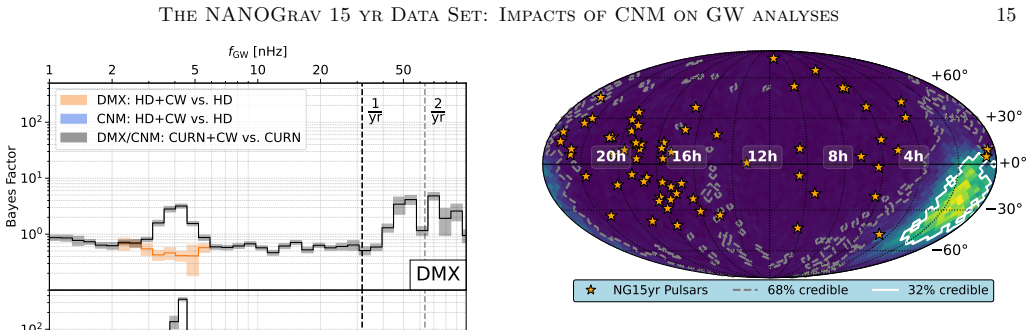
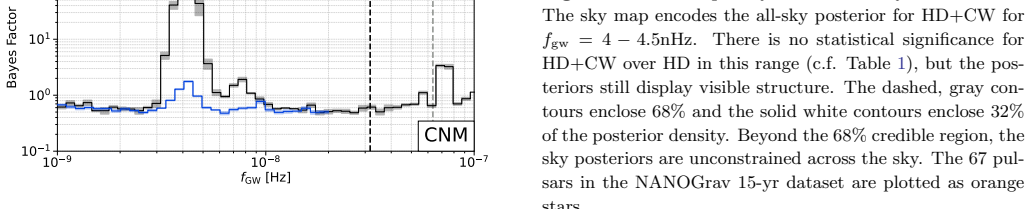
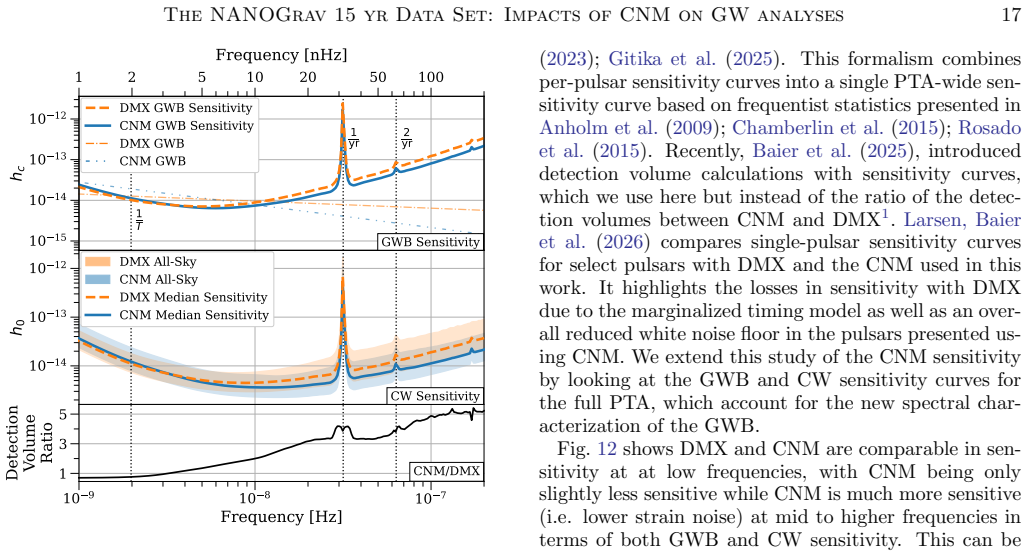
- The effective search volume for continuous gravitational wave sources increases by a factor of 3.2.
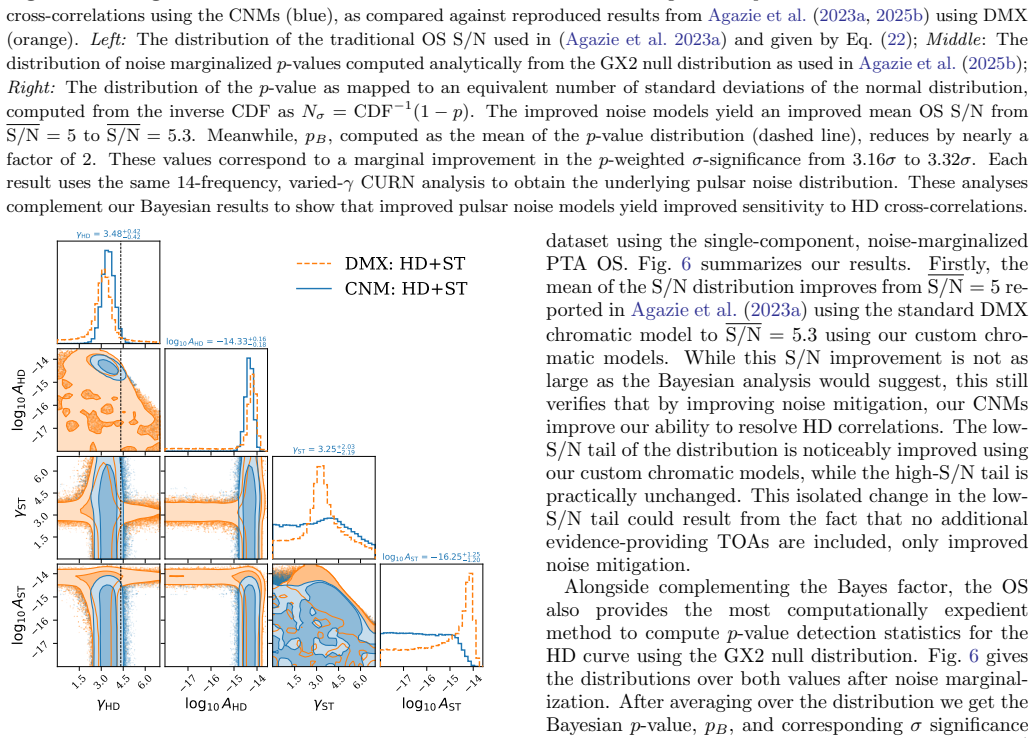
- Evidence for a scalar-transverse gravitational wave polarization mode decreases.
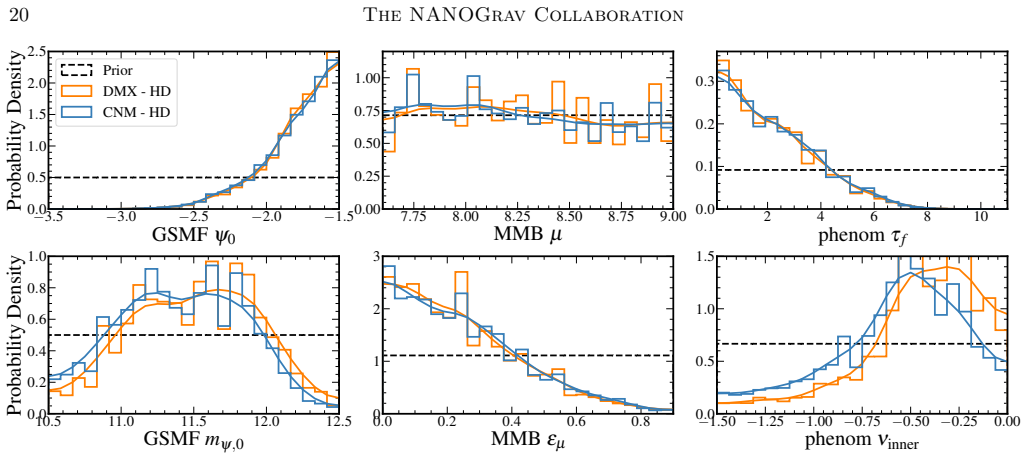
- Posterior distributions for both supermassive black hole binary and cosmological source models shift only marginally.
Where Pith is reading between the lines
- Improved separation of noise from signal could help future larger datasets distinguish astrophysical from cosmological origins of the background.
- The same noise-modeling strategy may be worth testing on independent pulsar timing arrays to check consistency of the correlation signature.
- If the models hold, earlier analyses may have underestimated the strength of the nanohertz gravitational wave signal mainly because of residual chromatic noise.
Load-bearing premise
The customized chromatic noise models correctly capture all relevant noise processes without removing or biasing any gravitational wave signal component.
What would settle it
An independent analysis of the same timing residuals that applies different noise models and recovers a Bayes factor near the earlier lower value would indicate that the reported increase depends on the specific noise modeling choice.
Figures
read the original abstract
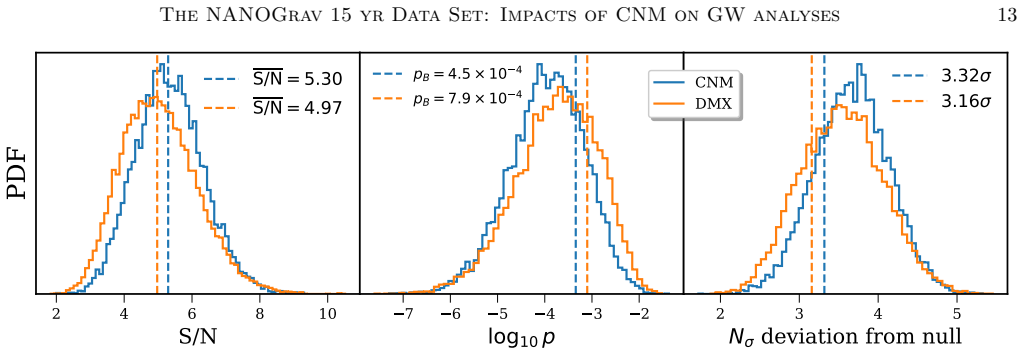
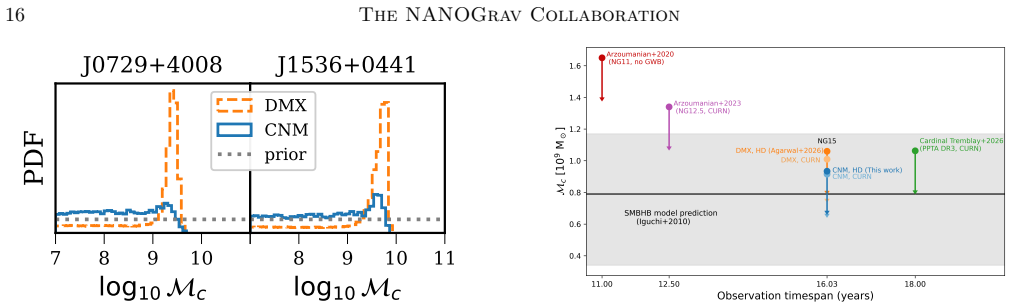
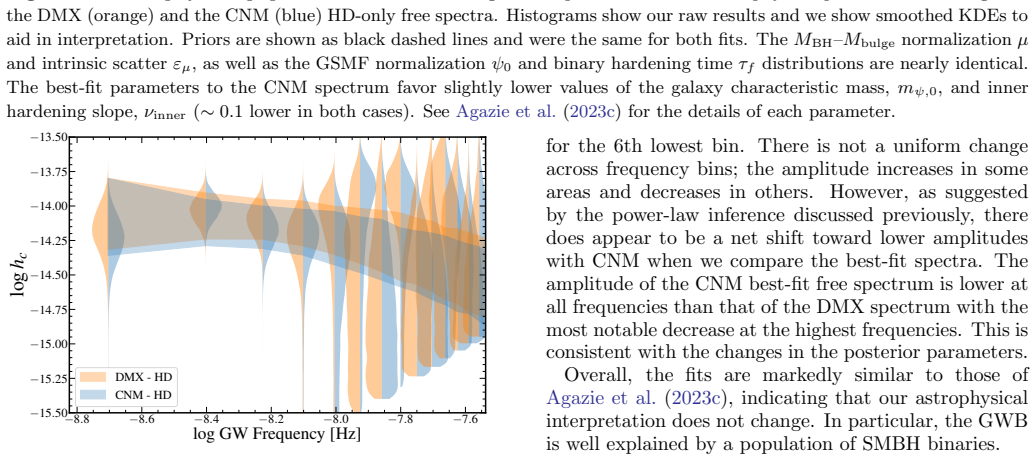
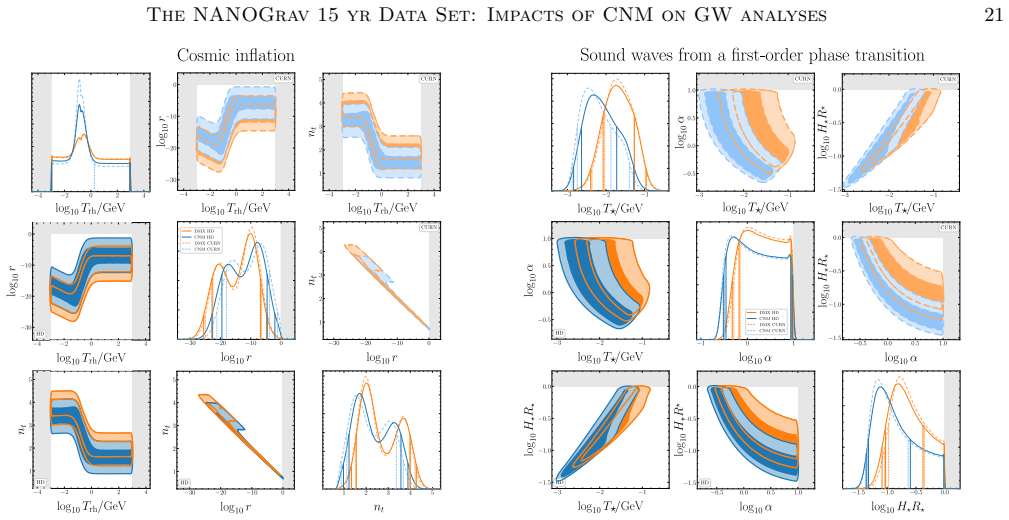
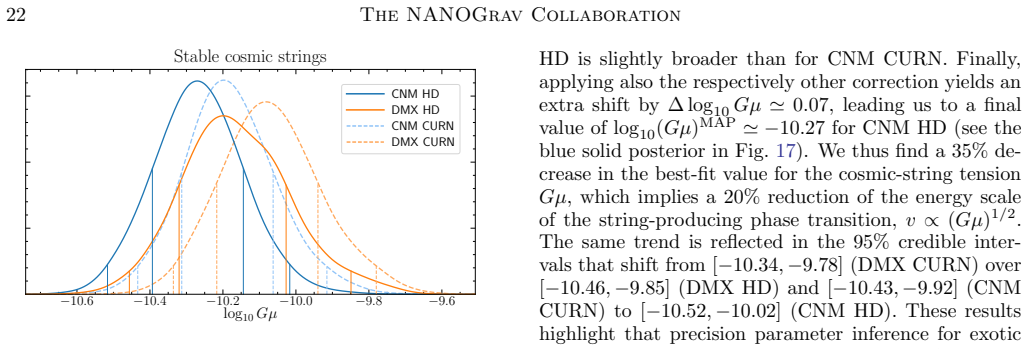
We report updated nHz gravitational wave (GW) significance, characterization, and interpretations using the customized chromatic-noise models (CNMs) developed in Larsen, Baier et al. (2026). for the NANOGrav 15-year data set. We find increased evidence for the Hellings-Downs (HD) correlation signature of the stochastic gravitational wave background (GWB), with a Bayes factor of $1571\pm14$ for HD-correlations over a common uncorrelated red-noise process using a power-law model with $14$ Fourier modes. We find this $\sim8\times$ increase in Bayes factor from Agazie et al. (2023a) is a result of improved noise mitigation. Assuming an analytic null distribution for the frequentist interpulsar correlation statistic, this corresponds to a slightly more significant measurement from $3.16\sigma$ to $3.32\sigma$ against the no-correlation scenario. Spectral inference with CNMs brings the power-law GWB amplitude down to $A_{\rm GWB} = 2.1^{+0.6}_{-0.5}\times10^{-15}$ at fixed $\gamma_{\rm GWB} = 13/3$. In a varied-$\gamma$ analysis, the spectral index increases to $\gamma_{\rm GWB}=3.5^{+0.7}_{-0.6}$. We report updates on an all-sky continuous gravitational wave (CW) search as well as select targeted searches and calculate a $3.2\times$ larger detection volume for the NANOGrav detector. With CNMs, we find reduced evidence for a non-Einsteinian, scalar-transverse mode of gravity. Finally, we reinterpret the GWB first with the assumption of an astrophysical background sourced by SMBHBs and then assuming the more exotic origins of cosmic inflation, a first-order cosmological phase transition, and stable cosmic strings. Under both the SMBHB hypothesis and the cosmological hypotheses, we see only marginal shifts in model parameter posteriors which are consistent with the slightly quieter and steeper power-law GWB spectrum.
Editorial analysis
A structured set of objections, weighed in public.
Referee Report
Summary. The manuscript reports an updated analysis of the NANOGrav 15-year pulsar timing array data set using customized chromatic noise models (CNMs) from a companion paper. It claims an approximately 8-fold increase in the Bayes factor (to 1571±14) favoring the Hellings-Downs correlation over a common uncorrelated red-noise process (power-law model with 14 Fourier modes), a modest rise in frequentist significance from 3.16σ to 3.32σ, a lower GWB amplitude (A_GWB = 2.1^{+0.6}_{-0.5}×10^{-15} at γ_GWB=13/3), a steeper spectral index when γ is free (3.5^{+0.7}_{-0.6}), a 3.2× larger CW detection volume, reduced evidence for scalar-transverse modes, and only marginal shifts in SMBHB and cosmological model posteriors.
Significance. If the CNMs demonstrably preserve the common-process signal, the work would provide a concrete demonstration that refined per-pulsar noise modeling can substantially strengthen evidence for the HD signature and tighten GWB parameter constraints. The numerical updates and dual astrophysical/cosmological reinterpretations would be useful benchmarks for the PTA community. The modest frequentist significance gain and the dependence on an unvalidated separation between chromatic and achromatic terms limit the immediate strength of the conclusions.
major comments (2)
- [Abstract and Results] Abstract and main results: The central claim that the ~8× Bayes-factor increase results from improved noise mitigation requires explicit verification that the additional per-pulsar chromatic degrees of freedom do not absorb power from the spatially correlated common red-noise process. No injection-recovery tests, posterior comparisons of the common-process parameters with/without CNMs, or other separation diagnostics are described; the formal distinction between chromatic and achromatic spectra does not by itself guarantee that the joint posterior remains unbiased.
- [Results] Results on frequentist significance: The reported rise from 3.16σ to 3.32σ assumes an analytic null distribution for the interpulsar correlation statistic, but the manuscript does not state whether this null distribution has been recomputed or adjusted to account for the extra free parameters introduced by the CNMs.
minor comments (2)
- [Abstract] The citation 'Larsen, Baier et al. (2026)' should include a preprint identifier or note on publication status, as the CNMs are central to all quantitative claims.
- [Abstract] The quoted uncertainties on the Bayes factor (1571±14) and on A_GWB, γ_GWB are given to high precision; the text should briefly indicate the sampling method or convergence diagnostics used to obtain them.
Simulated Author's Rebuttal
We thank the referee for their thoughtful review and for identifying areas where the manuscript can be strengthened. We address each major comment below. Where appropriate, we will revise the manuscript to provide additional clarification and supporting material.
read point-by-point responses
-
Referee: [Abstract and Results] Abstract and main results: The central claim that the ~8× Bayes-factor increase results from improved noise mitigation requires explicit verification that the additional per-pulsar chromatic degrees of freedom do not absorb power from the spatially correlated common red-noise process. No injection-recovery tests, posterior comparisons of the common-process parameters with/without CNMs, or other separation diagnostics are described; the formal distinction between chromatic and achromatic spectra does not by itself guarantee that the joint posterior remains unbiased.
Authors: We agree that additional diagnostics would strengthen the presentation. The companion paper validates the CNMs through extensive per-pulsar tests, and the separation relies on the distinct frequency scaling of chromatic versus achromatic processes. In the revised manuscript we will add direct posterior comparisons of the common-process amplitude and spectral index with and without CNMs to demonstrate that the spatially correlated signal is preserved rather than absorbed. We will also expand the discussion of why the frequency-dependent separation provides robustness. Full injection-recovery tests specific to the GWB analysis are not included here but are referenced to ongoing work; the observed Bayes-factor increase is consistent with reduced per-pulsar noise variance allowing clearer recovery of the correlated component. revision: partial
-
Referee: [Results] Results on frequentist significance: The reported rise from 3.16σ to 3.32σ assumes an analytic null distribution for the interpulsar correlation statistic, but the manuscript does not state whether this null distribution has been recomputed or adjusted to account for the extra free parameters introduced by the CNMs.
Authors: The analytic null distribution is the same as that used in Agazie et al. (2023a) because the CNMs are pulsar-specific noise models that do not alter the structure of the correlation statistic or the null hypothesis of no spatial correlations. The extra degrees of freedom are absorbed into individual pulsar likelihoods and do not change the distribution of the statistic under the null. We will revise the text to explicitly state this assumption and provide the justification that recomputation is unnecessary. revision: yes
Circularity Check
Standard Bayesian GW analyses with companion-supplied noise models show no algebraic reduction to inputs
full rationale
The paper performs standard likelihood comparisons (Bayes factors for HD correlations vs. common uncorrelated red noise, spectral inference on power-law GWB parameters) after substituting the CNMs developed in the cited companion paper. These outputs are computed quantities from the data and the fixed noise-model parameterization; they are not equivalent by construction to the CNM parameters themselves, nor do any equations define the target GWB evidence in terms of the noise-model fit. The self-citation supplies the per-pulsar chromatic terms but does not carry the load of proving the HD signature; the correlation statistic and model comparison remain independent of that construction. No self-definitional steps, fitted inputs relabeled as predictions, or imported uniqueness theorems appear in the reported chain.
Axiom & Free-Parameter Ledger
free parameters (2)
- A_GWB =
2.1 x 10^{-15}
- gamma_GWB =
3.5
axioms (1)
- domain assumption Hellings-Downs correlations are the expected signature for an isotropic stochastic gravitational wave background in general relativity
Reference graph
Works this paper leans on
-
[1]
, year = 1990, month = sep, volume =
The generation of timing noise by superfluid rotation in pulsars. , year = 1990, month = sep, volume =
1990
-
[2]
Handbook of Pulsar Astronomy
-
[3]
Classical and Quantum Gravity , keywords =
A sensitivity curve approach to tuning a pulsar timing array in the detection era. Classical and Quantum Gravity , keywords =. doi:10.1088/1361-6382/adbbab , archivePrefix =. 2409.00336 , primaryClass =
-
[4]
Separating deterministic and stochastic gravitational wave signals in realistic pulsar timing array datasets. , keywords =. doi:10.1051/0004-6361/202451809 , archivePrefix =. 2407.21105 , primaryClass =
-
[5]
The weighted likelihood ratio, linear hypotheses on normal location parameters , year =
Dickey, James M , journal =. The weighted likelihood ratio, linear hypotheses on normal location parameters , year =
-
[7]
Exploring the time variability of the solar wind using LOFAR pulsar data. , keywords =. doi:10.1051/0004-6361/202450680 , archivePrefix =. 2409.09838 , primaryClass =
-
[8]
New advances in the Gaussian-process approach to pulsar-timing data analysis
doi:10.1103/PhysRevD.90.104012 , eid =. arXiv , author =:1407.1838 , journal =
work page internal anchor Pith review Pith/arXiv arXiv doi:10.1103/physrevd.90.104012
-
[9]
The NANOGrav Nine-Year Data Set: Measurement and Interpretation of Variations in Dispersion Measures
doi:10.3847/1538-4357/aa73df , eid =. arXiv , author =:1612.03187 , journal =
work page internal anchor Pith review Pith/arXiv arXiv doi:10.3847/1538-4357/aa73df
-
[10]
Cordes and Stella Koch Ocker and Shami Chatterjee and Timothy Dolch and Ross J
James M. Cordes and Stella Koch Ocker and Shami Chatterjee and Timothy Dolch and Ross J. Jennings and Michael T. Lam and Jacob E. Turner , title =. , year =
-
[11]
Pulsar timing noise from superfluid turbulence
Pulsar timing noise from superfluid turbulence. , keywords =. doi:10.1093/mnras/stt1828 , archivePrefix =. 1310.3108 , primaryClass =
work page internal anchor Pith review Pith/arXiv arXiv doi:10.1093/mnras/stt1828
-
[12]
Understanding and analysing time-correlated stochastic signals in pulsar timing
Understanding and analysing time-correlated stochastic signals in pulsar timing. , keywords =. doi:10.1093/mnras/sts097 , archivePrefix =. 1202.5932 , primaryClass =
work page internal anchor Pith review Pith/arXiv arXiv doi:10.1093/mnras/sts097
-
[13]
On measuring the gravitational-wave background using Pulsar Timing Arrays. , keywords =. doi:10.1111/j.1365-2966.2009.14590.x , archivePrefix =. 0809.0791 , primaryClass =
-
[14]
An Asteroid Belt Interpretation for the Timing Variations of the Millisecond Pulsar B1937+21
An Asteroid Belt Interpretation for the Timing Variations of the Millisecond Pulsar B1937+21. , keywords =. doi:10.1088/0004-637X/766/1/5 , archivePrefix =. 1301.6429 , primaryClass =
work page internal anchor Pith review Pith/arXiv arXiv doi:10.1088/0004-637x/766/1/5
-
[15]
Precision Orbital Dynamics from Interstellar Scintillation Arcs for PSR J0437-4715. , keywords =. doi:10.3847/1538-4357/abbd40 , archivePrefix =. 2009.12757 , primaryClass =
-
[16]
The NANOGrav 15-Year Data Set: A Case Study for Simplified Dispersion Measure Modeling for PSR J1455-3330 and the Impact on Gravitational Wave Sensitivity. arXiv e-prints , keywords =. doi:10.48550/arXiv.2506.03597 , archivePrefix =. 2506.03597 , primaryClass =
work page internal anchor Pith review Pith/arXiv arXiv doi:10.48550/arxiv.2506.03597
-
[17]
Pulsar scintillation through thick and thin: bow shocks, bubbles, and the broader interstellar medium. , keywords =. doi:10.1093/mnras/stad3683 , archivePrefix =. 2309.13809 , primaryClass =
-
[19]
A Second Chromatic Timing Event of Interstellar Origin toward PSR J1713+0747
doi:10.3847/1538-4357/aac770 , eid =. arXiv , author =:1712.03651 , journal =
work page internal anchor Pith review Pith/arXiv arXiv doi:10.3847/1538-4357/aac770
-
[20]
Frequency-Dependent Dispersion Measures and Implications for Pulsar Timing
doi:10.3847/0004-637X/817/1/16 , eid =. arXiv , author =:1503.08491 , journal =
work page internal anchor Pith review Pith/arXiv arXiv doi:10.3847/0004-637x/817/1/16
-
[21]
arXiv , author =:2202.08293 , journal =
doi:10.1103/PhysRevD.105.084049 , eid =. arXiv , author =:2202.08293 , journal =
-
[22]
arXiv , author =:2012.11726 , journal =
doi:10.1051/0004-6361/202039846 , eid =. arXiv , author =:2012.11726 , journal =
-
[23]
doi:10.1093/mnras/stv2143 , eprint =
, keywords =. doi:10.1093/mnras/stv2143 , eprint =
-
[24]
arXiv , author =:1912.08807 , journal =
doi:10.1088/1361-6382/ab8bbd , eid =. arXiv , author =:1912.08807 , journal =
-
[25]
doi:10.1038/s41550-017-0299-6 , eprint =
Nature Astronomy , keywords =. doi:10.1038/s41550-017-0299-6 , eprint =
-
[26]
doi:10.3847/2041-8205/819/1/L6 , eid =. arXiv , author =:1511.05564 , journal =
work page internal anchor Pith review Pith/arXiv arXiv doi:10.3847/2041-8205/819/1/l6 2041
-
[27]
arXiv , author =:2010.11950 , journal =
doi:10.3847/2041-8213/abf2c9 , eid =. arXiv , author =:2010.11950 , journal =
-
[28]
Optimal Frequency Ranges for Sub-Microsecond Precision Pulsar Timing
doi:10.3847/1538-4357/aac48d , eid =. arXiv , author =:1710.02272 , journal =
work page internal anchor Pith review Pith/arXiv arXiv doi:10.3847/1538-4357/aac48d
-
[29]
doi:10.1088/0264-9381/30/22/224009 , eid =
Classical and Quantum Gravity , month = nov, number =. doi:10.1088/0264-9381/30/22/224009 , eid =
-
[30]
The Parkes Pulsar Timing Array Project
doi:10.1017/pasa.2012.017 , eid =. arXiv , author =:1210.6130 , journal =
work page internal anchor Pith review Pith/arXiv arXiv doi:10.1017/pasa.2012.017 2012
-
[31]
Luke Zoltan Kelley and Emiko C Gardiner and David Wright and Magdalena Siwek and Cayenne Matt and Jeff Hazboun and A. Cingoranelli and J. Andrew Casey-Clyde and Tingting Liu and Kayhan G. holodeck , url =. 2023 , bdsk-url-1 =. doi:10.5281/zenodo.10966412 , eid =
-
[32]
arXiv , author =:2305.01116 , journal =
doi:10.1103/PhysRevD.108.104050 , eid =. arXiv , author =:2305.01116 , journal =
-
[33]
Practical Methods for Continuous Gravitational Wave Detection using Pulsar Timing Data
doi:10.1088/0004-637X/753/2/96 , eid =. arXiv , author =:1202.0808 , journal =
work page internal anchor Pith review Pith/arXiv arXiv doi:10.1088/0004-637x/753/2/96
-
[34]
doi:10.1103/PhysRevD.90.104028 , eid =. arXiv , author =:1406.5224 , journal =
work page internal anchor Pith review Pith/arXiv arXiv doi:10.1103/physrevd.90.104028
-
[35]
Targeted search for continuous gravitational waves: Bayesian versus maximum-likelihood statistics
doi:10.1088/0264-9381/26/20/204013 , eid =. arXiv , author =:0907.2569 , journal =
work page internal anchor Pith review Pith/arXiv arXiv doi:10.1088/0264-9381/26/20/204013
-
[36]
The generalized F-statistic: multiple detectors and multiple GW pulsars
doi:10.1103/PhysRevD.72.063006 , eid =. arXiv , author =:gr-qc/0504011 , journal =
work page internal anchor Pith review Pith/arXiv arXiv doi:10.1103/physrevd.72.063006
-
[37]
doi:10.1103/PhysRevD.58.063001 , eid =. arXiv , author =:gr-qc/9804014 , journal =
work page internal anchor Pith review Pith/arXiv arXiv doi:10.1103/physrevd.58.063001
-
[38]
Optimization of NANOGrav's Time Allocation for Maximum Sensitivity to Single Sources
doi:10.1088/0004-637X/794/2/163 , eid =. arXiv , author =:1409.7722 , journal =
work page internal anchor Pith review Pith/arXiv arXiv doi:10.1088/0004-637x/794/2/163
-
[39]
The stochastic background: scaling laws and time to detection for pulsar timing arrays
doi:10.1088/0264-9381/30/22/224015 , eid =. arXiv , author =:1305.3196 , journal =
work page internal anchor Pith review Pith/arXiv arXiv doi:10.1088/0264-9381/30/22/224015
-
[40]
arXiv , author =:2309.07227 , journal =
doi:10.3847/1538-4357/ad2be8 , eid =. arXiv , author =:2309.07227 , journal =
-
[41]
doi:10.1093/mnras/stv1098 , eprint =
, keywords =. doi:10.1093/mnras/stv1098 , eprint =
-
[42]
Searching For Anisotropic Gravitational-wave Backgrounds Using Pulsar Timing Arrays
doi:10.1103/PhysRevD.88.084001 , eid =. arXiv , author =:1306.5395 , journal =
work page internal anchor Pith review Pith/arXiv arXiv doi:10.1103/physrevd.88.084001
-
[43]
Characterising gravitational wave stochastic background anisotropy with Pulsar Timing Arrays
doi:10.1103/PhysRevD.88.062005 , eid =. arXiv , author =:1306.5394 , journal =
work page internal anchor Pith review Pith/arXiv arXiv doi:10.1103/physrevd.88.062005
-
[44]
doi:10.1093/mnras/stac3237 , eprint =
, keywords =. doi:10.1093/mnras/stac3237 , eprint =
-
[45]
arXiv , author =:2404.02864 , journal =
doi:10.48550/arXiv.2404.02864 , eid =. arXiv , author =:2404.02864 , journal =
-
[46]
doi:10.1103/PhysRevD.91.044048 , eid =. arXiv , author =:1410.8256 , journal =
work page internal anchor Pith review Pith/arXiv arXiv doi:10.1103/physrevd.91.044048
-
[47]
Optimal strategies for gravitational wave stochastic background searches in pulsar timing data
doi:10.1103/PhysRevD.79.084030 , eid =. arXiv , author =:0809.0701 , journal =
work page internal anchor Pith review Pith/arXiv arXiv doi:10.1103/physrevd.79.084030
-
[48]
doi:10.1088/0004-637X/718/2/1400 , eprint =
, keywords =. doi:10.1088/0004-637X/718/2/1400 , eprint =
-
[49]
Assessing Pulsar Timing Array Sensitivity to Gravitational Wave Bursts with Memory
doi:10.1088/0004-637X/788/2/141 , eid =. arXiv , author =:1404.5682 , journal =
work page internal anchor Pith review Pith/arXiv arXiv doi:10.1088/0004-637x/788/2/141
-
[50]
Sensitivity curves for searches for gravitational-wave backgrounds
doi:10.1103/PhysRevD.88.124032 , eid =. arXiv , author =:1310.5300 , journal =
work page internal anchor Pith review Pith/arXiv arXiv doi:10.1103/physrevd.88.124032
-
[51]
arXiv , author =:2309.00693 , journal =
doi:10.48550/arXiv.2309.00693 , eid =. arXiv , author =:2309.00693 , journal =
-
[52]
arXiv , author =:2301.07135 , journal =
doi:10.3847/1538-4357/acb492 , eid =. arXiv , author =:2301.07135 , journal =
-
[53]
arXiv , author =:2303.12105 , journal =
doi:10.1103/PhysRevD.108.023008 , eid =. arXiv , author =:2303.12105 , journal =
-
[54]
doi:10.1086/191076 , journal =
-
[55]
arXiv , author =:1010.3785 , journal =
-
[56]
Effects of the ISM on Detection of Low-frequency Gravitational Waves
doi:10.1088/0264-9381/30/22/224006 , eid =. arXiv , author =:1310.8316 , journal =
work page internal anchor Pith review Pith/arXiv arXiv doi:10.1088/0264-9381/30/22/224006
-
[57]
in preparation , title =
-
[58]
doi:10.1119/1.1374248 , journal =
-
[59]
doi:10.48550/arXiv.1706.09975 , eid =. arXiv , author =:1706.09975 , journal =
work page internal anchor Pith review Pith/arXiv arXiv doi:10.48550/arxiv.1706.09975
-
[60]
arXiv , author =:2306.16223 , journal =
doi:10.48550/arXiv.2306.16223 , eid =. arXiv , author =:2306.16223 , journal =
-
[61]
arXiv , author =:2303.15442 , journal =
doi:10.48550/arXiv.2303.15442 , eid =. arXiv , author =:2303.15442 , journal =
-
[62]
doi:10.1088/1674-4527/acdfa5 , eid =. arXiv , author =:2306.16216 , journal =
work page internal anchor Pith review Pith/arXiv arXiv doi:10.1088/1674-4527/acdfa5
-
[63]
arXiv , author =:2306.16228 , journal =
doi:10.48550/arXiv.2306.16228 , eid =. arXiv , author =:2306.16228 , journal =
-
[64]
arXiv , author =:2306.16227 , journal =
doi:10.48550/arXiv.2306.16227 , eid =. arXiv , author =:2306.16227 , journal =
-
[65]
arXiv , author =:2306.16226 , journal =
doi:10.48550/arXiv.2306.16226 , eid =. arXiv , author =:2306.16226 , journal =
-
[66]
doi:10.48550/arXiv.2306.16214 , eid =. arXiv , author =:2306.16214 , journal =
work page internal anchor Pith review Pith/arXiv arXiv doi:10.48550/arxiv.2306.16214
-
[67]
arXiv , author =:2306.16225 , journal =
doi:10.48550/arXiv.2306.16225 , eid =. arXiv , author =:2306.16225 , journal =
-
[68]
arXiv , author =:2306.16224 , journal =
doi:10.48550/arXiv.2306.16224 , eid =. arXiv , author =:2306.16224 , journal =
-
[69]
arXiv , author =:2306.16229 , journal =
doi:10.3847/2041-8213/acdd03 , eid =. arXiv , author =:2306.16229 , journal =
-
[70]
arXiv , author =:2306.16230 , journal =
doi:10.48550/arXiv.2306.16230 , eid =. arXiv , author =:2306.16230 , journal =
-
[71]
Search for an isotropic gravitational-wave background with the Parkes Pulsar Timing Array
doi:10.3847/2041-8213/acdd02 , eid =. arXiv , author =:2306.16215 , journal =
work page internal anchor Pith review Pith/arXiv arXiv doi:10.3847/2041-8213/acdd02 2041
-
[72]
The NANOGrav 15-year Data Set: Search for Signals from New Physics
doi:10.3847/2041-8213/acdc91 , eid =. arXiv , author =:2306.16219 , journal =
work page internal anchor Pith review Pith/arXiv arXiv doi:10.3847/2041-8213/acdc91 2041
-
[73]
arXiv , author =:2306.16221 , journal =
doi:10.48550/arXiv.2306.16221 , eid =. arXiv , author =:2306.16221 , journal =
-
[74]
doi:10.3847/2041-8213/acda9a , eid =. arXiv , author =:2306.16217 , journal =
-
[75]
arXiv , author =:2306.16218 , journal =
doi:10.3847/2041-8213/acda88 , eid =. arXiv , author =:2306.16218 , journal =
-
[76]
The NANOGrav 15-year Data Set: Evidence for a Gravitational-Wave Background
doi:10.3847/2041-8213/acdac6 , eid =. arXiv , author =:2306.16213 , journal =
work page internal anchor Pith review Pith/arXiv arXiv doi:10.3847/2041-8213/acdac6 2041
-
[77]
The NANOGrav 15 yr Data Set: Targeted Searches for Supermassive Black Hole Binaries
The NANOGrav 15 yr Data Set: Targeted Searches for Supermassive Black Hole Binaries. arXiv e-prints , keywords =. doi:10.48550/arXiv.2508.16534 , archivePrefix =. 2508.16534 , primaryClass =
work page internal anchor Pith review Pith/arXiv arXiv doi:10.48550/arxiv.2508.16534
-
[78]
arXiv , author =:2306.16222 , journal =
doi:10.48550/arXiv.2306.16222 , eid =. arXiv , author =:2306.16222 , journal =
-
[79]
Fast Bayesian analysis of individual binaries in pulsar timing array data. , keywords =. doi:10.1103/PhysRevD.105.122003 , archivePrefix =. 2204.07160 , primaryClass =
-
[80]
The NANOGrav 15 yr Data Set: Constraints on Supermassive Black Hole Binaries from the Gravitational-wave Background. , keywords =. doi:10.3847/2041-8213/ace18b , archivePrefix =. 2306.16220 , primaryClass =
-
[81]
doi:10.1088/1538-3873/aaecbe , eprint =
, keywords =. doi:10.1088/1538-3873/aaecbe , eprint =
-
[82]
doi:10.48550/arXiv.1612.05560 , eid =. arXiv , author =:1612.05560 , journal =
work page internal anchor Pith review Pith/arXiv arXiv doi:10.48550/arxiv.1612.05560
discussion (0)
Sign in with ORCID, Apple, or X to comment. Anyone can read and Pith papers without signing in.