The NANOGrav 15 yr Data Set: Targeted Searches for Supermassive Black Hole Binaries
Pith reviewed 2026-05-18 21:13 UTC · model grok-4.3
The pith
Targeted pulsar timing searches with electromagnetic priors find no continuous gravitational wave signals from 114 active galactic nuclei.
A machine-rendered reading of the paper's core claim, the machinery that carries it, and where it could break.
Core claim
By folding in electromagnetic information on the positions and properties of 114 active galactic nuclei, the targeted analysis of the pulsar timing data set disfavors the presence of continuous gravitational waves from supermassive black hole binaries in all cases. Upper limits improve by roughly a factor of two, and marginal candidates are shown to be noise through additional statistical tests. This establishes both the current reach of such searches and a practical method for multimessenger follow-up.
What carries the argument
Targeted Bayesian search that incorporates electromagnetic priors on sky location, distance, redshift, and continuous wave frequency to compute strain and chirp mass upper limits and Bayes factors against a background-only model.
If this is right
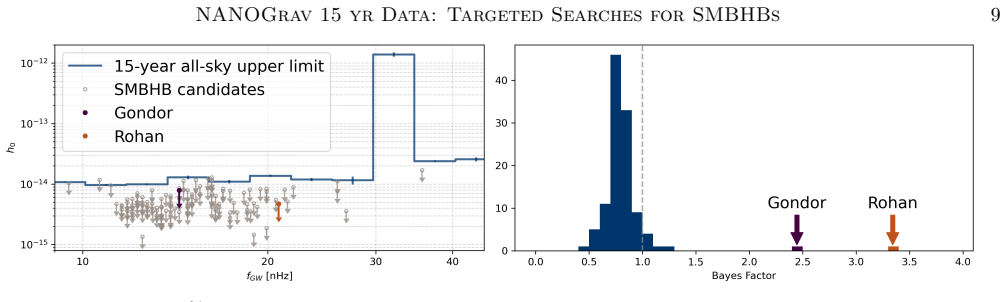
- Strain and chirp mass upper limits improve by a typical factor of two compared to untargeted searches at the same frequency.
- The data disfavor continuous wave signals from all 114 targets, with an average Bayes factor of 0.73.
- Two marginal candidates are ruled out as signals after coherence tests and trials factor correction.
- Part of the previously allowed parameter space for a binary in 3C 66B is excluded.
- Procedures are defined for validating future candidate signals in targeted searches.
Where Pith is reading between the lines
- Combining gravitational wave searches with targeted electromagnetic candidates could accelerate the first multimessenger detection of a supermassive black hole binary.
- Refinements in electromagnetic selection of plausible binary hosts would further boost the power of future targeted analyses.
- Longer pulsar timing baselines or more sensitive arrays might cross the threshold for detection if such binaries exist at the amplitudes allowed by current limits.
Load-bearing premise
The electromagnetic priors on sky location, distance, redshift, and continuous wave frequency for the 114 targets are accurate and the targets are plausible hosts for binaries emitting in the pulsar timing array frequency band.
What would settle it
A high-significance continuous wave detection from one of the targets that survives coherence tests, random targeting checks, and the trials factor correction would indicate the presence of a signal and falsify the no-detection conclusion.
Figures




read the original abstract
We present the first targeted searches for continuous gravitational waves (CWs) from 114 active galactic nuclei (AGN) that may host supermassive black hole binaries, using the NANOGrav 15 yr data set. By incorporating electromagnetic priors on sky location, distance, redshift, and CW frequency, our strain and chirp mass upper limits are typically improved by a factor of $\sim 2$ (median 2.2) relative to all-sky limits at the same frequency. Bayesian comparisons against a model including only a Hellings-Downs correlated background disfavors a CW signal for all targets, with a mean Bayes factor of $0.73 \pm 0.32$. Two targets have Bayes factors slightly above unity, but coherence tests, random targeting experiments, and a conservative accounting of the 114-target trials factor all indicate that they are consistent with noise. We use these two candidates as worked examples to illustrate an end-to-end targeted CW search analysis and a suite of follow up tests that future promising candidates would need to pass. We find that the electromagnetic interpretations of both candidates are ambiguous, and we update the constraints on a putative binary in 3C 66B, ruling out part of its previously allowed parameter space. Ultimately, our results demonstrate the current sensitivity of targeted pulsar timing array searches for CWs and define a roadmap for future multimessenger CW detections.
Editorial analysis
A structured set of objections, weighed in public.
Referee Report
Summary. The manuscript reports the first targeted searches for continuous gravitational waves (CWs) from 114 active galactic nuclei (AGN) using the NANOGrav 15 yr pulsar timing array data set. Electromagnetic priors on sky location, distance, redshift, and CW frequency are folded into the analysis, yielding strain and chirp-mass upper limits improved by a median factor of 2.2 relative to all-sky searches at the same frequencies. Bayesian model comparisons against a Hellings-Downs correlated background-only model produce a mean Bayes factor of 0.73 ± 0.32 disfavoring a CW signal for every target. Two targets with Bayes factors slightly above unity are shown to be consistent with noise after coherence tests, random-targeting experiments, and a conservative 114-target trials-factor correction. Updated constraints are placed on a putative binary in 3C 66B, and the work outlines a roadmap for future multimessenger CW detections.
Significance. If the results hold, the paper is significant for demonstrating how electromagnetic priors can tighten continuous-wave limits in pulsar-timing data by a factor of ~2 and for establishing a statistically rigorous null-result framework that includes coherence tests and look-elsewhere corrections. Credit is given for the end-to-end analysis of two marginal candidates and for the use of the public NANOGrav 15 yr data set with reproducible Bayesian methods. The work supplies both current sensitivity benchmarks and a practical template for future targeted searches.
major comments (2)
- [§3] §3 (targeted-search likelihood): The electromagnetic priors on sky location, distance, redshift, and CW frequency are incorporated directly into the likelihood. The manuscript does not present a sensitivity analysis showing how plausible uncertainties or systematic offsets in these priors (e.g., errors in AGN redshift or orbital-period estimates) propagate into the reported Bayes factors and strain upper limits. Because the priors are load-bearing for both the factor-of-2 improvement and the mean BF = 0.73 ± 0.32, such a test is required to confirm the conclusions are robust.
- [§5.2] §5.2 (coherence and random-targeting tests): For the two targets with BF > 1, the coherence statistic and the random-targeting procedure are used to conclude consistency with noise. The text does not supply the explicit definition of the coherence statistic or the exact number and distribution of random trials performed; without these details the claim that the candidates survive the trials-factor correction cannot be independently verified.
minor comments (2)
- [Figure 2] Figure 2 and associated text: The caption should explicitly state the frequency band over which the median improvement factor of 2.2 is computed and whether the factor applies to strain or chirp-mass limits.
- [Table 1] Table 1: The column listing the electromagnetic priors should include a reference or footnote for each source of the sky-location, distance, and frequency priors so that readers can assess their provenance.
Simulated Author's Rebuttal
We thank the referee for their careful reading of the manuscript and for providing insightful comments that will help strengthen our presentation. We respond to each major comment below and indicate the revisions we have made or plan to make in the updated version of the paper.
read point-by-point responses
-
Referee: [§3] §3 (targeted-search likelihood): The electromagnetic priors on sky location, distance, redshift, and CW frequency are incorporated directly into the likelihood. The manuscript does not present a sensitivity analysis showing how plausible uncertainties or systematic offsets in these priors (e.g., errors in AGN redshift or orbital-period estimates) propagate into the reported Bayes factors and strain upper limits. Because the priors are load-bearing for both the factor-of-2 improvement and the mean BF = 0.73 ± 0.32, such a test is required to confirm the conclusions are robust.
Authors: We agree with the referee that demonstrating the robustness of our results to uncertainties in the electromagnetic priors is important. In the revised manuscript, we will add a sensitivity analysis in Section 3. This will involve perturbing the priors (e.g., varying redshifts within their 1σ uncertainties from the literature, and orbital periods by factors consistent with measurement errors) and recomputing the Bayes factors and upper limits for a subset of targets. We will report the median change in the improvement factor and show that the mean Bayes factor remains below unity. This addition will confirm that our conclusions are not sensitive to reasonable prior variations. revision: yes
-
Referee: [§5.2] §5.2 (coherence and random-targeting tests): For the two targets with BF > 1, the coherence statistic and the random-targeting procedure are used to conclude consistency with noise. The text does not supply the explicit definition of the coherence statistic or the exact number and distribution of random trials performed; without these details the claim that the candidates survive the trials-factor correction cannot be independently verified.
Authors: We appreciate this comment and acknowledge that additional details are needed for full reproducibility. In the revised manuscript, we will explicitly define the coherence statistic in §5.2 as the difference in log-likelihood between a model with phase-coherent signals across all pulsars and an incoherent model. We will also specify that we performed 10,000 random-targeting trials for each of the two candidates, sampling from the same frequency range and sky distribution as the original targets, and provide the resulting distribution of Bayes factors (showing that the observed values are consistent with the tail of the noise distribution). These details will allow independent verification of the trials-factor correction. revision: yes
Circularity Check
Targeted CW search derives Bayes factors and limits directly from PTA likelihoods and external EM priors with no self-referential reductions
full rationale
The paper conducts a standard Bayesian analysis of NANOGrav 15 yr timing residuals for 114 AGN targets, folding in independent electromagnetic priors on sky location, distance, redshift, and frequency to compute strain upper limits and Bayes factors against a Hellings-Downs background-only model. The mean BF of 0.73 and the updated 3C 66B constraints follow from direct likelihood evaluations and coherence tests on the data; no equation reduces the reported evidence ratios or limits to quantities fitted or defined within the same analysis. Prior NANOGrav results on the background are cited as external input rather than load-bearing self-justification, and the derivation remains self-contained against the observed residuals and separate EM observations.
Axiom & Free-Parameter Ledger
axioms (1)
- domain assumption The Hellings-Downs correlation pattern accurately describes the stochastic gravitational wave background against which continuous-wave signals are tested.
Lean theorems connected to this paper
-
IndisputableMonolith/Foundation/RealityFromDistinction.leanreality_from_one_distinction unclear?
unclearRelation between the paper passage and the cited Recognition theorem.
Bayesian comparisons against a model including only a Hellings-Downs correlated background disfavors a CW signal... mean Bayes factor of 0.73 ± 0.32
-
IndisputableMonolith/Foundation/AlphaCoordinateFixation.leanalpha_pin_under_high_calibration unclear?
unclearRelation between the paper passage and the cited Recognition theorem.
incorporating electromagnetic priors on sky location, distance, redshift, and CW frequency
What do these tags mean?
- matches
- The paper's claim is directly supported by a theorem in the formal canon.
- supports
- The theorem supports part of the paper's argument, but the paper may add assumptions or extra steps.
- extends
- The paper goes beyond the formal theorem; the theorem is a base layer rather than the whole result.
- uses
- The paper appears to rely on the theorem as machinery.
- contradicts
- The paper's claim conflicts with a theorem or certificate in the canon.
- unclear
- Pith found a possible connection, but the passage is too broad, indirect, or ambiguous to say the theorem truly supports the claim.
Forward citations
Cited by 5 Pith papers
-
Gravity Echoes from Supermassive Black Hole Binaries
Future microhertz detections combined with nanohertz pulsar terms can serve as gravity echoes to measure supermassive black hole binary inspiral rates from hundreds to thousands of years in the past.
-
Scalable continuous gravitational wave detection in PTA data with non-parametric red noise suppression and optimal pulsar selection
A frequentist CGW search method with non-parametric red noise suppression and optimal pulsar selection achieves Bayesian-comparable accuracy on NANOGrav-based simulations at far lower computational cost.
-
Finding Supermassive Black Hole Binary Mergers in Pulsar Timing Array Data
A complete SMBHB waveform model enables unified PTA searches for mergers and memory signals, with parameter recovery shown on simulated data for 10^8-10^10 solar mass systems.
-
Expectations for the first supermassive black-hole binary resolved by PTAs II: Milestones for binary characterization
Simulations of continuous-wave searches show that PTA data first constrain GW frequency and strain amplitude together, then sky location, with chirp mass and inclination following later for evolving sources, with prec...
-
Gauge-independent Gravitational Waves from Cogenesis in a $B-L$ Conserving Universe
In a B-L conserving SM extension with U(1)_x dark sector, CP-violating Yukawas generate opposite lepton asymmetries in visible and hidden sectors that sphalerons convert to baryon asymmetry, with gauge-independent bub...
Reference graph
Works this paper leans on
-
[1]
doi:10.3847/2041-8213/acdac6 , keywords =
Agazie, G., Anumarlapudi, A., Archibald, A. M., et al. 2023a, ApJL, 951, L8, doi: 10.3847/2041-8213/acdac6
-
[2]
The NANOGrav 15 yr Data Set: Observations and Timing of 68 Millisecond Pulsars
Agazie, G., Alam, M. F., Anumarlapudi, A., et al. 2023b, ApJL, 951, L9, doi: 10.3847/2041-8213/acda9a NANOGrav 15 yr Data: Targeted Searches for SMBHBs 29
-
[3]
Agazie, G., Anumarlapudi, A., Archibald, A. M., et al. 2023c, ApJL, 951, L50, doi: 10.3847/2041-8213/ace18a
-
[4]
Agazie, G., Anumarlapudi, A., Archibald, A. M., et al. 2023, The Astrophysical Journal Letters, 956, L3, doi: 10.3847/2041-8213/acf4fd
-
[5]
Agazie, G., Anumarlapudi, A., Archibald, A. M., et al. 2023, ApJL, 951, L10, doi: 10.3847/2041-8213/acda88
-
[6]
Agazie, G., Arzoumanian, Z., Baker, P. T., et al. 2024, ApJ, 963, 144, doi: 10.3847/1538-4357/ad1f61
-
[7]
Agazie, G., Anumarlapudi, A., Archibald, A. M., et al. 2025, ApJ, 978, 31, doi: 10.3847/1538-4357/ad93d5
-
[8]
Aggarwal, K., Arzoumanian, Z., Baker, P. T., et al. 2019, ApJ, 880, 116, doi: 10.3847/1538-4357/ab2236
-
[9]
Alam, M. F., Arzoumanian, Z., Baker, P. T., et al. 2021, ApJS, 252, 5, doi: 10.3847/1538-4365/abc6a1
-
[10]
Allen, B., & Ottewill, A. C. 1997, PhRvD, 56, 545, doi: 10.1103/PhysRevD.56.545
-
[11]
Living Reviews in Relativity , keywords =
Amaro-Seoane, P., Andrews, J., Arca Sedda, M., et al. 2023, Living Reviews in Relativity, 26, 2, doi: 10.1007/s41114-022-00041-y
-
[12]
2016, ApJ, 821, 13, doi: 10.3847/0004-637X/821/1/13
Arzoumanian, Z., Brazier, A., Burke-Spolaor, S., et al. 2016, ApJ, 821, 13, doi: 10.3847/0004-637X/821/1/13
-
[13]
Arzoumanian, Z., Baker, P. T., Brazier, A., et al. 2018, ApJ, 859, 47, doi: 10.3847/1538-4357/aabd3b —. 2020, ApJ, 900, 102, doi: 10.3847/1538-4357/ababa1
-
[14]
Arzoumanian, Z., Baker, P. T., Blecha, L., et al. 2023, ApJL, 951, L28, doi: 10.3847/2041-8213/acdbc7
-
[15]
2016, MNRAS, 455, 1665, doi: 10.1093/mnras/stv2092
Babak, S., Petiteau, A., Sesana, A., et al. 2016, MNRAS, 455, 1665, doi: 10.1093/mnras/stv2092
-
[16]
2023, PhRvD, 108, 103034, doi: 10.1103/PhysRevD.108.103034
Barausse, E., Dey, K., Crisostomi, M., et al. 2023, PhRvD, 108, 103034, doi: 10.1103/PhysRevD.108.103034
-
[17]
Bardati, J., Ruan, J. J., Haggard, D., & Tremmel, M. 2024a, ApJ, 961, 34, doi: 10.3847/1538-4357/ad055a
-
[18]
2024b, ApJ, 977, 265, doi: 10.3847/1538-4357/ad9471 B´ ecsy, B
Horlaville, P. 2024b, ApJ, 977, 265, doi: 10.3847/1538-4357/ad9471 B´ ecsy, B. 2024, Classical and Quantum Gravity, 41, 225017, doi: 10.1088/1361-6382/ad84b0 B´ ecsy, B., Cornish, N. J., Petrov, P., et al. 2025, arXiv e-prints, arXiv:2502.18114, doi: 10.48550/arXiv.2502.18114
-
[19]
Begelman, M. C., Blandford, R. D., & Rees, M. J. 1980, Nature, 287, 307, doi: 10.1038/287307a0 Bogdanovi´ c, T., Miller, M. C., & Blecha, L. 2022, Living Reviews in Relativity, 25, 3, doi: 10.1007/s41114-022-00037-8
-
[20]
Bondi, M., & P´ erez-Torres, M. A. 2010, ApJL, 714, L271, doi: 10.1088/2041-8205/714/2/L271
-
[21]
Boroson, T. A., & Lauer, T. R. 2009, Nature, 458, 53, doi: 10.1038/nature07779
-
[22]
2021, ApJ, 914, 37, doi: 10.3847/1538-4357/abfa9a
Breiding, P., Burke-Spolaor, S., Eracleous, M., et al. 2021, ApJ, 914, 37, doi: 10.3847/1538-4357/abfa9a
-
[23]
2023, ApJ, 951, 106, doi: 10.3847/1538-4357/accbbc
Britzen, S., Zajaˇ cek, M., Gopal-Krishna, et al. 2023, ApJ, 951, 106, doi: 10.3847/1538-4357/accbbc
-
[24]
Burke-Spolaor, S., Taylor, S. R., Charisi, M., et al. 2019, A&A Rv, 27, 5, doi: 10.1007/s00159-019-0115-7
-
[25]
Burt, B. J., Lommen, A. N., & Finn, L. S. 2011, ApJ, 730, 17, doi: 10.1088/0004-637X/730/1/17
-
[26]
Casey-Clyde, J. A., Mingarelli, C. M. F., Greene, J. E., et al. 2025, The Astrophysical Journal, 987, 106, doi: 10.3847/1538-4357/adce05
-
[27]
Casey-Clyde, J. A., Mingarelli, C. M. F., Greene, J. E., et al. 2022, ApJ, 924, 93, doi: 10.3847/1538-4357/ac32de
-
[28]
2022, MNRAS, 509, 5538, doi: 10.1093/mnras/stab3283
Chalumeau, A., Babak, S., Petiteau, A., et al. 2022, MNRAS, 509, 5538, doi: 10.1093/mnras/stab3283
-
[29]
Charisi, M., Haiman, Z., Schiminovich, D., & D’Orazio, D. J. 2018, MNRAS, 476, 4617, doi: 10.1093/mnras/sty516
-
[30]
Trump, J. R. 2022, MNRAS, 510, 5929, doi: 10.1093/mnras/stab3713
-
[31]
Chen, S., Sesana, A., & Conselice, C. J. 2019, MNRAS, 488, 401, doi: 10.1093/mnras/stz1722
-
[32]
Chornock, R., Bloom, J. S., Cenko, S. B., et al. 2010, ApJL, 709, L39, doi: 10.1088/2041-8205/709/1/L39
-
[33]
Corbin, V., & Cornish, N. J. 2010, arXiv e-prints, arXiv:1008.1782, doi: 10.48550/arXiv.1008.1782
work page internal anchor Pith review Pith/arXiv arXiv doi:10.48550/arxiv.1008.1782 2010
-
[34]
Davis, M. C., Grace, K. E., Trump, J. R., et al. 2024, ApJ, 965, 34, doi: 10.3847/1538-4357/ad276e de la Parra, P. V., Kiehlmann, S., Mr´ oz, P., et al. 2025, ApJ, 987, 191, doi: 10.3847/1538-4357/addc60
-
[35]
2009, ApJL, 703, L76, doi: 10.1088/0004-637X/703/1/L76
Decarli, R., Dotti, M., Falomo, R., et al. 2009, ApJL, 703, L76, doi: 10.1088/0004-637X/703/1/L76
-
[36]
Dexter, J., Lutz, D., Shimizu, T. T., et al. 2020, ApJ, 905, 33, doi: 10.3847/1538-4357/abc24f
-
[37]
Dittmann, A. J., & Ryan, G. 2024, ApJ, 967, 12, doi: 10.3847/1538-4357/ad2f1e D’Orazio, D. J., & Charisi, M. 2023, arXiv e-prints, arXiv:2310.16896, doi: 10.48550/arXiv.2310.16896 D’Orazio, D. J., & Di Stefano, R. 2018, MNRAS, 474, 2975, doi: 10.1093/mnras/stx2936 D’Orazio, D. J., Duffell, P. C., & Tiede, C. 2024, ApJ, 977, 244, doi: 10.3847/1538-4357/ad9...
-
[38]
2016, MNRAS, 459, 2379, doi: 10.1093/mnras/stw792 D’Orazio, D
Farris, B. 2016, MNRAS, 459, 2379, doi: 10.1093/mnras/stw792 D’Orazio, D. J., Haiman, Z., & Schiminovich, D. 2015, Nature, 525, 351, doi: 10.1038/nature15262 30 the NANOGrav Collaboration D’Orazio, D. J., & Loeb, A. 2018, ApJ, 863, 185, doi: 10.3847/1538-4357/aad413
-
[39]
Duffell and Daniel D'Orazio and Andrea Derdzinski and Zoltan Haiman and Andrew MacFadyen and Anna L
Duffell, P. C., D’Orazio, D., Derdzinski, A., et al. 2020, ApJ, 901, 25, doi: 10.3847/1538-4357/abab95 EPTA Collaboration, InPTA Collaboration, Antoniadis, J., et al. 2023, A&A, 678, A50, doi: 10.1051/0004-6361/202346844
-
[40]
Eracleous, M., Boroson, T. A., Halpern, J. P., & Liu, J. 2012, ApJS, 201, 23, doi: 10.1088/0067-0049/201/2/23 Event Horizon Telescope Collaboration, Akiyama, K.,
-
[41]
First M87 Event Horizon Telescope Results
Alberdi, A., et al. 2019, ApJL, 875, L1, doi: 10.3847/2041-8213/ab0ec7
-
[42]
Farris and Paul Duffell and Andrew I
Farris, B. D., Duffell, P., MacFadyen, A. I., & Haiman, Z. 2014, ApJ, 783, 134, doi: 10.1088/0004-637X/783/2/134
-
[43]
2025, A&A, 694, A194, doi: 10.1051/0004-6361/202451809
Ferranti, I., Shaifullah, G., Chalumeau, A., & Sesana, A. 2025, A&A, 694, A194, doi: 10.1051/0004-6361/202451809
-
[44]
Gardiner, E. C., Kelley, L. Z., Lemke, A.-M., & Mitridate, A. 2024, ApJ, 965, 164, doi: 10.3847/1538-4357/ad2be8
-
[45]
Gaskell, C. M. 1984, Annals of the New York Academy of Sciences, 422, 349, doi: 10.1111/j.1749-6632.1984.tb23380.x —. 2010, Nature, 463, E1, doi: 10.1038/nature08665
-
[46]
Goldstein, J. M., Sesana, A., Holgado, A. M., & Veitch, J. 2019, MNRAS, 485, 248, doi: 10.1093/mnras/stz420
-
[47]
Graham, M. J., Djorgovski, S. G., Stern, D., et al. 2015, MNRAS, 453, 1562, doi: 10.1093/mnras/stv1726 GRAVITY Collaboration, Abuter, R., Amorim, A., et al. 2021, A&A, 647, A59, doi: 10.1051/0004-6361/202040208
-
[48]
Greene, J. E., & Ho, L. C. 2005, ApJ, 630, 122, doi: 10.1086/431897
work page internal anchor Pith review doi:10.1086/431897 2005
-
[49]
Grunthal, K., Nathan, R. S., Thrane, E., et al. 2025, MNRAS, 536, 1501, doi: 10.1093/mnras/stae2573
-
[50]
2020, MNRAS, 492, 2910, doi: 10.1093/mnras/stz3566
Guo, H., Liu, X., Zafar, T., & Liao, W.-T. 2020, MNRAS, 492, 2910, doi: 10.1093/mnras/stz3566
-
[51]
Butcher, H. R. 1981, ApJ, 247, 403, doi: 10.1086/159050
-
[52]
Hincks, A. D., Ma, X., Naess, S. K., et al. 2025, arXiv e-prints, arXiv:2504.04278, doi: 10.48550/arXiv.2504.04278
-
[53]
Ho, L. C., & Kim, M. 2015, ApJ, 809, 123, doi: 10.1088/0004-637X/809/2/123
-
[54]
Horlaville, P., Ruan, J. J., Eracleous, M., et al. 2025, arXiv e-prints, arXiv:2504.21145, doi: 10.48550/arXiv.2504.21145
work page internal anchor Pith review Pith/arXiv arXiv doi:10.48550/arxiv.2504.21145 2025
-
[55]
2023, PhRvD, 107, 084045, doi: 10.1103/PhysRevD.107.084045
Hourihane, S., Meyers, P., Johnson, A., Chatziioannou, K., & Vallisneri, M. 2023, PhRvD, 107, 084045, doi: 10.1103/PhysRevD.107.084045
-
[56]
2010, ApJL, 724, L166, doi: 10.1088/2041-8205/724/2/L166
Iguchi, S., Okuda, T., & Sudou, H. 2010, ApJL, 724, L166, doi: 10.1088/2041-8205/724/2/L166
-
[57]
Jenet and Andrea Lommen and Shane L
Jenet, F. A., Lommen, A., Larson, S. L., & Wen, L. 2004, ApJ, 606, 799, doi: 10.1086/383020
-
[58]
Katz, J. I., Anderson, S. F., Margon, B., & Grandi, S. A. 1982, ApJ, 260, 780, doi: 10.1086/160297
-
[59]
Z., Haiman, Z., Sesana, A., & Hernquist, L
Kelley, L. Z., Haiman, Z., Sesana, A., & Hernquist, L. 2019, MNRAS, 485, 1579, doi: 10.1093/mnras/stz150
-
[60]
2022, Science, 376, doi: 10.1126/science.abm3231
Kerr, M., & Parthasarathy, A. 2022, Science, 376, doi: 10.1126/science.abm3231
-
[61]
Casey-Clyde, J. A., & Barnacka, A. 2023, ApJ, 955, 25, doi: 10.3847/1538-4357/ace16f
-
[62]
Kiehlmann, S., de la Parra, P. V., Sullivan, A. G., et al. 2025, ApJ, 985, 59, doi: 10.3847/1538-4357/adc567
-
[63]
Larsen, B., Mingarelli, C. M. F., Hazboun, J. S., et al. 2024, ApJ, 972, 49, doi: 10.3847/1538-4357/ad5291
-
[64]
Lauer, T. R., & Boroson, T. A. 2009, ApJ, 703, 930, doi: 10.1088/0004-637X/703/1/930
-
[65]
Lee, K. J., Wex, N., Kramer, M., et al. 2011, MNRAS, 414, 3251, doi: 10.1111/j.1365-2966.2011.18622.x
-
[66]
2019, ApJS, 243, 21, doi: 10.3847/1538-4365/ab298b
Liu, H.-Y., Liu, W.-J., Dong, X.-B., et al. 2019, ApJS, 243, 21, doi: 10.3847/1538-4365/ab298b
-
[67]
Liu, T., & Vigeland, S. J. 2021, ApJ, 921, 178, doi: 10.3847/1538-4357/ac1da9
-
[68]
2021, ApJ, 911, 45, doi: 10.3847/1538-4357/abe62f
Luo, J., Ransom, S., Demorest, P., et al. 2021, ApJ, 911, 45, doi: 10.3847/1538-4357/abe62f
-
[69]
Merritt, D., & Ekers, R. D. 2002, Science, 297, 1310, doi: 10.1126/science.1074688
-
[70]
Miles, M. T., Shannon, R. M., Reardon, D. J., et al. 2025, MNRAS, 536, 1489, doi: 10.1093/mnras/stae2571 Milosavljevi´ c, M., & Merritt, D. 2003, in American Institute of Physics Conference Series, Vol. 686, The Astrophysics of Gravitational Wave Sources, ed. J. M. Centrella (AIP), 201–210, doi: 10.1063/1.1629432
-
[71]
Mingarelli, C. M. F., Grover, K., Sidery, T., Smith, R. J. E., & Vecchio, A. 2012, PhRvL, 109, 081104, doi: 10.1103/PhysRevLett.109.081104
-
[72]
Mingarelli, C. M. F., Sidery, T., Mandel, I., & Vecchio, A. 2013, PhRvD, 88, 062005, doi: 10.1103/PhysRevD.88.062005
-
[73]
Mingarelli, C. M. F., Lazio, T. J. W., Sesana, A., et al. 2017, Nature Astronomy, 1, 886, doi: 10.1038/s41550-017-0299-6
-
[74]
Mingarelli, C. M. F., Blecha, L., Bogdanovi´ c, T., et al. 2025, Nature Astronomy, 9, 183, doi: 10.1038/s41550-025-02482-1
-
[75]
Oh, K., Yi, S. K., Schawinski, K., et al. 2015, ApJS, 219, 1, doi: 10.1088/0067-0049/219/1/1 O’Neill, S., Kiehlmann, S., Readhead, A. C. S., et al. 2022, ApJL, 926, L35, doi: 10.3847/2041-8213/ac504b NANOGrav 15 yr Data: Targeted Searches for SMBHBs 31
-
[76]
Petrov, P., Taylor, S. R., Charisi, M., & Ma, C.-P. 2024, ApJ, 976, 129, doi: 10.3847/1538-4357/ad7b14
-
[77]
Phinney, E. S. 2001, arXiv e-prints, astro, doi: 10.48550/arXiv.astro-ph/0108028
work page internal anchor Pith review Pith/arXiv arXiv doi:10.48550/arxiv.astro-ph/0108028 2001
-
[78]
Reardon and Andrew Zic and Ryan M
Reardon, D. J., Zic, A., Shannon, R. M., et al. 2023, ApJL, 951, L6, doi: 10.3847/2041-8213/acdd02
-
[79]
Reines, A. E., & Volonteri, M. 2015, ApJ, 813, 82, doi: 10.1088/0004-637X/813/2/82
-
[80]
Rosado, P. A., & Sesana, A. 2014, MNRAS, 439, 3986, doi: 10.1093/mnras/stu254
discussion (0)
Sign in with ORCID, Apple, or X to comment. Anyone can read and Pith papers without signing in.