REVIEW 7 minor 126 references
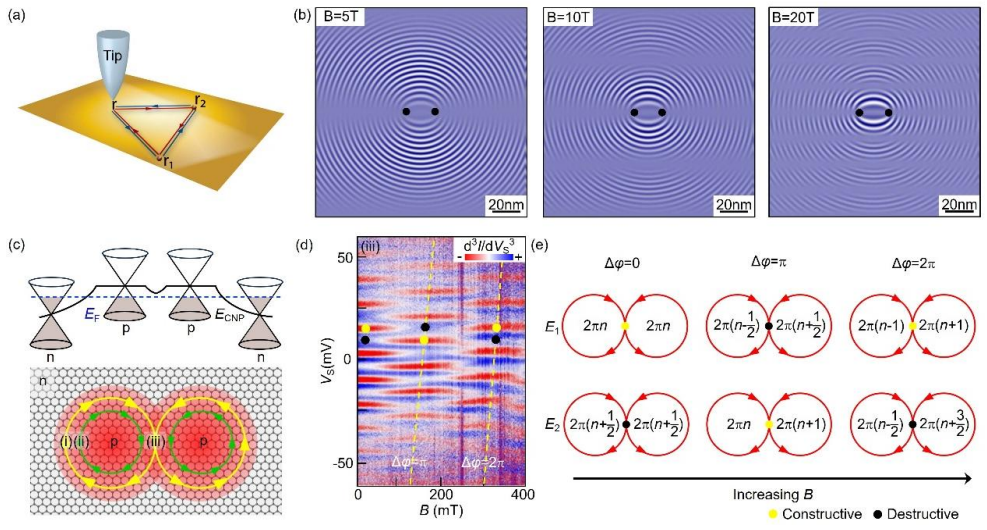
Scanning tunneling microscopy can map quantum geometric phases in real space, turning them into local observables that constrain topology and correlated order.
Reviewed by Pith at T0; open to challenge. T0 means a machine referee read the full paper against a public rubric. the ladder, T0–T4 →
STM/STS can resolve quantum geometric phases in real space via interferometry, wavefront dislocations, order-parameter decomposition, and 2D lock-in mapping of density-wave textures.
T0 review reviewed 2026-07-12 challenge →
load-bearing objection Solid, accurate review of four STM routes to real-space geometric phases; organizational value only, no new data or methods.
Probing Quantum Geometric Phases via Scanning Tunneling Microscopy
The pith
A machine-rendered reading of the paper's core claim, the machinery that carries it, and where it could break.
The reading
Core claim
Phase-resolved STM imaging translates quantum geometric phases into real-space, locally resolvable observables. Across four methodologies—Aharonov-Bohm interferometry, wavefront-dislocation analysis of Berry phase, order-parameter decomposition in moiré systems, and 2D lock-in mapping of density-wave phases—the paper argues that STM thereby supplies stringent constraints on topological order, symmetry-breaking patterns, and electronic correlations, forming a practical framework for in-situ phase engineering.
What carries the argument
Four STM-based phase-to-observable maps: (1) real-space Aharonov-Bohm interferometers formed by scatterers or artificial quantum dots; (2) counting extra wavefronts in intervalley Friedel oscillations to read the Berry phase; (3) symmetry-adapted Fourier decomposition of complex order parameters; (4) numerical 2D lock-in extraction of amplitude and phase of density-wave modulations.
Load-bearing premise
The numerical filters used to pull phase maps out of STM images (especially the 2D lock-in step) faithfully recover the physical phase textures and do not invent defects when the signal is near the noise floor.
What would settle it
In a well-characterized density-wave or graphene defect system, change the lock-in window size, cutoff, or target wave-vector by amounts comparable to experimental resolution and check whether the reported phase windings and dislocation counts remain invariant; if they flip or appear only for particular filter choices, the extracted phases are not physical.
If this is right
- Atomic-scale phase maps become a routine diagnostic that can discriminate among competing topological and correlated ground states that look identical to bulk probes.
- Defects and tip fields can be used deliberately as local phase manipulators, enabling in-situ engineering of vortices, dislocations, and intervalley order.
- The same real-space phase tools extend to transition-metal dichalcogenides, kagome lattices, and other multivalley or spin-orbit systems that host geometric phases.
- Time-resolved and Josephson STM variants can track transient phase dynamics and superconducting phase slips that are invisible to static spectroscopy.
Where Pith is reading between the lines
- Because the phase maps are post-processed, independent groups re-analyzing the same raw STM datasets with open filter codes will be needed before the method is accepted as a standard diagnostic.
- Combining spin-polarized STM with the proposed quantum-metric extraction could turn the geometric tensor itself into a routinely mappable quantity rather than a derived transport property.
- If tip-induced electric or magnetic fields can controllably write and erase phase vortices, the same platform becomes a testbed for topological information processing at the single-defect level.
Editorial analysis
A structured set of objections, weighed in public.
Referee Report
Summary. This review surveys four STM/STS methodologies for resolving quantum geometric phases in real space: (i) nanoscale interferometry of the Aharonov-Bohm phase via closed electron trajectories and magnetic-flux-dependent LDOS oscillations; (ii) extraction of the Berry phase from defect-induced intervalley quasiparticle interference and wavefront dislocations in graphene and related systems; (iii) reconstruction of complex order-parameter phases (e.g., intervalley coherent and Kekulé orders) in magic-angle twisted bilayer graphene and hydrogen-adatom graphene via Fourier filtering and C3v-adapted decomposition; and (iv) mapping of PDW/CDW phase textures and topological defects in cuprates, iron-based films, and NbSe2 with the numerical 2D lock-in technique. The manuscript synthesizes primary experimental and theoretical literature, presents the standard equations for AB phase accumulation, wavefront counting, order-parameter components, and lock-in demodulation, and concludes that phase-resolved STM supplies local constraints on topology, symmetry breaking, and correlations while enabling in-situ phase engineering.
Significance. If the synthesis holds, the paper supplies a timely, coherent map of how atomic-scale tunneling spectroscopies convert geometric and many-body phases into real-space observables. The four-paradigm organization is pedagogically useful for mesoscopic and correlated-electron communities, and the explicit Discussion caveats on filter sensitivity strengthen rather than weaken the review. Strengths include accurate restatement of primary results (AB interferometry on graphene quantum dots, wavefront dislocations confirming π Berry phase, IVC/Kekulé phase vortices, and PDW–CDW phase relations), standard equations without ad-hoc parameters, and a forward-looking outlook on time-resolved and tip-engineered phase control. As a review it does not claim new experiments or derivations, but it organizes an emerging toolkit that is already shaping interpretation of topological and PDW states.
minor comments (7)
- Introduction and §I: the AB phase difference is written both as 2πΦ/Φ0 and later as Δϕ = (e/h)∮A·dl = (e/h)ΦB; a single consistent convention (and explicit statement that the factor of 2 arises from the two counter-propagating paths) would help non-specialist readers.
- §II and Fig. 2: the transition from two wavefront dislocations (symmetric defect) to one (asymmetric defect) is clear, but a brief sentence linking the observed dislocation number to the winding of the pseudospin texture (rather than only to angular momentum 2) would tighten the Berry-phase identification.
- §III: the six complex order parameters adapted to C3v are introduced without an explicit listing or reference equation; a short table or parenthetical definition of the three IVC channels (bond, site A, site B) would improve reproducibility of the decomposition.
- §IV, lock-in formulae: the real-space Gaussian cutoff σr and reciprocal-space cutoff σq appear without recommended ranges or a note on how they are chosen relative to the moiré or CDW period; a practical remark would reduce the risk of over-filtering.
- Figures 1–4 captions are informative but dense; labeling the key wave vectors (QIVC, QPDW, 2Q) directly on the panels would aid rapid reading.
- A few typographical inconsistencies remain (e.g., “mod ern”, “conducti ng”, “s pace”, “demonstrat ed”, “superconducti vity”); a final copy-edit pass is warranted.
- References include several preprints and overlapping-author works; ensuring that primary experimental claims are always paired with the original experimental citation (in addition to any theory follow-ups) would further clarify provenance.
Circularity Check
No significant circularity: this is a methods review that synthesizes independent primary experiments and theories without deriving new predictions from its own inputs or self-referential definitions.
full rationale
The manuscript is an explicit review of four established STM methodologies (AB interferometry, wavefront-dislocation Berry-phase extraction, order-parameter decomposition, and 2D lock-in PDW/CDW phase mapping). It contains no original derivation chain, no fitted parameters that are later re-labeled as predictions, no uniqueness theorems imported from the authors’ prior work to force a conclusion, and no ansatz smuggled in as a first-principles result. All equations (e.g., the AB phase 2πΦ/Φ0, the PDW order-parameter form Δ(r)=Δ_Q e^{iQ·r}+Δ_{-Q}e^{-iQ·r}, and the 2D lock-in filter expressions) are standard textbook or previously published constructions that are merely restated for exposition. Self-citations (e.g., Yin et al. on kagome Chern magnets) appear only as illustrative examples of systems to which the reviewed techniques could be extended; they are not load-bearing for any claim. The Discussion section itself flags the numerical sensitivity of 2D lock-in filtering, confirming that the authors do not treat post-processed phase maps as raw observables. Consequently the paper’s synthesis claim—that phase-resolved STM supplies real-space constraints on topology and correlations—rests entirely on the cited external literature and is free of circular reduction.
Axiom & Free-Parameter Ledger
axioms (3)
- domain assumption Differential conductance dI/dV maps the local density of states (Tersoff-Hamann approximation).
- domain assumption Intervalley scattering in graphene produces a √3×√3 R30° modulation whose wavefront dislocations count pseudospin winding.
- domain assumption The complex amplitude extracted by 2D lock-in filtering of an STM map at wavevector Q yields the physical phase texture of the corresponding density-wave order.
Cite this review
Pith. "Pith review of Probing Quantum Geometric Phases via Scanning Tunneling Microscopy." pith.science (2026). https://pith.science/paper/Z55YVRIT
@misc{pith2026260629564,
  author       = {Pith},
  title        = {Pith review of: Probing Quantum Geometric Phases via Scanning Tunneling Microscopy},
  year         = {2026},
  howpublished = {\url{https://pith.science/paper/Z55YVRIT}},
  note         = {Machine review of arXiv:2606.29564}
}
read the original abstract
The quantum geometric phase intrinsically dictates the geometry, topology, and many-body correlations of electronic wave functions. While quantum geometric phases are conventionally inferred through momentum-space probes or macroscopic transport measurements, their direct visualization and quantification in real space have historically been restricted by the spatial averaging of bulk techniques. Scanning tunneling microscopy and spectroscopy (STM/STS) circumvent this limitation, leveraging atomic-scale spatial resolution and high energy sensitivity to resolve local electronic phase profiles directly. This review highlights recent progress across four representative methodologies: probing the Aharonov-Bohm (AB) geometric phase via nanoscale real space interferometry; extracting the Berry phase from defect-induced quasiparticle interference and wavefront dislocations; reconstructing the complex phase structure in symmetric systems, such as magic-angle graphene, using order parameter decomposition; and mapping the phase textures and topological defects of pair density wave (PDW) and charge density wave (CDW) in unconventional superconductors utilizing the numerical 2D lock-in technique. Together, these developments show how quantum phases can be translated onto real space and locally resolvable observables. Phase-resolved STM imaging provides stringent constraints on topological states of matter, symmetry-breaking patterns, and strong electronic correlations, outlining a robust framework for in situ phase engineering in quantum materials.
Figures



Reference graph
Works this paper leans on
-
[1]
& Weibel, E
Binnig, G., Rohrer, H., Gerber, Ch. & Weibel, E. Surface Studies by Scanning Tunneling Microscopy. Phys. Rev. Lett. 49, 57-61 (1982)
1982
-
[2]
& Hamann, D
Tersoff, J. & Hamann, D. R. Theory of the scanning tunneling microscope. Phys. Rev. B 31, 805- 813 (1985)
1985
-
[3]
& Rohrer, H
Binnig, G. & Rohrer, H. Scanning tunneling microscopy -from birth to adolescence. Rev. Mod. Phys. 59, 615-625 (1987)
1987
-
[4]
& Bohm, D
Aharonov, Y . & Bohm, D. Significance of Electromagnetic Potentials in the Quantum Theory. Phys. Rev. 115, 485-491 (1959)
1959
-
[5]
Tonomura, A. et al. Observation of Aharonov-Bohm Effect by Electron Holography. Phys. Rev. Lett. 48, 1443-1446 (1982)
1982
-
[6]
J., Wind, S
Chandrasekhar, V ., Rooks, M. J., Wind, S. & Prober, D. E. Observation of Aharonov -Bohm Electron Interference Effects with Periods h/e and h/2e in Individual Micron-Size, Normal-Metal Rings. Phys. Rev. Lett. 55, 1610-1613 (1985)
1985
-
[7]
& Laibowitz, R
Webb, R., Washburn, S., Umbach, C. & Laibowitz, R. Observation of h/e Aharonov-Bohm Oscillations in Normal-Metal Rings. Phys. Rev. Lett 54, 2696-2699 (1985)
1985
-
[8]
& Webb, R
Washburn, S., Schmid, H., Kern, D. & Webb, R. A. Normal -metal Aharonov-Bohm effect in the presence of a transverse electric field. Phys. Rev. Lett. 59, 1791 (1987)
1987
-
[9]
H., Nazarov, Y
van Oudenaarden, A., Devoret, M. H., Nazarov, Y . V . & Mooij, J. E. Magneto-electric Aharonov- Bohm effect in metal rings. Nature 391, 768-770 (1998)
1998
-
[10]
Hackens, B. et al. Imaging and controlling electron transport inside a quantum ring. Nature Phys 2, 826-830 (2006)
2006
-
[11]
Peng, H. et al. Aharonov-Bohm interference in topological insulator nanoribbons. Nature Mater 9, 225-229 (2010)
2010
-
[12]
Cho, S. et al. Aharonov-Bohm oscillations in a quasi -ballistic three -dimensional topological insulator nanowire. Nat Commun 6, 7634 (2015)
2015
-
[13]
Xu, S. G. et al. Giant oscillations in a triangular network of one -dimensional states in marginally twisted graphene. Nat Commun 10, 4008 (2019)
2019
-
[14]
Ronen, Y . et al. Aharonov-Bohm effect in graphene -based Fabry -Pérot quantum Hall interferometers. Nat. Nanotechnol. 16, 563-569 (2021)
2021
-
[15]
Guo, C. et al. Many-body interference in kagome crystals. Nature 647, 68-73 (2025)
2025
-
[16]
& Paul, I
Cano, A. & Paul, I. Aharonov -Bohm oscillations in the local density of states. Phys. Rev. B 80, 153401 (2009)
2009
-
[17]
de Juan, F., Cortijo, A., V ozmediano, M. A. H. & Cano, A. Aharonov -Bohm interferences from local deformations in graphene. Nature Phys 7, 810-815 (2011)
2011
-
[18]
Fu, Z.-G., Zhang, P. & Li, S. -S. Aharonov-Bohm oscillations in the local density of topological surface states. Appl. Phys. Lett. 99, 243110 (2011)
2011
-
[19]
-G., Zhang, P
Fu, Z. -G., Zhang, P. & Li, S. -S. Probing crossover from analogous weak antilocalization to localization by an Aharonov -Bohm interferometer on topological insulator surface. Appl. Phys. Lett. 100, 133103 (2012)
2012
-
[20]
Ge, Z. et al. Giant orbital magnetic moments and paramagnetic shift in artificial relativistic atoms and molecules. Nat. Nanotechnol. 18, 250-256 (2023)
2023
-
[21]
Yoffe, A. D. Low -dimensional systems: quantum size effects and electronic properties of semiconductor microcrystallites (zero -dimensional systems) and some quasi -two-dimensional systems. Advances in Physics 42, 173-262 (1993)
1993
-
[22]
Ashoori, R. C. Electrons in artificial atoms. Nature 379, 413-419 (1996)
1996
-
[23]
Reimann, S. M. & Manninen, M. Electronic structure of quantum dots. Rev. Mod. Phys. 74, 1283- 1342 (2002). 17
2002
-
[24]
Li, S.-Y . & He, L. Recent progresses of quantum confinement in graphene quantum dots. Front. Phys. 17, 33201 (2022)
2022
-
[25]
Fu, Z.-Q. et al. Relativistic Artificial Molecules Realized by Two Coupled Graphene Quantum Dots. Nano Lett. 20, 6738-6743 (2020)
2020
-
[26]
Zheng, Q. et al. Molecular Collapse States in Graphene/WSe 2 Heterostructure Quantum Dots. Phys. Rev. Lett. 130, 076202 (2023)
2023
-
[27]
Zhou, X.-F. et al. Relativistic artificial molecule of two coupled graphene quantum dots at tunable distances. Nat Commun 15, 8786 (2024)
2024
-
[28]
Liu, Y .-W., Ren, Y .-N., Hao, C. -Y . & He, L. Direct observation of magneto -electric Aharonov- Bohm effect in moiré -scale quantum paths of minimally twisted bilayer graphene. Preprint at https://doi.org/10.48550/arXiv.2102.00164 (2021)
-
[29]
Novoselov, K. S. et al. Two-dimensional gas of massless Dirac fermions in graphene. Nature 438, 197–200 (2005)
2005
-
[30]
Zhang, Y ., Tan, Y .-W., Stormer, H. L. & Kim, P. Experimental observation of the quantum Hall effect and Berry’s phase in graphene. Nature 438, 201-204 (2005)
2005
-
[31]
H., Guinea, F., Peres, N
Castro Neto, A. H., Guinea, F., Peres, N. M. R., Novoselov, K. S. & Geim, A. K. The electronic properties of graphene. Rev. Mod. Phys. 81, 109-162 (2009)
2009
-
[32]
Novoselov, K. S. et al. Unconventional quantum Hall effect and Berry’s phase of 2 π in bilayer graphene. Nature Phys 2, 177-180 (2006)
2006
-
[33]
F., Zhang, Y
Young, A. F., Zhang, Y . & Kim, P. Experimental Manifestation of Berry Phase in Graphene. in Physics of Graphene (eds Aoki, H. & S. Dresselhaus, M.) 3-27 (Springer International Publishing, Cham, 2014)
2014
-
[34]
Ghahari, F. et al. An on/off Berry phase switch in circular graphene resonators. Science 356, 845- 849 (2017)
2017
-
[35]
Pan, W. et al. Berry phase and anomalous transport of the composite fermions at the half -filled Landau level. Nature Phys 13, 1168-1172 (2017)
2017
-
[36]
Hou, Z., Zhou, Y .-F., Xie, X. C. & Sun, Q.-F. Berry phase induced valley level crossing in bilayer graphene quantum dots. Phys. Rev. B 99, 125422 (2019)
2019
-
[37]
Liu, Y .-W., Hou, Z., Li, S.-Y ., Sun, Q.-F. & He, L. Movable Valley Switch Driven by Berry Phase in Bilayer-Graphene Resonators. Phys. Rev. Lett. 124, 166801 (2020)
2020
-
[38]
Ren, Y .-N., Cheng, Q., Sun, Q.-F. & He, L. Realizing Valley-Polarized Energy Spectra in Bilayer Graphene Quantum Dots via Continuously Tunable Berry Phases. Phys. Rev. Lett. 128, 206805 (2022)
2022
-
[39]
Rutter, G. M. et al. Scattering and Interference in Epitaxial Graphene. Science 317, 219-222 (2007)
2007
-
[40]
Brihuega, I. et al. Quasiparticle Chirality in Epitaxial Graphene Probed at the Nanometer Scale. Phys. Rev. Lett. 101, 206802 (2008)
2008
-
[41]
Mallet, P. et al. Role of pseudospin in quasiparticle interferences in epitaxial graphene probed by high-resolution scanning tunneling microscopy. Phys. Rev. B 86, 045444 (2012)
2012
-
[42]
Nye, J. F. & Berry, M. V . Dislocations in wave trains. Proc. A 336, 165-190 (1974)
1974
-
[43]
Dutreix, C. et al. Measuring the Berry phase of graphene from wavefront dislocations in Friedel oscillations. Nature 574, 219-222 (2019)
2019
-
[44]
Liu, Y .-W. et al. Visualizing a single wavefront dislocation induced by orbital angular momentum in graphene. Nat Commun 15, 3546 (2024)
2024
-
[45]
Zhang, Y ., Su, Y . & He, L. Quantum Interferences of Pseudospin-Mediated Atomic-Scale V ortices in Monolayer Graphene. Nano Lett. 21, 2526-2531 (2021)
2021
-
[46]
Zhang, M. -H. et al. Atomic-level precision creation and manipulation of interfacial Se chemisorbates in graphene/WSe2 heterostructures. Phys. Rev. B 110, L041405 (2024)
2024
-
[47]
& Yang, W
Zhang, S.-H., Yang, J., Shao, D.-F., Wu, Z. & Yang, W. Robust wavefront dislocations of Friedel oscillations in gapped graphene. Phys. Rev. B 103, L161407 (2021). 18
2021
-
[48]
& Chang, K
Zhang, S.-H., Yang, J., Shao, D.-F., Yang, W. & Chang, K. Geometric wavefront dislocations of RKKY interaction in graphene. Phys. Rev. B 104, 245405 (2021)
2021
-
[49]
& Yang, W
Yang, J., Zhang, S.-H. & Yang, W. Wavefronts Dislocations of Friedel Oscillations in Graphene: Trigonal Warping Effect. physica status solidi (RRL) - Rapid Research Letters 18, 2300378 (2024)
2024
-
[50]
& Marzari, N
Park, C.-H. & Marzari, N. Berry phase and pseudospin winding number in bilayer graphene. Phys. Rev. B 84, 205440 (2011)
2011
-
[51]
Yin, L.-J., Li, S.-Y ., Qiao, J.-B., Nie, J.-C. & He, L. Landau quantization in graphene monolayer, Bernal bilayer, and Bernal trilayer on graphite surface. Phys. Rev. B 91, 115405 (2015)
2015
-
[52]
Yin, L.-J., Jiang, H., Qiao, J. -B. & He, L. Direct imaging of topological edge states at a bilayer graphene domain wall. Nat Commun 7, 11760 (2016)
2016
-
[53]
Yang, G., Li, L., Lee, W. B. & Ng, M. C. Structure of graphene and its disorders: a review. Science and Technology of Advanced Materials 19, 613-648 (2018)
2018
-
[54]
Yan, C., Zhao, Y .-X., Liu, Y .-W. & He, L. Kinetics of Nanobubbles in Tiny-Angle Twisted Bilayer Graphene. Nano Lett. 23, 8532-8538 (2023)
2023
-
[55]
Zhang, Y ., Su, Y . & He, L. Local Berry Phase Signatures of Bilayer Graphene in Intervalley Quantum Interference. Phys. Rev. Lett. 125, 116804 (2020)
2020
-
[56]
Cao, Y . et al. Correlated insulator behaviour at half-filling in magic-angle graphene superlattices. Nature 556, 80-84 (2018)
2018
-
[57]
Cao, Y . et al. Unconventional superconductivity in magic-angle graphene superlattices. Nature 556, 43-50 (2018)
2018
-
[58]
Yankowitz, M. et al. Tuning superconductivity in twisted bilayer graphene. Science 363, 1059- 1064 (2019)
2019
-
[59]
Lu, X. et al. Superconductors, orbital magnets and correlated states in magic -angle bilayer graphene. Nature 574, 653-657 (2019)
2019
-
[60]
Sharpe, A. L. et al. Emergent ferromagnetism near three -quarters filling in twisted bilayer graphene. Science 365, 605-608 (2019)
2019
-
[61]
Kerelsky, A. et al. Maximized electron interactions at the magic angle in twisted bilayer graphene. Nature 572, 95-100 (2019)
2019
-
[62]
Choi, Y . et al. Electronic correlations in twisted bilayer graphene near the magic angle. Nat. Phys. 15, 1174-1180 (2019)
2019
-
[63]
Xie, Y . et al. Spectroscopic signatures of many -body correlations in magic -angle twisted bilayer graphene. Nature 572, 101-105 (2019)
2019
-
[64]
Jiang, Y . et al. Charge order and broken rotational symmetry in magic -angle twisted bilayer graphene. Nature 573, 91-95 (2019)
2019
-
[65]
Wong, D. et al. Cascade of electronic transitions in magic-angle twisted bilayer graphene. Nature 582, 198-202 (2020)
2020
-
[66]
N., Zhang, Y ., Liu, Y
Ren, Y . N., Zhang, Y ., Liu, Y . W. & He, L. Twistronics in graphene-based van der Waals structures. Chin. Phys. B 29, 117303 (2020)
2020
-
[67]
Andrei, E. Y . et al. The marvels of moiré materials. Nat Rev Mater 6, 201-206 (2021)
2021
-
[68]
Oh, M. et al. Evidence for unconventional superconductivity in twisted bilayer graphene. Nature 600, 240-245 (2021)
2021
-
[69]
Choi, Y . et al. Interaction-driven band flattening and correlated phases in twisted bilayer graphene. Nat. Phys. 17, 1375-1381 (2021)
2021
-
[70]
Choi, Y . et al. Correlation-driven topological phases in magic -angle twisted bilayer graphene. Nature 589, 536-541 (2021)
2021
-
[71]
Xie, Y . et al. Fractional Chern insulators in magic -angle twisted bilayer graphene. Nature 600, 439-443 (2021)
2021
-
[72]
& Dai, X
Liu, J. & Dai, X. Orbital magnetic states in moiré graphene systems. Nat Rev Phys 3, 367-382 (2021). 19
2021
-
[73]
Lin, J. -X. et al. Spin-orbit-driven ferromagnetism at half moiré filling in magic -angle twisted bilayer graphene. Science 375, 437-441 (2022)
2022
-
[74]
Nuckolls, K. P. & Y azdani, A. A microscopic perspective on moiré materials. Nat Rev Mater 9, 460-480 (2024)
2024
-
[75]
Phong, V . T. & Mele, E. J. Obstruction and Interference in Low-Energy Models for Twisted Bilayer Graphene. Phys. Rev. Lett. 125, 176404 (2020)
2020
-
[76]
Gao, A., Nagaosa, N., Ni, N. & Xu, S. -Y . Quantum Geometry Phenomena in Condensed Matter Systems. Preprint at https://doi.org/10.48550/arXiv.2508.00469 (2025)
-
[77]
Zhang, S. -H. et al. Geometric Amplitude Accompanying Local Responses: Spinor Phase Information from the Amplitudes of Spin -Polarized STM Measurements. Phys. Rev. Lett. 133, 036204 (2024)
2024
-
[78]
Zheng, S.-H. et al. Origin of planar Hall effect on the surface of topological insulators: Tilt of Dirac cone by an in-plane magnetic field. Phys. Rev. B 101, 041408 (2020)
2020
-
[79]
Zhang, S.-B. et al. Super-Resonant Transport of Topological Surface States Subjected to In-Plane Magnetic Fields. Phys. Rev. Lett. 127, 076601 (2021)
2021
-
[80]
Zhang, S. -H. et al. Spin-polarized STM measurement scheme for quantum geometric tensor. Preprint at https://doi.org/10.48550/arXiv.2501.13588 (2025)
This paper was first reviewed by grok-4.5 on July 12, 2026.
discussion (0)
Sign in with ORCID, Apple, or X to comment. Anyone can read and Pith papers without signing in.