Gaussian Quantum Metrology with Realistic Linear Sensors
Pith reviewed 2026-06-30 07:11 UTC · model grok-4.3
The pith
A hardware-efficient readout reaches the tight Holevo Cramer-Rao bound for realistic linear sensors and outperforms homodyne detection.
A machine-rendered reading of the paper's core claim, the machinery that carries it, and where it could break.
Core claim
For Gaussian states in realistic linear sensors the ultimate precision limit is the Holevo Cramer-Rao bound, which is stricter than the standard quantum Cramer-Rao bound. Homodyne readout does not attain this bound, yet a proposed hardware-efficient scheme reaches it without extra signal loss.
What carries the argument
The tight Holevo Cramer-Rao bound derived for Gaussian states subject to realistic degradation by squeezing, filtering, and loss.
If this is right
- Gravitational-wave detectors already sit inside the derived performance hierarchy.
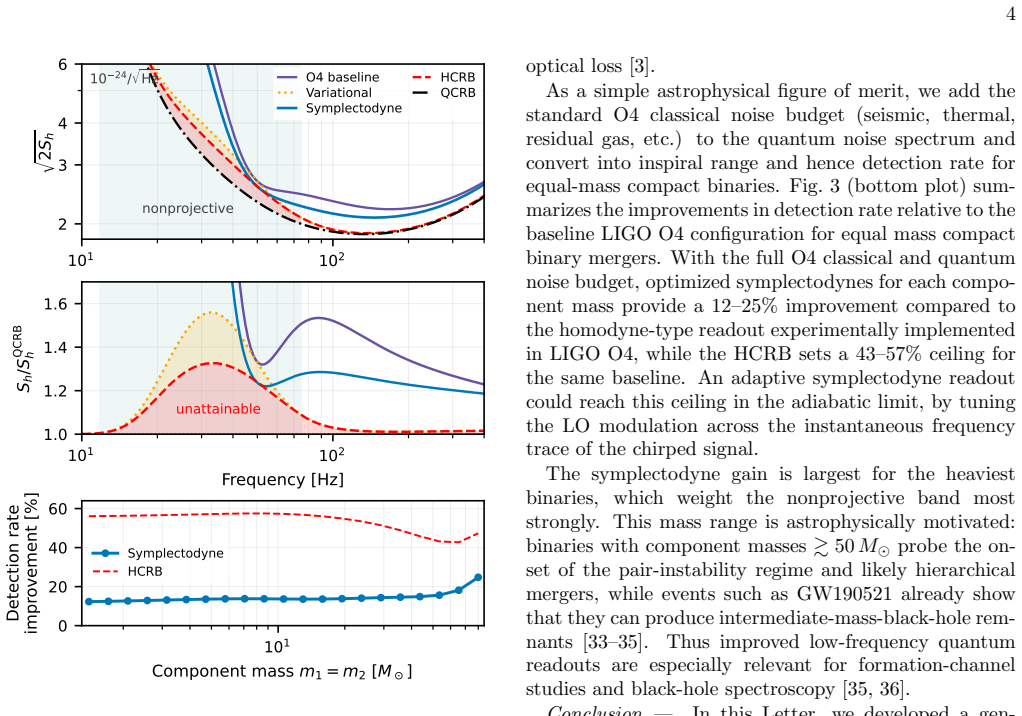
- The new readout can raise compact-binary detection rates by up to 25 percent relative to present LIGO homodyne operation.
- Precision estimates for any linear quantum sensor must incorporate realistic degradation or they will be optimistic.
- Hardware design for future sensors should prioritize schemes that saturate the Holevo bound.
Where Pith is reading between the lines
- The readout architecture could be tested first in table-top optical sensors before deployment in large interferometers.
- Similar hierarchies may appear in other Gaussian sensing tasks once loss and filtering are modeled explicitly.
- The bound supplies a concrete target for optimizing readout hardware in any linear sensor affected by the same degradations.
Load-bearing premise
The proposed readout reaches the Holevo bound without introducing extra loss or filtering through its coupling to the sensor.
What would settle it
A side-by-side measurement or simulation in a gravitational-wave detector that compares the achieved detection rate of the new readout against the rate predicted by the Holevo bound and against current homodyne performance.
Figures
read the original abstract
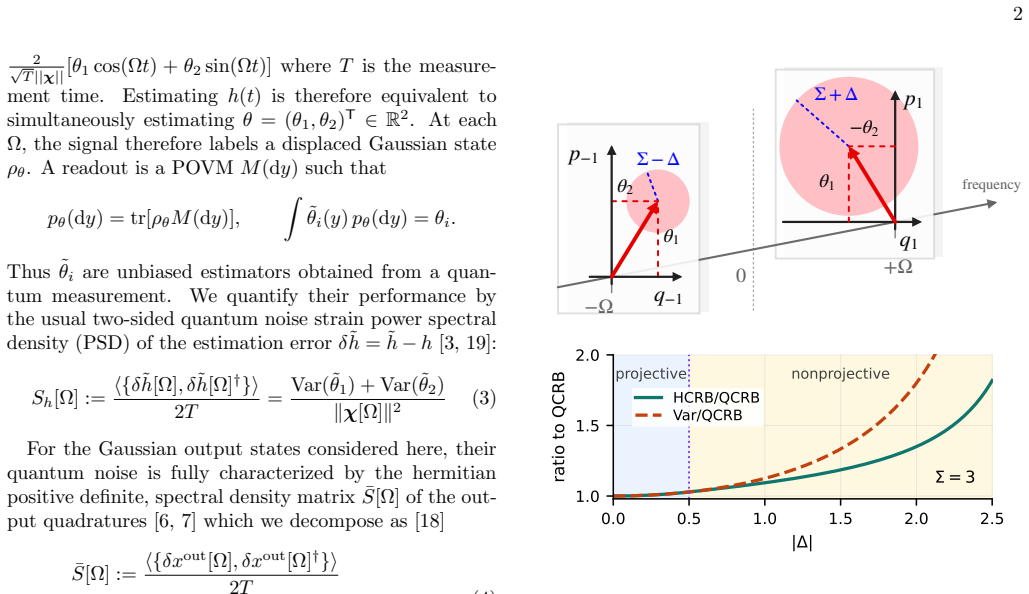
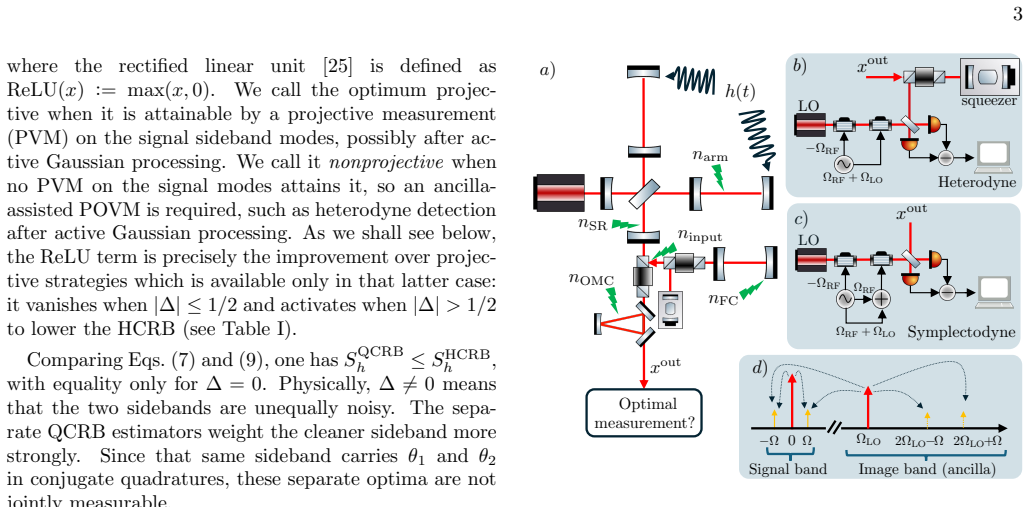
Quantum sensing promises enhanced precision, but the usual quantum Cramer Rao bound can be too optimistic for realistic linear sensors, where squeezing, filtering, and loss reshape quantum noise. We derive the tight Holevo Cramer Rao bound and show that realistic degradation yields a hierarchy with the usual bound and homodyne readout. This hierarchy already exists in gravitational-wave detectors. We propose a hardware-efficient readout that reaches the Holevo bound without extra signal loss, increasing compact-binary detection rates by up to 25% over the present LIGO homodyne readout.
Editorial analysis
A structured set of objections, weighed in public.
Referee Report
Summary. The paper derives the tight Holevo Cramér-Rao bound for Gaussian quantum metrology applied to realistic linear sensors that include squeezing, filtering, and loss. It demonstrates that these effects produce a performance hierarchy among the Holevo bound, the conventional quantum Cramér-Rao bound, and homodyne readout. A hardware-efficient readout scheme is proposed that attains the Holevo bound without introducing additional signal loss, and the authors quantify that this yields up to a 25% increase in compact-binary detection rates relative to the current LIGO homodyne readout.
Significance. If the central derivation and the zero-extra-loss claim for the readout hold, the work supplies a more realistic benchmark for quantum-enhanced sensing under experimental imperfections and directly links the improvement to an existing detector (LIGO), which strengthens its practical relevance. The explicit rate-gain estimate and the focus on attainable rather than idealized bounds are positive features.
major comments (2)
- [readout proposal / coupling model] The 25% detection-rate improvement is load-bearing for the central claim yet rests on the assertion that the proposed readout couples to the sensor without extra loss or filtering. The manuscript must supply the explicit coupling equations (likely in the readout-scheme section) and the associated loss budget to confirm that no unmodeled degradation is introduced beyond the already-included sensor imperfections.
- [numerical results / Holevo-bound computation] The numerical evaluation of the Holevo bound under realistic degradation (squeezing, filtering, loss) must be shown with sufficient detail on the optimization procedure and convergence criteria; without this, it is unclear whether the reported hierarchy and the 25% figure are robust to the choice of numerical parameters or post-selection.
minor comments (2)
- [introduction / notation] Notation for the various bounds (Holevo CRB, standard QCRB, homodyne) should be introduced once with a clear table or equation list to avoid repeated re-definition in later sections.
- [figures] Figure captions for the rate-improvement plots should explicitly state the assumed detector parameters (squeezing level, loss values, filter bandwidth) so that the 25% figure can be reproduced from the caption alone.
Simulated Author's Rebuttal
We thank the referee for the constructive comments, which help strengthen the presentation of our results on the tight Holevo Cramér-Rao bound for realistic linear sensors. We address each major point below and will revise the manuscript accordingly to improve clarity and completeness.
read point-by-point responses
-
Referee: [readout proposal / coupling model] The 25% detection-rate improvement is load-bearing for the central claim yet rests on the assertion that the proposed readout couples to the sensor without extra loss or filtering. The manuscript must supply the explicit coupling equations (likely in the readout-scheme section) and the associated loss budget to confirm that no unmodeled degradation is introduced beyond the already-included sensor imperfections.
Authors: We agree that explicit coupling equations and a loss budget are required to substantiate the zero-extra-loss claim. In the revised manuscript we will insert a new subsection (in the readout-scheme section) containing the full coupling Hamiltonian and the associated input-output relations, together with a tabulated loss budget that isolates the sensor imperfections already modeled from any readout-specific contributions. This addition will confirm that the proposed scheme introduces no unaccounted degradation. revision: yes
-
Referee: [numerical results / Holevo-bound computation] The numerical evaluation of the Holevo bound under realistic degradation (squeezing, filtering, loss) must be shown with sufficient detail on the optimization procedure and convergence criteria; without this, it is unclear whether the reported hierarchy and the 25% figure are robust to the choice of numerical parameters or post-selection.
Authors: We will expand the numerical-methods section (and add an appendix) to document the optimization procedure used to evaluate the Holevo bound. This will include the specific semidefinite-programming formulation, the solver employed, the convergence tolerance (e.g., duality gap < 10^{-8}), the range of initial conditions tested, and a brief sensitivity study confirming that the reported hierarchy and rate-gain figures remain stable under reasonable variations in numerical parameters. No post-selection is applied in the calculations. revision: yes
Circularity Check
No circularity: derivation presented as independent of its target outputs.
full rationale
The provided abstract and context describe a derivation of the tight Holevo CRB for realistic sensors, a hierarchy with homodyne, and a hardware-efficient readout proposal yielding rate gains. No equations, fitted parameters, or self-citations are exhibited that reduce the bound, hierarchy, or 25% improvement to a self-definition or input fit by construction. The central claims are framed as following from the sensor model and readout design without evidence of the enumerated circular patterns. This is the expected non-finding when the derivation chain remains self-contained against external benchmarks.
Axiom & Free-Parameter Ledger
Reference graph
Works this paper leans on
-
[1]
C. W. Helstrom, Journal of Statistical Physics1, 231 (1969)
1969
-
[2]
C. W. Helstrom,Quantum Detection and Estimation Theory(Academic Press, New York, 1976)
1976
-
[3]
H. J. Kimble, Y. Levin, A. B. Matsko, K. S. Thorne, and S. P. Vyatchanin, Phys. Rev. D65, 022002 (2001)
2001
-
[4]
A. Buonanno and Y. Chen, Physical Review D64, 10.1103/physrevd.64.042006 (2001)
-
[5]
A. Buonanno and Y. Chen, Physical Review D65, 10.1103/physrevd.65.042001 (2002)
-
[6]
S. L. Danilishin and F. Y. Khalili, Living Reviews in Relativity15, 5 (2012)
2012
-
[8]
J. W. Gardner, T. Gefen, S. A. Haine, J. J. Hope, and Y. Chen, Physical Review Letters132, 130801 (2024)
2024
-
[9]
Gefen, R
T. Gefen, R. Tarafder, R. X. Adhikari, and Y. Chen, Phys. Rev. Lett.132, 020801 (2024)
2024
-
[10]
Ganapathy, W
D. Ganapathy, W. Jia, M. Nakano, V. Xu, N. Aritomi, T. Cullen, N. Kijbunchoo, S. Dwyer, A. Mullavey, L. Mc- Culler, and LIGO O4 Detector Collaboration, Physical Review X13, 041021 (2023)
2023
-
[11]
Acerneseet al.(Virgo Collaboration), Phys
F. Acerneseet al.(Virgo Collaboration), Phys. Rev. Lett. 131, 041403 (2023)
2023
-
[12]
P. Kwee, J. Miller, T. Isogai, L. Barsotti, and M. Evans, Phys. Rev. D90, 062006 (2014)
2014
-
[13]
McCuller, S
L. McCuller, S. E. Dwyer, A. C. Green, H. Yu, K. Kuns, et al., Phys. Rev. D104, 062006 (2021)
2021
-
[14]
W. Jia, V. Xu, K. Kuns, M. Nakano, L. Barsotti, M. Evans, N. Mavalvala, and members of the LIGO Sci- entific Collaboration, Science385, 1318 (2024)
2024
-
[15]
E. Capoteet al.(LIGO O4 Detector Collaboration), Physical Review D111, 10.1103/physrevd.111.062002 (2025)
-
[16]
C. W. Gardiner and P. Zoller,Quantum Noise(Springer, 1999)
1999
-
[17]
Compatibility of quan- tum states,
H. Miao, Physical Review A95, 10.1103/phys- reva.95.012103 (2017)
- [18]
-
[19]
Maggiore,Gravitational Waves
M. Maggiore,Gravitational Waves. Volume 1: The- ory and Experiments(Oxford University Press, Oxford, 2008)
2008
-
[20]
S. P. Vyatchanin and E. A. Zubova, Physics Letters A 201, 269 (1995)
1995
-
[21]
See Supplemental Material for derivations of the varia- tional, QCRB, and HCRB spectra, details of the optimal Gaussian and symplectodyne measurements, and numer- ical validation of the LIGO O4 application
-
[22]
Demkowicz-Dobrza´ nski, W
R. Demkowicz-Dobrza´ nski, W. G´ orecki, and M. Gut ¸˘ a, Journal of Physics A: Mathematical and Theoretical53, 363001 (2020)
2020
-
[23]
Holevo,Probabilistic and Statistical Aspects of Quan- tum Theory, 1st ed., Publications of the Scuola Normale Superiore, Vol
A. Holevo,Probabilistic and Statistical Aspects of Quan- tum Theory, 1st ed., Publications of the Scuola Normale Superiore, Vol. 1 (Edizioni della Normale, Pisa, 2011)
2011
-
[24]
S. Imai, J. Yang, and L. Pezz` e, Hierarchy of satura- tion conditions for multiparameter quantum metrology 6 bounds (2026), arXiv:2602.12097 [quant-ph]
work page internal anchor Pith review Pith/arXiv arXiv 2026
-
[25]
Bach,Learning Theory from First Principles(The MIT Press, 2024)
F. Bach,Learning Theory from First Principles(The MIT Press, 2024)
2024
-
[26]
Carollo, B
A. Carollo, B. Spagnolo, A. A. Dubkov, and D. Valenti, Journal of Statistical Mechanics: Theory and Experi- ment2019, 094010 (2019)
2019
-
[27]
Tsang, F
M. Tsang, F. Albarelli, and A. Datta, Physical Review X10, 031023 (2020)
2020
-
[28]
J. G. Rollins, E. Hall, C. Wipf, and L. McCuller, pyg- winc: Gravitational wave interferometer noise calculator, Astrophysics Source Code Library, record ascl:2007.020 (2020)
2007
-
[29]
S. Grebien, J. Gurs, R. Schnabel, and M. Korobko, Hy- perloss from coherent spatial-mode mixing in quantum- correlated networks (2026), arXiv:2603.21982 [quant-ph]
-
[30]
K. Kuns and D. Brown, Squeezed state degradations due to mode mismatch and thermal aberrations in grav- itational wave detectors (2026), LIGO-P2500132, CE- P2400005, arXiv:2604.23835 [physics.ins-det]
work page internal anchor Pith review Pith/arXiv arXiv 2026
-
[31]
S. Hild, H. Grote, J. Degallaix, S. Chelkowski, K. Danz- mann, A. Freise, M. Hewitson, J. Hough, H. L¨ uck, M. Prijatelj, K. A. Strain, J. R. Smith, and B. Willke, Classical and Quantum Gravity26, 055012 (2009)
2009
-
[32]
T. T. Fricke, N. D. Smith-Lefebvre, R. Abbott, R. X. Ad- hikari, K. L. Dooley, M. Evans, P. Fritschel, V. V. Frolov, K. Kawabe, J. S. Kissel, B. J. J. Slagmolen, and S. J. Waldman, Classical and Quantum Gravity29, 065005 (2012)
2012
-
[33]
Abbottet al., Physical Review Letters125, 10.1103/PhysRevLett.125.101102 (2020)
R. Abbottet al., Physical Review Letters125, 10.1103/PhysRevLett.125.101102 (2020)
-
[34]
H. Tong, M. Fishbach, E. Thrane,et al., Nature 10.1038/s41586-026-10359-0 (2026)
-
[35]
Torniamenti, M
S. Torniamenti, M. Mapelli, C. P´ erigois, M. Arca Sedda, M. C. Artale, M. Dall’Amico, and M. P. Vaccaro, Astron- omy & Astrophysics688, A148 (2024)
2024
-
[36]
Carullo, General Relativity and Gravitation57, 76 (2025)
G. Carullo, General Relativity and Gravitation57, 76 (2025)
2025
-
[37]
H. Miao, N. D. Smith, and M. Evans, Physical Review X 9, 10.1103/physrevx.9.011053 (2019)
-
[38]
Buchmann, S
L. Buchmann, S. Schreppler, J. Kohler, N. Spethmann, and D. Stamper-Kurn, Physical Review Letters117, 030801 (2016)
2016
-
[39]
Ockeloen-Korppi, E
C. Ockeloen-Korppi, E. Damsk¨ agg, G. Paraoanu, F. Mas- sel, and M. Sillanp¨ a¨ a, Physical Review Letters121, 243601 (2018)
2018
-
[40]
V. Srivastava, D. Davis, K. Kuns, P. Landry, S. Ballmer, M. Evans, E. D. Hall, J. Read, and B. S. Sathyaprakash, Science-driven tunable design of cosmic explorer detec- tors (2022), arXiv:2201.10668 [gr-qc]
-
[41]
Branchesi, M
M. Branchesi, M. Maggiore, D. Alonso, C. Badger, B. Banerjee, F. Beirnaert, E. Belgacem,et al., Journal of Cosmology and Astroparticle Physics2023(07), 068
-
[42]
Albarelli, J
F. Albarelli, J. F. Friel, and A. Datta, Physical Review Letters123, 200503 (2019)
2019
-
[43]
J. S. Sidhu, Y. Ouyang, E. T. Campbell, and P. Kok, Physical Review X11, 011028 (2021)
2021
-
[44]
L. O. Conlon, J. Suzuki, P. K. Lam, and S. M. Assad, Physics Letters A542, 130445 (2025)
2025
- [45]
-
[46]
M. Frigerio, M. G. A. Paris, C. E. Lopetegui, and M. Walschaers, Joint estimation of position and momen- tum with arbitrarily high precision using non-Gaussian states (2025), arXiv:2504.01910 [quant-ph]
-
[47]
Labarca, S
L. Labarca, S. Turcotte, A. Blais, and B. Royer, PRX Quantum7, 020301 (2026). END MA TTER Two-photon and sideband conventions The physical sideband (or single-photon picture) modes at±Ω have annihilation operatorsa[±Ω] satisfying [a[Ω], a[Ω′]†] = 2πδ[Ω−Ω ′]. For a finite measurement timeT≃2πδ[0], we regularize these continuous-frequency modes by the binsa...
2026
discussion (0)
Sign in with ORCID, Apple, or X to comment. Anyone can read and Pith papers without signing in.