Recognition: unknown
Squeezed state degradations due to mode mismatch and thermal aberrations in gravitational wave detectors
Pith reviewed 2026-05-08 04:53 UTC · model grok-4.3
The pith
Thermal aberrations create two frequency-dependent types of mode mismatch that degrade squeezed states in gravitational wave detectors.
A machine-rendered reading of the paper's core claim, the machinery that carries it, and where it could break.
Core claim
The central claim is that the mismatch between the quadratic component of the wavefronts of two optical modes due to thermal aberrations exhibits low-pass frequency dependence in its degradation of squeezed states, whereas the mismatch from all higher-order thermal aberrations shows high-pass behavior. As a result, the two sources produce different squeezing losses across frequency bands, with some effects already relevant for current detectors and others becoming important only for future instruments that use longer arms.
What carries the argument
The decomposition of thermal wavefront aberrations into a quadratic part and all higher-order parts, which produces the distinct low-pass versus high-pass dynamics of the resulting mode mismatch.
If this is right
- Quadratic mismatch will limit squeezing performance at low frequencies in detectors operating today.
- Higher-order aberrations will dominate degradation in future detectors that use longer arm cavities.
- Characterization procedures can target separate frequency bands to isolate each mismatch type.
- Thermal control systems can be designed to address the quadratic and higher-order components independently.
Where Pith is reading between the lines
- Frequency-dependent squeezing filters may need adjustment that accounts for arm length to compensate the differing mismatch behaviors.
- Active thermal compensation could be optimized to suppress the mismatch component that is strongest in a given frequency band.
- The same quadratic-versus-higher-order split may appear in other high-power optical systems that rely on squeezed light.
Load-bearing premise
The analysis assumes that thermal aberrations generated by absorbed circulating arm power dominate internal mismatch sources and that separating the quadratic wavefront term from higher-order terms fully captures the frequency-dependent degradation behavior.
What would settle it
Measurements of the squeezing degradation spectrum versus frequency in an operating detector that fail to show a clear low-pass component tied to quadratic mismatch and a high-pass component tied to higher-order aberrations would falsify the predicted dynamics.
Figures




read the original abstract
To date, frequency-dependent squeezed light has been used to reduce quantum noise in interferometric gravitational wave detectors by 6.1 dB (a factor of two). Future upgrades and detectors aim to both reduce quantum noise by 10 dB (a factor of three) and to increase the circulating power in the interferometer arm cavities. Achieving these goals will be extremely challenging due, in part, to the degradations to the squeezed state caused by mode mismatch between the internal interferometer optical cavities and between the auxiliary external cavities. It is therefore imperative to gain a detailed understanding of all sources of mismatch and to obtain experience in mitigating their effects in the current detectors in order to improve astrophysical sensitivity now and in the future. Two types of internal mismatch are identified which are due to the thermal aberrations generated when the test mass optics absorb a small fraction of the circulating arm power. It is found that the dynamics responsible for the degradations caused by the mismatch between the quadratic part of the wavefront of two modes has a characteristic low-pass frequency dependence while the dynamics of the mismatch due to all higher order thermal aberrations has a high-pass behavior. As a consequence, the two types of mismatch are predominantly responsible for different squeezing degradations -- some of which are significant for the current detectors and some of which will only be important for future detectors with longer arms. The behavior of these two types of internal mismatch are described and the implications for detector design, operation, and characterization are discussed.
Editorial analysis
A structured set of objections, weighed in public.
Referee Report
Summary. The manuscript analyzes mode-mismatch degradations to frequency-dependent squeezed light in gravitational-wave interferometers arising from thermal aberrations in the test-mass optics. It identifies two distinct internal mismatch mechanisms: quadratic wavefront mismatch (primarily curvature/defocus) whose squeezing degradation exhibits low-pass frequency dependence, and mismatch from all higher-order thermal aberrations whose degradation exhibits high-pass behavior. The paper discusses how these mechanisms dominate different squeezing loss channels at current versus future arm powers and arm lengths, and outlines implications for detector design, operation, and characterization.
Significance. If the reported frequency scalings hold, the work supplies a concrete, physically motivated framework for predicting and mitigating squeezing degradation as circulating power and arm length increase. This directly supports the community goal of reaching 10 dB squeezing while scaling arm power, and supplies testable signatures (low-pass versus high-pass roll-offs) that can be used in commissioning and in-situ characterization of current detectors.
major comments (2)
- [thermal aberration model and modal decomposition] The central claim—that quadratic wavefront mismatch produces low-pass dynamics while higher-order aberrations produce high-pass dynamics—rests on a clean modal decomposition without cross-terms. The manuscript must demonstrate (with explicit equations) that the projection of the thermal lens onto the fundamental mode does not mix low- and high-pass contributions via cavity filtering or Gouy-phase accumulation; otherwise the reported frequency scalings do not follow from the model.
- [assumptions and validity range] The analysis assumes thermal aberrations are linear in absorbed circulating power and that the quadratic/higher-order split accurately isolates the dynamics. The paper should quantify the size of any nonlinear or cross-term contributions (e.g., via the next-order term in the absorbed-power expansion) and show that they remain negligible across the power range considered for current and future detectors.
minor comments (2)
- [Introduction] The abstract cites 6.1 dB and 10 dB squeezing targets; the introduction should explicitly reference the experimental papers that achieved these values so readers can trace the performance baseline.
- [figures and notation] Notation for the wavefront decomposition (quadratic coefficient versus higher-order coefficients) should be defined once in a dedicated subsection and used consistently; several figures would benefit from explicit labels indicating which curve corresponds to the quadratic component.
Simulated Author's Rebuttal
We thank the referee for their constructive and insightful comments, which help clarify key aspects of our analysis. We address each major point below and will revise the manuscript accordingly to strengthen the presentation of our results.
read point-by-point responses
-
Referee: [thermal aberration model and modal decomposition] The central claim—that quadratic wavefront mismatch produces low-pass dynamics while higher-order aberrations produce high-pass dynamics—rests on a clean modal decomposition without cross-terms. The manuscript must demonstrate (with explicit equations) that the projection of the thermal lens onto the fundamental mode does not mix low- and high-pass contributions via cavity filtering or Gouy-phase accumulation; otherwise the reported frequency scalings do not follow from the model.
Authors: We appreciate the referee drawing attention to this foundational element of the model. In our analysis the thermal aberration is decomposed into orthogonal components (quadratic defocus versus higher-order terms) via overlap integrals with the cavity eigenmodes. The frequency scalings then follow from the distinct coupling of these components to the frequency-dependent squeezed vacuum: quadratic mismatch produces an effective low-pass filter through amplitude coupling, while higher-order terms produce high-pass behavior via phase and Gouy-phase-induced mode conversion. To make the absence of cross-mixing explicit, we will add the relevant overlap-integral equations and a short derivation showing that cavity filtering (a common frequency-dependent operator) and Gouy-phase accumulation do not introduce leading-order mixing between the quadratic and higher-order projections in the paraxial regime used throughout the paper. These equations will be inserted in Section III of the revised manuscript. revision: yes
-
Referee: [assumptions and validity range] The analysis assumes thermal aberrations are linear in absorbed circulating power and that the quadratic/higher-order split accurately isolates the dynamics. The paper should quantify the size of any nonlinear or cross-term contributions (e.g., via the next-order term in the absorbed-power expansion) and show that they remain negligible across the power range considered for current and future detectors.
Authors: We agree that an explicit bound on the linear approximation is valuable. The manuscript adopts the standard linear scaling of thermal aberrations with absorbed power, appropriate for the low absorption levels of fused-silica test masses. In the revision we will add a short calculation of the next-order (quadratic) term in the absorbed-power expansion, using representative absorption coefficients and thermo-optic constants. We will show that, for the arm powers and lengths considered (hundreds of kW to a few MW for current detectors; several MW for future detectors), the nonlinear contribution remains below a few percent and does not alter the reported low-pass versus high-pass scalings. This estimate will be placed in a new paragraph in Section II. revision: yes
Circularity Check
No circularity: frequency-dependent mismatch dynamics derived from independent optical modeling
full rationale
The paper models thermal aberrations in GW detectors by decomposing wavefront mismatches into quadratic (curvature) and higher-order components, then derives their distinct low-pass versus high-pass frequency responses in squeezing degradation from the underlying cavity dynamics and thermal lens effects. No equations or claims reduce by construction to fitted parameters, self-definitions, or self-citation chains; the separation and resulting behaviors follow from standard modal analysis and linear thermal absorption assumptions that remain externally falsifiable. The derivation is self-contained against benchmarks of interferometer optics and does not rely on renaming known results or importing uniqueness from prior author work.
Axiom & Free-Parameter Ledger
axioms (1)
- domain assumption Thermal aberrations are generated when test mass optics absorb a small fraction of the circulating arm power.
Reference graph
Works this paper leans on
-
[1]
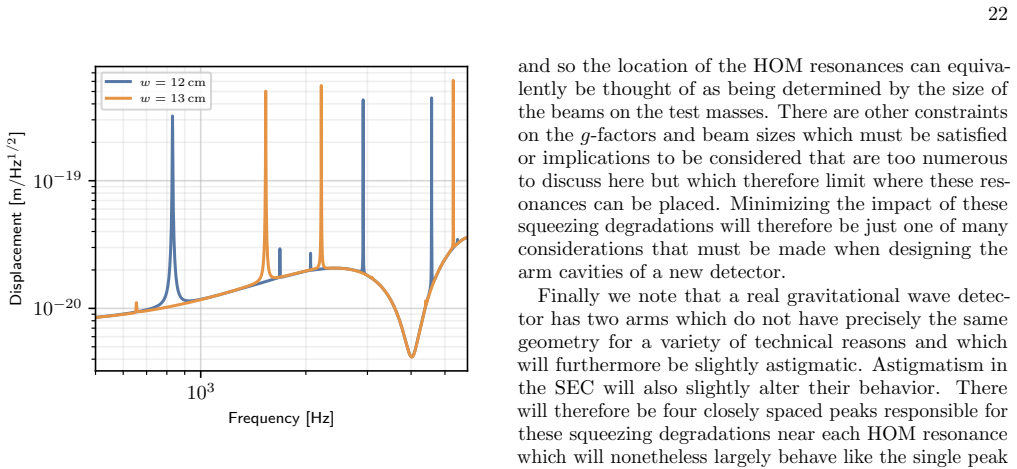
Rotation, loss, and dephasing As can be seen from Fig. 4, the most prominent degrada- tion around a higher order mode resonance for reasonable values of mismatch for Cosmic Explorer is due to the anti-squeezing caused by the squeezed state rotation. For more extreme values of mismatch, the dephasing can be- come even more significant but can no longer be ...
-
[2]
The FSR is the difference in frequencies between resonances of the fundamental mode, and the TMS is the frequency difference between HOM resonances
Placement of higher order mode resonances In the absence of thermal aberrations and apertures, a higher order mode of order N will become resonant in the arm cavities around frequencies [31] δωa =|pN ω tms −qω fsr|=ω fsr pN Ψa π −q (56a) ωtms =ω fsr Ψa π , ω fsr = πc La (56b) for integers p and q where ωfsr is the free spectral range (FSR), ωtms is the tr...
-
[3]
mis- rotation
Use in tuning and characterizing detectors It may be possible to take advantage of these squeezed state degradations around a HOM arm cavity resonance by carefully measuring them in order to characterize the detector state and tune the interferometer for better mode matching. It is possible to measure the McCuller metrics directly using an audio diagnosti...
- [4]
-
[5]
B. P. Abbottet al.(LIGO Scientific, Virgo), GW170817: Observation of Gravitational Waves from a Binary Neu- tron Star Inspiral, Phys. Rev. Lett.119, 161101 (2017), arXiv:1710.05832 [gr-qc]
work page internal anchor Pith review arXiv 2017
-
[6]
Capoteet al., Advanced LIGO detector performance in the fourth observing run, Phys
E. Capoteet al., Advanced LIGO detector performance in the fourth observing run, Phys. Rev. D111, 062002 (2025), arXiv:2411.14607 [gr-qc]
-
[7]
Barsotti, J
L. Barsotti, J. Harms, and R. Schnabel, Squeezed vacuum states of light for gravitational wave detectors, Rept. Prog. Phys.82, 016905 (2019)
2019
-
[8]
Tseet al., Quantum-Enhanced Advanced LIGO Detec- tors in the Era of Gravitational-Wave Astronomy, Phys
M. Tseet al., Quantum-Enhanced Advanced LIGO Detec- tors in the Era of Gravitational-Wave Astronomy, Phys. Rev. Lett.123, 231107 (2019)
2019
-
[9]
Acerneseet al.(Virgo), Increasing the Astrophysical Reach of the Advanced Virgo Detector via the Application of Squeezed Vacuum States of Light, Phys
F. Acerneseet al.(Virgo), Increasing the Astrophysical Reach of the Advanced Virgo Detector via the Application of Squeezed Vacuum States of Light, Phys. Rev. Lett.123, 231108 (2019)
2019
- [10]
-
[11]
J. Loughet al., First Demonstration of 6 dB Quan- tum Noise Reduction in a Kilometer Scale Gravitational Wave Observatory, Phys. Rev. Lett.126, 041102 (2021), arXiv:2005.10292 [physics.ins-det]
-
[12]
Ganapathyet al.(LIGO O4 Detector), Broadband Quantum Enhancement of the LIGO Detectors with Frequency-Dependent Squeezing, Phys
D. Ganapathyet al.(LIGO O4 Detector), Broadband Quantum Enhancement of the LIGO Detectors with Frequency-Dependent Squeezing, Phys. Rev. X13, 041021 (2023)
2023
-
[13]
McCulleret al., Frequency-Dependent Squeezing for Advanced LIGO, Phys
L. McCulleret al., Frequency-Dependent Squeezing for Advanced LIGO, Phys. Rev. Lett.124, 171102 (2020), arXiv:2003.13443 [astro-ph.IM]
-
[14]
Y. Zhaoet al., Frequency-Dependent Squeezed Vacuum Source for Broadband Quantum Noise Reduction in Ad- vanced Gravitational-Wave Detectors, Phys. Rev. Lett. 124, 171101 (2020), arXiv:2003.10672 [astro-ph.IM]
-
[15]
McCulleret al., LIGO’s quantum response to squeezed states, Phys
L. McCulleret al., LIGO’s quantum response to squeezed states, Phys. Rev. D104, 062006 (2021), arXiv:2105.12052 [physics.ins-det]
- [16]
-
[17]
Hello and J.-Y
P. Hello and J.-Y. Vinet, Analytical models of thermal aberrations in massive mirrors heated by high power laser beams, Journal de Physique51, 1267–1282 (1990)
1990
-
[18]
Hello and J.-Y
P. Hello and J.-Y. Vinet, Analytical models of transient thermoelastic deformations of mirrors heated by high power cw laser beams, J. Phys. France51, 2243 (1990)
1990
-
[19]
Vinet, On special optical modes and thermal issues in advanced gravitational wave interferometric detectors, Living Rev
J.-Y. Vinet, On special optical modes and thermal issues in advanced gravitational wave interferometric detectors, Living Rev. Rel.12, 5 (2009)
2009
- [20]
-
[21]
Post-O5 Study Group,Report of the LSC Post-O5 Study Group, Technical Note LIGO-T2200287 (2023)
2023
-
[22]
The VIRGO Collaboration,Virgo nEXT: Beyond the AdV+ project A concept study, Technical Note VIR-0497A- 22 (2022)
2022
-
[23]
A Horizon Study for Cosmic Explorer: Science, Observatories, and Community
M. Evanset al., A Horizon Study for Cosmic Explorer: Science, Observatories, and Community, arXiV (2021), arXiv:2109.09882 [astro-ph.IM]
work page internal anchor Pith review arXiv 2021
-
[24]
ET Steering Committee,ET Design Report Update 2020, Tech. Rep. ET-0007A-20 (Einstein Telescope, 2020)
2020
-
[25]
Mizuno, K
J. Mizuno, K. A. Strain, P. G. Nelson, J. M. Chen, R. Schilling, A. R¨ udiger, W. Winkler, and K. Danzmann, Resonant sideband extraction: a new configuration for in- terferometric gravitational wave detectors, Physics Letters A175, 273 (1993)
1993
-
[26]
B. J. Meers, Recycling in laser-interferometric gravitational-wave detectors, Phys. Rev. D38, 2317 (1988)
1988
-
[27]
C. M. Caves and B. L. Schumaker, New formalism for two-photon quantum optics. 1. Quadrature phases and squeezed states, Phys. Rev. A31, 3068 (1985)
1985
- [28]
-
[29]
B. J. Meers and K. A. Strain, Wave-front distortion in laser-interferometric gravitational-wave detectors, Phys. Rev. D43, 3117 (1991)
1991
- [30]
-
[31]
M. Granata, A. Amato, L. Balzarini, M. Canepa, J. De- gallaix, D. Forest, V. Dolique, L. Mereni, C. Michel, L. Pinard, B. Sassolas, J. Teillon, and G. Cagnoli, Amor- phous optical coatings of present gravitational-wave inter- ferometers, Classical and Quantum Gravity37, 095004 (2020), arXiv:1909.03737 [physics.ins-det]
-
[32]
K. A. Strain, K. Danzmann, J. Mizuno, P. G. Nelson, A. R¨ udiger, R. Schilling, and W. Winkler, Thermal lensing in recycling interferometric gravitational wave detectors, Physics Letters A194, 124–132 (1994)
1994
-
[33]
Winkler, K
W. Winkler, K. Danzmann, A. Ruediger, and R. Schilling, Heating by optical absorption and the performance of interferometric gravitational wave detectors, Phys. Rev. A44, 7022 (1991)
1991
-
[34]
A. E. Siegman,Lasers(1986)
1986
-
[35]
C. Bond, D. Brown, A. Freise, and K. A. Strain, Interfer- ometer techniques for gravitational-wave detection, Living Reviews in Relativity19, 3 (2016)
2016
-
[36]
A. Perreca, A. Brooks, J. Richardson, D. Toyra, and R. Smith, Analysis and visualization of the output mode- matching requirements for squeezing in Advanced LIGO and future gravitational wave detectors, Phys. Rev. D 101, 102005 (2020), arXiv:2001.10132 [physics.ins-det]
- [37]
-
[38]
Rocchi, E
A. Rocchi, E. Coccia, V. Fafone, V. Malvezzi, Y. Mi- nenkov, and L. Sperandio, Thermal effects and their com- pensation in advanced Virgo, J. Phys. Conf. Ser.363, 012016 (2012)
2012
-
[39]
A. W. Goodwin-Jones, R. Cabrita, M. Korobko, M. Van Beuzekom, D. D. Brown, V. Fafone, J. Van Heijningen, A. Rocchi, M. G. Schiworski, and M. Tacca, Transverse mode control in quantum enhanced interferometers: a review and recommendations for a new generation, Optica 11, 273 (2024), arXiv:2311.04736 [physics.optics]. 35
-
[40]
C. M. Caves, Quantum Mechanical Noise in an Interfer- ometer, Phys. Rev. D23, 1693 (1981)
1981
-
[41]
Caves, Quantum-Mechanical Radiation-Pressure Fluc- tuations in an Interferometer, Phys
C. Caves, Quantum-Mechanical Radiation-Pressure Fluc- tuations in an Interferometer, Phys. Rev. Lett.45, 75 (1980)
1980
-
[42]
A. Buonanno and Y.-b. Chen, Quantum noise in second generation, signal recycled laser interferometric gravita- tional wave detectors, Phys. Rev. D64, 042006 (2001), arXiv:gr-qc/0102012
- [43]
-
[44]
H. J. Kimble, Y. Levin, A. B. Matsko, K. S. Thorne, and S. P. Vyatchanin, Conversion of conventional gravitational-wave interferometers into quantum nonde- molition interferometers by modifying their input and/or output optics, Phys. Rev. D65, 022002 (2001), arXiv:gr- qc/0008026 [gr-qc]
-
[45]
Bachor and T
H.-A. Bachor and T. C. Ralph,A Guide to Experiments in Quantum Optics, 2nd, Revised and Enlarged Edition (2004)
2004
-
[46]
D. Ganapathy, L. McCuller, J. Graef Rollins, E. D. Hall, L. Barsotti, and M. Evans, Tuning Advanced LIGO to kilohertz signals from neutron-star collisions, Phys. Rev. D103, 022002 (2021), arXiv:2010.15735 [astro-ph.IM]
- [47]
-
[48]
M. Rakhmanov, J. D. Romano, and J. T. Whelan, High- frequency corrections to the detector response and their effect on searches for gravitational waves, Class. Quant. Grav.25, 184017 (2008), arXiv:0808.3805 [gr-qc]
- [49]
-
[50]
V. Srivastava, D. Davis, K. Kuns, P. Landry, S. Ballmer, M. Evans, E. D. Hall, J. Read, and B. S. Sathyaprakash, Science-driven Tunable Design of Cosmic Explorer De- tectors, Astrophys. J.931, 22 (2022), arXiv:2201.10668 [gr-qc]
-
[51]
D. Martynovet al., Exploring the sensitivity of gravita- tional wave detectors to neutron star physics, Phys. Rev. D99, 102004 (2019), arXiv:1901.03885 [astro-ph.IM]
-
[52]
K. Ackleyet al., Neutron Star Extreme Matter Obser- vatory: A kilohertz-band gravitational-wave detector in the global network, Publ. Astron. Soc. Austral.37, e047 (2020), arXiv:2007.03128 [astro-ph.HE]
-
[53]
D. T¨ oyr¨ a, D. D. Brown, M. Davis, S. Song, A. Wormald, J. Harms, H. Miao, and A. Freise, Multi-spatial-mode effects in squeezed-light-enhanced interferometric gravita- tional wave detectors, Phys. Rev. D96, 022006 (2017), arXiv:1704.08237 [physics.optics]
-
[54]
D. Ganapathy, V. Xu, W. Jia, C. Whittle, M. Tse, L. Bar- sotti, M. Evans, and L. McCuller, Probing squeezing for gravitational-wave detectors with an audio-band field, Phys. Rev. D105, 122005 (2022), arXiv:2203.03849 [astro- ph.IM]
-
[55]
A. Buonanno and Y. Chen, Signal recycled laser inter- ferometer gravitational wave detectors as optical springs, Phys. Rev. D65, 042001 (2002), arXiv:gr-qc/0107021
-
[56]
Srivastavaet al., Piezo-deformable mirrors for active mode matching in advanced LIGO, Opt
V. Srivastavaet al., Piezo-deformable mirrors for active mode matching in advanced LIGO, Opt. Express30, 10491 (2022), arXiv:2110.00674 [astro-ph.IM]
-
[57]
H. T. Cao, S. W. S. Ng, M. Noh, A. Brooks, F. Matichard, and P. J. Veitch, Enhancing the dynamic range of de- formable mirrors with compression bias, Optics Express 28, 38480 (2020)
2020
- [58]
-
[59]
Arai,On the accumulated round-trip Gouy phase shift for a general optical cavity, Technical Note LIGO- T1300189 (2013)
K. Arai,On the accumulated round-trip Gouy phase shift for a general optical cavity, Technical Note LIGO- T1300189 (2013)
2013
-
[60]
D. D. Brown, A. Freise, H. T. Cao, A. Ciobanu, J. Gobeil, A. Green, P. Hapke, P. Jones, M. van der Kolk, K. Kuns, S. Leavey, J. W. Perry, S. Rowlinson, and M. Sall´ e, Finesse (2025)
2025
- [61]
discussion (0)
Sign in with ORCID, Apple, or X to comment. Anyone can read and Pith papers without signing in.