TopoAgent: An Agentic Framework for Automated Topology Learning in Medical Imaging
Pith reviewed 2026-06-30 06:30 UTC · model grok-4.3
The pith
TopoAgent is an LLM-based agent that automatically picks the best topological descriptor for a medical image dataset and outputs the matching feature vectors with no task-specific training.
A machine-rendered reading of the paper's core claim, the machinery that carries it, and where it could break.
Core claim
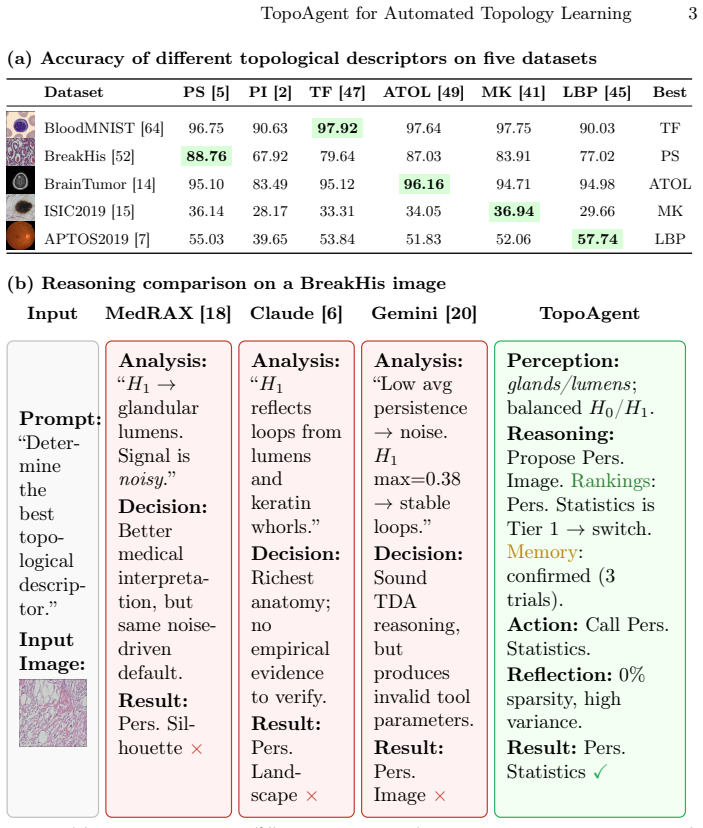
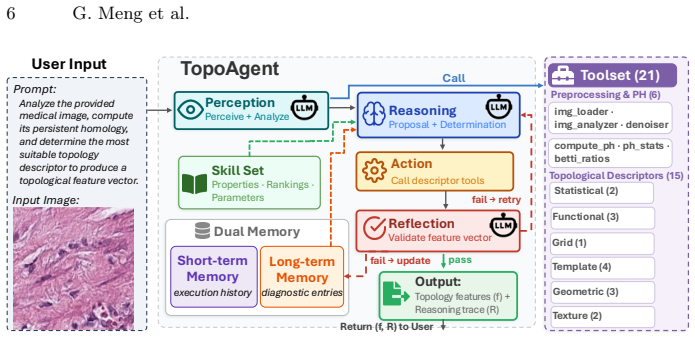
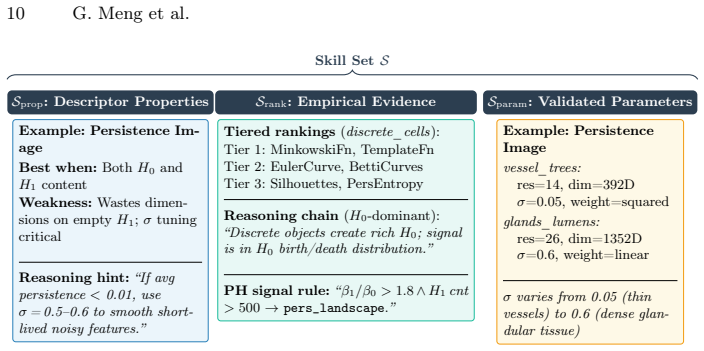
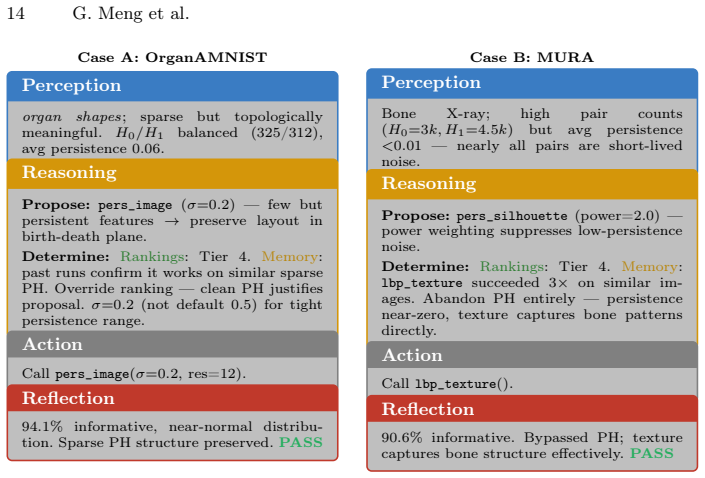
TopoAgent is an LLM-based agentic framework that automates topology learning for medical image analysis. It operates through a Perception-Reasoning-Action-Reflection loop supported by twenty-one domain-specific tools and dual memory that accumulates experience across runs. Its skill set is distilled from systematic evaluation of fifteen topological descriptors across twenty-six datasets with six classifiers. TopoAgent analyzes input images and their topological characteristics, reasons about which topological descriptors best suit the input, and determines the optimal descriptor and its configuration, all without task-specific training.
What carries the argument
The Perception-Reasoning-Action-Reflection loop with twenty-one domain-specific tools and dual memory that stores and reuses prior experience.
If this is right
- The same agent can generate ready-to-use topological feature vectors for any new medical image collection.
- No human expert or retraining step is required to switch descriptors when the dataset changes.
- The method inherits the performance range observed across the fifteen descriptors evaluated on twenty-six datasets.
- Topological information that pixel-level networks miss becomes available to any downstream classifier through the agent's output vectors.
Where Pith is reading between the lines
- The same agent structure could be tested on non-medical image collections to see whether the tool set generalizes beyond the medical domain.
- If memory across runs continues to improve selections, repeated use on similar hospital data streams might yield progressively better descriptor choices.
- Pairing the agent's output vectors with existing deep networks could be checked to measure additive gains in classification tasks.
Load-bearing premise
An LLM agent supported only by domain tools and accumulated memory can reliably analyze images and select the optimal topological descriptor without any task-specific training.
What would settle it
Run the agent on a held-out medical image dataset, compare the downstream accuracy of its chosen descriptor against the accuracy obtained by always using the single most common fixed descriptor, and check whether the agent's selection is consistently no better or worse.
Figures
read the original abstract
Topological data analysis (TDA), particularly persistent homology (PH), captures geometric structural properties in medical images (e.g., connected components, loops, shape characteristics), which conventional pixel-level deep learning approaches often neglect. While many topological descriptors are known for converting persistence diagrams (PDs) or raw images into topological feature vectors, existing methods mostly default to a single fixed descriptor (e.g., persistence images), leaving the diversity of topological representations largely unexplored. To the best of our knowledge, there is no known large language model (LLM)-based agentic framework that can automatically determine the most suitable topological descriptors for a given image dataset and produce the corresponding topological feature vectors for downstream tasks. To fill this gap, we propose \textbf{TopoAgent}, an LLM-based agentic framework that automates topology learning for medical image analysis.TopoAgent operates through a Perception--Reasoning--Action--Reflection loop supported by 21 domain-specific tools and dual memory that accumulates experience across runs. Its skill set is distilled from systematic evaluation of 15 topological descriptors across 26 datasets with six classifiers. TopoAgent analyzes input images and their topological characteristics, reasons about which topological descriptors best suit the input, and determines the optimal descriptor and its configuration, all without task-specific training.
Editorial analysis
A structured set of objections, weighed in public.
Referee Report
Summary. The manuscript proposes TopoAgent, an LLM-based agentic framework for automating topology learning in medical imaging. It operates via a Perception–Reasoning–Action–Reflection loop with 21 domain-specific tools and dual memory, distilling skills from a systematic evaluation of 15 topological descriptors across 26 datasets with six classifiers. The framework is claimed to analyze input images, reason about suitable descriptors, select and configure the optimal one, and produce feature vectors for downstream tasks, all without task-specific training or human intervention.
Significance. If the central claim holds, the work would advance TDA applications in medical imaging by replacing fixed-descriptor defaults (e.g., persistence images) with automated, dataset-adaptive selection from a diverse set of 15 descriptors. The breadth of the underlying 26-dataset evaluation and the agentic architecture with accumulated memory represent concrete strengths that could enable reproducible, generalizable automation if empirically validated.
major comments (2)
- [Abstract] Abstract (paragraph beginning 'To fill this gap...'): The central claim that TopoAgent 'analyzes input images and their topological characteristics, reasons about which topological descriptors best suit the input, and determines the optimal descriptor and its configuration, all without task-specific training' is presented without any quantitative results, success rates, ablation studies, or downstream-task metrics on the 26 datasets or held-out data. This absence directly undermines assessment of whether the Perception–Reasoning–Action–Reflection loop with 21 tools actually succeeds at reliable selection.
- [Framework description] Description of skill distillation (paragraph on the 26-dataset evaluation): The manuscript states that the agent's skill set 'is distilled from systematic evaluation of 15 topological descriptors across 26 datasets,' yet supplies no tables, figures, or reported metrics (e.g., selection accuracy, comparison to fixed baselines, or generalization tests) showing how the evaluation outcomes translate into verifiable agent behavior on new images. This is load-bearing for the claim of autonomous, training-free operation.
Simulated Author's Rebuttal
We sincerely thank the referee for the constructive review and recommendation for major revision. The comments highlight important aspects of how results are presented, and we address each point below with plans to strengthen the manuscript.
read point-by-point responses
-
Referee: [Abstract] Abstract (paragraph beginning 'To fill this gap...'): The central claim that TopoAgent 'analyzes input images and their topological characteristics, reasons about which topological descriptors best suit the input, and determines the optimal descriptor and its configuration, all without task-specific training' is presented without any quantitative results, success rates, ablation studies, or downstream-task metrics on the 26 datasets or held-out data. This absence directly undermines assessment of whether the Perception–Reasoning–Action–Reflection loop with 21 tools actually succeeds at reliable selection.
Authors: The abstract is a concise summary and does not include specific metrics, which is standard practice. The full manuscript reports quantitative results supporting the claim in the Experiments section, including agent success rates on descriptor selection, ablation studies on the loop components, and downstream performance metrics across the 26 datasets and held-out cases. In revision we will add 1-2 key quantitative highlights (e.g., selection accuracy and average downstream improvement) to the abstract for immediate visibility. revision: yes
-
Referee: [Framework description] Description of skill distillation (paragraph on the 26-dataset evaluation): The manuscript states that the agent's skill set 'is distilled from systematic evaluation of 15 topological descriptors across 26 datasets,' yet supplies no tables, figures, or reported metrics (e.g., selection accuracy, comparison to fixed baselines, or generalization tests) showing how the evaluation outcomes translate into verifiable agent behavior on new images. This is load-bearing for the claim of autonomous, training-free operation.
Authors: The underlying evaluation of the 15 descriptors is performed and referenced in the manuscript, with the distilled skills encoded in the agent's tools and memory. We acknowledge that the main text would benefit from an explicit summary of the evaluation metrics. In the revised manuscript we will insert a concise table (or figure) summarizing key outcomes such as per-descriptor performance, selection accuracy on held-out data, and comparison to fixed baselines, directly linking the evaluation to the agent's autonomous behavior. revision: yes
Circularity Check
No circularity: framework proposal with no derivations or fitted predictions
full rationale
The paper proposes an LLM-based agentic software framework (TopoAgent) for descriptor selection in TDA. No equations, first-principles derivations, or statistical predictions appear in the provided text. The skill set is informed by prior evaluation on 26 datasets, but this is standard empirical grounding for a tool, not a reduction of any claimed result to its own inputs by construction. No self-citations, uniqueness theorems, or ansatzes are invoked as load-bearing. The contribution is architectural rather than predictive, so none of the enumerated circularity patterns apply.
Axiom & Free-Parameter Ledger
axioms (2)
- domain assumption Topological descriptors from persistent homology capture geometric structural properties in medical images that conventional pixel-level deep learning approaches often neglect.
- ad hoc to paper An LLM agent equipped with domain-specific tools can reason about topological characteristics of input images without task-specific training.
invented entities (1)
-
TopoAgent framework
no independent evidence
Reference graph
Works this paper leans on
-
[1]
In: CBMS
Adame, D., Nunez, J.A., Vazquez, F., Gurrola, N., Li, H., Tang, H., Fu, B., Gu, P.: Topo-VM-UNetV2: Encoding topology into vision Mamba UNet for polyp seg- mentation. In: CBMS. pp. 258–263 (2025)
2025
-
[2]
Journal of Machine Learning Research18(8), 1–35 (2017)
Adams, H., Emerson, T., Kirby, M., Neville, R., Peterson, C., et al.: Persistence Images: A stable vector representation of persistent homology. Journal of Machine Learning Research18(8), 1–35 (2017)
2017
-
[3]
gradient histograms: A comparative study for medical image classification
Ahmed, F.: Topological signatures vs. gradient histograms: A comparative study for medical image classification. arXiv preprint arXiv:2507.03006 (2025)
-
[4]
Journal of Imaging Informatics in Medicine (2025)
Ahmed, F., Bhuiyan, M.A.N., Coskunuzer, B.: Topo-CNN: Retinal image analysis with topological deep learning. Journal of Imaging Informatics in Medicine (2025)
2025
-
[5]
IEEE Transactions on Pattern Analysis and Machine Intelligence45(12) (2023)
Ali, D., Asaad, A., Jimenez, M.J., Nanda, V., Paluzo-Hidalgo, E., Soriano- Trigueros, M.: A survey of vectorization methods in topological data analysis. IEEE Transactions on Pattern Analysis and Machine Intelligence45(12) (2023)
2023
-
[6]
anthropic
Anthropic: The Claude model card (2025),https : / / www . anthropic . com / research/claude-model-card
2025
-
[7]
Asia Pacific Tele-Ophthalmology Society: APTOS 2019 blindness detection (2019), https://www.kaggle.com/c/aptos2019-blindness-detection
2019
-
[8]
Machine Learning45(1), 5–32 (2001)
Breiman, L.: Random forests. Machine Learning45(1), 5–32 (2001)
2001
-
[9]
The Journal of Machine Learning Research16(1), 77–102 (2015)
Bubenik, P.: Statistical topological data analysis using persistence landscapes. The Journal of Machine Learning Research16(1), 77–102 (2015)
2015
-
[10]
Bulletin of the American Mathematical Society 46(2), 255–308 (2009)
Carlsson, G.: Topology and data. Bulletin of the American Mathematical Society 46(2), 255–308 (2009)
2009
-
[11]
In: AISTATS
Carrière, M., Chazal, F., Ike, Y., Lacombe, T., Royer, M., Umeda, Y.: PersLay: A neuralnetworklayerforpersistencediagramsandnewgraphtopologicalsignatures. In: AISTATS. pp. 2786–2796 (2020)
2020
-
[12]
arXiv preprint arXiv:2507.01171 (2025)
Chambers, E.W., Meng, G.: A stable and theoretically grounded Gromov- Wasserstein distance for Reeb graph comparison using persistence images. arXiv preprint arXiv:2507.01171 (2025)
-
[13]
In: ACM SIGKDD
Chen, T., Guestrin, C.: XGBoost: A scalable tree boosting system. In: ACM SIGKDD. pp. 785–794 (2016)
2016
-
[14]
PLoS ONE10(10), e0140381 (2015)
Cheng, J., Huang, W., Cao, S., Yang, R., Yang, W., Yun, Z., Wang, Z., Feng, Q.: Enhanced performance of brain tumor classification via tumor region augmentation and partition. PLoS ONE10(10), e0140381 (2015)
2015
-
[15]
The Lancet Digital Health4(5), e330–e339 (2022)
Combalia, M., Codella, N.C., Rotemberg, V., Helba, B., Vilaplana, V., Reiter, O., Carrera, C., Barreiro, A., Halpern, A.C., Puig, S., Malvehy, J.: Validation of artificial intelligence prediction models for skin cancer diagnosis using dermoscopy images: The 2019 International Skin Imaging Collaboration Grand Challenge. The Lancet Digital Health4(5), e330–...
2019
-
[16]
Discrete & Computational Geometry28(4), 511–533 (2002)
Edelsbrunner, Letscher, Zomorodian: Topological persistence and simplification. Discrete & Computational Geometry28(4), 511–533 (2002)
2002
-
[17]
TabArena: A Living Benchmark for Machine Learning on Tabular Data
Erickson, N., Purucker, L., Tschalzev, A., Holzmüller, D., Desai, P.M., Salinas, D., Hutter, F.: TabArena: A living benchmark for machine learning on tabular data. arXiv preprint arXiv:2506.16791 (2025)
work page internal anchor Pith review Pith/arXiv arXiv 2025
-
[18]
arXiv preprint arXiv:2502.02673 (2025)
Fallahpour, A., Ma, J., Munim, A., Lyu, H., Wang, B.: MedRAX: Medical reason- ing agent for chest X-Ray. arXiv preprint arXiv:2502.02673 (2025)
-
[19]
Advances in Neural Information Processing Systems28(2015) TopoAgent for Automated Topology Learning 17
Feurer, M., Klein, A., Eggensperger, K., Springenberg, J., Blum, M., Hutter, F.: Efficient and robust automated machine learning. Advances in Neural Information Processing Systems28(2015) TopoAgent for Automated Topology Learning 17
2015
-
[20]
Google DeepMind: Gemini 2.5: Our most intelligent AI model (2025),https:// deepmind.google/technologies/gemini/
2025
-
[21]
In: ICLR (2025)
Gorishniy, Y., Kotelnikov, A., Babenko, A.: TabM: Advancing tabular deep learn- ing with parameter-efficient ensembling. In: ICLR (2025)
2025
-
[22]
Grattafiori, A., Dubey, A., Jauhri, A., Pandey, A., Kadian, A., Al-Dahle, A., Let- man,A.,Mathur,A.,Schelten,A.,Vaughan,A.,etal.:TheLlama3herdofmodels. arXiv preprint arXiv:2407.21783 (2024)
work page internal anchor Pith review Pith/arXiv arXiv 2024
-
[23]
In: WACV
Gu, P., Li, H., Tang, H., Xu, D., Enriquez, E., Kim, D., Fu, B., Chen, D.Z.: Integrating multi-scale and multi-filtration topological features for medical image classification. In: WACV. pp. 8660–8669 (2026)
2026
-
[24]
In: ACM MM
Gu, P., Wang, H., Zhang, Y., Li, H., Wang, C., Chen, D.: TopoImages: Incorpo- rating local topology encoding into deep learning models for medical image classi- fication. In: ACM MM. pp. 1938–1947 (2025)
1938
-
[25]
In: CVPR
He, K., Zhang, X., Ren, S., Sun, J.: Deep residual learning for image recognition. In: CVPR. pp. 770–778 (2016)
2016
-
[26]
Nature (2025)
Hollmann, N., Müller, S., Purucker, L., Krishnakumar, A., Körfer, M., et al.: Ac- curate predictions on small data with a tabular foundation model. Nature (2025)
2025
-
[27]
In: NeurIPS (2024)
Holzmüller, D., Grinsztajn, L., Obst, N.: Better by default: Strong pre-tuned MLPs and boosted trees on tabular data. In: NeurIPS (2024)
2024
-
[28]
Hurst, A., Lerer, A., Goucher, A.P., Perelman, A., Ramesh, A., Clark, A., et al.: GPT-4o system card. arXiv preprint arXiv:2410.21276 (2024)
work page internal anchor Pith review Pith/arXiv arXiv 2024
-
[29]
Springer (2019)
Hutter, F., Kotthoff, L., Vanschoren, J.: Automated Machine Learning: Methods, Systems, Challenges. Springer (2019)
2019
-
[30]
IEEE Access (2025)
Khamis, A.: Agentic AI systems: Architecture and evaluation using a frictionless parking scenario. IEEE Access (2025)
2025
-
[31]
Advances in Neural Information Processing Systems33, 15965–15977 (2020)
Kim, K., Kim, J., Zaheer, M., Kim, J., Chazal, F., Wasserman, L.: PLLay: Efficient topological layer based on persistent landscapes. Advances in Neural Information Processing Systems33, 15965–15977 (2020)
2020
-
[32]
LangChain, Inc.: LangGraph: Build resilient language agents as graphs (2024), https://github.com/langchain-ai/langgraph
2024
-
[33]
Scientific Reports9(1), 1139 (2019)
Lawson,P.,Sholl, A.B.,Brown,J.Q., Fasy, B.T.,Wenk,C.: Persistenthomology for the quantitative evaluation of architectural features in prostate cancer histology. Scientific Reports9(1), 1139 (2019)
2019
-
[34]
Scientific Data4(1), 1–9 (2017)
Lee, R.S., Gimenez, F., Hoogi, A., Miyake, K.K., Gorovoy, M., Rubin, D.L.: A curated mammography data set for use in computer-aided detection and diagnosis research. Scientific Data4(1), 1–9 (2017)
2017
-
[35]
In: Findings of EMNLP
Li, B., Yan, T., Pan, Y., Luo, J., Ji, R., et al.: MMedAgent: Learning to use medical tools with multi-modal agent. In: Findings of EMNLP. pp. 8745–8760 (2024)
2024
-
[36]
IEEE Transactions on Medical Imaging45(4), 1311–1324 (2026)
Liang, P., Ding, Y., Zhang, Y., Chen, J., Zheng, H., Wang, H., Zhang, Y., Meng, G., Weninger, T., Niemier, M., et al.: Cell instance segmentation: The devil is in the boundaries. IEEE Transactions on Medical Imaging45(4), 1311–1324 (2026)
2026
-
[37]
In: CVPR
Lin, J., Zhu, C., Kneuertz, P.J., Bai, Y., Xue, Y.: When models learn to ask why: Adaptive causal reasoning for trustworthy medical vision-language models. In: CVPR. pp. 5556–5568 (2026)
2026
-
[38]
Foundations of Data Science6(2), 221 (2024)
Liu, J., Shen, L., Wei, G.W.: ChatGPT for computational topology. Foundations of Data Science6(2), 221 (2024)
2024
-
[39]
In: CVPR
Liu, Z., Hu, H., Lin, Y., Yao, Z., Xie, Z., Wei, Y., Ning, J., Cao, Y., Zhang, Z., Dong, L., et al.: Swin Transformer V2: Scaling up capacity and resolution. In: CVPR. pp. 12009–12019 (2022)
2022
-
[40]
In: ICMS
Maria, C., Boissonnat, J.D., Glisse, M., Yvinec, M.: GUDHI: Simplicial complexes and persistent homology packages. In: ICMS. pp. 167–174 (2014) 18 G. Meng et al
2014
-
[41]
In: SP-SS, pp
Mecke, K.R.: Additivity, convexity, and beyond: Applications of Minkowski func- tionals in statistical physics. In: SP-SS, pp. 111–184. Springer (2000)
2000
-
[42]
In: CVPR
Meng, G., Gu, P., Liang, P., Lalor, J.P., Chambers, E.W., Chen, D.Z.: TopoCL: Topological contrastive learning for medical imaging. In: CVPR. pp. 42681–42690 (2026)
2026
-
[43]
Computational Linguistics pp
Meng, G., Zeng, Q., Lalor, J.P., Yu, H.: A psychology-based unified dynamic frame- work for curriculum learning. Computational Linguistics pp. 1–49 (2025)
2025
-
[44]
IEEE Transactions on Multimedia (2025)
Meng, G., Zhou, R., Liu, L., Liang, P., Liu, F., Chen, D.Z., Niemier, M., Hu, X.S.: Efficient approximation of Earth Mover’s distance based on nearest neighbor search. IEEE Transactions on Multimedia (2025)
2025
-
[45]
IEEE Transactions on Pattern Analysis and Machine Intelligence24(7), 971–987 (2002)
Ojala, T., Pietikainen, M., Maenpaa, T.: Multiresolution gray-scale and rotation invariant texture classification with local binary patterns. IEEE Transactions on Pattern Analysis and Machine Intelligence24(7), 971–987 (2002)
2002
-
[46]
In: WACV
Peng, Y., Wang, H., Sonka, M., Chen, D.Z.: PHG-Net: Persistent homology guided medical image classification. In: WACV. pp. 7583–7592 (2024)
2024
-
[47]
Foundations of Computational Mathematics23(4), 1215–1272 (2023)
Perea, J.A., Munch, E., Khasawneh, F.A.: Approximating continuous functions on persistence diagrams using template functions. Foundations of Computational Mathematics23(4), 1215–1272 (2023)
2023
-
[48]
Advances in Neural Information Pro- cessing Systems31(2018)
Prokhorenkova, L., Gusev, G., Vorobev, A., Dorogush, A.V., Gulin, A.: CatBoost: Unbiased boosting with categorical features. Advances in Neural Information Pro- cessing Systems31(2018)
2018
-
[49]
In: AISTATS (2021)
Royer, M., Chazal, F., Levrard, C., Umeda, Y., Ike, Y.: ATOL: Measure vector- ization for automatic topologically-oriented learning. In: AISTATS (2021)
2021
-
[50]
Advances in Neural Information Processing Systems36, 8634–8652 (2023)
Shinn, N., Cassano, F., Gopinath, A., Narasimhan, K., Yao, S.: Reflexion: Lan- guage agents with verbal reinforcement learning. Advances in Neural Information Processing Systems36, 8634–8652 (2023)
2023
-
[51]
Cancer Research (2026)
Singhal, S., Li, C., Aukerman, A., Carrière, M., Miller, M.L., Hibshoosh, H., Mc- Donald, J.A., Winfield, J.R., et al.: Topology-based biomarkers accurately predict breast cancer outcome and survival. Cancer Research (2026)
2026
-
[52]
IEEE Transactions on Biomedical Engineer- ing63(7), 1455–1462 (2016)
Spanhol, F.A., Oliveira, L.S., Petitjean, C., Heutte, L.: A dataset for breast cancer histopathological image classification. IEEE Transactions on Biomedical Engineer- ing63(7), 1455–1462 (2016)
2016
-
[53]
Artificial Intelligence Review (2025)
Su, Z., Liu, X., Hamdan, L.B., Maroulas, V., Wu, J., Carlsson, G., Wei, G.W.: Topological data analysis and topological deep learning beyond persistent homol- ogy: A review. Artificial Intelligence Review (2025)
2025
-
[54]
Tang, Y., Wang, K., Chen, Y., Zhou, G.: EndoAgent: A memory-guided reflec- tive agent for intelligent endoscopic vision-to-decision reasoning. arXiv preprint arXiv:2508.07292 (2025), withdrawal
work page internal anchor Pith review Pith/arXiv arXiv 2025
-
[55]
Information and Inference: A Journal of the IMA3(4), 310–344 (2014)
Turner, K., Mukherjee, S., Boyer, D.M.: Persistent homology transform for mod- eling shapes and surfaces. Information and Inference: A Journal of the IMA3(4), 310–344 (2014)
2014
-
[56]
Information and Media Technologies12, 228–239 (2017)
Umeda, Y.: Time series classification via topological data analysis. Information and Media Technologies12, 228–239 (2017)
2017
-
[57]
Voyager: An Open-Ended Embodied Agent with Large Language Models
Wang, G., Xie, Y., Jiang, Y., Mandlekar, A., thers: Voyager: An open-ended em- bodied agent with large language models. arXiv preprint arXiv:2305.16291 (2023)
work page internal anchor Pith review Pith/arXiv arXiv 2023
-
[58]
IEEE Transactions on Medical Imaging (2023)
Wang, H., Huang, G., Zhao, Z., Cheng, L., et al.: CCF-GNN: A unified model ag- gregating appearance, microenvironment, and topology for pathology image clas- sification. IEEE Transactions on Medical Imaging (2023)
2023
-
[59]
Frontiers of Computer Science18(6), 186345 (2024) TopoAgent for Automated Topology Learning 19
Wang, L., Ma, C., Feng, X., Zhang, Z., Yang, H., Zhang, J., Chen, Z., Tang, J., Chen, X., Lin, Y., et al.: A survey on large language model based autonomous agents. Frontiers of Computer Science18(6), 186345 (2024) TopoAgent for Automated Topology Learning 19
2024
-
[60]
Wang, Z., Wu, J., Cai, L., Low, C.H., Yang, X., Li, Q., Jin, Y.: MedAgent-Pro: Towards evidence-based multi-modal medical diagnosis via reasoning agentic work- flow. arXiv preprint arXiv:2503.18968 (2025)
-
[61]
Science China Information Sciences68(2), 121101 (2025)
Xi, Z., Chen, W., Guo, X., He, W., Ding, Y., Hong, B., Zhang, M., Wang, J., Jin, S., Zhou, E., et al.: The rise and potential of large language model based agents: A survey. Science China Information Sciences68(2), 121101 (2025)
2025
-
[62]
In: Proceedings of the AAAI Conference on Artificial Intelligence
Xiao, J., Wu, Z., Lin, H., Chen, Y., Liu, Y., Zhao, X., Wang, Z., He, Z.: Not just what’sthere:Enablingcliptocomprehendnegatedvisualdescriptionswithoutfine- tuning. In: Proceedings of the AAAI Conference on Artificial Intelligence. vol. 40, pp. 10978–10986 (2026)
2026
-
[63]
Authorea Preprints (2025)
Xu, G., Li, X., Chen, Y., Duan, Y., Wu, S., Yu, A., Chiu, C.H., et al.: A compre- hensive survey of agentic AI in healthcare. Authorea Preprints (2025)
2025
-
[64]
Scientific Data10(1), 41 (2023)
Yang, J., Shi, R., Wei, D., Liu, Z., Zhao, L., Ke, B., Pfister, H., Ni, B.: MedM- NIST v2–a large-scale lightweight benchmark for 2D and 3D biomedical image classification. Scientific Data10(1), 41 (2023)
2023
-
[65]
In: ICLR (2022)
Yao, S., Zhao, J., Yu, D., Du, N., Shafran, I., Narasimhan, K.R., Cao, Y.: ReAct: Synergizing reasoning and acting in language models. In: ICLR (2022)
2022
-
[66]
Yu, J., Xiao, J., Zhu, C., Li, J., Li, J., Deng, H., Wang, X., Jia, G., Li, J., Bai, X., Zhou, B., Ma, Z.: I2e: From image pixels to actionable interactive environments for text-guided image editing (2026),https://arxiv.org/abs/2601.03741
work page internal anchor Pith review Pith/arXiv arXiv 2026
-
[67]
In: BIBM
Zhu, C., Lin, J., Tan, G., Zhu, N., Li, K., Wang, C., Li, S.: Advancing ultrasound medical continuous learning with task-specific generalization and adaptability. In: BIBM. pp. 3019–3025 (2024)
2024
-
[68]
In: AAAI
Zhu, C., Lin, Y., Chen, S., Wang, Y., Lin, J.: MedEyes: Learning dynamic visual focus for medical progressive diagnosis. In: AAAI. vol. 40, pp. 13916–13924 (2026)
2026
-
[69]
In: ACM MM
Zhu, C., Lin, Y., Shao, J., Lin, J., Wang, Y.: Pathology-aware prototype evolu- tion via LLM-driven semantic disambiguation for multicenter diabetic retinopathy diagnosis. In: ACM MM. pp. 9196–9205 (2025)
2025
-
[70]
IEEE Transactions on Circuits and Systems for Video Technology (2025)
Zhu, C., Shao, J., Lin, J., Wang, Y., Wang, J., Tang, J., Li, K.: fMRI2GES: Co- speech gesture reconstruction from fMRI signal with dual brain decoding align- ment. IEEE Transactions on Circuits and Systems for Video Technology (2025)
2025
-
[71]
In: MICCAI (2026)
Zhu, C., Wang, Y., Lin, J., Wang, F., Wang, H., Zhao, L., Li, S., Li, K.: Anatomy- anchored self-supervision: Distilling vision foundation models for invariant ultra- sound representation. In: MICCAI (2026)
2026
-
[72]
MedSynapse-V: Bridging Visual Perception and Clinical Intuition via Latent Memory Evolution
Zhu, C., Zeng, J., Jiang, J., Lin, J., Wang, Y.: Medsynapse-v: Bridging visual perception and clinical intuition via latent memory evolution. arXiv preprint arXiv:2604.26283 (2026)
work page internal anchor Pith review Pith/arXiv arXiv 2026
-
[73]
In: CVPR
Zhu, W., Zhang, Y., Jin, X., Zeng, W., Zhang, L.: ANTS: Adaptive negative tex- tual space shaping for OOD detection via test-time MLLM understanding and reasoning. In: CVPR. pp. 20–30 (2026)
2026
-
[74]
ISIC Challenge (2018)
Zhuang, J., Li, W., Manivannan, S., Wang, R., et al.: Skin lesion analysis towards melanoma detection using deep neural network ensemble. ISIC Challenge (2018)
2018
-
[75]
Artificial Intelligence Review57(4), 77 (2024)
Zia, A., Khamis, A., Nichols, J., Tayab, U.B., Hayder, Z., Rolland, V., Stone, E., Petersson, L.: Topological deep learning: A review of an emerging paradigm. Artificial Intelligence Review57(4), 77 (2024)
2024
discussion (0)
Sign in with ORCID, Apple, or X to comment. Anyone can read and Pith papers without signing in.