Lighting Up the CGM: Strong, Jet-Aligned Hα Emission around Radio Galaxies
Pith reviewed 2026-06-30 05:07 UTC · model grok-4.3
The pith
Radio jets produce strong localized Hα emission in the CGM only along their axes.
A machine-rendered reading of the paper's core claim, the machinery that carries it, and where it could break.
Core claim
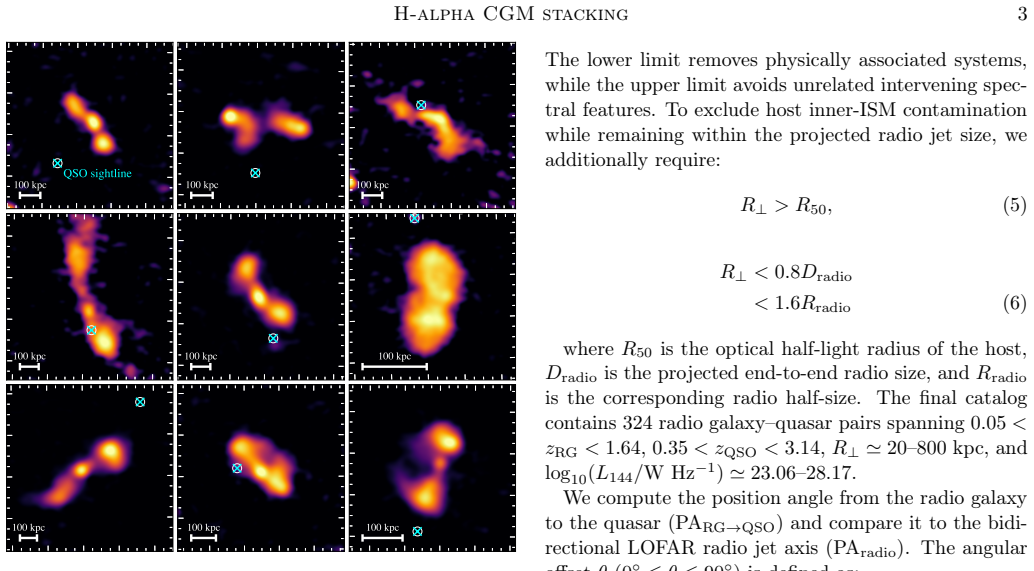
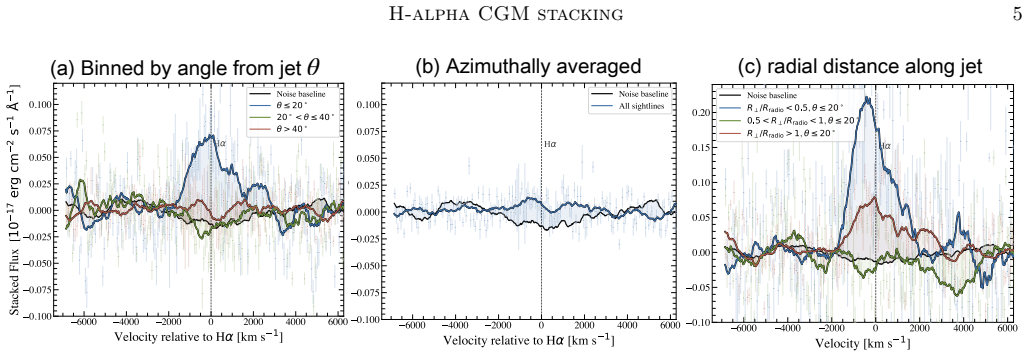
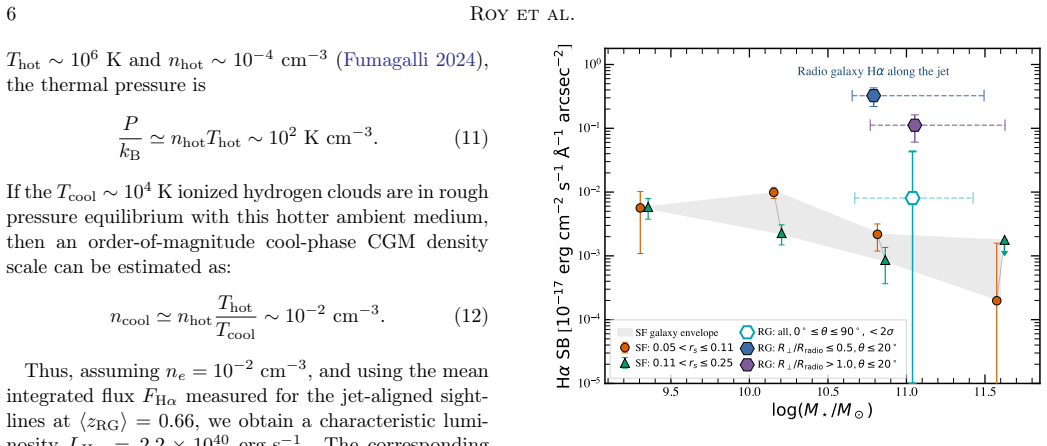
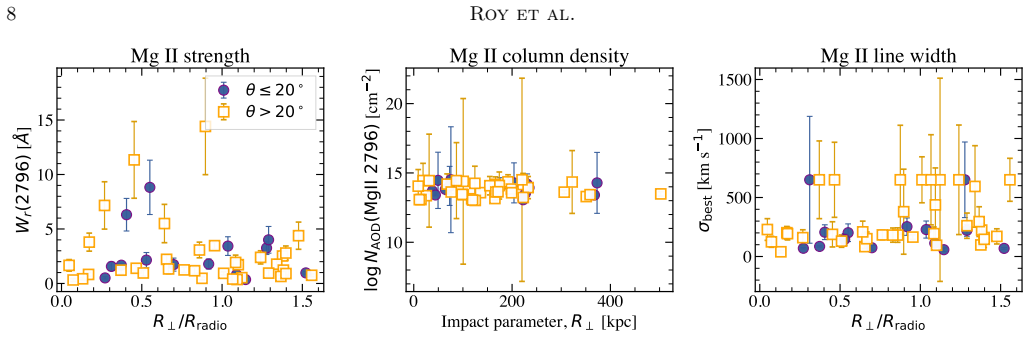
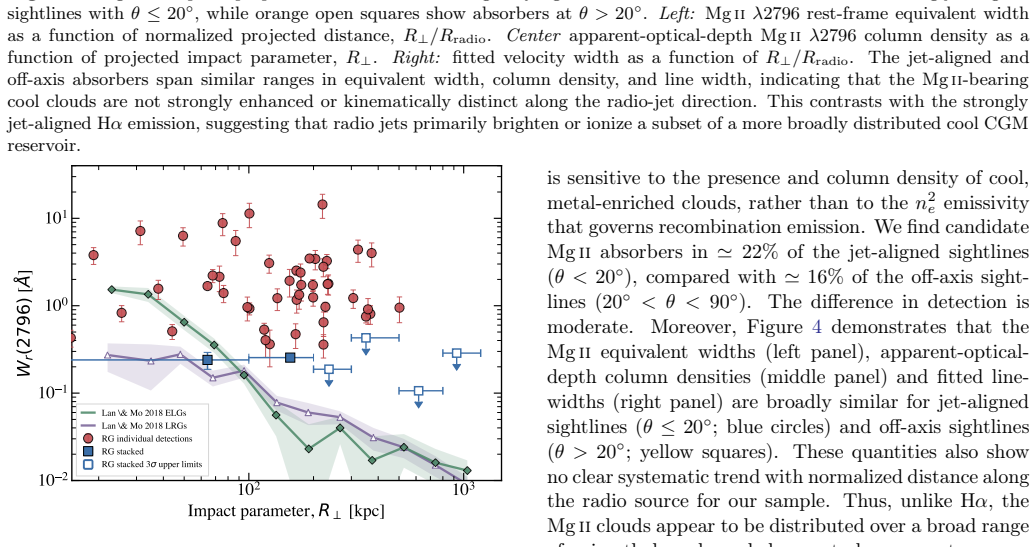
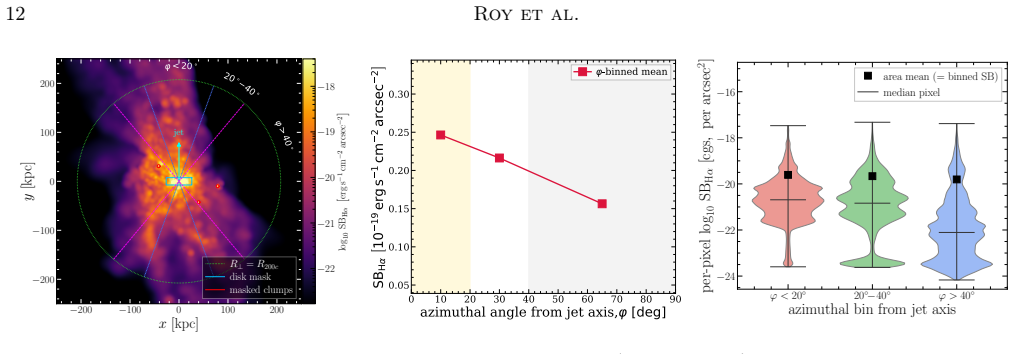
By stacking DESI quasar spectra around radio galaxies and binning by position angle to the jet axis, a strong Hα excess appears at greater than 5 sigma only along the jet direction with mean flux 1.19 times 10 to the minus 17 erg cm squared s inverse. The azimuthally averaged stack over 324 sightlines shows no detection, and the aligned signal is about 100 times brighter than normal halos with peaks near the optical half-light radius and radio lobes. Mg II absorption incidence, equivalent widths, column densities, and line widths show no difference between aligned and off-axis directions. This contrast demonstrates that Hα directly traces localized low-covering-fraction clouds whose density,
What carries the argument
Position-angle-binned stacking of background quasar spectra that isolates signals along the radio jet axis versus off-axis directions.
If this is right
- Jet-CGM coupling is anisotropic and confined to narrow angles around the jet axis.
- Hα emission captures jet-boosted clouds while Mg II traces the unaffected ambient CGM.
- The boosted emission is radially structured with enhancements near the host galaxy and radio lobes.
- Localized jet interaction can dramatically raise the emissivity of cool gas without altering absorption statistics.
Where Pith is reading between the lines
- Similar angle-binned stacking could be applied to other lines or wavelengths to map the full extent of directional feedback.
- The low covering fraction implied for the Hα clouds suggests they are discrete structures rather than a uniform medium.
- This anisotropy may help explain why some observed outflows appear bipolar rather than spherical.
Load-bearing premise
Radio jet axes are accurately determined from observations and quasar sightline position angles relative to the jet are measured without errors that would mix aligned and off-axis signals.
What would settle it
Repeating the stack after randomizing the assigned jet position angles for each galaxy and finding the same Hα excess strength would show the signal is not tied to the jet direction.
Figures
read the original abstract
A primary question within galaxy evolution is how active galactic nuclei (AGN) feedback modifies the circumgalactic medium (CGM). We present a search for faint H$\alpha$ emission from the cool ionized CGM ($T\sim 10^4$ K) around radio galaxies by stacking background-quasar spectra from DESI sightlines. We take into account the projected distance and position angle of each quasar sightline relative to the radio jet axis, and test whether jet--CGM coupling is anisotropic. We detect a strong H$\alpha$ excess at $>5\sigma$ along the collimated radio jet axis ($\theta<20^\circ$) with a mean integrated flux of $1.19\times10^{-17}\ {\rm erg\ cm^{-2}\ s^{-1}}$. In contrast, the azimuthally averaged stack over all 324 sightline angles yields no detection ($<2\sigma$), indicating that this excess emission is very localized along the radio jet. We also find that the jet-aligned H$\alpha$ signal is radially structured, where the strongest emission occurs near the host galaxy just outside the optical half-light radius, and rising again near the projected radio-lobe region. The jet-aligned stacks reveal H$\alpha$ signal that is roughly 100 times brighter than normal halos. In the same sightlines however, Mg II absorption shows no difference in incidence between jet-aligned and off-axis directions, with broadly similar equivalent widths, column densities, and line widths. This striking contrast shows that while Mg II traces the ambient, clumpy cool CGM reservoir, the H$\alpha$ emission directly captures localized, low-covering-fraction clouds whose density, pressure, or ionization level has been dramatically boosted by the propagating jet. These results deliver clear evidence of localized jet-CGM interaction in radio-jetted AGNs.
Editorial analysis
A structured set of objections, weighed in public.
Referee Report
Summary. The paper reports a stacking analysis of 324 DESI quasar sightlines through the CGM of radio galaxies, finding a >5σ Hα emission excess (mean flux 1.19×10^{-17} erg cm^{-2} s^{-1}) confined to sightlines with θ<20° relative to the radio jet axis, while the azimuthally averaged stack over all angles yields <2σ. The jet-aligned signal is radially structured and ~100× brighter than typical halos; Mg II absorption shows no corresponding anisotropy in incidence, equivalent width, or column density. The authors interpret this as evidence for localized, jet-driven boosting of cool CGM clouds.
Significance. If robust, the result supplies direct observational evidence that radio jets couple anisotropically to the cool ionized CGM, producing localized Hα emission enhancements without altering the ambient Mg II-traced reservoir. This would strengthen models of mechanical AGN feedback by showing that jet propagation can dramatically alter density, pressure, or ionization in a small solid angle while leaving the bulk CGM unaffected.
major comments (1)
- [position-angle binning and stacking procedure (abstract and methods description)] The central claim of jet-aligned anisotropy rests on accurate classification of the 324 sightlines into the θ<20° bin. The manuscript provides no assessment of radio-jet position-angle uncertainties (arising from finite resolution, lobe asymmetry, or core-jet misalignment) nor any robustness test that perturbs the observed PAs and re-stacks. If typical PA errors are ≳10–20°, a non-negligible fraction of off-axis sightlines will be misclassified into the aligned stack, potentially generating the reported >5σ contrast and the null azimuthal result as an artifact rather than a physical signal.
Simulated Author's Rebuttal
Thank you for the detailed and constructive referee report. We address the major comment on position-angle binning below, providing the strongest honest response based on the manuscript content. We agree the point identifies a genuine gap and will revise accordingly.
read point-by-point responses
-
Referee: [position-angle binning and stacking procedure (abstract and methods description)] The central claim of jet-aligned anisotropy rests on accurate classification of the 324 sightlines into the θ<20° bin. The manuscript provides no assessment of radio-jet position-angle uncertainties (arising from finite resolution, lobe asymmetry, or core-jet misalignment) nor any robustness test that perturbs the observed PAs and re-stacks. If typical PA errors are ≳10–20°, a non-negligible fraction of off-axis sightlines will be misclassified into the aligned stack, potentially generating the reported >5σ contrast and the null azimuthal result as an artifact rather than a physical signal.
Authors: We agree that the manuscript does not provide an assessment of radio-jet position-angle uncertainties or any robustness test that perturbs the observed PAs and re-stacks. This is a valid concern, as unaccounted errors of 10–20° could lead to misclassification and potentially inflate the reported contrast between the aligned and azimuthal stacks. In the revised manuscript, we will add a dedicated subsection in the methods describing typical PA uncertainties for the radio data used (drawing on resolution and morphology considerations from the source catalogs), followed by a Monte Carlo robustness test in which the PAs are perturbed within estimated error ranges and the stacks are recomputed. The results of this test will be reported, including the impact on the >5σ Hα detection significance. revision: yes
Circularity Check
No significant circularity; direct observational stacking result
full rationale
The paper reports an empirical detection of Hα excess via stacking of DESI quasar spectra, with sightlines binned by observed radio jet position angles. The central >5σ excess in the θ<20° bin and the contrast to the azimuthal stack (<2σ) are direct measurements of integrated flux from the data, with no equations, fitted parameters renamed as predictions, or derivations that reduce to inputs by construction. No self-citation chain, uniqueness theorem, or ansatz is invoked to justify the anisotropy claim; the result is self-contained against external benchmarks as a straightforward observational analysis.
Axiom & Free-Parameter Ledger
axioms (1)
- domain assumption Radio jet axes can be reliably determined from radio observations and position angles of quasar sightlines can be measured accurately relative to them.
Reference graph
Works this paper leans on
-
[1]
Begelman, M. C., & Cioffi, D. F. 1989, ApJL, 345, L21, doi: 10.1086/185542
-
[2]
Benson, A. J., Bower, R. G., Frenk, C. S., et al. 2003, ApJ, 599, 38, doi: 10.1086/379160
-
[3]
Bicknell, G. V. 1995, ApJS, 101, 29, doi: 10.1086/192232 Bîrzan, L., McNamara, B. R., Nulsen, P. E. J., Carilli, C. L., & Wise, M. W. 2008, ApJ, 686, 859, doi: 10.1086/591416
-
[4]
Neumann, D. M. 1993, MNRAS, 264, L25, doi: 10.1093/mnras/264.1.L25
-
[5]
2015, ApJ, 813, 46, doi: 10.1088/0004-637X/813/1/46 —
Borthakur, S., Heckman, T., Tumlinson, J., et al. 2015, ApJ, 813, 46, doi: 10.1088/0004-637X/813/1/46 —. 2016, ApJ, 833, 259, doi: 10.3847/1538-4357/833/2/259
-
[6]
Bower, R. G., Benson, A. J., Malbon, R., et al. 2006, MNRAS, 370, 645, doi: 10.1111/j.1365-2966.2006.10519.x
-
[7]
Chang, Y.-L., Lan, T.-W., Prochaska, J. X., et al. 2024, ApJ, 974, 191, doi: 10.3847/1538-4357/ad6c44
-
[8]
2023, RMxAA, 59, 327, doi: 10.22201/ia.01851101p.2023.59.02.12
Chatzikos, M., Bianchi, S., Camilloni, F., et al. 2023, RMxAA, 59, 327, doi: 10.22201/ia.01851101p.2023.59.02.12
-
[9]
2023, ApJ, 944, 107, doi: 10.3847/1538-4357/acb3c2
Chaussidon, E., Yèche, C., Palanque-Delabrouille, N., et al. 2023, ApJ, 944, 107, doi: 10.3847/1538-4357/acb3c2
-
[10]
Cowie, L. L., & Binney, J. 1977, ApJ, 215, 723, doi: 10.1086/155406
-
[11]
Croton, D. J., Springel, V., White, S. D. M., et al. 2006, MNRAS, 365, 11, doi: 10.1111/j.1365-2966.2005.09675.x Davé, R., Anglés-Alcázar, D., Narayanan, D., et al. 2019, MNRAS, 486, 2827, doi: 10.1093/mnras/stz937 DESI Collaboration, Aghamousa, A., Aguilar, J., et al. 2016, arXiv e-prints, arXiv:1611.00037, doi: 10.48550/arXiv.1611.00037 DESI Collaborati...
-
[12]
Donahue, M., & Voit, G. M. 2022, PhR, 973, 1, doi: 10.1016/j.physrep.2022.04.005
-
[13]
Dutta, R., Sharma, P., Sarkar, K. C., & Stone, J. M. 2023, arXiv e-prints, arXiv:2401.00446, doi: 10.48550/arXiv.2401.00446
-
[14]
Fabian, A. C. 2012, ARA&A, 50, 455, doi: 10.1146/annurev-astro-081811-125521
work page internal anchor Pith review doi:10.1146/annurev-astro-081811-125521 2012
-
[15]
Fabian, A. C., & Nulsen, P. E. J. 1977, MNRAS, 180, 479, doi: 10.1093/mnras/180.3.479
-
[16]
Fabian, A. C., Sanders, J. S., Allen, S. W., et al. 2003, MNRAS, 344, L43, doi: 10.1046/j.1365-8711.2003.06902.x
-
[17]
2024, arXiv e-prints, arXiv:2409.00174, doi: 10.48550/arXiv.2409.00174 14Roy et al
Fumagalli, M. 2024, arXiv e-prints, arXiv:2409.00174, doi: 10.48550/arXiv.2409.00174 14Roy et al
-
[18]
Gitti, M., Brighenti, F., & McNamara, B. R. 2012, Advances in Astronomy, 2012, 950641, doi: 10.1155/2012/950641
-
[19]
2023, AJ, 165, 144, doi: 10.3847/1538-3881/acb212
Guy, J., Bailey, S., Kremin, A., et al. 2023, AJ, 165, 144, doi: 10.3847/1538-3881/acb212
-
[20]
2012, ApJ, 746, 125, doi: 10.1088/0004-637X/746/2/125
Haardt, F., & Madau, P. 2012, ApJ, 746, 125, doi: 10.1088/0004-637X/746/2/125
-
[21]
Hardcastle, M. J., & Croston, J. H. 2020, NewAR, 88, 101539, doi: 10.1016/j.newar.2020.101539
-
[22]
Hardcastle, M. J., Horton, M. A., Williams, W. L., et al. 2023, A&A, 678, A151, doi: 10.1051/0004-6361/202347333
-
[23]
Heckman, T. M., & Best, P. N. 2014, ARA&A, 52, 589, doi: 10.1146/annurev-astro-081913-035722
work page internal anchor Pith review doi:10.1146/annurev-astro-081913-035722 2014
-
[24]
Ho, L. C. 2008, ARA&A, 46, 475, doi: 10.1146/annurev.astro.45.051806.110546
work page internal anchor Pith review Pith/arXiv arXiv doi:10.1146/annurev.astro.45.051806.110546 2008
-
[25]
Kondapally, R., Best, P. N., Raouf, M., et al. 2023, MNRAS, 523, 5292, doi: 10.1093/mnras/stad1813
-
[26]
2018, ApJ, 866, 36, doi: 10.3847/1538-4357/aadc08
Lan, T.-W., & Mo, H. 2018, ApJ, 866, 36, doi: 10.3847/1538-4357/aadc08
-
[27]
Leitherer, C., Schaerer, D., Goldader, J. D., et al. 1999, ApJS, 123, 3, doi: 10.1086/313233
work page internal anchor Pith review doi:10.1086/313233 1999
-
[28]
McCarthy, P. J. 1993, ARA&A, 31, 639, doi: 10.1146/annurev.aa.31.090193.003231
-
[29]
Self-healing high-dimensional quantum key distribution using hybrid spin-orbit Bessel states
McNamara, B. R., & Nulsen, P. E. J. 2007, ARA&A, 45, 117, doi: 10.1146/annurev.astro.45.051806.110625 —. 2012, New Journal of Physics, 14, 055023, doi: 10.1088/1367-2630/14/5/055023
work page internal anchor Pith review Pith/arXiv arXiv doi:10.1146/annurev.astro.45.051806.110625 2007
-
[30]
McNamara, B. R., Nulsen, P. E. J., Wise, M. W., et al. 2005, Nature, 433, 45, doi: 10.1038/nature03202
-
[31]
2008, A&A Rv, 15, 67, doi: 10.1007/s00159-007-0008-z
Miley, G., & De Breuck, C. 2008, A&A Rv, 15, 67, doi: 10.1007/s00159-007-0008-z
-
[32]
2016, MNRAS, 461, 967, doi: 10.1093/mnras/stw1368
Mukherjee, D., Bicknell, G. V., Sutherland, R., & Wagner, A. 2016, MNRAS, 461, 967, doi: 10.1093/mnras/stw1368
-
[33]
Mukherjee, D., Bicknell, G. V., Wagner, A. Y., Sutherland, R. S., & Silk, J. 2018, MNRAS, 479, 5544, doi: 10.1093/mnras/sty1776
work page internal anchor Pith review doi:10.1093/mnras/sty1776 2018
-
[34]
Nesvadba, N. P. H., De Breuck, C., Lehnert, M. D., Best, P. N., & Collet, C. 2017, A&A, 599, A123, doi: 10.1051/0004-6361/201528040
-
[35]
Gilbert, A. M., & van Breugel, W. 2008, A&A, 491, 407, doi: 10.1051/0004-6361:200810346
-
[36]
Nesvadba, N. P. H., Lehnert, M. D., Eisenhauer, F., et al. 2006, ApJ, 650, 693, doi: 10.1086/507266
-
[37]
2026, ApJ, 1002, 57, doi: 10.3847/1538-4357/ae5b68
Roy, N., Heckman, T., Henry, A., Wang, W., & Kukreti, P. 2026, ApJ, 1002, 57, doi: 10.3847/1538-4357/ae5b68
-
[38]
2021, ApJ, 922, 230, doi: 10.3847/1538-4357/ac24a0
Roy, N., Moravec, E., Bundy, K., et al. 2021, ApJ, 922, 230, doi: 10.3847/1538-4357/ac24a0
-
[39]
2024, ApJ, 970, 69, doi: 10.3847/1538-4357/ad4bda
Roy, N., Heckman, T., Overzier, R., et al. 2024, ApJ, 970, 69, doi: 10.3847/1538-4357/ad4bda
-
[40]
Saxena, A., Overzier, R. A., Villar-Martín, M., et al. 2024, arXiv e-prints, arXiv:2401.12199, doi: 10.48550/arXiv.2401.12199
-
[41]
Shimwell, T. W., Röttgering, H. J. A., Best, P. N., et al. 2017, A&A, 598, A104, doi: 10.1051/0004-6361/201629313
-
[42]
Shimwell, T. W., Hardcastle, M. J., Tasse, C., et al. 2022, A&A, 659, A1, doi: 10.1051/0004-6361/202142484
-
[43]
H., Fagrelius, P., Fanning, K., et al
Silber, J. H., Fagrelius, P., Fanning, K., et al. 2023, AJ, 165, 9, doi: 10.3847/1538-3881/ac9ab1
-
[44]
Sutherland, R. S., & Bicknell, G. V. 2007, Ap&SS, 311, 293, doi: 10.1007/s10509-007-9580-y
-
[45]
Thom, C., Tumlinson, J., Werk, J. K., et al. 2012, ApJL, 758, L41, doi: 10.1088/2041-8205/758/2/L41
-
[46]
Tumlinson, J., Peeples, M. S., & Werk, J. K. 2017, ARA&A, 55, 389, doi: 10.1146/annurev-astro-091916-055240
work page internal anchor Pith review doi:10.1146/annurev-astro-091916-055240 2017
-
[47]
Tumlinson, J., Thom, C., Werk, J. K., et al. 2013, ApJ, 777, 59, doi: 10.1088/0004-637X/777/1/59
-
[48]
The Astrophysical Journal Supplement Series , archivePrefix = "arXiv", eprint =
Turk, M. J., Smith, B. D., Oishi, J. S., et al. 2011, ApJS, 192, 9, doi: 10.1088/0067-0049/192/1/9 van Ojik, R., Roettgering, H. J. A., Miley, G. K., &
-
[49]
Hunstead, R. W. 1997, A&A, 317, 358, doi: 10.48550/arXiv.astro-ph/9608092
work page internal anchor Pith review Pith/arXiv arXiv doi:10.48550/arxiv.astro-ph/9608092 1997
-
[50]
Veilleux, S., Cecil, G., & Bland-Hawthorn, J. 2005, ARA&A, 43, 769, doi: 10.1146/annurev.astro.43.072103.150610 Villar-Martín, M., Vernet, J., di Serego Alighieri, S., et al. 2003, NewAR, 47, 291, doi: 10.1016/S1387-6473(03)00041-1
-
[51]
Wagner, A. Y., & Bicknell, G. V. 2011, ApJ, 728, 29, doi: 10.1088/0004-637X/728/1/29
-
[52]
Wagner, A. Y., Bicknell, G. V., & Umemura, M. 2012, ApJ, 757, 136, doi: 10.1088/0004-637X/757/2/136
-
[53]
2024, A&A, 683, A169, doi: 10.1051/0004-6361/202348531
Wang, W., Wylezalek, D., De Breuck, C., et al. 2024, A&A, 683, A169, doi: 10.1051/0004-6361/202348531
-
[54]
2024, MNRAS, 527, 1612, doi: 10.1093/mnras/stad3223
Yang, T., Davé, R., Cui, W., et al. 2024, MNRAS, 527, 1612, doi: 10.1093/mnras/stad3223
-
[55]
2020, ApJ, 888, 33, doi: 10.3847/1538-4357/ab55ed
Zhang, H., Yang, X., Zaritsky, D., Behroozi, P., & Werk, J. 2020, ApJ, 888, 33, doi: 10.3847/1538-4357/ab55ed
-
[56]
Zhang, H., Zaritsky, D., Zhu, G., Ménard, B., & Hogg, D. W. 2016, ApJ, 833, 276, doi: 10.3847/1538-4357/833/2/276
-
[57]
2014, MNRAS, 439, 3139, doi: 10.1093/mnras/stu186
Zhu, G., Ménard, B., Bizyaev, D., et al. 2014, MNRAS, 439, 3139, doi: 10.1093/mnras/stu186
discussion (0)
Sign in with ORCID, Apple, or X to comment. Anyone can read and Pith papers without signing in.