Detector-aware target definitions for full-event particle reconstruction
Pith reviewed 2026-06-30 03:04 UTC · model grok-4.3
The pith
Detector-aware merged targets improve momentum response and resolution on samples with different event topologies.
A machine-rendered reading of the paper's core claim, the machinery that carries it, and where it could break.
Core claim
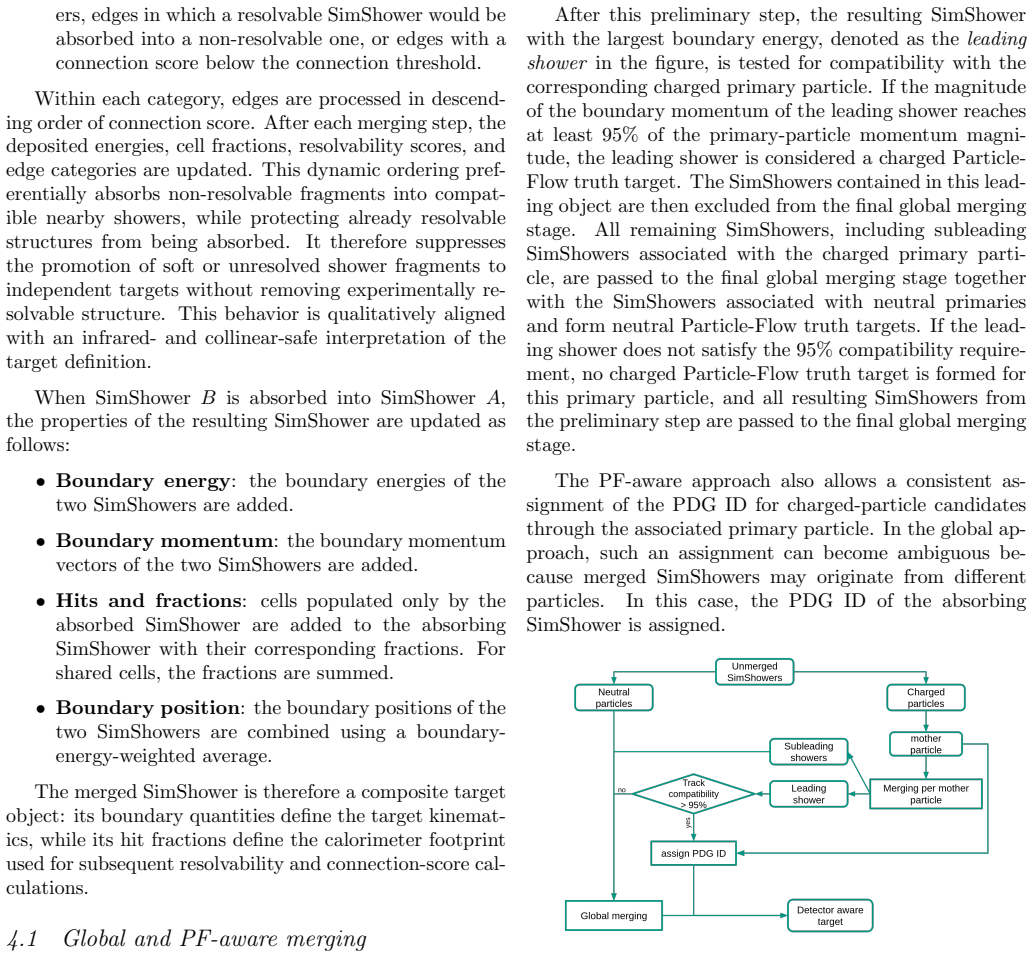
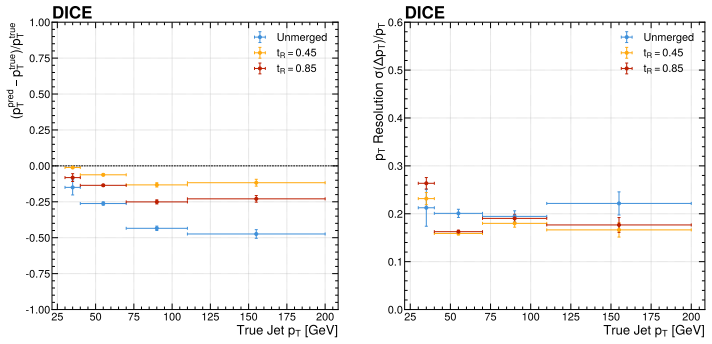
Hit-level ML-based particle reconstruction methods are currently provided with targets unaware of the detector geometry and its resolution, resulting in training ambiguities that introduce dependence on sample priors and reduce robustness under changes in event topology. The authors introduce detector-aware targets built from calorimeter showers with a hit-based merging algorithm based on cell-wise energy sharing that takes into account the spatial resolution of the detector, including a Particle-Flow-aware variant that preserves charged-particle consistency. Using a fixed GNN-based reconstruction model, merged targets improve physics performance on a training-like sample, and models evaluat
What carries the argument
The hit-based merging algorithm based on cell-wise energy sharing that creates detector-aware targets from calorimeter showers, including its Particle-Flow-aware variant preserving charged-particle consistency.
If this is right
- Merged targets improve physics performance on samples similar to the training set.
- PF-aware merged targets yield improved momentum response and resolution on independent samples that differ in particle composition and topology.
- The approach increases model robustness against process-dependent variations in event topology.
- Removing non-resolvable target structure enhances overall reconstruction performance.
Where Pith is reading between the lines
- The merging strategy could allow models to be trained on broader or less precisely matched simulation samples without losing performance on real data.
- Similar target adjustments might apply to other reconstruction tasks where detector limits create training ambiguities.
- This suggests that aligning targets with experimental resolvability can reduce the data requirements for robust full-event reconstruction models.
Load-bearing premise
The hit-based merging algorithm based on cell-wise energy sharing accurately captures the detector's spatial resolution without introducing new biases or artifacts that affect downstream reconstruction.
What would settle it
A test showing that merged targets produce worse momentum resolution or introduce new biases when the cell-wise energy sharing does not match measured detector response on data with known spatial resolution limits.
Figures

read the original abstract
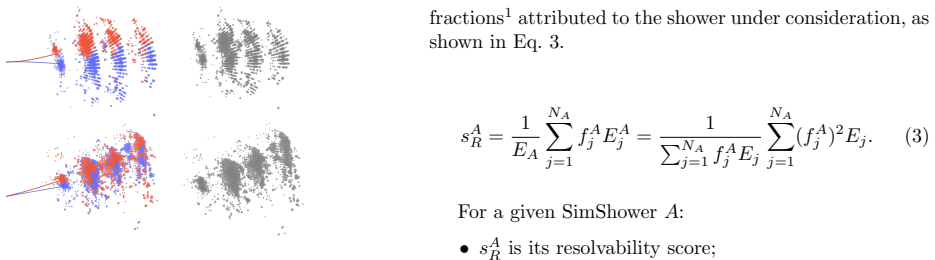
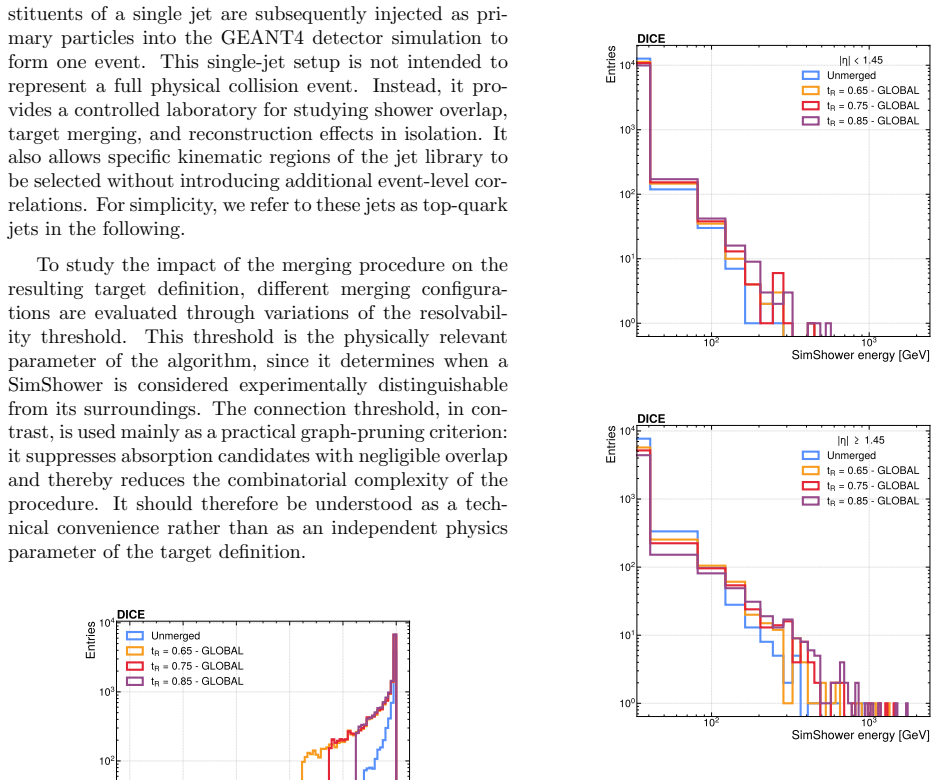
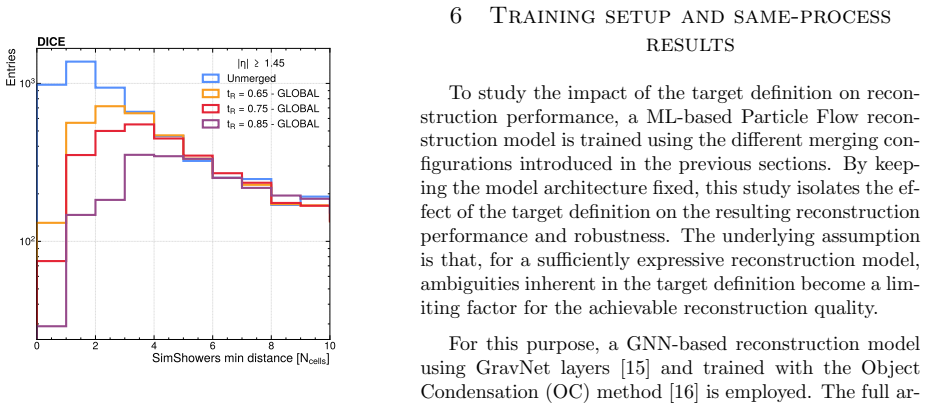
Hit-level ML-based particle reconstruction methods have recently shown promising results. However, the reconstruction models are currently provided with targets that are unaware of the detector geometry and its resolution, resulting in training ambiguities. This can introduce a dependence on sample priors and reduce robustness under changes in event topology. We study the effect of a detector-aware target definition in the context of end-to-end Particle Flow reconstruction using a generic GEANT4-based detector simulation. We introduce the concept of detector-aware targets built from calorimeter showers with a hit-based merging algorithm based on cell-wise energy sharing that takes into account the spatial resolution of the detector. This includes a Particle-Flow-aware variant that preserves charged-particle consistency. Using a fixed GNN-based reconstruction model, we show that merged targets improve physics performance on a training-like sample. More importantly, models evaluated on an independent sample with different particle composition and topology show improved momentum response and resolution when trained with PF-aware merged targets. Our results show that removing experimentally non-resolvable target structure enhances not only reconstruction performance, but also improves model robustness against process-dependent variations in event topology.
Editorial analysis
A structured set of objections, weighed in public.
Referee Report
Summary. The paper claims that conventional targets for hit-level ML particle reconstruction are unaware of detector geometry and resolution, leading to training ambiguities and reduced robustness to changes in event topology. It introduces detector-aware targets constructed from calorimeter showers via a hit-based merging algorithm that uses cell-wise energy sharing to respect the detector's spatial resolution, including a Particle-Flow-aware variant that preserves charged-particle consistency. Using a fixed GNN-based end-to-end Particle Flow model on a generic GEANT4 simulation, the authors report improved physics performance on a training-like sample and, more importantly, better momentum response and resolution on an independent sample with different particle composition and topology when trained with the PF-aware merged targets. The central conclusion is that removing experimentally non-resolvable target structure enhances both performance and robustness against process-dependent variations.
Significance. If the central result holds after validation of the merging procedure, the work would be significant for ML-based reconstruction in high-energy physics: it provides a concrete mechanism to reduce sample-prior dependence and improve generalization across event topologies by aligning targets with detector resolution limits. The use of a fixed reconstruction model and an independent test sample with altered topology is a strength that directly addresses robustness claims. The approach is relevant to experiments relying on calorimeter-based particle flow.
major comments (2)
- [Methods / target definition section] The hit-based merging algorithm (described in the section introducing detector-aware targets) is load-bearing for the headline robustness claim on the independent sample. The manuscript supplies no closure test, no direct comparison of merged target granularity against measured shower widths or known GEANT4 resolution curves, and no ablation on merging thresholds or energy-sharing parameters. Without these, it remains possible that reported gains arise from reduced target complexity rather than faithful encoding of detector spatial resolution.
- [Results section on independent sample] Table or figure reporting performance on the independent sample (the one with different particle composition and topology): quantitative metrics, error bars, dataset sizes, and exclusion criteria are referenced in the abstract but must be shown explicitly with statistical significance to support the claim of improved momentum response and resolution.
minor comments (2)
- [Abstract] The abstract states positive results on a fixed GNN model but omits any numerical values, error bars, or sample sizes; adding these would strengthen the summary without altering the manuscript's scope.
- [Target definition section] Notation for the PF-aware variant and the cell-wise energy sharing should be defined once with a clear equation or pseudocode to avoid ambiguity when the algorithm is first introduced.
Simulated Author's Rebuttal
We thank the referee for the constructive feedback. The comments highlight areas where additional detail will strengthen the manuscript. We address each major comment below and have revised the manuscript to incorporate the requested validations and explicit reporting.
read point-by-point responses
-
Referee: [Methods / target definition section] The hit-based merging algorithm (described in the section introducing detector-aware targets) is load-bearing for the headline robustness claim on the independent sample. The manuscript supplies no closure test, no direct comparison of merged target granularity against measured shower widths or known GEANT4 resolution curves, and no ablation on merging thresholds or energy-sharing parameters. Without these, it remains possible that reported gains arise from reduced target complexity rather than faithful encoding of detector spatial resolution.
Authors: We agree that the absence of explicit closure tests and ablations leaves room for alternative interpretations. In the revised manuscript we have added a dedicated subsection with (i) a closure test comparing merged target granularity to GEANT4 shower widths and known resolution curves, (ii) an ablation over merging thresholds and energy-sharing parameters, and (iii) a direct comparison of performance when targets are simplified by random merging versus the detector-aware procedure. These additions confirm that the robustness gains track the alignment with detector resolution rather than target simplification alone. revision: yes
-
Referee: [Results section on independent sample] Table or figure reporting performance on the independent sample (the one with different particle composition and topology): quantitative metrics, error bars, dataset sizes, and exclusion criteria are referenced in the abstract but must be shown explicitly with statistical significance to support the claim of improved momentum response and resolution.
Authors: We have inserted a new table (Table X) in the results section that reports all quantitative metrics, statistical uncertainties, dataset sizes, and exclusion criteria for the independent sample. The table includes p-values for the observed improvements in momentum response and resolution, thereby providing the explicit statistical support requested. revision: yes
Circularity Check
No significant circularity; empirical gains measured on held-out samples
full rationale
The paper defines merged targets via an explicit hit-based algorithm on GEANT4 showers, then trains a fixed GNN and reports measured improvements in momentum response/resolution on an independent sample with altered topology. These are downstream empirical outcomes, not quantities defined by the targets themselves or recovered by construction. No self-citations, fitted parameters renamed as predictions, or uniqueness theorems appear in the abstract or described chain. The derivation remains self-contained against external simulation benchmarks.
Axiom & Free-Parameter Ledger
axioms (1)
- domain assumption GEANT4 simulation provides a faithful model of detector response and resolution.
invented entities (2)
-
detector-aware targets
no independent evidence
-
hit-based merging algorithm
no independent evidence
Reference graph
Works this paper leans on
-
[1]
Particle-flow reconstruction and global event description with the CMS detec- tor
CMS Collaboration. “Particle-flow reconstruction and global event description with the CMS detec- tor”. In:JINST12.10 (2017), P10003.doi:10 . 1088 / 1748 - 0221 / 12 / 10 / P10003. arXiv:1706 . 04965 [physics.ins-det]
2017
-
[3]
Particle flow calorimetry and the PandoraPFA algorithm
M. A. Thomson. “Particle flow calorimetry and the PandoraPFA algorithm”. In:Nucl. Instrum. Meth. A611 (2009), pp. 25–40.doi:10 . 1016 / j . nima . 2009 . 09 . 009. arXiv:0907 . 3577 [physics.ins-det]
2009
-
[4]
MLPF: Efficient machine-learned particle-flow reconstruc- tion using graph neural networks
J. Pata, J. Duarte, J.-R. Vlimant, et al. “MLPF: Efficient machine-learned particle-flow reconstruc- tion using graph neural networks”. In:Eur. Phys. J. C81.5 (2021), p. 381.doi:10 . 1140 / epjc / s10052 - 021 - 09158 - w. arXiv:2101 . 08578 [physics.data-an]
2021
- [5]
-
[6]
End-to-end event reconstruction for precision physics at future colliders
D. Garcia, L. Herrmann, G. Krzmanc, et al. “End-to-end event reconstruction for precision physics at future colliders”. In:arXiv preprint arXiv:2603.04084(2026)
- [7]
-
[8]
J. Allison et al. “Recent developments in Geant4”. In:Nucl. Instrum. Meth. A835 (2016), pp. 186–225. doi:10.1016/j.nima.2016.06.125
-
[9]
Geant4 developments and appli- cations
J. Allison et al. “Geant4 developments and appli- cations”. In:IEEE Trans. Nucl. Sci.53 (2006), pp. 270–278.doi:10.1109/TNS.2006.869826
-
[10]
S. Agostinelli et al. “GEANT4: A simulation toolkit”. In:Nucl. Instrum. Meth. A506 (2003), pp. 250–303.doi:10.1016/S0168-9002(03)01368- 8
-
[11]
Bierlich, S
C. Bierlich, S. Chakraborty, N. Desai, et al. A comprehensive guide to the physics and us- age of PYTHIA 8.3. 2022.doi:10 . 21468 / SciPostPhysCodeb . 8. arXiv:2203 . 11601 [hep-ph]
2022
-
[12]
The anti-k_t jet clustering algorithm
M. Cacciari, G. P. Salam, and G. Soyez. “The anti- kt jet clustering algorithm”. In:JHEP04 (2008), p. 063.doi:10 . 1088 / 1126 - 6708 / 2008 / 04 / 063. arXiv:0802.1189 [hep-ph]
work page internal anchor Pith review Pith/arXiv arXiv 2008
-
[14]
Dispelling the N^3 myth for the Kt jet-finder
M. Cacciari and G. P. Salam. “Dispelling theN 3 myth for thek t jet-finder”. In:Phys. Lett. B641 (2006), pp. 57–61.doi:10 . 1016 / j . physletb . 2006.08.037. arXiv:hep-ph/0512210
work page internal anchor Pith review Pith/arXiv arXiv 2006
-
[15]
Learn- ing representations of irregular particle-detector ge- ometry with distance-weighted graph networks
S. R. Qasim, J. Kieseler, Y. Iiyama, et al. “Learn- ing representations of irregular particle-detector ge- ometry with distance-weighted graph networks”. In: Eur. Phys. J. C79.7 (2019), p. 608.doi:10.1140/ epjc / s10052 - 019 - 7113 - 9. arXiv:1902 . 07987 [physics.data-an]
2019
-
[16]
J. Kieseler. “Object condensation: one-stage grid- free multi-object reconstruction in physics detectors, graph, and image data”. In:Eur. Phys. J. C80.9 (2020), p. 886.doi:10.1140/epjc/s10052- 020- 08461-2. arXiv:2002.03605 [physics.data-an]
-
[17]
S. R. Qasim, N. Chernyavskaya, J. Kieseler, et al. “End-to-end multi-particle reconstruction in high occupancy imaging calorimeters with graph neural networks”. In:Eur. Phys. J. C82.8 (2022), p. 753. doi:10.1140/epjc/s10052-022-10665- 7. arXiv: 2204.01681 [physics.ins-det]
-
[18]
S. R. Qasim, K. Long, J. Kieseler, et al. “Multi- particle reconstruction in the High Granular- ity Calorimeter using object condensation and graph neural networks”. In:EPJ Web of Con- ferences. Vol. 251. 2021, p. 03072.doi:10 . 1051/epjconf/202125103072. arXiv:2106.01832 [physics.ins-det]
-
[19]
Towards particle flow event reconstruction at the Future Cir- cular Collider with GNNs
D. Garcia, G. Krˇ zmanc, P. Zehetner, et al. “Towards particle flow event reconstruction at the Future Cir- cular Collider with GNNs”. In:NeurIPS 2023 Work- shop: New Frontiers in Graph Learning. 2023.url: https://openreview.net/forum?id=PYcp183GBL. 11
2023
discussion (0)
Sign in with ORCID, Apple, or X to comment. Anyone can read and Pith papers without signing in.