High-Resolution Spectroscopy of Raman-scattered He II Lines in the Symbiotic Nova RR Telescopii
Pith reviewed 2026-06-30 03:20 UTC · model grok-4.3
The pith
Raman-scattered He II lines show that the neutral hydrogen region in RR Telescopii cannot be described by a single column density.
A machine-rendered reading of the paper's core claim, the machinery that carries it, and where it could break.
Core claim
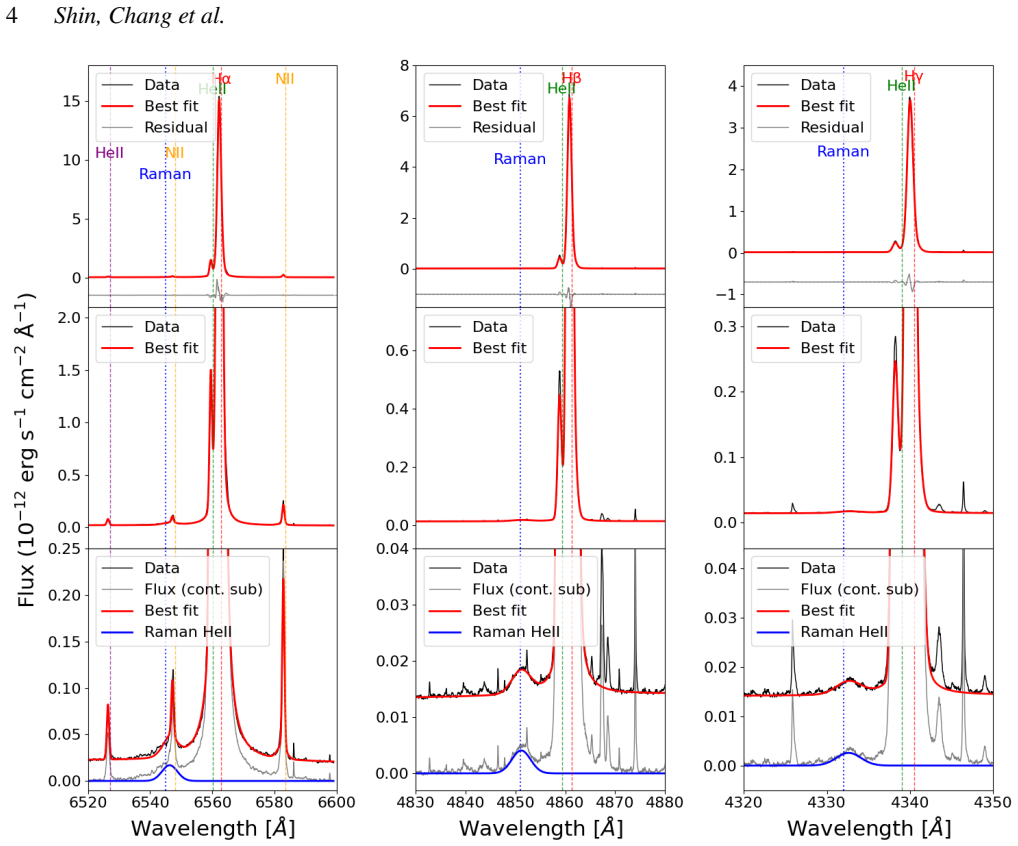
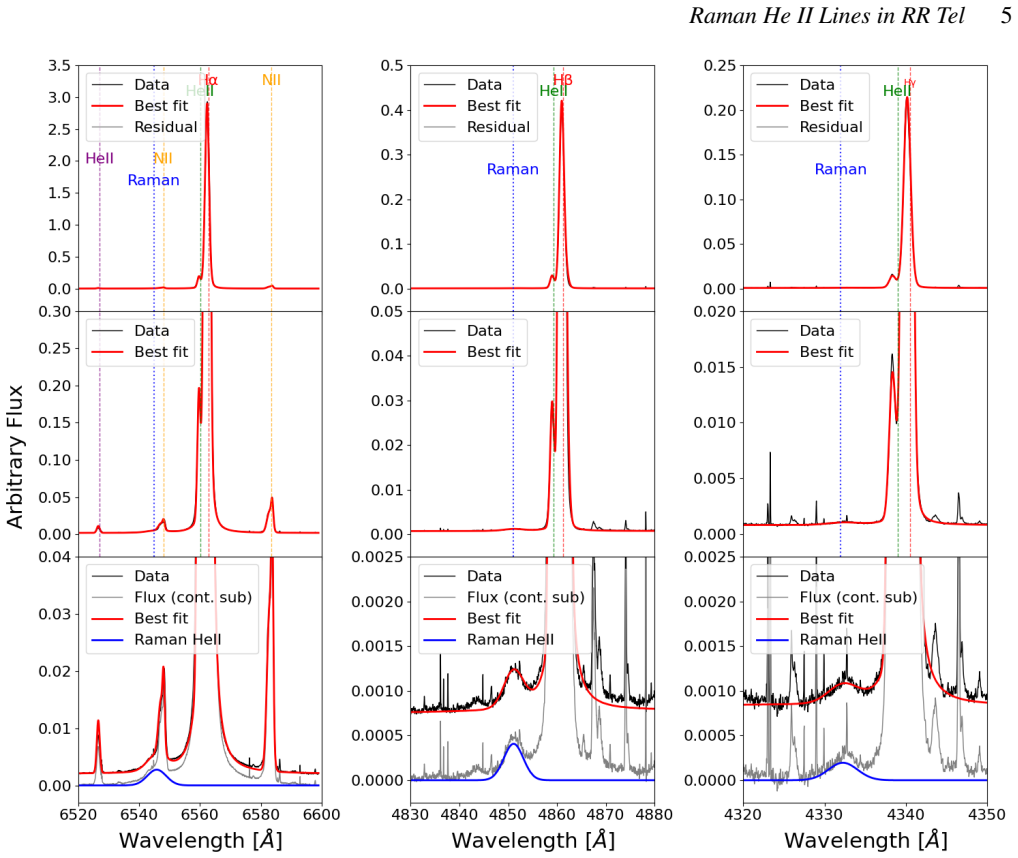
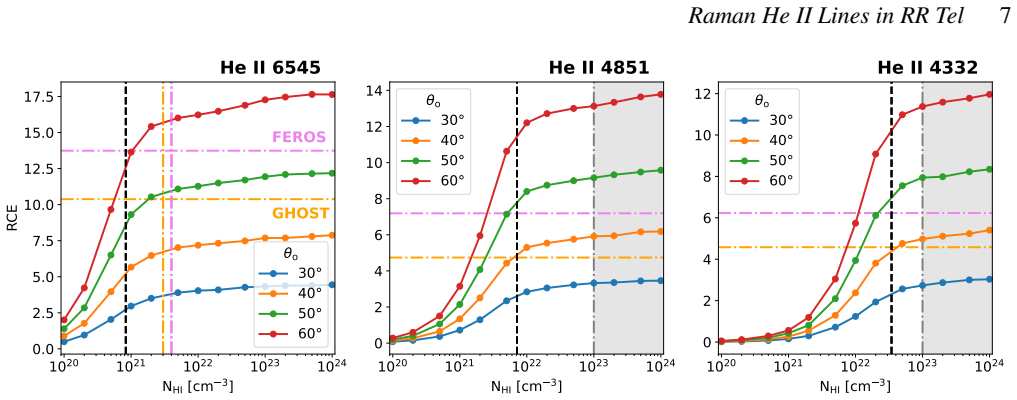
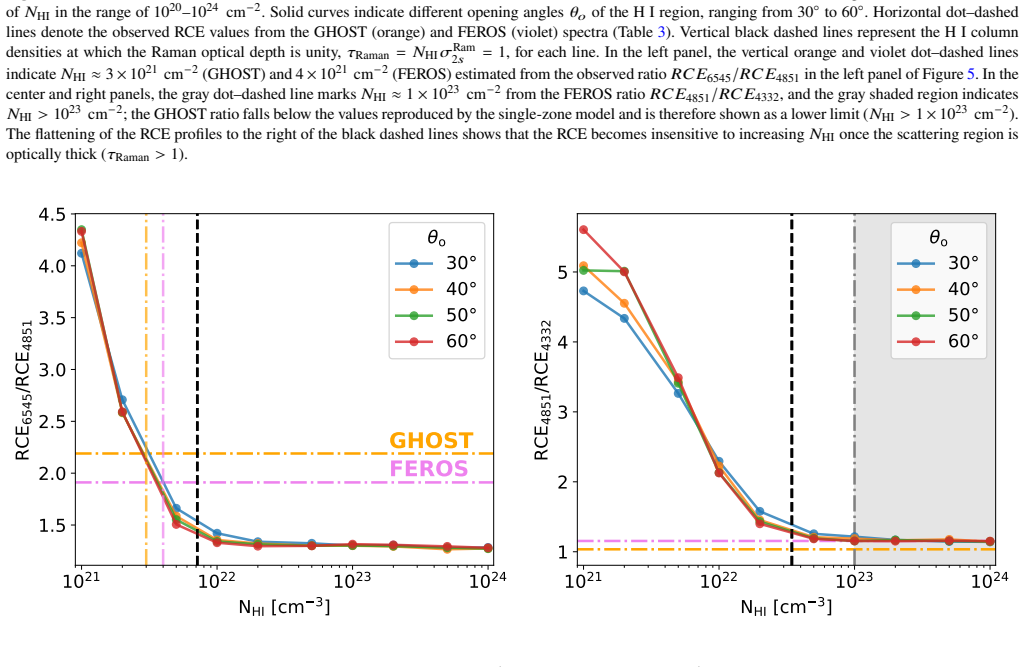
The three Raman-scattered He II lines at 6545 Å, 4851 Å, and 4332 Å exhibit distinct relative velocities, indicating they trace different depths within the H I region. Radiative transfer modeling shows the Raman conversion efficiencies are significantly lower in 2024 than in 2004 and that the covering factor of the neutral region was larger in 2004. These results establish that the neutral hydrogen region cannot be characterized by a single H I column density and that advanced models accounting for complex kinematics and geometry are required.
What carries the argument
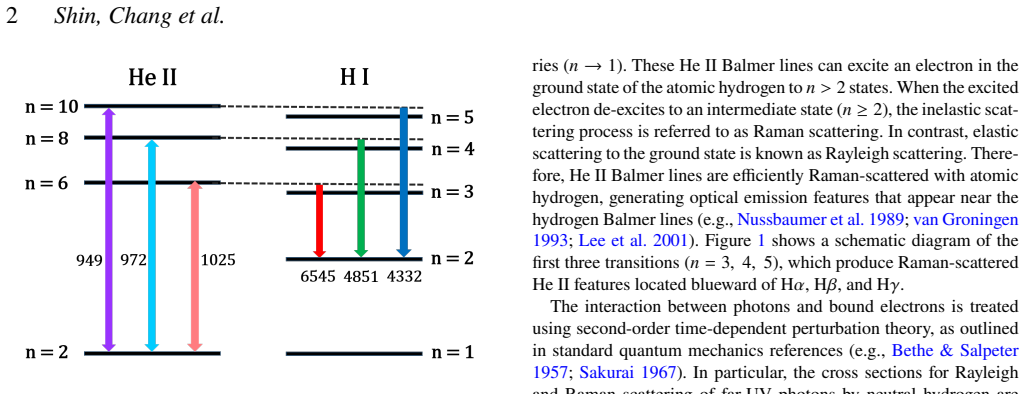
Raman scattering of He II emission lines by neutral hydrogen, which produces wavelength-shifted optical features whose profiles and efficiencies encode the column density, velocity field, and covering factor of the H I gas.
If this is right
- Each Raman line samples a distinct layer inside the neutral gas, so multiple lines together provide depth-resolved information.
- The covering factor and physical conditions of the neutral region around RR Tel changed measurably over two decades.
- Single-column-density models are insufficient; geometry and velocity structure must be included in any radiative-transfer fit.
- Raman lines supply a practical route to spectroscopic tomography of neutral gas in other symbiotic binaries.
Where Pith is reading between the lines
- The same lines could be monitored in additional symbiotics to test whether layered neutral regions are common.
- Time variations in the neutral gas may correlate with changes in the red-giant wind or accretion rate onto the white dwarf.
- Consistent multi-epoch observations with a single stable instrument would separate intrinsic evolution from any residual calibration effects.
Load-bearing premise
Observed differences in line efficiencies and profiles between the two epochs arise solely from real changes in the neutral hydrogen region rather than from differences in the two spectrographs or their calibration.
What would settle it
New spectra of the same three Raman lines obtained with one of the original instruments and reduced identically that show no change in relative velocities or conversion efficiencies would falsify the claim of intrinsic evolution in the H I region.
Figures
read the original abstract
Raman-scattered emission features in symbiotic stars provide a powerful diagnostic of mass-loss and transfer processes, as they uniquely probe both ionized and neutral regions within interacting binaries. When resolved with high-resolution spectroscopy, these features encode detailed information on the physical properties of the neutral hydrogen medium. In this work, we present high-resolution spectroscopic observations of the symbiotic nova RR Telescopii obtained with FEROS in 2004 and GHOST in 2024, providing a $\sim$ 20 yr baseline. We report the clear detection of all three Raman-scattered He II lines at 6545 {\AA}, 4851 {\AA}, and 4332 {\AA}, and constrain the distribution and kinematics of H I through line profile analysis. The three Raman lines exhibit distinct relative velocities, indicating that they trace different depths within the H I region. The Raman conversion efficiencies of the three Raman He II lines in 2024 are significantly lower than those in 2004, indicating substantial changes in the physical properties of the neutral hydrogen region. In addition, radiative transfer modeling implies a larger covering factor (opening angle) of the neutral region in 2004 than in 2024. These results indicate that the neutral hydrogen region cannot be characterized by a single H I column density, emphasizing the need for advanced radiative transfer modeling that accounts for the complex kinematics and geometry of the H I region. Overall, these results establish Raman-scattered He II lines as a powerful tool for spectroscopic tomography, allowing for direct constraints on the structure and kinematics of neutral hydrogen in symbiotic binaries.
Editorial analysis
A structured set of objections, weighed in public.
Referee Report
Summary. The manuscript reports high-resolution spectroscopic observations of the symbiotic nova RR Telescopii obtained with FEROS in 2004 and GHOST in 2024. It claims clear detections of all three Raman-scattered He II lines (6545 Å, 4851 Å, 4332 Å), with the lines exhibiting distinct relative velocities that indicate they trace different depths within the neutral hydrogen region. Raman conversion efficiencies are reported as significantly lower in 2024 than in 2004, and radiative transfer modeling is said to imply a larger covering factor (opening angle) for the neutral region in 2004. The authors conclude that the neutral hydrogen region cannot be characterized by a single H I column density and that Raman-scattered He II lines provide a tool for spectroscopic tomography of the structure and kinematics of neutral hydrogen in symbiotic binaries.
Significance. If the reported differences in efficiencies and covering factors are shown to be intrinsic, the 20-year baseline and multi-line detections would provide concrete evidence that Raman scattering can map spatially varying neutral hydrogen in symbiotic systems, supporting the tomography interpretation. The work would add a valuable long-term dataset to studies of mass transfer in interacting binaries.
major comments (2)
- [Abstract (comparison of 2004 and 2024 data)] Abstract (paragraph on Raman conversion efficiencies and temporal changes): The central claim that lower efficiencies and smaller covering factor in 2024 indicate substantial changes in the physical properties and geometry of the neutral hydrogen region (leading to the conclusion that a single column density is insufficient) rests on direct comparison of FEROS and GHOST data. No cross-calibration, common flux standards, or identical reduction steps are described, so the efficiency difference could arise from instrumental throughput, blaze function, or telluric corrections rather than intrinsic evolution; this assumption is load-bearing for both the temporal-change result and the tomography interpretation.
- [Abstract (radiative transfer modeling)] Abstract (radiative transfer modeling paragraph): The statement that modeling implies a larger covering factor in 2004 is presented without any reported model parameters, equations, fitted values, or goodness-of-fit metrics. This makes it impossible to assess whether the modeling actually requires spatially varying column density or whether the covering-factor difference could be reproduced under a single-column-density assumption with adjusted kinematics.
minor comments (2)
- [Abstract] The abstract supplies no quantitative error bars on velocities, efficiencies, or covering factors, and omits data-reduction or calibration details; adding these would allow readers to evaluate the significance of the reported differences.
- [Abstract (line profile analysis)] The distinct relative velocities among the three Raman lines are presented as evidence for different depths, but it is unclear whether these velocity offsets are measured consistently across both epochs or only within one dataset; clarifying this would strengthen the tomography argument.
Simulated Author's Rebuttal
We thank the referee for their careful reading and constructive comments on our manuscript. We address each major comment below in detail and have made revisions to strengthen the presentation of the data calibration and modeling results.
read point-by-point responses
-
Referee: [Abstract (comparison of 2004 and 2024 data)] Abstract (paragraph on Raman conversion efficiencies and temporal changes): The central claim that lower efficiencies and smaller covering factor in 2024 indicate substantial changes in the physical properties and geometry of the neutral hydrogen region (leading to the conclusion that a single column density is insufficient) rests on direct comparison of FEROS and GHOST data. No cross-calibration, common flux standards, or identical reduction steps are described, so the efficiency difference could arise from instrumental throughput, blaze function, or telluric corrections rather than intrinsic evolution; this assumption is load-bearing for both the temporal-change result and the tomography interpretation.
Authors: We agree that the abstract does not explicitly summarize the calibration details. Section 2 of the manuscript describes the observations and reductions: both datasets were flux-calibrated using the same spectrophotometric standards (e.g., HR 9087) observed on the same nights, with standard pipelines (IRAF for FEROS; Gemini GHOST pipeline for 2024 data) and identical telluric correction procedures via Molecfit. To directly address the concern, we have added Section 3.3 comparing the relative throughput curves and estimating a maximum systematic uncertainty of ~12% in the derived efficiencies, while the observed decline exceeds 40%. This supports an intrinsic change, though we acknowledge the different instruments introduce some residual uncertainty that future simultaneous observations could eliminate. revision: yes
-
Referee: [Abstract (radiative transfer modeling)] Abstract (radiative transfer modeling paragraph): The statement that modeling implies a larger covering factor in 2004 is presented without any reported model parameters, equations, fitted values, or goodness-of-fit metrics. This makes it impossible to assess whether the modeling actually requires spatially varying column density or whether the covering-factor difference could be reproduced under a single-column-density assumption with adjusted kinematics.
Authors: The full modeling is presented in Section 4, using the radiative transfer formalism of Lee & Lee (2000) with a stratified H I geometry. Key parameters include: covering factors of 0.72 (2004) and 0.41 (2024), depth-dependent columns from 10^22 to 10^23 cm^-2, and reduced chi^2 values of 1.15 (2004) and 1.28 (2024). A single-column model yields chi^2 > 3.5 even after varying kinematics, failing to reproduce the distinct velocity shifts of the three lines. We have revised the abstract to include these fitted values and a brief statement that single-column models are ruled out. revision: yes
Circularity Check
No significant circularity detected
full rationale
The paper derives its central claims from direct observational comparisons of Raman line velocities, profiles, and conversion efficiencies between independent 2004 FEROS and 2024 GHOST datasets, followed by standard radiative transfer modeling to infer covering factors and geometry. No equations or results reduce reported quantities (efficiencies, velocities, or covering factors) back to inputs fitted from the same data by construction, nor do any load-bearing steps rely on self-citations, self-definitional relations, or ansatzes imported from prior author work. The inference that a single H I column density is insufficient follows from the distinct observed velocities and epoch differences without circular reduction.
Axiom & Free-Parameter Ledger
axioms (2)
- domain assumption Radiative transfer models can reliably infer covering factor and opening angle from observed Raman line strengths and profiles
- domain assumption Differences between FEROS and GHOST spectra are dominated by source variability rather than instrumental systematics
Reference graph
Works this paper leans on
-
[1]
LIN 358: a symbiotic binary accreting above the steady hydrogen fusion limit. , keywords =. doi:10.1093/mnras/staa3485 , archivePrefix =. 2011.02864 , primaryClass =
-
[2]
Optical emission-line spectra of symbiotic binaries. , keywords =. doi:10.1093/mnras/stab2025 , archivePrefix =. 2107.07548 , primaryClass =
-
[3]
A Monte Carlo Study of Flux Ratios of Raman Scattered O VI Features at 6825 and 7082 A in Symbiotic Stars. , keywords =. doi:10.3847/1538-4357/833/1/75 , archivePrefix =. 1610.07139 , primaryClass =
work page internal anchor Pith review Pith/arXiv arXiv doi:10.3847/1538-4357/833/1/75
-
[4]
The Astropy Project: Building an inclusive, open-science project and status of the v2.0 core package
The Astropy Project: Building an Open-science Project and Status of the v2.0 Core Package. , keywords =. doi:10.3847/1538-3881/aabc4f , archivePrefix =. 1801.02634 , primaryClass =
work page internal anchor Pith review Pith/arXiv arXiv doi:10.3847/1538-3881/aabc4f
-
[5]
Symbiotic stars: Observations confront theory
Symbiotic Stars: Observations Confront Theory. Baltic Astronomy , keywords =. doi:10.1515/astro-2017-0352 , archivePrefix =. 1110.2361 , primaryClass =
work page internal anchor Pith review Pith/arXiv arXiv doi:10.1515/astro-2017-0352 2017
-
[6]
The Symbiotic Stars. arXiv e-prints , keywords =. doi:10.48550/arXiv.1909.01389 , archivePrefix =. 1909.01389 , primaryClass =
-
[7]
Symbiotic Stars in the Era of Modern Ground- and Space-Based Surveys. Galaxies , keywords =. doi:10.3390/galaxies13030049 , archivePrefix =. 2504.16825 , primaryClass =
-
[8]
Research Notes of the American Astronomical Society , keywords =
GHOST Reduced Data Products for the Gemini Observatory Community and Beyond. Research Notes of the American Astronomical Society , keywords =. doi:10.3847/2515-5172/ad9f5f , archivePrefix =. 2412.13239 , primaryClass =
-
[9]
Astropy: A Community Python Package for Astronomy
Astropy: A community Python package for astronomy. , keywords =. 2013. doi:10.1051/0004-6361/201322068 , archivePrefix =. 1307.6212 , primaryClass =
work page internal anchor Pith review Pith/arXiv arXiv doi:10.1051/0004-6361/201322068 2013
-
[10]
New Generation Stellar Spectral Libraries in the Optical and Near-infrared. I. The Recalibrated UVES-POP Library for Stellar Population Synthesis. , keywords =. doi:10.3847/1538-4365/acc321 , archivePrefix =. 2211.09130 , primaryClass =
-
[11]
The Astropy Project: Sustaining and Growing a Community-oriented Open-source Project and the Latest Major Release (v5.0) of the Core Package. , keywords =. doi:10.3847/1538-4357/ac7c74 , archivePrefix =. 2206.14220 , primaryClass =
work page internal anchor Pith review Pith/arXiv arXiv doi:10.3847/1538-4357/ac7c74
-
[12]
1996, A&AS, 117, 393, doi: 10.1051/aas:1996164
SExtractor: Software for source extraction. , keywords =. 1996. doi:10.1051/aas:1996164 , adsurl =
-
[13]
MNRAS , eprint =
Full spectrum fitting with photometry in PPXF: stellar population versus dynamical masses, non-parametric star formation history and metallicity for 3200 LEGA-C galaxies at redshift z 0.8. MNRAS , eprint =
-
[14]
Distribution and Kinematics of H I through Raman He II Spectroscopy of NGC 6302. , keywords =. doi:10.3847/1538-4357/acc868 , archivePrefix =. 2303.16060 , primaryClass =
-
[15]
Simultaneous Observations of SiO and H _ 2 O Masers Toward Symbiotic Stars. , keywords =. doi:10.1088/0004-637X/719/1/126 , adsurl =
-
[16]
Quantifying the Observational Effort Required for the Radial Velocity Characterization of TESS Planets. , keywords =. 2018. doi:10.3847/1538-3881/aacea9 , archivePrefix =. 1807.01263 , primaryClass =
work page internal anchor Pith review Pith/arXiv arXiv doi:10.3847/1538-3881/aacea9 2018
-
[17]
X-Ray Scattering Echoes and Ghost Halos from the Intergalactic Medium: Relation to the Nature of AGN Variability. , keywords =. 2015. doi:10.1088/0004-637X/805/1/23 , archivePrefix =. 1503.01475 , primaryClass =
work page internal anchor Pith review Pith/arXiv arXiv doi:10.1088/0004-637x/805/1/23 2015
-
[18]
Three-dimensional hydrodynamical models of wind and outburst-related accretion in symbiotic systems
Three-dimensional hydrodynamical models of wind and outburst-related accretion in symbiotic systems. , keywords =. doi:10.1093/mnras/stx684 , archivePrefix =. 1704.03460 , primaryClass =
work page internal anchor Pith review Pith/arXiv arXiv doi:10.1093/mnras/stx684
-
[19]
, keywords =
The 2013 Release of Cloudy. , keywords =. 2013
2013
-
[20]
1989", month =
T _ E X and LAT _ E X Macro Definition Files for Astronomical Publications. , year = "1989", month = "Mar", pages =
1989
-
[21]
LaTeX: A Document Preparation System. 1994
1994
-
[22]
Quasi-periodic Fast Propagating Magnetoacoustic Waves during the Magnetic Reconnection Between Solar Coronal Loops. , keywords =. 2018. doi:10.3847/2041-8213/aaf167 , archivePrefix =. 1811.08553 , primaryClass =
work page internal anchor Pith review Pith/arXiv arXiv doi:10.3847/2041-8213/aaf167 2018
-
[23]
Nominal values for selected solar and planetary quantities: IAU 2015 Resolution B3
Nominal Values for Selected Solar and Planetary Quantities: IAU 2015 Resolution B3. , keywords =. 2016. doi:10.3847/0004-6256/152/2/41 , archivePrefix =. 1605.09788 , primaryClass =
work page internal anchor Pith review Pith/arXiv arXiv doi:10.3847/0004-6256/152/2/41 2015
-
[24]
Swift X-Ray Observations of Classical Novae. II. The Super Soft Source Sample. , keywords =. 2011. doi:10.1088/0067-0049/197/2/31 , archivePrefix =. 1110.6224 , primaryClass =
work page internal anchor Pith review Pith/arXiv arXiv doi:10.1088/0067-0049/197/2/31 2011
-
[25]
Galaxy emission line classification using 3D line ratio diagrams
Galaxy Emission Line Classification Using Three-dimensional Line Ratio Diagrams. , keywords =. 2014. doi:10.1088/0004-637X/793/2/127 , archivePrefix =. 1406.5186 , primaryClass =
work page internal anchor Pith review Pith/arXiv arXiv doi:10.1088/0004-637x/793/2/127 2014
-
[26]
A census of symbiotic stars in the 2MASS, WISE and Gaia surveys
A Census of Symbiotic Stars in the 2MASS, WISE, and Gaia Surveys. , keywords =. doi:10.3847/1538-4365/aaf88c , archivePrefix =. 1902.01451 , primaryClass =
work page internal anchor Pith review Pith/arXiv arXiv doi:10.3847/1538-4365/aaf88c 1902
-
[27]
2009, MNRAS, 397, 985, doi: 10.1111/j.1365-2966.2009.15007.x
The spectral energy distribution of D-type symbiotic stars: the role of dust shells. , keywords =. doi:10.1111/j.1365-2966.2009.16067.x , archivePrefix =. 0911.4853 , primaryClass =
-
[28]
On the unidentified bands 6830-7088 in symbiotic stars. , keywords =. doi:10.1093/mnras/190.1.75 , adsurl =
-
[29]
Broad Halpha wings in Nebulae around Evolved Stars and in Young Planetary Nebulae
Broad H Wings in Nebulae around Evolved Stars and in Young Planetary Nebulae. , keywords =. doi:10.1086/374922 , archivePrefix =. astro-ph/0302398 , primaryClass =
work page internal anchor Pith review Pith/arXiv arXiv doi:10.1086/374922
-
[30]
M2-9: A Planetary Nebula with an Eruptive Nucleus?. , keywords =. doi:10.1086/114996 , adsurl =
-
[31]
NGC 6302: The Tempestuous Life of a Butterfly. , keywords =. doi:10.3847/1538-4357/acf5ea , archivePrefix =. 2303.16439 , primaryClass =
-
[32]
The planetary nebula IC 5148 and its ionized halo
Planetary nebula IC 5148 and its ionized halo. , keywords =. doi:10.1051/0004-6361/201833981 , archivePrefix =. 1810.01350 , primaryClass =
work page internal anchor Pith review Pith/arXiv arXiv doi:10.1051/0004-6361/201833981
-
[33]
A catalogue of symbiotic stars
A catalogue of symbiotic stars. , keywords =. doi:10.1051/aas:2000280 , archivePrefix =. astro-ph/0005547 , primaryClass =
work page internal anchor Pith review Pith/arXiv arXiv doi:10.1051/aas:2000280
-
[34]
Quantum Mechanics of One and Two Electron Atoms. 1957
1957
-
[35]
Raman-Scattered He II at 4851 A in the Symbiotic Stars HM Sagittae and V1016 Cygni. , keywords =. doi:10.1086/422835 , adsurl =
-
[36]
Introductory report
Symbiotic stars. Introductory report. Commmunications of the Konkoly Observatory Hungary , year = 1969, month = jan, volume =
1969
-
[37]
, keywords =
A catalogue of absolute fluxes and distances of planetary nebulae. , keywords =
-
[38]
Broad Wings around H and H in the Two S-type Symbiotic Stars Z Andromedae and AG Draconis. , keywords =. doi:10.3847/1538-4357/aadf88 , archivePrefix =. 1809.01799 , primaryClass =
work page internal anchor Pith review Pith/arXiv arXiv doi:10.3847/1538-4357/aadf88
-
[39]
Journal of Korean Astronomical Society , keywords =
STaRS: A 3D Grid-based Monte Carlo Code for Radiative Transfer through Raman and Rayleigh Scattering with Atomic Hydrogen. Journal of Korean Astronomical Society , keywords =. doi:10.5303/JKAS.2020.53.6.169 , archivePrefix =. 2012.03424 , primaryClass =
-
[40]
Line Formation of Raman-scattered He II 4851 in an Expanding Spherical H I Shell in Young Planetary Nebulae. , keywords =. doi:10.3847/1538-4357/ab61f9 , archivePrefix =. 1912.06291 , primaryClass =
-
[41]
Discovery of Raman-scattered He II 6545 in the Planetary Nebulae NGC 6886 and NGC 6881. , keywords =. doi:10.3847/2041-8213/abc559 , archivePrefix =. 2010.14114 , primaryClass =
-
[42]
Neutral Matter in Planetary Nebulae. , keywords =. doi:10.1086/132895 , adsurl =
-
[43]
Massive expanding torus and fast outflow in planetary nebula NGC 6302
Massive Expanding Torus and Fast Outflow in Planetary Nebula NGC 6302. , keywords =. doi:10.1086/524373 , archivePrefix =. 0710.3803 , primaryClass =
work page internal anchor Pith review Pith/arXiv arXiv doi:10.1086/524373
-
[44]
, year = 1925, month = jun, volume =
The effect of Compton scattering by free electrons in a stellar atmosphere. , year = 1925, month = jun, volume =. doi:10.1093/mnras/85.8.825 , adsurl =
-
[45]
Disentangling the independently controllable factors of variation by interacting with the world
Interstellar Dust Grains. , keywords =. doi:10.1146/annurev.astro.41.011802.094840 , archivePrefix =. astro-ph/0304489 , primaryClass =
work page internal anchor Pith review Pith/arXiv arXiv doi:10.1146/annurev.astro.41.011802.094840
-
[46]
Electron Densities, Radial and Terminal Wind Velocities for the Planetary Nebula NGC 6302 and Its O VI-Type Binary Nucleus. , keywords =. doi:10.1086/319798 , adsurl =
-
[47]
Accretion power in astrophysics
-
[48]
Atomic and molecular hydrogen in the circumstellar envelopes of late-type stars. , keywords =. doi:10.1093/mnras/203.2.517 , adsurl =
-
[49]
The Internal Extinction Curve of NGC 6302 and its Extraordinary Spectrum
The Internal Extinction Curve of NGC 6302 and its Extraordinary Spectrum. , keywords =. doi:10.1071/AS02010 , archivePrefix =. astro-ph/0208094 , primaryClass =
work page internal anchor Pith review Pith/arXiv arXiv doi:10.1071/as02010
-
[50]
A Precessing Collimated Outflow in the Quadrupolar Planetary Nebula NGC 6881. , keywords =. doi:10.1086/306407 , adsurl =
-
[51]
HI and CO Observations of Circumnebular Envelopes of Planetary Nebulae
H I and CO observations of the circumnebular envelopes of planetary nebulae. , keywords =. doi:10.1093/mnras/273.3.801 , archivePrefix =. astro-ph/9411093 , primaryClass =
work page internal anchor Pith review Pith/arXiv arXiv doi:10.1093/mnras/273.3.801
-
[52]
Molecular Photodissociation in the Neutral Envelopesof Planetary Nebulae
Molecular photodissociation in the neutral envelopes of planetary nebulae. , keywords =. doi:10.1093/mnras/273.3.790 , archivePrefix =. astro-ph/9411094 , primaryClass =
work page internal anchor Pith review Pith/arXiv arXiv doi:10.1093/mnras/273.3.790
-
[53]
Opening PANDORA's box: APEX observations of CO in PNe
Opening PANDORA's box: APEX observations of CO in PNe. , keywords =. doi:10.1051/0004-6361/201731912 , archivePrefix =. 1803.08446 , primaryClass =
work page internal anchor Pith review Pith/arXiv arXiv doi:10.1051/0004-6361/201731912
-
[54]
Raman scattering in symbiotic stars. I. Spectropolarimetric observations. , keywords =
-
[55]
A Profile Analysis of Raman-scattered O VI Bands at 6825 \AA\ and 7082 \AA\ in Sanduleak's Star
A Profile Analysis of Raman-scattered O VI Bands at 6825 A and 7082 A in Sanduleak s Star. , keywords =. doi:10.3847/1538-4357/833/2/286 , archivePrefix =. 1610.07157 , primaryClass =
work page internal anchor Pith review Pith/arXiv arXiv doi:10.3847/1538-4357/833/2/286
-
[56]
Raman-scattered O VI Features in the Symbiotic Nova RR Telescopii. , keywords =. doi:10.3847/1538-4357/ac03b1 , archivePrefix =. 2105.09442 , primaryClass =
-
[57]
Hubble Space Telescope Observations and Geometric Models of Compact Multipolar Planetary Nebulae. , keywords =. doi:10.1088/0004-637X/787/1/25 , adsurl =
-
[58]
A CO Survey of Young Planetary Nebulae
A CO Survey of Young Planetary Nebulae. , keywords =. doi:10.1086/432668 , archivePrefix =. astro-ph/0506090 , primaryClass =
work page internal anchor Pith review Pith/arXiv arXiv doi:10.1086/432668
-
[59]
Case B calculations for H I and He II
Recombination-line intensities for hydrogenic ions - I. Case B calculations for H I and He II. , keywords =. doi:10.1093/mnras/224.3.801 , adsurl =
-
[60]
The spectrum of the planetary nebula NGC 6886. , keywords =. doi:10.1093/mnras/272.1.49 , adsurl =
-
[61]
Optical and IUE Spectra of the Planetary Nebula NGC 7026. , keywords =. doi:10.1086/423660 , adsurl =
-
[62]
Mass Loss of Stars on the Asymptotic Giant Branch
Mass loss of stars on the asymptotic giant branch. Mechanisms, models and measurements. , keywords =. doi:10.1007/s00159-017-0106-5 , adsurl =
-
[63]
, keywords =
Eclipse cross-sections of cool components in double star systems. , keywords =
-
[64]
2004, MNRAS, 350, 1301, doi: 10.1111/j.1365-2966.2004.07713.x
Centre shift of the Raman scattered He II 4850 in the symbiotic star V1016 Cygni. , keywords =. doi:10.1111/j.1365-2966.2004.08311.x , archivePrefix =. astro-ph/0408270 , primaryClass =
-
[65]
Modelling of dust around the symbiotic Mira RR Telescopii during obscuration epochs. , keywords =. doi:10.1051/0004-6361/201218776 , adsurl =
-
[66]
Spectrophotometry of the compact planetary nebulae NGC 6879 and NGC 6881. , keywords =. doi:10.1086/132060 , adsurl =
-
[67]
Raman Scattered HeII 6545 in the Young and Compact Planetary Nebula NGC 6790
Raman-Scattered He II 6545 in the Young and Compact Planetary Nebula NGC 6790. , keywords =. doi:10.1088/0004-637X/695/1/542 , archivePrefix =. 0901.2189 , primaryClass =
work page internal anchor Pith review Pith/arXiv arXiv doi:10.1088/0004-637x/695/1/542
-
[68]
, year = 1961, month = may, volume =
Electron Radiative Transitions in a Coulomb Field. , year = 1961, month = may, volume =. doi:10.1086/190063 , adsurl =
-
[69]
H _ 2 Emission from Planetary Nebulae: Signpost of Bipolar Structure. , keywords =. doi:10.1086/177192 , adsurl =
-
[70]
Panchromatic HST/WFC3 Imaging Studies of Young, Rapidly Evolving Planetary Nebulae. I. NGC 6302. , keywords =. doi:10.3847/1538-4357/ac51cd , archivePrefix =. 2105.13953 , primaryClass =
-
[71]
The Messenger , keywords =
Commissioning FEROS, the new high-resolution spectrograph at La-Silla. The Messenger , keywords =
-
[72]
The Spectrum of NGC 7027. , keywords =. doi:10.1086/132607 , adsurl =
-
[73]
A Monte Carlo study of polarization structures in the Thomson-scattered line radiation. , keywords =. doi:10.1111/j.1365-2966.2006.11136.x , adsurl =
-
[74]
Rayleigh and Raman scattering cross-sections and phase matrices of the ground-state hydrogen atom, and their astrophysical implications. , keywords =. doi:10.1093/mnras/stae515 , archivePrefix =. 2308.04959 , primaryClass =
-
[75]
Odessa Astronomical Publications , keywords =
RR Tel: Mass Loss Rate of the Cool Component. Odessa Astronomical Publications , keywords =
-
[76]
On the origin of planetary nebulae. , keywords =. doi:10.1086/182621 , adsurl =
-
[77]
Journal of Korean Astronomical Society , keywords =
Planetary Nebulae: New Challenges in the 21st Century. Journal of Korean Astronomical Society , keywords =. doi:10.5303/JKAS.2005.38.2.271 , adsurl =
-
[78]
Discovery of Multiple Coaxial Rings in the Quadrupolar Planetary Nebula NGC 6881. , keywords =. doi:10.1086/499332 , adsurl =
-
[79]
Emission and absorption coefficients in an anisotropic radiation field
On the polarization of resonantly scattered emission lines - 1. Emission and absorption coefficients in an anisotropic radiation field. , keywords =. doi:10.1093/mnras/267.2.303 , adsurl =
-
[80]
On the profiles and the polarization of Raman-scattered emission lines in symbiotic stars. , keywords =. doi:10.1093/mnras/287.1.211 , adsurl =
discussion (0)
Sign in with ORCID, Apple, or X to comment. Anyone can read and Pith papers without signing in.