Little Red Dots as Intermediate Mass, Super-Eddington Engines: Insights from Type IIn Supernovae and The 1837-1856 Great Eruption of η Carinae
Pith reviewed 2026-07-01 02:12 UTC · model grok-4.3
The pith
Little Red Dots are powered by intermediate-mass super-Eddington engines whose wind outflows produce the observed pseudo-photospheres and broad lines.
A machine-rendered reading of the paper's core claim, the machinery that carries it, and where it could break.
Core claim
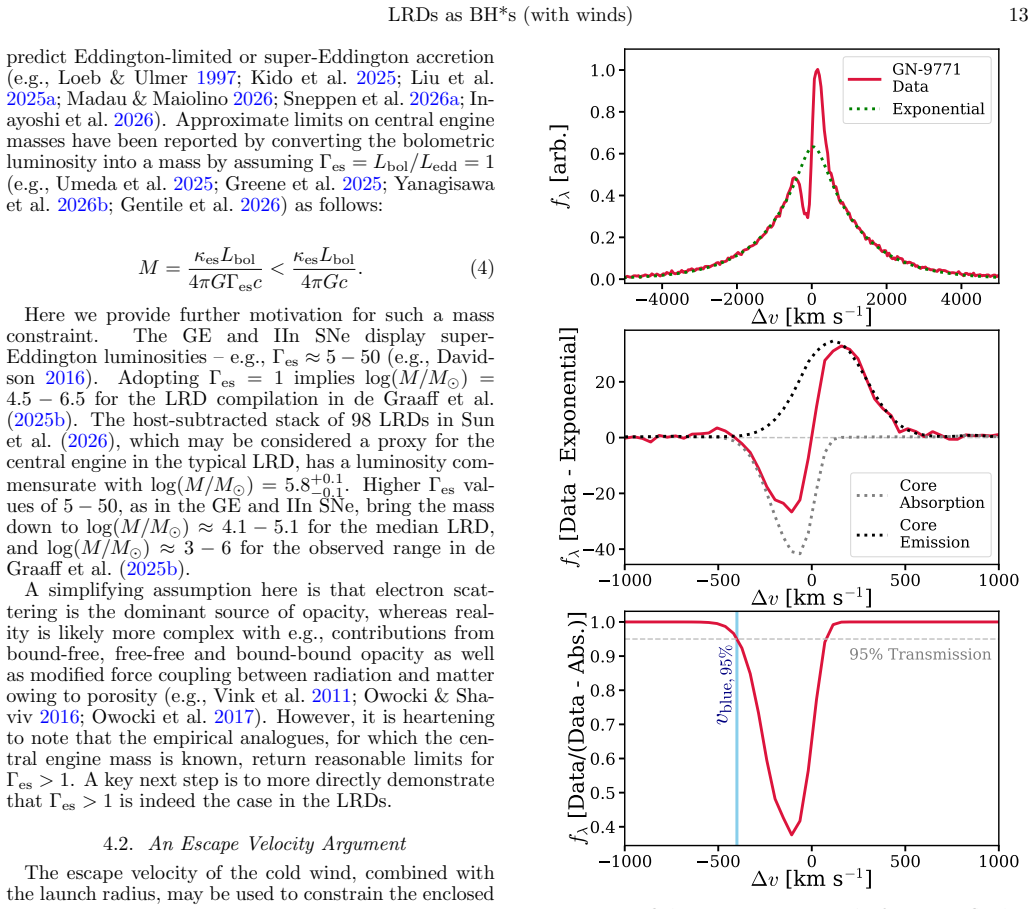
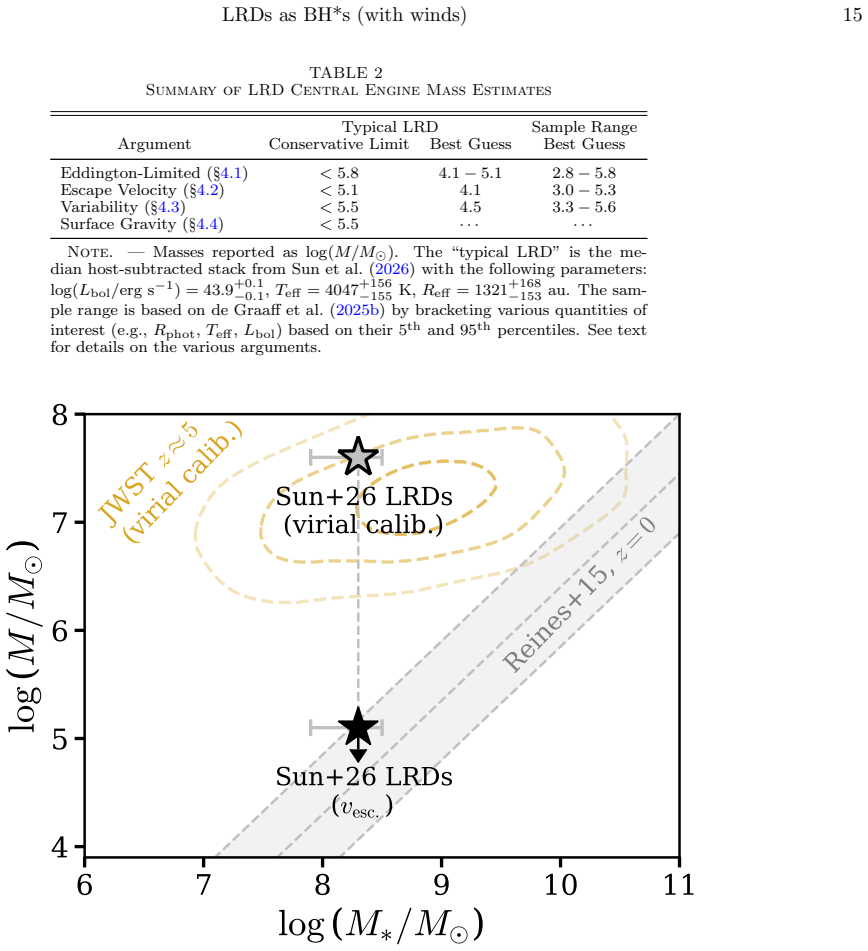
LRDs arise when outflows from an intermediate-mass central engine build a dense, slow wind that forms an obscuring pseudo-photosphere; radiation from the buried engine powers the system while fast winds crashing into the envelope produce shocks, and lines form via electron scattering and absorption in the clumpy medium above the photosphere. This wind-like physics, rather than a virial broad-line region, accounts for the spectra, and an escape-velocity argument applied to the line widths limits the engine mass to M < 10^5 M_⊙, favoring super-Eddington (L_bol/L_edd ≳ 5) systems with M ≈ 10^3-6 M_⊙ that are either supermassive stars or IMBHs.
What carries the argument
Escape-velocity mass constraint applied to broad lines interpreted as forming in a slow, dense outflow wind rather than a virialized broad-line region, scaled from the outflow-enshrouded pseudo-photosphere seen in η Carinae and Type IIn supernovae.
If this is right
- Virial black-hole mass estimates for LRDs are systematically too high because the lines trace wind motion instead of orbital motion.
- The central engines have masses between roughly 10^3 and 10^6 solar masses and radiate at more than five times the Eddington luminosity.
- Dust condensation in the expanding envelope will eventually allow the central engine to become visible as a classical AGN.
- The large size and low surface gravity of the photosphere naturally explain the lack of observed variability.
- LRDs represent an early, enshrouded phase that can grow into more massive black holes.
Where Pith is reading between the lines
- If correct, LRDs would supply a population of intermediate-mass seeds that can grow into the supermassive black holes observed at lower redshifts.
- The same wind-envelope physics might explain other compact, red, high-redshift sources that lack strong variability.
- Future spectroscopy could test whether the line ratios and absorption features match the clumpy-wind predictions calibrated on η Carinae.
Load-bearing premise
That the spectra and photometry of LRDs are generated by the same outflow-trapped pseudo-photosphere mechanism that operates on stellar scales in η Carinae and Type IIn supernovae, without extra galactic-scale effects or different geometries.
What would settle it
Observation of rapid variability on timescales much shorter than the light-crossing time of a large, low-gravity photosphere, or line profiles that cannot be reproduced by electron scattering plus absorption in a clumpy ionized-neutral wind.
Figures
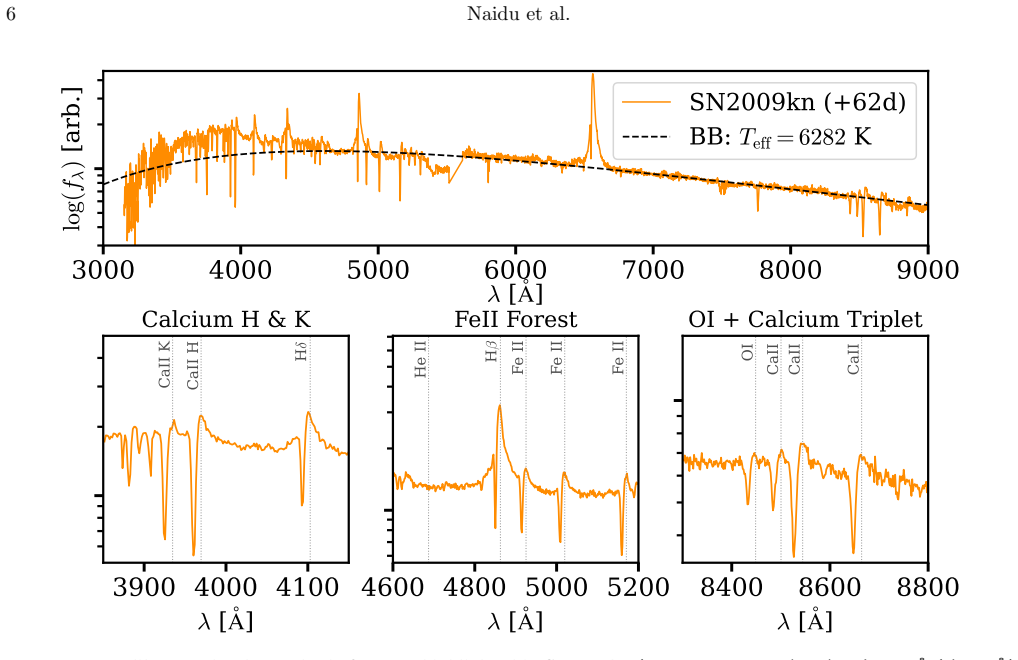
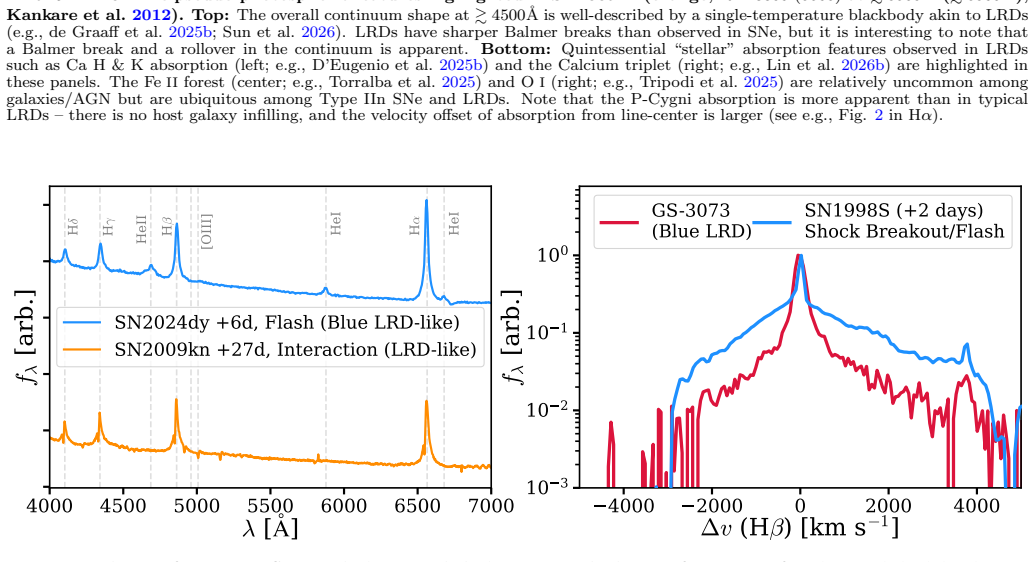
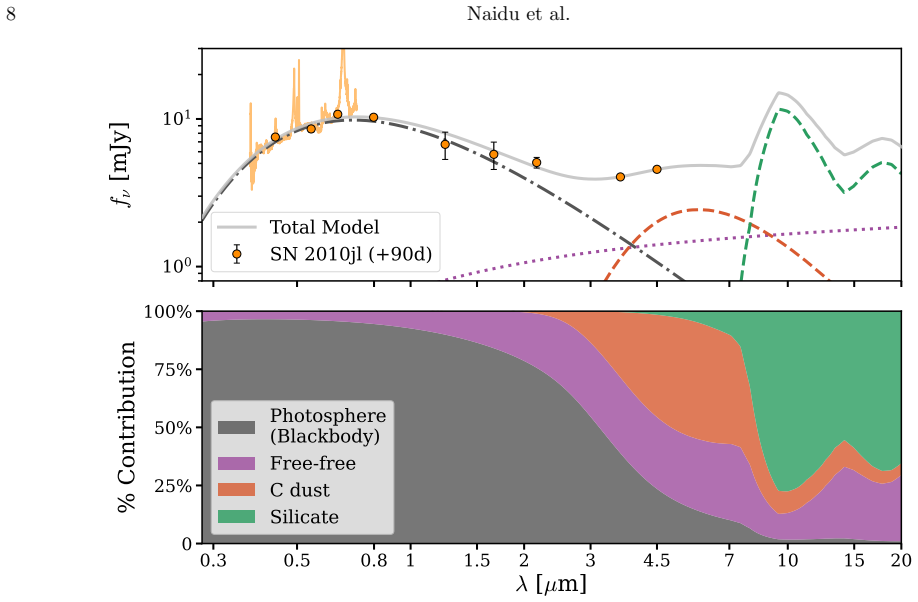
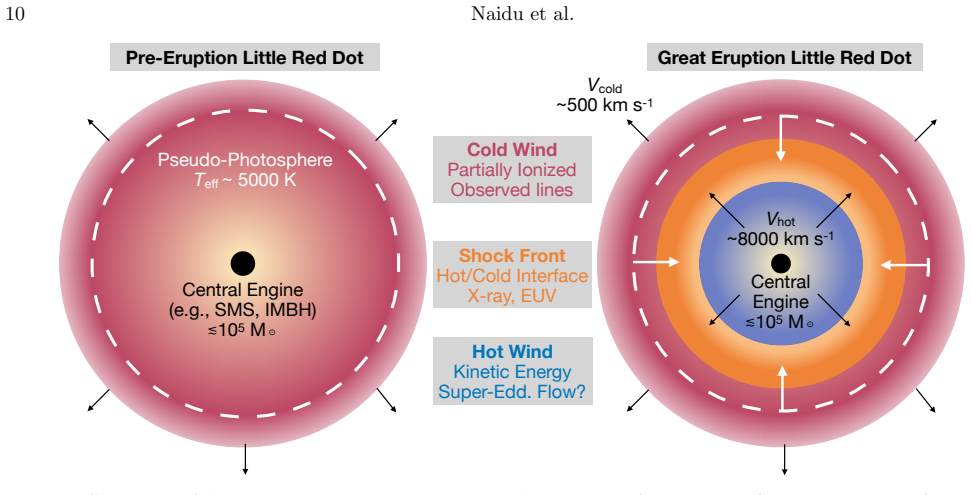
read the original abstract
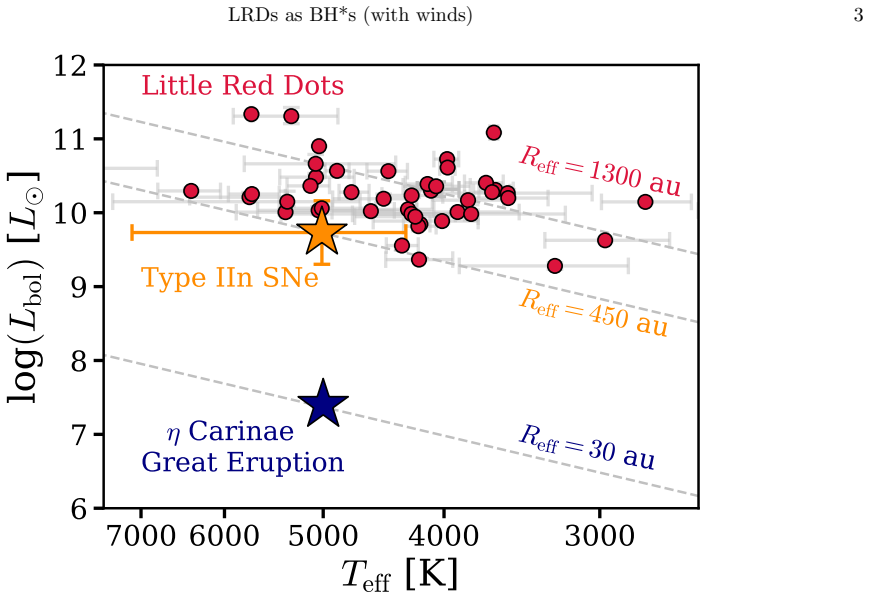
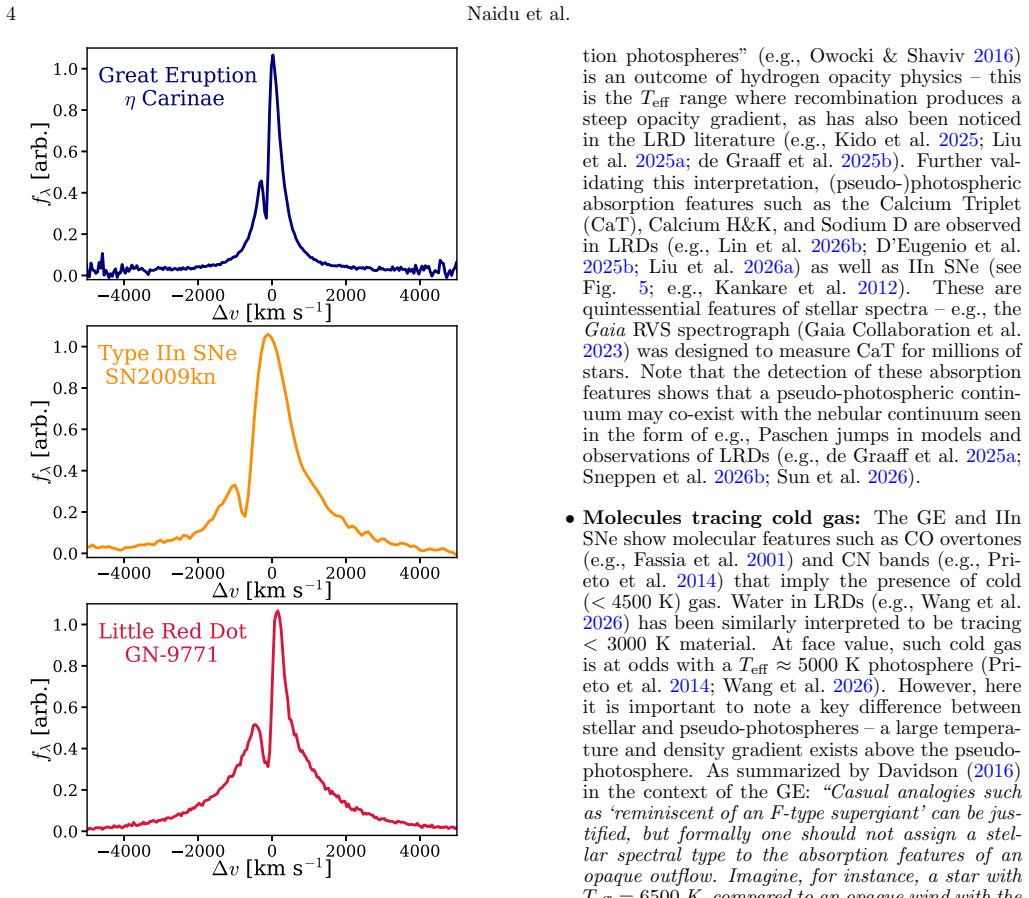
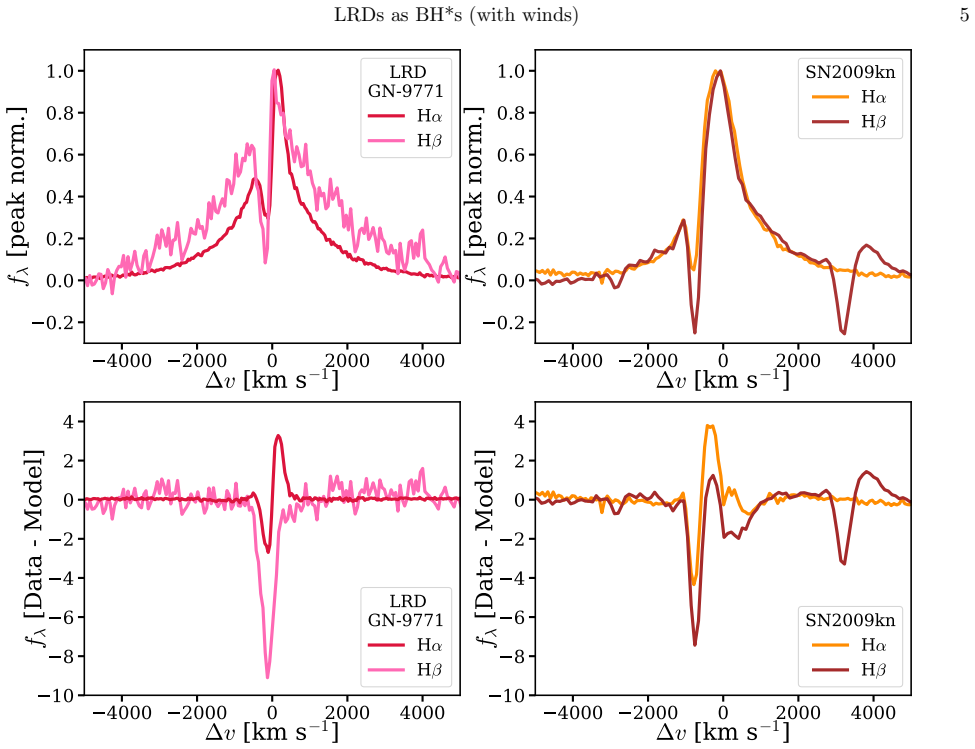
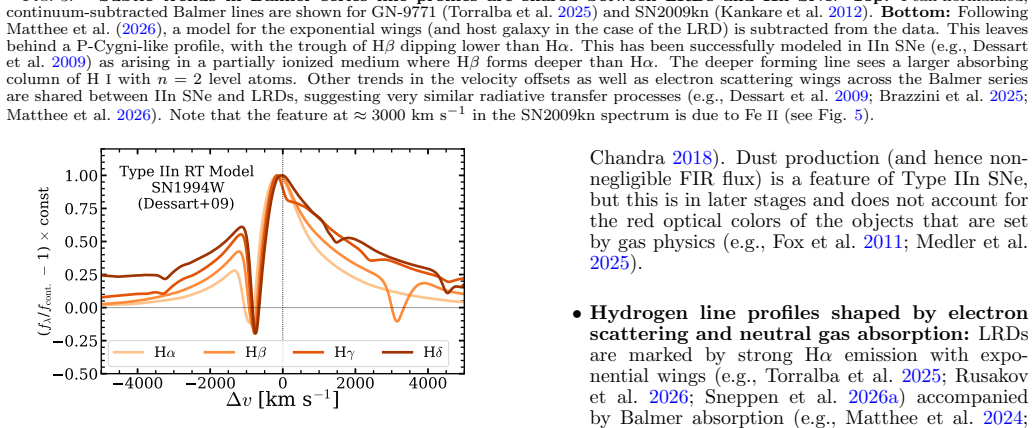
JWST's Little Red Dots (LRDs) display a unique constellation of features that do not occur simultaneously in any other class of galaxies or AGN. Here we observe that many of these features find parallels in the 19th century Great Eruption (GE) of $\eta$ Carinae and a sub-class of supernovae (Type IIn). Drawing on these stellar phenomena -- outflows trapped by dense circumstellar gas envelopes -- we sketch a possible scenario for LRDs. Outflows from the central engine produce an enshrouding envelope of gas that may be thought of as a slow wind. This dense wind and its enormous extent produce an opacity so high that a pseudo-photosphere forms within the wind, obscuring the central engine and manifesting as a blackbody-like continuum. Radiation from the buried engine powers the system. The engine may also launch fast winds that crash into the existing envelope to generate shocks. Lines form within the wind above the photosphere -- electron scattering and absorption in the clumpy (ionized + neutral) medium account for broad wings and P-Cygni cores. A key implication is that inferences of ``overmassive black holes" may be interpreting this wind-like physics as a virial broad-line region. We propose an escape velocity argument to constrain the mass of the engine, which yields $M<10^{5} M_\odot$ for the typical LRD. The lack of variability and low surface gravity of the photosphere provide further support for intermediate mass ($M\approx10^{3-6} M_\odot$), but very luminous super-Eddington ($L_{\rm{bol}}/L_{\rm{edd}}\gtrsim5$) systems harboring a supermassive star or intermediate mass black hole. Paralleling the evolution of IIn SNe, dust production in the envelope may mark the beginnings of classical AGN. This paper explores a possible self-consistent explanation for the entire life-cycle of LRDs, from their enshrouding in dense gas to their fates as seeds of massive black holes.
Editorial analysis
A structured set of objections, weighed in public.
Referee Report
Summary. The manuscript proposes that JWST Little Red Dots (LRDs) are powered by intermediate-mass (M ≈ 10^{3-6} M_⊙), super-Eddington (L_bol/L_edd ≳ 5) engines—either supermassive stars or IMBHs—whose outflows create a dense, enshrouding wind envelope that forms a pseudo-photosphere. This produces the observed blackbody-like continuum while broad lines arise from electron scattering and absorption in the clumpy medium above the photosphere, analogous to the 1837-1856 Great Eruption of η Carinae and Type IIn supernovae. The model reinterprets broad-line widths as wind features rather than virial motions, yielding an escape-velocity mass upper limit M < 10^5 M_⊙, and sketches an evolutionary sequence toward classical AGN via dust formation in the envelope.
Significance. If the scaling of the stellar wind-photosphere physics to galactic scales can be validated, the result would be significant for reinterpreting LRD demographics and black-hole seeding at high redshift, offering a self-consistent alternative to overmassive-BH interpretations and a potential life-cycle link to AGN. The qualitative parallels are suggestive, but the absence of quantitative radiative-transfer calculations or scale-invariance tests currently limits the strength of the central claim.
major comments (2)
- [Abstract / escape-velocity argument] Abstract and main-text escape-velocity argument: the mass bound M < 10^5 M_⊙ is obtained from M < v_line² R_phot / (2G) where both v_line and R_phot (from L_bol and T) are inferred from the same spectral features the wind model is invoked to explain; this circularity is load-bearing for the central mass constraint and is not mitigated by any explicit derivation or error propagation in the text.
- [Main text (qualitative parallels)] Main text (qualitative parallels section): the claim that LRD spectral and photometric features arise from the same outflow-enshrouded pseudo-photosphere physics as η Car and IIn SNe assumes invariance of the v_esc relation under a ~10^6 size increase and different galactic potentials, yet no radiative-transfer models, predicted line-profile comparisons, or tests of the three required conditions (line-forming gas at the continuum photosphere, velocity set by local escape speed, negligible additional galactic effects) are supplied.
minor comments (1)
- [Abstract] The notation for the Eddington ratio threshold (L_bol/L_edd ≳ 5) and the precise definition of the pseudo-photosphere radius are introduced without a dedicated equation or table summarizing the adopted parameters.
Simulated Author's Rebuttal
We thank the referee for their careful reading and constructive comments, which help clarify the scope and limitations of our conceptual framework. We address each major comment below.
read point-by-point responses
-
Referee: [Abstract / escape-velocity argument] Abstract and main-text escape-velocity argument: the mass bound M < 10^5 M_⊙ is obtained from M < v_line² R_phot / (2G) where both v_line and R_phot (from L_bol and T) are inferred from the same spectral features the wind model is invoked to explain; this circularity is load-bearing for the central mass constraint and is not mitigated by any explicit derivation or error propagation in the text.
Authors: We acknowledge the referee's point on potential circularity. The escape-velocity bound is presented as a consistency check under the wind-photosphere interpretation, where line widths are reinterpreted as wind features rather than virial motions. To address this, we will add an explicit derivation of the mass formula in the revised text, including the steps from observed L_bol and T to R_phot, the assumption that v_line traces local escape speed at the photosphere, and a basic error propagation to quantify the M < 10^5 M_⊙ limit. This will make the logical structure transparent without claiming the bound as fully independent. revision: partial
-
Referee: [Main text (qualitative parallels)] Main text (qualitative parallels section): the claim that LRD spectral and photometric features arise from the same outflow-enshrouded pseudo-photosphere physics as η Car and IIn SNe assumes invariance of the v_esc relation under a ~10^6 size increase and different galactic potentials, yet no radiative-transfer models, predicted line-profile comparisons, or tests of the three required conditions (line-forming gas at the continuum photosphere, velocity set by local escape speed, negligible additional galactic effects) are supplied.
Authors: The manuscript is explicitly framed as a qualitative sketch drawing physical analogies, not a quantitative model. We agree that full radiative-transfer calculations, line-profile predictions, and explicit tests of scale invariance would strengthen the case but lie beyond the paper's scope. In revision we will expand the parallels section to state the three conditions explicitly, note the assumed invariance of the wind-photosphere physics, and clarify that the work is hypothesis-generating rather than definitive. No new calculations will be added at this stage. revision: partial
Circularity Check
No significant circularity in derivation chain.
full rationale
The manuscript sketches an analogy-based scenario for LRDs drawing on external stellar phenomena (η Carinae Great Eruption and Type IIn SNe) and proposes an escape-velocity mass argument yielding M < 10^5 M_⊙. No equations, self-citations, or load-bearing steps are present in the provided text that reduce any claimed result to its own inputs by construction. The central mass constraint is framed as a proposal under the adopted model rather than a fitted parameter renamed as a prediction or a self-definitional loop. The derivation therefore remains self-contained against the enumerated circularity patterns.
Axiom & Free-Parameter Ledger
free parameters (2)
- Eddington ratio threshold (L_bol/L_edd ≳ 5)
- Mass upper limit (M < 10^5 M_⊙)
axioms (2)
- domain assumption The observed LRD continuum and line profiles are produced by a pseudo-photosphere within a dense, slow wind rather than by a standard accretion disk or virial broad-line region.
- domain assumption Stellar-wind and supernova-envelope physics can be scaled to the sizes and luminosities of LRDs without modification for galactic gravity or radiation transport differences.
invented entities (1)
-
Pseudo-photosphere within the LRD wind envelope
no independent evidence
Reference graph
Works this paper leans on
-
[1]
D., Vanzella, E., et al
Adamo, A., Bradley, L. D., Vanzella, E., et al. 2024, Nature, 632, 513
2024
-
[2]
2014, Science, 345, 1330
Alexander, T., & Natarajan, P. 2014, Science, 345, 1330
2014
-
[3]
Algera, H. S. B., Rowland, L., Stefanon, M., et al. 2026, MNRAS, 545, staf1897
2026
-
[4]
Hickox, R. C. 2024, ApJ, 969, L18
2024
-
[5]
Ando, M., Harikane, Y., Katz, H., Inayoshi, K., & Tanaka, T. S. 2026, arXiv e-prints, arXiv:2606.03522
work page internal anchor Pith review Pith/arXiv arXiv 2026
-
[6]
E., Clayton, G
Andrews, J. E., Clayton, G. C., Wesson, R., et al. 2011, AJ, 142, 45 Anthropic. 2025, Claude Opus 4.7, Large language model, https://www.anthropic.com/claude, accessed: 2026-05-03
2011
-
[7]
J., et al
Aretxaga, I., Benetti, S., Terlevich, R. J., et al. 1999, MNRAS, 309, 343
1999
-
[8]
Asada, Y., Inayoshi, K., Fei, Q., Fujimoto, S., & Willott, C. 2026, arXiv e-prints, arXiv:2601.10573 Astropy Collaboration, Robitaille, T. P., Tollerud, E. J., et al. 2013, A&A, 558, A33 Ba˜ nados, E., Venemans, B. P., Mazzucchelli, C., et al. 2018, Nature, 553, 473
work page internal anchor Pith review Pith/arXiv arXiv 2026
-
[9]
Barro, G., Perez-Gonzalez, P. G., Kocevski, D., et al. 2025, arXiv e-prints, arXiv:2512.15853
-
[10]
2017, MNRAS, 464, 2174
Baumgardt, H. 2017, MNRAS, 464, 2174
2017
-
[11]
Begelman, M. C., & Dexter, J. 2025, arXiv e-prints, arXiv:2507.09085
-
[12]
C., Rossi, E
Begelman, M. C., Rossi, E. M., & Armitage, P. J. 2008, MNRAS, 387, 1649
2008
-
[13]
C., Volonteri, M., & Rees, M
Begelman, M. C., Volonteri, M., & Rees, M. J. 2006, MNRAS, 370, 289
2006
-
[14]
Deason, A. J. 2018, MNRAS, 478, 611
2018
-
[15]
2023, MNRAS, 525, 4456 —
Belokurov, V., & Kravtsov, A. 2023, MNRAS, 525, 4456 —. 2024, MNRAS, 528, 3198
2023
-
[16]
C., Denney, K
Bentz, M. C., Denney, K. D., Grier, C. J., et al. 2013, ApJ, 767, 149
2013
-
[17]
Do little red dots really form a distinct class of astronomical objects?
Billand, J.-B., Elbaz, D., Franco, M., et al. 2026, arXiv e-prints, arXiv:2604.11677
work page internal anchor Pith review Pith/arXiv arXiv 2026
-
[18]
doi:10.5281/zenodo.8319596 , url =
Brammer, G. 2023, msaexp: NIRSpec analyis tools, doi:10.5281/zenodo.8319596
-
[19]
Brazzini, M., D’Eugenio, F., Maiolino, R., et al. 2025, MNRAS, 544, L167 —. 2026, arXiv e-prints, arXiv:2601.22214
-
[20]
Brooks, M., Trump, J. R., Simons, R. C., et al. 2025a, arXiv e-prints, arXiv:2511.19609
-
[21]
J., Stone, Z., Shen, Y., & Jiang, Y.-F
Burke, C. J., Stone, Z., Shen, Y., & Jiang, Y.-F. 2025, arXiv e-prints, arXiv:2511.16082
-
[22]
Cantiello, M., Hassan, J. B., Perna, R., et al. 2025, arXiv e-prints, arXiv:2512.17997
-
[23]
M., Akins, H
Casey, C. M., Akins, H. B., Finkelstein, S. L., et al. 2025, ApJ, 990, L61
2025
-
[24]
2018, Space Sci
Chandra, P. 2018, Space Sci. Rev., 214, 27
2018
-
[25]
2025, arXiv e-prints, arXiv:2508.08768
Chang, S.-J., Gronke, M., Matthee, J., & Mason, C. 2025, arXiv e-prints, arXiv:2508.08768
-
[26]
2023, A&A, 673, L7
Charbonnel, C., Schaerer, D., Prantzos, N., et al. 2023, A&A, 673, L7
2023
-
[27]
2026, ApJ, 1003, L46
Chen, Y.-X., Liu, H., Li, R., et al. 2026, ApJ, 1003, L46
2026
-
[28]
A., & Irwin, C
Chevalier, R. A., & Irwin, C. M. 2012, ApJ, 747, L17
2012
-
[29]
Chisholm, J., Berg, D. A., Boylan-Kolchin, M., et al. 2026, arXiv e-prints, arXiv:2602.15935
-
[30]
N., Blinnikov, S
Chugai, N. N., Blinnikov, S. I., Cumming, R. J., et al. 2004, MNRAS, 352, 1213
2004
-
[31]
2025, MNRAS, 537, 2535
Claeyssens, A., Adamo, A., Messa, M., et al. 2025, MNRAS, 537, 2535
2025
-
[32]
Curtis-Lake, E., Cameron, A. J., Bunker, A. J., et al. 2026, MNRAS, arXiv:2510.01033
work page internal anchor Pith review Pith/arXiv arXiv 2026
-
[33]
1987, ApJ, 317, 760
Davidson, K. 1987, ApJ, 317, 760
1987
-
[34]
2016, in Journal of Physics Conference Series, Vol
Davidson, K. 2016, in Journal of Physics Conference Series, Vol. 728, Journal of Physics Conference Series (IOP), 022008
2016
-
[35]
D., & Vink, J
Davies, B., Oudmaijer, R. D., & Vink, J. S. 2005, A&A, 439, 1107
2005
-
[36]
Davis, K., Brooks, M., Simons, R. C., et al. 2026, arXiv e-prints, arXiv:2606.00258 de Graaff, A., Brammer, G., Weibel, A., et al. 2024, arXiv e-prints, arXiv:2409.05948 de Graaff, A., Rix, H.-W., Naidu, R. P., et al. 2025a, arXiv e-prints, arXiv:2503.16600 de Graaff, A., Hviding, R. E., Naidu, R. P., et al. 2025b, arXiv e-prints, arXiv:2511.21820 20 Naidu et al
work page internal anchor Pith review Pith/arXiv arXiv 2026
-
[37]
2025, A&A, 704, A313
Delvecchio, I., Daddi, E., Magnelli, B., et al. 2025, A&A, 704, A313
2025
-
[38]
A., & Hartwick, F
Denissenkov, P. A., & Hartwick, F. D. A. 2014, MNRAS, 437, L21
2014
-
[39]
M., Ashall, C., Baron, E., et al
DerKacy, J. M., Ashall, C., Baron, E., et al. 2026, ApJ, 997, 179
2026
-
[40]
Dessart, L., Audit, E., & Hillier, D. J. 2015, Monthly Notices of the Royal Astronomical Society, 449, 4304
2015
-
[41]
Dessart, L., & Hillier, D. J. 2008, MNRAS, 383, 57 —. 2011, MNRAS, 410, 1739
2008
-
[42]
J., Audit, E., Livne, E., & Waldman, R
Dessart, L., Hillier, D. J., Audit, E., Livne, E., & Waldman, R. 2016, MNRAS, 458, 2094
2016
-
[43]
J., Gezari, S., Basa, S., & Matheson, T
Dessart, L., Hillier, D. J., Gezari, S., Basa, S., & Matheson, T. 2009, MNRAS, 394, 21
2009
-
[44]
Dessart, L., Jacobson-Galan, W. V., Bostroem, K. A., et al. 2026, arXiv e-prints, arXiv:2604.05145 D’Eugenio, F., Maiolino, R., Perna, M., et al. 2025a, arXiv e-prints, arXiv:2503.11752 D’Eugenio, F., Nelson, E., Ji, X., et al. 2025b, arXiv e-prints, arXiv:2510.00101 Dias dos Santos, D., Panda, S., Rodr´ ıguez-Ardila, A., &
work page internal anchor Pith review Pith/arXiv arXiv 2026
-
[45]
Marinello, M. 2026, arXiv e-prints, arXiv:2605.30477
work page internal anchor Pith review Pith/arXiv arXiv 2026
-
[46]
A., & Ulrich, R
Drake, S. A., & Ulrich, R. K. 1980, ApJS, 42, 351
1980
-
[47]
J., Willott, C., Alberts, S., et al
Eisenstein, D. J., Willott, C., Alberts, S., et al. 2026, ApJS, 283, 6
2026
-
[48]
2019, MNRAS, 482, 4528
Boylan-Kolchin, M. 2019, MNRAS, 482, 4528
2019
-
[49]
2024, arXiv e-prints, arXiv:2410.01905
Whitler, L. 2024, arXiv e-prints, arXiv:2410.01905
-
[50]
Fan, X., Ba˜ nados, E., & Simcoe, R. A. 2023, ARA&A, 61, 373
2023
-
[51]
K., Lupton, R
Fan, X., Narayanan, V. K., Lupton, R. H., et al. 2001, AJ, 122, 2833
2001
-
[52]
Fassia, A., Meikle, W. P. S., Chugai, N., et al. 2001, MNRAS, 325, 907
2001
-
[53]
Filippenko, A. V. 1989, AJ, 97, 726
1989
-
[54]
D., Chevalier, R
Fox, O. D., Chevalier, R. A., Skrutskie, M. F., et al. 2011, ApJ, 741, 7
2011
-
[55]
D., Fransson, C., Smith, N., et al
Fox, O. D., Fransson, C., Smith, N., et al. 2020, MNRAS, 498, 517
2020
-
[56]
A., Filippenko, A
Fransson, C., Chevalier, R. A., Filippenko, A. V., et al. 2002, ApJ, 572, 350
2002
-
[57]
J., et al
Fransson, C., Ergon, M., Challis, P. J., et al. 2014, ApJ, 797, 118
2014
-
[58]
2026, Nature Astronomy, arXiv:2512.02096
Fu, S., Zhang, Z., Jiang, D., et al. 2026, Nature Astronomy, arXiv:2512.02096
-
[59]
2024, arXiv e-prints, arXiv:2402.18543
Fujimoto, S., Ouchi, M., Kohno, K., et al. 2024, arXiv e-prints, arXiv:2402.18543
-
[60]
J., Labb´ e, I., Zitrin, A., et al
Furtak, L. J., Labb´ e, I., Zitrin, A., et al. 2024, Nature, 628, 57
2024
-
[61]
J., Secunda, A
Furtak, L. J., Secunda, A. R., Greene, J. E., et al. 2025, A&A, 698, A227 Gaia Collaboration, Vallenari, A., Brown, A. G. A., et al. 2023, A&A, 674, A1
2025
-
[62]
2014, Nature, 511, 326
Gall, C., Hjorth, J., Watson, D., et al. 2014, Nature, 511, 326
2014
-
[63]
The quasi-star model for Little Red Dots: potential and challenges
Gentile, F., Giavalisco, M., Daddi, E., et al. 2026, The quasi-star model for Little Red Dots: potential and challenges, arXiv:2606.06575
work page internal anchor Pith review Pith/arXiv arXiv 2026
-
[64]
Gieles, M., Charbonnel, C., Krause, M. G. H., et al. 2018, MNRAS, 478, 2461
2018
-
[65]
Grandi, S. A. 1980, ApJ, 238, 10
1980
-
[66]
E., & Ho, L
Greene, J. E., & Ho, L. C. 2006, ApJ, 641, L21
2006
-
[67]
E., Strader, J., & Ho, L
Greene, J. E., Strader, J., & Ho, L. C. 2020, ARA&A, 58, 257
2020
-
[68]
Greene, J. E., Setton, D. J., Furtak, L. J., et al. 2025, arXiv e-prints, arXiv:2509.05434
-
[69]
Gupta, A. R., Taylor, A., Curtis-Lake, E., et al. 2026, arXiv e-prints, arXiv:2605.30414 Haemmerl´ e, L. 2021, A&A, 650, A204
work page internal anchor Pith review Pith/arXiv arXiv 2026
-
[70]
Hall, P. B. 2007, AJ, 133, 1271
2007
-
[71]
B., Brandt, W
Hall, P. B., Brandt, W. N., Petitjean, P., et al. 2013, MNRAS, 434, 222
2013
-
[72]
W., & Frew, D
Hamacher, D. W., & Frew, D. J. 2010, Journal of Astronomical History and Heritage, 13, 220
2010
-
[73]
2024, A&A, 688, A105
Hawcroft, C., Sana, H., Mahy, L., et al. 2024, A&A, 688, A105
2024
-
[74]
H., et al
Helmi, A., Babusiaux, C., Koppelman, H. H., et al. 2018, Nature, 563, 85
2018
-
[75]
J., Davidson, K., Ishibashi, K., & Gull, T
Hillier, D. J., Davidson, K., Ishibashi, K., & Gull, T. 2001, ApJ, 553, 837
2001
-
[76]
J., & Dessart, L
Hillier, D. J., & Dessart, L. 2012, MNRAS, 424, 252
2012
-
[77]
2021, MNRAS, 503, 4276
Smith, N. 2021, MNRAS, 503, 4276
2021
-
[78]
Hiramatsu, D., Berger, E., Gomez, S., et al. 2024, arXiv e-prints, arXiv:2411.07287
work page internal anchor Pith review Pith/arXiv arXiv 2024
-
[79]
F., Grudic, M
Hopkins, P. F., Grudic, M. Y., Su, K.-Y., et al. 2024, The Open Journal of Astrophysics, 7, 18
2024
-
[80]
M., & Davidson, K
Humphreys, R. M., & Davidson, K. 1994, PASP, 106, 1025
1994
discussion (0)
Sign in with ORCID, Apple, or X to comment. Anyone can read and Pith papers without signing in.