The UV Side of Little Red Dots: Red, Compact, and Iron-Enhanced Rest-UV Emission with a Strong Downturn around Lyα
Pith reviewed 2026-06-28 09:23 UTC · model grok-4.3
The pith
Little Red Dots require an additional central red UV continuum source beyond host galaxy emission alone.
A machine-rendered reading of the paper's core claim, the machinery that carries it, and where it could break.
Core claim
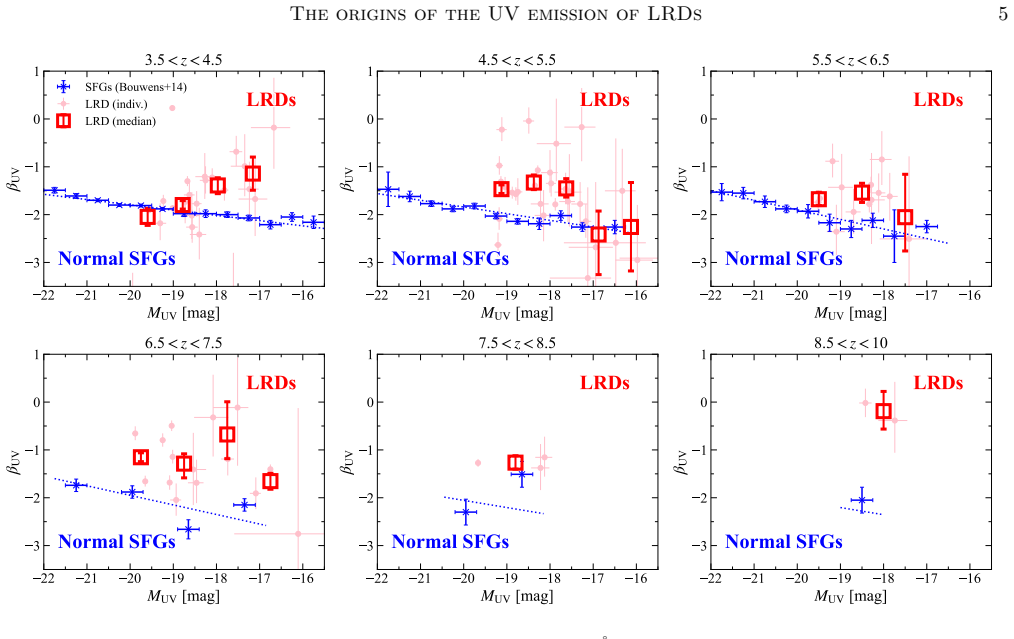
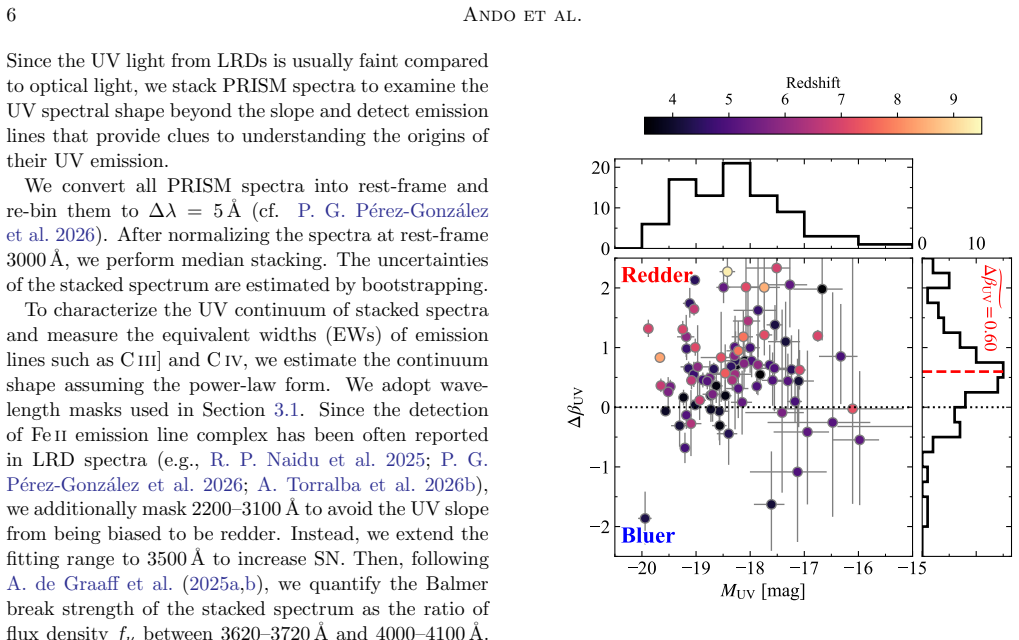
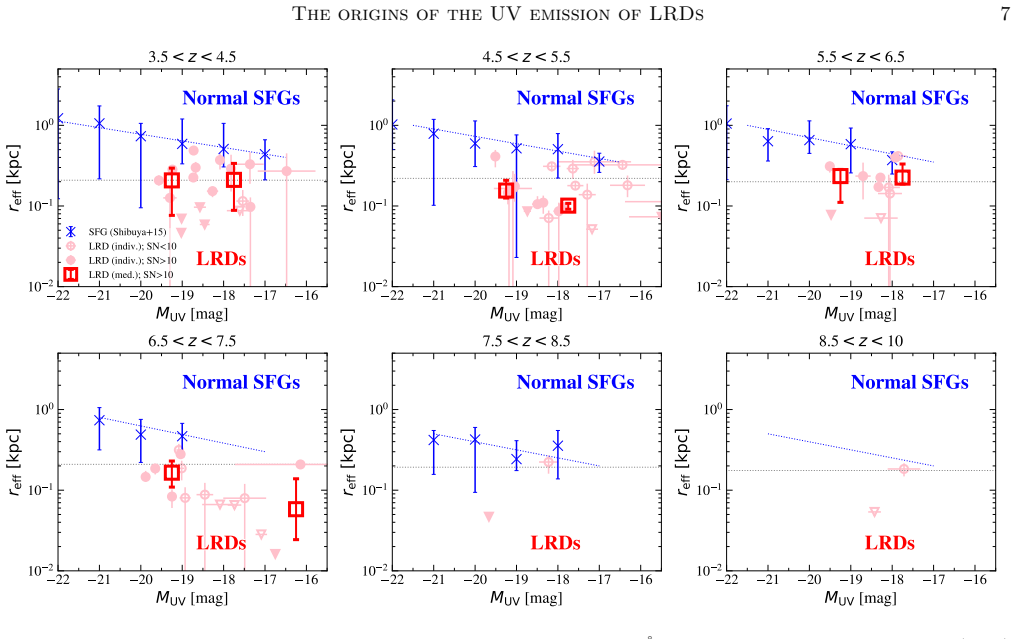
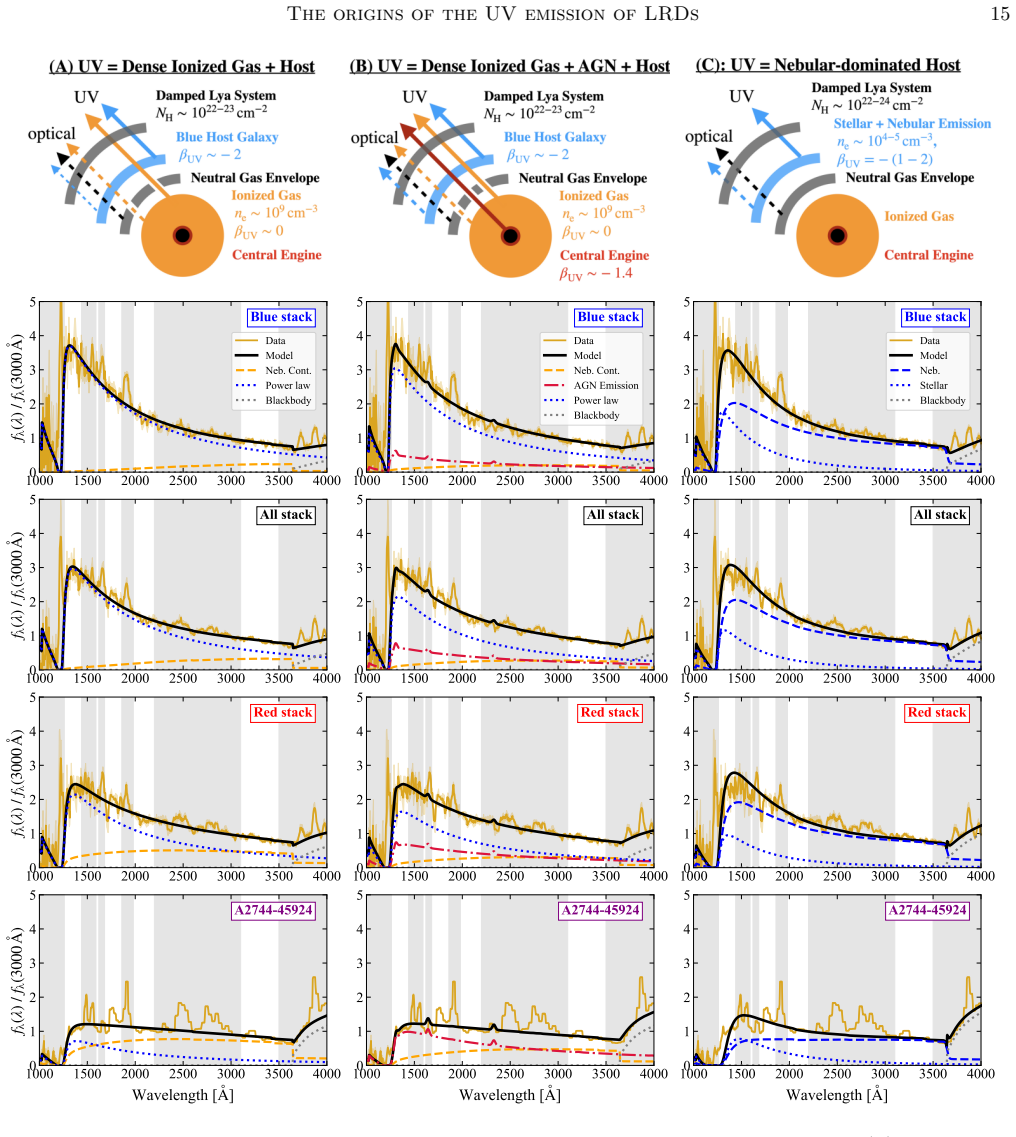
LRDs exhibit systematically redder UV slopes, smaller UV sizes, and stronger Fe II emission relative to Mg II compared with star-forming galaxies. These UV traits correlate with optical features such as Balmer break strength, indicating that the UV light includes a substantial contribution from a central red compact emitter. Modeling requires this extra component to have β_UV ∼ 0 and suggests it arises as nebular continuum radiation that escapes through a porous neutral gas envelope surrounding the central region.
What carries the argument
The additional very red continuum source with β_UV ∼ 0, required by spectral modeling to explain the observed UV properties beyond host galaxy emission.
If this is right
- Diversity in UV continuum shape traces the varying dominance of central emission over host galaxy light.
- UV size shrinks as the central component grows stronger relative to the host, producing the observed anticorrelation with Balmer break strength.
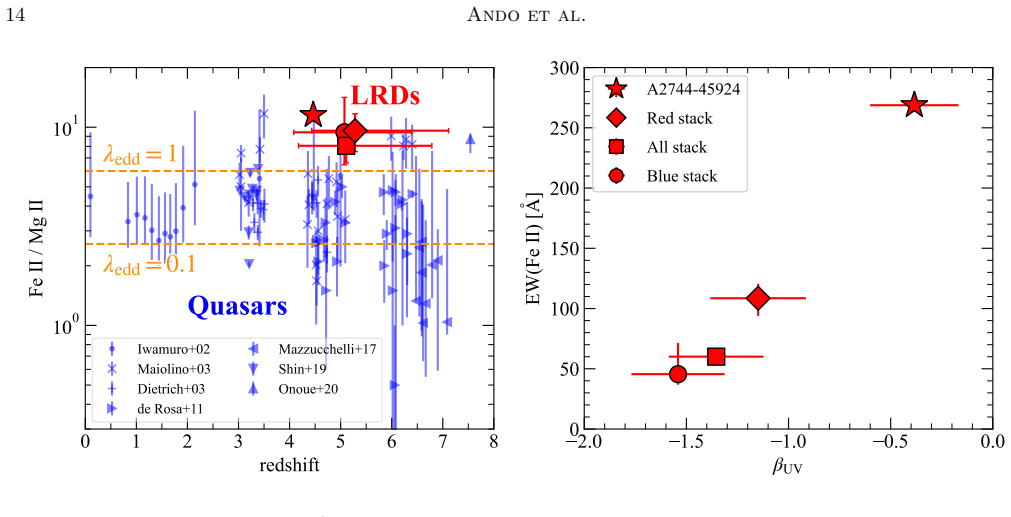
- Fe II/Mg II ratios of 8-10 exceed those in typical quasars at similar redshifts.
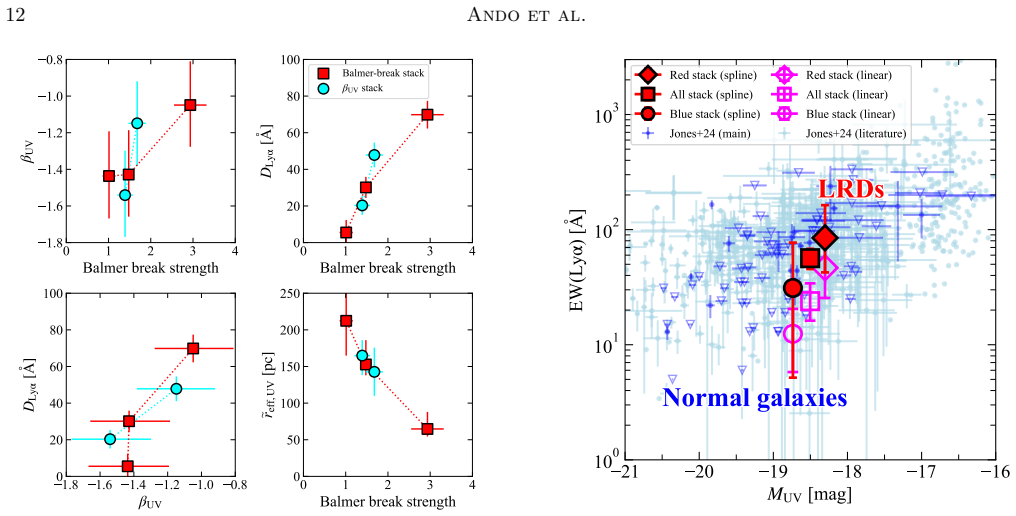
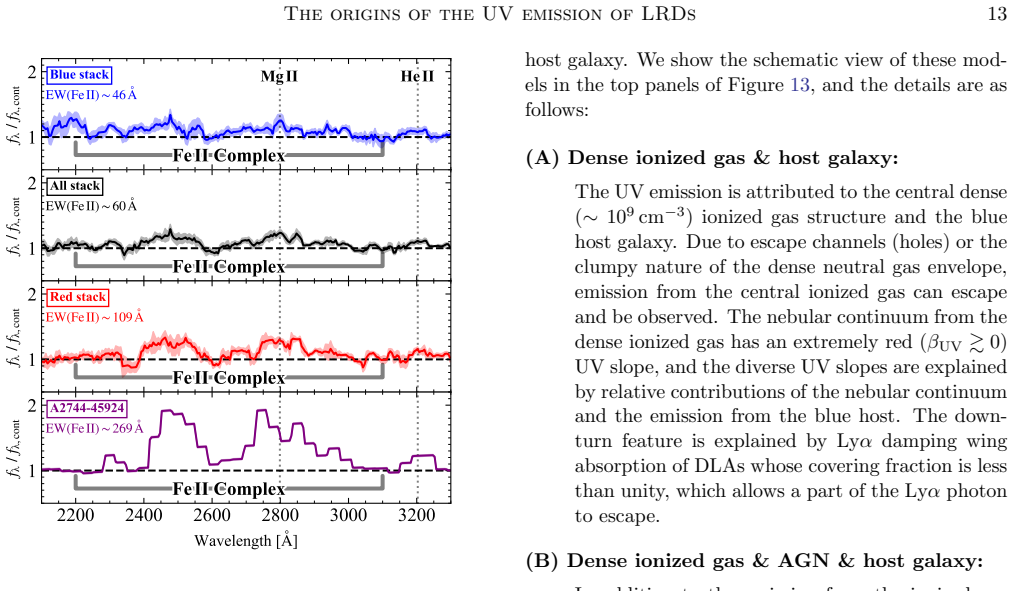
- The strength of the Lyα downturn, UV slope, and Fe II lines all increase together with the Balmer break in stacked spectra.
Where Pith is reading between the lines
- If the clumpy-envelope leakage picture holds, the same geometry could link the UV downturn to the V-shaped optical spectra already noted in LRDs.
- Higher-resolution UV imaging could test whether the red compact component is spatially offset from the host or co-located with the broad-line region.
- The elevated iron lines may indicate chemical enrichment patterns tied to rapid early black-hole growth rather than standard stellar populations.
Load-bearing premise
Spectral models can accurately decompose observed UV light into host galaxy starlight versus a distinct central component without bias introduced by the LRD selection criteria.
What would settle it
A set of LRDs whose UV slopes and sizes match those of ordinary star-forming galaxies after refined decomposition or higher-resolution data would falsify the requirement for an extra central red source.
Figures
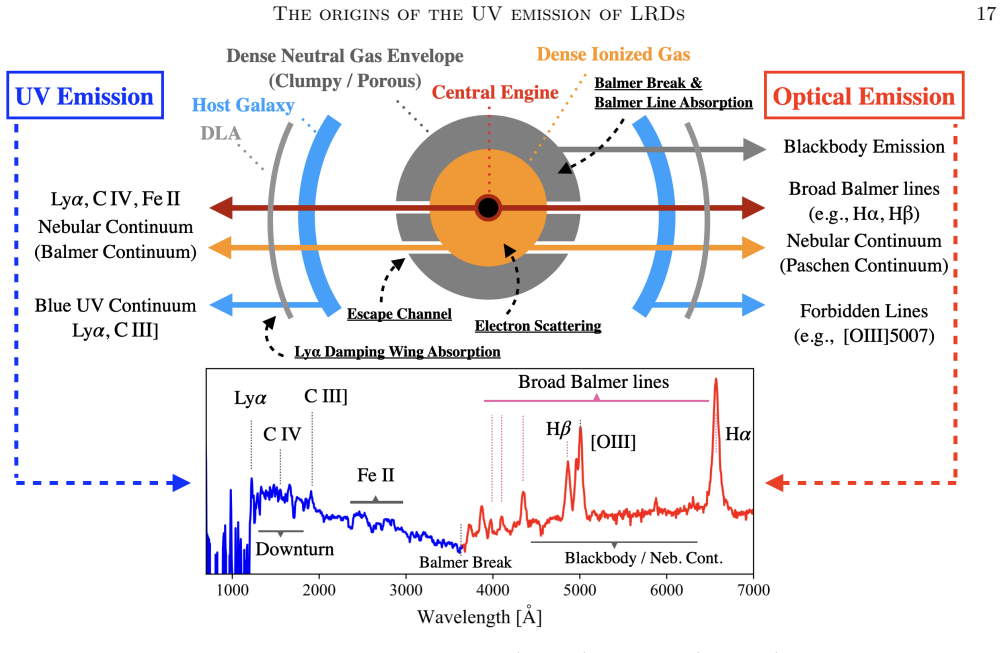
read the original abstract
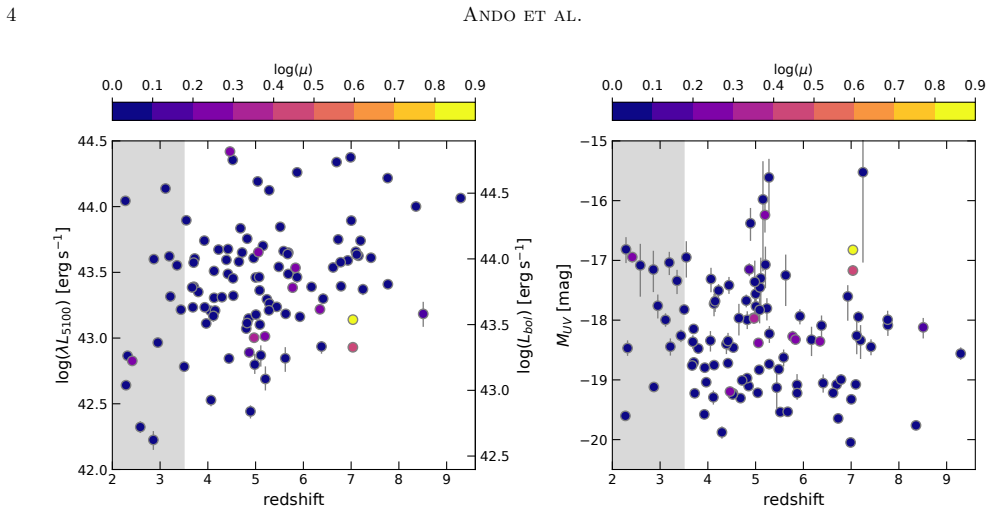
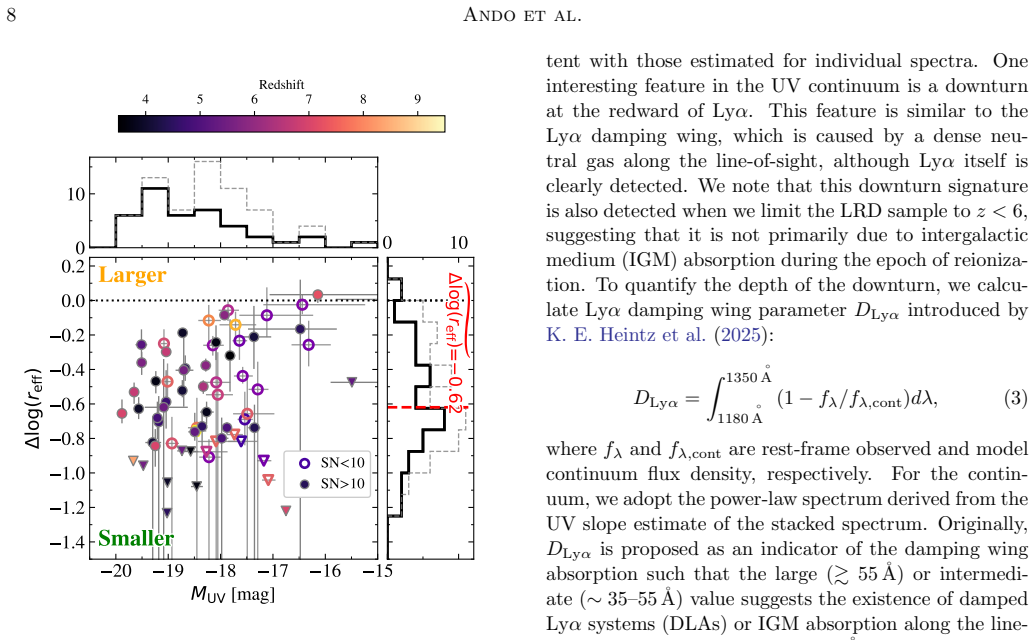
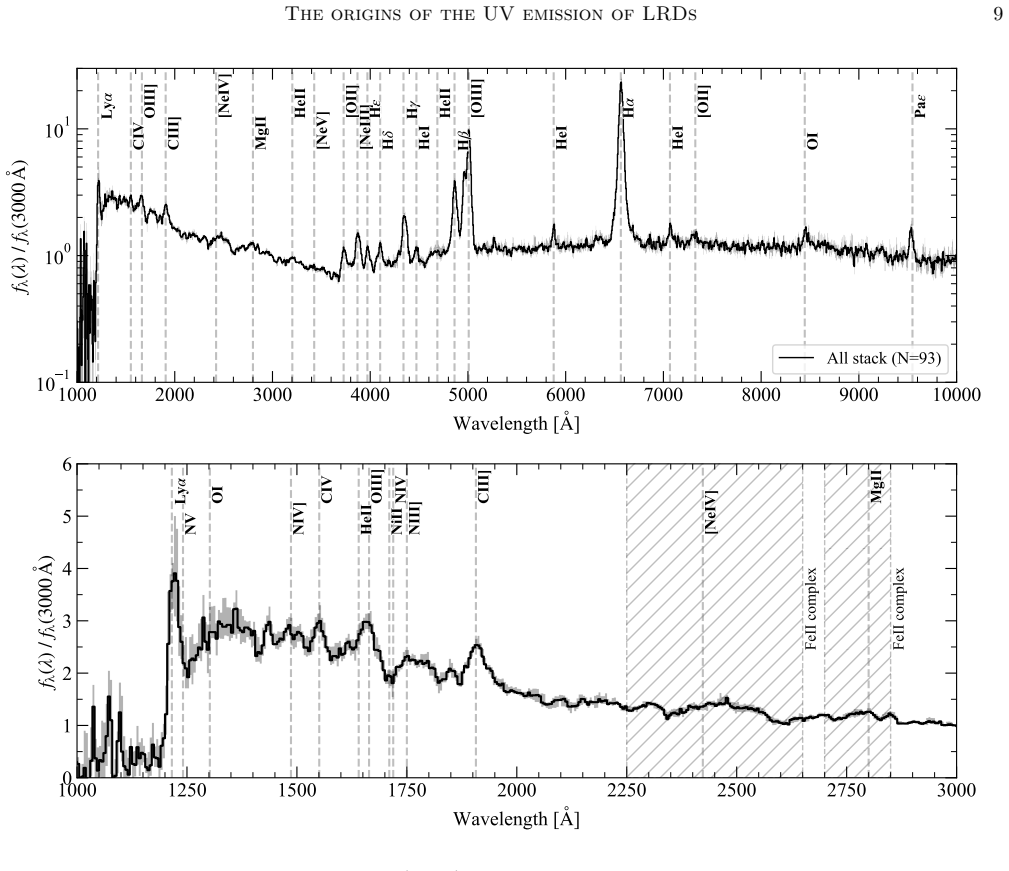
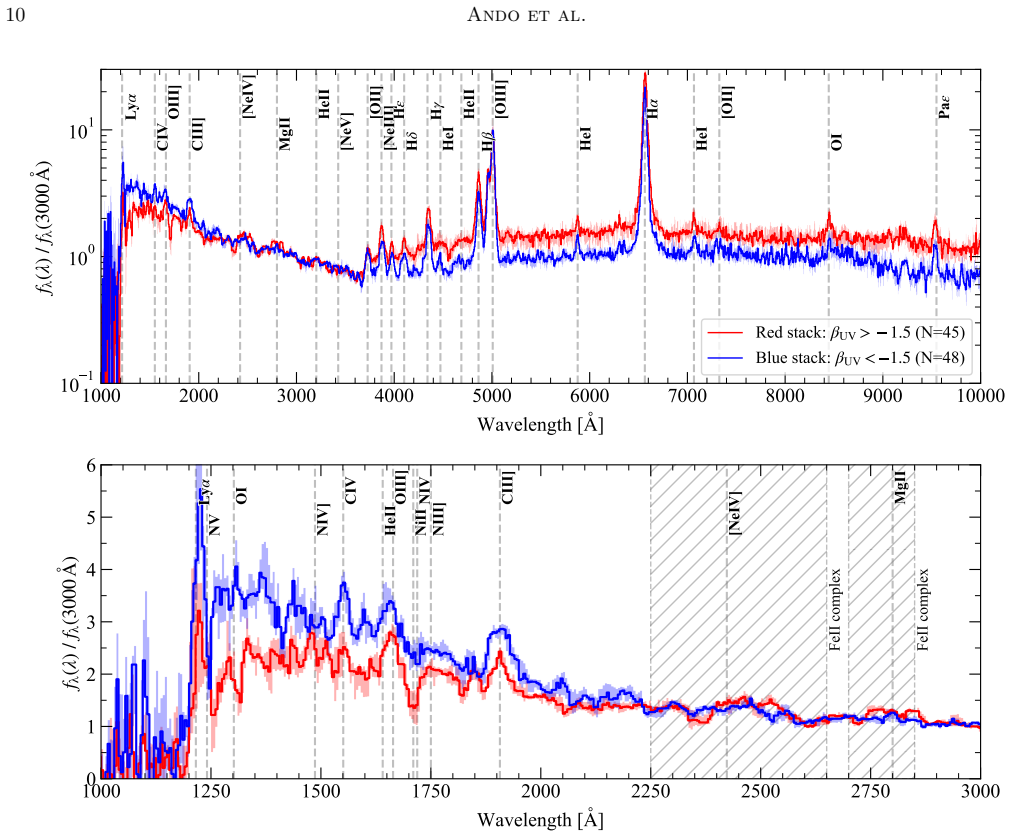
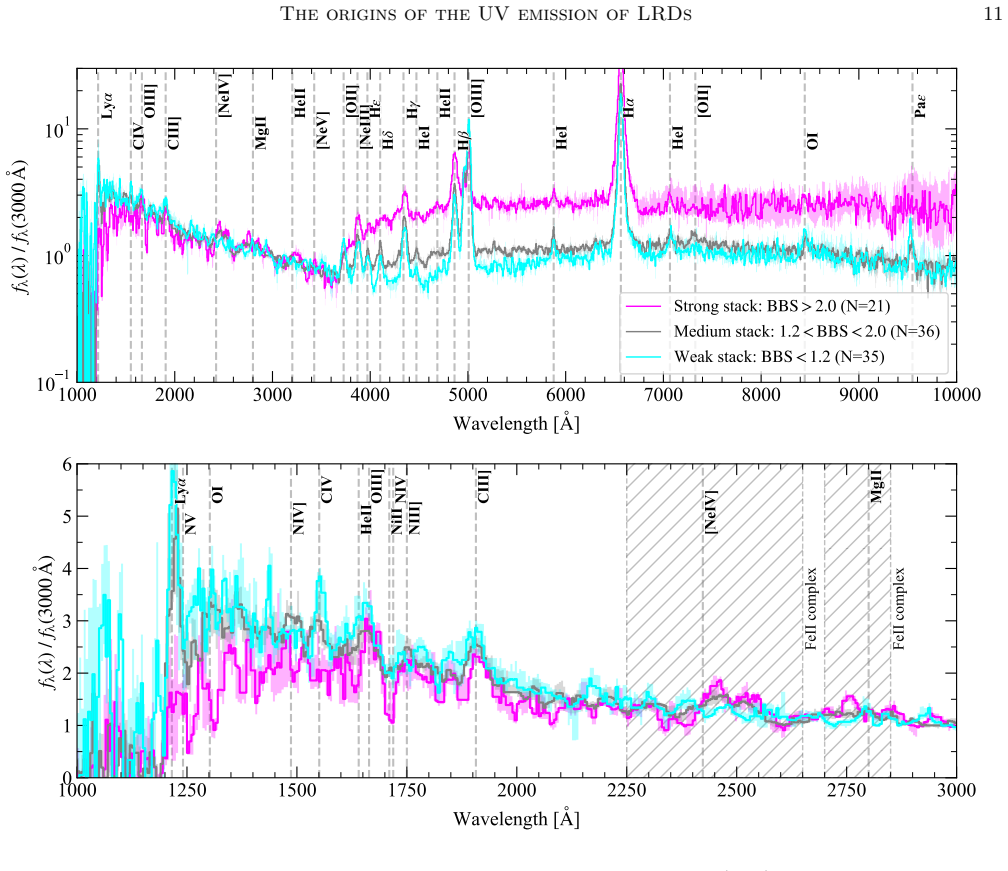
Little Red Dots (LRDs) are candidates for growing supermassive black holes newly discovered by the James Webb Space Telescope (JWST), characterized by compact rest-optical morphology, V-shaped spectra, and broad Hydrogen Balmer lines. While recently proposed BH-star/envelope models have made progress in explaining their optical features, their rest-UV emission, which is considered to originate from host galaxies, remains poorly investigated. In this paper, we present a comprehensive analysis of the UV emission, including continuum shapes, emission line strengths, and morphology, using $\sim100$ LRDs selected from the JWST spectral archive. Compared to star-forming galaxies at the same redshifts and UV magnitudes, LRDs show systematically redder UV slopes and more compact UV sizes, indicating that their UV emission cannot be explained solely by normal star-forming galaxies and requires a significant contribution from central red and compact emission. From stacked spectra, we find that the Balmer break strength, UV slope, downturn depth around Ly$\alpha$, and $\mathrm{Fe\, II}$ equivalent width are positively correlated, while the UV size is anticorrelated with the Balmer break strength, suggesting that diversity in the UV continuum shape reflects the varying dominance of the central emission relative to its host. We also measure $\mathrm{Fe\, II//Mg\, II}\sim8-10$, higher than in quasars at similar redshifts, further supporting a substantial contribution from the central component. Spectral modeling suggests that the observed red UV continuum cannot be reproduced by host galaxy emission alone, but requires an additional very red continuum source ($\beta_\mathrm{UV}\sim0$), possibly nebular continuum emission leaking from dense ionized gas through a clumpy or porous neutral gas envelope.
Editorial analysis
A structured set of objections, weighed in public.
Referee Report
Summary. The paper analyzes the rest-UV properties of ~100 Little Red Dots (LRDs) selected from the JWST spectral archive. It reports that LRDs exhibit systematically redder UV continuum slopes and more compact UV morphologies than star-forming galaxies at comparable redshifts and UV magnitudes. Stacked spectra reveal positive correlations among Balmer break strength, UV slope, Lyα downturn depth, and Fe II equivalent width, with UV size anticorrelated with Balmer break strength. The paper measures Fe II/Mg II ~8-10 (higher than typical quasars) and concludes from spectral modeling that the red UV continuum cannot be reproduced by host-galaxy emission alone, requiring an additional central component with β_UV~0, possibly nebular continuum leaking through a clumpy neutral envelope.
Significance. If the central claim holds, the work provides empirical evidence that LRD UV emission includes a significant central contribution distinct from normal star-forming hosts, strengthening the case for AGN-related or nebular processes in these objects and offering testable correlations between UV shape and optical features. The stacked-spectra correlations and Fe II/Mg II measurement constitute falsifiable, observationally grounded results that could guide future modeling of LRDs.
major comments (2)
- [Abstract] Abstract and modeling section: the claim that host-galaxy emission alone cannot reproduce the observed red UV continuum (β_UV~0) is load-bearing for the central conclusion, yet the text provides no details on the SPS code, attenuation law, SFH parameterization, dust geometry grid, or metallicity range explored. Without an exhaustive search or demonstration that plausible host combinations are ruled out while preserving the observed Balmer break and line ratios, the requirement for an additional central component is not uniquely established.
- [Abstract] Sample selection and stacking procedures (implied in abstract): the ~100 LRDs are selected on compact optical morphology, V-shaped spectra, and broad Balmer lines; these criteria may correlate with dust or age properties that bias the measured UV slopes and sizes. The manuscript does not report the parent catalog, completeness, or how stacking weights and error propagation are handled, which directly affects the reported correlations and the comparison to star-forming galaxies at matched z and M_UV.
minor comments (1)
- [Abstract] Notation: β_UV is used for the central component without an explicit definition or reference to the wavelength range over which it is measured.
Simulated Author's Rebuttal
We thank the referee for their constructive comments, which highlight areas where additional methodological detail will strengthen the manuscript. We address each major comment below and will revise the paper accordingly.
read point-by-point responses
-
Referee: [Abstract] Abstract and modeling section: the claim that host-galaxy emission alone cannot reproduce the observed red UV continuum (β_UV~0) is load-bearing for the central conclusion, yet the text provides no details on the SPS code, attenuation law, SFH parameterization, dust geometry grid, or metallicity range explored. Without an exhaustive search or demonstration that plausible host combinations are ruled out while preserving the observed Balmer break and line ratios, the requirement for an additional central component is not uniquely established.
Authors: We agree that the modeling details require expansion to fully support the claim. The revised manuscript will add a dedicated methods subsection specifying the SPS code (Bruzual & Charlot 2003), attenuation law (Calzetti), SFH parameterizations (constant and exponentially declining), dust geometry grid, and metallicity range (0.2–1 Z⊙). A comprehensive grid search was performed over these parameters while enforcing consistency with the observed Balmer break and line ratios; the results demonstrate that no plausible host combination reproduces β_UV ≈ 0. Updated figures will illustrate the model grids and residuals. revision: yes
-
Referee: [Abstract] Sample selection and stacking procedures (implied in abstract): the ~100 LRDs are selected on compact optical morphology, V-shaped spectra, and broad Balmer lines; these criteria may correlate with dust or age properties that bias the measured UV slopes and sizes. The manuscript does not report the parent catalog, completeness, or how stacking weights and error propagation are handled, which directly affects the reported correlations and the comparison to star-forming galaxies at matched z and M_UV.
Authors: Section 2 describes the selection from the JWST spectral archive. The revised version will explicitly name the parent programs (e.g., CEERS, JADES), report completeness as a function of magnitude and redshift, and detail the stacking procedure (inverse-variance weighting with bootstrap resampling for errors). While selection criteria may correlate with certain properties, comparisons use star-forming galaxies matched in z and M_UV, and internal correlations within the LRD sample remain robust. A new paragraph will discuss potential selection effects. revision: partial
Circularity Check
No significant circularity; analysis grounded in external comparisons
full rationale
The paper presents observational results from JWST spectra of LRDs, including direct comparisons to star-forming galaxies at matching redshifts and magnitudes, stacked spectral correlations (Balmer break vs. UV slope, Fe II EW, UV size), Fe II/Mg II ratios, and spectral modeling conclusions. No equations, fitted parameters presented as predictions, self-definitional loops, or load-bearing self-citations appear in the provided text. Claims rest on external sample benchmarks and model comparisons without reduction to the paper's own inputs by construction.
Axiom & Free-Parameter Ledger
free parameters (1)
- β_UV for central component
axioms (1)
- domain assumption LRD selection based on compact rest-optical morphology, V-shaped spectra, and broad Balmer lines defines a clean sample for UV analysis
invented entities (1)
-
clumpy or porous neutral gas envelope
no independent evidence
Forward citations
Cited by 8 Pith papers
-
Black Hole Stars Across the Universe: Identifying Central Engine Dominated Little Red Dots at $z\sim1.5-9.5$
New template-fitting selection yields 241 BH*-dominated LRD candidates at z~1.7-9.3 with number density peaking at z~5-6, demonstrating persistence to lower redshifts.
-
Through the Veil: Ly$\alpha$ Illuminates the Host Galaxies of Little Red Dots
Lyα observations of Little Red Dots show luminosities and equivalent widths like normal star-forming galaxies but lower Lyα/Hα ratios and extended asymmetric emission, supporting a two-component model with host-scale gas.
-
Little Red Dots as Supermassive Analogs of SS 433
LRDs are interpreted as high-inclination hyper-Eddington accreting SMBHs analogous to SS 433, with V-shaped SEDs, X-ray weakness, and Balmer breaks emerging from disk self-shielding geometry.
-
TBD LBD: The nature of `little blue dots'
LBDs are interpreted as lower-column analogues of LRDs in a gas-cocooned AGN sequence, with predicted spectral features including Balmer jumps and X-ray weakness.
-
JADES: the mass-metallicity relation at $z=1-10$. New calibrations, extremely metal-poor galaxies, and chemical diversity
New stack-based strong-line calibrations from ~1500 spectra yield mass-metallicity relations at z=1-10 with decreasing metallicity toward higher redshift and no slope change, plus 50 EMPG candidates at 1-4% solar meta...
-
A Scaling Relation of LRDs between Broad H$\alpha$ and Bolometric Luminosities: Enhanced Broad H$\alpha$ Emission Relative to Low-$z$ Type 1 AGN
LRDs at z~3-7 exhibit an L_Hα,broad-L_bol scaling relation enhanced by a factor of ~40 compared to low-z Type 1 AGN, explained via Cloudy modeling with near-unity covering factor and high column density.
-
Constraints on the Gas Geometry Surrounding Little Red Dots through Narrow-Line Diagnostics
Narrow-line diagnostics on ~20 LRDs indicate that stellar photoionization alone cannot explain the observed ratios in many objects, implying anisotropic ionizing radiation from complex gas geometry.
-
Little Red and Blue Dots: AGN-excited narrow lines, Lyman-$\alpha$ emission, and resemblance to standard quasars
JWST data on LRDs and LBDs show AGN-like excitation, strong Lyα with broad components, and X-ray weakness, implying clumpy or equatorial geometries around growing black holes rather than complete gas envelopes.
Reference graph
Works this paper leans on
-
[1]
Akins, H. B., Casey, C. M., Lambrides, E., et al. 2025, ApJ, 991, 37, doi: 10.3847/1538-4357/ade984
-
[2]
Ananna, T. T., Bogd´ an,´A., Kov´ acs, O. E., Natarajan, P., & Hickox, R. C. 2024, ApJL, 969, L18, doi: 10.3847/2041-8213/ad5669
-
[3]
Asada, Y., Inayoshi, K., Fei, Q., Fujimoto, S., & Willott, C. 2026, arXiv e-prints, arXiv:2601.10573, doi: 10.48550/arXiv.2601.10573 Astropy Collaboration, Robitaille, T. P., Tollerud, E. J., et al. 2013, A&A, 558, A33, doi: 10.1051/0004-6361/201322068 Astropy Collaboration, Price-Whelan, A. M., Sip˝ ocz, B. M., et al. 2018, AJ, 156, 123, doi: 10.3847/153...
work page internal anchor Pith review Pith/arXiv arXiv doi:10.48550/arxiv.2601.10573 2026
-
[4]
Baggen, J. F. W., Scoggins, M. T., van Dokkum, P., et al. 2026, arXiv e-prints, arXiv:2602.02702, doi: 10.48550/arXiv.2602.02702
work page internal anchor Pith review Pith/arXiv arXiv doi:10.48550/arxiv.2602.02702 2026
-
[5]
Bouwens, R. J., Illingworth, G. D., Oesch, P. A., et al. 2012, ApJ, 754, 83, doi: 10.1088/0004-637X/754/2/83
-
[6]
Bouwens, R. J., Illingworth, G. D., Oesch, P. A., et al. 2014, ApJ, 793, 115, doi: 10.1088/0004-637X/793/2/115
-
[7]
2023a, msaexp: NIRSpec analyis tools, 0.6.17 Zenodo, doi: 10.5281/zenodo.8319596
Brammer, G. 2023a, msaexp: NIRSpec analyis tools, 0.6.17 Zenodo, doi: 10.5281/zenodo.8319596
-
[8]
2023b, grizli, 1.9.11 Zenodo, doi: 10.5281/zenodo.8370018
Brammer, G. 2023b, grizli, 1.9.11 Zenodo, doi: 10.5281/zenodo.8370018
-
[9]
Brammer, G., & Valentino, F. 2025, The DAWN JWST Archive: Compilation of Public NIRSpec Spectra, 4.4 Zenodo, doi: 10.5281/zenodo.15472354
-
[10]
Brammer, G. B., van Dokkum, P. G., & Coppi, P. 2008, ApJ, 686, 1503, doi: 10.1086/591786
work page internal anchor Pith review doi:10.1086/591786 2008
-
[11]
Calzetti, D., Armus, L., Bohlin, R. C., et al. 2000, ApJ, 533, 682, doi: 10.1086/308692
work page internal anchor Pith review doi:10.1086/308692 2000
-
[12]
J., Katz, H., Witten, C., et al
Cameron, A. J., Katz, H., Witten, C., et al. 2024, MNRAS, 534, 523, doi: 10.1093/mnras/stae1547
-
[13]
Casey, C. M., Akins, H. B., Finkelstein, S. L., et al. 2025, ApJL, 990, L61, doi: 10.3847/2041-8213/adfa91
-
[14]
2026, MNRAS, 545, staf2131, doi: 10.1093/mnras/staf2131
Chang, S.-J., Gronke, M., Matthee, J., & Mason, C. 2026, MNRAS, 545, staf2131, doi: 10.1093/mnras/staf2131
-
[15]
2023, RMxAA, 59, 327, doi: 10.22201/ia.01851101p.2023.59.02.12
Chatzikos, M., Bianchi, S., Camilloni, F., et al. 2023, RMxAA, 59, 327, doi: 10.22201/ia.01851101p.2023.59.02.12
-
[16]
Chen, C.-H., Ho, L. C., Li, R., & Inayoshi, K. 2025, ApJL, 989, L12, doi: 10.3847/2041-8213/adee0a
-
[17]
Cloonan, A. P., Whitaker, K. E., Manning, S. M., et al. 2026, arXiv e-prints, arXiv:2603.24700, doi: 10.48550/arXiv.2603.24700 de Graaff, A., Rix, H.-W., Naidu, R. P., et al. 2025a, A&A, 701, A168, doi: 10.1051/0004-6361/202554681 de Graaff, A., Hviding, R. E., Naidu, R. P., et al. 2025b, arXiv e-prints, arXiv:2511.21820, doi: 10.48550/arXiv.2511.21820 de...
-
[18]
Ding, X., Birrer, S., Treu, T., & Silverman, J. D. 2021, arXiv e-prints, arXiv:2111.08721, doi: 10.48550/arXiv.2111.08721
-
[19]
Dong, X.-B., Wang, J.-G., Ho, L. C., et al. 2011, ApJ, 736, 86, doi: 10.1088/0004-637X/736/2/86
-
[20]
Erb, D. K., Quider, A. M., Henry, A. L., & Martin, C. L. 2012, ApJ, 759, 26, doi: 10.1088/0004-637X/759/1/26
-
[21]
Furtak, L. J., Secunda, A. R., Greene, J. E., et al. 2025, A&A, 698, A227, doi: 10.1051/0004-6361/202554110
-
[22]
Golubchik, M., Furtak, L. J., Allingham, J. F. V., et al. 2025, arXiv e-prints, arXiv:2512.02117, doi: 10.48550/arXiv.2512.02117 Gonz´ alez, V., Bouwens, R. J., Labb´ e, I., et al. 2012, ApJ, 755, 148, doi: 10.1088/0004-637X/755/2/148
work page internal anchor Pith review Pith/arXiv arXiv doi:10.48550/arxiv.2512.02117 2025
-
[23]
Greene, J. E., Labbe, I., Goulding, A. D., et al. 2024, ApJ, 964, 39, doi: 10.3847/1538-4357/ad1e5f
-
[24]
Greene, J. E., Setton, D. J., Furtak, L. J., et al. 2026, ApJ, 996, 129, doi: 10.3847/1538-4357/ae1836 The origins of the UV emission of LRDs21
-
[25]
N., Maiolino, R., Juodˇ zbalis, I., et al
Hainline, K. N., Maiolino, R., Juodˇ zbalis, I., et al. 2025, ApJ, 979, 138, doi: 10.3847/1538-4357/ad9920
-
[26]
2023, ApJ, 959, 39, doi: 10.3847/1538-4357/ad029e
Harikane, Y., Zhang, Y., Nakajima, K., et al. 2023, ApJ, 959, 39, doi: 10.3847/1538-4357/ad029e
-
[27]
Heintz, K. E., Brammer, G. B., Watson, D., et al. 2025, A&A, 693, A60, doi: 10.1051/0004-6361/202450243
-
[28]
The pair-instability origin of supernova 2023vbw
Hiramatsu, D., Berger, E., Tsuna, D., et al. 2026, arXiv e-prints, arXiv:2605.16487, doi: 10.48550/arXiv.2605.16487 Ili´ c, D., Raki´ c, N., & Popovi´ c, L.ˇC. 2023, ApJS, 267, 19, doi: 10.3847/1538-4365/acd783
work page internal anchor Pith review Pith/arXiv arXiv doi:10.48550/arxiv.2605.16487 2026
-
[29]
2025, ApJL, 988, L22, doi: 10.3847/2041-8213/adea66
Inayoshi, K. 2025, ApJL, 988, L22, doi: 10.3847/2041-8213/adea66
-
[30]
Inayoshi, K., Kimura, S. S., & Noda, H. 2025, PASJ, 77, 811, doi: 10.1093/pasj/psaf050
-
[31]
2025, ApJL, 980, L27, doi: 10.3847/2041-8213/adaebd
Inayoshi, K., & Maiolino, R. 2025, ApJL, 980, L27, doi: 10.3847/2041-8213/adaebd
-
[32]
2026, ApJ, 1000, 90, doi: 10.3847/1538-4357/ae42ce
Inayoshi, K., Murase, K., & Kashiyama, K. 2026, ApJ, 1000, 90, doi: 10.3847/1538-4357/ae42ce
-
[33]
Inayoshi, K., Onoue, M., Sugahara, Y., Inoue, A. K., & Ho, L. C. 2022, ApJL, 931, L25, doi: 10.3847/2041-8213/ac6f01
-
[34]
K., Shimizu, I., Iwata, I., & Tanaka, M
Inoue, A. K., Shimizu, I., Iwata, I., & Tanaka, M. 2014, MNRAS, 442, 1805, doi: 10.1093/mnras/stu936
-
[35]
2025, MNRAS, 544, 3900, doi: 10.1093/mnras/staf1867
Ji, X., Maiolino, R., ¨Ubler, H., et al. 2025, MNRAS, 544, 3900, doi: 10.1093/mnras/staf1867
-
[36]
2026a, MNRAS, 545, staf2235, doi: 10.1093/mnras/staf2235
Ji, X., D’Eugenio, F., Juodˇ zbalis, I., et al. 2026a, MNRAS, 545, staf2235, doi: 10.1093/mnras/staf2235
-
[37]
Ji, X., Pezzulli, G., D’Eugenio, F., et al. 2026b, arXiv e-prints, arXiv:2604.03370, doi: 10.48550/arXiv.2604.03370
work page internal anchor Pith review Pith/arXiv arXiv doi:10.48550/arxiv.2604.03370
-
[38]
2001, SciPy: Open source scientific tools for Python, http://www.scipy.org/
Jones, E., Oliphant, T., Peterson, P., et al. 2001, SciPy: Open source scientific tools for Python, http://www.scipy.org/
2001
-
[39]
Jones, G. C., Bunker, A. J., Saxena, A., et al. 2024, A&A, 683, A238, doi: 10.1051/0004-6361/202347099
-
[40]
Katz, H., Cameron, A. J., Saxena, A., et al. 2025, The Open Journal of Astrophysics, 8, 104, doi: 10.33232/001c.142570
-
[41]
Kido, D., Ioka, K., Hotokezaka, K., Inayoshi, K., & Irwin, C. M. 2025, MNRAS, 544, 3407, doi: 10.1093/mnras/staf1898
-
[42]
D., Onoue, M., Inayoshi, K., et al
Kocevski, D. D., Onoue, M., Inayoshi, K., et al. 2023, ApJL, 954, L4, doi: 10.3847/2041-8213/ace5a0
-
[43]
Kocevski, D. D., Finkelstein, S. L., Barro, G., et al. 2025, ApJ, 986, 126, doi: 10.3847/1538-4357/adbc7d
-
[44]
Kokorev, V., Caputi, K. I., Greene, J. E., et al. 2024, ApJ, 968, 38, doi: 10.3847/1538-4357/ad4265
-
[45]
2025, ApJ, 995, 24, doi: 10.3847/1538-4357/ae119e Labb´ e, I., van Dokkum, P., Nelson, E., et al
Kokubo, M., & Harikane, Y. 2025, ApJ, 995, 24, doi: 10.3847/1538-4357/ae119e Labb´ e, I., van Dokkum, P., Nelson, E., et al. 2023, Nature, 616, 266, doi: 10.1038/s41586-023-05786-2
-
[46]
Labbe, I., Greene, J. E., Matthee, J., et al. 2024, arXiv e-prints, arXiv:2412.04557, doi: 10.48550/arXiv.2412.04557
-
[47]
Lambrides, E., Larson, R. L., Garofali, K., et al. 2026, Nature Astronomy, doi: 10.1038/s41550-026-02813-w
-
[48]
Langer, N., Norman, C. A., de Koter, A., et al. 2007, A&A, 475, L19, doi: 10.1051/0004-6361:20078482
-
[49]
M., Gerasimov, R., & Burgasser, A
Larkin, M. M., Gerasimov, R., & Burgasser, A. J. 2023, AJ, 165, 2, doi: 10.3847/1538-3881/ac9b43
-
[50]
2026, ApJ, 997, 364, doi: 10.3847/1538-4357/ae2bdf
Lin, X., Fan, X., Cai, Z., et al. 2026, ApJ, 997, 364, doi: 10.3847/1538-4357/ae2bdf
-
[51]
How I Wonder What You Are -- JWST's Little Red Dots do not TWINKLE
Liu, Z., Naidu, R. P., Secunda, A., et al. 2026, arXiv e-prints, arXiv:2604.13000, doi: 10.48550/arXiv.2604.13000
work page internal anchor Pith review Pith/arXiv arXiv doi:10.48550/arxiv.2604.13000 2026
-
[52]
Luridiana, V., Morisset, C., & Shaw, R. A. 2015, A&A, 573, A42, doi: 10.1051/0004-6361/201323152
-
[53]
Ma, Y., Greene, J. E., Volonteri, M., et al. 2025, arXiv e-prints, arXiv:2509.02662, doi: 10.48550/arXiv.2509.02662
-
[54]
Ma, Y., Greene, J. E., Setton, D. J., et al. 2026, ApJ, 1000, 59, doi: 10.3847/1538-4357/ae4596
-
[55]
2024, ApJL, 976, L24, doi: 10.3847/2041-8213/ad90e1
Madau, P., & Haardt, F. 2024, ApJL, 976, L24, doi: 10.3847/2041-8213/ad90e1
-
[56]
2025, MNRAS, 538, 1921, doi: 10.1093/mnras/staf359
Maiolino, R., Risaliti, G., Signorini, M., et al. 2025, MNRAS, 538, 1921, doi: 10.1093/mnras/staf359
-
[57]
Matthee, J., Naidu, R. P., Brammer, G., et al. 2024, ApJ, 963, 129, doi: 10.3847/1538-4357/ad2345
-
[58]
2026, arXiv e-prints, arXiv:2603.17667, doi: 10.48550/arXiv.2603.17667
Matthee, J., Torralba, A., Pezzulli, G., et al. 2026, arXiv e-prints, arXiv:2603.17667, doi: 10.48550/arXiv.2603.17667
-
[59]
E., Bautista, M., Garc´ ıa-Rojas, J., & Morisset, C
Mendoza, C., M´ endez-Delgado, J. E., Bautista, M., Garc´ ıa-Rojas, J., & Morisset, C. 2023, Atoms, 11, 63, doi: 10.3390/atoms11040063
-
[60]
Meurer, G. R., Heckman, T. M., & Calzetti, D. 1999, ApJ, 521, 64, doi: 10.1086/307523
-
[61]
2020, Atoms, 8, 66, doi: 10.3390/atoms8040066
Morisset, C., Luridiana, V., Garc´ ıa-Rojas, J., et al. 2020, Atoms, 8, 66, doi: 10.3390/atoms8040066
-
[62]
A "Black Hole Star" Reveals the Remarkable Gas-Enshrouded Hearts of the Little Red Dots
Naidu, R. P., Matthee, J., Katz, H., et al. 2025, arXiv e-prints, arXiv:2503.16596, doi: 10.48550/arXiv.2503.16596
work page internal anchor Pith review Pith/arXiv arXiv doi:10.48550/arxiv.2503.16596 2025
-
[63]
2018, A&A, 612, A94, doi: 10.1051/0004-6361/201731935
Nakajima, K., Schaerer, D., Le F` evre, O., et al. 2018, A&A, 612, A94, doi: 10.1051/0004-6361/201731935
-
[64]
Evidence of violation of Case B recombination in Little Red Dots
Nikopoulos, G. P., Watson, D., Sneppen, A., et al. 2025, arXiv e-prints, arXiv:2510.06362, doi: 10.48550/arXiv.2510.06362
work page internal anchor Pith review Pith/arXiv arXiv doi:10.48550/arxiv.2510.06362 2025
-
[65]
Oke, J. B., & Gunn, J. E. 1983, ApJ, 266, 713, doi: 10.1086/160817 22Ando et al
-
[66]
2020, ApJ, 898, 105, doi: 10.3847/1538-4357/aba193 P´ erez-Gonz´ alez, P
Onoue, M., Ba˜ nados, E., Mazzucchelli, C., et al. 2020, ApJ, 898, 105, doi: 10.3847/1538-4357/aba193 P´ erez-Gonz´ alez, P. G., Barro, G., Rieke, G. H., et al. 2024, ApJ, 968, 4, doi: 10.3847/1538-4357/ad38bb P´ erez-Gonz´ alez, P. G., Barro, G., Carniani, S., et al. 2026, arXiv e-prints, arXiv:2602.20247, doi: 10.48550/arXiv.2602.20247
-
[67]
Rinaldi, P., Bonaventura, N., Rieke, G. H., et al. 2025, ApJ, 992, 71, doi: 10.3847/1538-4357/adfa10
-
[68]
Rusakov, V., Watson, D., Nikopoulos, G. P., et al. 2026, Nature, 649, 574, doi: 10.1038/s41586-025-09900-4
-
[69]
2025, ApJL, 989, L30, doi: 10.3847/2041-8213/adf5c8
Sacchi, A., & Bogd´ an,´A. 2025, ApJL, 989, L30, doi: 10.3847/2041-8213/adf5c8
-
[70]
2017, ApJ, 834, 203, doi: 10.3847/1538-4357/834/2/203 S´ anchez Almeida, J., Elmegreen, B
Sameshima, H., Yoshii, Y., & Kawara, K. 2017, ApJ, 834, 203, doi: 10.3847/1538-4357/834/2/203 S´ anchez Almeida, J., Elmegreen, B. G., Mu˜ noz-Tu˜ n´ on, C., & Elmegreen, D. M. 2014, A&A Rv, 22, 71, doi: 10.1007/s00159-014-0071-1
-
[71]
Saxena, A., Cameron, A. J., Katz, H., et al. 2024, arXiv e-prints, arXiv:2411.14532, doi: 10.48550/arXiv.2411.14532 S´ ersic, J. L. 1963, Boletin de la Asociacion Argentina de Astronomia La Plata Argentina, 6, 41
work page internal anchor Pith review Pith/arXiv arXiv doi:10.48550/arxiv.2411.14532 2024
-
[72]
Setton, D. J., Greene, J. E., Spilker, J. S., et al. 2025a, ApJL, 991, L10, doi: 10.3847/2041-8213/ade78b
-
[73]
Setton, D. J., Greene, J. E., de Graaff, A., et al. 2025b, ApJ, 995, 118, doi: 10.3847/1538-4357/ae1500
-
[74]
Shen, Y., & Ho, L. C. 2014, Nature, 513, 210, doi: 10.1038/nature13712
-
[75]
2015, ApJS, 219, 15, doi: 10.1088/0067-0049/219/2/15
Shibuya, T., Ouchi, M., & Harikane, Y. 2015, ApJS, 219, 15, doi: 10.1088/0067-0049/219/2/15
-
[76]
Sneppen, A., Watson, D., Matthews, J. H., et al. 2026a, arXiv e-prints, arXiv:2601.18864, doi: 10.48550/arXiv.2601.18864
-
[77]
Paschen Jumps in Little Red Dots: Evidence for Nebular Continua
Sneppen, A., Matthews, J. H., Watson, D., et al. 2026b, arXiv e-prints, arXiv:2604.09399, doi: 10.48550/arXiv.2604.09399
work page internal anchor Pith review Pith/arXiv arXiv doi:10.48550/arxiv.2604.09399
-
[78]
Sun, W. Q., Naidu, R. P., Matthee, J., et al. 2026, arXiv e-prints, arXiv:2601.20929, doi: 10.48550/arXiv.2601.20929
work page internal anchor Pith review Pith/arXiv arXiv doi:10.48550/arxiv.2601.20929 2026
-
[79]
Tanaka, T. S., Akins, H. B., Harikane, Y., et al. 2025, ApJ, 995, 21, doi: 10.3847/1538-4357/ae145f
-
[80]
Tang, M., Stark, D. P., Plat, A., et al. 2025, ApJ, 991, 217, doi: 10.3847/1538-4357/adfd57
discussion (0)
Sign in with ORCID, Apple, or X to comment. Anyone can read and Pith papers without signing in.