Pith. sign in

REVIEW 2 major objections 2 minor 300 references

Global trends in morphology from massive to dwarf galaxies

T0 review · 2 major / 2 minor · reviewed 2026-07-01 · grok-4.3

Pith's one-line read Galaxies become less concentrated, more asymmetric and less clumpy as stellar mass falls, with bars disappearing below 10^8 solar masses.

desk verdict The paper extends CAS morphology and visual classifications to a JWST mass-complete sample down to 10^7 Msun, reporting declining concentration, rising asymmetry, falling clumpiness, loss of CAS separating power, and bar fraction reaching zero near 10^8 Msun, but the dwarf trends rest on untested assumptions about CAS reliability at low surface brightness. read the letter →

arxiv 2606.30719 v1 pith:MOVV7O2Z submitted 2026-06-29 astro-ph.GA

classification astro-ph.GA
keywords galaxymorphologydwarfgalaxiesstellarmassCASparametersbarfractionJWSTimagingstarformationhistoryearly-type
verification ladder T0 review T1 audit T2 compute T3 formal

The pith

A machine-rendered reading of the paper's core claim, the machinery that carries it, and where it could break.

The reading

The study examines a mass-complete sample of about 1000 galaxies spanning stellar masses from 10^7 to 10^12 solar masses at redshifts below 0.15. It combines JWST-derived concentration, asymmetry and clumpiness values with visual classifications to track how these properties vary with mass and surface brightness. The work also checks how morphology links to recent star-formation history and measures the frequency of bars across the mass range. These measurements show that the usual morphological distinctions between early- and late-type systems weaken at low masses while bar occurrence falls steadily toward zero.

What carries the argument

CAS parameters (concentration, asymmetry and clumpiness) measured from JWST images, together with visual classifications and bar identifications, applied across a mass-complete sample.

What would settle it

Deep, high-resolution imaging that finds a non-zero bar fraction in galaxies below 10^8 solar masses or shows that CAS values cleanly separate early- and late-type dwarfs would contradict the reported trends.

Watch

Extended reading notes

Core claim

Galaxies become less concentrated, more asymmetric and less clumpy with decreasing stellar mass. In both the massive and dwarf regimes, more concentrated and less asymmetric systems are more likely to be red. The bar fraction declines steadily with falling stellar mass and becomes consistent with zero near 10^8 solar masses. As a result, the CAS parameters lose their ability to separate early-type from late-type galaxies in the dwarf regime.

Load-bearing premise

The JWST-derived CAS parameters remain reliable and directly comparable for low-surface-brightness dwarf galaxies despite possible effects from resolution, noise or surface-brightness limits.

Editorial extensions

If this is right

  • The link between higher concentration, lower asymmetry and redder colors holds in both massive and dwarf regimes.
  • CAS parameters lose leverage for separating morphological types once stellar mass drops below roughly 10^9.5 solar masses.
  • Bar formation appears to require a minimum stellar mass near 10^8 solar masses.
  • Morphological trends with effective surface brightness parallel those with stellar mass.

Reading between the lines

Editorial extensions of the paper, not claims the author makes directly.

  • Models of galaxy assembly must explain why dynamical instabilities that produce bars and central concentration become ineffective below 10^8 solar masses.
  • New morphological metrics tailored to low-mass systems may be needed once CAS parameters lose discriminatory power.
  • The same mass threshold that eliminates bars may also mark a transition in how star-formation quenching couples to structure.
  • Surveys that reach still lower masses could test whether the reported trends continue or flatten.
Share X Bluesky LinkedIn Reddit HN

Signed reviews

No signed human review yet.

Request a human review

A listed scientist reviews the paper for a fee and the review publishes here regardless of verdict. See the reviewers or get listed.

Editorial analysis

A structured set of objections, weighed in public.

Desk editor's note, referee report, simulated authors' rebuttal, and a circularity audit.

Referee Report

2 major / 2 minor

Summary. The paper claims that in a mass-complete sample of ~1000 galaxies at z<0.15 spanning 10^7 to 10^12 solar masses, JWST-derived CAS parameters show galaxies become less concentrated, more asymmetric, and less clumpy with decreasing stellar mass. In both mass regimes, higher concentration and lower asymmetry correlate with redder colors. CAS parameters lose leverage for separating early- and late-type galaxies in the dwarf regime, while the bar fraction declines steadily and reaches consistency with zero near 10^8 solar masses.

Significance. If the CAS measurements remain unbiased, the work supplies empirical trends that constrain how morphology scales with stellar mass down to the dwarf regime, using a mass-complete sample that extends beyond the local volume. The reported bar-fraction threshold and the loss of CAS diagnostic power at low mass are potentially useful benchmarks for galaxy-formation models.

major comments (2)
  1. [Methods (CAS parameter derivation and sample selection)] The headline trends (declining C, rising A, falling S with Mstar; bar fraction o0 at ~10^8 Msun) rest on the assumption that JWST CAS values are directly comparable from 10^12 down to 10^7 Msun. The methods section must demonstrate that the observed trends are not driven by surface-brightness selection or noise-floor effects in the low-SB dwarf subsample; without recovery tests on simulated low-SB galaxies or explicit SB-limit corrections, the increase in asymmetry and drop in concentration could be partly systematic.
  2. [Results (bar fraction analysis)] Table or figure reporting the bar fraction versus stellar mass: the claim that the fraction becomes consistent with zero at Mstar ~10^8 Msun requires the visual classification completeness and false-positive rate at the lowest masses to be quantified; without these, the statistical significance of the decline cannot be assessed.
minor comments (2)
  1. The abstract states the sample size as ~1000 but does not break down the number of galaxies per mass decade; adding this would clarify the statistical weight of the dwarf regime.
  2. Ensure that all CAS parameter definitions and any adopted thresholds for bar identification are restated with references in the main text rather than only in supplementary material.

Simulated Author's Rebuttal

2 responses · 0 unresolved

We thank the referee for their constructive comments, which highlight important aspects of robustness that will improve the manuscript. We respond point-by-point to the major comments below.

read point-by-point responses
  1. Referee: [Methods (CAS parameter derivation and sample selection)] The headline trends (declining C, rising A, falling S with Mstar; bar fraction o0 at ~10^8 Msun) rest on the assumption that JWST CAS values are directly comparable from 10^12 down to 10^7 Msun. The methods section must demonstrate that the observed trends are not driven by surface-brightness selection or noise-floor effects in the low-SB dwarf subsample; without recovery tests on simulated low-SB galaxies or explicit SB-limit corrections, the increase in asymmetry and drop in concentration could be partly systematic.

    Authors: We agree that explicit verification against surface-brightness and noise effects is required to support the robustness of the CAS trends. Our sample is constructed to be mass-complete using stellar-mass estimates, and the JWST imaging depth is sufficient for the included dwarfs; however, we did not include simulated recovery tests in the original submission. In the revised manuscript we will add a dedicated subsection describing recovery tests in which mock low-SB galaxies are inserted into the real images, CAS parameters are re-measured, and any systematic offsets are quantified and, if necessary, corrected. We will also tabulate the effective surface-brightness limits as a function of stellar mass. revision: yes

  2. Referee: [Results (bar fraction analysis)] Table or figure reporting the bar fraction versus stellar mass: the claim that the fraction becomes consistent with zero at Mstar ~10^8 Msun requires the visual classification completeness and false-positive rate at the lowest masses to be quantified; without these, the statistical significance of the decline cannot be assessed.

    Authors: We accept that the statistical significance of the bar-fraction decline cannot be fully evaluated without completeness and false-positive estimates at the lowest masses. The original analysis relied on single-pass visual classifications without these metrics. In the revision we will perform repeat classifications on a representative low-mass subsample, derive completeness and contamination fractions, and propagate these into the reported bar fractions and their uncertainties as a function of stellar mass. revision: yes

Circularity Check

0 steps flagged · score 0.0 of 10

No circularity: purely empirical reporting of observed trends

full rationale

The paper measures CAS parameters directly from JWST imaging and performs visual classifications on a mass-complete sample spanning 10^7 to 10^12 Msun. It then reports observed correlations between these quantities and stellar mass, color, and bar presence. No equations, model fits, predictions, or derivations are present that reduce any claimed result to a quantity defined by the paper's own parameters or self-citations. The analysis is self-contained against external benchmarks (imaging data and visual inspection) with no load-bearing self-citation chains or ansatzes.

Assumptions & free parameters 0 free parameters · 2 assumptions · 0 invented entities

The central claims rest on the accuracy of photometric stellar-mass and redshift estimates used to define the mass-complete sample and on the assumption that CAS parameters extracted from JWST imaging are unbiased across the full mass and surface-brightness range.

assumptions (2)
  • domain assumption Stellar masses and redshifts derived from photometry accurately place galaxies in the stated mass and redshift bins.
    Used to construct the mass-complete sample spanning 10^7 to 10^12 Msun.
  • domain assumption CAS morphological parameters measured on JWST images are comparable and unbiased between massive and dwarf galaxies.
    Underpins all reported trends in concentration, asymmetry, and clumpiness.

how reviews work

0 comments
Cite this review

Pith. "Pith review of Global trends in morphology from massive to dwarf galaxies." pith.science (2026). https://pith.science/paper/MOVV7O2Z

@misc{pith2026260630719,
  author       = {Pith},
  title        = {Pith review of: Global trends in morphology from massive to dwarf galaxies},
  year         = {2026},
  howpublished = {\url{https://pith.science/paper/MOVV7O2Z}},
  note         = {Machine review of arXiv:2606.30719}
}
read the original abstract

The morphological properties of dwarf galaxies (Mstar < 10^9.5 MSun) remain largely unexplored, particularly outside the local neighbourhood. We explore how morphology changes across the massive to dwarf-galaxy regimes, using a mass-complete sample of ~1000 galaxies, with stellar masses and redshifts in the ranges 10^7 MSun < Mstar < 10^12 MSun and z < 0.15 respectively. By combining JWST-derived morphological parameters (concentration, asymmetry and clumpiness; `CAS') and visual morphological classifications, we explore: (1) how morphology changes with stellar mass and effective surface brightness, (2) the connection between morphology and recent star formation history, as a function of stellar mass, (3) how bar frequency changes between the massive and dwarf regimes and (4) how well the CAS parameters perform in separating early- and late-type galaxies, as a function of stellar mass. We demonstrate that galaxies become less concentrated, more asymmetric and less clumpy with decreasing stellar mass. In both mass regimes, galaxies that are more concentrated and less asymmetric are more likely to be red (i.e. quenched). The decrease in concentration towards lower stellar masses results in a loss of the leverage that this parameter can provide in separating early- and late-type galaxies. Thus, while the CAS system successfully separates early- and late-type systems in the massive-galaxy regime, these morphological classes become significantly more difficult to separate, using these parameters, in the dwarf regime. Finally, the bar fraction declines steadily with decreasing stellar mass and becomes consistent with zero at Mstar ~ 10^8 MSun, suggesting a lower limit for the galaxy mass needed to induce bar formation.

Figures

Figures reproduced from arXiv: 2606.30719 by the authors.

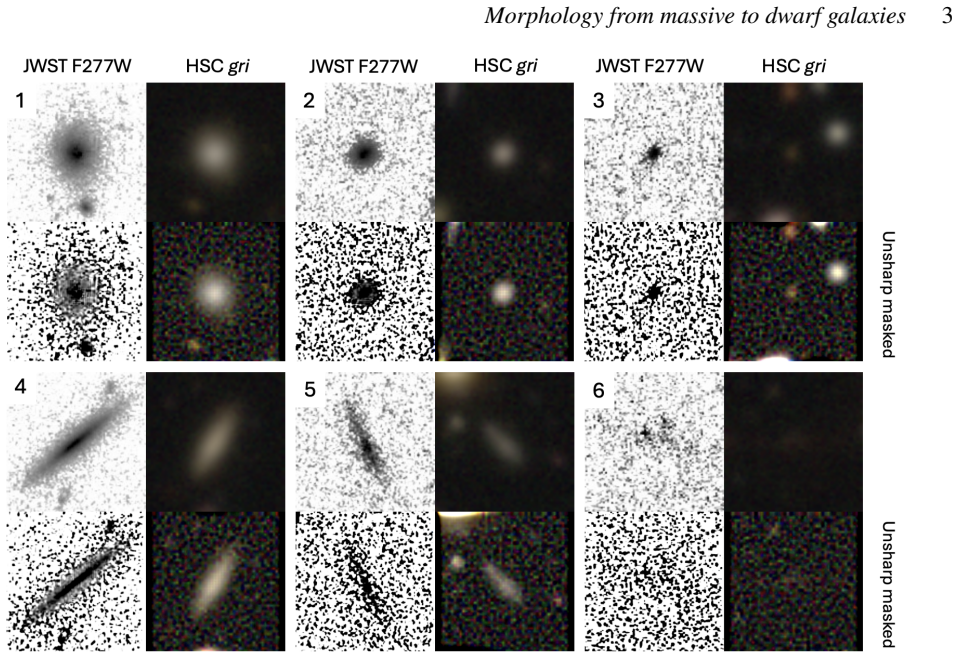
Figure 1
Figure 1. Example images of ETGs (1, 2), galaxies classified as compact (3), LTGs (4, 5) and those flagged as unclassifiable (6). The size of each image is 5 arcseconds on a side. The images from different instruments have different orientations – we intentionally keep it this way so that each galaxy is visually inspected at different orientations. In each image the first and second columns show the JWST and HSC images respec… view at source ↗
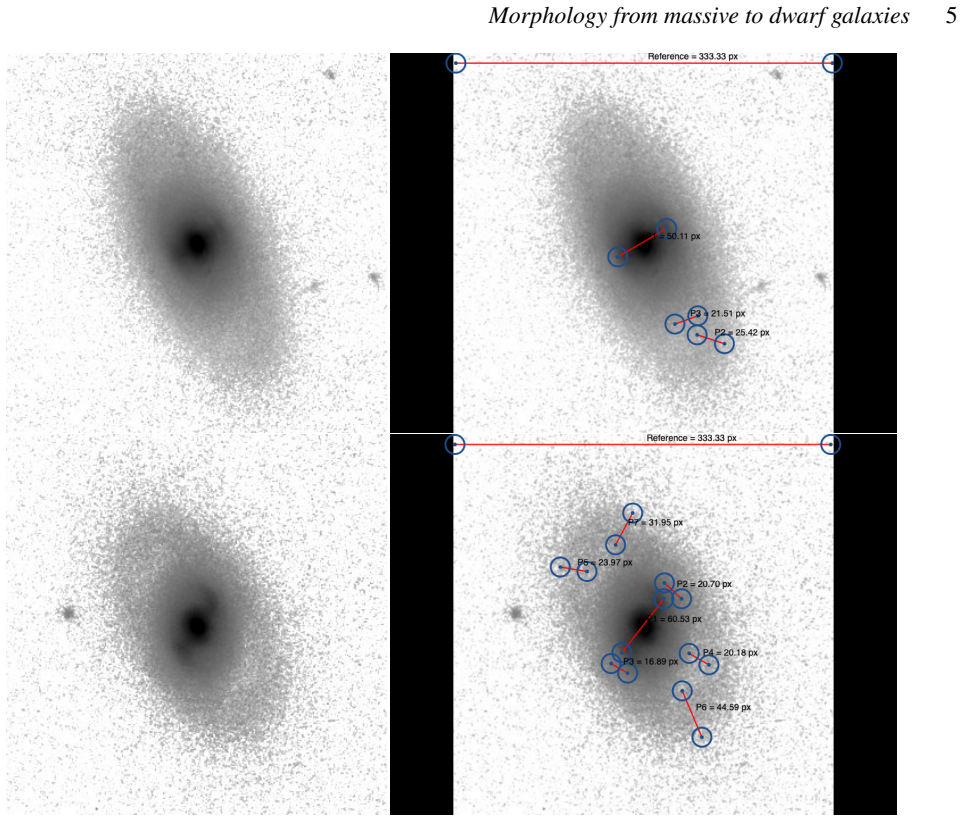
Figure 2
Figure 2. The measured sizes of structures in two massive barred galaxies (shown in separate rows). The left-hand column shows the original image of the galaxy, while the right-hand column shows the same image but with measurements of various structures (bar lengths, disk lengths and heights and intra-disk features, such as the width of and spacing between spiral arms) within the galaxy, in units of the number of JWST pixels.… view at source ↗
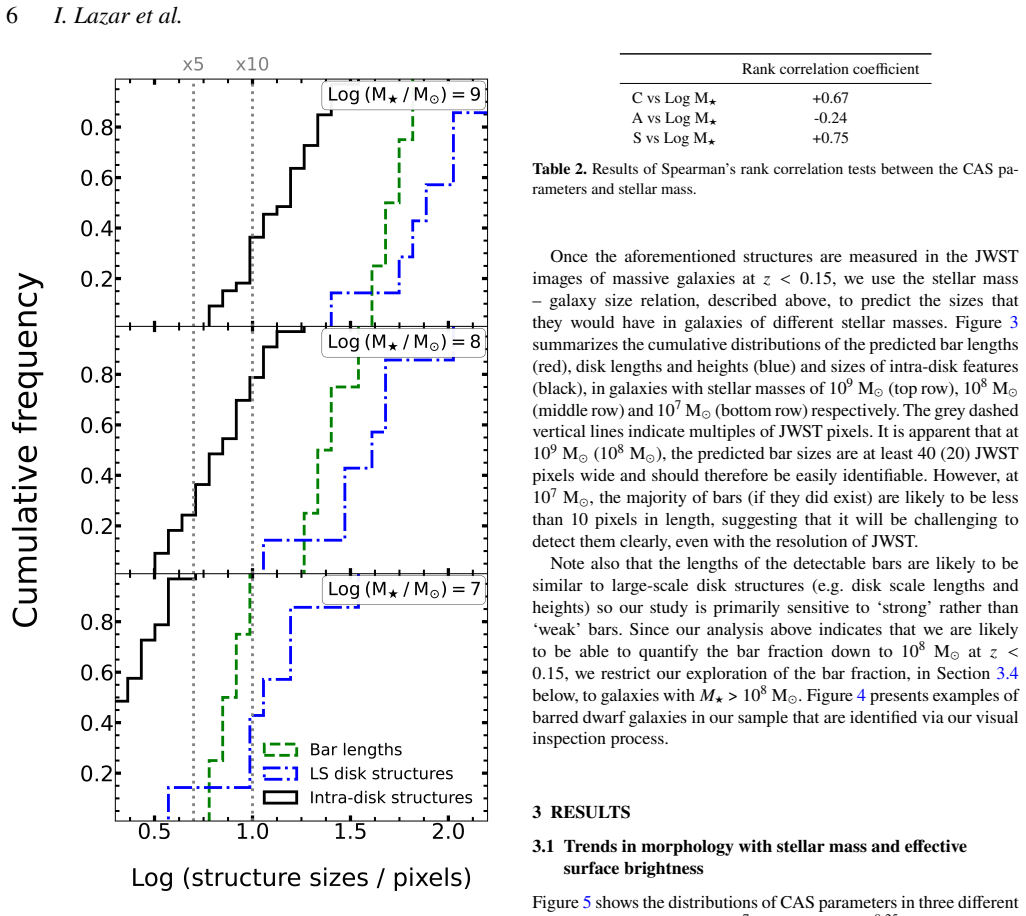
Figure 3
Figure 3. Cumulative distributions of the predicted sizes, in JWST pixels, of bar lengths, large-scale (LS) disk structures (such as disk lengths and heights) and intra-disk features in dwarf galaxies at various stellar masses. The top, middle and bottom panels show predictions for dwarf galaxies with 𝑀★ ∼ 109 , 108 and 107 M⊙ respectively. The dotted vertical lines indicate 5 and 10 JWST pixels [PITH_FULL_IMAGE:figures/full… view at source ↗
Figures from the paper (4 more)
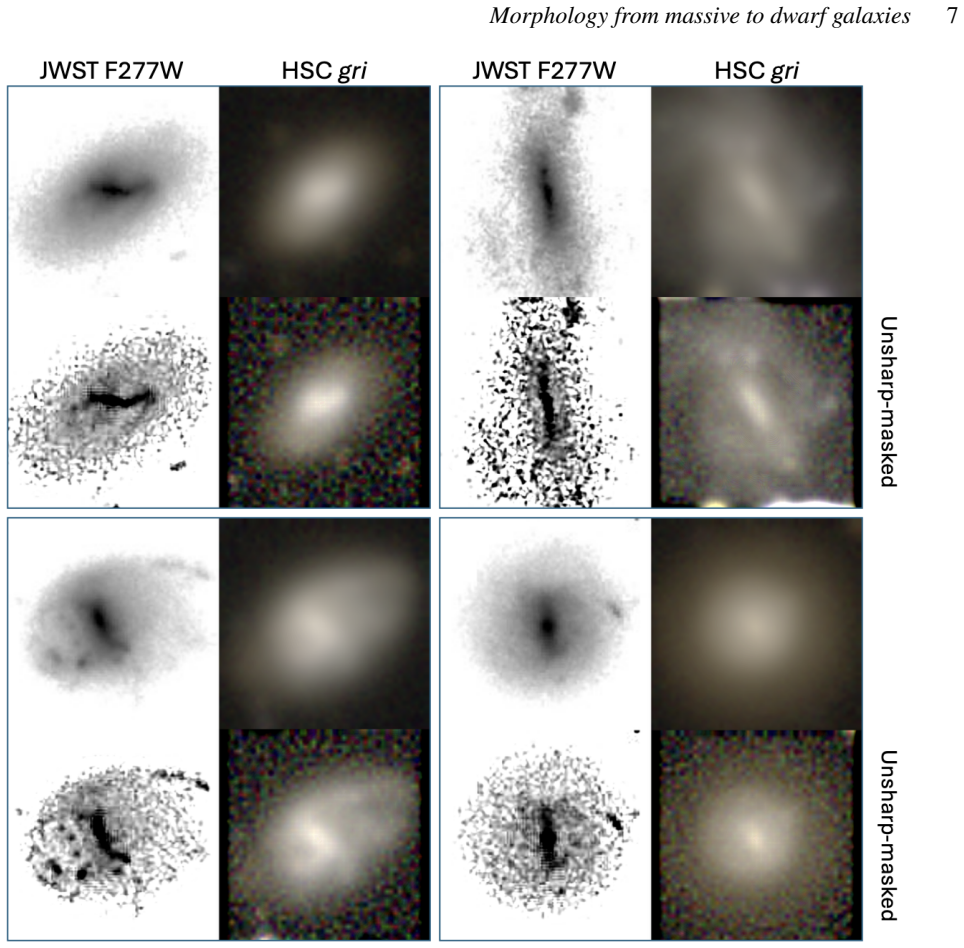
Figure 4
Figure 4. Figure 4: Examples of dwarf galaxies in our sample which have bars, identified via visual inspection. The size of each image is 5 arcseconds on a side. The images from different instruments have different orientations - we intentionally keep it this way so that each galaxy is vi…
Figure 5
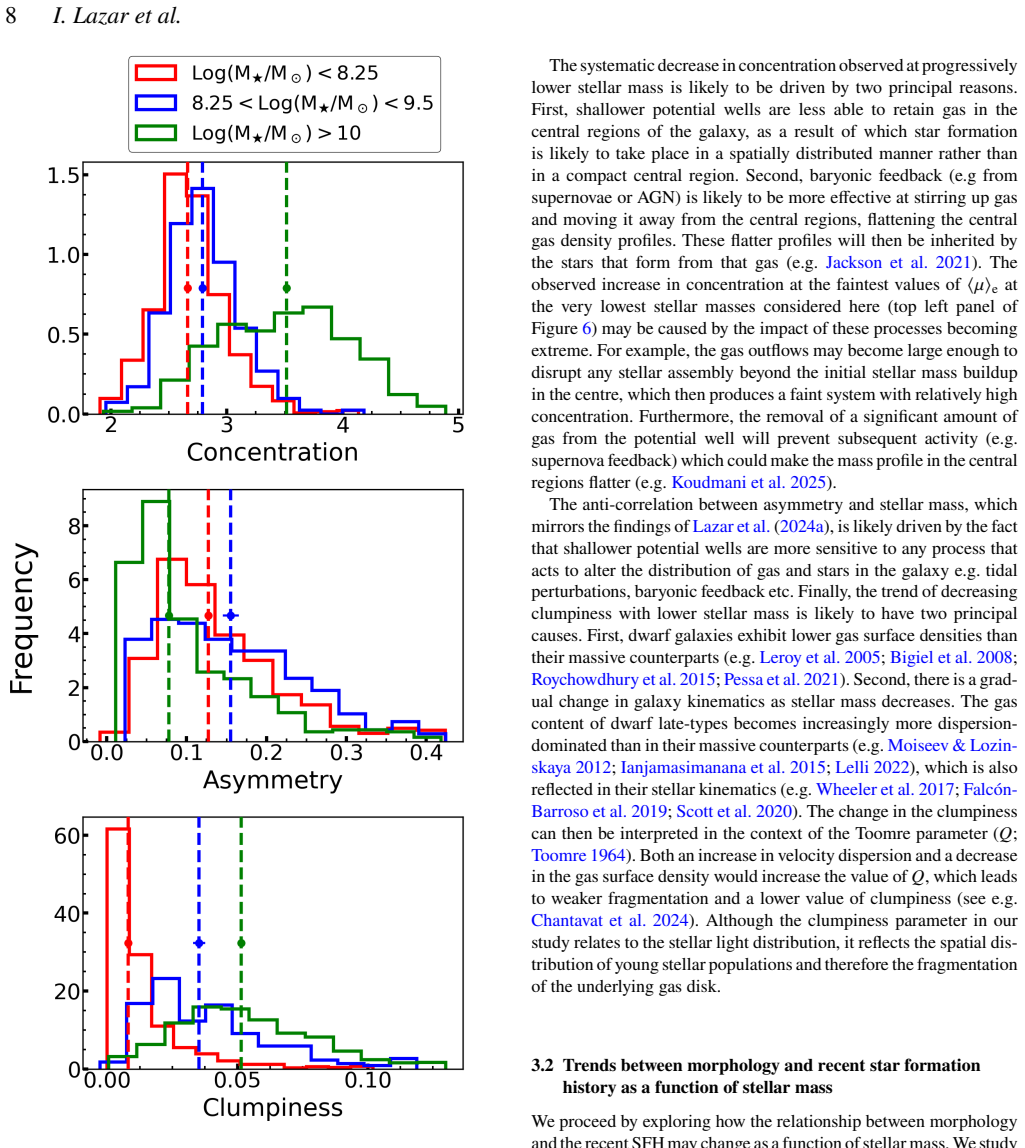
Figure 5. Figure 5: The concentration (top), asymmetry (middle) and clumpiness (bot￾tom) distributions for galaxies in three different mass regimes: the lower (107 M⊙ < 𝑀★ < 108.25 M⊙; red) and upper (108.25 M⊙ < 𝑀★ < 109.5 M⊙; blue) halves of the stellar mass range in the dwarf regime an…
Figure 6
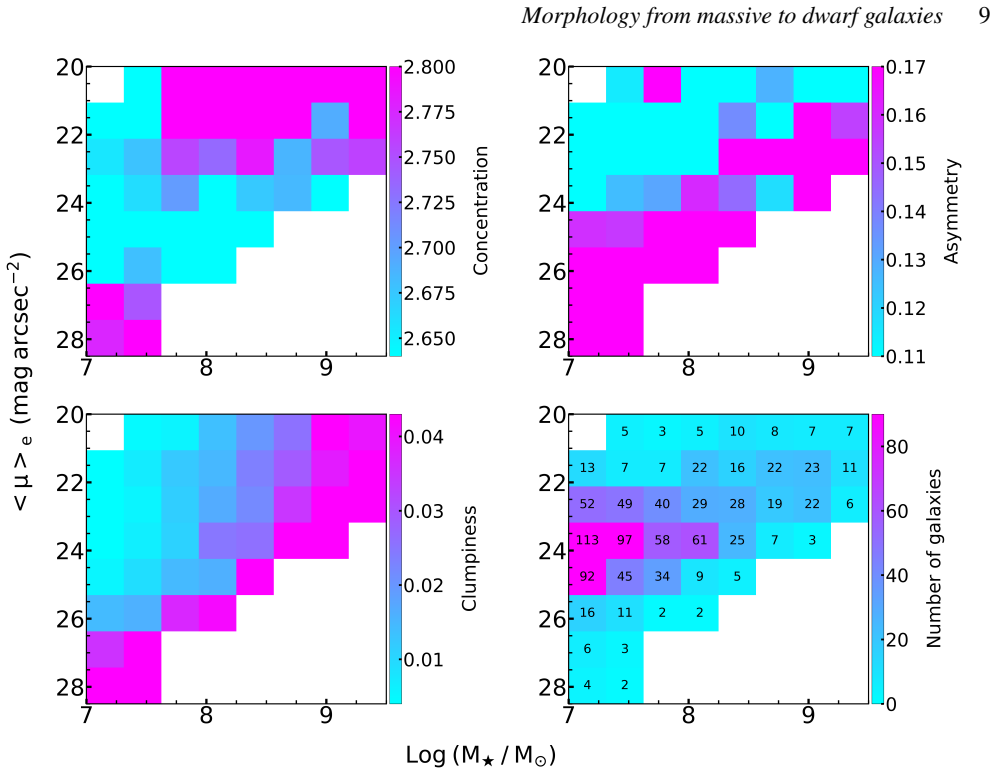
Figure 6. Figure 6: The concentration (top-left), asymmetry (top-right) and clumpiness (bottom-left) distributions in the effective surface brightness – stellar mass plane. The bottom-right panel shows the number of galaxies in different regions of this plane. greater probability for the …
Figure 8
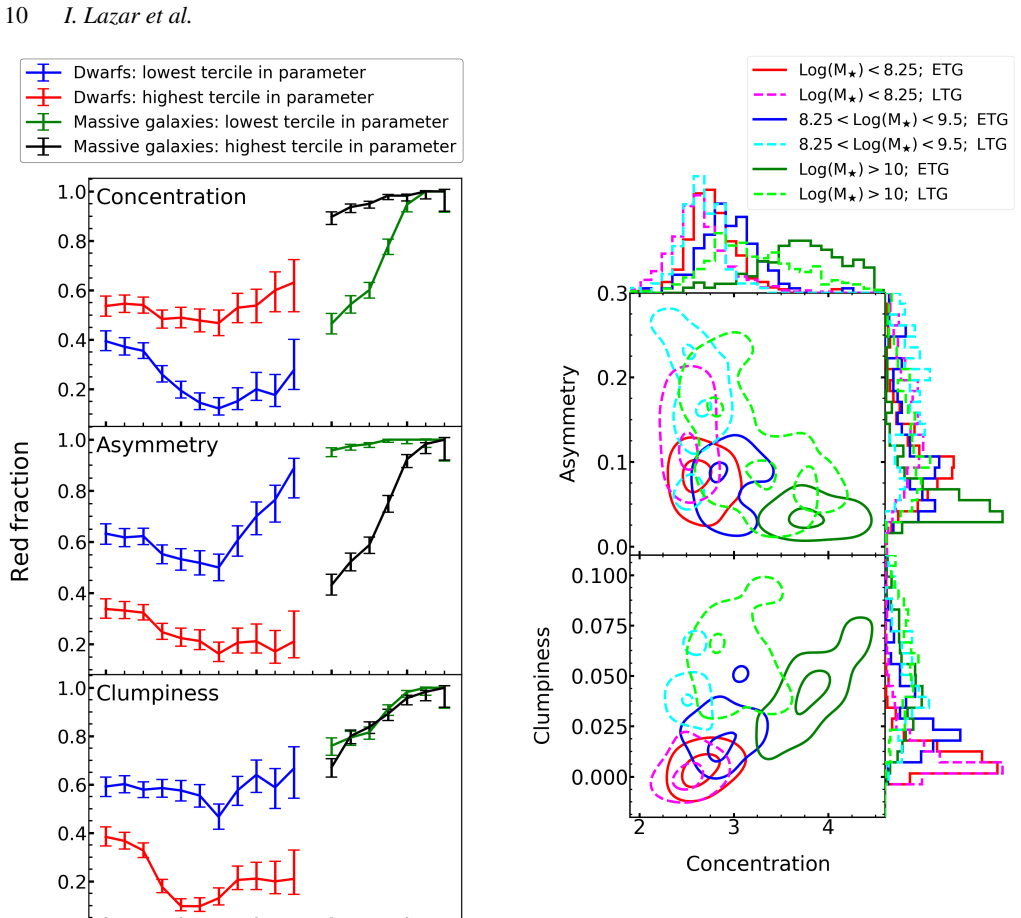
Figure 8. Figure 8: The asymmetry vs concentration (top) and clumpiness vs concen￾tration planes (bottom) for galaxies in three different mass regimes: the lower (107 M⊙ < 𝑀★ < 108.25 M⊙) and upper (108.25 M⊙ < 𝑀★ < 109.5 M⊙) halves of the stellar mass range in the dwarf regime and the ma…

Discussion (0). Continue with ORCID to comment.

Reference graph

Works this paper leans on

300 extracted references · 300 canonical work pages

  1. [1]

    Hunter, J. D. , Title =. Computing In Science & Engineering , Volume =

  2. [2]

    Astropy: A community Python package for astronomy

    Astropy: A community Python package for astronomy. , archivePrefix = "arXiv", eprint =. doi:10.1051/0004-6361/201322068 , adsurl =

  3. [3]

    ArXiv e-prints , archivePrefix = "arXiv", eprint =

    Total density profile of massive early-type galaxies in Horizon-AGN simulation: impact of AGN feedback and comparison with observations. ArXiv e-prints , archivePrefix = "arXiv", eprint =

  4. [4]

    and Duc, P.-A

    From tidal dwarf galaxies to satellite galaxies. , eprint =. doi:10.1051/0004-6361:20065248 , adsurl =

  5. [5]

    doi:10.1086/305523 , eprint =

    The Star Formation History of Field Galaxies. , eprint =. doi:10.1086/305523 , adsurl =

  6. [6]

    Cosmic Star-Formation History

    Cosmic Star-Formation History. , archivePrefix = "arXiv", eprint =. doi:10.1146/annurev-astro-081811-125615 , adsurl =

  7. [7]

    J., et al., 2008, @doi [ ] 10.1111/j.1365-2966.2008.13486.x , http://adsabs.harvard.edu/abs/2008MNRAS.388.1335W 388, 1335

    Star formation history up to z = 7.4: implications for gamma-ray bursts and cosmic metallicity evolution. , archivePrefix = "arXiv", eprint =. doi:10.1111/j.1365-2966.2008.13488.x , adsurl =

  8. [8]

    , keywords =

    Gas segregation in the interacting system ARP 105. , keywords =

Show all 300 references
  1. [9]

    , keywords =

    Ultraluminous infrared galaxies and the origin of quasars. , keywords =. doi:10.1086/165983 , adsurl =

  2. [10]

    Science , eprint =

    A Fossil Record of Galaxy Encounters. Science , eprint =. doi:10.1126/science.1081525 , adsurl =

  3. [11]

    , archivePrefix = "arXiv", eprint =

    Newborn spheroids at high redshift: when and how did the dominant, old stars in today's massive galaxies form?. , archivePrefix = "arXiv", eprint =. doi:10.1093/mnras/sts031 , adsurl =

  4. [12]

    , archivePrefix = "arXiv", eprint =

    The Major and Minor Galaxy Merger Rates at z 1.5. , archivePrefix = "arXiv", eprint =. doi:10.1088/0004-637X/742/2/103 , adsurl =

  5. [13]

    , archivePrefix = "arXiv", eprint =

    The merger rates and sizes of galaxies across the peak epoch of star formation from the HiZELS survey. , archivePrefix = "arXiv", eprint =. doi:10.1093/mnras/sts684 , adsurl =

  6. [14]

    , eprint =

    The nature of high-redshift galaxies. , eprint =. doi:10.1046/j.1365-8711.2001.03975.x , adsurl =

  7. [15]

    , eprint =

    The Relation between Quasar and Merging Galaxy Luminosity Functions and the Merger-driven Star Formation History of the Universe. , eprint =. doi:10.1086/508503 , adsurl =

  8. [16]

    Galaxy structures and the merger rate to z \ 3 in the Hubble Ultra-Deep Field

    The structures of distant galaxies - I. Galaxy structures and the merger rate to z \ 3 in the Hubble Ultra-Deep Field. , archivePrefix = "arXiv", eprint =. doi:10.1111/j.1365-2966.2008.13069.x , adsurl =

  9. [17]

    , archivePrefix = "arXiv", eprint =

    The effect of galaxy mass ratio on merger-driven starbursts. , archivePrefix = "arXiv", eprint =. doi:10.1111/j.1365-2966.2007.12730.x , adsurl =

  10. [18]

    , eprint =

    The Merger Rate of Massive Galaxies. , eprint =. doi:10.1086/508408 , adsurl =

  11. [19]

    , archivePrefix = "arXiv", eprint =

    Evolution of the dust emission of massive galaxies up to z = 4 and constraints on their dominant mode of star formation. , archivePrefix = "arXiv", eprint =. doi:10.1051/0004-6361/201425031 , adsurl =

  12. [20]

    , archivePrefix = "arXiv", eprint =

    The Era of Star Formation in Galaxy Clusters. , archivePrefix = "arXiv", eprint =. doi:10.1088/0004-637X/779/2/138 , adsurl =

  13. [21]

    , archivePrefix = "arXiv", eprint =

    The Lesser Role of Starbursts in Star Formation at z = 2. , archivePrefix = "arXiv", eprint =. doi:10.1088/2041-8205/739/2/L40 , adsurl =

  14. [22]

    , archivePrefix = "arXiv", eprint =

    On the Evolution of the Molecular Gas Fraction of Star-Forming Galaxies. , archivePrefix = "arXiv", eprint =. doi:10.1088/2041-8205/730/2/L19 , adsurl =

  15. [23]

    , archivePrefix = "arXiv", eprint =

    High molecular gas fractions in normal massive star-forming galaxies in the young Universe. , archivePrefix = "arXiv", eprint =. doi:10.1038/nature08773 , adsurl =

  16. [24]

    , eprint =

    Gasdynamics and Starbursts in Major Mergers. , eprint =. doi:10.1086/177353 , adsurl =

  17. [25]

    , archivePrefix = "arXiv", eprint =

    On the frequency, intensity, and duration of starburst episodes triggered by galaxy interactions and mergers. , archivePrefix = "arXiv", eprint =. doi:10.1051/0004-6361:200809480 , adsurl =

  18. [26]

    , archivePrefix = "arXiv", eprint =

    Dancing in the dark: galactic properties trace spin swings along the cosmic web. , archivePrefix = "arXiv", eprint =. doi:10.1093/mnras/stu1227 , adsurl =

  19. [27]

    , archivePrefix = "arXiv", eprint =

    The interaction-driven starburst contribution to the cosmic star formation rate density. , archivePrefix = "arXiv", eprint =. doi:10.1051/0004-6361/201220754 , adsurl =

  20. [28]

    , archivePrefix = "arXiv", eprint =

    High-resolution simulations of galaxy mergers: resolving globular cluster formation. , archivePrefix = "arXiv", eprint =. doi:10.1111/j.1745-3933.2008.00511.x , adsurl =

  21. [29]

    , eprint =

    The Asymmetry of Galaxies: Physical Morphology for Nearby and High-Redshift Galaxies. , eprint =. doi:10.1086/308300 , adsurl =

  22. [30]

    , eprint =

    A New Nonparametric Approach to Galaxy Morphological Classification. , eprint =. doi:10.1086/421849 , adsurl =

  23. [31]

    , year = 1966, month = nov, volume = 14, pages =

    Atlas of Peculiar Galaxies. , year = 1966, month = nov, volume = 14, pages =. doi:10.1086/190147 , adsurl =

  24. [32]

    , keywords =

    Correlations between UBV colors and fine structure in E and S0 galaxies - A first attempt at dating ancient merger events. , keywords =. doi:10.1086/116296 , adsurl =

  25. [33]

    , archivePrefix = "arXiv", eprint =

    Linking the structural properties of galaxies and their star formation histories with STAGES. , archivePrefix = "arXiv", eprint =. doi:10.1093/mnras/stv2321 , adsurl =

  26. [34]

    , archivePrefix = "arXiv", eprint =

    Major mergers are not significant drivers of star formation or morphological transformation around the epoch of peak cosmic star formation. , archivePrefix = "arXiv", eprint =. doi:10.1093/mnras/stw2895 , adsurl =

  27. [35]

    , archivePrefix = "arXiv", eprint =

    The importance of minor-merger-driven star formation and black hole growth in disc galaxies. , archivePrefix = "arXiv", eprint =. doi:10.1093/mnras/stu338 , adsurl =

  28. [36]

    , keywords =

    Triggering of starbursts in galaxies by minor mergers. , keywords =. doi:10.1086/187299 , adsurl =

  29. [37]

    , archivePrefix = "arXiv", eprint =

    Disc formation and the origin of clumpy galaxies at high redshift. , archivePrefix = "arXiv", eprint =. doi:10.1111/j.1745-3933.2009.00685.x , adsurl =

  30. [38]

    , archivePrefix = "arXiv", eprint =

    A Physical Approach to the Identification of High-z Mergers: Morphological Classification in the Stellar Mass Domain. , archivePrefix = "arXiv", eprint =. doi:10.1088/0004-637X/805/2/181 , adsurl =

  31. [39]

    Constraints on the Assembly and Dynamics of Galaxies. II. Properties of Kiloparsec-scale Clumps in Rest-frame Optical Emission of z \ 2 Star-forming Galaxies. , archivePrefix = "arXiv", eprint =. doi:10.1088/0004-637X/739/1/45 , adsurl =

  32. [40]

    , archivePrefix = "arXiv", eprint =

    Slow Evolution of the Specific Star Formation Rate at z 2: The Impact of Dust, Emission Lines, and a Rising Star Formation History. , archivePrefix = "arXiv", eprint =. doi:10.1088/0004-637X/781/1/34 , adsurl =

  33. [41]

    , eprint =

    Semi-analytic modelling of galaxy formation: the local Universe. , eprint =. doi:10.1046/j.1365-8711.1999.03032.x , adsurl =

  34. [42]

    A hybrid N-body/semi-analytic model of hierarchical galaxy formation

    GALICS- I. A hybrid N-body/semi-analytic model of hierarchical galaxy formation. , eprint =. doi:10.1046/j.1365-8711.2003.05589.x , adsurl =

  35. [43]

    , eprint =

    The many lives of active galactic nuclei: cooling flows, black holes and the luminosities and colours of galaxies. , eprint =. doi:10.1111/j.1365-2966.2005.09675.x , adsurl =

  36. [44]

    , archivePrefix = "arXiv", eprint =

    The dusty, albeit ultraviolet bright, infancy of galaxies. , archivePrefix = "arXiv", eprint =. doi:10.1111/j.1745-3933.2010.00820.x , adsurl =

  37. [45]

    , archivePrefix = "arXiv", eprint =

    The EAGLE project: simulating the evolution and assembly of galaxies and their environments. , archivePrefix = "arXiv", eprint =. doi:10.1093/mnras/stu2058 , adsurl =

  38. [46]

    , archivePrefix = "arXiv", eprint =

    Introducing the Illustris Project: simulating the coevolution of dark and visible matter in the Universe. , archivePrefix = "arXiv", eprint =. doi:10.1093/mnras/stu1536 , adsurl =

  39. [47]

    , archivePrefix = "arXiv", eprint =

    The MassiveBlack-II simulation: the evolution of haloes and galaxies to z 0. , archivePrefix = "arXiv", eprint =. doi:10.1093/mnras/stv627 , adsurl =

  40. [48]

    A new high resolution code called RAMSES

    Cosmological hydrodynamics with adaptive mesh refinement. A new high resolution code called RAMSES. , eprint =. doi:10.1051/0004-6361:20011817 , adsurl =

  41. [49]

    , archivePrefix = "arXiv", eprint =

    Seven-year Wilkinson Microwave Anisotropy Probe (WMAP) Observations: Cosmological Interpretation. , archivePrefix = "arXiv", eprint =. doi:10.1088/0067-0049/192/2/18 , adsurl =

  42. [50]

    ArXiv e-prints , archivePrefix = "arXiv", eprint =

    The Horizon-AGN simulation: evolution of galaxy properties over cosmic time. ArXiv e-prints , archivePrefix = "arXiv", eprint =

  43. [51]

    , archivePrefix = "arXiv", eprint =

    Towards simulating star formation in turbulent high-z galaxies with mechanical supernova feedback. , archivePrefix = "arXiv", eprint =. doi:10.1093/mnras/stv1211 , adsurl =

  44. [52]

    , archivePrefix = "arXiv", eprint =

    Constraining stellar assembly and active galactic nucleus feedback at the peak epoch of star formation. , archivePrefix = "arXiv", eprint =. doi:10.1111/j.1745-3933.2012.01309.x , adsurl =

  45. [53]

    Cosmic logistics in a hierarchical universe

    The history of the baryon budget. Cosmic logistics in a hierarchical universe. , eprint =. doi:10.1051/0004-6361:20053116 , adsurl =

  46. [54]

    , eprint =

    The origin and implications of dark matter anisotropic cosmic infall on \ L _ * haloes. , eprint =. doi:10.1111/j.1365-2966.2004.07883.x , adsurl =

  47. [55]

    Towards improving galaxy formation models using subhaloes

    Building merger trees from cosmological N-body simulations. Towards improving galaxy formation models using subhaloes. , archivePrefix = "arXiv", eprint =. doi:10.1051/0004-6361/200911787 , adsurl =

  48. [56]

    , archivePrefix = "arXiv", eprint =

    High-redshift major mergers weakly enhance star formation. , archivePrefix = "arXiv", eprint =. doi:10.1093/mnras/stw2920 , adsurl =

  49. [57]

    Advanced Science Letters , archivePrefix = "arXiv", eprint =

    The formation of disk galaxies in computer simulations. Advanced Science Letters , archivePrefix = "arXiv", eprint =

  50. [58]

    , archivePrefix = "arXiv", eprint =

    Galaxy morphology and star formation in the Illustris Simulation at z = 0. , archivePrefix = "arXiv", eprint =. doi:10.1093/mnras/stv2078 , adsurl =

  51. [59]

    , keywords =

    Formation and rotation of disc galaxies with haloes. , keywords =. doi:10.1093/mnras/193.2.189 , adsurl =

  52. [60]

    The Angular Momentum of Gas in Protogalaxies. I. Implications for the Formation of Disk Galaxies. , eprint =. doi:10.1086/341619 , adsurl =

  53. [61]

    , archivePrefix = "arXiv", eprint =

    The formation of disc galaxies in a CDM universe. , archivePrefix = "arXiv", eprint =. doi:10.1111/j.1365-2966.2010.17530.x , adsurl =

  54. [62]

    Morphologies of 190,000 Galaxies at z = 0-10 Revealed with HST Legacy Data. I. Size Evolution. , archivePrefix = "arXiv", eprint =. doi:10.1088/0067-0049/219/2/15 , adsurl =

  55. [63]

    Early-Type Galaxies in the Sloan Digital Sky Survey. I. The Sample. , eprint =. doi:10.1086/367776 , adsurl =

  56. [64]

    , archivePrefix = "arXiv", eprint =

    SINFONI/VLT 3D spectroscopy of massive galaxies: evidence of rotational support at z 1.4. , archivePrefix = "arXiv", eprint =. doi:10.1093/mnras/stu034 , adsurl =

  57. [65]

    , eprint =

    Evolution since z = 1 of the Morphology-Density Relation for Galaxies. , eprint =. doi:10.1086/426930 , adsurl =

  58. [66]

    , eprint =

    Evolution since z = 0.5 of the Morphology-Density Relation for Clusters of Galaxies. , eprint =. doi:10.1086/304890 , adsurl =

  59. [67]

    , eprint =

    The Morphology-Density Relation in z \ 1 Clusters. , eprint =. doi:10.1086/428881 , adsurl =

  60. [68]

    , archivePrefix = "arXiv", eprint =

    The unorthodox evolution of major merger remnants into star-forming spiral galaxies. , archivePrefix = "arXiv", eprint =. doi:10.1093/mnras/stx1516 , adsurl =

  61. [69]

    , archivePrefix = "arXiv", eprint =

    Merger Histories of Galaxy Halos and Implications for Disk Survival. , archivePrefix = "arXiv", eprint =. doi:10.1086/588579 , adsurl =

  62. [70]

    Encyclopedia of Astronomy and Astrophysics , year = 2000, month = nov, editor =

    Galaxies: Interactions and Mergers. Encyclopedia of Astronomy and Astrophysics , year = 2000, month = nov, editor =. doi:10.1888/0333750888/2623 , adsurl =

  63. [71]

    , eprint =

    A Merger-driven Scenario for Cosmological Disk Galaxy Formation. , eprint =. doi:10.1086/504412 , adsurl =

  64. [72]

    ArXiv e-prints , archivePrefix = "arXiv", eprint =

    The diversity of assembly histories leading to disc galaxy formation in a LambdaCDM model. ArXiv e-prints , archivePrefix = "arXiv", eprint =

  65. [73]

    Forming Disk Galaxies in Wet Major Mergers. I. Three Fiducial Examples. , archivePrefix = "arXiv", eprint =. doi:10.3847/0004-637X/821/2/90 , adsurl =

  66. [74]

    , eprint =

    The fundamental properties of galaxies and a new galaxy classification system. , eprint =. doi:10.1111/j.1365-2966.2006.11114.x , adsurl =

  67. [75]

    , eprint =

    The Mass Assembly Histories of Galaxies of Various Morphologies in the GOODS Fields. , eprint =. doi:10.1086/429549 , adsurl =

  68. [76]

    , archivePrefix = "arXiv", eprint =

    CANDELS: The Correlation between Galaxy Morphology and Star Formation Activity at z \ 2. , archivePrefix = "arXiv", eprint =. doi:10.1088/0004-637X/774/1/47 , adsurl =

  69. [77]

    ArXiv e-prints , archivePrefix = "arXiv", eprint =

    Large Synoptic Survey Telescope Galaxies Science Roadmap. ArXiv e-prints , archivePrefix = "arXiv", eprint =

  70. [78]

    , keywords =

    Cooling functions for low-density astrophysical plasmas. , keywords =. doi:10.1086/191823 , adsurl =

  71. [79]

    Radiative Transfer in a Clumpy Universe. II. The Ultraviolet Extragalactic Background. , eprint =. doi:10.1086/177035 , adsurl =

  72. [80]

    , eprint =

    The Global Schmidt Law in Star-forming Galaxies. , eprint =. doi:10.1086/305588 , adsurl =

  73. [81]

    , keywords =

    Deposition of mass, momentum, and energy by massive stars into the interstellar medium. , keywords =. doi:10.1086/172089 , adsurl =

  74. [82]

    , eprint =

    Starburst99: Synthesis Models for Galaxies with Active Star Formation. , eprint =. doi:10.1086/313233 , adsurl =

  75. [83]

    , archivePrefix = "arXiv", eprint =

    A Library of Theoretical Ultraviolet Spectra of Massive, Hot Stars for Evolutionary Synthesis. , archivePrefix = "arXiv", eprint =. doi:10.1088/0067-0049/189/2/309 , adsurl =

  76. [84]

    , keywords =

    Relative roles of type I and II supernovae in the chemical enrichment of the interstellar gas. , keywords =

  77. [85]

    , eprint =

    On the Typical Timescale for the Chemical Enrichment from Type Ia Supernovae in Galaxies. , eprint =. doi:10.1086/322472 , adsurl =

  78. [86]

    , eprint =

    Thermal Stability of White Dwarfs Accreting Hydrogen-rich Matter and Progenitors of Type Ia Supernovae. , eprint =. doi:10.1086/518465 , adsurl =

  79. [87]

    , archivePrefix = "arXiv", eprint =

    The delay-time distribution of Type Ia supernovae from Sloan II. , archivePrefix = "arXiv", eprint =. doi:10.1111/j.1365-2966.2012.21871.x , adsurl =

  80. [88]

    , keywords =

    The origin and lifetime of giant molecular cloud complexes. , keywords =. doi:10.1086/157968 , adsurl =

  81. [89]

    , eprint =

    Rapid Formation of Molecular Clouds and Stars in the Solar Neighborhood. , eprint =. doi:10.1086/323863 , adsurl =

  82. [90]

    , archivePrefix = "arXiv", eprint =

    The HORIZON-AGN simulation: morphological diversity of galaxies promoted by AGN feedback. , archivePrefix = "arXiv", eprint =. doi:10.1093/mnras/stw2265 , adsurl =

  83. [91]

    , archivePrefix = "arXiv", eprint =

    Cosmological simulations of the growth of supermassive black holes and feedback from active galactic nuclei: method and tests. , archivePrefix = "arXiv", eprint =. doi:10.1111/j.1365-2966.2009.15043.x , adsurl =

  84. [92]

    , archivePrefix = "arXiv", eprint =

    Feeding compact bulges and supermassive black holes with low angular momentum cosmic gas at high redshift. , archivePrefix = "arXiv", eprint =. doi:10.1111/j.1365-2966.2012.21160.x , adsurl =

  85. [93]

    , archivePrefix = "arXiv", eprint =

    Phibss: Molecular Gas Content and Scaling Relations in z \ 1-3 Massive, Main-sequence Star-forming Galaxies. , archivePrefix = "arXiv", eprint =. doi:10.1088/0004-637X/768/1/74 , adsurl =

  86. [94]

    , archivePrefix = "arXiv", eprint =

    The Horizon-AGN simulation: evolution of galaxy properties over cosmic time. , archivePrefix = "arXiv", eprint =. doi:10.1093/mnras/stx126 , adsurl =

  87. [95]

    , archivePrefix = "arXiv", eprint =

    Galaxy merger histories and the role of merging in driving star formation at z 1. , archivePrefix = "arXiv", eprint =. doi:10.1093/mnras/stv1500 , adsurl =

  88. [96]

    , archivePrefix = "arXiv", eprint =

    The cosmic evolution of massive black holes in the Horizon-AGN simulation. , archivePrefix = "arXiv", eprint =. doi:10.1093/mnras/stw1123 , adsurl =

  89. [97]

    , archivePrefix = "arXiv", eprint =

    The limited role of galaxy mergers in driving stellar mass growth over cosmic time. , archivePrefix = "arXiv", eprint =. doi:10.1093/mnrasl/slx136 , adsurl =

  90. [98]

    , archivePrefix = "arXiv", eprint =

    The role of mergers and halo spin in shaping galaxy morphology. , archivePrefix = "arXiv", eprint =. doi:10.1093/mnras/stx305 , adsurl =

  91. [99]

    , eprint =

    Hierarchical galaxy formation. , eprint =. doi:10.1046/j.1365-8711.2000.03879.x , adsurl =

  92. [100]

    , eprint =

    The hierarchical formation of the brightest cluster galaxies. , eprint =. doi:10.1111/j.1365-2966.2006.11287.x , adsurl =

  93. [101]

    , eprint =

    Breaking the hierarchy of galaxy formation. , eprint =. doi:10.1111/j.1365-2966.2006.10519.x , adsurl =

  94. [102]

    , eprint =

    What Shapes the Luminosity Function of Galaxies?. , eprint =. doi:10.1086/379160 , adsurl =

  95. [103]

    , archivePrefix = "arXiv", eprint =

    Time evolution of galaxy scaling relations in cosmological simulations. , archivePrefix = "arXiv", eprint =. doi:10.1093/mnras/stw2157 , adsurl =

  96. [104]

    , eprint =

    Evolutionary tracks and isochrones for low- and intermediate-mass stars: From 0.15 to 7 M _ sun , and from Z=0.0004 to 0.03. , eprint =. doi:10.1051/aas:2000126 , adsurl =

  97. [105]

    , keywords =

    Evolution of low- and intermediate-mass stars to the end of the asymptotic giant branch with mass loss. , keywords =. doi:10.1086/173033 , adsurl =

  98. [106]

    , archivePrefix = "arXiv", eprint =

    Galaxy Zoo 1: data release of morphological classifications for nearly 900 000 galaxies. , archivePrefix = "arXiv", eprint =. doi:10.1111/j.1365-2966.2010.17432.x , adsurl =

  99. [107]

    Realm of the Nebulae, by E.P

    Realm of the Nebulae. Realm of the Nebulae, by E.P. Hubble. New Haven: Yale University Press, 1936. ISBN 9780300025002 , year = 1936, adsurl =

  100. [108]

    A new look at the morphology of nearby galaxies: the kinematic morphology-density relation

    The ATLAS ^ 3D project - VII. A new look at the morphology of nearby galaxies: the kinematic morphology-density relation. , archivePrefix = "arXiv", eprint =. doi:10.1111/j.1365-2966.2011.18600.x , adsurl =

  101. [109]

    I - Formation mechanisms and mean free paths

    Spiral structure and star formation. I - Formation mechanisms and mean free paths. , keywords =. doi:10.1086/161746 , adsurl =

  102. [110]

    , keywords =

    Galaxy morphology in rich clusters - Implications for the formation and evolution of galaxies. , keywords =. doi:10.1086/157753 , adsurl =

  103. [111]

    Evolution of Galaxies and Stellar Populations , year = 1977, editor =

    Mergers and Some Consequences. Evolution of Galaxies and Stellar Populations , year = 1977, editor =

  104. [112]

    , keywords =

    Simulations of mergers between disc-halo galaxies. , keywords =. doi:10.1093/mnras/205.4.1009 , adsurl =

  105. [113]

    , eprint =

    Star formation efficiency in galaxy interactions and mergers: a statistical study. , eprint =. doi:10.1051/0004-6361:20066959 , adsurl =

  106. [114]

    , archivePrefix = "arXiv", eprint =

    The effects of gas on morphological transformation in mergers: implications for bulge and disc demographics. , archivePrefix = "arXiv", eprint =. doi:10.1111/j.1365-2966.2009.14983.x , adsurl =

  107. [115]

    Two-dimensional kinematic analysis of simulated galaxies and the cosmological origin of fast and slow rotators

    The ATLAS ^ 3D project - XXV. Two-dimensional kinematic analysis of simulated galaxies and the cosmological origin of fast and slow rotators. , archivePrefix = "arXiv", eprint =. doi:10.1093/mnras/stt1919 , adsurl =

  108. [116]

    , archivePrefix = "arXiv", eprint =

    Compaction and quenching of high-z galaxies in cosmological simulations: blue and red nuggets. , archivePrefix = "arXiv", eprint =. doi:10.1093/mnras/stv740 , adsurl =

  109. [117]

    , archivePrefix = "arXiv", eprint =

    The rise and fall of stellar across the peak of cosmic star formation history: effects of mergers versus diffuse stellar mass acquisition. , archivePrefix = "arXiv", eprint =. doi:10.1093/mnras/stw2778 , adsurl =

  110. [118]

    , eprint =

    Resolving the Structure of Cold Dark Matter Halos. , eprint =. doi:10.1086/311333 , adsurl =

  111. [119]

    , eprint =

    Ram pressure stripping of spiral galaxies in clusters. , eprint =. doi:10.1046/j.1365-8711.1999.02715.x , adsurl =

  112. [120]

    , archivePrefix = "arXiv", eprint =

    On the Evolution of Galaxy Spin in a Cosmological Hydrodynamic Simulation of Galaxy Clusters. , archivePrefix = "arXiv", eprint =. doi:10.3847/1538-4357/aa5e4b , adsurl =

  113. [121]

    , eprint =

    Formation of a Spiral Galaxy in a Major Merger. , eprint =. doi:10.1086/429486 , adsurl =

  114. [122]

    , archivePrefix = "arXiv", eprint =

    The role of minor mergers in the recent star formation history of early-type galaxies. , archivePrefix = "arXiv", eprint =. doi:10.1111/j.1365-2966.2009.14403.x , adsurl =

  115. [123]

    , archivePrefix = "arXiv", eprint =

    A coincidence of disturbed morphology and blue UV colour: minor-merger-driven star formation in early-type galaxies at z 0.6. , archivePrefix = "arXiv", eprint =. doi:10.1111/j.1365-2966.2010.17754.x , adsurl =

  116. [124]

    , keywords =

    Encounters of disk/halo galaxies. , keywords =. doi:10.1086/166593 , adsurl =

  117. [125]

    I - Bulgeless progenitors

    Structure of merger remnants. I - Bulgeless progenitors. , keywords =. doi:10.1086/172009 , adsurl =

  118. [126]

    Simulations of binary galaxy mergers and the link with fast rotators, slow rotators and kinematically distinct cores

    The ATLAS ^ 3D project - VI. Simulations of binary galaxy mergers and the link with fast rotators, slow rotators and kinematically distinct cores. , archivePrefix = "arXiv", eprint =. doi:10.1111/j.1365-2966.2011.19113.x , adsurl =

  119. [127]

    , archivePrefix = "arXiv", eprint =

    The origin of discs and spheroids in simulated galaxies. , archivePrefix = "arXiv", eprint =. doi:10.1111/j.1365-2966.2012.20975.x , adsurl =

  120. [128]

    The galaxy merger history as a measure of cosmological parameters

    Galaxy formation as a cosmological tool - I. The galaxy merger history as a measure of cosmological parameters. , archivePrefix = "arXiv", eprint =. doi:10.1093/mnras/stu1385 , adsurl =

  121. [129]

    , archivePrefix = "arXiv", eprint =

    Formation of Massive Galaxies at High Redshift: Cold Streams, Clumpy Disks, and Compact Spheroids. , archivePrefix = "arXiv", eprint =. doi:10.1088/0004-637X/703/1/785 , adsurl =

  122. [130]

    Modelling the formation and evolution of fast and slow rotator early-type galaxies within CDM

    The ATLAS ^ 3D project - VIII. Modelling the formation and evolution of fast and slow rotator early-type galaxies within CDM. , archivePrefix = "arXiv", eprint =. doi:10.1111/j.1365-2966.2011.19486.x , adsurl =

  123. [131]

    ArXiv e-prints , archivePrefix = "arXiv", eprint =

    Euclid Definition Study Report. ArXiv e-prints , archivePrefix = "arXiv", eprint =

  124. [132]

    Survey and Other Telescope Technologies and Discoveries , year = 2002, series =

    Large Synoptic Survey Telescope: Overview. Survey and Other Telescope Technologies and Discoveries , year = 2002, series =. doi:10.1117/12.456772 , adsurl =. astro-ph/0302102 , editor =

  125. [133]

    , eprint =

    The James Webb Space Telescope. , eprint =. doi:10.1007/s11214-006-8315-7 , adsurl =

  126. [134]

    , archivePrefix = "arXiv", eprint =

    The Dark Energy Survey: more than dark energy - an overview. , archivePrefix = "arXiv", eprint =. doi:10.1093/mnras/stw641 , adsurl =

  127. [135]

    , archivePrefix = "arXiv", eprint =

    CANDELS: The Cosmic Assembly Near-infrared Deep Extragalactic Legacy Survey The Hubble Space Telescope Observations, Imaging Data Products, and Mosaics. , archivePrefix = "arXiv", eprint =. doi:10.1088/0067-0049/197/2/36 , adsurl =

  128. [136]

    , archivePrefix = "arXiv", eprint =

    The Epoch of Disk Settling: z \ 1 to Now. , archivePrefix = "arXiv", eprint =. doi:10.1088/0004-637X/758/2/106 , adsurl =

  129. [137]

    , archivePrefix = "arXiv", eprint =

    Kinematic Evolution of Simulated Star-forming Galaxies. , archivePrefix = "arXiv", eprint =. doi:10.1088/0004-637X/790/2/89 , adsurl =

  130. [138]

    , archivePrefix = "arXiv", eprint =

    Is NGC 3108 transforming itself from an early- to late-type galaxy - an astronomical hermaphrodite?. , archivePrefix = "arXiv", eprint =. doi:10.1111/j.1365-2966.2007.12740.x , adsurl =

  131. [139]

    , archivePrefix = "arXiv", eprint =

    E/S0 Galaxies on the Blue Color-Stellar Mass Sequence at z = 0: Fading Mergers or Future Spirals?. , archivePrefix = "arXiv", eprint =. doi:10.1088/0004-6256/138/2/579 , adsurl =

  132. [140]

    , archivePrefix = "arXiv", eprint =

    Morpho-kinematics of z 1 galaxies probe the hierarchical scenario. , archivePrefix = "arXiv", eprint =. doi:10.1093/mnras/stw2711 , adsurl =

  133. [141]

    , archivePrefix = "arXiv", eprint =

    Towards a more realistic population of bright spiral galaxies in cosmological simulations. , archivePrefix = "arXiv", eprint =. doi:10.1093/mnras/stt1230 , adsurl =

  134. [142]

    , archivePrefix = "arXiv", eprint =

    Properties of galaxies reproduced by a hydrodynamic simulation. , archivePrefix = "arXiv", eprint =. doi:10.1038/nature13316 , adsurl =

  135. [143]

    The early build-up of the Hubble sequence

    The Argo simulation - II. The early build-up of the Hubble sequence. , archivePrefix = "arXiv", eprint =. doi:10.1093/mnras/stu2228 , adsurl =

  136. [144]

    , archivePrefix = "arXiv", eprint =

    The Mass Assembly History of Spheroidal Galaxies: Did Newly Formed Systems Arise via Major Mergers?. , archivePrefix = "arXiv", eprint =. doi:10.1086/519526 , adsurl =

  137. [145]

    , archivePrefix = "arXiv", eprint =

    Galaxy Zoo: disentangling the environmental dependence of morphology and colour. , archivePrefix = "arXiv", eprint =. doi:10.1111/j.1365-2966.2009.15334.x , adsurl =

  138. [146]

    ArXiv e-prints , archivePrefix = "arXiv", eprint =

    The three phases of galaxy formation. ArXiv e-prints , archivePrefix = "arXiv", eprint =

  139. [147]

    , eprint =

    Color Separation of Galaxy Types in the Sloan Digital Sky Survey Imaging Data. , eprint =. doi:10.1086/323301 , adsurl =

  140. [148]

    , eprint =

    The Luminosity Density of Red Galaxies. , eprint =. doi:10.1086/341392 , adsurl =

  141. [149]

    , archivePrefix = "arXiv", eprint =

    Bulge mass is king: the dominant role of the bulge in determining the fraction of passive galaxies in the Sloan Digital Sky Survey. , archivePrefix = "arXiv", eprint =. doi:10.1093/mnras/stu594 , adsurl =

  142. [150]

    , archivePrefix = "arXiv", eprint =

    Galaxy Structure as a Driver of the Star Formation Sequence Slope and Scatter. , archivePrefix = "arXiv", eprint =. doi:10.1088/2041-8205/811/1/L12 , adsurl =

  143. [151]

    , archivePrefix = "arXiv", eprint =

    Galaxy and Mass Assembly (GAMA): formation and growth of elliptical galaxies in the group environment. , archivePrefix = "arXiv", eprint =. doi:10.1093/mnras/stx441 , adsurl =

  144. [152]

    , archivePrefix = "arXiv", eprint =

    Testing the modern merger hypothesis via the assembly of massive blue elliptical galaxies in the local Universe. , archivePrefix = "arXiv", eprint =. doi:10.1093/mnras/stv989 , adsurl =

  145. [153]

    , archivePrefix = "arXiv", eprint =

    A Catalog of Visual-like Morphologies in the 5 CANDELS Fields Using Deep Learning. , archivePrefix = "arXiv", eprint =. doi:10.1088/0067-0049/221/1/8 , adsurl =

  146. [154]

    , archivePrefix = "arXiv", eprint =

    The Morphologies of Massive Galaxies from z \ 3 Witnessing the Two Channels of Bulge Growth. , archivePrefix = "arXiv", eprint =. doi:10.1088/0004-637X/809/1/95 , adsurl =

  147. [155]

    , archivePrefix = "arXiv", eprint =

    Mass assembly and morphological transformations since z 3 from CANDELS. , archivePrefix = "arXiv", eprint =. doi:10.1093/mnras/stw1866 , adsurl =

  148. [156]

    , keywords =

    Nature of blue galaxies in the cluster C11447 + 2619. , keywords =. doi:10.1038/310031a0 , adsurl =

  149. [157]

    , archivePrefix = "arXiv", eprint =

    Cosmological simulations of the formation of the stellar haloes around disc galaxies. , archivePrefix = "arXiv", eprint =. doi:10.1111/j.1365-2966.2011.19227.x , adsurl =

  150. [158]

    The merger history of over 20000 massive galaxies at z 1.2

    The structures of distant galaxies - III. The merger history of over 20000 massive galaxies at z 1.2. , archivePrefix = "arXiv", eprint =. doi:10.1111/j.1365-2966.2009.14396.x , adsurl =

  151. [159]

    Diverse galaxy structures and local environments at z = 4-6 implications for early galaxy assembly

    The structures of distant galaxies - II. Diverse galaxy structures and local environments at z = 4-6 implications for early galaxy assembly. , archivePrefix = "arXiv", eprint =. doi:10.1111/j.1365-2966.2009.14959.x , adsurl =

  152. [160]

    , archivePrefix = "arXiv", eprint =

    Ongoing assembly of massive galaxies by major merging in large groups and clusters from the SDSS. , archivePrefix = "arXiv", eprint =. doi:10.1111/j.1365-2966.2008.13531.x , adsurl =

  153. [161]

    , archivePrefix = "arXiv", eprint =

    Submillimeter Galaxies at z \ 2: Evidence for Major Mergers and Constraints on Lifetimes, IMF, and CO-H _ 2 Conversion Factor. , archivePrefix = "arXiv", eprint =. doi:10.1086/587168 , adsurl =

  154. [162]

    ArXiv e-prints , archivePrefix = "arXiv", eprint =

    Mass Assembly of High-z Galaxies with MASSIV. ArXiv e-prints , archivePrefix = "arXiv", eprint =

  155. [163]

    , archivePrefix = "arXiv", eprint =

    The kinematics and spatial distribution of stellar populations in E+A galaxies. , archivePrefix = "arXiv", eprint =. doi:10.1111/j.1365-2966.2009.14836.x , adsurl =

  156. [164]

    , eprint =

    The 2dF Galaxy Redshift Survey: the local E+A galaxy population. , eprint =. doi:10.1111/j.1365-2966.2004.08351.x , adsurl =

  157. [165]

    , archivePrefix = "arXiv", eprint =

    Structure and Kinematics of Early-Type Galaxies from Integral Field Spectroscopy. , archivePrefix = "arXiv", eprint =. doi:10.1146/annurev-astro-082214-122432 , adsurl =

  158. [166]

    , eprint =

    266 E+A galaxies selected from the Sloan Digital Sky Survey Data Release 2: the origin of E+A galaxies. , eprint =. doi:10.1111/j.1365-2966.2005.08701.x , adsurl =

  159. [167]

    , archivePrefix = "arXiv", eprint =

    The evolution of post-starburst galaxies from z=2 to 0.5. , archivePrefix = "arXiv", eprint =. doi:10.1093/mnras/stw1996 , adsurl =

  160. [168]

    Mergers in Galaxy Groups. I. Structure and Properties of Elliptical Remnants. , archivePrefix = "arXiv", eprint =. doi:10.1088/0004-637X/778/1/61 , adsurl =

  161. [169]

    , archivePrefix = "arXiv", eprint =

    Four phases of angular-momentum buildup in high-z galaxies: from cosmic-web streams through an extended ring to disc and bulge. , archivePrefix = "arXiv", eprint =. doi:10.1093/mnras/stv270 , adsurl =

  162. [170]

    , archivePrefix = "arXiv", eprint =

    The merger rate of galaxies in the Illustris simulation: a comparison with observations and semi-empirical models. , archivePrefix = "arXiv", eprint =. doi:10.1093/mnras/stv264 , adsurl =

  163. [171]

    , archivePrefix = "arXiv", eprint =

    A Magnified View of the Kinematics and Morphology of RCSGA 032727-132609: Zooming in on a Merger at z = 1.7. , archivePrefix = "arXiv", eprint =. doi:10.1088/0004-637X/781/2/61 , adsurl =

  164. [172]

    , archivePrefix = "arXiv", eprint =

    Zooming in on major mergers: dense, starbursting gas in cosmological simulations. , archivePrefix = "arXiv", eprint =. doi:10.1093/mnras/stw1793 , adsurl =

  165. [173]

    , year = 1993, month = sep, volume = 264, pages =

    The Formation and Evolution of Galaxies Within Merging Dark Matter Haloes. , year = 1993, month = sep, volume = 264, pages =. doi:10.1093/mnras/264.1.201 , adsurl =

  166. [174]

    , eprint =

    Binary Aggregations in Hierarchical Galaxy Formation: The Evolution of the Galaxy Luminosity Function. , eprint =. doi:10.1086/341191 , adsurl =

  167. [175]

    , archivePrefix = "arXiv", eprint =

    A Bayesian approach to the semi-analytic model of galaxy formation: methodology. , archivePrefix = "arXiv", eprint =. doi:10.1111/j.1365-2966.2011.19170.x , adsurl =

  168. [176]

    Low Surface Brightness Galaxies in the Sloan Digital Sky Survey. I. Search Method and Test Sample. , keywords =. doi:10.1086/381061 , adsurl =

  169. [177]

    The sample and the stellar populations

    A large sample of low surface brightness disc galaxies from the SDSS - I. The sample and the stellar populations. , keywords =. doi:10.1111/j.1365-2966.2008.13972.x , adsurl =

  170. [178]

    , archivePrefix = "arXiv", eprint =

    The Seventh Data Release of the Sloan Digital Sky Survey. , archivePrefix = "arXiv", eprint =. doi:10.1088/0067-0049/182/2/543 , adsurl =

  171. [179]

    , eprint =

    The Properties and Luminosity Function of Extremely Low Luminosity Galaxies. , eprint =. doi:10.1086/431416 , adsurl =

  172. [180]

    , keywords =

    The Millennium Galaxy Catalogue: the space density and surface- brightness distribution(s) of galaxies. , keywords =. doi:10.1111/j.1365-2966.2005.08990.x , adsurl =

  173. [181]

    , year = 1994, month = Jun, volume =

    Understanding the Surface-Brightness Distribution of Disc Galaxies. , year = 1994, month = Jun, volume =. doi:10.1093/mnras/268.4.984 , adsurl =

  174. [182]

    Studies of the Virgo cluster. III. A classification system and an illustrated Atlas of Virgo cluster dwarf galaxies. , keywords =. doi:10.1086/113588 , adsurl =

  175. [183]

    , keywords =

    Extremely Low Surface Brightness Galaxies in the Fornax Cluster: Properties, Stability, and Luminosity Fluctuations. , keywords =. doi:10.1086/170290 , adsurl =

  176. [184]

    , keywords =

    Virgo Dwarfs: New Light on Faint Galaxies. , keywords =. doi:10.1086/166500 , adsurl =

  177. [185]

    , keywords =

    The Number Density of Low-Surface Brightness Galaxies with 23 < mu \_ 0 < 25 V Mag/arcsec^2. , keywords =. doi:10.1086/118499 , adsurl =

  178. [186]

    , keywords =

    Forty-seven Milky Way-sized, Extremely Diffuse Galaxies in the Coma Cluster. , keywords =. doi:10.1088/2041-8205/798/2/L45 , adsurl =

  179. [187]

    , keywords =

    Approximately a Thousand Ultra-diffuse Galaxies in the Coma Cluster. , keywords =. doi:10.1088/2041-8205/807/1/L2 , adsurl =

  180. [188]

    The Astrophysical Journal Supplement Series , keywords =

    Noise-based Detection and Segmentation of Nebulous Objects. The Astrophysical Journal Supplement Series , keywords =. doi:10.1088/0067-0049/220/1/1 , adsurl =

  181. [189]

    Publications of the Astronomical Society of the Pacific , keywords =

    Ultra-Low Surface Brightness Imaging with the Dragonfly Telephoto Array. Publications of the Astronomical Society of the Pacific , keywords =. doi:10.1086/674875 , adsurl =

  182. [190]

    Ground-based and Airborne Instrumentation for Astronomy IV

    Hyper Suprime-Cam. Ground-based and Airborne Instrumentation for Astronomy IV. Proceedings of the SPIE, Volume 8446, article id. 84460Z, 9 pp. (2012). , year = 2012, volume =. doi:10.1117/12.926844 , adsurl =

  183. [191]

    , keywords =

    Automated detection of very Low Surface Brightness galaxies in the Virgo Cluster. , keywords =. doi:10.1093/mnras/sty1021 , adsurl =

  184. [192]

    Publications of the Astronomical Society of Japan , keywords =

    Subaru Prime Focus Camera -- Suprime-Cam. Publications of the Astronomical Society of Japan , keywords =. doi:10.1093/pasj/54.6.833 , adsurl =

  185. [193]

    The Fornax Deep Survey with VST. III. Low surface brightness dwarfs and ultra diffuse galaxies in the center of the Fornax cluster. , keywords =. doi:10.1051/0004-6361/201730696 , adsurl =

  186. [194]

    , keywords =

    Unveiling a Rich System of Faint Dwarf Galaxies in the Next Generation Fornax Survey. , keywords =. doi:10.1088/2041-8205/813/1/L15 , adsurl =

  187. [195]

    The Messenger , keywords =

    OmegaCAM: the 16k 16k CCD camera for the VLT survey telescope. The Messenger , keywords =

  188. [196]

    Physics Procedia , keywords =

    The Dark Energy Survey Camera (DECam). Physics Procedia , keywords =. doi:10.1016/j.phpro.2012.02.472 , adsurl =

  189. [197]

    , keywords =

    The abundance and spatial distribution of ultra-diffuse galaxies in nearby galaxy clusters. , keywords =. doi:10.1051/0004-6361/201628222 , adsurl =

  190. [198]

    , keywords =

    A deep CCD search for low surface brightness galaxies in A3574. , keywords =. doi:10.1093/mnras/261.1.39 , adsurl =

  191. [199]

    The Dragonfly Nearby Galaxies Survey. II. Ultra-Diffuse Galaxies near the Elliptical Galaxy NGC 5485. , archivePrefix = "arXiv", eprint =. doi:10.3847/1538-4357/833/2/168 , adsurl =

  192. [200]

    , keywords =

    Ultra-diffuse galaxies outside clusters: clues to their formation and evolution. , keywords =. doi:10.1093/mnras/stx694 , adsurl =

  193. [201]

    , keywords =

    Spatial distribution of ultra-diffuse galaxies within large-scale structures. , keywords =. doi:10.1093/mnras/stx438 , adsurl =

  194. [202]

    , archivePrefix = "arXiv", eprint =

    Discovery of an Ultra-diffuse Galaxy in the Pisces--Perseus Supercluster. , archivePrefix = "arXiv", eprint =. doi:10.3847/0004-6256/151/4/96 , adsurl =

  195. [203]

    Stellar systems in the direction of the Hickson Compact Group 44. I. Low surface brightness galaxies. , archivePrefix = "arXiv", eprint =. doi:10.1051/0004-6361/201628969 , adsurl =

  196. [204]

    , archivePrefix = "arXiv", eprint =

    The HI content of isolated ultra-diffuse galaxies: A sign of multiple formation mechanisms?. , archivePrefix = "arXiv", eprint =. doi:10.1051/0004-6361/201730795 , adsurl =

  197. [205]

    , keywords =

    The globular cluster systems of 54 Coma ultra-diffuse galaxies: statistical constraints from HST data. , keywords =. doi:10.1093/mnras/sty116 , adsurl =

  198. [206]

    , keywords =

    Dark Matter in Ultra-diffuse Galaxies in the Virgo Cluster from Their Globular Cluster Populations. , keywords =. doi:10.3847/2041-8213/aab603 , adsurl =

  199. [207]

    , keywords =

    A Universe of ultradiffuse galaxies: theoretical predictions from CDM simulations. , keywords =. doi:10.1093/mnras/stx1440 , adsurl =

  200. [208]

    , keywords =

    The quenching and survival of ultra diffuse galaxies in the Coma cluster. , keywords =. doi:10.1093/mnras/stv1073 , adsurl =

  201. [209]

    , keywords =

    Ultradiffuse galaxies: the high-spin tail of the abundant dwarf galaxy population. , keywords =. doi:10.1093/mnrasl/slw055 , adsurl =

  202. [210]

    ArXiv e-prints , keywords =

    The globular cluster systems of 54 Coma ultra-diffuse galaxies: statistical constraints from HST data. ArXiv e-prints , keywords =

  203. [211]

    , keywords =

    A High Stellar Velocity Dispersion and ??100 Globular Clusters for the Ultra-diffuse Galaxy Dragonfly 44. , keywords =. doi:10.3847/2041-8205/828/1/L6 , adsurl =

  204. [212]

    Formation of ultra-diffuse galaxies by outflows

    NIHAO - XI. Formation of ultra-diffuse galaxies by outflows. , keywords =. doi:10.1093/mnrasl/slw210 , adsurl =

  205. [213]

    ArXiv e-prints , keywords =

    The origin of ultra diffuse galaxies: stellar feedback and quenching. ArXiv e-prints , keywords =

  206. [214]

    , keywords =

    Globular Clusters Indicate That Ultra-diffuse Galaxies Are Dwarfs. , keywords =. doi:10.3847/0004-637X/830/1/23 , adsurl =

  207. [215]

    , keywords =

    A Rich Globular Cluster System in Dragonfly 17: Are Ultra-diffuse Galaxies Pure Stellar Halos?. , keywords =. doi:10.3847/2041-8205/822/2/L31 , adsurl =

  208. [216]

    , keywords =

    B and R CCD surface photometry of selected low surface brigtness galaxies in the region of Fornax cluster. , keywords =

  209. [217]

    Colours and HI line observations

    The dwarf low surface brightness galaxy population of the Virgo Cluster - II. Colours and HI line observations. , keywords =. doi:10.1111/j.1365-2966.2005.08608.x , adsurl =

  210. [218]

    Low surface brightness galaxies around the HDF-S. II. Distances and volume densities. , keywords =. doi:10.1051/0004-6361:20066918 , adsurl =

  211. [219]

    , keywords =

    The Space Density of Galaxies through _ B (0)=25.0 Magnitudes per Inverse Arcsecond Squared. , keywords =. doi:10.1086/308322 , adsurl =

  212. [220]

    , eprint =

    The cosmological significance of low surface brightness galaxies found in a deep blind neutral hydrogen survey. , eprint =. doi:10.1111/j.1365-2966.2004.08409.x , adsurl =

  213. [221]

    , keywords =

    The Contribution of Normal, Dim, and Dwarf Galaxies to the Local Luminosity Density. , keywords =. doi:10.1086/312379 , adsurl =

  214. [222]

    Uncovering Additional Clues to Galaxy Evolution. II. The Environmental Impact of the Virgo Cluster on the Evolution of Dwarf Irregular Galaxies. , keywords =. doi:10.1086/375304 , adsurl =

  215. [223]

    , keywords =

    The Origin of Dwarf Ellipticals in the Virgo Cluster. , keywords =. doi:10.1086/525513 , adsurl =

  216. [224]

    H 3: an H imaging survey of HI selected galaxies from ALFALFA. II. Star formation properties of galaxies in the Virgo cluster and surroundings. , keywords =. doi:10.1051/0004-6361/201218789 , adsurl =

  217. [225]

    , keywords =

    Galaxy evolution in the cluster Abell 85: new insights from the dwarf population. , keywords =. doi:10.1093/mnras/sty005 , adsurl =

  218. [226]

    , year = 1972, month = Aug, volume =

    On the Infall of Matter Into Clusters of Galaxies and Some Effects on Their Evolution. , year = 1972, month = Aug, volume =. doi:10.1086/151605 , adsurl =

  219. [227]

    , keywords =

    The H I deficiency of the Virgo cluster spirals. , keywords =

  220. [228]

    , keywords =

    Ram Pressure Stripping and Galaxy Orbits: The Case of the Virgo Cluster. , keywords =. doi:10.1086/323368 , adsurl =

  221. [229]

    , keywords =

    Are `Bondi-Hoyle wakes' detectable in clusters of galaxies?. , keywords =. doi:10.1046/j.1365-8711.2000.03816.x , adsurl =

  222. [230]

    ArXiv e-prints , keywords =

    Deep Surface Brightness Profiles of Spiral Galaxies from SDSS Stripe82: Touching Stellar Halos. ArXiv e-prints , keywords =

  223. [231]

    , keywords =

    Galaxy And Mass Assembly (GAMA): detection of low-surface-brightness galaxies from SDSS data. , keywords =. doi:10.1093/mnras/stw2185 , adsurl =

  224. [232]

    , keywords =

    Identifying the progenitors of present-day early-type galaxies in observational surveys: correcting `progenitor bias' using the Horizon-AGN simulation. , keywords =. doi:10.1093/mnras/stx3057 , adsurl =

  225. [233]

    , keywords =

    The bulge-halo conspiracy in massive elliptical galaxies: implications for the stellar initial mass function and halo response to baryonic processes. , keywords =. doi:10.1093/mnras/stt2489 , adsurl =

  226. [234]

    , keywords =

    Dwarf Galaxy Formation Induced by Galaxy Interactions. , keywords =. doi:10.1086/317109 , adsurl =

  227. [235]

    , keywords =

    Tidal dwarf galaxies in the nearby Universe. , keywords =. doi:10.1111/j.1365-2966.2011.19673.x , adsurl =

  228. [236]

    , keywords =

    Formation of dwarf galaxies in tidal tails. , keywords =. doi:10.1038/360715a0 , adsurl =

  229. [237]

    , keywords =

    Early-type Galaxy Spin Evolution in the Horizon-AGN Simulation. , keywords =. doi:10.3847/1538-4357/aab08f , adsurl =

  230. [238]

    , keywords =

    Tidal Generation of Active Spirals and S0 Galaxies by Rich Clusters. , keywords =. doi:10.1086/168362 , adsurl =

  231. [239]

    , keywords =

    The origin of ultra diffuse galaxies: stellar feedback and quenching. , keywords =. doi:10.1093/mnras/sty1153 , adsurl =

  232. [240]

    Publications of the Astronomical Society of the Pacific , keywords =

    Galactic Stellar and Substellar Initial Mass Function. Publications of the Astronomical Society of the Pacific , keywords =. doi:10.1086/376392 , adsurl =

  233. [241]

    , keywords =

    Stellar population synthesis at the resolution of 2003. , keywords =. doi:10.1046/j.1365-8711.2003.06897.x , adsurl =

  234. [242]

    , keywords =

    Dust Masses, PAH Abundances, and Starlight Intensities in the SINGS Galaxy Sample. , keywords =. doi:10.1086/518306 , adsurl =

  235. [243]

    , keywords =

    What are protoclusters? - Defining high-redshift galaxy clusters and protoclusters. , keywords =. doi:10.1093/mnras/stv1449 , adsurl =

  236. [244]

    , keywords =

    Galaxy evolution in protoclusters. , keywords =. doi:10.1093/mnras/stx2454 , adsurl =

  237. [245]

    , keywords =

    The assembly of matter in galaxy clusters. , keywords =. doi:10.1046/j.1365-8711.1998.01545.x , adsurl =

  238. [246]

    , keywords =

    On the assembly of dwarf galaxies in clusters and their efficient formation of globular clusters. , keywords =. doi:10.1093/mnras/stv2435 , adsurl =

  239. [247]

    , keywords =

    Dwarf elliptical galaxies as ancient tidal dwarf galaxies. , keywords =. doi:10.1093/mnras/sts326 , adsurl =

  240. [248]

    , keywords =

    Galaxies at the Extremes: Ultra-diffuse Galaxies in the Virgo Cluster. , keywords =. doi:10.1088/2041-8205/809/2/L21 , adsurl =

  241. [249]

    The Next Generation Fornax Survey (NGFS). II. The Central Dwarf Galaxy Population. , keywords =. doi:10.3847/1538-4357/aaab60 , adsurl =

  242. [250]

    ArXiv e-prints , keywords =

    The Formation of Ultra Diffuse Galaxies in Cored Dark Matter Halos Through Tidal Stripping and Heating. ArXiv e-prints , keywords =

  243. [251]

    ArXiv e-prints , keywords =

    Measured and found wanting: reconciling mass-estimates of ultra-diffuse galaxies. ArXiv e-prints , keywords =

  244. [252]

    , year = 2018, month = Mar, volume =

    A galaxy lacking dark matter. , year = 2018, month = Mar, volume =. doi:10.1038/nature25767 , adsurl =

  245. [253]

    Research Notes of the American Astronomical Society , year = 2018, month = Mar, volume =

    Ultra-diffuse Galaxies Are a Subset of Cluster Dwarf Elliptical/Spheroidal Galaxies. Research Notes of the American Astronomical Society , year = 2018, month = Mar, volume =. doi:10.3847/2515-5172/aab7f6 , adsurl =

  246. [254]

    , year = 1996, month = Feb, volume =

    Galaxy harassment and the evolution of clusters of galaxies. , year = 1996, month = Feb, volume =. doi:10.1038/379613a0 , adsurl =

  247. [255]

    , keywords =

    Tidal Effects in Clusters of Galaxies. , keywords =. doi:10.1086/344636 , adsurl =

  248. [256]

    The Astrophysical Journal Supplement Series , keywords =

    Catalog of Ultra-diffuse Galaxies in the Coma Clusters from Subaru Imaging Data. The Astrophysical Journal Supplement Series , keywords =. doi:10.3847/0067-0049/225/1/11 , adsurl =

  249. [257]

    , keywords =

    The Luminosity Function of the Coma Cluster Core for -25 & lt;M/R & lt;-9.4. , keywords =. doi:10.1086/117624 , adsurl =

  250. [258]

    , keywords =

    The Cosmological Unimportance of Low Surface Brightness Galaxies. , keywords =. doi:10.1086/497565 , adsurl =

  251. [259]

    , keywords =

    NIHAO IX: the role of gas inflows and outflows in driving the contraction and expansion of cold dark matter haloes. , keywords =. doi:10.1093/mnras/stw1537 , adsurl =

  252. [260]

    , keywords =

    The impact of baryonic physics on the structure of dark matter haloes: the view from the FIRE cosmological simulations. , keywords =. doi:10.1093/mnras/stv2165 , adsurl =

  253. [261]

    , keywords =

    Breathing FIRE: How Stellar Feedback Drives Radial Migration, Rapid Size Fluctuations, and Population Gradients in Low-mass Galaxies. , keywords =. doi:10.3847/0004-637X/820/2/131 , adsurl =

  254. [262]

    , keywords =

    Minor Mergers and the Size Evolution of Elliptical Galaxies. , keywords =. doi:10.1088/0004-637X/699/2/L178 , adsurl =

  255. [263]

    , keywords =

    The effect of many minor mergers on the size growth of compact quiescent galaxies. , keywords =. doi:10.1093/mnras/stt208 , adsurl =

  256. [264]

    , keywords =

    The Relation Between Compact, Quiescent High-redshift Galaxies and Massive Nearby Elliptical Galaxies: Evidence for Hierarchical, Inside-Out Growth. , keywords =. doi:10.1088/0004-637X/697/2/1290 , adsurl =

  257. [265]

    , keywords =

    Discriminating between the physical processes that drive spheroid size evolution. , keywords =. doi:10.1111/j.1365-2966.2009.15699.x , adsurl =

  258. [266]

    , keywords =

    Constraining the distribution of dark matter in dwarf spheroidal galaxies with stellar tidal streams. , keywords =. doi:10.1093/mnrasl/slv012 , adsurl =

  259. [267]

    , keywords =

    Density profile of dark matter haloes and galaxies in the HORIZON-AGN simulation: the impact of AGN feedback. , keywords =. doi:10.1093/mnras/stx2099 , adsurl =

  260. [268]

    ArXiv e-prints , archivePrefix = "arXiv", eprint =

    A distance of 13 Mpc resolves the claimed anomalies of the galaxy lacking dark matter. ArXiv e-prints , archivePrefix = "arXiv", eprint =

  261. [269]

    On the estimation of the discrepancy between empirical curves of distribution for two independent samples , author=. Bull. Math. Univ. Moscou , volume=

  262. [270]

    ArXiv e-prints , keywords =

    Testing the Breathing Mode in Intermediate Mass Galaxies and its Predicted Star Formation Rate-Size Anti-Correlation. ArXiv e-prints , keywords =

  263. [271]

    Technometrics , volume=

    Variable kernel estimates of multivariate densities , author=. Technometrics , volume=. 1977 , publisher=

  264. [272]

    , keywords =

    Response of Dark Matter Halos to Condensation of Baryons: Cosmological Simulations and Improved Adiabatic Contraction Model. , keywords =. doi:10.1086/424914 , archivePrefix =. astro-ph/0406247 , adsurl =

  265. [273]

    , keywords =

    Galaxy Zoo: the fraction of merging galaxies in the SDSS and their morphologies. , keywords =. doi:10.1111/j.1365-2966.2009.15686.x , archivePrefix =. 0903.4937 , adsurl =

  266. [274]

    , keywords =

    Normal black holes in bulge-less galaxies: the largely quiescent, merger-free growth of black holes over cosmic time. , keywords =. doi:10.1093/mnras/sty324 , adsurl =

  267. [275]

    , keywords =

    An Overmassive Dark Halo around an Ultra-diffuse Galaxy in the Virgo Cluster. , keywords =. doi:10.3847/2041-8205/819/2/L20 , adsurl =

  268. [276]

    , keywords =

    (Almost) Dark Galaxies in the ALFALFA Survey: Isolated H I-bearing Ultra-diffuse Galaxies. , keywords =. doi:10.3847/1538-4357/aa7575 , adsurl =

  269. [277]

    , keywords =

    Ultra-diffuse and Ultra-compact Galaxies in the Frontier Fields Cluster Abell 2744. , keywords =. doi:10.3847/2041-8213/aa667d , adsurl =

  270. [278]

    , keywords =

    A first constraint on the average mass of ultra-diffuse galaxies from weak gravitational lensing. , keywords =. doi:10.1093/mnras/stx2648 , adsurl =

  271. [279]

    , keywords =

    Illuminating Low Surface Brightness Galaxies with the Hyper Suprime-Cam Survey. , keywords =. doi:10.3847/1538-4357/aab842 , adsurl =

  272. [280]

    Publications of the Astronomical Society of Japan , keywords =

    Sumo Puff: Tidal debris or disturbed ultra-diffuse galaxy?. Publications of the Astronomical Society of Japan , keywords =. doi:10.1093/pasj/psx051 , adsurl =

  273. [281]

    , keywords =

    Evidence of Absence of Tidal Features in the Outskirts of Ultra Diffuse Galaxies in the Coma Cluster. , keywords =. doi:10.3847/1538-4357/aa961b , adsurl =

  274. [282]

    Constraints from their stellar populations

    Origins of ultra-diffuse galaxies in the Coma cluster - II. Constraints from their stellar populations. , keywords =. doi:10.1093/mnras/sty1597 , adsurl =

  275. [283]

    , keywords =

    Galaxy collisions as a mechanism of ultra diffuse galaxy (UDG) formation. , keywords =. doi:10.1016/j.newast.2017.10.008 , adsurl =

  276. [284]

    , keywords =

    Spectroscopic characterization of the stellar content of ultra-diffuse galaxies. , keywords =. doi:10.1093/mnras/sty1112 , adsurl =

  277. [285]

    Research Notes of the American Astronomical Society , keywords =

    The Maybe Stream: A Possible Cold Stellar Stream in the Ultra-diffuse Galaxy NGC1052-DF2. Research Notes of the American Astronomical Society , keywords =. doi:10.3847/2515-5172/aac087 , adsurl =

  278. [286]

    ArXiv e-prints , keywords =

    Tidal stripping as a possible origin of the ultra diffuse galaxy lacking dark matter. ArXiv e-prints , keywords =

  279. [287]

    , keywords =

    Tidal disruption of dwarf spheroidal galaxies: the strange case of Crater II. , keywords =. doi:10.1093/mnras/sty1278 , adsurl =

  280. [288]

    , keywords =

    How supernova feedback turns dark matter cusps into cores. , keywords =. doi:10.1111/j.1365-2966.2012.20571.x , archivePrefix =. 1106.0499 , adsurl =

  281. [289]

    , keywords =

    Forged in FIRE: cusps, cores and baryons in low-mass dwarf galaxies. , keywords =. doi:10.1093/mnras/stv2072 , adsurl =

  282. [290]

    , keywords =

    Cusp-core transformations in dwarf galaxies: observational predictions. , keywords =. doi:10.1093/mnras/sts563 , archivePrefix =. 1206.4895 , adsurl =

  283. [291]

    , keywords =

    The cores of dwarf galaxy haloes. , keywords =. doi:10.1093/mnras/283.3.L72 , archivePrefix =. astro-ph/9610187 , adsurl =

  284. [292]

    , keywords =

    Bulgeless dwarf galaxies and dark matter cores from supernova-driven outflows. , keywords =. doi:10.1038/nature08640 , archivePrefix =. 0911.2237 , adsurl =

  285. [293]

    , keywords =

    The role of mergers in driving morphological transformation over cosmic time. , keywords =. doi:10.1093/mnras/sty1936 , adsurl =

  286. [294]

    , keywords =

    Hierarchical formation of bulgeless galaxies: why outflows have low angular momentum. , keywords =. doi:10.1111/j.1365-2966.2011.18545.x , archivePrefix =. 1010.1004 , adsurl =

  287. [295]

    Redistribution of angular momentum via galactic fountains

    Hierarchical formation of bulgeless galaxies - II. Redistribution of angular momentum via galactic fountains. , keywords =. doi:10.1111/j.1365-2966.2011.19740.x , archivePrefix =. 1105.2562 , adsurl =

  288. [296]

    , keywords =

    Cold dark matter heats up. , keywords =. doi:10.1038/nature12953 , archivePrefix =. 1402.1764 , adsurl =

  289. [297]

    , keywords =

    The dependence of dark matter profiles on the stellar-to-halo mass ratio: a prediction for cusps versus cores. , keywords =. doi:10.1093/mnras/stt1891 , archivePrefix =. 1306.0898 , adsurl =

  290. [298]

    , keywords =

    A mass-dependent density profile for dark matter haloes including the influence of galaxy formation. , keywords =. doi:10.1093/mnras/stu729 , archivePrefix =. 1404.5959 , adsurl =

  291. [299]

    , keywords =

    Growing black holes and galaxies: black hole accretion versus star formation rate. , keywords =. doi:10.1093/mnras/stv387 , adsurl =

  292. [300]

    , keywords =

    Blossoms from black hole seeds: properties and early growth regulated by supernova feedback. , keywords =. doi:10.1093/mnras/stx666 , adsurl =

Pith tools

Reviewed July 1, 2026 · model on record in the stance chip above.