Introducing AuriGLOBES: the effect of compressive tides, compact object-induced mass loss, and size evolution on modelling globular clusters
Pith reviewed 2026-07-01 01:39 UTC · model grok-4.3
The pith
Compressive tides and compact-object remnant heating are needed to turn initial Schechter mass functions into the observed globular cluster mass function.
A machine-rendered reading of the paper's core claim, the machinery that carries it, and where it could break.
Core claim
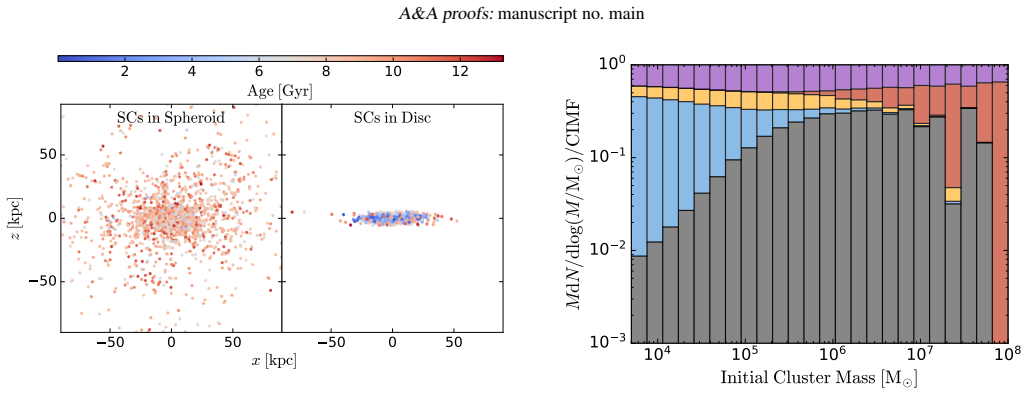
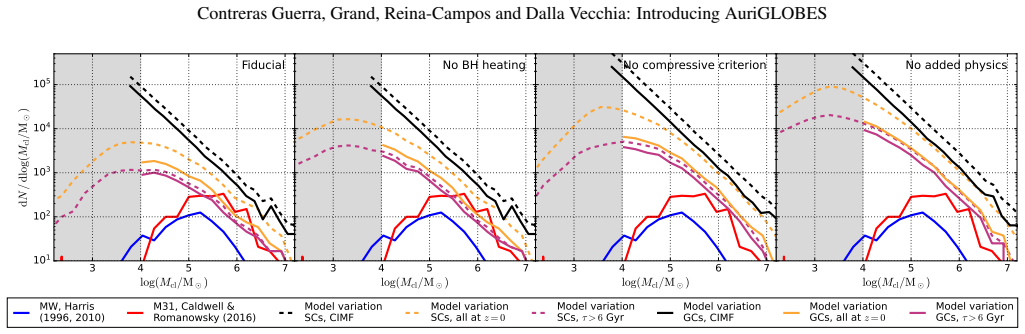
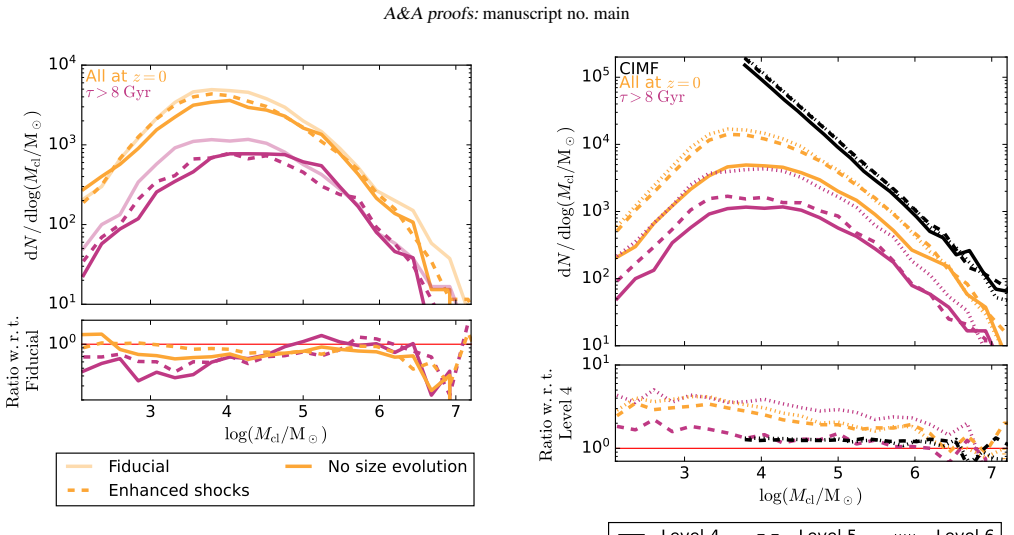
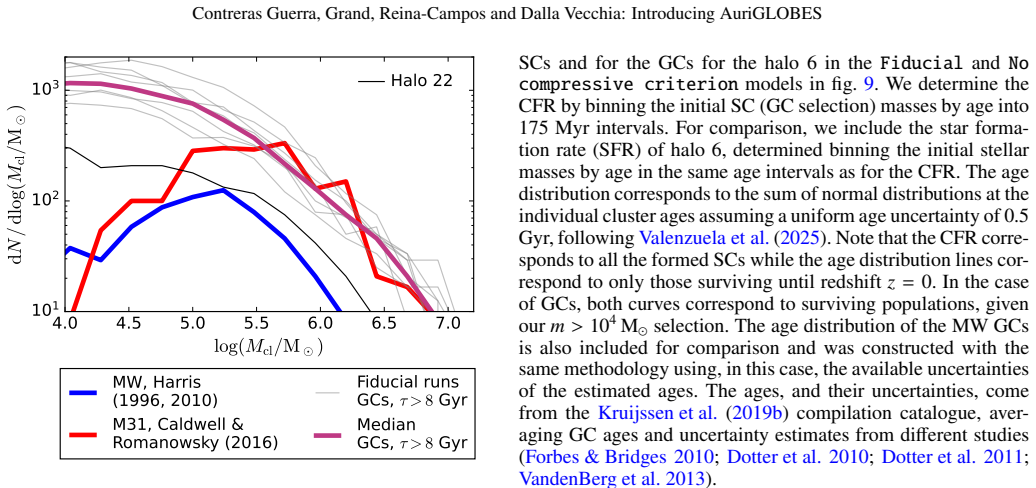
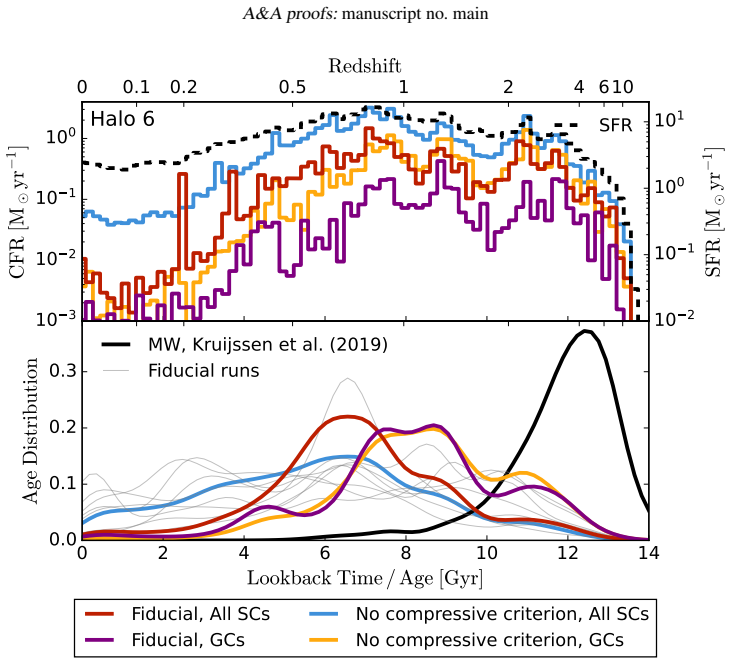
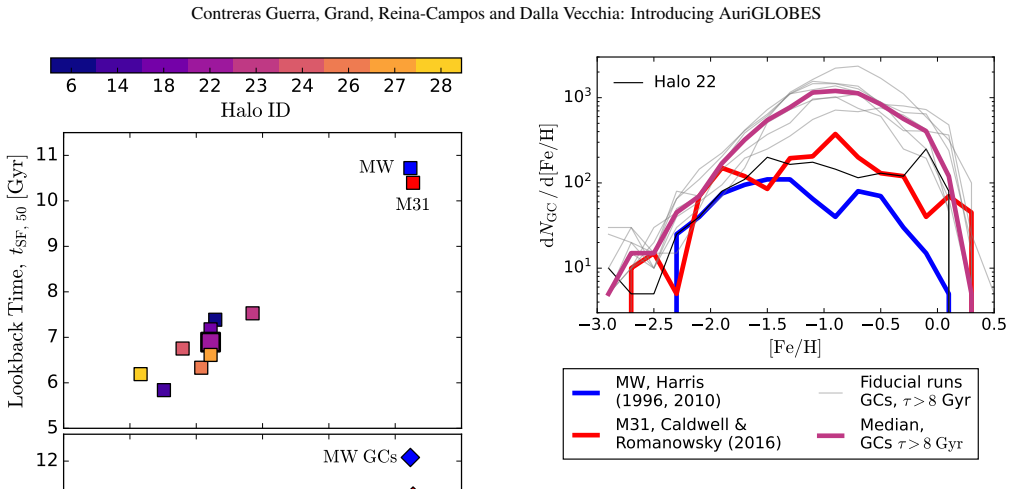
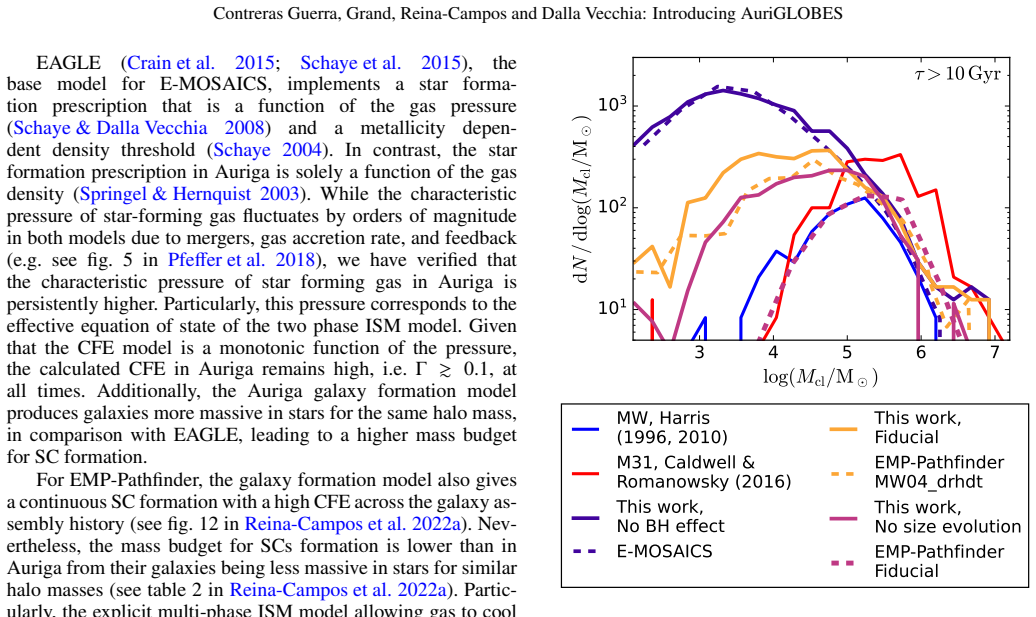
The formation of SCs in tidally compressive, high-pressure gas in addition to enhanced mass loss from compact object remnants heating is required to capture the transformation of an initial Schechter mass function to the characteristic observed GC mass function in the Milky Way/M31 systems. The resulting GC populations show spatial and metallicity distributions qualitatively similar to the Milky Way/M31 systems, as well as a variety of age distributions that correlate with the star formation history of the simulated galaxies.
What carries the argument
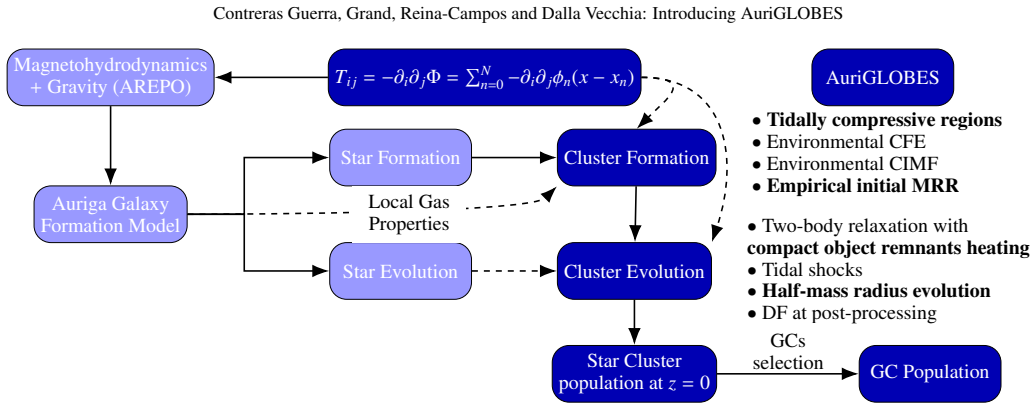
AuriGLOBES subgrid model for star cluster formation and evolution that includes compressive tides, compact object-induced mass loss, and size evolution.
If this is right
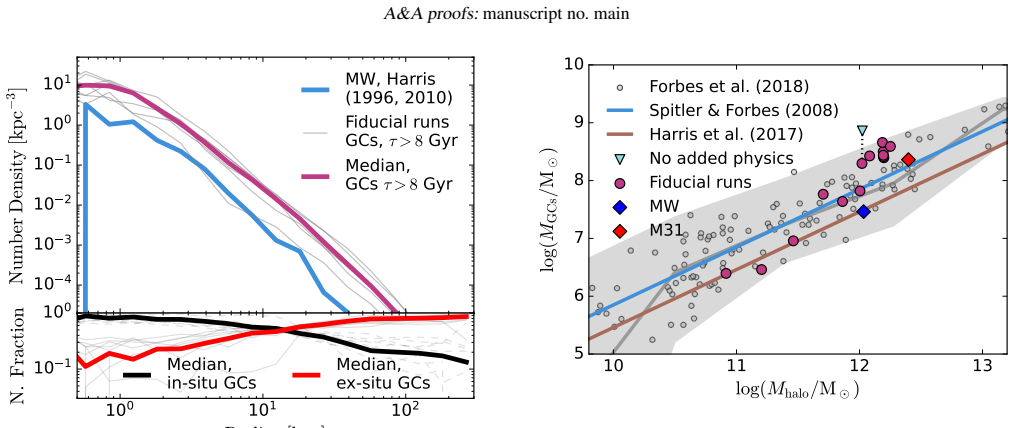
- The model reproduces the empirical GC system mass-halo mass relation within 2 sigma scatter.
- Simulated GC populations exhibit spatial and metallicity distributions qualitatively similar to those in the Milky Way and M31.
- Age distributions of GCs vary with each galaxy's star formation history.
- The framework supplies a foundation for future modeling of stellar streams from GC disruption.
Where Pith is reading between the lines
- Without both compressive tides and remnant heating, cosmological simulations would retain too many low-mass clusters and fail to produce the observed GC mass function shape.
- The older peak age of real Milky Way GCs compared with the simulations points to missing early star formation or assembly events that could be added in future runs.
- The same subgrid rules could be applied to lower-mass galaxies to test whether they reproduce the GC populations observed in those systems.
Load-bearing premise
The subgrid prescriptions for compressive tides, compact-object mass loss rates, and cluster size evolution accurately represent unresolved physical processes without introducing systematic biases when compared to observations.
What would settle it
Running the same galaxies with compressive tides or compact-object mass loss turned off and checking whether the final cluster mass function still matches the observed Milky Way/M31 distribution.
Figures
read the original abstract
Globular clusters (GCs) are long time survivors of galaxy assembly and evolution yet their emergence from an initial cluster population is still poorly constrained. We present the Auriga GLOBular clustEr Simulations (AuriGLOBES) a physically motivated subgrid model for star cluster (SC) formation and evolution that includes enhanced mass loss from compact object remnants. With this model, implemented in the Auriga cosmological galaxy formation model, we run a suite of zoom-in cosmological simulations comprising 9 Milky Way mass and 5 lower mass galaxies. We demonstrate that our model produces plausible GC populations compared to the Milky Way/M31 systems and reproduces the empirical GC system mass -- halo mass relation within a 2$\sigma$ scatter. We show that the formation of SCs in tidally compressive, high-pressure gas in addition to enhanced mass loss from compact object remnants heating is required to capture the transformation of an initial Schechter mass function to the characteristic observed GC mass function in the Milky Way/M31 systems. The resulting GC populations show spatial and metallicity distributions qualitatively similar to the Milky Way/M31 systems, as well as a variety of age distributions that correlate with the star formation history of the simulated galaxies. However, the peak of the age distribution of Milky Way GCs is older than any of our simulated Milky Way-mass galaxies, which is attributed to unrepresented star formation and galaxy assembly histories. AuriGLOBES represents a reliable framework for the study of GC populations through cosmic history and a robust foundation for future applications for a model of stellar streams arising from GCs disruption.
Editorial analysis
A structured set of objections, weighed in public.
Referee Report
Summary. The paper introduces AuriGLOBES, a subgrid model for star cluster formation and evolution implemented in the Auriga cosmological simulations. It incorporates SC formation restricted to tidally compressive high-pressure gas and enhanced mass loss from compact-object remnant heating, with two free parameters. Across zoom-in simulations of 9 Milky Way-mass and 5 lower-mass galaxies, the model reproduces the GC system mass-halo mass relation within 2σ, yields qualitatively similar spatial and metallicity distributions to the Milky Way/M31, and asserts that both compressive tides and enhanced mass loss are required to transform an initial Schechter mass function into the observed GC mass function. Age distributions correlate with star-formation history but peak younger than observed Milky Way GCs, which is attributed to missing early assembly physics.
Significance. If the subgrid prescriptions prove robust, this would supply a physically motivated framework for evolving GC populations self-consistently within cosmological galaxy-formation simulations and for future extensions to stellar-stream modeling. The multi-galaxy simulation suite and the reported reproduction of the mass-halo relation within 2σ constitute concrete strengths that would support broader applications if the necessity claim for the two physical ingredients holds after validation.
major comments (2)
- [Abstract] Abstract and model description: the central claim that both compressive-tide formation and compact-object mass loss 'are required' to produce the observed GC mass function from a Schechter initial mass function rests on the specific functional forms of the two free parameters (compact-object mass-loss enhancement factor and tidal-compression strength parameter). No ablation experiments isolating each ingredient or direct comparisons to resolved N-body or higher-resolution hydrodynamical simulations of individual clusters are reported, so it remains possible that the transformation is an artifact of the chosen subgrid implementations rather than a robust physical requirement.
- [Abstract] Abstract: the reported age-distribution mismatch (simulated peaks younger than Milky Way GCs) is ascribed to unrepresented star-formation and assembly histories. Because the mass-function transformation is asserted to occur through early, high-pressure formation, this mismatch raises a load-bearing concern for whether the model can be applied to the epochs that dominate the observed GC population without additional tuning.
minor comments (1)
- The paper would benefit from an explicit statement of how the two free parameters were calibrated and whether any posterior predictive checks against independent observables (e.g., individual cluster sizes or disruption timescales) were performed.
Simulated Author's Rebuttal
We thank the referee for their constructive and detailed review. We address each major comment below and indicate the revisions that will be incorporated into the revised manuscript.
read point-by-point responses
-
Referee: [Abstract] Abstract and model description: the central claim that both compressive-tide formation and compact-object mass loss 'are required' to produce the observed GC mass function from a Schechter initial mass function rests on the specific functional forms of the two free parameters (compact-object mass-loss enhancement factor and tidal-compression strength parameter). No ablation experiments isolating each ingredient or direct comparisons to resolved N-body or higher-resolution hydrodynamical simulations of individual clusters are reported, so it remains possible that the transformation is an artifact of the chosen subgrid implementations rather than a robust physical requirement.
Authors: We acknowledge that the manuscript does not report dedicated ablation experiments that isolate each ingredient independently or direct comparisons against resolved N-body or higher-resolution hydrodynamical simulations of individual clusters. Within the AuriGLOBES subgrid framework the two components together are necessary to transform the initial Schechter function into the observed GC mass function across the simulated galaxies, but we agree that this does not rule out possible sensitivities to the specific functional forms chosen. We will revise the abstract to replace the phrasing 'are required to capture' with 'play a key role in capturing' and will add a dedicated paragraph in the discussion section that explicitly notes the absence of ablation studies and resolved-cluster comparisons, together with the need for such validation in future work. revision: yes
-
Referee: [Abstract] Abstract: the reported age-distribution mismatch (simulated peaks younger than Milky Way GCs) is ascribed to unrepresented star-formation and assembly histories. Because the mass-function transformation is asserted to occur through early, high-pressure formation, this mismatch raises a load-bearing concern for whether the model can be applied to the epochs that dominate the observed GC population without additional tuning.
Authors: The manuscript already notes that the simulated age distributions correlate with each galaxy's star-formation history and that the Milky Way peak is older than any of our Milky Way-mass runs, attributing the offset to missing early assembly physics. The mass-function transformation is driven by formation in tidally compressive high-pressure gas at early times plus the subsequent compact-object mass loss; the age offset does not alter the parameter values or the functional forms used. We will expand the discussion of age distributions to clarify that the model remains applicable to the epochs that dominate the observed GC population, while acknowledging that more realistic early assembly histories would be needed to match the precise age peak. revision: partial
Circularity Check
No significant circularity; claims rest on external observational benchmarks
full rationale
The paper introduces subgrid prescriptions for compressive tides, compact-object mass loss, and size evolution within the Auriga framework, runs zoom-in cosmological simulations, and compares resulting GC populations (mass function transformation, mass-halo relation, spatial/metallicity distributions) to Milky Way/M31 observations. The necessity claim for both compressive tides and remnant heating is supported by variant runs that fail to reproduce the observed GC mass function without those features. No equations or steps reduce outputs to inputs by construction, no self-citation chains justify core premises, and no fitted parameters are relabeled as predictions. The derivation chain is self-contained against external benchmarks.
Axiom & Free-Parameter Ledger
free parameters (2)
- compact object mass loss enhancement factor
- tidal compression strength parameter
axioms (2)
- domain assumption Initial star cluster mass function follows a Schechter form
- domain assumption Auriga cosmological framework provides accurate large-scale galaxy assembly
Reference graph
Works this paper leans on
-
[1]
, archivePrefix = "arXiv", eprint =
Following the flow: tracer particles in astrophysical fluid simulations. , archivePrefix = "arXiv", eprint =. doi:10.1093/mnras/stt1383 , adsurl =
-
[2]
Quantifying the robustness of the Auriga galaxy formation model. arXiv e-prints , keywords =. doi:10.48550/arXiv.2507.13440 , archivePrefix =. 2507.13440 , primaryClass =
-
[3]
Star cluster formation in the most extreme environments: insights from the HiPEEC survey. , keywords =. doi:10.1093/mnras/staa2380 , archivePrefix =. 2008.12794 , primaryClass =
-
[4]
Planck 2013 results. XVI. Cosmological parameters. , keywords =. doi:10.1051/0004-6361/201321591 , archivePrefix =. 1303.5076 , primaryClass =
work page internal anchor Pith review Pith/arXiv arXiv doi:10.1051/0004-6361/201321591 2013
-
[5]
A prescription and fast code for the long-term evolution of star clusters. , keywords =. doi:10.1111/j.1365-2966.2012.20867.x , archivePrefix =. 1203.4744 , primaryClass =
-
[6]
doi:10.1038/324446a0 , Keywords =
A hierarchical O(N log N) force-calculation algorithm. , keywords =. doi:10.1038/324446a0 , adsurl =
-
[7]
On the star formation rate - brightest cluster relation: estimating the peak star formation rate in post-merger galaxies. , keywords =. doi:10.1111/j.1365-2966.2008.13775.x , archivePrefix =. 0807.4687 , primaryClass =
-
[8]
Dynamical evolution of star clusters in tidal fields. , keywords =. doi:10.1046/j.1365-8711.2003.06286.x , archivePrefix =. astro-ph/0211471 , primaryClass =
-
[9]
Extragalactic Globular Clusters and Galaxy Formation. , keywords =. doi:10.1146/annurev.astro.44.051905.092441 , archivePrefix =. astro-ph/0602601 , primaryClass =
-
[10]
Radii of young star clusters in nearby galaxies. , keywords =. doi:10.1093/mnras/stab2907 , archivePrefix =. 2106.12420 , primaryClass =
-
[11]
2003, PASP, 115, 763, doi: 10.1086/376392
Galactic Stellar and Substellar Initial Mass Function. , keywords =. doi:10.1086/376392 , archivePrefix =. astro-ph/0304382 , primaryClass =
work page internal anchor Pith review Pith/arXiv arXiv doi:10.1086/376392
-
[12]
Catalogue of model star clusters in the Milky Way and M31 galaxies. , keywords =. doi:10.1093/mnras/stad3345 , archivePrefix =. 2309.13374 , primaryClass =
-
[13]
Formation of Globular Cluster Systems: From Dwarf Galaxies to Giants
Formation of globular cluster systems: from dwarf galaxies to giants. , keywords =. doi:10.1093/mnras/sty1952 , archivePrefix =. 1801.03515 , primaryClass =
work page internal anchor Pith review Pith/arXiv arXiv doi:10.1093/mnras/sty1952
-
[14]
The EAGLE simulations of galaxy formation: calibration of subgrid physics and model variations
The EAGLE simulations of galaxy formation: calibration of subgrid physics and model variations. , keywords =. doi:10.1093/mnras/stv725 , archivePrefix =. 1501.01311 , primaryClass =
work page internal anchor Pith review Pith/arXiv arXiv doi:10.1093/mnras/stv725
-
[15]
Globular Clusters Formed within Dark Halos I: present-day abundance, distribution and kinematics
Globular clusters formed within dark haloes I: present-day abundance, distribution, and kinematics. , keywords =. doi:10.1093/mnras/sty2701 , archivePrefix =. 1806.11118 , primaryClass =
work page internal anchor Pith review Pith/arXiv arXiv doi:10.1093/mnras/sty2701
-
[16]
The evolution of large-scale structure in a universe dominated by cold dark matter. , keywords =. doi:10.1086/163168 , adsurl =
-
[17]
On the origin of globular clusters in a hierarchical universe. , keywords =. doi:10.1093/mnras/stae1006 , archivePrefix =. 2307.02530 , primaryClass =
-
[18]
Star formation in the lam ORI region. I. The distribution of young objects. , keywords =. doi:10.1086/160325 , adsurl =
-
[19]
Grids of stellar models with rotation. I. Models from 0.8 to 120 M _ at solar metallicity (Z = 0.014). , keywords =. doi:10.1051/0004-6361/201117751 , archivePrefix =. 1110.5049 , primaryClass =
work page internal anchor Pith review Pith/arXiv arXiv doi:10.1051/0004-6361/201117751
-
[20]
Star Formation from Galaxies to Globules
Star Formation from Galaxies to Globules. , keywords =. doi:10.1086/342177 , archivePrefix =. astro-ph/0207114 , primaryClass =
work page internal anchor Pith review Pith/arXiv arXiv doi:10.1086/342177
-
[21]
On the Disruption of Star Clusters in a Hierarchical Interstellar Medium
On the Disruption of Star Clusters in a Hierarchical Interstellar Medium. , keywords =. doi:10.1088/0004-637X/712/1/604 , archivePrefix =. 1002.2823 , primaryClass =
work page internal anchor Pith review Pith/arXiv arXiv doi:10.1088/0004-637x/712/1/604
-
[22]
The Globular Cluster Mass Function as a Remnant of Violent Birth
The Globular Cluster Mass Function as a Remnant of Violent Birth. , keywords =. doi:10.1088/2041-8205/712/2/L184 , archivePrefix =. 1003.0798 , primaryClass =
work page internal anchor Pith review Pith/arXiv arXiv doi:10.1088/2041-8205/712/2/l184 2041
-
[23]
Dynamical Evolution of the Mass Function of Globular Star Clusters
Dynamical Evolution of the Mass Function of Globular Star Clusters. , keywords =. doi:10.1086/323358 , archivePrefix =. astro-ph/0107298 , primaryClass =
work page internal anchor Pith review Pith/arXiv arXiv doi:10.1086/323358
-
[24]
A New Calculation of the Ionizing Background Spectrum and the Effects of HeII Reionization
A New Calculation of the Ionizing Background Spectrum and the Effects of He II Reionization. , keywords =. doi:10.1088/0004-637X/703/2/1416 , archivePrefix =. 0901.4554 , primaryClass =
work page internal anchor Pith review Pith/arXiv arXiv doi:10.1088/0004-637x/703/2/1416
-
[25]
Accreted versus in situ Milky Way globular clusters. , keywords =. doi:10.1111/j.1365-2966.2010.16373.x , archivePrefix =. 1001.4289 , primaryClass =
-
[26]
The effect of spiral arm passages on the evolution of stellar clusters. , keywords =. doi:10.1111/j.1365-2966.2007.11477.x , archivePrefix =. astro-ph/0701136 , primaryClass =
-
[27]
A prescription and fast code for the long-term evolution of star clusters - II. Unbalanced and core evolution. , keywords =. doi:10.1093/mnras/stt1980 , archivePrefix =. 1310.3631 , primaryClass =
work page internal anchor Pith review Pith/arXiv arXiv doi:10.1093/mnras/stt1980
-
[28]
The mass-loss rates of star clusters with stellar-mass black holes: implications for the globular cluster mass function. , keywords =. doi:10.1093/mnras/stad1287 , archivePrefix =. 2303.03791 , primaryClass =
-
[29]
Monthly Notices of the Royal Astronomical Society , author =
The life cycle of star clusters in a tidal field. , keywords =. doi:10.1111/j.1365-2966.2011.18320.x , archivePrefix =. 1101.1821 , primaryClass =
-
[30]
2006, MNRAS, 372, 233, doi: 10.1111/j.1365-2966.2006.10840.x
Star cluster disruption by giant molecular clouds. , keywords =. doi:10.1111/j.1365-2966.2006.10711.x , archivePrefix =. astro-ph/0606451 , primaryClass =
-
[31]
If it does not kill them, it makes them stronger: collisional evolution of star clusters with tidal shocks. , keywords =. doi:10.1093/mnrasl/slw163 , archivePrefix =. 1605.05940 , primaryClass =
work page internal anchor Pith review Pith/arXiv arXiv doi:10.1093/mnrasl/slw163
-
[32]
Statistics of N-body Simulations I. Equal Masess Before Core Collapse
Statistics of N-Body Simulations - Part One - Equal Masses Before Core Collapse. , keywords =. doi:10.1093/mnras/268.1.257 , archivePrefix =. astro-ph/9305008 , primaryClass =
work page internal anchor Pith review Pith/arXiv arXiv doi:10.1093/mnras/268.1.257
-
[33]
Tidal Shocking by Extended Mass Distributions. , keywords =. doi:10.1086/306910 , adsurl =
-
[34]
Effects of Tidal Shocks on the Evolution of Globular Clusters
Effects of Tidal Shocks on the Evolution of Globular Clusters. , keywords =. doi:10.1086/307659 , archivePrefix =. astro-ph/9806245 , primaryClass =
work page internal anchor Pith review Pith/arXiv arXiv doi:10.1086/307659
-
[35]
Destruction of the Galactic Globular Cluster System
Destruction of the Galactic Globular Cluster System. , keywords =. doi:10.1086/303441 , archivePrefix =. astro-ph/9603042 , primaryClass =
work page internal anchor Pith review Pith/arXiv arXiv doi:10.1086/303441
-
[36]
The Auriga Project: the properties and formation mechanisms of disc galaxies across cosmic time
The Auriga Project: the properties and formation mechanisms of disc galaxies across cosmic time. , keywords =. doi:10.1093/mnras/stx071 , archivePrefix =. 1610.01159 , primaryClass =
work page internal anchor Pith review Pith/arXiv arXiv doi:10.1093/mnras/stx071
-
[37]
Overview and public data release of the augmented Auriga Project: cosmological simulations of dwarf and Milky Way-mass galaxies. , keywords =. doi:10.1093/mnras/stae1598 , archivePrefix =. 2401.08750 , primaryClass =
-
[38]
On the Observed Diversity of Star Formation Efficiencies in Giant Molecular Clouds
On the observed diversity of star formation efficiencies in Giant Molecular Clouds. , keywords =. doi:10.1093/mnras/stz1201 , archivePrefix =. 1902.00518 , primaryClass =
work page internal anchor Pith review Pith/arXiv arXiv doi:10.1093/mnras/stz1201 1902
-
[39]
On The Nature of Variations in the Measured Star Formation Efficiency of Molecular Clouds
On the nature of variations in the measured star formation efficiency of molecular clouds. , keywords =. doi:10.1093/mnras/stz1758 , archivePrefix =. 1809.08348 , primaryClass =
work page internal anchor Pith review Pith/arXiv arXiv doi:10.1093/mnras/stz1758
-
[40]
A general-purpose time-step criterion for simulations with gravity. , keywords =. doi:10.1093/mnras/staa1453 , archivePrefix =. 1910.06349 , primaryClass =
-
[41]
The globular cluster system of the Auriga simulations. , keywords =. doi:10.1093/mnras/staa1380 , archivePrefix =. 1909.02630 , primaryClass =
-
[42]
Globular cluster systems in galaxies beyond the Local Group. , keywords =. doi:10.1146/annurev.aa.29.090191.002551 , adsurl =
-
[43]
Annales d'Astrophysique , year = 1961, month = feb, volume =
Sur l' \'e volution dynamique des amas globulaires. Annales d'Astrophysique , year = 1961, month = feb, volume =
1961
-
[44]
Exploration num \'e rique du probl \`e me restreint. II. Masses \'e gales, stabilit \'e des orbites p \'e riodiques. Annales d'Astrophysique , year = 1965, month = feb, volume =
1965
-
[45]
, year = 1994, month = jul, volume =
A dwarf satellite galaxy in Sagittarius. , year = 1994, month = jul, volume =. doi:10.1038/370194a0 , adsurl =
-
[46]
A new way of setting the phases for cosmological multi-scale Gaussian initial conditions
A new way of setting the phases for cosmological multiscale Gaussian initial conditions. , keywords =. doi:10.1093/mnras/stt1154 , archivePrefix =. 1306.5968 , primaryClass =
work page internal anchor Pith review Pith/arXiv arXiv doi:10.1093/mnras/stt1154
-
[47]
The Physical Conditions in a Pre Super Star Cluster Molecular Cloud in the Antennae Galaxies
The Physical Conditions in a Pre-super Star Cluster Molecular Cloud in the Antennae Galaxies. , keywords =. doi:10.1088/0004-637X/806/1/35 , archivePrefix =. 1503.06477 , primaryClass =
work page internal anchor Pith review Pith/arXiv arXiv doi:10.1088/0004-637x/806/1/35
-
[48]
Panchromatic Hubble Andromeda Treasury. XVIII. The High-mass Truncation of the Star Cluster Mass Function. , keywords =. doi:10.3847/1538-4357/aa6a1f , archivePrefix =. 1703.10312 , primaryClass =
work page internal anchor Pith review Pith/arXiv arXiv doi:10.3847/1538-4357/aa6a1f
-
[49]
The ACS Virgo Cluster Survey. XII. The Luminosity Function of Globular Clusters in Early-Type Galaxies. , keywords =. doi:10.1086/516840 , archivePrefix =. astro-ph/0702496 , primaryClass =
work page internal anchor Pith review Pith/arXiv arXiv doi:10.1086/516840
-
[50]
Formation of globular cluster candidates in merging proto-galaxies at high redshift: a view from the FIRE cosmological simulations. , keywords =. doi:10.1093/mnras/stx2994 , archivePrefix =. 1704.02988 , primaryClass =
work page internal anchor Pith review Pith/arXiv arXiv doi:10.1093/mnras/stx2994
-
[51]
The structure of star clusters. I. an empirical density law. , year = 1962, month = oct, volume =. doi:10.1086/108756 , adsurl =
-
[52]
On the fraction of star formation occurring in bound stellar clusters. , keywords =. doi:10.1111/j.1365-2966.2012.21923.x , archivePrefix =. 1208.2963 , primaryClass =
-
[53]
Globular clusters as the relics of regular star formation in 'normal' high-redshift galaxies
Globular clusters as the relics of regular star formation in `normal' high-redshift galaxies. , keywords =. doi:10.1093/mnras/stv2026 , archivePrefix =. 1509.02163 , primaryClass =
work page internal anchor Pith review Pith/arXiv arXiv doi:10.1093/mnras/stv2026
-
[54]
The evolution of the stellar mass function in star clusters
The evolution of the stellar mass function in star clusters. , keywords =. doi:10.1051/0004-6361/200913325 , archivePrefix =. 0910.4579 , primaryClass =
work page internal anchor Pith review Pith/arXiv arXiv doi:10.1051/0004-6361/200913325
-
[55]
Globular cluster formation in the context of galaxy formation and evolution
Globular cluster formation in the context of galaxy formation and evolution. Classical and Quantum Gravity , keywords =. doi:10.1088/0264-9381/31/24/244006 , archivePrefix =. 1407.2953 , primaryClass =
work page internal anchor Pith review Pith/arXiv arXiv doi:10.1088/0264-9381/31/24/244006
-
[56]
The Formation of Globular Clusters. arXiv e-prints , keywords =. doi:10.48550/arXiv.2501.16438 , archivePrefix =. 2501.16438 , primaryClass =
-
[57]
The photometric evolution of star clusters and the preferential loss of low-mass bodies - with an application to globular clusters. , keywords =. doi:10.1051/0004-6361:200810167 , archivePrefix =. 0809.0307 , primaryClass =
work page internal anchor Pith review Pith/arXiv arXiv doi:10.1051/0004-6361:200810167
-
[58]
Monthly Notices of the Royal Astronomical Society , author =
Modelling the formation and evolution of star cluster populations in galaxy simulations. , keywords =. doi:10.1111/j.1365-2966.2011.18467.x , archivePrefix =. 1102.1013 , primaryClass =
-
[59]
The E-MOSAICS project: tracing galaxy formation and assembly with the age-metallicity distribution of globular clusters. , keywords =. doi:10.1093/mnras/stz968 , archivePrefix =. 1904.04261 , primaryClass =
work page internal anchor Pith review Pith/arXiv arXiv doi:10.1093/mnras/stz968 1904
-
[60]
Fast and inefficient star formation due to short-lived molecular clouds and rapid feedback
Fast and inefficient star formation due to short-lived molecular clouds and rapid feedback. , keywords =. doi:10.1038/s41586-019-1194-3 , archivePrefix =. 1905.08801 , primaryClass =
work page internal anchor Pith review Pith/arXiv arXiv doi:10.1038/s41586-019-1194-3 1905
-
[61]
A General Theory of Turbulence-Regulated Star Formation, From Spirals to ULIRGs
A General Theory of Turbulence-regulated Star Formation, from Spirals to Ultraluminous Infrared Galaxies. , keywords =. doi:10.1086/431734 , archivePrefix =. astro-ph/0505177 , primaryClass =
work page internal anchor Pith review Pith/arXiv arXiv doi:10.1086/431734
-
[62]
Tidal-Shock Relaxation: A Reexamination of Tidal Shocks in Stellar Systems. , keywords =. doi:10.1086/175114 , adsurl =
-
[63]
Merger rates in hierarchical models of galaxy formation. , keywords =. doi:10.1093/mnras/262.3.627 , adsurl =
-
[64]
The GRIFFIN Project Formation of Star Clusters with Individual Massive Stars in a Simulated Dwarf Galaxy Starburst. , keywords =. doi:10.3847/1538-4357/ab7190 , archivePrefix =. 1911.05093 , primaryClass =
-
[65]
An analytical description of the disruption of star clusters in tidal fields with an application to Galactic open clusters. , keywords =. doi:10.1051/0004-6361:20042241 , archivePrefix =. astro-ph/0505558 , primaryClass =
work page internal anchor Pith review Pith/arXiv arXiv doi:10.1051/0004-6361:20042241
-
[66]
The bifurcated age-metallicity relation of Milky Way globular clusters and its implications for the accretion history of the galaxy. , keywords =. doi:10.1093/mnras/stt1540 , archivePrefix =. 1309.0822 , primaryClass =
work page internal anchor Pith review Pith/arXiv arXiv doi:10.1093/mnras/stt1540
-
[67]
Star Cluster Formation in Cosmological Simulations. I. Properties of Young Clusters. , keywords =. doi:10.3847/1538-4357/834/1/69 , archivePrefix =. 1608.03244 , primaryClass =
work page internal anchor Pith review Pith/arXiv arXiv doi:10.3847/1538-4357/834/1/69
-
[68]
Star Cluster Formation in Cosmological Simulations. II. Effects of Star Formation Efficiency and Stellar Feedback. , keywords =. doi:10.3847/1538-4357/aac9b8 , archivePrefix =. 1712.01219 , primaryClass =
work page internal anchor Pith review Pith/arXiv arXiv doi:10.3847/1538-4357/aac9b8
-
[69]
Star cluster formation in cosmological simulations. III. Dynamical and chemical evolution
Star cluster formation in cosmological simulations - III. Dynamical and chemical evolution. , keywords =. doi:10.1093/mnras/stz1114 , archivePrefix =. 1810.11036 , primaryClass =
work page internal anchor Pith review Pith/arXiv arXiv doi:10.1093/mnras/stz1114
-
[70]
Formation and evolution of young massive clusters in galaxy mergers: the SMUGGLE view. , keywords =. doi:10.1093/mnras/stac1136 , archivePrefix =. 2109.10356 , primaryClass =
-
[71]
Self-consistent proto-globular cluster formation in cosmological simulations of high-redshift galaxies. , keywords =. doi:10.1093/mnras/staa527 , archivePrefix =. 1906.11261 , primaryClass =
-
[72]
The population of giant clumps in simulated high-z galaxies: in situ and ex situ migration and survival. , keywords =. doi:10.1093/mnras/stu1340 , archivePrefix =. 1311.0013 , primaryClass =
work page internal anchor Pith review Pith/arXiv arXiv doi:10.1093/mnras/stu1340
-
[73]
The formation of disc galaxies in high resolution moving-mesh cosmological simulations
The formation of disc galaxies in high-resolution moving-mesh cosmological simulations. , keywords =. doi:10.1093/mnras/stt2003 , archivePrefix =. 1305.5360 , primaryClass =
work page internal anchor Pith review Pith/arXiv arXiv doi:10.1093/mnras/stt2003
-
[74]
Evolution of the Galactic globular cluster system. , keywords =. doi:10.1093/mnras/291.4.717 , adsurl =
-
[75]
The Effect of the Galactic Spheroid on Globular Cluster Evolution
The effect of the Galactic spheroid on globular cluster evolution. , keywords =. doi:10.1093/mnras/288.3.749 , archivePrefix =. astro-ph/9604049 , primaryClass =
work page internal anchor Pith review Pith/arXiv arXiv doi:10.1093/mnras/288.3.749
-
[76]
Globular Cluster Evolution in M87 and Fundamental Plane Ellipticals
Globular cluster evolution in M87 and fundamental plane ellipticals. , keywords =. doi:10.1093/mnras/288.3.767 , archivePrefix =. astro-ph/9602058 , primaryClass =
work page internal anchor Pith review Pith/arXiv arXiv doi:10.1093/mnras/288.3.767
-
[77]
Star Formation Efficiencies and Lifetimes of Giant Molecular Clouds in the Milky Way
Star Formation Efficiencies and Lifetimes of Giant Molecular Clouds in the Milky Way. , keywords =. doi:10.1088/0004-637X/729/2/133 , archivePrefix =. 1007.3270 , primaryClass =
work page internal anchor Pith review Pith/arXiv arXiv doi:10.1088/0004-637x/729/2/133
-
[78]
, year = 1972, month = sep, volume =
On the Evolution of Globular Clusters. , year = 1972, month = sep, volume =. doi:10.1086/181018 , adsurl =
-
[79]
Magnetic field formation in the Milky Way-like disk galaxies of the Auriga project
Magnetic field formation in the Milky Way like disc galaxies of the Auriga project. , keywords =. doi:10.1093/mnras/stx1074 , archivePrefix =. 1701.07028 , primaryClass =
work page internal anchor Pith review Pith/arXiv arXiv doi:10.1093/mnras/stx1074
-
[80]
SIEGE: IV. Compact star clusters in cosmological simulations with a high star formation efficiency and subparsec resolution. , keywords =. doi:10.1051/0004-6361/202453252 , archivePrefix =. 2505.06346 , primaryClass =
discussion (0)
Sign in with ORCID, Apple, or X to comment. Anyone can read and Pith papers without signing in.