SN 2023rve: A Type II Supernova with No Nebular Oxygen
Pith reviewed 2026-07-01 01:00 UTC · model grok-4.3
The pith
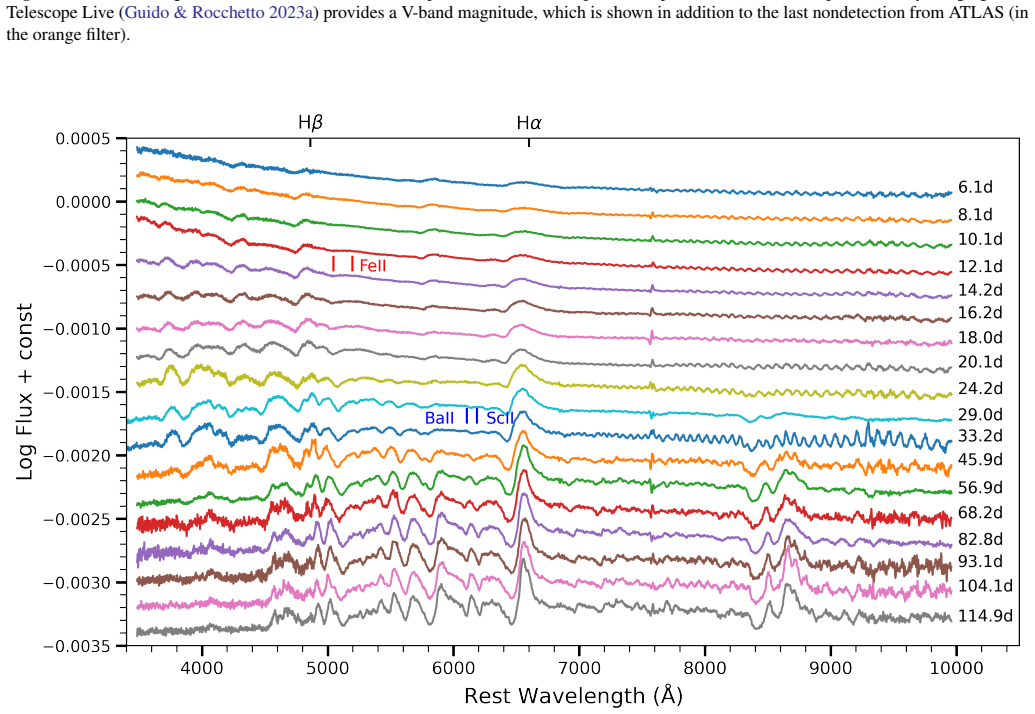
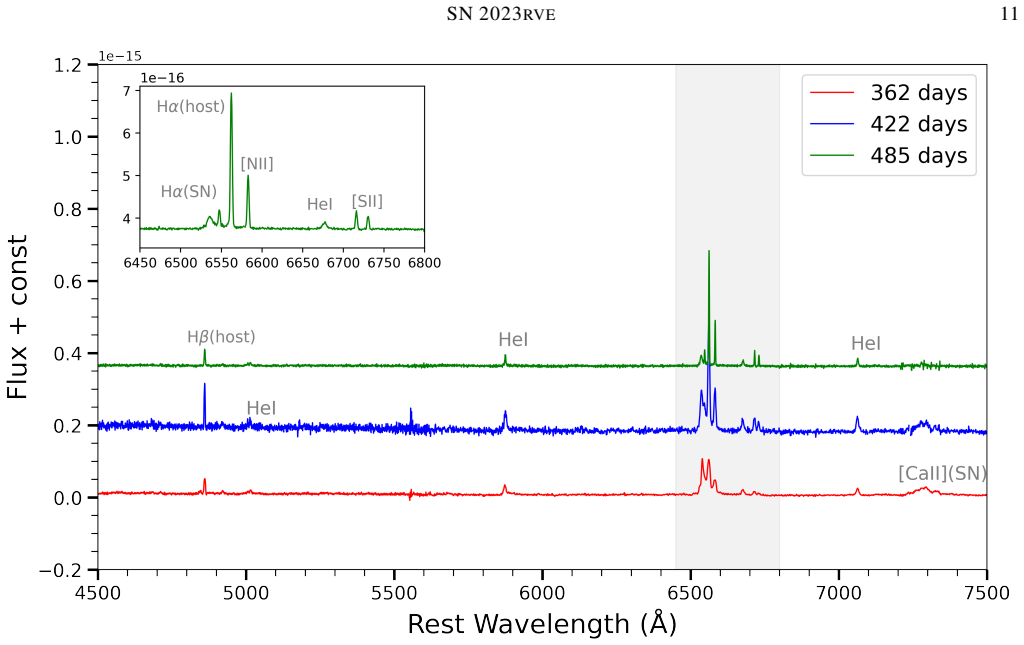
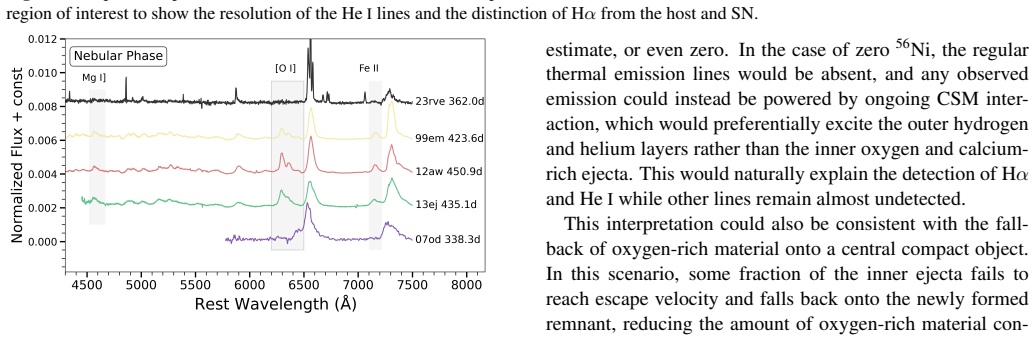
SN 2023rve is a Type II supernova whose nebular spectra lack any [O I] emission, a feature the observations link to low explosion energy and possible partial fallback onto the remnant.
A machine-rendered reading of the paper's core claim, the machinery that carries it, and where it could break.
Core claim
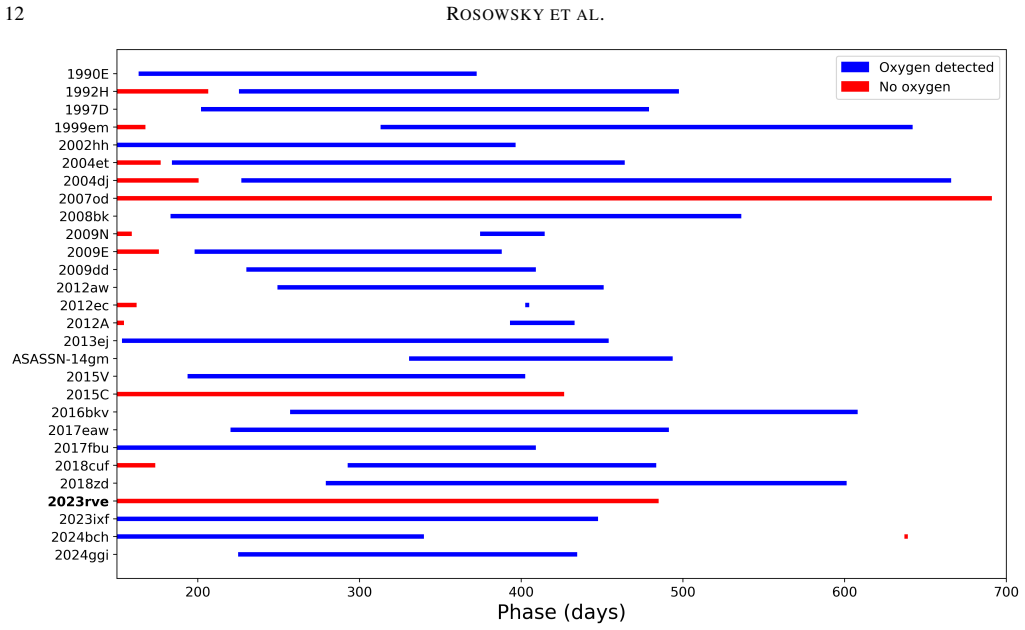
The nebular spectra of SN 2023rve show an absence of [O I] lines unprecedented among Type II supernovae; when combined with the low explosion energy, long plateau, and small nickel mass, this absence may be consistent with partial fallback of material onto the compact remnant.
What carries the argument
Partial fallback of material onto the compact remnant, invoked to suppress oxygen emission while matching the measured low explosion energy and nickel mass.
If this is right
- A progenitor in the 14-18 solar-mass range can produce a Type II supernova with dense circumstellar material that shapes the plateau and late-time spectra.
- Enhanced pre-supernova mass loss can increase the diversity of Type II light curves and spectra.
- Fewer than 10 percent of Type II supernovae lack oxygen signatures at comparable epochs.
- Low nickel yields and low explosion energies may systematically correlate with suppressed oxygen lines in the nebular phase.
Where Pith is reading between the lines
- If fallback is required to explain the missing oxygen, similar low-energy events should show reduced oxygen yields in detailed spectral synthesis models.
- Repeated observations of this object at still later times could test whether oxygen emission eventually appears once any fallback material has settled.
- The same fallback picture might alter the expected remnant mass distribution for stars in this progenitor range.
Load-bearing premise
The nebular spectra truly contain no [O I] emission because of the fallback mechanism rather than because of dust, mixing, or limits of the observations.
What would settle it
Detection of strong [O I] emission lines in deeper spectra or at later epochs than those already obtained would show that oxygen is present and undermine the fallback interpretation.
Figures


read the original abstract
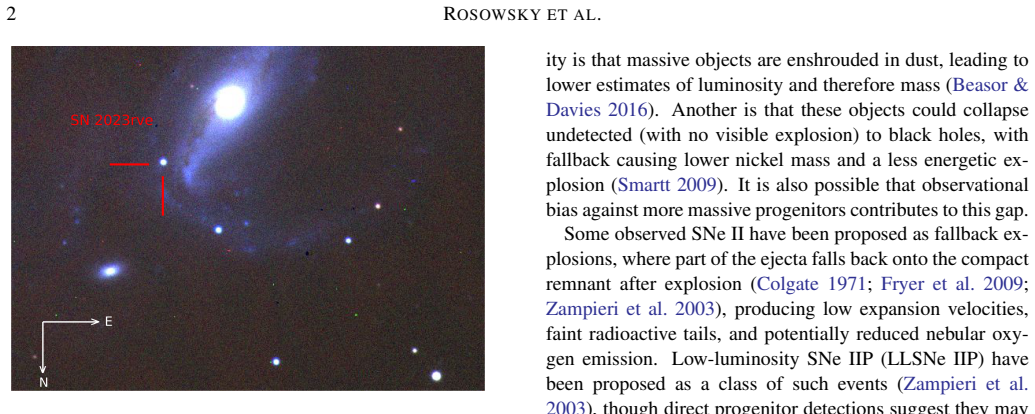
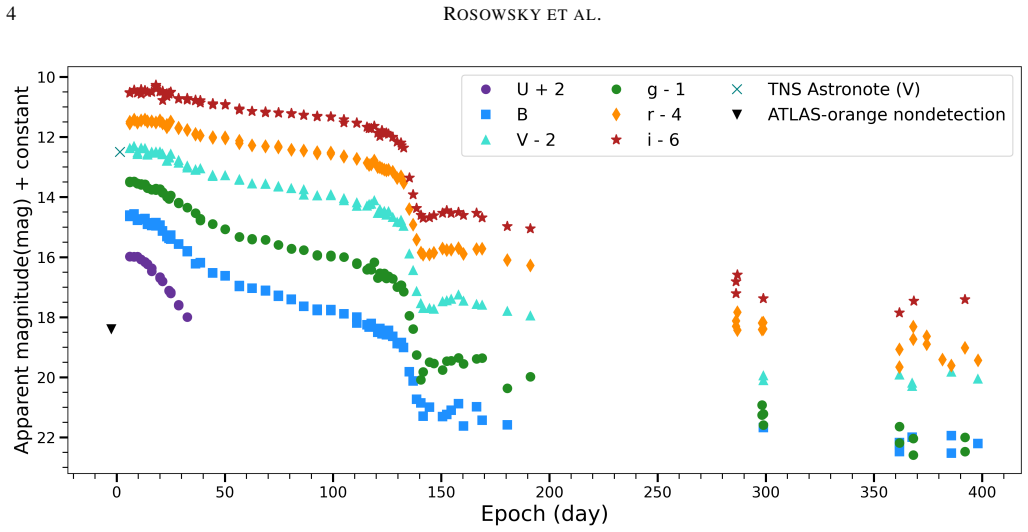
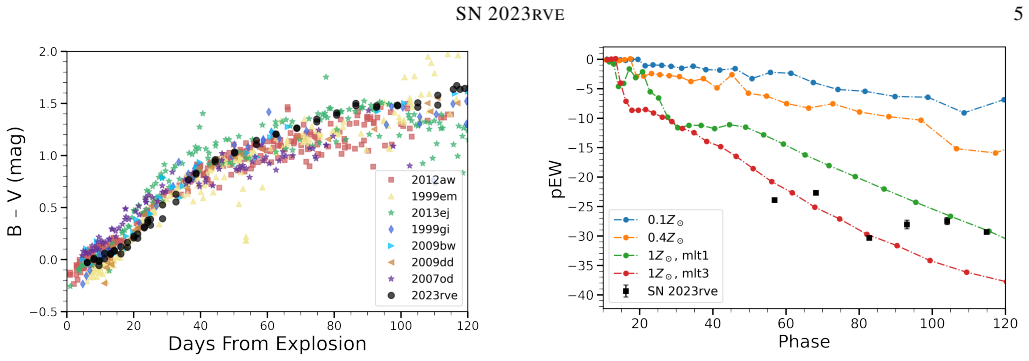
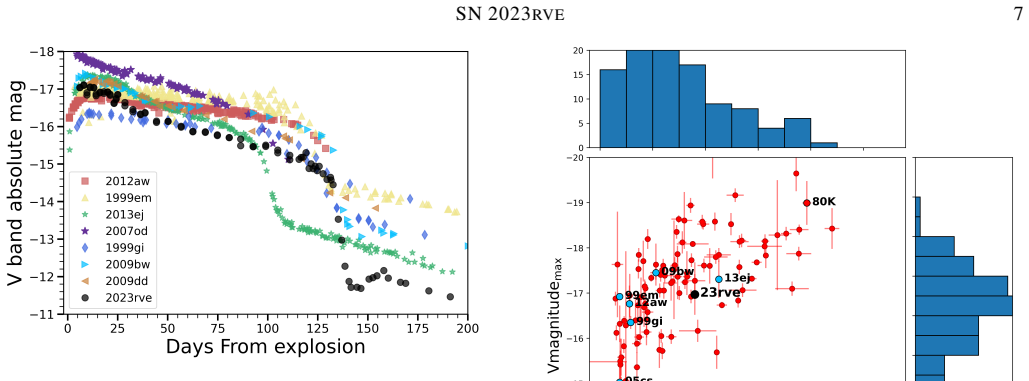
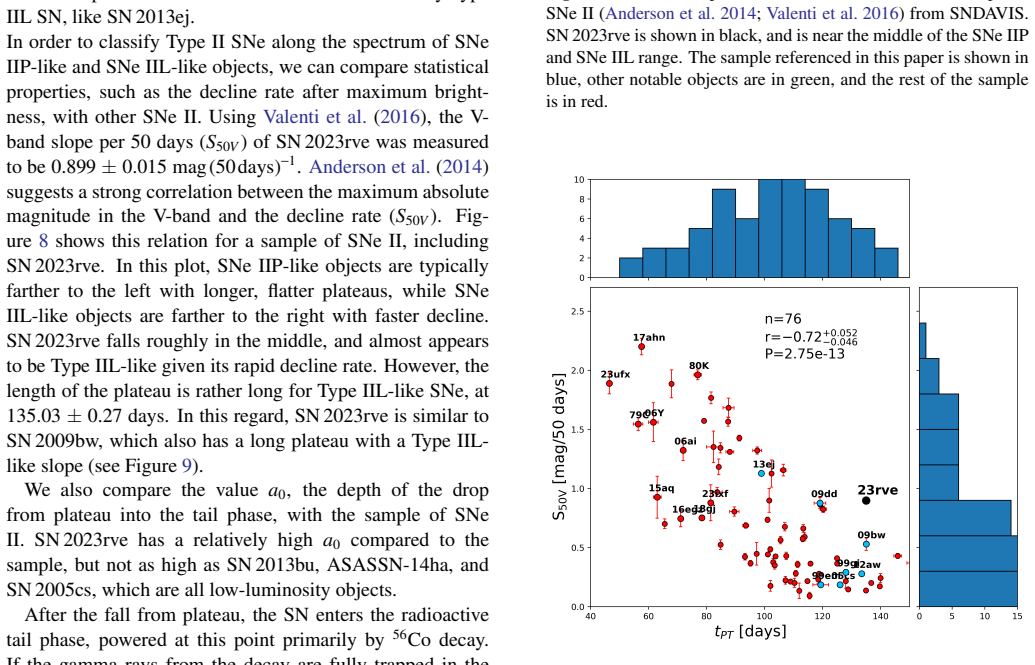
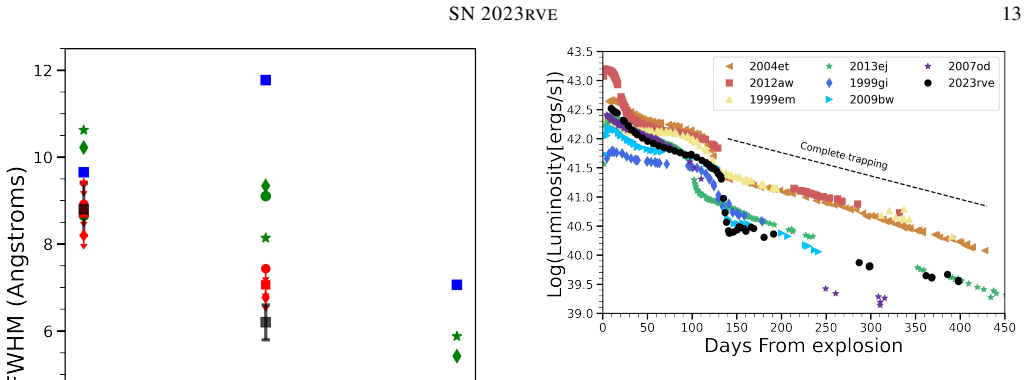
We report on multiband photometric and spectroscopic observations of SN 2023rve, a nearby Type II supernova (SN II) discovered in galaxy NGC 1097 (D=$15.4 \pm 3.2$ Mpc). Nearby SNe II provide constraints on late-stage evolution and progenitor mass loss, particularly the role of circumstellar material (CSM) in shaping SN II observables. SN 2023rve peaks with an absolute V-band magnitude of -17.1 and declines at a rate of $0.90 \pm 0.02$ mag/50 days during the plateau. The bolometric light curve implies a $^{56}$Ni mass of 0.0064 $M_\odot$. Using hydrodynamic light-curve modeling, we infer an intermediate-mass progenitor (~14-18 $M_\odot$), a low explosion energy of 0.27 $\times 10^{51}$ ergs, and a dense CSM component with radial extent of 2900 $R_\odot$ and density of $10^{18}$g cm$^{-1}$. This supports growing evidence that enhanced pre-SN mass loss influences the diversity of SNe II. The nebular spectra of SN 2023rve show narrow He I lines and an absence of [O I] lines unprecedented among Type II SNe. Comparison with other SNe II shows that only two other known objects, both with higher velocities, lack oxygen signatures at similar epochs, <10% of the sample. The lack of oxygen emission combined with low explosion energy, a long plateau, and a small synthesized nickel mass may be consistent with partial fallback of material onto the compact remnant. We also discuss alternative explanations for the suppressed oxygen emission, including dust formation, oxygen-calcium mixing, and ongoing CSM interaction.
Editorial analysis
A structured set of objections, weighed in public.
Referee Report
Summary. The manuscript reports multiband photometric and spectroscopic observations of the nearby Type II supernova SN 2023rve in NGC 1097. From the bolometric light curve it derives a 56Ni mass of 0.0064 M⊙; hydrodynamic modeling infers a progenitor mass of 14–18 M⊙, explosion energy 0.27 × 10^51 erg, and a dense CSM component (radial extent 2900 R⊙, density 10^18 g cm^−1). The nebular spectra exhibit narrow He I lines but no [O I] emission—an unprecedented feature among SNe II—and the authors suggest this combination may indicate partial fallback onto the compact remnant while enumerating alternative explanations (dust formation, O–Ca mixing, ongoing CSM interaction).
Significance. If the non-detection of [O I] can be shown to arise from fallback rather than the listed alternatives, the result would strengthen evidence that low-energy explosions with dense CSM can produce fallback events, tightening the link between progenitor mass, explosion energy, and remnant properties. The well-sampled light curve and spectra of a nearby SN II also add a useful data point to studies of pre-supernova mass loss.
major comments (2)
- [Abstract] Abstract: The claim that absent [O I] together with E_exp = 0.27 × 10^51 erg, long plateau, and M_Ni = 0.0064 M⊙ 'may be consistent with partial fallback' is load-bearing for the central interpretation, yet the text provides no [O I] line-flux upper limits, no predicted [O I] luminosities under the dust, mixing, or CSM-interaction scenarios, and no argument that the reported dense CSM would suppress [O I] while producing the observed narrow He I. Without these quantitative tests the fallback interpretation cannot be distinguished from the alternatives the abstract itself enumerates.
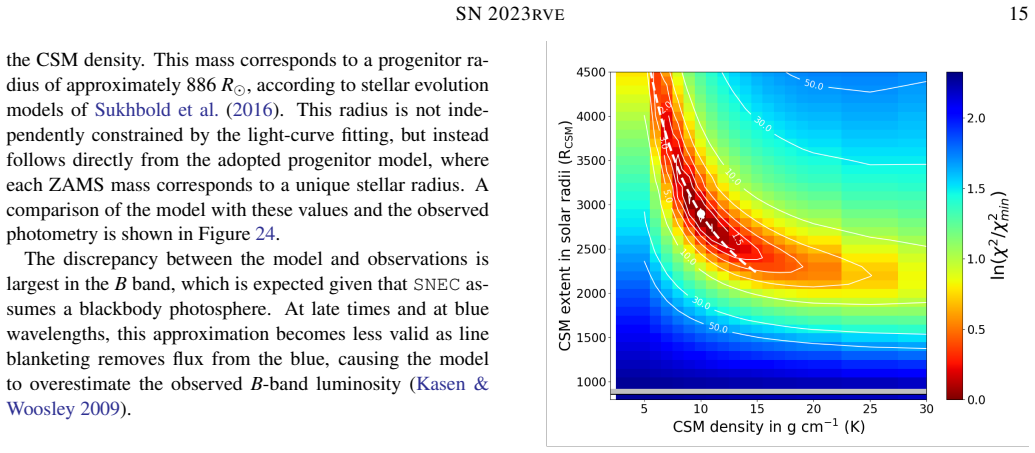
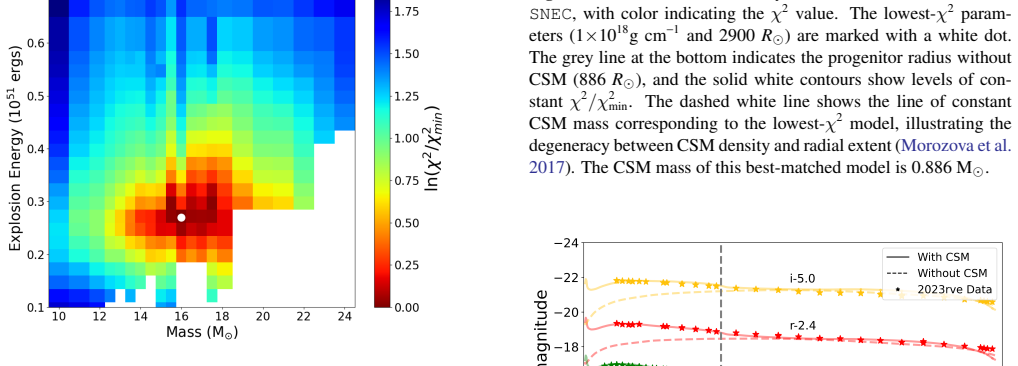
- [Hydrodynamic modeling] Hydrodynamic modeling section: The reported progenitor mass (14–18 M⊙), explosion energy, and CSM parameters are presented without the fitting procedure, χ² surfaces, or covariance with the observed plateau duration and decline rate; it is therefore unclear whether the low-energy solution is unique or whether modest changes in the assumed density profile would alter the fallback interpretation.
minor comments (1)
- [Introduction] The distance modulus and its uncertainty (15.4 ± 3.2 Mpc) should cite the specific measurement method or reference used.
Simulated Author's Rebuttal
We thank the referee for their careful and constructive review of our manuscript. We address each major comment below and will revise the paper to incorporate the suggested improvements.
read point-by-point responses
-
Referee: [Abstract] Abstract: The claim that absent [O I] together with E_exp = 0.27 × 10^51 erg, long plateau, and M_Ni = 0.0064 M⊙ 'may be consistent with partial fallback' is load-bearing for the central interpretation, yet the text provides no [O I] line-flux upper limits, no predicted [O I] luminosities under the dust, mixing, or CSM-interaction scenarios, and no argument that the reported dense CSM would suppress [O I] while producing the observed narrow He I. Without these quantitative tests the fallback interpretation cannot be distinguished from the alternatives the abstract itself enumerates.
Authors: We agree that additional quantitative context would strengthen the fallback discussion. In the revised manuscript we will report [O I] λ6300,6364 flux upper limits measured from the nebular spectra. We will also add a short comparison, drawing on published models, of the [O I] luminosities expected under dust formation, O–Ca mixing, and continued CSM interaction, and will note that the observed narrow He I lines are consistent with the reported dense CSM while the complete absence of [O I] is more readily explained by fallback given the low explosion energy. Full radiative-transfer calculations for every alternative remain beyond the present scope and will be acknowledged as a limitation. revision: yes
-
Referee: [Hydrodynamic modeling] Hydrodynamic modeling section: The reported progenitor mass (14–18 M⊙), explosion energy, and CSM parameters are presented without the fitting procedure, χ² surfaces, or covariance with the observed plateau duration and decline rate; it is therefore unclear whether the low-energy solution is unique or whether modest changes in the assumed density profile would alter the fallback interpretation.
Authors: We will expand the hydrodynamic modeling section to describe the SNEC grid that was explored (progenitor masses 12–20 M⊙, energies 0.1–1.0 × 10^51 erg, and a range of CSM densities and extents). We will report the χ² minimization procedure used to match the plateau duration and decline rate, include representative χ² contours, and quote the covariance between energy and CSM parameters. These additions will demonstrate that the reported low-energy solution is the only family of models that simultaneously reproduces the long plateau and the early luminosity without requiring unphysical adjustments to the density profile. revision: yes
Circularity Check
No circularity: purely observational report with standard modeling
full rationale
The paper reports multiband photometry, spectroscopy, and standard hydrodynamic light-curve modeling to infer progenitor mass (~14-18 M⊙), explosion energy (0.27×10^51 erg), 56Ni mass (0.0064 M⊙), and CSM parameters. These inferences rely on external codes and assumptions not derived within the paper. The fallback interpretation is explicitly labeled 'may be consistent' and is accompanied by enumerated alternatives (dust, mixing, CSM interaction) without any claim that the data force one conclusion over others. No equations, self-citations, or fitted parameters are presented as independent predictions; the work contains no derivation chain that reduces to its own inputs by construction.
Axiom & Free-Parameter Ledger
free parameters (4)
- progenitor mass =
14-18 M_sun
- explosion energy =
0.27 x 10^51 ergs
- nickel mass =
0.0064 M_sun
- CSM radial extent =
2900 R_sun
axioms (1)
- domain assumption Standard assumptions in Type II supernova hydrodynamic light-curve modeling hold for this event
Reference graph
Works this paper leans on
-
[1]
doi:10.1051/0004-6361/201322068 , keywords =
Astropy: A community Python package for astronomy. , archivePrefix = "arXiv", eprint =. doi:10.1051/0004-6361/201322068 , adsurl =
-
[2]
, archivePrefix = "arXiv", eprint =
The Astropy Project: Building an Open-science Project and Status of the v2.0 Core Package. , archivePrefix = "arXiv", eprint =. doi:10.3847/1538-3881/aabc4f , adsurl =
-
[3]
D., 2007, @doi [Computing in Science & Engineering] 10.1109/MCSE.2007.55 , 9, 90
Matplotlib: A 2D Graphics Environment. Computing in Science and Engineering , keywords =. doi:10.1109/MCSE.2007.55 , adsurl =
-
[4]
HOTPANTS: High Order Transform of PSF ANd Template Subtraction
-
[5]
, keywords =
Equivalent width of NA I and K I lines and reddening. , keywords =. 1997
1997
-
[6]
An empirical relation between sodium absorption and dust extinction. , keywords =. 2012. doi:10.1111/j.1365-2966.2012.21796.x , archivePrefix =. 1206.6107 , primaryClass =
-
[7]
Measuring Reddening with SDSS Stellar Spectra and Recalibrating SFD
Measuring Reddening with Sloan Digital Sky Survey Stellar Spectra and Recalibrating SFD. , keywords =. 2011. doi:10.1088/0004-637X/737/2/103 , archivePrefix =. 1012.4804 , primaryClass =
work page internal anchor Pith review Pith/arXiv arXiv doi:10.1088/0004-637x/737/2/103 2011
-
[8]
The Carnegie Supernova Project I. Methods to estimate host-galaxy reddening of stripped-envelope supernovae. , keywords =. doi:10.1051/0004-6361/201730843 , archivePrefix =. 1707.07615 , primaryClass =
work page internal anchor Pith review Pith/arXiv arXiv doi:10.1051/0004-6361/201730843
-
[9]
The First Systematic Study of Type Ibc Supernova Multi-band Light Curves
The First Systematic Study of Type Ibc Supernova Multi-band Light Curves. , keywords =. doi:10.1088/0004-637X/741/2/97 , archivePrefix =. 1011.4959 , primaryClass =
work page internal anchor Pith review Pith/arXiv arXiv doi:10.1088/0004-637x/741/2/97
-
[10]
Early-time light curves of Type Ib/c supernovae from the SDSS-II Supernova Survey
Early-time light curves of Type Ib/c supernovae from the SDSS-II Supernova Survey. , keywords =. doi:10.1051/0004-6361/201423915 , archivePrefix =. 1408.4084 , primaryClass =
work page internal anchor Pith review Pith/arXiv arXiv doi:10.1051/0004-6361/201423915
-
[11]
Model Light Curves for Type Ib and Ic Supernovae. , keywords =. doi:10.3847/1538-4357/abf3be , archivePrefix =. 2009.06868 , primaryClass =
-
[12]
Inferring supernova IIb/Ib/Ic ejecta properties from light curves and spectra: correlations from radiative-transfer models. , keywords =. doi:10.1093/mnras/stw418 , archivePrefix =. 1602.06280 , primaryClass =
work page internal anchor Pith review Pith/arXiv arXiv doi:10.1093/mnras/stw418
-
[13]
Transient Name Server Discovery Report , keywords =
DLT40 Transient Discovery Report for 2022-02-19. Transient Name Server Discovery Report , keywords =
2022
-
[14]
PROMPT: Panchromatic Robotic Optical Monitoring and Polarimetry Telescopes
PROMPT: Panchromatic Robotic Optical Monitoring and Polarimetry Telescopes. Nuovo Cimento C Geophysics Space Physics C , keywords =. 2005. doi:10.1393/ncc/i2005-10149-6 , archivePrefix =. astro-ph/0502429 , primaryClass =
work page internal anchor Pith review Pith/arXiv arXiv doi:10.1393/ncc/i2005-10149-6 2005
-
[15]
The broad-lined Type Ic supernova 2003jd. , keywords =. doi:10.1111/j.1365-2966.2007.12647.x , archivePrefix =. 0710.5173 , primaryClass =
-
[16]
Bolometric light curves and explosion parameters of 38 stripped-envelope core-collapse supernovae
Bolometric light curves and explosion parameters of 38 stripped-envelope core-collapse supernovae. , keywords =. doi:10.1093/mnras/stv2983 , archivePrefix =. 1406.3667 , primaryClass =
work page internal anchor Pith review Pith/arXiv arXiv doi:10.1093/mnras/stv2983
-
[17]
Bolometric Corrections for optical light curves of Core-collapse Supernovae
Bolometric corrections for optical light curves of core-collapse supernovae. , keywords =. doi:10.1093/mnras/stt2187 , archivePrefix =. 1311.1946 , primaryClass =
work page internal anchor Pith review Pith/arXiv arXiv doi:10.1093/mnras/stt2187 1946
-
[18]
I - Analytic solutions for the early part of the light curve
Type I supernovae. I - Analytic solutions for the early part of the light curve. , keywords =. doi:10.1086/159681 , adsurl =
-
[19]
SN 2009jf: a slow-evolving stripped-envelope core-collapse supernova. , keywords =. doi:10.1111/j.1365-2966.2011.19262.x , archivePrefix =. 1106.3030 , primaryClass =
-
[20]
The early detection and follow-up of the highly obscured Type II supernova 2016ija/DLT16am
The Early Detection and Follow-up of the Highly Obscured Type II Supernova 2016ija/DLT16am. , keywords =. 2018. doi:10.3847/1538-4357/aaa014 , archivePrefix =. 1711.03940 , primaryClass =
work page internal anchor Pith review Pith/arXiv arXiv doi:10.3847/1538-4357/aaa014 2018
-
[21]
The Properties of NI CO Fe Decay. , keywords =. doi:10.1086/192008 , adsurl =
-
[22]
Radiative-transfer models for supernovae IIb/Ib/Ic from binary-star progenitors
Radiative-transfer models for supernovae IIb/Ib/Ic from binary-star progenitors. , keywords =. doi:10.1093/mnras/stv1747 , archivePrefix =. 1507.07783 , primaryClass =
work page internal anchor Pith review Pith/arXiv arXiv doi:10.1093/mnras/stv1747
-
[23]
A Two-Component Model for the Light Curves of Hypernovae
A Two-Component Model for the Light Curves of Hypernovae. , keywords =. doi:10.1086/376591 , archivePrefix =. astro-ph/0305182 , primaryClass =
work page internal anchor Pith review Pith/arXiv arXiv doi:10.1086/376591
-
[24]
The Unique Type Ib Supernova 2005bf at Nebular Phases: A Possible Birth Event of a Strongly Magnetized Neutron Star. , keywords =. doi:10.1086/520054 , archivePrefix =. 0705.2713 , primaryClass =
work page internal anchor Pith review Pith/arXiv arXiv doi:10.1086/520054
-
[25]
Supernova Light Curves Powered by Young Magnetars
Supernova Light Curves Powered by Young Magnetars. , keywords =. doi:10.1088/0004-637X/717/1/245 , archivePrefix =. 0911.0680 , primaryClass =
work page internal anchor Pith review Pith/arXiv arXiv doi:10.1088/0004-637x/717/1/245
-
[26]
A Unified Energy-reservoir Model Containing Contributions from 56Ni and Neutron Stars and Its Implication for Luminous Type Ic Supernovae. , keywords =. doi:10.1088/0004-637X/807/2/147 , archivePrefix =. 1504.04704 , primaryClass =
work page internal anchor Pith review Pith/arXiv arXiv doi:10.1088/0004-637x/807/2/147
-
[27]
Las Cumbres Observatory Global Telescope Network
Las Cumbres Observatory Global Telescope Network. , keywords =. doi:10.1086/673168 , archivePrefix =. 1305.2437 , primaryClass =
work page internal anchor Pith review Pith/arXiv arXiv doi:10.1086/673168
-
[28]
The progenitor mass of the Type IIP supernova SN 2004et from late-time spectral modeling
The progenitor mass of the Type IIP supernova SN 2004et from late-time spectral modeling. , keywords =. doi:10.1051/0004-6361/201219528 , archivePrefix =. 1208.2183 , primaryClass =
work page internal anchor Pith review Pith/arXiv arXiv doi:10.1051/0004-6361/201219528
-
[29]
Nebular phase observations of the type-Ib supernova iPTF13bvn favour a binary progenitor
Nebular phase observations of the Type-Ib supernova iPTF13bvn favour a binary progenitor. , keywords =. doi:10.1051/0004-6361/201425604 , archivePrefix =. 1504.01473 , primaryClass =
work page internal anchor Pith review Pith/arXiv arXiv doi:10.1051/0004-6361/201425604
-
[30]
Nebular phase properties of supernova Ibc from He-star explosions. , keywords =. doi:10.1051/0004-6361/202141927 , archivePrefix =. 2109.12350 , primaryClass =
-
[31]
Late-time spectral line formation in Type IIb supernovae, with application to SN 1993J, SN 2008ax, and SN 2011dh. , keywords =. doi:10.1051/0004-6361/201423983 , archivePrefix =. 1408.0732 , primaryClass =
work page internal anchor Pith review Pith/arXiv arXiv doi:10.1051/0004-6361/201423983
-
[32]
The Astrophysical Journal , author =
The Explosion of Helium Stars Evolved with Mass Loss. , keywords =. doi:10.3847/1538-4357/ab6458 , archivePrefix =. 1910.01641 , primaryClass =
-
[33]
The Evolution of Massive Helium Stars Including Mass Loss
The Evolution of Massive Helium Stars, Including Mass Loss. , keywords =. doi:10.3847/1538-4357/ab1b41 , archivePrefix =. 1901.00215 , primaryClass =
work page internal anchor Pith review Pith/arXiv arXiv doi:10.3847/1538-4357/ab1b41 1901
-
[34]
Nucleosynthesis and Remnants in Massive Stars of Solar Metallicity
Nucleosynthesis and remnants in massive stars of solar metallicity. , keywords =. doi:10.1016/j.physrep.2007.02.009 , archivePrefix =. astro-ph/0702176 , primaryClass =
work page internal anchor Pith review Pith/arXiv arXiv doi:10.1016/j.physrep.2007.02.009 2007
-
[35]
The Evolution and Explosion of Massive Stars. II. Explosive Hydrodynamics and Nucleosynthesis. , keywords =. doi:10.1086/192237 , adsurl =
-
[36]
What Stars Become Peculiar Type I Supernovae?. , keywords =. doi:10.1086/184777 , adsurl =
-
[37]
SN Ib 1990I: Clumping and Dust in the Ejecta?
SN Ib 1990I: Clumping and dust in the ejecta?. , keywords =. doi:10.1051/0004-6361:20041318 , archivePrefix =. astro-ph/0407145 , primaryClass =
work page internal anchor Pith review Pith/arXiv arXiv doi:10.1051/0004-6361:20041318
-
[38]
Optical studies of SN 2009jf: a Type Ib supernova with an extremely slow decline and aspherical signature. , keywords =. doi:10.1111/j.1365-2966.2011.18326.x , archivePrefix =. 1101.2068 , primaryClass =
-
[39]
Nucleosynthesis Yields of Core-Collapse Supernovae and Hypernovae, and Galactic Chemical Evolution
Nucleosynthesis yields of core-collapse supernovae and hypernovae, and galactic chemical evolution. , keywords =. doi:10.1016/j.nuclphysa.2006.05.008 , archivePrefix =. astro-ph/0605725 , primaryClass =
work page internal anchor Pith review Pith/arXiv arXiv doi:10.1016/j.nuclphysa.2006.05.008 2006
-
[40]
Analyzing the Largest Spectroscopic Data Set of Stripped Supernovae to Improve Their Identifications and Constrain Their Progenitors. , keywords =. doi:10.3847/0004-637X/827/2/90 , archivePrefix =. 1510.08049 , primaryClass =
work page internal anchor Pith review Pith/arXiv arXiv doi:10.3847/0004-637x/827/2/90
-
[41]
Determining the Type, Redshift, and Age of a Supernova Spectrum
Determining the Type, Redshift, and Age of a Supernova Spectrum. , keywords =. doi:10.1086/520494 , archivePrefix =. 0709.4488 , primaryClass =
work page internal anchor Pith review Pith/arXiv arXiv doi:10.1086/520494
-
[42]
Metallicity gradients and the [Z/H]-mass, [ /Fe]-mass relations
Hydrogen and helium in the late phase of supernovae of Type IIb. , keywords =. doi:10.1111/j.1365-2966.2010.17186.x , archivePrefix =. 1007.1881 , primaryClass =
-
[43]
Type IIb Supernova SN 2011dh: Spectra and Photometry from the Ultraviolet to the Near-Infrared
Type IIb Supernova SN 2011dh: Spectra and Photometry from the Ultraviolet to the Near-infrared. , keywords =. doi:10.1088/0004-637X/781/2/69 , archivePrefix =. 1303.5482 , primaryClass =
work page internal anchor Pith review Pith/arXiv arXiv doi:10.1088/0004-637x/781/2/69
-
[44]
How much hydrogen is in Type Ib and IIb supernova progenitors?. , keywords =. doi:10.1093/mnras/stac088 , archivePrefix =. 2111.04432 , primaryClass =
-
[45]
An Early Warning System for Asteroid Impact
An Early Warning System for Asteroid Impact. , keywords =. 2011. doi:10.1086/657997 , archivePrefix =. 1011.1028 , primaryClass =
work page internal anchor Pith review Pith/arXiv arXiv doi:10.1086/657997 2011
-
[46]
Design and Operation of the ATLAS Transient Science Server. , keywords =. doi:10.1088/1538-3873/ab936e , archivePrefix =. 2003.09052 , primaryClass =
-
[47]
Transient Name Server Classification Report , keywords =
DLT40 Transient Classification Report for 2022-02-19. Transient Name Server Classification Report , keywords =
2022
-
[48]
The DEIMOS spectrograph for the Keck II Telescope: integration and testing. Instrument Design and Performance for Optical/Infrared Ground-based Telescopes , year = 2003, editor =. doi:10.1117/12.460346 , adsurl =
-
[49]
The Swift Gamma-Ray Burst Mission
The Swift Gamma-Ray Burst Mission. , keywords =. 2004. doi:10.1086/422091 , archivePrefix =. astro-ph/0405233 , primaryClass =
work page internal anchor Pith review Pith/arXiv arXiv doi:10.1086/422091 2004
-
[50]
Society of Photo-Optical Instrumentation Engineers (SPIE) Conference Series , year = 2006, editor =
The prime focus imaging spectrograph for the Southern African Large Telescope: structural and mechanical design and commissioning. Society of Photo-Optical Instrumentation Engineers (SPIE) Conference Series , year = 2006, editor =. doi:10.1117/12.672415 , adsurl =
-
[51]
and Stone, Remington P
Miller, Joseph S. and Stone, Remington P. S. , year =. The
-
[52]
Green, Richard and Schmidt, Gary and Oey, Sally and Wittman, David and Hall, Pat , year =. Steward
-
[53]
Ground-based Instrumentation for Astronomy , year = 2004, editor =
The Goodman spectrograph. Ground-based Instrumentation for Astronomy , year = 2004, editor =. doi:10.1117/12.550069 , adsurl =
-
[54]
The Keck Low-Resolution Imaging Spectrometer. , keywords =. doi:10.1086/133562 , adsurl =
-
[55]
The Gemini-North Multi-Object Spectrograph: Performance in Imaging, Long-Slit, and Multi-Object Spectroscopic Modes. , keywords =. doi:10.1086/383624 , adsurl =
-
[56]
Optical Design and Engineering , year = 2004, editor =
SNIFS: a wideband integral field spectrograph with microlens arrays. Optical Design and Engineering , year = 2004, editor =. doi:10.1117/12.512493 , adsurl =
-
[57]
, year = 2011, month = mar, volume =
IMACS: The Inamori-Magellan Areal Camera and Spectrograph on Magellan-Baade. , year = 2011, month = mar, volume =. doi:10.1086/658908 , adsurl =
-
[58]
Ground-based Instrumentation for Astronomy , year = 2004, editor =
Mass producing an efficient NIR spectrograph. Ground-based Instrumentation for Astronomy , year = 2004, editor =. doi:10.1117/12.550925 , adsurl =
-
[59]
SpeX: A Medium-Resolution 0.8-5.5 Micron Spectrograph and Imager for the NASA Infrared Telescope Facility. , keywords =. doi:10.1086/367745 , adsurl =
-
[60]
, year = 2013, month = mar, volume =
FIRE: A Facility Class Near-Infrared Echelle Spectrometer for the Magellan Telescopes. , year = 2013, month = mar, volume =. doi:10.1086/670241 , adsurl =
-
[61]
MMT & Magellan Infrared Spectrograph
MMT and Magellan Infrared Spectrograph. , keywords =. doi:10.1086/669044 , archivePrefix =. 1211.6174 , primaryClass =
work page internal anchor Pith review Pith/arXiv arXiv doi:10.1086/669044
-
[62]
, year = 2006, month = feb, volume =
Supernova 2006T in NGC 3054. , year = 2006, month = feb, volume =
2006
-
[63]
The Carnegie Supernova Project I: analysis of stripped-envelope supernova light curves
The Carnegie Supernova Project I. Analysis of stripped-envelope supernova light curves. , keywords =. doi:10.1051/0004-6361/201730844 , archivePrefix =. 1707.07614 , primaryClass =
work page internal anchor Pith review Pith/arXiv arXiv doi:10.1051/0004-6361/201730844
-
[64]
The Extragalactic Distance Database. , keywords =. doi:10.1088/0004-6256/138/2/323 , adsurl =
-
[65]
Hosseinzadeh, Griffin and Gomez, Sebastian , year =. Light. doi:10.5281/zenodo.4312178 , adsurl =
-
[66]
Type Ib/Ic Supernovae: Effect of Nickel Mixing on the Early-time Color Evolution and Implications for the Progenitors. , keywords =. doi:10.3847/1538-4357/ab0020 , archivePrefix =. 1810.03108 , primaryClass =
work page internal anchor Pith review Pith/arXiv arXiv doi:10.3847/1538-4357/ab0020
-
[67]
arXiv , author =:2110.12083 , journal =
Carnegie Supernova Project-II: Near-infrared Spectroscopy of Stripped-envelope Core-collapse Supernovae. , keywords =. doi:10.3847/1538-4357/ac4030 , archivePrefix =. 2110.12083 , primaryClass =
-
[68]
Type Ic supernova of a 22 M _ progenitor. , keywords =. doi:10.1093/mnras/staa123 , archivePrefix =. 2001.07111 , primaryClass =
-
[69]
A Catalog of Near Infrared Spectra from Type Ia Supernovae
A Catalog of Near-Infrared Spectra from Type Ia Supernovae. , keywords =. doi:10.1088/0004-6256/138/3/727 , archivePrefix =. 0906.4085 , primaryClass =
work page internal anchor Pith review Pith/arXiv arXiv doi:10.1088/0004-6256/138/3/727
-
[70]
Thermonuclear Supernovae , year = 1997, editor =
Type Ib and Ic supernovae: models and spectra. Thermonuclear Supernovae , year = 1997, editor =. doi:10.1007/978-94-011-5710-0_51 , adsurl =
-
[71]
On the nature of supernovae Ib and Ic. , keywords =. doi:10.1111/j.1365-2966.2012.21374.x , archivePrefix =. 1205.5349 , primaryClass =
-
[72]
Low-Mass Helium Star Models for Type Ib Supernovae: Light Curves, Mixing, and Nucleosynthesis. , keywords =. doi:10.1086/185818 , adsurl =
-
[73]
Investigating the Observational Properties of Type Ib Supernova SN 2017iro. , keywords =. doi:10.3847/1538-4357/ac4bb9 , archivePrefix =. 2201.03260 , primaryClass =
-
[74]
Direct Analysis of Spectra of Type Ib Supernovae
Direct Analysis of Spectra of Type Ib Supernovae. , keywords =. doi:10.1086/338127 , archivePrefix =. astro-ph/0106367 , primaryClass =
work page internal anchor Pith review Pith/arXiv arXiv doi:10.1086/338127
-
[75]
An extremely luminous X-ray outburst at the birth of a supernova
An extremely luminous X-ray outburst at the birth of a supernova. , keywords =. doi:10.1038/nature06997 , archivePrefix =. 0802.1712 , primaryClass =
work page internal anchor Pith review Pith/arXiv arXiv doi:10.1038/nature06997
-
[76]
The He-rich core-collapse supernova 2007Y: Observations from X-ray to Radio Wavelengths
The He-Rich Core-Collapse Supernova 2007Y: Observations from X-Ray to Radio Wavelengths. , keywords =. doi:10.1088/0004-637X/696/1/713 , archivePrefix =. 0902.0609 , primaryClass =
work page internal anchor Pith review Pith/arXiv arXiv doi:10.1088/0004-637x/696/1/713
-
[77]
SN 2005bf: A Possible Transition Event Between Type Ib/c Supernovae and Gamma Ray Bursts
SN 2005bf: A Possible Transition Event between Type Ib/c Supernovae and Gamma-Ray Bursts. , keywords =. doi:10.1086/500531 , archivePrefix =. astro-ph/0509731 , primaryClass =
work page internal anchor Pith review Pith/arXiv arXiv doi:10.1086/500531
-
[78]
Photometric, polarimetric, and spectroscopic studies of the luminous, slow-decaying Type Ib SN 2012au. , keywords =. doi:10.1093/mnras/stab1889 , archivePrefix =. 2106.15856 , primaryClass =
-
[79]
Type Ib/c Supernovae in Binary Systems. I. Evolution and Properties of the Progenitor Stars. , keywords =. doi:10.1088/0004-637X/725/1/940 , archivePrefix =. 1004.0843 , primaryClass =
work page internal anchor Pith review Pith/arXiv arXiv doi:10.1088/0004-637x/725/1/940
-
[80]
Nebular emission-line profiles of Type Ib/c supernovae - probing the ejecta asphericity. , keywords =. doi:10.1111/j.1365-2966.2009.15003.x , archivePrefix =. 0904.4632 , primaryClass =
discussion (0)
Sign in with ORCID, Apple, or X to comment. Anyone can read and Pith papers without signing in.