STEB: Style Text Embedding Benchmark
Pith reviewed 2026-07-01 05:47 UTC · model grok-4.3
The pith
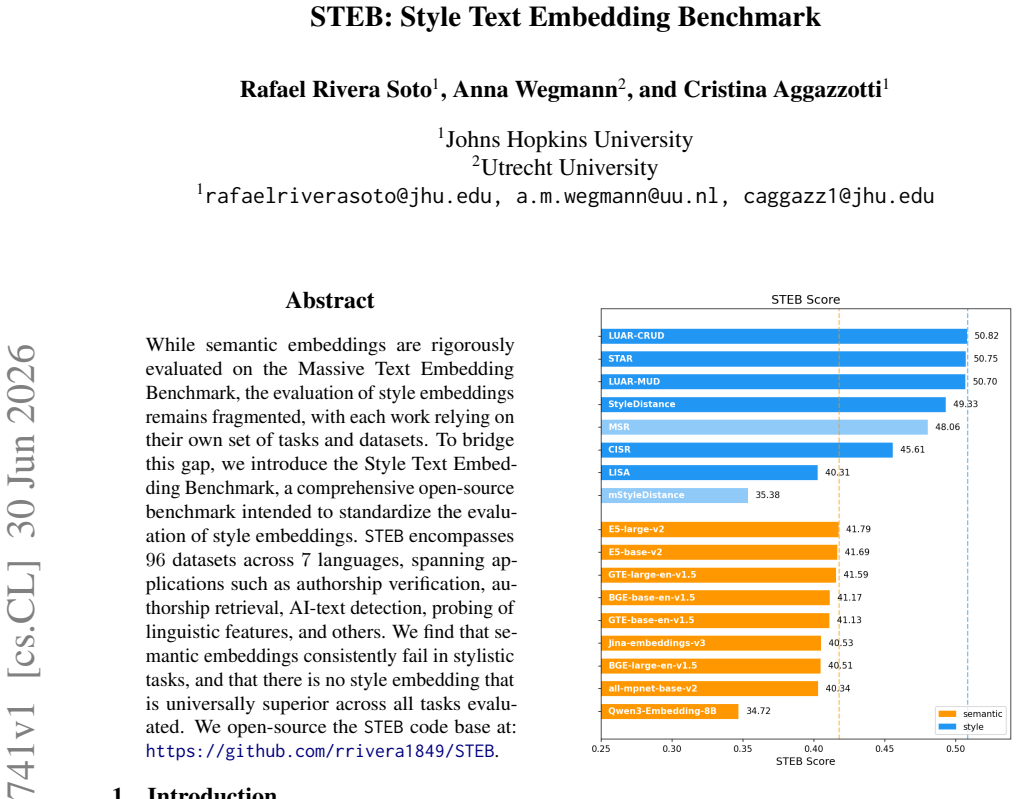
STEB benchmark shows semantic embeddings fail on stylistic tasks and no style embedding wins universally.
A machine-rendered reading of the paper's core claim, the machinery that carries it, and where it could break.
Core claim
By releasing STEB, the authors establish that semantic embeddings consistently underperform on stylistic tasks and that performance among style embeddings is task-dependent rather than dominated by any single model across the full suite of 96 datasets and seven languages.
What carries the argument
The Style Text Embedding Benchmark (STEB), a curated collection of 96 datasets spanning seven languages and multiple style-oriented tasks that enables direct, standardized comparison of embedding models.
If this is right
- Future papers claiming new style embeddings must report results on the STEB tasks to allow comparison.
- Applications that rely on style, such as authorship attribution or AI detection, should avoid relying on semantic-only embeddings.
- Task-specific fine-tuning or selection of style embeddings becomes necessary instead of assuming one model suffices.
- Multilingual style evaluation now has a shared reference point across the seven languages covered.
Where Pith is reading between the lines
- The consistent failure of semantic embeddings suggests that style information is largely orthogonal to the semantic dimensions captured by current large models.
- Extending STEB to additional languages or new tasks such as style transfer evaluation would test whether the current findings generalize.
- Hybrid models that explicitly separate or combine semantic and stylistic signals could be evaluated directly against the existing STEB baselines.
Load-bearing premise
The 96 chosen datasets and seven languages together capture stylistic variation without systematic bias or gaps.
What would settle it
A single style embedding that ranks first on every task and language in the released STEB suite, or a semantic embedding that matches or exceeds style embeddings on the full set of tasks.
Figures
read the original abstract
While semantic embeddings are rigorously evaluated on the Massive Text Embedding Benchmark, the evaluation of style embeddings remains fragmented, with each work relying on their own set of tasks and datasets. To bridge this gap, we introduce the Style Text Embedding Benchmark, a comprehensive open-source benchmark intended to standardize the evaluation of style embeddings. STEB encompasses 96 datasets across 7 languages, spanning applications such as authorship verification, authorship retrieval, AI-text detection, probing of linguistic features, and others. We find that semantic embeddings consistently fail in stylistic tasks, and that there is no style embedding that is universally superior across all tasks evaluated. We open-source the STEB code base at: https://github.com/rrivera1849/STEB.
Editorial analysis
A structured set of objections, weighed in public.
Referee Report
Summary. The manuscript introduces the Style Text Embedding Benchmark (STEB), an open-source benchmark with 96 datasets across 7 languages covering tasks including authorship verification, authorship retrieval, AI-text detection, and linguistic probing. It reports that semantic embeddings consistently fail on stylistic tasks and that no style embedding is universally superior across the evaluated tasks.
Significance. If the benchmark construction and results hold, STEB would provide a much-needed standardized evaluation framework for style embeddings, paralleling MTEB for semantic embeddings. The scale (96 datasets, multiple languages and task categories) and open-sourced code base support reproducibility and could accelerate research distinguishing semantic from stylistic representations.
major comments (2)
- [Abstract] Abstract: the central claim that semantic embeddings 'consistently fail in stylistic tasks' is load-bearing for the benchmark's value, yet the abstract (and by extension the reported findings) provides no details on the metrics, baselines, or thresholds defining failure; without this, the empirical contrast with style embeddings cannot be assessed.
- [Abstract] Abstract: the claim of no universally superior style embedding rests on the assumption that the 96 datasets and selected tasks (authorship verification, retrieval, AI-text detection, probing) adequately represent stylistic features without bias; the manuscript must justify dataset selection and task construction to support this generalizability conclusion.
minor comments (1)
- [Abstract] The abstract would benefit from naming the specific style embeddings evaluated to allow readers to contextualize the 'no universal superiority' result.
Simulated Author's Rebuttal
We thank the referee for the positive evaluation and recommendation of minor revision. We address each major comment below, clarifying the abstract claims and strengthening the justification for dataset and task selection.
read point-by-point responses
-
Referee: [Abstract] Abstract: the central claim that semantic embeddings 'consistently fail in stylistic tasks' is load-bearing for the benchmark's value, yet the abstract (and by extension the reported findings) provides no details on the metrics, baselines, or thresholds defining failure; without this, the empirical contrast with style embeddings cannot be assessed.
Authors: We agree the abstract is brief by design. The full manuscript details the metrics (accuracy, F1, MRR, AUC), semantic baselines (e.g., all-MiniLM-L6-v2, other Sentence-BERT variants), and failure definition (performance at or below random chance or substantially below style-specific models across tasks, per Section 3). We have revised the abstract to add a concise qualifier referencing the evaluation protocol in the methods section. revision: yes
-
Referee: [Abstract] Abstract: the claim of no universally superior style embedding rests on the assumption that the 96 datasets and selected tasks (authorship verification, retrieval, AI-text detection, probing) adequately represent stylistic features without bias; the manuscript must justify dataset selection and task construction to support this generalizability conclusion.
Authors: Section 2 details dataset selection criteria (public availability, style annotations, domain and language diversity across 7 languages) and task construction rationale (covering authorship, detection, and linguistic probing to span stylistic dimensions). To further support the generalizability claim, we have expanded the discussion of selection process and potential limitations in the revised manuscript. revision: yes
Circularity Check
No significant circularity identified
full rationale
The paper introduces an external benchmark (STEB) consisting of 96 datasets and reports empirical evaluation results on it. Central claims about semantic embeddings failing stylistic tasks and lack of universal superiority are direct observations from those results, with no derivations, equations, fitted parameters, or self-citations that reduce the findings to inputs by construction. The argument structure is self-contained against external verification via the open-sourced benchmark.
Axiom & Free-Parameter Ledger
Reference graph
Works this paper leans on
-
[1]
InExperimental IR Meets Multilinguality, Mul- timodality, and Interaction, pages 459–481
Overview of PAN 2023: Authorship Verifi- cation, Multi-Author Writing Style Analysis, Profil- ing Cryptocurrency Influencers, and Trigger Detec- tion. InExperimental IR Meets Multilinguality, Mul- timodality, and Interaction, pages 459–481. Springer, Cham. Janek Bevendorff, Berta Chulvi, Gretel Liz De La Peña Sarracén, Mike Kestemont, Enrique Manjavacas, ...
2023
-
[2]
InExperimental IR Meets Multilinguality, Multimodality, and Interac- tion, pages 382–394
Overview of PAN 2022: Authorship Veri- fication, Profiling Irony and Stereotype Spreaders, and Style Change Detection. InExperimental IR Meets Multilinguality, Multimodality, and Interac- tion, pages 382–394. Springer, Cham. Janek Bevendorff, Daryna Dementieva, Maik Fröbe, Bela Gipp, André Greiner-Petter, Jussi Karlgren, Maximilian Mayerl, Preslav Nakov, ...
2022
-
[3]
Overview of PAN 2026: V oight-kampff gen- erative ai detection, text watermarking, multi-author writing style analysis, generative plagiarism detec- tion, and reasoning trajectory detection.Preprint, arXiv:2602.09147. Janek Bevendorff, Bilal Ghanem, Anastasia Giachanou, Mike Kestemont, Enrique Manjavacas, Ilia Markov, Maximilian Mayerl, Martin Potthast, F...
-
[4]
Royal Society Open Science, 5(10):171920
Evaluating prose style transfer with the Bible. Royal Society Open Science, 5(10):171920. Alexis Conneau, German Kruszewski, Guillaume Lam- ple, Loïc Barrault, and Marco Baroni. 2018. What you can cram into a single $&!#* vector: Probing sentence embeddings for linguistic properties. In Proceedings of the 56th Annual Meeting of the As- sociation for Compu...
-
[5]
In Findings of the Association for Computational Lin- guistics: EMNLP 2025, pages 16830–16855, Suzhou, China
EnDive: A Cross-Dialect Benchmark for Fair- ness and Performance in Large Language Models. In Findings of the Association for Computational Lin- guistics: EMNLP 2025, pages 16830–16855, Suzhou, China. Association for Computational Linguistics. Oren Halvani. 2017. Enron authorship verification cor- pus. https://data.mendeley.com/datasets/n 77w7mygwg/1. Pen...
2025
-
[6]
Dongyeop Kang, Varun Gangal, and Eduard Hovy
InConference and Labs of the Evaluation Forum. Dongyeop Kang, Varun Gangal, and Eduard Hovy. 2019. (Male, Bachelor) and (Female, Ph.D) have differ- ent connotations: Parallelly Annotated Stylistic Lan- guage Dataset with Multiple Personas. InProceed- ings of the 2019 Conference on Empirical Methods in Natural Language Processing and the 9th Inter- nationa...
-
[7]
XML conversion and encoding by Lassi Saario. Terttu Nevalainen, Helena Raumolin-Brunberg, Samuli Kaislaniemi, Mikko Laitinen, Minna Nevala, Arja Nurmi, Minna Palander-Collin, Tanja Säily, and Anni Sairio. 2022. CEECES 2 = Corpus of Early English Correspondence Extension Sampler part 2. XML conversion and encoding by Lassi Saario. Jianmo Ni, Jiacheng Li, a...
work page internal anchor Pith review Pith/arXiv arXiv 2022
-
[8]
C-Pack: Packed Resources For General Chinese Embeddings
Same author or just same topic? towards content-independent style representations. InPro- ceedings of the 7th Workshop on Representation Learning for NLP, pages 249–268, Dublin, Ireland. Association for Computational Linguistics. Junchao Wu, Runzhe Zhan, Derek F Wong, Shu Yang, Xinyi Yang, Yulin Yuan, and Lidia S Chao. 2024. Detectrl: Benchmarking llm-gen...
work page internal anchor Pith review Pith/arXiv arXiv 2024
-
[9]
OPT: Open Pre-trained Transformer Language Models
A New Dataset and Method for Automatically Grading ESOL Texts. InProceedings of the 49th Annual Meeting of the Association for Computational Linguistics: Human Language Technologies, pages 180–189, Portland, Oregon, USA. Association for Computational Linguistics. Susan Zhang, Stephen Roller, Naman Goyal, Mikel Artetxe, Moya Chen, Shuohui Chen, Christopher...
work page internal anchor Pith review Pith/arXiv arXiv 2022
-
[10]
Qwen3 Embedding: Advancing Text Embedding and Reranking Through Foundation Models
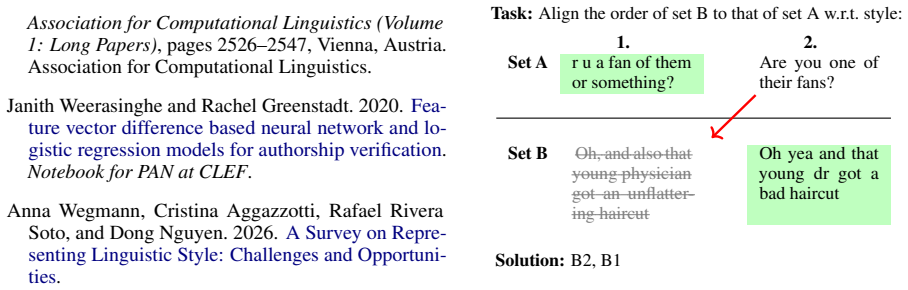
2. Set A r u a fan of them or something? Are you one of their fans? Set B Oh, and also that young physician got an unflatter- ing haircut Oh yea and that young dr got a bad haircut Solution:B2, B1 Figure 2:Order Alignment Example.Set A is written in an informal and a formal style, respectively. Set B is written in the reverse stylistic order. The task is ...
work page internal anchor Pith review Pith/arXiv arXiv 2022
-
[11]
into 8 register (cf. Section C.3) and 32 lin- guistic features (i.e., everything else, including fea- tures like All Lower Case / Proper Capitalization). We combine the train and test split, leading to 100 pairs per feature. SynthSTEL is released under the MIT license per its HuggingFace dataset card at https://huggingface.co/datasets/StyleDis tance/synth...
-
[12]
into registers (i.e., formality and complexity dimension) and linguistic features (cf. C.1). The registers consist of≈200instances each. SynthSTEL_registeradded asorder alignment task. We split the SynthSTEL dataset (Patel et al.,
-
[13]
register
into 8 register (e.g., formal tone, offen- sive language, sarcasm) and 32 linguistic features (cf. Section C.1). Note that depending on ones def- inition of “register”, some categories like positive sentiment expression might not be considered style (Wegmann et al., 2026). We combine the train and test split, leading to 100 pairs per feature. Synth- STEL ...
2026
-
[14]
Compared to CORE, 15 sub-labels and their texts are discarded
into a joint 9-label schema using classifica- tion models. Compared to CORE, 15 sub-labels and their texts are discarded. The added dataset consists of ≈2k English documents. We merge the train/dev/test partitions. X-GENRE is released under CC BY-SA 4.0 on HuggingFace. MASCadded asclusteringandall-to-all pair classificationtask. We add the Manually Anno- ...
2008
-
[15]
Both Zenodo records are licensed under Cre- ative Commons Attribution Non Commercial 4.0 International and Creative Commons Attribution Non Commercial No Derivatives 4.0 International at https://zenodo.org/records/6411789 and https://zenodo.org/records/5887101. Bible versionsadded asclusteringandall-to- all pair classificationtask. We add the parallel Bib...
discussion (0)
Sign in with ORCID, Apple, or X to comment. Anyone can read and Pith papers without signing in.