The location of the upper edge of the pair-instability supernovae black hole mass gap
Pith reviewed 2026-07-01 04:21 UTC · model grok-4.3
The pith
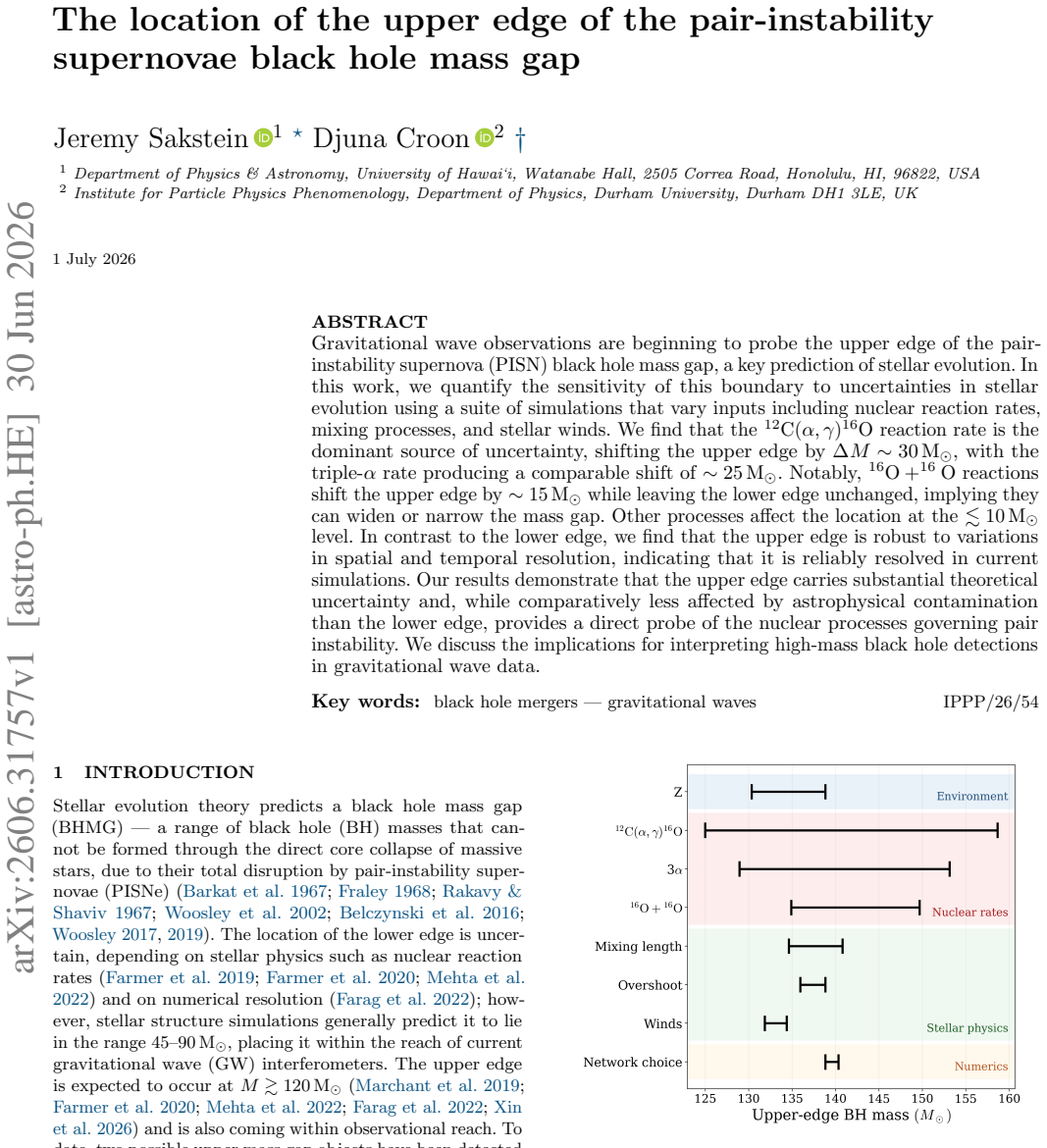
The 12C(α,γ)16O reaction rate dominates uncertainty in the upper edge of the pair-instability black hole mass gap, shifting it by about 30 solar masses.
A machine-rendered reading of the paper's core claim, the machinery that carries it, and where it could break.
Core claim
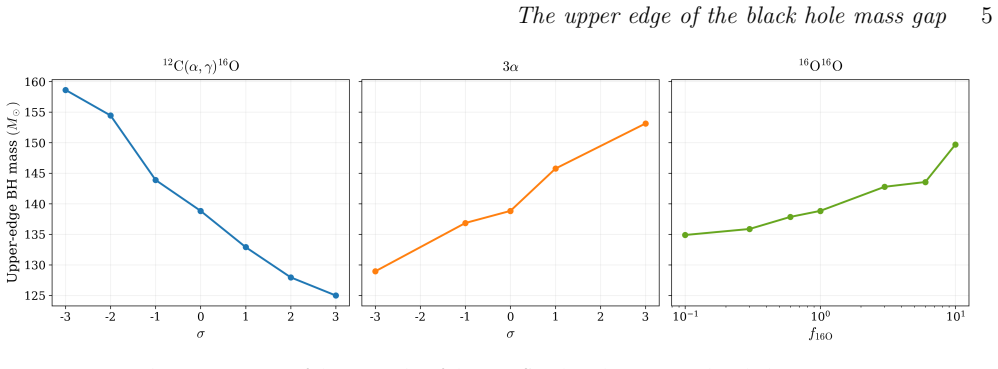
The upper edge of the pair-instability supernova black hole mass gap is most sensitive to the 12C(α,γ)16O reaction rate, which shifts the edge by approximately 30 solar masses. The triple-α rate produces a shift of about 25 solar masses, while 16O+16O reactions shift the upper edge by 15 solar masses without affecting the lower edge. Other processes contribute shifts at the level of 10 solar masses or less. The upper edge is robust to variations in spatial and temporal resolution.
What carries the argument
A suite of stellar evolution simulations that independently vary nuclear reaction rates (12C(α,γ)16O, triple-α, 16O+16O), mixing processes, and stellar winds to locate the upper edge of the PISN black hole mass gap.
If this is right
- The upper edge can serve as a direct probe of the nuclear processes that govern pair instability.
- 16O+16O reactions can widen or narrow the mass gap by shifting only the upper edge.
- The upper edge is reliably resolved in current simulations because it is insensitive to resolution changes.
- High-mass black hole detections in gravitational wave data can be compared against models that incorporate these nuclear uncertainties.
Where Pith is reading between the lines
- Tighter experimental constraints on the 12C(α,γ)16O rate would reduce the theoretical spread in the predicted upper edge location.
- Because some reactions affect only the upper edge, the observed width of the mass gap could encode information about specific nuclear rates.
- Catalogs of high-mass black holes from gravitational wave detectors could test which nuclear rate assumptions best match the data.
Load-bearing premise
Varying the listed nuclear reaction rates, mixing, and wind inputs independently in the simulations captures the dominant uncertainties in the upper edge location.
What would settle it
A laboratory measurement of the 12C(α,γ)16O reaction rate lying outside the range used in the simulations that would place the predicted upper edge at a mass inconsistent with observed black holes in gravitational wave catalogs.
Figures
read the original abstract
Gravitational wave observations are beginning to probe the upper edge of the pair-instability supernova (PISN) black hole mass gap, a key prediction of stellar evolution. In this work, we quantify the sensitivity of this boundary to uncertainties in stellar evolution using a suite of simulations that vary inputs including nuclear reaction rates, mixing processes, and stellar winds. We find that the $^{12}{\rm C}(\alpha,\gamma)^{16}{\rm O}$ reaction rate is the dominant source of uncertainty, shifting the upper edge by $\Delta M\sim30\,{\rm M}_\odot$, with the triple-$\alpha$ rate producing a comparable shift of $\sim25\,{\rm M}_\odot$. Notably, $^{16}{\rm O}+^{16}{\rm O}$ reactions shift the upper edge by $\sim15\,{\rm M}_\odot$ while leaving the lower edge unchanged, implying they can widen or narrow the mass gap. Other processes affect the location at the $\lesssim10\,{\rm M}_\odot$ level. In contrast to the lower edge, we find that the upper edge is robust to variations in spatial and temporal resolution, indicating that it is reliably resolved in current simulations. Our results demonstrate that the upper edge carries substantial theoretical uncertainty and, while comparatively less affected by astrophysical contamination than the lower edge, provides a direct probe of the nuclear processes governing pair instability. We discuss the implications for interpreting high-mass black hole detections in gravitational wave data.
Editorial analysis
A structured set of objections, weighed in public.
Referee Report
Summary. The paper uses a suite of stellar evolution simulations to quantify how uncertainties in nuclear reaction rates (including 12C(α,γ)16O, triple-α, and 16O+16O), mixing processes, and stellar winds affect the location of the upper edge of the pair-instability supernova black hole mass gap. It reports that the 12C(α,γ)16O rate dominates with a ~30 M⊙ shift, triple-α produces a comparable ~25 M⊙ shift, 16O+16O shifts the upper edge by ~15 M⊙ without affecting the lower edge, and other processes contribute ≲10 M⊙; the upper edge is robust to resolution changes.
Significance. If the results hold, the work provides a systematic quantification of theoretical uncertainties in the upper PISN edge, positioning it as a cleaner probe of nuclear physics than the lower edge for gravitational-wave interpretations of high-mass black holes. The simulation suite approach to varying inputs is a strength for mapping sensitivities.
major comments (2)
- [simulation suite description] The central ranking of uncertainties (12C(α,γ)16O as dominant) rests on one-at-a-time parameter variations in the simulation suite. No joint variations or sensitivity matrix is reported, leaving open whether non-additive interactions (e.g., between the 12C(α,γ)16O rate and convective overshoot) could reorder the quoted ΔM shifts of ~30 M⊙ versus ~25 M⊙.
- [results on nuclear rate variations] The reported shifts (e.g., ΔM∼30 M⊙ for 12C(α,γ)16O) lack accompanying uncertainty estimates or convergence tests across the varied inputs, making it difficult to assess whether the differences between rates are statistically distinguishable.
minor comments (2)
- [abstract] The abstract states that the upper edge is 'reliably resolved' due to robustness to resolution, but the specific resolution parameters and convergence criteria used are not detailed.
- [results] Notation for the mass shifts (ΔM∼30 M⊙) would benefit from explicit definition of the reference fiducial model mass in the main text.
Simulated Author's Rebuttal
We thank the referee for their constructive comments. We address each major comment below, indicating planned revisions where appropriate.
read point-by-point responses
-
Referee: The central ranking of uncertainties (12C(α,γ)16O as dominant) rests on one-at-a-time parameter variations in the simulation suite. No joint variations or sensitivity matrix is reported, leaving open whether non-additive interactions (e.g., between the 12C(α,γ)16O rate and convective overshoot) could reorder the quoted ΔM shifts of ~30 M⊙ versus ~25 M⊙.
Authors: Our suite isolates individual parameter effects via one-at-a-time variations, a standard method for ranking sensitivities in stellar evolution studies. While non-additive interactions between inputs such as the 12C(α,γ)16O rate and convective overshoot cannot be excluded without a full sensitivity matrix, the large individual shifts indicate that the dominant rates would likely retain their ordering even under combined variations. A complete joint analysis exceeds the computational scope of the present work. In revision we will add an explicit discussion of this methodological limitation and its implications for the reported ranking. revision: partial
-
Referee: The reported shifts (e.g., ΔM∼30 M⊙ for 12C(α,γ)16O) lack accompanying uncertainty estimates or convergence tests across the varied inputs, making it difficult to assess whether the differences between rates are statistically distinguishable.
Authors: The quoted shifts represent direct differences in upper-edge location between simulations that differ only in the specified nuclear rate. These differences substantially exceed the variations found in our spatial and temporal resolution tests, which serve as a measure of numerical uncertainty. We agree that explicit comparison to these tests would improve clarity. In the revised manuscript we will incorporate the resolution variations as uncertainty estimates on the reported shifts and demonstrate that the rate-induced changes remain distinguishable. revision: yes
Circularity Check
No circularity: upper-edge shifts obtained by direct one-at-a-time input variation in stellar-evolution simulations.
full rationale
The paper reports results from a suite of simulations in which nuclear rates, mixing, and winds are varied independently around a fiducial model; the quoted ΔM values are direct numerical outputs of those runs. No equation is defined in terms of its own output, no fitted parameter is relabeled as a prediction, and no load-bearing premise rests on a self-citation chain. The derivation chain is therefore self-contained against external benchmarks (the stellar codes and nuclear libraries).
Axiom & Free-Parameter Ledger
axioms (1)
- domain assumption Stellar evolution simulations with varied nuclear rates, mixing, and winds accurately capture the location of the upper PISN mass gap edge.
Reference graph
Works this paper leans on
-
[1]
Angulo C., et al., 1999, @doi [ ] 10.1016/S0375-9474(99)00030-5 , https://ui.adsabs.harvard.edu/abs/1999NuPhA.656....3A 656, 3
-
[2]
Barkat Z., Rakavy G., Sack N., 1967, @doi [Phys. Rev. Lett.] 10.1103/PhysRevLett.18.379 , 18, 379
-
[3]
Baxter E. J., Croon D., McDermott S. D., Sakstein J., 2021, @doi [Astrophys. J. Lett.] 10.3847/2041-8213/ac11fc , 916, L16 ( @eprint arXiv 2104.02685 )
-
[4]
The Effect of Pair-Instability Mass Loss on Black Hole Mergers
Belczynski K., et al., 2016, @doi [Astron. Astrophys.] 10.1051/0004-6361/201628980 , 594, A97 ( @eprint arXiv 1607.03116 )
work page internal anchor Pith review Pith/arXiv arXiv doi:10.1051/0004-6361/201628980 2016
-
[5]
Rotating Massive Main-Sequence Stars I: Grids of Evolutionary Models and Isochrones
Brott I., et al., 2011, @doi [Astron. Astrophys.] 10.1051/0004-6361/201016113 , 530, A115 ( @eprint arXiv 1102.0530 )
work page internal anchor Pith review Pith/arXiv arXiv doi:10.1051/0004-6361/201016113 2011
-
[6]
P., Giuli R
Cox J. P., Giuli R. T., 1968, Principles of stellar structure . Gordon and Breach, New York
1968
-
[7]
Croon D., Sakstein J., 2025, @doi [Phys. Rev. D] 10.1103/53lj-hm4d , 112, 063053 ( @eprint arXiv 2312.13459 )
-
[8]
D., Sakstein J., 2020, @doi [Phys
Croon D., McDermott S. D., Sakstein J., 2020, @doi [Phys. Rev. D] 10.1103/PhysRevD.102.115024 , 102, 115024 ( @eprint arXiv 2007.07889 )
-
[9]
D., Sakstein J., 2021, @doi [Phys
Croon D., McDermott S. D., Sakstein J., 2021, @doi [Phys. Dark Univ.] 10.1016/j.dark.2021.100801 , 32, 100801 ( @eprint arXiv 2007.00650 )
-
[10]
Croon D., Gerosa D., Sakstein J., 2026, @doi [Mon. Not. Roy. Astron. Soc.] 10.1093/mnras/stag073 , 546, stag073 ( @eprint arXiv 2508.10088 )
-
[11]
Weak mixing angle at low energies
Erler J., Ramsey-Musolf M. J., 2005, @doi [Phys. Rev. D] 10.1103/PhysRevD.72.073003 , 72, 073003 ( @eprint arXiv hep-ph/0409169 )
work page internal anchor Pith review Pith/arXiv arXiv doi:10.1103/physrevd.72.073003 2005
-
[12]
Farag E., Renzo M., Farmer R., Chidester M. T., Timmes F. X., 2022, @doi [Astrophys. J.] 10.3847/1538-4357/ac8b83 , 937, 112 ( @eprint arXiv 2208.09624 )
-
[13]
E., Marchant P., Justham S., 2019, @doi [Astrophys
Farmer R., Renzo M., de Mink S. E., Marchant P., Justham S., 2019, @doi [Astrophys. J.] 10.3847/1538-4357/ab518b , https://ui.adsabs.harvard.edu/abs/2019ApJ...887...53F 887, 53 ( @eprint arXiv 1910.12874 )
-
[14]
Farmer R., Renzo M., de Mink S., Fishbach M., Justham S., 2020, @doi [Astrophys. J. Lett.] 10.3847/2041-8213/abbadd , 902, L36 ( @eprint arXiv 2006.06678 )
-
[15]
Fiorillo D. F. G., Lucente G., Sakstein J., Vitagliano E., Cantiello M., 2026 ( @eprint arXiv 2604.02413 )
work page internal anchor Pith review Pith/arXiv arXiv 2026
-
[16]
Fishbach M., Holz D. E., 2020, @doi [Astrophys. J. Lett.] 10.3847/2041-8213/abc827 , 904, L26 ( @eprint arXiv 2009.05472 )
-
[17]
Fraley G. S., 1968, @doi [Astrophys. Space Sci.] 10.1007/BF00651498 , https://ui.adsabs.harvard.edu/abs/1968Ap&SS...2...96F 2, 96
-
[18]
Hamann W.-R., Koesterke L., Wessolowski U., 1995, , https://ui.adsabs.harvard.edu/abs/1995A&A...299..151H 299, 151
1995
-
[19]
The Impact of Neutrino Magnetic Moments on the Evolution of Massive Stars
Heger A., Friedland A., Giannotti M., Cirigliano V., 2009, @doi [Astrophys. J.] 10.1088/0004-637X/696/1/608 , 696, 608 ( @eprint arXiv 0809.4703 )
work page internal anchor Pith review Pith/arXiv arXiv doi:10.1088/0004-637x/696/1/608 2009
-
[20]
Itoh N., Hayashi H., Nishikawa A., Kohyama Y., 1996, @doi [ ] 10.1086/192264 , https://ui.adsabs.harvard.edu/abs/1996ApJS..102..411I 102, 411
-
[21]
Jermyn A. S., et al., 2023, @doi [Astrophys. J. Supp. S.] 10.3847/1538-4365/acae8d , 265, 15 ( @eprint arXiv 2208.03651 )
-
[22]
M., Taam R
Marchant P., Renzo M., Farmer R., Pappas K. M., Taam R. E., De Mink S. E., Kalogera V., 2019, The Astrophysical Journal, 882, 36
2019
-
[23]
K., Buonanno A., Gair J., Miller M
Mehta A. K., Buonanno A., Gair J., Miller M. C., Farag E., deBoer R. J., Wiescher M., Timmes F. X., 2022, @doi [Astrophys. J.] 10.3847/1538-4357/ac3130 , 924, 39 ( @eprint arXiv 2105.06366 )
-
[24]
Mohr P. J., Newell D. B., Taylor B. N., 2016, @doi [Reviews of Modern Physics] 10.1103/RevModPhys.88.035009 , 88, 035009
-
[25]
Nieuwenhuijzen H., de Jager C., 1990, , https://ui.adsabs.harvard.edu/abs/1990A&A...231..134N 231, 134
1990
-
[26]
Paxton B., Bildsten L., Dotter A., Herwig F., Lesaffre P., Timmes F., 2011, @doi [Astrophys. J. Supp. S.] 10.1088/0067-0049/192/1/3 , 192, 3 ( @eprint arXiv 1009.1622 )
work page internal anchor Pith review Pith/arXiv arXiv doi:10.1088/0067-0049/192/1/3 2011
-
[27]
Paxton B., et al., 2013, @doi [Astrophys. J. Supp. S.] 10.1088/0067-0049/208/1/4 , 208, 4 ( @eprint arXiv 1301.0319 )
work page internal anchor Pith review Pith/arXiv arXiv doi:10.1088/0067-0049/208/1/4 2013
-
[28]
Paxton B., et al., 2015, @doi [Astrophys. J. Supp. S.] 10.1088/0067-0049/220/1/15 , 220, 15 ( @eprint arXiv 1506.03146 )
work page internal anchor Pith review Pith/arXiv arXiv doi:10.1088/0067-0049/220/1/15 2015
-
[29]
Paxton B., et al., 2018, @doi [Astrophys. J. Supp. S.] 10.3847/1538-4365/aaa5a8 , 234, 34 ( @eprint arXiv 1710.08424 )
work page internal anchor Pith review Pith/arXiv arXiv doi:10.3847/1538-4365/aaa5a8 2018
-
[30]
Paxton B., et al., 2019, @doi [Astrophys. J. Supp. S.] 10.3847/1538-4365/ab2241 , 243, 10 ( @eprint arXiv 1903.01426 )
work page internal anchor Pith review Pith/arXiv arXiv doi:10.3847/1538-4365/ab2241 2019
-
[31]
J.] 10.1086/149204 , https://ui.adsabs.harvard.edu/abs/1967ApJ...148..803R 148, 803
Rakavy G., Shaviv G., 1967, @doi [Astrophys. J.] 10.1086/149204 , https://ui.adsabs.harvard.edu/abs/1967ApJ...148..803R 148, 803
-
[32]
Rauscher T., 2011, @doi [Int. J. Mod. Phys. E] 10.1142/S021830131101840X , 20, 1071 ( @eprint arXiv 1010.4283 )
work page internal anchor Pith review Pith/arXiv arXiv doi:10.1142/s021830131101840x 2011
-
[33]
Sakstein J., Croon D., McDermott S. D., Straight M. C., Baxter E. J., 2020, @doi [Phys. Rev. Lett.] 10.1103/PhysRevLett.125.261105 , 125, 261105 ( @eprint arXiv 2009.01213 )
-
[34]
STARLIB: A Next-Generation Reaction-Rate Library for Nuclear Astrophysics
Sallaska A. L., Iliadis C., Champange A. E., Goriely S., Starrfield S., Timmes F. X., 2013, @doi [ ] 10.1088/0067-0049/207/1/18 , https://ui.adsabs.harvard.edu/abs/2013ApJS..207...18S 207, 18 ( @eprint arXiv 1304.7811 )
work page internal anchor Pith review Pith/arXiv arXiv doi:10.1088/0067-0049/207/1/18 2013
- [35]
-
[36]
New theoretical Mass-loss rates of O and B Stars
Vink J. S., de Koter A., Lamers H. J. G. L. M., 2000, @doi [ ] 10.48550/arXiv.astro-ph/0008183 , https://ui.adsabs.harvard.edu/abs/2000A&A...362..295V 362, 295 ( @eprint arXiv astro-ph/0008183 )
work page internal anchor Pith review Pith/arXiv arXiv doi:10.48550/arxiv.astro-ph/0008183 2000
-
[37]
Pulsational Pair-Instability Supernovae
Woosley S. E., 2017, @doi [Astrophys. J.] 10.3847/1538-4357/836/2/244 , https://ui.adsabs.harvard.edu/abs/2017ApJ...836..244W 836, 244 ( @eprint arXiv 1608.08939 )
work page internal anchor Pith review Pith/arXiv arXiv doi:10.3847/1538-4357/836/2/244 2017
-
[38]
The Evolution of Massive Helium Stars Including Mass Loss
Woosley S. E., 2019, @doi [ ] 10.3847/1538-4357/ab1b41 , https://ui.adsabs.harvard.edu/abs/2019ApJ...878...49W 878, 49 ( @eprint arXiv 1901.00215 )
work page internal anchor Pith review Pith/arXiv arXiv doi:10.3847/1538-4357/ab1b41 2019
-
[39]
Woosley S. E., Heger A., Weaver T. A., 2002, @doi [Reviews of Modern Physics] 10.1103/RevModPhys.74.1015 , https://ui.adsabs.harvard.edu/abs/2002RvMP...74.1015W 74, 1015
-
[40]
Xin W., Hou X., Zhang X., Bi S., Zhao G., 2026, ] 10.1088/1674-4527/ae56dd ( @eprint arXiv 2603.19883 )
work page internal anchor Pith review Pith/arXiv arXiv doi:10.1088/1674-4527/ae56dd 2026
-
[41]
Type Ib/c supernovae in binary systems I. Evolution and properties of the progenitor stars
Yoon S.-C., Woosley S. E., Langer N., 2010, @doi [ ] 10.1088/0004-637X/725/1/940 , https://ui.adsabs.harvard.edu/abs/2010ApJ...725..940Y 725, 940 ( @eprint arXiv 1004.0843 )
work page internal anchor Pith review Pith/arXiv arXiv doi:10.1088/0004-637x/725/1/940 2010
-
[42]
The 12C(a,g)16O reaction and its implications for stellar helium burning
deBoer R. J., et al., 2017, @doi [Rev. Mod. Phys.] 10.1103/RevModPhys.89.035007 , 89, 035007 ( @eprint arXiv 1709.03144 )
work page internal anchor Pith review Pith/arXiv arXiv doi:10.1103/revmodphys.89.035007 2017
discussion (0)
Sign in with ORCID, Apple, or X to comment. Anyone can read and Pith papers without signing in.