REVIEW 2 major objections 1 minor 54 references
Optimal interactions for addressable self-assembly
T0 review · 2 major / 1 minor · reviewed 2026-07-01 · grok-4.3
Pith's one-line read Interactions forming a spanning tree of strong bonds prevent monomer depletion in addressable self-assembly.
desk verdict The spanning-tree rule for avoiding depletion is the real contribution, but its claimed independence from the kinetics model needs the full proof to confirm it isn't tied to the reaction network used in the optimization. read the letter →
The pith
A machine-rendered reading of the paper's core claim, the machinery that carries it, and where it could break.
The reading
What carries the argument
The spanning tree formed by the strong interactions on the graph of the target structure, which supplies a unique, cycle-free path for every monomer to reach its final position.
What would settle it
A simulation or experiment in which strong bonds are restricted to a spanning tree yet partial fragments still accumulate and exhaust monomers before the target completes.
Extended reading notes
Core claim
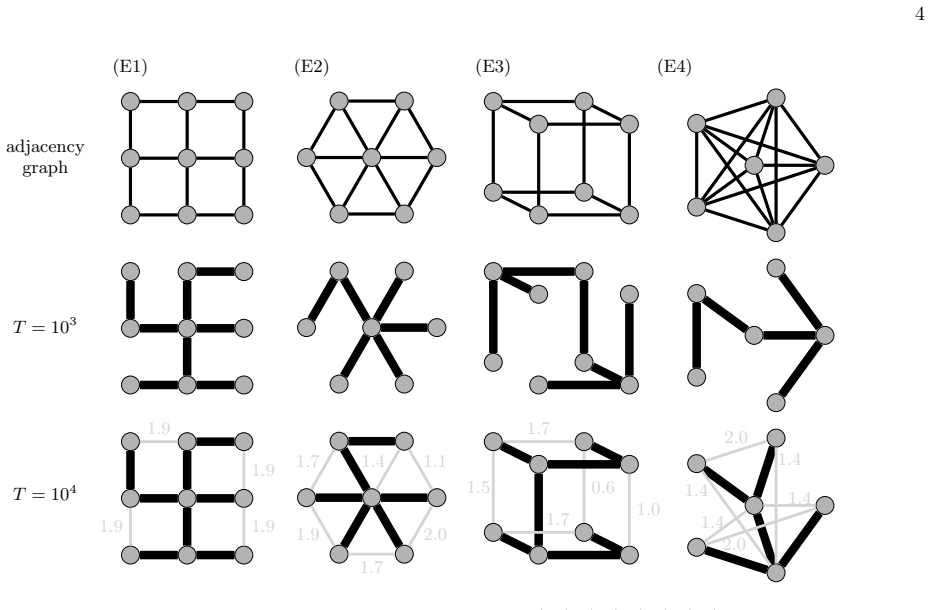
When the strong interactions form a spanning tree of the target structure, monomer depletion cannot occur because every partial assembly has a direct path to completion via strong bonds and no cycles exist that could trap material in incomplete fragments; assembly therefore proceeds downhill in energy space with no kinetic traps, and this property depends only on the topology of the interaction graph.
Load-bearing premise
The set of reaction equations is assumed to include every relevant intermediate and to capture the dominant assembly pathways.
Editorial extensions
If this is right
- Yield is maximized by making every bond either very strong or very weak.
- Strong bonds must contain no cycles; any loop allows competing nuclei that cause depletion.
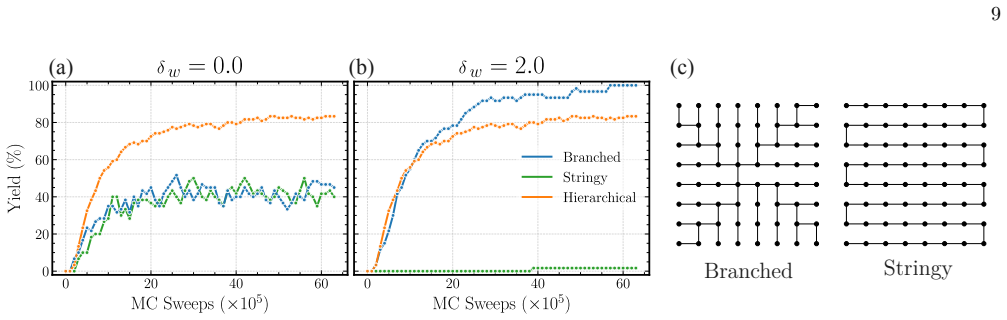
- Among spanning trees, more compact ones produce higher yields in numerical tests.
- The design rule is independent of the detailed kinetic model and therefore applies across different physical realizations.
Reading between the lines
- The same tree principle could be used to predict which multiprotein complexes assemble reliably without kinetic traps.
- If higher-order interactions or reversible steps omitted from the model become important, the tree guarantee would no longer hold in experiment.
- The result reduces the design problem to choosing a cycle-free subset of contacts, opening a direct link to graph-theoretic optimization methods.
Signed reviews
Editorial analysis
A structured set of objections, weighed in public.
Referee Report
Summary. The manuscript claims that in addressable self-assembly, monomer depletion can be avoided by designing interactions such that all bonds are either very strong or very weak and the strong bonds form a spanning tree of the target structure. Using reaction equations for all intermediate assembly steps combined with numerical optimization, the authors identify this configuration as optimal for yield in a given time. They then provide a combinatorial proof that spanning-tree interactions ensure assembly always proceeds downhill in energy space with no kinetic traps, independent of the specific kinetic model. This principle is validated in simulations of larger structures, with more compact spanning trees showing better yields, and suggested as a design rule for DNA nanotechnology and multiprotein complexes.
Significance. If the central result holds, the work supplies a robust, graph-theoretic design principle for high-yield addressable self-assembly that is independent of detailed kinetics. The combinatorial proof and its claimed model-independence constitute a genuine strength, as does the explicit validation that compact spanning trees outperform others. These elements could influence both practical engineering of DNA nanostructures and theoretical understanding of assembly pathways in biological complexes.
major comments (2)
- [Proof of the spanning-tree property (following the optimization results)] The proof that spanning-tree interactions prevent monomer depletion is presented as a combinatorial property of the interaction graph that holds independently of the kinetics model. However, the optimization that selects spanning trees is performed on a concrete reaction network enumerating all intermediate steps. If the proof steps rely on the allowed mergers, energy counting, or completeness of that specific network (e.g., absence of certain reversible or higher-order reactions), the independence assertion requires explicit demonstration; otherwise the result remains tied to the assumed reaction equations.
- [Section describing the reaction network and optimization procedure] The reaction equations are stated to describe all intermediate assembly steps, yet the manuscript does not provide an explicit argument that this enumeration is exhaustive for the target structures considered. Missing reversible steps or multi-particle interactions could alter both the optimization outcome and the validity of the downhill-assembly claim.
minor comments (1)
- [Methods / optimization setup] Notation for bond strengths (strong/weak threshold) and the precise definition of 'spanning tree' in the interaction graph should be stated once in a dedicated paragraph or equation for clarity.
Simulated Author's Rebuttal
We thank the referee for their careful reading of the manuscript and for raising these points about the separation between the optimization results and the combinatorial proof, as well as the completeness of the reaction network. We address each major comment below.
read point-by-point responses
-
Referee: [Proof of the spanning-tree property (following the optimization results)] The proof that spanning-tree interactions prevent monomer depletion is presented as a combinatorial property of the interaction graph that holds independently of the kinetics model. However, the optimization that selects spanning trees is performed on a concrete reaction network enumerating all intermediate steps. If the proof steps rely on the allowed mergers, energy counting, or completeness of that specific network (e.g., absence of certain reversible or higher-order reactions), the independence assertion requires explicit demonstration; otherwise the result remains tied to the assumed reaction equations.
Authors: The optimization is performed within a specific reaction network to discover that spanning-tree patterns maximize yield, but the proof itself is developed as a separate, purely combinatorial argument on the interaction graph. It establishes that a spanning tree of strong bonds guarantees, for any partial assembly of the distinct monomers, the existence of at least one attachable monomer that forms a strong bond and lowers the total energy, with no possibility of closed loops creating kinetic traps. This relies solely on the acyclic connectivity of the tree and the binary character of bonds; it makes no reference to the particular list of allowed mergers, the enumeration of intermediates, or any rate constants. Consequently the downhill-assembly property holds for any kinetic model in which assembly occurs through pairwise bond formation. We will revise the manuscript to state this separation more explicitly, clarifying that the model independence applies to the proof rather than to the preceding numerical optimization. revision: partial
-
Referee: [Section describing the reaction network and optimization procedure] The reaction equations are stated to describe all intermediate assembly steps, yet the manuscript does not provide an explicit argument that this enumeration is exhaustive for the target structures considered. Missing reversible steps or multi-particle interactions could alter both the optimization outcome and the validity of the downhill-assembly claim.
Authors: For the small, finite target structures used in the optimization (typically four to six distinct monomers), the reaction network enumerates every possible connected subassembly that can be formed by adding one monomer at a time via the allowed bonds; this enumeration is exhaustive by construction within the model of pairwise assembly. We agree that the manuscript would benefit from an explicit sentence justifying why this set is complete for the structures considered and why higher-order or additional reversible reactions fall outside the scope of the model (and do not affect the combinatorial proof). We will add such a clarifying statement in the revised version. revision: yes
Circularity Check
No significant circularity; derivation is self-contained
full rationale
The paper derives optimal interactions via numerical optimization over a concrete reaction network, then states a combinatorial proof that spanning-tree graphs prevent monomer depletion independently of kinetics. No quoted equations or steps reduce the claimed combinatorial result to a fitted parameter, self-definition, or self-citation chain; the independence assertion is presented without internal reduction to the optimization inputs. No self-citations, ansatzes, or renamings of known results are load-bearing in the provided text. This is the normal case of a self-contained argument against external benchmarks.
Assumptions & free parameters
free parameters (1)
- strong/weak bond threshold
assumptions (2)
- domain assumption All relevant assembly intermediates and their reaction rates can be captured by a closed set of reaction equations.
- ad hoc to paper Optimal interactions are achieved by setting every bond to one of two extreme strength values.
Cite this review
Pith. "Pith review of Optimal interactions for addressable self-assembly." pith.science (2026). https://pith.science/paper/TBIE74CM
@misc{pith2026260631838,
  author       = {Pith},
  title        = {Pith review of: Optimal interactions for addressable self-assembly},
  year         = {2026},
  howpublished = {\url{https://pith.science/paper/TBIE74CM}},
  note         = {Machine review of arXiv:2606.31838}
}
read the original abstract
Addressable self-assembly asks that each building block assemble into a particular location in a target structure. Although particles may all be distinct, achieving high yield is a challenge because of monomer depletion: more target structures can nucleate than there are building blocks for, so they form partial fragments which cannot complete growth. We ask how to design the interactions between building blocks to achieve the highest yield in a given time. Using reaction equations describing all the intermediate steps of assembly, combined with numerical optimization, we show that the optimal interactions are such that (i) all bonds are either very strong or very weak, and (ii) the strong bonds form a spanning tree of the target structure. We then prove that when interactions form a spanning tree, monomer depletion cannot occur: assembly can always proceed downhill in energy space, with no kinetic traps. This result is a combinatorial property of the underlying interaction graph, and does not depend on the particular model for the kinetics. It suggests a robust design principle: create a network of strong interactions that has no loops, and make all other interactions much weaker. We validate this principle in numerical simulations of larger structures, and we further show that spanning trees that are more compact have typically better yield. Our results suggest a new framework for understanding monomer depletion and addressable self-assembly, which may be applied to DNA nanotechnology and which may give insight into the assembly pathways of certain multiprotein complexes.
Figures


Figures from the paper (13 more)




Reference graph
Works this paper leans on
-
[1]
P. W. K. Rothemund and E. S. Andersen, The impor- tance of being modular, Nature485, 584 (2012)
work page 2012
-
[2]
P. W. K. Rothemund, Folding DNA to create nanoscale shapes and patterns, Nature440, 297 (2006)
work page 2006
-
[3]
S. Sacanna, D. J. Pine, and G.-R. Yi, Engineering shape: the novel geometries of colloidal self-assembly, Soft Mat- ter9, 8096 (2013)
work page 2013
-
[4]
Y. Wang, Y. Wang, D. R. Breed, V. N. Manoharan, L. Feng, A. D. Hollingsworth, M. Weck, and D. J. Pine, Colloids with valence and specific directional bonding, Nature491, 51 (2012)
work page 2012
-
[5]
W. B. Rogers and V. N. Manoharan, Programming col- loidal phase transitions with DNA strand displacement, Science347, 639 (2015)
work page 2015
-
[6]
W. B. Rogers, W. M. Shih, and V. N. Manoharan, Using DNA to program the self-assembly of colloidal nanopar- ticles and microparticles, Nature Reviews Materials1, 16008 (2016)
work page 2016
-
[7]
F. Hong, F. Zhang, Y. Liu, and H. Yan, DNA Origami: Scaffolds for Creating Higher Order Structures, Chemical Reviews117, 12584 (2017)
work page 2017
-
[8]
A. Murugan, Z. Zeravcic, M. P. Brenner, and S. Leibler, Multifarious assembly mixtures: Systems allowing re- trieval of diverse stored structures, Proceedings of the National Academy of Sciences112, 54 (2015)
work page 2015
Show all 54 references
-
[9]
De La Cruz, K
J. De La Cruz, K. Karbstein, and J. L. Woolford Jr, Functions of ribosomal proteins in assembly of eukaryotic ribosomes in vivo, Annual review of biochemistry84, 93 (2015)
2015
-
[10]
Klinge and J
S. Klinge and J. L. Woolford Jr, Ribosome assembly com- ing into focus, Nature reviews Molecular cell biology20, 116 (2019)
2019
-
[11]
K¨ uhner, V
S. K¨ uhner, V. van Noort, M. J. Betts, A. Leo-Macias, C. Batisse, M. Rode, T. Yamada, T. Maier, S. Bader, P. Beltran-Alvarez,et al., Proteome organization in a genome-reduced bacterium, Science326, 1235 (2009)
2009
-
[12]
Sartori and S
P. Sartori and S. Leibler, Lessons from equilibrium sta- tistical physics regarding the assembly of protein com- plexes, Proceedings of the National Academy of Sciences 117, 114 (2020)
2020
-
[13]
A. A. Green, J. Kim, D. Ma, P. A. Silver, J. J. Collins, and P. Yin, Complex cellular logic computation using ribocomputing devices, Nature548, 117 (2017)
2017
-
[14]
S. Woo, S. K. Saka, F. Xuan, and P. Yin, Molecular robotic agents that survey molecular landscapes for in- formation retrieval, Nature Communications15, 3293 (2024)
2024
-
[15]
H. Fu, W. Gao, Y. Tang, X. Liu, M. Wang, J. Zhang, T. Liu, and J. Zhang, Programmable next-generation supramolecular self-assembled materials as drug delivery systems, Bioactive Materials60, 539 (2026)
2026
-
[16]
B. R. Madhanagopal, T. Wang, and A. R. Chan- drasekaran, Light-responsive dna nanostructures, Nature Reviews Chemistry , 1 (2026)
2026
-
[17]
Y. C. Zeng, O. J. Young, Q. Xiong, L. Si, M. W. Ku, S. G. Bernier, H. Dembele, G. Isinelli, T. Gilboa, Z. N. Swank,et al., Dna origami vaccine (dorivac) nanoparti- cles improve both humoral and cellular immune responses to infectious diseases, bioRxiv , 2023 (2025)
2023
-
[18]
B. Wei, M. Dai, and P. Yin, Complex shapes self- assembled from single-stranded DNA tiles, Nature485, 623 (2012)
2012
-
[19]
Y. Ke, L. L. Ong, W. M. Shih, and P. Yin, Three-Dimensional Structures Self-Assembled from DNA Bricks, Science338, 1177 (2012)
2012
-
[20]
L. L. Ong, N. Hanikel, O. K. Yaghi, C. Grun, M. T. Strauss, P. Bron, J. Lai-Kee-Him, F. Schueder, B. Wang, P. Wang, J. Y. Kishi, C. Myhrvold, A. Zhu, R. Jung- mann, G. Bellot, Y. Ke, and P. Yin, Programmable self-assembly of three-dimensional nanostructures from 10,000 unique ...
2017
-
[21]
C. G. Evans, J. O’Brien, E. Winfree, and A. Murugan, Pattern recognition in the nucleation kinetics of non- equilibrium self-assembly, Nature625, 500 (2024)
2024
-
[22]
Chatterjee and W
S. Chatterjee and W. M. Jacobs, Multiobjective Op- timization for Targeted Self-Assembly among Compet- ing Polymorphs, Physical Review X15, 011075 (2025), 2401.11234
2025
-
[23]
Shakhnovich, Protein folding thermodynamics and dy- namics: where physics, chemistry, and biology meet, Chemical Reviews106, 1559 (2006)
E. Shakhnovich, Protein folding thermodynamics and dy- namics: where physics, chemistry, and biology meet, Chemical Reviews106, 1559 (2006)
2006
-
[24]
Reinhardt and D
A. Reinhardt and D. Frenkel, Numerical Evidence for Nu- cleated Self-Assembly of DNA Brick Structures, Physical Review Letters112, 238103 (2014), 1402.6228. 11
2014 arXiv
-
[25]
W. M. Jacobs, A. Reinhardt, and D. Frenkel, Rational design of self-assembly pathways for complex multicom- ponent structures, Proceedings of the National Academy of Sciences112, 6313 (2015), 1502.01351
2015 arXiv
-
[26]
Bupathy, D
A. Bupathy, D. Frenkel, and S. Sastry, Temperature pro- tocols to guide selective self-assembly of competing struc- tures, Proceedings of the National Academy of Sciences 119, e2119315119 (2022)
2022
-
[27]
Hormoz and M
S. Hormoz and M. P. Brenner, Design principles for self- assembly with short-range interactions, Proceedings of the National Academy of Sciences108, 5193 (2011)
2011
-
[28]
L. O. Hedges, R. V. Mannige, and S. Whitelam, Growth of equilibrium structures built from a large number of distinct component types, Soft matter10, 6404 (2014)
2014
-
[29]
Madge, D
J. Madge, D. Bourne, and M. A. Miller, Controlling Fragment Competition on Pathways to Addressable Self- Assembly, The Journal of Physical Chemistry B122, 9815 (2018), 1912.00961
2018
-
[30]
Murugan, J
A. Murugan, J. Zou, and M. P. Brenner, Undesired usage and the robust self-assembly of heterogeneous structures, Nature communications6, 6203 (2015)
2015
-
[31]
Holmes-Cerfon and M
M. Holmes-Cerfon and M. Wyart, Hierarchical self- assembly for high-yield addressable complexity at fixed conditions, arXiv preprint arXiv:2501.02611 (2025)
2025
-
[32]
Rackauckas and Q
C. Rackauckas and Q. Nie, Differentialequations.jl–a per- formant and feature-rich ecosystem for solving differen- tial equations in julia, Journal of Open Research Software 5, 15 (2017)
2017
-
[33]
Schoenholz and E
S. Schoenholz and E. D. Cubuk, Jax md: a framework for differentiable physics, Advances in Neural Information Processing Systems33, 11428 (2020)
2020
-
[34]
C. P. Goodrich, E. M. King, S. S. Schoenholz, E. D. Cubuk, and M. P. Brenner, Designing self-assembling kinetics with differentiable statistical physics models, Proceedings of the National Academy of Sciences118, e2024083118 (2021)
2021
-
[35]
M. C. Engel, J. A. Smith, and M. P. Brenner, Optimal control of nonequilibrium systems through automatic dif- ferentiation, Physical Review X13, 041032 (2023)
2023
-
[36]
E. M. King, C. X. Du, Q.-Z. Zhu, S. S. Schoenholz, and M. P. Brenner, Programming patchy particles for materials assembly design, Proceedings of the National Academy of Sciences121, e2311891121 (2024)
2024
-
[37]
Jhaveri, S
A. Jhaveri, S. Loggia, Y. Qian, and M. E. Johnson, Dis- covering optimal kinetic pathways for self-assembly using automatic differentiation, Proceedings of the National Academy of Sciences121, e2403384121 (2024)
2024
-
[38]
M. C. H¨ ubl and C. P. Goodrich, Simultaneous optimiza- tion of assembly time and yield in programmable self- assembly, The Journal of Chemical Physics164, 084904 (2026)
2026
-
[39]
E. J. Deeds, J. A. Bachman, and W. Fontana, Optimizing ring assembly reveals the strength of weak interactions, Proceedings of the National Academy of Sciences - PNAS 109, 2348 (2012)
2012
-
[40]
Wiener, Structural determination of paraffin boiling points, Journal of the American chemical society69, 17 (1947)
H. Wiener, Structural determination of paraffin boiling points, Journal of the American chemical society69, 17 (1947)
1947
-
[41]
A. A. Dobrynin, R. Entringer, and I. Gutman, Wiener in- dex of trees: Theory and applications, Acta applicandae mathematicae66, 211 (2001)
2001
-
[42]
Bonchev, O
D. Bonchev, O. Mekenyan, and H. Fritsche, An approach to the topological modelling of crystal growth, Journal of crystal growth49, 90 (1980)
1980
-
[43]
D. H. Rouvray, The modeling of chemical phenomena us- ing topological indices, Journal of computational chem- istry8, 470 (1987)
1987
-
[44]
K. Xu, M. Liu, I. Gutman, K. Ch. Das, and B. Furtula, A survey on graphs extremal with respect to distance- based topological indices, Communications in Mathemat- ical and in Computer Chemistry71, 461 (2014)
2014
-
[45]
L. Lu, Q. Huang, J. Hou, and X. Chen, A sharp lower bound on steiner wiener index for trees with given diam- eter, Discrete Mathematics341, 723 (2018)
2018
-
[46]
S. G. Wagner, Correlation of graph-theoretical indices, SIAM Journal on Discrete Mathematics21, 33 (2007)
2007
-
[47]
Whitelam and P
S. Whitelam and P. L. Geissler, Avoiding unphysical ki- netic traps in Monte Carlo simulations of strongly at- tractive particles, The Journal of Chemical Physics127, 154101 (2007)
2007
-
[48]
M. H. Huntley, A. Murugan, and M. P. Brenner, Infor- mation capacity of specific interactions, Proceedings of the National Academy of Sciences113, 5841 (2016)
2016
-
[49]
Mohar and T
B. Mohar and T. Pisanski, How to compute the wiener index of a graph, Journal of mathematical chemistry2, 267 (1988)
1988
-
[50]
B. Luo, Z. Wang, T. Curk, G. Watson, C. Liu, A. Kim, Z. Ou, E. Luijten, and Q. Chen, Unravelling crystal growth of nanoparticles, Nature nanotechnology18, 589 (2023). 12 Appendix A: Reaction equations for a 2x2 square Here is a list of all the reactions possible in the interme...
2023
-
[51]
First, determine a list of clusters from whichPcan form, by merging clusters together. This is similar to the initialization of the list of clusters, where given the initial clusterP, we iterate over the power set of its vertices, to find all of the vertex setsV, where the ind...
-
[52]
blockages
Second, find all the reactions thatPis involved in to make a bigger cluster. To do this, we find all of the clusters (connected subgraphs)H⊂GcontainingP, such that the induced subgraphKofH\Pis also a cluster. We then record the interactions forHbreaking apart to formPandK, as ...
-
[53]
Greedy Algorithm Optimizingρ(T) Consider a vertexu∈T, and suppose thatuis connected to the verticesv 1, . . . , vk. Iff(v) denotes the number of subtrees containingv, and suppose thatf(u)> f(w), then (hereT∪ (ℓ,v) denotes the resulting tree by adding a leaf to vertexvofT) ρ(T∪...
-
[54]
To see this letvbe the center vertex ofT
Star shaped trees are optimal If a graphGcontains a star shaped spanning treeTand a non-star shaped spanning treeT ′ thenGmust contain an off-pathway cluster (with respect toT ′) with a strong bond. To see this letvbe the center vertex ofT. Then, sinceT ′ is not a star, there ...
Reviewed July 1, 2026 · model on record in the stance chip above.
Discussion (0). Continue with ORCID to comment.