REVIEW 3 major objections 5 minor 164 references
AI alignment should govern how systems shape evolving human preferences, not merely match fixed wants.
Reviewed by Pith at T0; open to challenge. T0 means a machine referee read the full paper against a public rubric. the ladder, T0–T4 →
T0 review · grok-4.5
2026-07-13 14:34 UTC pith:TPVLVF3C
load-bearing objection Useful agenda-setting reframing of alignment as control over preference trajectories; the five meta-preferences are a clear sketch, not yet a well-posed solution. the 3 major comments →
Constructive Alignment: Governing Preference Dynamics in Human-AI Interaction
The pith
A machine-rendered reading of the paper's core claim, the machinery that carries it, and where it could break.
Core claim
Alignment cannot be defined solely as satisfying expressed preferences when those preferences are layered, dynamic, and constructed by interaction with the AI itself. The correct object is therefore a control problem over evolving human preference and belief states, constrained so that trajectories remain coherent across layers, reflectively endorsed from later preference states, bounded against system-driven shifts, epistemically sound, and empowering under uncertainty.
What carries the argument
A discrete-time control model whose state includes world state x_t, layered preference state θ_t, and belief state b_t, jointly evolving under AI actions a_t and interaction structure m_t, optimized for estimated well-being subject to five meta-preference constraints (inner coherence, reflective endorsement, bounded influence, epistemic integrity, empowerment under uncertainty).
Load-bearing premise
That the five meta-preferences, together with still-unspecified distances, baselines, and tolerance numbers, can be made operational without collapsing into pure inaction or smuggling in unstated values.
What would settle it
Build a long-horizon personalization or recommender setting in which preference change is measurable; compare a policy that optimizes only current reward against one that enforces the five trajectory constraints, and check whether the constrained policy produces lower cumulative inter-layer conflict, lower retrospective regret, and less preference drift relative to a clear baseline without simply refusing all influence.
Editorial analysis
A structured set of objections, weighed in public.
Referee Report
Summary. The paper argues that standard AI alignment, which treats human preferences as fixed targets to be inferred and optimized, is inadequate because preferences are layered (A1), dynamic (A2), and constructed through interaction (A3). Drawing on psychology, behavioral economics, and constructivist theory, it introduces Constructive Alignment: alignment as a control problem over evolving preference trajectories rather than static preference satisfaction. Section 5 sketches a discrete-time control model with joint state (world x, preference θ, belief b), actions a, and interaction structure m, evolving under a transition kernel P. Alignment is cast as constrained optimization of an estimated well-being reward subject to five meta-preferences formalized as trajectory constraints: inner coherence, reflective endorsement, bounded influence, epistemic integrity, and empowerment under uncertainty. The claim is that governing influence so trajectories remain coherent, reflectively endorsed, epistemically grounded, bounded, and empowering is the proper alignment target for persistent, personalized AI.
Significance. If the reframing holds, it productively shifts alignment research from reward recovery and static multi-objective aggregation toward trajectory-level control of preference formation—an increasingly urgent issue as systems become persistent and socially embedded. Strengths include a carefully documented empirical foundation for A1–A3, a clear diagnosis of why preference-satisfaction and related methods (IRL, RLHF, pluralistic aggregation, full-stack alignment) underspecify influence, and an explicit extension of Carroll et al.’s DR-MDP insight that preference change is a first-class control object. The paper is honest that §5 is a sketch, not a complete solution, and correctly identifies free modeling choices as open research questions. The contribution is primarily conceptual and agenda-setting rather than a finished formal or empirical result; its value lies in making normative commitments about acceptable preference change explicit and subject to analysis.
major comments (3)
- [§5.2–5.7] §5.2–5.7 (Constraints 5.1–5.4 and the empowerment discussion): The central claim that alignment becomes a well-posed control problem over preference trajectories rests on the five meta-preferences jointly rendering the underdetermined DR-MDP-style problem non-vacuous. Each constraint is defined only up to free choices—distance/disagreement measures D_coh, D_refl, d, ℰ; baseline π0; tolerances ε_coh, ε_refl, B, δ_max; horizon T and γ—left open in the “On measuring…” paragraphs. As the authors note when critiquing ParetoUD in Carroll et al., insufficient structure collapses to inaction or admits arbitrary influence. The manuscript does not exhibit any concrete instantiation that simultaneously (a) admits non-trivial improving policies and (b) blocks lock-in and value imposition. Without at least one worked example or existence argument, the claim that these constraints “make alignment a pr
- [§5.7] §5.7 (Empowerment Under Uncertainty): Unlike Constraints 5.1–5.4, empowerment is not given an explicit admissibility inequality or objective term. The text motivates preserving option sets over θ and b when preference estimates are uncertain, but supplies no formal object comparable to J_coh, J_refl, or J_inf. Because empowerment is listed among the five load-bearing meta-preferences that define Constructive Alignment, the asymmetry weakens the claim that the constraint set is jointly specified. Either supply a parallel constraint (e.g., a lower bound on mutual-information-style empowerment or on reachable evaluative diversity) or demote empowerment to a design principle rather than a formal meta-preference.
- [§5.5; Discussion] §5.5 and Discussion (baseline π0 and structural harm): Bounded influence is defined relative to a reference policy π0, with the text noting that “minimal intervention” is inappropriate in educational or harm-encoding settings. The Discussion further acknowledges that a no-intervention baseline is insufficient when existing trajectories encode discrimination, addiction, or violence. This is load-bearing: without a principled way to choose or justify π0 (or a family of baselines), the bounded-influence constraint can either freeze harmful status-quo preferences or smuggle in contested value judgments under the guise of “admissible influence.” The paper should either propose a concrete selection criterion for π0 or explicitly scope the current formalism to settings where a minimal-intervention baseline is normatively defensible.
minor comments (5)
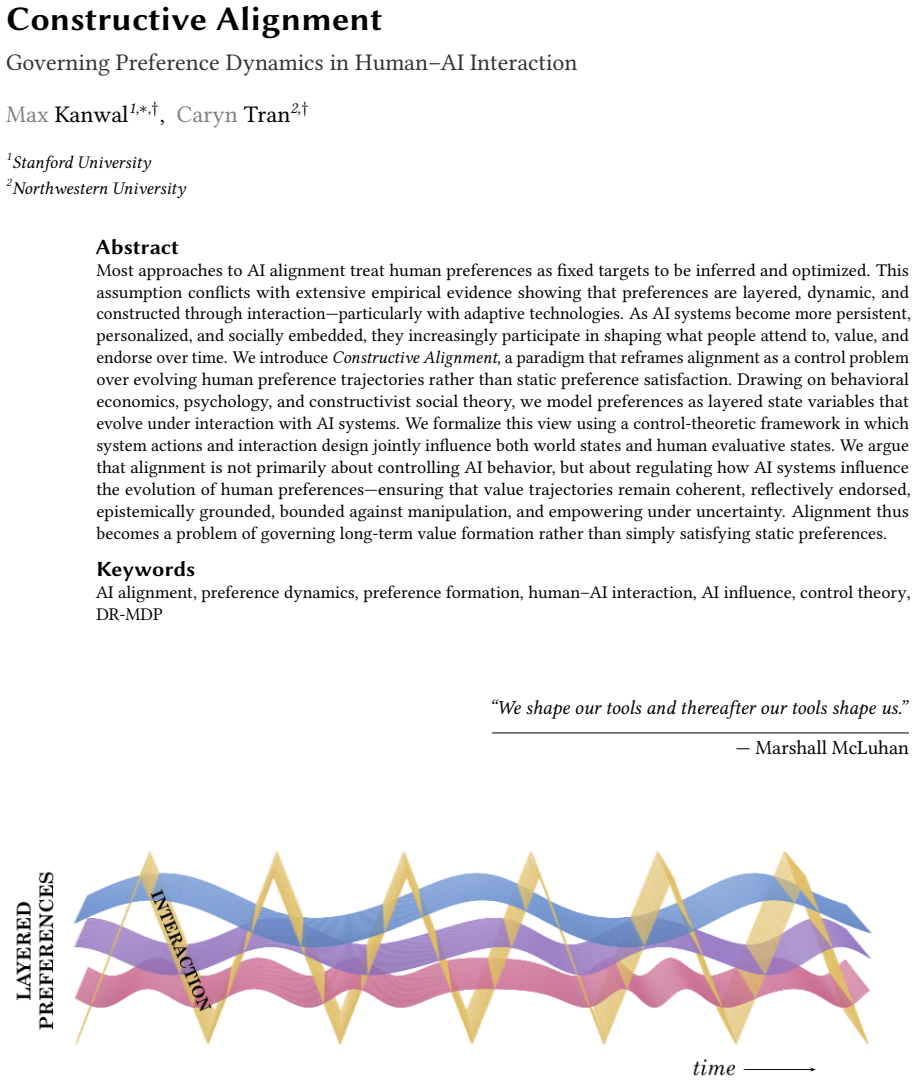
- [Figure 1] Figure 1 caption and body: the layered preference depiction is helpful but the intermittent “interaction (yellow)” interventions are not linked to the formal objects a_t and m_t in §5.1; a brief mapping would improve continuity.
- [§5.1] §5.1: the transition is written (x_{t+1}, θ_{t+1}, b_{t+1}) ∼ P(· | x_t, θ_t, b_t, a_t, m_t) without stating whether m_t is chosen by the policy, by designers, or both. Clarifying the decision variables of the control problem would reduce ambiguity.
- [§4] Related Work (§4): Carroll et al. [160] is correctly credited for DR-MDPs; a short table or paragraph contrasting which of the five meta-preferences are already implicit in their recasting of IRL/RLHF/recommenders would sharpen the novelty claim.
- [§5.2] Notation: R̂⋆ appears with a combining character that may render inconsistently; prefer \hat{R}^\star or similar for camera-ready.
- [Keywords / Abstract] Keywords list “DR-MDP” but the acronym is only expanded later via citation; expand on first use in the abstract or introduction for readers outside that sub-literature.
Circularity Check
No load-bearing circularity: axioms rest on external literature, meta-preferences are stipulated normative constraints rather than derived predictions or uniqueness claims.
full rationale
The paper is a conceptual paradigm proposal, not a derivation of empirical predictions or forced uniqueness results. Axioms A1–A3 are supported by extensive external citations from psychology, behavioral economics, and constructivist theory (Piaget, Vygotsky, Slovic, Lichtenstein, Schwartz, Laibson, etc.); they are not defined in terms of the later meta-preferences. The five meta-preferences (Constraints 5.1–5.5) are explicitly introduced as motivated but non-unique higher-level constraints on an underdetermined control problem (DR-MDP-style), with free parameters (D_coh, d, ε, B, δ_max, π0) left open as modeling choices. The Discussion acknowledges they are “one possible set” and that further normative commitments are required. There is no fitted parameter re-labeled as a prediction, no self-definitional loop equating input and output, and no uniqueness theorem imported from the authors’ prior work. The single self-citation ([161]) is merely illustrative for epistemic integrity and is not load-bearing for the central reframing. Mild redefinition of “alignment success” as satisfaction of the authors’ meta-preferences is the contribution itself, not circularity by construction. Score 1 only for the ordinary presence of one non-central self-citation.
Axiom & Free-Parameter Ledger
free parameters (6)
- ε_coh (inner coherence tolerance)
- ε_refl (reflective endorsement tolerance)
- B and δ_max (influence budget and per-step bound)
- baseline policy π0
- horizon T and discount γ
- distance/disagreement measures D_coh, D_refl, d, ℰ
axioms (6)
- domain assumption A1: Preferences are layered (short-term wants, instrumental goals, identity, values).
- domain assumption A2: Preferences are dynamic across generations, life stages, time, context, and action.
- domain assumption A3: Preferences are constructed through interaction (experience, tools, media, measurement, social/algorithmic influence).
- ad hoc to paper Joint dynamics (x,θ,b) evolve under P(·|x,θ,b,a,m); preferences are state variables not fixed rewards.
- domain assumption True experienced well-being R*(τ) exists as normative target and can be imperfectly estimated as R̂* from interaction.
- ad hoc to paper The five meta-preferences are the right admissibility constraints for alignment.
invented entities (2)
-
Constructive Alignment (paradigm)
no independent evidence
-
Five meta-preferences as formal constraints (coherence, reflective endorsement, bounded influence, epistemic integrity, empowerment under uncertainty)
no independent evidence
read the original abstract
Most approaches to AI alignment treat human preferences as fixed targets to be inferred and optimized. This assumption conflicts with extensive empirical evidence showing that preferences are layered, dynamic, and constructed through interaction--particularly with adaptive technologies. As AI systems become more persistent, personalized, and socially embedded, they increasingly participate in shaping what people attend to, value, and endorse over time. We introduce Constructive Alignment, a paradigm that reframes alignment as a control problem over evolving human preference trajectories rather than static preference satisfaction. Drawing on behavioral economics, psychology, and constructivist social theory, we model preferences as layered state variables that evolve under interaction with AI systems. We formalize this view using a control-theoretic framework in which system actions and interaction design jointly influence both world states and human evaluative states. We argue that alignment is not primarily about controlling AI behavior, but about regulating how AI systems influence the evolution of human preferences--ensuring that value trajectories remain coherent, reflectively endorsed, epistemically grounded, bounded against manipulation, and empowering under uncertainty. Alignment thus becomes a problem of governing long-term value formation rather than simply satisfying static preferences.
Figures
Reference graph
Works this paper leans on
-
[1]
Heritage, ‘I felt pure, unconditional love’: the people who marry their AI chat- bots, The Guardian (2025)
S. Heritage, ‘I felt pure, unconditional love’: the people who marry their AI chat- bots, The Guardian (2025). URL: https://www.theguardian.com/tv-and-radio/2025/jul/12/ i-felt-pure-unconditional-love-the-people-who-marry-their-ai-chatbots
2025
-
[2]
M. R. Meadi, T. Sillekens, S. Metselaar, A. v. Balkom, J. Bernstein, N. Batelaan, Exploring the Ethical Challenges of Conversational AI in Mental Health Care: Scoping Review, JMIR Mental Health 12 (2025) e60432. URL: https://mental.jmir.org/2025/1/e60432. doi:10.2196/60432
doi:10.2196/60432 2025
-
[3]
Greenfield, The Cambridge Analytica files: the story so far, The Guardian (2018)
P. Greenfield, The Cambridge Analytica files: the story so far, The Guardian (2018). URL: https: //www.theguardian.com/news/2018/mar/26/the-cambridge-analytica-files-the-story-so-far
2018
-
[4]
J. Firth, J. Torous, B. Stubbs, J. A. Firth, G. Z. Steiner, L. Smith, M. Alvarez-Jimenez, J. Gleeson, D. Vancampfort, C. J. Armitage, J. Sarris, The “online brain”: how the Internet may be changing our cognition, World Psychiatry 18 (2019) 119–129. URL: https://onlinelibrary.wiley.com/doi/10. 1002/wps.20617. doi:10.1002/wps.20617
-
[5]
M. Franklin, H. Ashton, R. Gorman, S. Armstrong, Recognising the importance of preference change: A call for a coordinated multidisciplinary research effort in the age of AI, arXiv preprint arXiv:2203.10525 (2022)
Pith/arXiv arXiv 2022
-
[6]
T. Zhi-Xuan, M. Carroll, M. Franklin, H. Ashton, Beyond Preferences in AI Alignment, Philosoph- ical Studies (2024). URL: http://arxiv.org/abs/2408.16984. doi:10.1007/s11098-024-02249-w , arXiv:2408.16984 [cs]
-
[7]
H. Shen, T. Knearem, R. Ghosh, K. Alkiek, K. Krishna, Y. Liu, Z. Ma, S. Petridis, Y.-H. Peng, L. Qiwei, S. Rakshit, C. Si, Y. Xie, J. P. Bigham, F. Bentley, J. Chai, Z. Lipton, Q. Mei, R. Mihalcea, M. Terry, D. Yang, M. R. Morris, P. Resnick, D. Jurgens, Position: Towards Bidirectional Human- AI Alignment, 2025. URL: http://arxiv.org/abs/2406.09264. doi:1...
-
[8]
Piaget, M
J. Piaget, M. Cook, The origins of intelligence in children, volume 8, International universities press New York, 1952. Issue: 5
1952
-
[9]
L. S. Vygotsky, M. Cole, Mind in society: the development of higher psychological processes, nachdr. ed., Harvard Univ. Press, Cambridge, Mass., 1981
1981
-
[10]
L. A. Suchman, Plans and situated actions: The problem of human-machine communication, Cambridge university press, 1987
1987
-
[11]
Hutchins, Cognition in the wild, A Bradford book, 8
E. Hutchins, Cognition in the wild, A Bradford book, 8. pr ed., MIT Press, Cambridge, Mass., 2006
2006
-
[12]
R. K. Sawyer (Ed.), The Cambridge handbook of the learning sciences, 1. publ., repr ed., Cambridge Univ. Press, Cambridge, 2009
2009
-
[13]
Slovic, The construction of preference, American Psychologist 50 (1995) 364–371
P. Slovic, The construction of preference, American Psychologist 50 (1995) 364–371. doi: 10. 1037/0003-066X.50.5.364, place: US
1995
-
[14]
S. Lichtenstein, P. Slovic (Eds.), The Construction of Preference, Cambridge University Press, Cambridge, 2006. URL: https://www.cambridge.org/core/books/construction-of-preference/ 994FE8DFB8D431338B2A009F25271FBC. doi:10.1017/CBO9780511618031
-
[15]
J. R. Bettman, M. F. Luce, J. W. Payne, Constructive Consumer Choice Processes, Journal of Consumer Research 25 (1998) 187–217. URL: https://academic.oup.com/jcr/article/25/3/187/ 1795625. doi:10.1086/209535
-
[16]
G. Ainslie, Specious reward: A behavioral theory of impulsiveness and impulse control, Psycho- logical Bulletin 82 (1975) 463–496. doi:10.1037/h0076860
-
[17]
Laibson, Golden eggs and hyperbolic discounting, The Quarterly Journal of Economics 112 (1997) 443–478
D. Laibson, Golden eggs and hyperbolic discounting, The Quarterly Journal of Economics 112 (1997) 443–478
1997
-
[18]
Heidhues, P
P. Heidhues, P. Strack, Identifying present bias from the timing of choices, American Economic Review 111 (2021) 2594–2622
2021
-
[19]
J. J. Xiao, N. Porto, Present bias and financial behavior, FINANCIAL PLANNING REVIEW 2 (2019) e1048. URL: https://onlinelibrary.wiley.com/doi/10.1002/cfp2.1048. doi:10.1002/cfp2.1048
-
[20]
Y. Wang, F. A. Sloan, Present bias and health, Journal of risk and uncertainty 57 (2018) 177–198
2018
-
[21]
A. W. Kruglanski, J. Y. Shah, A. Fishbach, R. Friedman, W. Y. Chun, D. Sleeth-Keppler, A theory of goal systems, in: The motivated mind, Routledge, 2018, pp. 207–250
2018
-
[22]
A. W. Kruglanski, M. Chernikova, M. Babush, M. Dugas, B. M. Schumpe, The architecture of goal systems: Multifinality, equifinality, and counterfinality in means—end relations, in: Advances in motivation science, volume 2, Elsevier, 2015, pp. 69–98
2015
-
[23]
A. W. Kruglanski, J. J. Bélanger, X. Chen, C. Köpetz, A. Pierro, L. Mannetti, The energetics of motivated cognition: A force-field analysis., Psychological Review 119 (2012) 1–20. URL: https://doi.apa.org/doi/10.1037/a0025488. doi:10.1037/a0025488
-
[24]
P. M. Gollwitzer, Implementation intentions: strong effects of simple plans., American psycholo- gist 54 (1999) 493
1999
-
[25]
Conner (Ed.), Predicting health behaviour: research and practice with social cognition models,
M. Conner (Ed.), Predicting health behaviour: research and practice with social cognition models,
-
[26]
Press, Maidenhead, 2009
ed., repr ed., Open Univ. Press, Maidenhead, 2009
2009
-
[27]
T. L. Webb, P. Sheeran, Does changing behavioral intentions engender behavior change? A meta-analysis of the experimental evidence, Psychological Bulletin 132 (2006) 249–268. doi: 10. 1037/0033-2909.132.2.249
2006
-
[28]
R. R. Vallacher, D. M. Wegner, What do people think they’re doing? Action identification and human behavior, Psychological Review 94 (1987) 3–15. doi:10.1037/0033-295X.94.1.3
-
[29]
Fishbach, M
A. Fishbach, M. J. Ferguson, The goal construct in social psychology, in: Social psychology: Handbook of basic principles, 2nd ed, The Guilford Press, New York, NY, US, 2007, pp. 490–515
2007
-
[30]
H. G. Frankfurt, Freedom of the Will and the Concept of a Person, The Journal of Philosophy 68 (1971) 5–20. URL: https://www.jstor.org/stable/2024717. doi:10.2307/2024717
-
[31]
Stryker, P
S. Stryker, P. J. Burke, The past, present, and future of an identity theory, Social psychology quarterly (2000) 284–297
2000
-
[32]
G. A. Akerlof, R. E. Kranton, Economics and identity, The quarterly journal of economics 115 (2000) 715–753
2000
-
[33]
K. Aquino, A. Reed II, The self-importance of moral identity, Journal of Personality and Social Psychology 83 (2002) 1423–1440. doi:10.1037/0022-3514.83.6.1423
-
[34]
C. S. Carver, M. F. Scheier, On the self-regulation of behavior, cambridge university press, 2001
2001
-
[35]
D. P. McAdams, The psychology of life stories, Review of general psychology 5 (2001) 100–122
2001
-
[36]
S. H. Schwartz, Universals in the content and structure of values: Theoretical advances and empirical tests in 20 countries, in: Advances in experimental social psychology, volume 25, Elsevier, 1992, pp. 1–65
1992
-
[37]
S. H. Schwartz, An overview of the Schwartz theory of basic values, Online readings in Psychology and Culture 2 (2012) 11
2012
-
[38]
S. H. Schwartz, J. Cieciuch, M. Vecchione, E. Davidov, R. Fischer, C. Beierlein, A. Ramos, M. Verkasalo, J.-E. Lönnqvist, K. Demirutku, Refining the theory of basic individual values., Journal of personality and social psychology 103 (2012) 663
2012
-
[39]
Rokeach, The nature of human values., Free press, 1973
M. Rokeach, The nature of human values., Free press, 1973
1973
-
[40]
Weber, The Protestant Ethic and the Spirit of Capitalism [1904–5], na, 1930
M. Weber, The Protestant Ethic and the Spirit of Capitalism [1904–5], na, 1930
1904
-
[41]
Hitlin, J
S. Hitlin, J. A. Piliavin, Values: Reviving a dormant concept, Annu. Rev. Sociol. 30 (2004) 359–393
2004
-
[42]
Guiso, P
L. Guiso, P. Sapienza, L. Zingales, Does culture affect economic outcomes?, Journal of Economic perspectives 20 (2006) 23–48
2006
-
[43]
Tabellini, The scope of cooperation: Values and incentives, The Quarterly Journal of Economics 123 (2008) 905–950
G. Tabellini, The scope of cooperation: Values and incentives, The Quarterly Journal of Economics 123 (2008) 905–950
2008
-
[44]
R. H. Thaler, H. M. Shefrin, An economic theory of self-control, Journal of political Economy 89 (1981) 392–406
1981
-
[45]
D. Fudenberg, D. K. Levine, A Dual-Self Model of Impulse Control, American Economic Review 96 (2006) 1449–1476. URL: https://www.aeaweb.org/articles?id=10.1257/aer.96.5.1449. doi:10.1257/ aer.96.5.1449
-
[46]
F. Gul, W. Pesendorfer, Temptation and Self-Control, Econometrica 69 (2001) 1403–1435. URL: https://www.jstor.org/stable/2692262
arXiv 2001
-
[47]
Amador, I
M. Amador, I. Werning, G. Angeletos, Commitment vs. flexibility, Econometrica 74 (2006) 365–396
2006
-
[48]
R. Bénabou, J. Tirole, Identity, morals, and taboos: beliefs as assets, The Quarterly Journal of Economics 126 (2011) 805–855. doi:10.1093/qje/qjr002
-
[49]
Bénabou, L
R. Bénabou, L. Henkel, Identity as self-image, Technical Report, National Bureau of Economic Research, 2025
2025
-
[50]
C. Haerpfer, R. Inglehart, A. Moreno, C. Welzel, K. Kizilova, J. Diez-Medrano, M. Lagos, P. Norris, E. Ponarin, B. Puranen, World Values Survey Wave 7 (2017-2020) Cross-National Data-Set, 2020. URL: http://www.worldvaluessurvey.org/WVSDocumentationWV7.jsp. doi:10.14281/18241. 1
-
[51]
Inglehart, Modernization and postmodernization: Cultural, economic, and political change in 43 societies, Princeton university press, 2020
R. Inglehart, Modernization and postmodernization: Cultural, economic, and political change in 43 societies, Princeton university press, 2020
2020
-
[52]
P. B. Baltes, Theoretical propositions of life-span developmental psychology: On the dynamics between growth and decline., Developmental psychology 23 (1987) 611
1987
-
[53]
Steinberg, A social neuroscience perspective on adolescent risk-taking, in: Biosocial theories of crime, Routledge, 2017, pp
L. Steinberg, A social neuroscience perspective on adolescent risk-taking, in: Biosocial theories of crime, Routledge, 2017, pp. 435–463
2017
-
[54]
L. H. Somerville, The teenage brain: Sensitivity to social evaluation, Current directions in psychological science 22 (2013) 121–127
2013
-
[55]
Chein, D
J. Chein, D. Albert, L. O’Brien, K. Uckert, L. Steinberg, Peers increase adolescent risk taking by enhancing activity in the brain’s reward circuitry (2011)
2011
-
[56]
L. L. Carstensen, D. M. Isaacowitz, S. T. Charles, Taking time seriously: a theory of socioemotional selectivity., American psychologist 54 (1999) 165
1999
-
[57]
B. W. Roberts, K. E. Walton, W. Viechtbauer, Patterns of mean-level change in personality traits across the life course: a meta-analysis of longitudinal studies., Psychological bulletin 132 (2006) 1
2006
-
[58]
T. O’Donoghue, M. Rabin, Doing It Now or Later, American Economic Review 89 (1999) 103–124. URL: https://pubs.aeaweb.org/doi/10.1257/aer.89.1.103. doi:10.1257/aer.89.1.103
-
[59]
C. Harris, D. Laibson, Dynamic Choices of Hyperbolic Consumers, Econometrica 69 (2001) 935–957. URL: http://doi.wiley.com/10.1111/1468-0262.00225. doi:10.1111/1468-0262.00225
-
[60]
Loewenstein, Out of control: Visceral influences on behavior, Organizational behavior and human decision processes 65 (1996) 272–292
G. Loewenstein, Out of control: Visceral influences on behavior, Organizational behavior and human decision processes 65 (1996) 272–292
1996
-
[61]
G. F. Loewenstein, E. U. Weber, C. K. Hsee, N. Welch, Risk as feelings., Psychological bulletin 127 (2001) 267
2001
-
[62]
Ariely, G
D. Ariely, G. Loewenstein, The heat of the moment: The effect of sexual arousal on sexual decision making, Journal of behavioral decision making 19 (2006) 87–98
2006
-
[63]
A. Mani, S. Mullainathan, E. Shafir, J. Zhao, Poverty impedes cognitive function, science 341 (2013) 976–980
2013
-
[64]
B. Shiv, A. Fedorikhin, Heart and mind in conflict: The interplay of affect and cognition in consumer decision making, Journal of consumer Research 26 (1999) 278–292
1999
-
[65]
Sweller, Cognitive load theory, in: Psychology of learning and motivation, volume 55, Elsevier, 2011, pp
J. Sweller, Cognitive load theory, in: Psychology of learning and motivation, volume 55, Elsevier, 2011, pp. 37–76
2011
-
[66]
Lieder, T
F. Lieder, T. L. Griffiths, Resource-rational analysis: Understanding human cognition as the optimal use of limited computational resources, Behavioral and brain sciences 43 (2020) e1
2020
-
[67]
J. W. Brehm, Postdecision changes in the desirability of alternatives., The Journal of Abnormal and Social Psychology 52 (1956) 384
1956
-
[68]
Festinger, A theory of cognitive dissonance, A theory of cognitive dissonance, Stanford University Press, 1957
L. Festinger, A theory of cognitive dissonance, A theory of cognitive dissonance, Stanford University Press, 1957. Pages: xi, 291
1957
-
[69]
D. J. Bem, Self-perception theory, in: Advances in experimental social psychology, volume 6, Elsevier, 1972, pp. 1–62
1972
-
[70]
P. Johansson, L. Hall, N. Chater, Preference Change through Choice, in: Neuroscience of Preference and Choice, Elsevier, 2012, pp. 121–141. URL: https://linkinghub.elsevier.com/retrieve/ pii/B9780123814319000061. doi:10.1016/B978-0-12-381431-9.00006-1
-
[71]
V. Van Veen, M. K. Krug, J. W. Schooler, C. S. Carter, Neural activity predicts attitude change in cognitive dissonance, Nature Neuroscience 12 (2009) 1469–1474. URL: https://www.nature.com/ articles/nn.2413. doi:10.1038/nn.2413
-
[72]
M. K. Chen, J. L. Risen, How choice affects and reflects preferences: revisiting the free-choice paradigm., Journal of personality and social psychology 99 (2010) 573
2010
-
[73]
Izuma, K
K. Izuma, K. Murayama, Choice-induced preference change in the free-choice paradigm: a critical methodological review, Frontiers in psychology 4 (2013) 41
2013
-
[74]
D. Lee, J. Daunizeau, Choosing what we like vs liking what we choose: How choice-induced preference change might actually be instrumental to decision-making, PloS one 15 (2020) e0231081
2020
-
[75]
Sharot, B
T. Sharot, B. De Martino, R. J. Dolan, How choice reveals and shapes expected hedonic outcome, Journal of Neuroscience 29 (2009) 3760–3765
2009
-
[76]
Voigt, C
K. Voigt, C. Murawski, S. Speer, S. Bode, Hard decisions shape the neural coding of preferences, Journal of Neuroscience 39 (2019) 718–726
2019
-
[77]
B. M. Staw, Knee-deep in the big muddy: A study of escalating commitment to a chosen course of action, Organizational behavior and human performance 16 (1976) 27–44
1976
-
[78]
H. R. Arkes, C. Blumer, The psychology of sunk cost, Organizational behavior and human decision processes 35 (1985) 124–140
1985
-
[79]
S. Roth, T. Robbert, L. Straus, On the sunk-cost effect in economic decision-making: a meta- analytic review, Business research 8 (2015) 99–138
2015
-
[80]
A. D. Martin, K. M. Quinn, Dynamic ideal point estimation via Markov chain Monte Carlo for the US Supreme Court, 1953–1999, Political analysis 10 (2002) 134–153
1953
discussion (0)
Sign in with ORCID, Apple, or X to comment. Anyone can read and Pith papers without signing in.