REVIEW 2 major objections 1 minor 69 references
Dissipation creates an intermediate phase that splits the one-dimensional Mott transition into two distinct critical points.
Reviewed by Pith at T0; open to challenge. T0 means a machine referee read the full paper against a public rubric. the ladder, T0–T4 →
T0 review · grok-4.3
2026-07-02 17:33 UTC pith:OYUQHMKB
load-bearing objection The paper claims dissipation splits the 1D Mott transition via a new intermediate gapless compressible phase with zero stiffness, but the control of the bosonized theory for s<3/2 is the untested core. the 2 major comments →
Dissipation splits the Mott transition in one dimension
The pith
A machine-rendered reading of the paper's core claim, the machinery that carries it, and where it could break.
Core claim
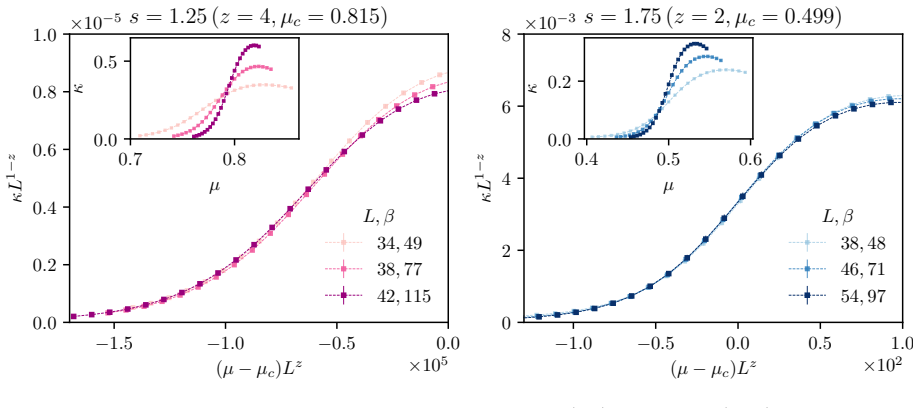
Rather than undergoing a direct LL-MI transition, the system develops an intermediate dissipative phase (DP) that is compressible and gapless, yet has zero superfluid stiffness. As a result, the conventional Mott transition splits into two distinct critical phenomena: a Berezinskii-Kosterlitz-Thouless transition from the LL to the DP, followed by a new commensurate-incommensurate transition from the DP to the MI. For 1 < s < 3/2 the critical exponents vary continuously with the bath exponent as β = ν = 1/z = s-1, while for s < 1 the transition is governed by β = ν = 1/z = 0 and the doping vanishes sharper than any power law.
What carries the argument
Bosonisation combined with exact integration of the bath degrees of freedom, which produces an effective long-range interaction that stabilizes the intermediate dissipative phase and splits the transition.
Load-bearing premise
Bosonisation together with exact bath integration remains valid and captures the low-energy physics when the bath exponent satisfies s less than 3/2 and the coupling is strictly local in density.
What would settle it
Quantum Monte Carlo simulations that either find no intermediate compressible gapless phase with zero stiffness or measure critical exponents different from the predicted s-dependent values at the DP-MI transition.
If this is right
- For bath exponents s below 3/2 the Mott transition splits into a Berezinskii-Kosterlitz-Thouless transition followed by a new commensurate-incommensurate transition.
- The dissipative phase is compressible and gapless but has vanishing superfluid stiffness.
- Critical exponents of the dissipative-phase to Mott-insulator transition vary continuously with s when 1 < s < 3/2.
- For s below 1 the doping vanishes faster than any power law across the second transition.
Where Pith is reading between the lines
- Similar splitting may occur in other open quantum systems where dissipation couples locally to a conserved density.
- Cold-atom experiments with tunable engineered baths could directly observe the two separate critical points and the intermediate phase.
- The new commensurate-incommensurate universality class might appear in related models with long-range interactions generated by baths.
Editorial analysis
A structured set of objections, weighed in public.
Referee Report
Summary. The manuscript claims that local dissipative baths coupled to density in one dimension split the conventional Luttinger-liquid to Mott-insulator transition for bath exponents s < 3/2. Bosonization plus exact bath integration yields an intermediate dissipative phase (DP) that remains compressible and gapless but possesses zero superfluid stiffness; the transition therefore decomposes into a Berezinskii-Kosterlitz-Thouless line from LL to DP followed by a new commensurate-incommensurate transition from DP to MI. The paper derives the universality class of the latter transition, obtaining continuously varying exponents β = ν = 1/z = s − 1 for 1 < s < 3/2 and β = ν = 1/z = 0 for s < 1, and reports quantitative agreement with state-of-the-art Monte Carlo simulations.
Significance. If the central claims are correct, the work demonstrates that dissipation can qualitatively restructure a paradigmatic quantum phase transition, producing an intermediate phase with unusual transport properties and a new universality class whose exponents vary continuously with the bath spectrum. The exact integration of the bath degrees of freedom and the reported quantitative Monte Carlo support constitute concrete strengths that would make the result a notable addition to the literature on open quantum systems.
major comments (2)
- [Abstract / derivation of effective action] Abstract and the bosonization-plus-bath-integration derivation: the existence of the intermediate DP as a stable, compressible, gapless phase with vanishing stiffness rests on the assumption that the dissipative kernel |ω|^s |∂φ(ω)|^2 only renormalizes Luttinger parameters for s < 3/2 without generating relevant operators that would either open a gap or restore finite stiffness. No explicit renormalization-group stability analysis or operator-content check of the resulting quadratic theory is supplied; this is load-bearing for the claimed splitting of the Mott transition.
- [Monte Carlo simulations] Monte Carlo section: the quantitative support for the predicted exponents and phase boundaries is presented as independent validation, yet the manuscript does not report the precise fitting procedures, data-exclusion criteria, or finite-size scaling ansatz used to extract β, ν, and z from the simulations. Without these details the claimed agreement cannot be assessed at the level required to confirm the new commensurate-incommensurate universality.
minor comments (1)
- The notation for the dissipative kernel and the definition of the bath exponent s could be stated more explicitly in the main text to aid readers who are not already familiar with Caldeira-Leggett-type baths.
Simulated Author's Rebuttal
We thank the referee for the careful reading and constructive comments. We address each major point below and will revise the manuscript to incorporate the requested clarifications.
read point-by-point responses
-
Referee: [Abstract / derivation of effective action] Abstract and the bosonization-plus-bath-integration derivation: the existence of the intermediate DP as a stable, compressible, gapless phase with vanishing stiffness rests on the assumption that the dissipative kernel |ω|^s |∂φ(ω)|^2 only renormalizes Luttinger parameters for s < 3/2 without generating relevant operators that would either open a gap or restore finite stiffness. No explicit renormalization-group stability analysis or operator-content check of the resulting quadratic theory is supplied; this is load-bearing for the claimed splitting of the Mott transition.
Authors: The effective action after exact bath integration is quadratic (Luttinger liquid terms plus the |ω|^s dissipative kernel). Within bosonization the only additional operator is the standard umklapp cosine, whose relevance is controlled by the renormalized K. Dissipation drives the system into a regime where this operator is irrelevant while the |ω|^s term enforces vanishing stiffness, yielding a compressible gapless phase. We acknowledge, however, that an explicit RG stability analysis of the quadratic fixed point was not supplied. We will add a concise RG section (or appendix) deriving the flow equations for K and the dissipative coefficient and confirming the absence of relevant operators for s < 3/2. This will be included in the revised manuscript. revision: yes
-
Referee: [Monte Carlo simulations] Monte Carlo section: the quantitative support for the predicted exponents and phase boundaries is presented as independent validation, yet the manuscript does not report the precise fitting procedures, data-exclusion criteria, or finite-size scaling ansatz used to extract β, ν, and z from the simulations. Without these details the claimed agreement cannot be assessed at the level required to confirm the new commensurate-incommensurate universality.
Authors: We agree that the numerical details must be reported for reproducibility. In the revised version we will expand the Monte Carlo section with: (i) the explicit finite-size scaling ansätze used for stiffness, compressibility and order parameter, (ii) the precise data-exclusion criteria (e.g., discarding points within a stated distance of the estimated critical point), and (iii) the fitting protocol, including system-size ranges and the data-collapse or direct-fit procedures employed to extract β, ν and z. These additions will allow independent verification of the reported quantitative agreement. revision: yes
Circularity Check
No significant circularity; derivation relies on standard bosonization and bath integration
full rationale
The paper's central derivation proceeds from bosonization of the 1D bosons plus exact integration of the local dissipative bath, yielding an effective quadratic action with a |ω|^s kernel. This leads to the claimed intermediate dissipative phase and split transitions without any parameter fitting, self-definition of observables, or load-bearing self-citations. Monte Carlo results are presented as an external numerical check rather than as input to the analytic claims. No step reduces the output to the input by construction.
Axiom & Free-Parameter Ledger
free parameters (1)
- bath exponent s
axioms (1)
- domain assumption Bosonisation plus exact integration of bath degrees of freedom accurately describes the low-energy effective theory for local density coupling.
read the original abstract
Understanding how dissipation modifies quantum phase transitions is a central challenge in many-body physics. A paradigmatic example is the one-dimensional Mott transition, which in isolated systems separates a conducting Luttinger liquid (LL) from a Mott insulator (MI). Here, we study the fate of this transition in the presence of dissipative baths locally coupled to the density. Using bosonisation and an exact integration of the bath degrees of freedom, we show that dissipation fundamentally reshapes the phase diagram for bath exponents $s<3/2$, where $s$ characterises the low-energy bath spectrum. Rather than undergoing a direct LL-MI transition, the system develops an intermediate dissipative phase (DP) that is compressible and gapless, yet has zero superfluid stiffness. As a result, the conventional Mott transition splits into two distinct critical phenomena: a Berezinskii-Kosterlitz-Thouless transition from the LL to the DP, followed by a new commensurate-incommensurate transition from the DP to the MI. We derive an effective field theory for the latter transition and characterize its universality. For $1<s<3/2$, the critical exponents vary continuously with the bath exponent as $\beta=\nu=1/z=s-1$, while for $s<1$ the transition is governed by $\beta=\nu=1/z=0$ and the doping vanishes sharper than any power law. State-of-the-art Monte Carlo simulations quantitatively support our predictions. These results demonstrate that dissipation can qualitatively alter the nature of the Mott transition and generate novel critical behaviour in strongly correlated one-dimensional systems.
Figures




Reference graph
Works this paper leans on
-
[1]
The fact they are oscillating functions is a non- universal feature due to the sharp real-space cutoff aused in the RG procedure. To make sense of these RG equations, we first no- tice that the dimensionless doping ˜δρ(l) =δρ ae l remains zero ifδρ= 0, and diverges to±∞for largelotherwise. This distinguishes the commensu- rate transition atδρ= 0, from the...
work page 2030
-
[2]
⟨Sg⟩+⟨S α⟩ − ⟨S2 g ⟩ 2 − ⟨SgSα⟩ # (a′)−
Perturbative OPE RG To perform our perturbative renormalisation group computation, we use the language of the op- erator product expansion as in [38]. We will track the one-loop corrections, which means going to or- derO(g 2, α) for the RG equations ofK,u,gand O(αg) for that ofα. To do so, we expand the parti- tion function up to orderO(α, g 2, αg) such t...
-
[3]
The time and space lattice spacings play the role of the cutoffsaandτ c =a/u
Current-fluctuation representation The model is put on a 2D lattice of sizeL×β∈N 2. The time and space lattice spacings play the role of the cutoffsaandτ c =a/u. We work in dimensionless units where both spacings are set to 1 andu= 1. The fieldϕ(x, τ) is replaced byϕ i withi∈J1, LK×J1, βK the site index. Discretising Eq. (9) yields S(ϕ) = X i ( 1 2πK h (ϕ...
-
[4]
Algorithm The previous current-fluctuation representation separates loop degrees of freedom ⃗Jfrom residual fluctuationsfwhich are respectively sampled with worm updates and ECMC updates. The worm moves require extending the configura- tion space by allowing for one open path, the worm, ranging from its tail atp t to its head atp h. More formally, we call...
-
[5]
The fieldX(τ) thus becomesX i withi= 1,
Algorithm The field theory is put on a lattice with unit spac- ing and total lengthβ∈N. The fieldX(τ) thus becomesX i withi= 1, . . . , βand the discretised action is S(X) = βX i=1 1 2(Xi −X i+1)2 + α 2 βX i,j=1(i̸=j) |Xi −X j|D(i−j),(E1) where the kernelD(j) has been introduced in the previous appendix. We use the event-chain Monte Carlo (ECMC) al- gorit...
-
[6]
•Pick a distancekaccording to the proba- bility distributionp(k) = ¯λk LR/¯λLR
While True: •Drawν= ran(0,1) and sett LR →t LR − logν/ ¯λLR. •Pick a distancekaccording to the proba- bility distributionp(k) = ¯λk LR/¯λLR. This can be done inO(1) operations using Walker’s method of alias [60, 61]. •Break out of the “While” loop with prob- abilityλ i,i+k LR (Xj+tLRδi,j)/¯λk LR = Θ(Xi+ tLR −X i+k), i.e. ifX i +t LR > X i+k
-
[7]
More details about this procedure can be found in Refs
The smallest long-range event time ist LR and the triggering site isj LR =i+k. More details about this procedure can be found in Refs. [22, 30]. With this continuous-time algorithm, computing the average of an observableO(X) is done by select- ing a sampling timeT sample and using ⟨O(X)⟩= lim nsample→∞ nsampleX n=1 O(X(t=nT sample)) nsample . (E10) Consid...
-
[8]
Performance test Monte Carlo algorithms are efficient if, starting from a typical configurationX, they are able to quickly produce a new configurationX ′ which is un- correlated withX. On a more quantitative level, we consider the observableO(X) =|X(ω 1 = 2π/β)| 2 which we expect to decorrelate very slowly as it cap- tures the large-scale physics. To defi...
-
[9]
N. D. Mermin and H. Wagner, Absence of Ferro- magnetism or Antiferromagnetism in One- or Two- Dimensional Isotropic Heisenberg Models, Phys. Rev. Lett.17, 1133 (1966)
work page 1966
-
[10]
A. Caldeira and A. Leggett, Quantum tunnelling in a dissipative system, Annals of Physics149, 374 (1983)
work page 1983
-
[11]
A. J. Leggett, S. Chakravarty, A. T. Dorsey, M. P. A. Fisher, A. Garg, and W. Zwerger, Dynamics of the dissipative two-state system, Rev. Mod. Phys.59, 1 (1987)
work page 1987
-
[12]
Schmid, Diffusion and localization in a dissipa- tive quantum system, Phys
A. Schmid, Diffusion and localization in a dissipa- tive quantum system, Phys. Rev. Lett.51, 1506 (1983)
work page 1983
-
[13]
G. Sch¨ on and A. Zaikin, Quantum coherent effects, phase transitions, and the dissipative dynamics of ultra small tunnel junctions, Physics Reports198, 237 (1990)
work page 1990
-
[14]
M. P. A. Fisher and W. Zwerger, Quantum brown- ian motion in a periodic potential, Phys. Rev. B32, 6190 (1985)
work page 1985
-
[15]
N. F. Mott, Metal-Insulator Transition, Rev. Mod. Phys.40, 677 (1968)
work page 1968
-
[16]
M. P. A. Fisher, P. B. Weichman, G. Grinstein, and D. S. Fisher, Boson localization and the superfluid- insulator transition, Phys. Rev. B40, 546 (1989)
work page 1989
-
[17]
T. Giamarchi, Mott transition in one dimension, Physica B: Condensed Matter230-232, 975 (1997), proceedings of the International Conference on Strongly Correlated Electron Systems
work page 1997
-
[18]
Mott,Metal-insulator transitions(CRC Press, 2004)
N. Mott,Metal-insulator transitions(CRC Press, 2004)
work page 2004
-
[19]
M. A. Cazalilla, Superconductor-”Metal” Transition of One-dimensional Interacting Bosons with Ohmic Quantum Dissipation (2026), arXiv:2605.30746 [cond-mat.mes-hall]
work page internal anchor Pith review Pith/arXiv arXiv 2026
-
[20]
A. L. S. Ribeiro, P. McClarty, P. Ribeiro, and M. Weber, Dissipation-induced long-range order in the one-dimensional bose-hubbard model, Phys. Rev. B110, 115145 (2024)
work page 2024
-
[21]
L. Radzihovsky and E. Pellett, Quantum Phases and Transitions of Bosons on a Comb Lattice, Phys. Rev. Lett.135, 016001 (2025)
work page 2025
-
[22]
E. Malatsetxebarria, Z. Cai, U. Schollw¨ ock, and M. A. Cazalilla, Dissipative effects on the superfluid- to-insulator transition in mixed-dimensional optical lattices, Phys. Rev. A88, 063630 (2013)
work page 2013
-
[23]
Z. Cai, U. Schollw¨ ock, and L. Pollet, Identifying a Bath-Induced Bose Liquid in Interacting Spin- Boson Models, Phys. Rev. Lett.113, 260403 (2014)
work page 2014
-
[24]
S. Majumdar, L. Foini, T. Giamarchi, and A. Rosso, Bath-induced phase transition in a Luttinger liquid, Phys. Rev. B107, 165113 (2023)
work page 2023
-
[25]
O. Bouverot-Dupuis, S. Majumdar, A. Rosso, and L. Foini, Antiferromagnetic order enhanced by local dissipation, Phys. Rev. B109, 205148 (2024)
work page 2024
-
[26]
F. D. M. Haldane, ’Luttinger liquid theory’ of one- dimensional quantum fluids. I. Properties of the Luttinger model and their extension to the general 1D interacting spinless Fermi gas, Journal of Physics C: Solid State Physics14, 2585 (1981)
work page 1981
-
[27]
T. Giamarchi,Quantum physics in one dimen- sion, International series of monographs on physics (Clarendon Press, Oxford, 2004)
work page 2004
-
[28]
J. von Delft and H. Schoeller, Bosonization for be- ginners — refermionization for experts, Annalen der Physik510, 225 (1998)
work page 1998
-
[29]
Dupuis,Field Theory of Condensed Mat- ter and Ultracold Gases, Vol
N. Dupuis,Field Theory of Condensed Mat- ter and Ultracold Gases, Vol. 2 (to be pub- lished) (World Scientific (EUROPE), 2026) see https://www.lptmc.jussieu.fr/users/dupuis
work page 2026
-
[30]
O. Bouverot-Dupuis, A. Rosso, and M. Michel, Bosonized one-dimensional quantum systems through enhanced event-chain Monte Carlo, Phys. Rev. B112, 035148 (2025)
work page 2025
-
[31]
O. Bouverot-Dupuis, V. Grison, and N. Paris, Func- tional renormalization group study of a dissipative Bose-Hubbard model, Phys. Rev. B113, 174503 (2026)
work page 2026
-
[32]
G. I. Japaridze and A. A. Nersesyan, [magnetic-field 24 phase transition in a one-dimensional system of elec- trons with attraction], JETP Letters27, 334 (1978)
work page 1978
-
[33]
V. L. Pokrovsky and A. L. Talapov, Ground State, Spectrum, and Phase Diagram of Two-Dimensional Incommensurate Crystals, Phys. Rev. Lett.42, 65 (1979)
work page 1979
-
[34]
H. J. Schulz, Critical behavior of commensurate- incommensurate phase transitions in two dimen- sions, Phys. Rev. B22, 5274 (1980)
work page 1980
-
[35]
E. Papa and A. M. Tsvelik, Scaling exponents in the incommensurate phase of the sine-Gordon and U(1) Thirring models, Phys. Rev. B63, 085109 (2001)
work page 2001
-
[36]
O. Bouverot-Dupuis, L. Foini, and A. Rosso, Generic Mott transition in the sine-Gordon model through an embedded worm algorithm, Phys. Rev. B113, 075126 (2026)
work page 2026
-
[37]
K. Fukui and S. Todo, Order-n cluster monte carlo method for spin systems with long-range interac- tions, Journal of Computational Physics228, 2629 (2009)
work page 2009
- [38]
-
[39]
A. B. Kolton, E. E. Ferrero, and A. Rosso, Depin- ning free of the elastic approximation, Phys. Rev. B 108, 174201 (2023)
work page 2023
-
[40]
N. Abitbol, A. Hansen, A. Rosso, and L. Talon, Flow of yield stress fluid in a percolating network, Phys- ical Review E113, 065107 (2026)
work page 2026
-
[41]
S. T. Chui and J. D. Weeks, Pinning and roughening of one-dimensional models of interfaces and steps, Phys. Rev. B23, 2438 (1981)
work page 1981
-
[42]
M. E. Fisher, Walks, walls, wetting, and melting, Journal of Statistical Physics34, 667 (1984)
work page 1984
- [43]
-
[44]
Krauth, Event-Chain Monte Carlo: Founda- tions, Applications, and Prospects, Front
W. Krauth, Event-Chain Monte Carlo: Founda- tions, Applications, and Prospects, Front. Phys.9, 10.3389/fphy.2021.663457 (2021)
-
[45]
A. M. Ferrenberg and R. H. Swendsen, New Monte Carlo technique for studying phase transitions, Phys. Rev. Lett.61, 2635 (1988)
work page 1988
-
[46]
J. Cardy,Scaling and Renormalization in Statistical Physics, Cambridge Lecture Notes in Physics (Cam- bridge University Press, 1996)
work page 1996
-
[47]
Sak, Recursion relations and fixed points for fer- romagnets with long-range interactions, Phys
J. Sak, Recursion relations and fixed points for fer- romagnets with long-range interactions, Phys. Rev. B8, 281 (1973)
work page 1973
- [48]
- [49]
-
[50]
T. Giamarchi and H. J. Schulz, Localization and In- teraction in One-Dimensional Quantum Fluids, Eu- rophysics Letters3, 1287 (1987)
work page 1987
-
[51]
T. Giamarchi and H. J. Schulz, Anderson local- ization and interactions in one-dimensional metals, Phys. Rev. B37, 325 (1988)
work page 1988
-
[52]
V. Grison and N. Dupuis, From Bose glass to many- body localization in a one-dimensional disordered Bose gas, Phys. Rev. B113, 174208 (2026)
work page 2026
- [53]
-
[54]
E. Orignac, T. Giamarchi, and P. Le Doussal, Pos- sible New Phase of Commensurate Insulators with Disorder: The Mott Glass, Phys. Rev. Lett.83, 2378 (1999)
work page 1999
-
[55]
T. Giamarchi, P. Le Doussal, and E. Orignac, Com- petition of random and periodic potentials in inter- acting fermionic systems and classical equivalents: The Mott glass, Phys. Rev. B64, 245119 (2001)
work page 2001
-
[56]
L. J. LeBlanc and J. H. Thywissen, Species-specific optical lattices, Phys. Rev. A75, 053612 (2007)
work page 2007
-
[57]
G. Lamporesi, J. Catani, G. Barontini, Y. Nishida, M. Inguscio, and F. Minardi, Scattering in Mixed Dimensions with Ultracold Gases, Phys. Rev. Lett. 104, 153202 (2010)
work page 2010
- [58]
-
[59]
P. Minnhagen, The two-dimensional Coulomb gas, vortex unbinding, and superfluid-superconducting films, Rev. Mod. Phys.59, 1001 (1987)
work page 1987
-
[60]
K. Harada and N. Kawashima, Universal jump in the helicity modulus of the two-dimensional quan- tum XY model, Phys. Rev. B55, R11949 (1997)
work page 1997
-
[61]
N. Kawashima and N. Ito, Critical Behavior of the Three-Dimensional±J Model in a Magnetic Field, Journal of the Physical Society of Japan62, 435 (1993)
work page 1993
-
[62]
F. L´ eonard and B. Delamotte, Critical Exponents Can Be Different on the Two Sides of a Transition: A Generic Mechanism, Phys. Rev. Lett.115, 200601 (2015)
work page 2015
-
[63]
B. Horovitz, T. Bohr, J. M. Kosterlitz, and H. J. Schulz, Commensurate-incommensurate transitions and a floating devil’s staircase, Phys. Rev. B28, 6596 (1983)
work page 1983
-
[64]
K. J. Wiese, Polymerized Membranes, a Review (2000), arXiv:cond-mat/0001345 [cond-mat]
work page internal anchor Pith review Pith/arXiv arXiv 2000
-
[65]
N. Prokof’ev, B. Svistunov, and I. Tupitsyn, “Worm” algorithm in quantum Monte Carlo sim- ulations, Physics Letters A238, 253 (1998)
work page 1998
-
[66]
N. Prokof’ev and B. Svistunov, Worm Algorithms for Classical Statistical Models, Phys. Rev. Lett.87, 160601 (2001)
work page 2001
-
[67]
P. A. W. Lewis and G. S. Shedler, Simulation of non- homogeneous poisson processes by thinning, Naval 25 Research Logistics Quarterly26, 403 (1979)
work page 1979
-
[68]
A. J. Walker, An efficient method for generating dis- crete random variables with general distributions, ACM Trans. Math. Softw.3, 253–256 (1977)
work page 1977
-
[69]
G. Marsaglia, W. W. Tsang, and J. Wang, Fast gen- eration of discrete random variables, Journal of Sta- tistical Software11, 1–11 (2004). 26
work page 2004
discussion (0)
Sign in with ORCID, Apple, or X to comment. Anyone can read and Pith papers without signing in.