AGN radiative feedback as the main regulator of [O III] outflow activity and obscuration in X-ray AGN
Pith reviewed 2026-07-02 18:07 UTC · model grok-4.3
The pith
Eddington ratio drives ionized outflow incidence and X-ray obscuration levels in AGN once luminosity is matched.
A machine-rendered reading of the paper's core claim, the machinery that carries it, and where it could break.
Core claim
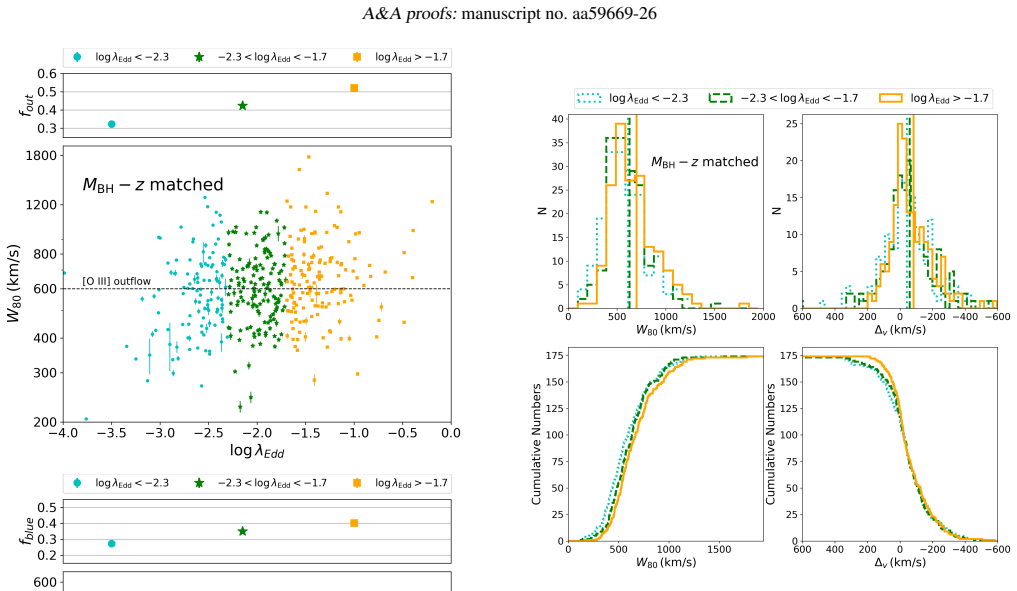
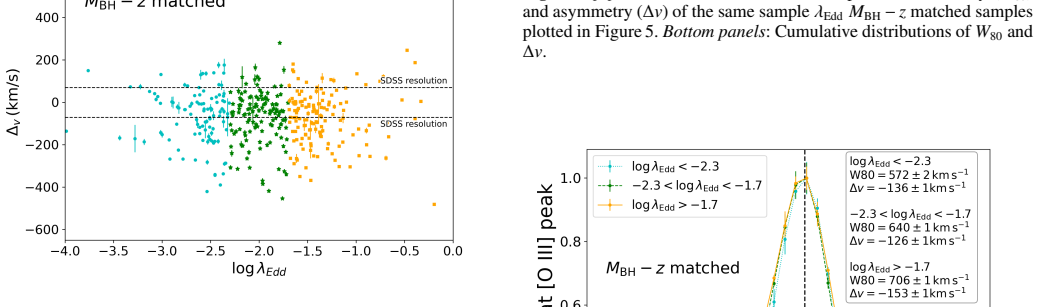
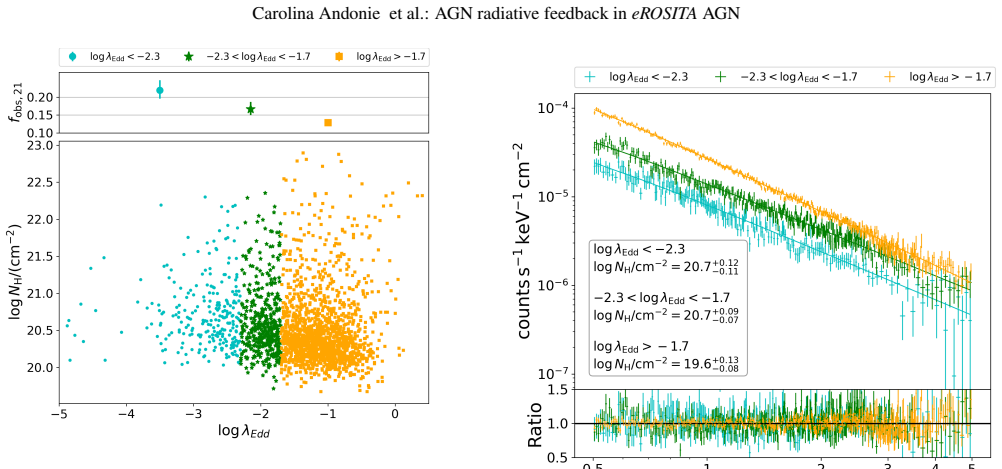
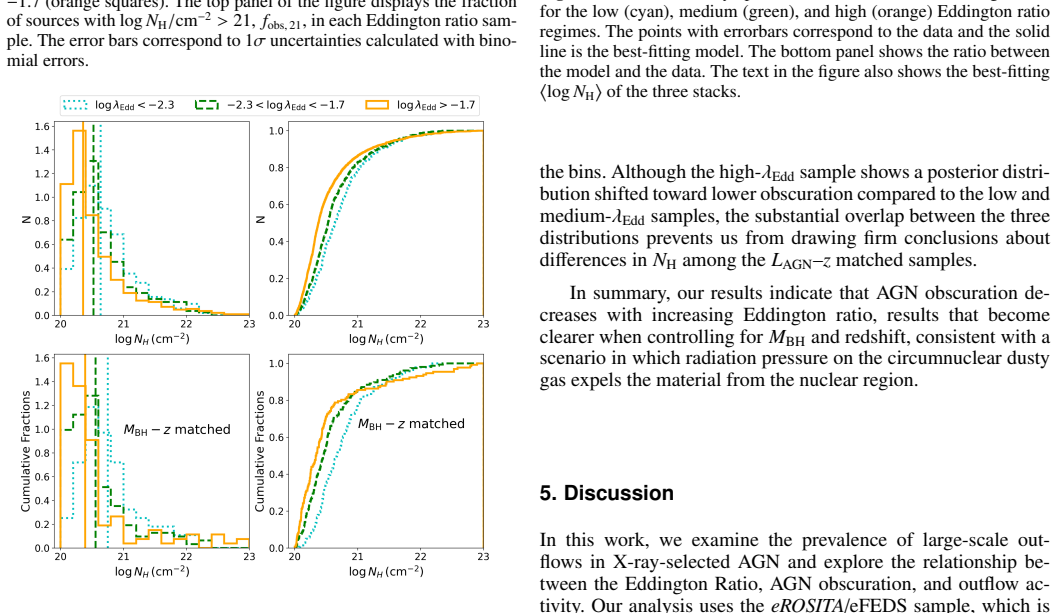
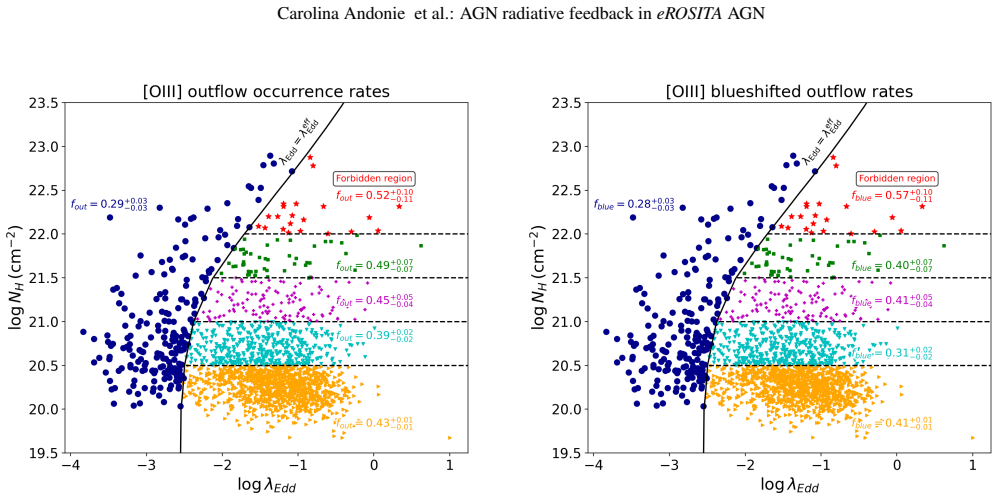
Radiation pressure tied to the Eddington ratio regulates both the incidence of [O III] outflows and the amount of X-ray obscuration, while black hole mass plays no significant independent role. This is shown by the disappearance of all trends with Eddington ratio once samples are matched on AGN luminosity, leaving only the short-lived high-outflow phase in the forbidden region of the NH–lambda plane.
What carries the argument
Luminosity-matched comparison of Eddington-ratio subsamples to isolate radiation-pressure effects from black-hole-mass effects.
Load-bearing premise
Matching samples solely on AGN luminosity removes all influence of black hole mass and leaves only radiation pressure as the cause of remaining differences.
What would settle it
Repeating the analysis after direct black-hole-mass measurements and matching on both luminosity and black-hole mass, then finding that outflow incidence or obscuration still correlates with Eddington ratio, would support the claim; persistent correlation with mass instead would falsify it.
Figures
read the original abstract
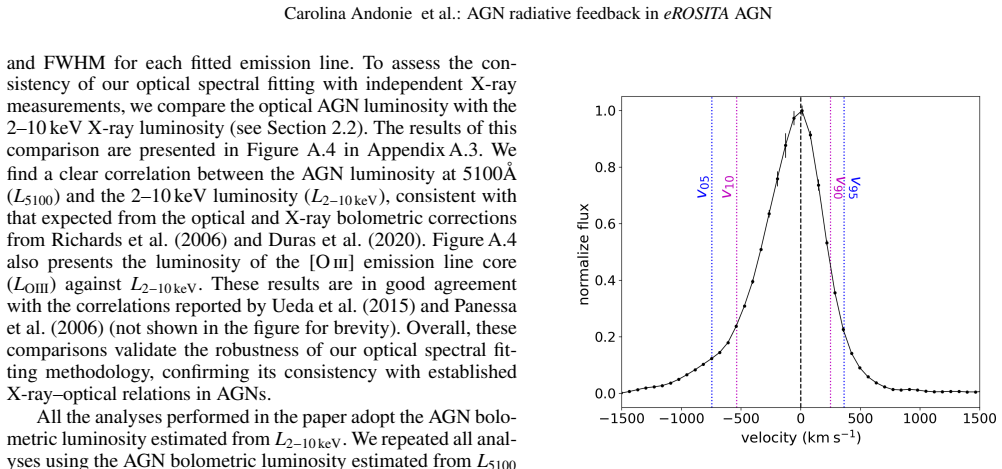
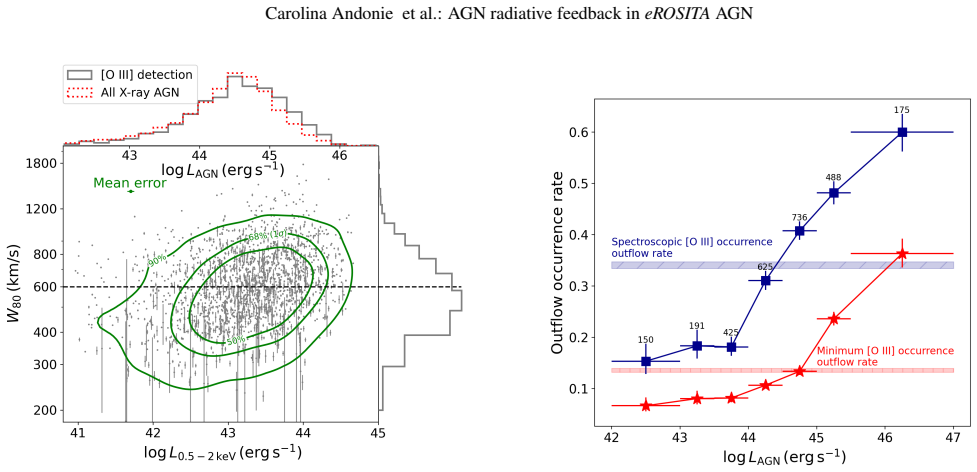
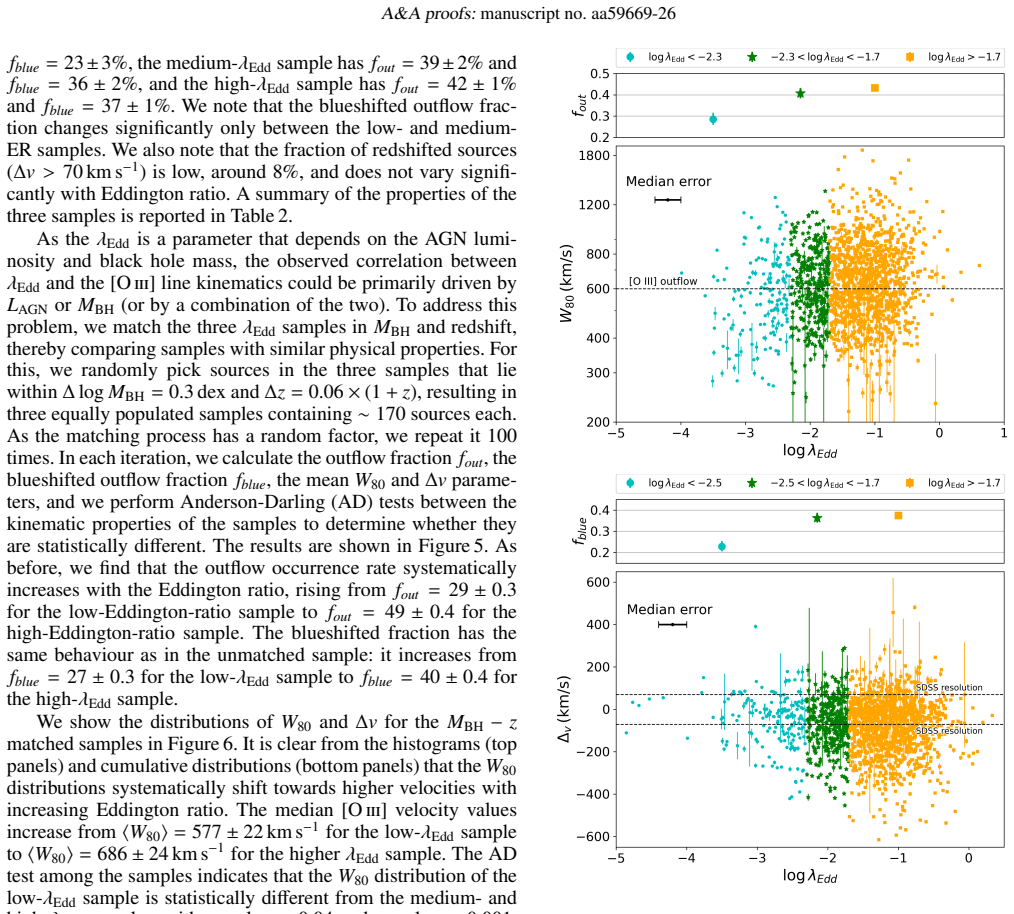
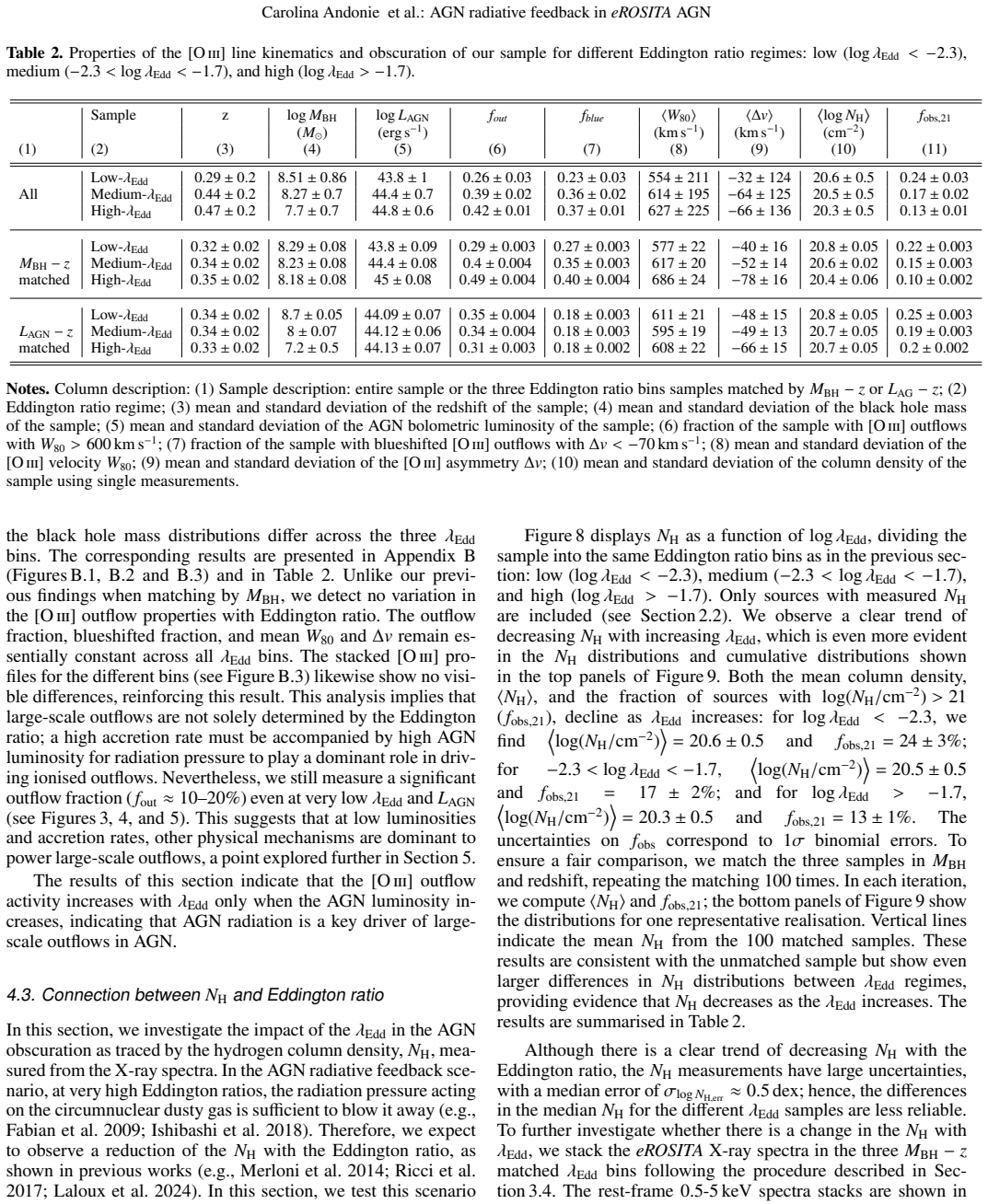
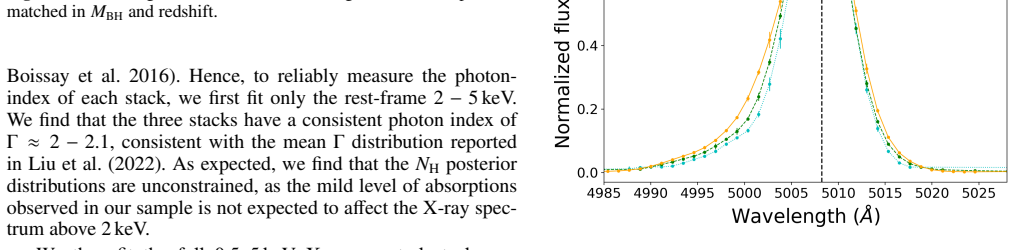
Large-scale ionised outflows and nuclear obscuration are fundamental manifestations of AGN activity, yet direct observational evidence linking these phenomena remains scarce. We use the eROSITA Final Equatorial Depth Survey, among the largest uniform optical spectroscopic datasets of X-ray AGN, to investigate how AGN accretion rate affects ionised outflow kinematics and X-ray obscuration. Our sample comprises 2.840 AGN at z<0.82 with high-quality SDSS spectra. Through optical spectral fitting, we measure Eddington ratios ($\lambda_{Edd}$) and [O III] emission-line kinematics, tracing ionised outflows. In addition, we use archival eROSITA X-ray spectroscopy with X-ray stacking analyses to constrain the obscuration of the sample, $N_H$. We find that (1) 35% of the entire sample hosts a [O III] outflows ($W_{80}>600$ km/s), with the outflow incidence increasing with the AGN luminosity from 15% at $L_{AGN}<10^{44}$ erg/s up to 60% at $L_{AGN}>10^{46}$ erg/s; (2) the outflow incidence increases with Eddington ratio from 29% at $\log \lambda_{Edd}<-2.3$ to 50% at $\log \lambda_{Edd}>-1.7$; and (3) the AGN obscuration decreases with Eddington ratio, as sources with $\log\lambda_{Edd}>-1.7$ are 5 times less obscured than lower Eddington ratios AGN. In addition, we find that 1% of the sample populates the "forbidden region" of the $N_H-\lambda_{Edd}$ plane, where the outflow incidence peaks at 52%, consistent with a short-lived feedback phase. Notably, when matching the Eddington ratios samples in AGN luminosity, these trends vanish, implying that radiation pressure drives changes in outflow activity and obscuration, while the black hole mass does not play a significant role. Our results are in agreement with AGN radiative feedback scenarios, where the Eddington ratio regulates the AGN environment by driving powerful, galaxy-wide outflows and shaping the amount of circumnuclear material.
Editorial analysis
A structured set of objections, weighed in public.
Referee Report
Summary. The manuscript analyzes 2840 X-ray AGN at z<0.82 from the eROSITA Final Equatorial Depth Survey with SDSS spectra. It measures Eddington ratios and [O III] kinematics (W_80>600 km/s for outflows) via optical spectral fitting and constrains obscuration N_H via eROSITA X-ray spectroscopy and stacking. Key findings: outflow incidence rises from 15% at L_AGN<10^44 erg/s to 60% at L_AGN>10^46 erg/s and from 29% at log λ_Edd<-2.3 to 50% at log λ_Edd>-1.7; obscuration drops by a factor of 5 at high λ_Edd; 1% of sources occupy a 'forbidden region' in the N_H-λ_Edd plane with 52% outflow incidence. After matching Eddington-ratio subsamples on AGN luminosity, trends vanish, implying radiation pressure via λ_Edd (not black hole mass) regulates outflows and obscuration, consistent with radiative feedback models.
Significance. If the luminosity-matching test holds after addressing the noted degeneracy, the result would strengthen observational evidence for radiative feedback in which Eddington ratio drives galaxy-scale outflows and modulates circumnuclear obscuration. The large, uniform X-ray-selected sample with high-quality spectroscopy and the combination of kinematic and X-ray stacking analyses constitute clear strengths; the identification of the forbidden region with elevated outflow activity is a potentially falsifiable prediction worth highlighting.
major comments (1)
- [Abstract] Abstract (final paragraph on luminosity matching): the claim that matching Eddington-ratio subsamples on AGN luminosity implies 'radiation pressure drives changes in outflow activity and obscuration, while the black hole mass does not play a significant role' is not supported by the described test. Because λ_Edd ≡ L_AGN / L_Edd and L_Edd ∝ M_BH, any two subsamples at identical L_AGN but differing λ_Edd necessarily differ in M_BH by the inverse factor; the procedure therefore leaves λ_Edd and M_BH perfectly degenerate. The vanishing of trends is equally consistent with no residual dependence on either quantity once L_AGN is controlled, so the inference that M_BH plays no role does not logically follow.
minor comments (2)
- The definition of the 'forbidden region' in the N_H-λ_Edd plane and the exact binning or selection criteria yielding the 52% outflow incidence should be stated explicitly (currently only noted in the abstract).
- Methods section on spectral fitting: the precise definition of W_80, the velocity threshold choice, and how uncertainties from line-profile decomposition propagate into the reported incidence percentages (15%, 29%, 50%, etc.) are not detailed in the abstract and would benefit from a dedicated methods subsection or table.
Simulated Author's Rebuttal
We thank the referee for their careful reading and constructive feedback on our manuscript. We address the single major comment below.
read point-by-point responses
-
Referee: [Abstract] Abstract (final paragraph on luminosity matching): the claim that matching Eddington-ratio subsamples on AGN luminosity implies 'radiation pressure drives changes in outflow activity and obscuration, while the black hole mass does not play a significant role' is not supported by the described test. Because λ_Edd ≡ L_AGN / L_Edd and L_Edd ∝ M_BH, any two subsamples at identical L_AGN but differing λ_Edd necessarily differ in M_BH by the inverse factor; the procedure therefore leaves λ_Edd and M_BH perfectly degenerate. The vanishing of trends is equally consistent with no residual dependence on either quantity once L_AGN is controlled, so the inference that M_BH plays no role does not logically follow.
Authors: We agree with the referee that the luminosity-matching procedure leaves λ_Edd and M_BH degenerate, since subsamples at fixed L_AGN but different λ_Edd must differ in M_BH by the inverse factor. The vanishing of trends after matching therefore shows that the observed dependencies are not independent of L_AGN, but does not permit the stronger claim that M_BH plays no role. We will revise the abstract and the relevant discussion sections to remove the statement that black hole mass does not play a significant role. The revised text will state that the results remain consistent with radiative feedback regulated by Eddington ratio, while explicitly noting the degeneracy with black hole mass at fixed luminosity. This change will be incorporated in the resubmitted version. revision: yes
Circularity Check
Observational correlation study with no circular derivation chain
full rationale
The paper reports empirical trends from eROSITA/SDSS data using standard spectral fitting to measure λ_Edd, [O III] kinematics, and N_H, followed by a luminosity-matching control. No equations, derivations, or first-principles results are presented that reduce to fitted parameters by construction. No self-citation load-bearing steps, uniqueness theorems, or ansatzes are invoked. The central claim rests on observational controls and data, remaining self-contained against external benchmarks.
Axiom & Free-Parameter Ledger
free parameters (2)
- Outflow velocity threshold =
600 km/s
- Eddington ratio bin edges =
-2.3 and -1.7
axioms (2)
- domain assumption [O III] line width traces ionized outflows
- domain assumption X-ray spectral fitting and stacking constrain line-of-sight N_H
Reference graph
Works this paper leans on
-
[1]
SUPER. III. Broad line region properties of AGNs at z 2. , keywords =. doi:10.1051/0004-6361/202039136 , archivePrefix =. 2010.07443 , primaryClass =
-
[2]
Annals of Statistics , year = 1978, month = jul, volume =
Estimating the Dimension of a Model. Annals of Statistics , year = 1978, month = jul, volume =
1978
-
[3]
A Spectroscopic Survey of X-ray Selected AGN in the Northern XMM-XXL Field
A spectroscopic survey of X-ray-selected AGNs in the northern XMM-XXL field. , keywords =. doi:10.1093/mnras/stv2749 , archivePrefix =. 1511.07870 , primaryClass =
work page internal anchor Pith review Pith/arXiv arXiv doi:10.1093/mnras/stv2749
-
[4]
Ionized gas outflow signatures in SDSS-IV MaNGA active galactic nuclei. , keywords =. doi:10.1093/mnras/staa062 , archivePrefix =. 1911.10212 , primaryClass =
-
[5]
Robust AGN and host-galaxy decomposition in optical spectral fitting
Robust active galactic nucleus and host-galaxy decomposition in optical spectral fitting. , keywords =. doi:10.1051/0004-6361/202558027 , archivePrefix =. 2604.27783 , primaryClass =
work page internal anchor Pith review Pith/arXiv arXiv doi:10.1051/0004-6361/202558027
-
[6]
Bian, W. and Gu, Q. and Zhao, Y. and Chao, L. and Cui, Q. , title =. Monthly Notices of the Royal Astronomical Society , volume =. 2006 , month =. doi:10.1111/j.1365-2966.2006.10915.x , url =
-
[7]
and Xue, Yongquan and Lin, Xiaozhi and Wang, Yijun , title =
Le, Huynh Anh N. and Xue, Yongquan and Lin, Xiaozhi and Wang, Yijun , title =. The Astrophysical Journal , abstract =. 2023 , month =. doi:10.3847/1538-4357/acb770 , url =
-
[8]
Changing-look Active Galactic Nuclei. I. Tracking the Transition on the Main Sequence of Quasars. , keywords =. doi:10.3847/1538-4365/ad344f , archivePrefix =. 2206.10056 , primaryClass =
-
[9]
A Catalog of Quasar Properties from Sloan Digital Sky Survey Data Release 16. , keywords =. doi:10.3847/1538-4365/ac9ead , archivePrefix =. 2209.03987 , primaryClass =
-
[10]
The Lick AGN Monitoring Project 2011: Fe II Reverberation from the Outer Broad-Line Region
The Lick AGN Monitoring Project 2011: Fe II Reverberation from the Outer Broad-line Region. , keywords =. doi:10.1088/0004-637X/769/2/128 , archivePrefix =. 1304.4643 , primaryClass =
work page internal anchor Pith review Pith/arXiv arXiv doi:10.1088/0004-637x/769/2/128 2011
-
[11]
Fast and furious at z 2: Obscured type-2 active nuclei host faster ionised winds than type-1 systems
SUPER: VIII. Fast and furious at z 2: Obscured type-2 active nuclei host faster ionised winds than type-1 systems. , keywords =. doi:10.1051/0004-6361/202450162 , archivePrefix =. 2407.04099 , primaryClass =
-
[12]
The eROSITA Final Equatorial Depth Survey (eFEDS): Complex absorption and soft excesses in hard X-ray selected active galactic nuclei. , keywords =. doi:10.1051/0004-6361/202245572 , archivePrefix =. 2306.00961 , primaryClass =
-
[13]
A Suzaku sample of unabsorbed narrow-line and broad-line Seyfert 1 galaxies - I. X-ray spectral properties. , keywords =. doi:10.1093/mnras/staa2783 , archivePrefix =. 2009.04378 , primaryClass =
-
[14]
A hard X-ray view of the soft excess in AGN
A hard X-ray view of the soft excess in AGN. , keywords =. doi:10.1051/0004-6361/201526982 , archivePrefix =. 1511.08168 , primaryClass =
work page internal anchor Pith review Pith/arXiv arXiv doi:10.1051/0004-6361/201526982
-
[15]
X-ray spectra of a large sample of quasars with ASCA. , keywords =. doi:10.1046/j.1365-8711.2000.03510.x , archivePrefix =. astro-ph/0003080 , primaryClass =
-
[16]
Is the soft excess in active galactic nuclei real?. , keywords =. doi:10.1111/j.1365-2966.2004.07687.x , archivePrefix =. astro-ph/0312271 , primaryClass =
-
[17]
The Journal of Open Source Software , keywords =
UltraNest - a robust, general purpose Bayesian inference engine. The Journal of Open Source Software , keywords =. doi:10.21105/joss.03001 , archivePrefix =. 2101.09604 , primaryClass =
-
[18]
Tracing outflows in the AGN forbidden region with SINFONI
Tracing outflows in the AGN forbidden region with SINFONI. , keywords =. doi:10.1051/0004-6361/201527968 , archivePrefix =. 1605.08631 , primaryClass =
work page internal anchor Pith review Pith/arXiv arXiv doi:10.1051/0004-6361/201527968
-
[19]
AGN wind scaling relations and the co-evolution of black holes and galaxies
AGN wind scaling relations and the co-evolution of black holes and galaxies. , keywords =. doi:10.1051/0004-6361/201629478 , archivePrefix =. 1702.04507 , primaryClass =
work page internal anchor Pith review Pith/arXiv arXiv doi:10.1051/0004-6361/201629478
-
[20]
Black Holes, Galaxy Formation, and the M_BH-sigma Relation
Black Holes, Galaxy Formation, and the M _ BH - Relation. , keywords =. doi:10.1086/379143 , archivePrefix =. astro-ph/0308342 , primaryClass =
work page internal anchor Pith review Pith/arXiv arXiv doi:10.1086/379143
-
[21]
On the X-ray, optical emission line and black hole mass properties of local Seyfert galaxies
On the X-ray, optical emission line and black hole mass properties of local Seyfert galaxies. , keywords =. doi:10.1051/0004-6361:20064894 , archivePrefix =. astro-ph/0605236 , primaryClass =
work page internal anchor Pith review Pith/arXiv arXiv doi:10.1051/0004-6361:20064894
-
[22]
[O iii] 5007 and X-Ray Properties of a Complete Sample of Hard X-Ray Selected AGNs in the Local Universe. , keywords =. doi:10.1088/0004-637X/815/1/1 , archivePrefix =. 1510.03153 , primaryClass =
work page internal anchor Pith review Pith/arXiv arXiv doi:10.1088/0004-637x/815/1/1
-
[23]
Optical, UV, and X-ray emission properties of unobscured Swift/BAT active galactic nuclei
BASS: XLIII. Optical, UV, and X-ray emission properties of unobscured Swift/BAT active galactic nuclei. , keywords =. doi:10.1051/0004-6361/202450567 , archivePrefix =. 2409.12239 , primaryClass =
-
[24]
The X-ray to optical-UV luminosity ratio of X-ray selected Type 1 AGN in XMM-COSMOS
The X-ray to optical-UV luminosity ratio of X-ray selected type 1 AGN in XMM-COSMOS. , keywords =. doi:10.1051/0004-6361/200913298 , archivePrefix =. 0912.4166 , primaryClass =
work page internal anchor Pith review Pith/arXiv arXiv doi:10.1051/0004-6361/200913298
-
[25]
Outflows in Infrared-Luminous Starbursts at z < 0.5. II. Analysis and Discussion. , keywords =. doi:10.1086/432889 , archivePrefix =. astro-ph/0506611 , primaryClass =
work page internal anchor Pith review Pith/arXiv arXiv doi:10.1086/432889
-
[26]
Light breeze in the local Universe
Light breeze in the local Universe. , keywords =. doi:10.1051/0004-6361/201629519 , archivePrefix =. 1701.06569 , primaryClass =
work page internal anchor Pith review Pith/arXiv arXiv doi:10.1051/0004-6361/201629519
-
[27]
The first archetypal quasar in the feedback phase discovered by eROSITA
The eROSITA Final Equatorial-Depth Survey (eFEDS). The first archetypal quasar in the feedback phase discovered by eROSITA. , keywords =. doi:10.1051/0004-6361/202141092 , archivePrefix =. 2106.14525 , primaryClass =
-
[28]
Active galactic nuclei dust tori at low and high luminosities. , keywords =. doi:10.1111/j.1365-2966.2007.12157.x , adsurl =
-
[29]
The LOFAR Two-metre Sky Survey. I. Survey description and preliminary data release. , keywords =. doi:10.1051/0004-6361/201629313 , archivePrefix =. 1611.02700 , primaryClass =
work page internal anchor Pith review Pith/arXiv arXiv doi:10.1051/0004-6361/201629313
-
[30]
The LOFAR - eFEDS survey: The incidence of radio and X-ray AGN and the disk-jet connection. , keywords =. doi:10.1051/0004-6361/202349069 , archivePrefix =. 2402.16943 , primaryClass =
-
[31]
Radio galaxies and feedback from AGN jets. , keywords =. doi:10.1016/j.newar.2020.101539 , archivePrefix =. 2003.06137 , primaryClass =
-
[32]
Ionised gas outflows over the radio AGN life cycle. , keywords =. doi:10.1051/0004-6361/202245691 , archivePrefix =. 2305.03725 , primaryClass =
-
[33]
A unified model for AGN feedback in cosmological simulations of structure formation. , keywords =. doi:10.1111/j.1365-2966.2007.12153.x , archivePrefix =. 0705.2238 , primaryClass =
-
[34]
A Census of Gas Outflows in Type 2 Active Galactic Nuclei
A Census of Gas Outflows in Type 2 Active Galactic Nuclei. , keywords =. doi:10.1088/0004-637X/795/1/30 , archivePrefix =. 1409.1580 , primaryClass =
work page internal anchor Pith review Pith/arXiv arXiv doi:10.1088/0004-637x/795/1/30
-
[35]
Type 1 versus type 2 AGN dichotomy from the point of view of ionized outflows
BAT AGN Spectroscopic Survey - XIX. Type 1 versus type 2 AGN dichotomy from the point of view of ionized outflows. , keywords =. doi:10.1093/mnras/stz3386 , archivePrefix =. 1911.12395 , primaryClass =
-
[36]
ERQs are the BOSS of quasar samples: the highest velocity [O III] quasar outflows. , keywords =. doi:10.1093/mnras/stz1993 , archivePrefix =. 1906.00980 , primaryClass =
-
[37]
Discovery of extreme [OIII]5007A outflows in high-redshift red quasars
Discovery of extreme [O III] 5007 A outflows in high-redshift red quasars. , keywords =. doi:10.1093/mnras/stw718 , archivePrefix =. 1512.02642 , primaryClass =
work page internal anchor Pith review Pith/arXiv arXiv doi:10.1093/mnras/stw718
-
[38]
A Model for the Correlation of Hard X-ray Index with Eddington Ratio in Black Hole X-ray Binaries
A Model for the Correlation of Hard X-Ray Index with Eddington Ratio in Black Hole X-Ray Binaries. , keywords =. doi:10.1088/0004-637X/764/1/2 , archivePrefix =. 1212.1770 , primaryClass =
work page internal anchor Pith review Pith/arXiv arXiv doi:10.1088/0004-637x/764/1/2
-
[39]
The Analogous Structure of Accretion Flows in Supermassive and Stellar Mass Black Holes: New Insights from Faded Changing-look Quasars. , keywords =. doi:10.3847/1538-4357/ab3c1a , archivePrefix =. 1903.02553 , primaryClass =
-
[40]
Radiatively Inefficient Accretion in Nearby Galaxies
Radiatively Inefficient Accretion in Nearby Galaxies. , keywords =. doi:10.1088/0004-637X/699/1/626 , archivePrefix =. 0906.4104 , primaryClass =
work page internal anchor Pith review Pith/arXiv arXiv doi:10.1088/0004-637x/699/1/626
-
[41]
Constraining Wind-driven Accretion onto Gaia BH3 with Chandra. , keywords =. doi:10.3847/1538-4357/ad6f96 , archivePrefix =. 2406.07602 , primaryClass =
-
[42]
Seyfert galaxies with weak broad H alpha emission lines. , keywords =. doi:10.1086/159306 , adsurl =
-
[43]
AGN-driven outflows in clumpy media: multiphase structure and scaling relations. , keywords =. doi:10.1093/mnras/stae1816 , archivePrefix =. 2407.17593 , primaryClass =
-
[44]
Regulation of Black Hole Winds and Jets Across the Mass Scale
Regulation of Black Hole Winds and Jets across the Mass Scale. , year = 2013, keywords =. doi:10.1088/0004-637X/762/2/103 , archivePrefix =. 1205.4222 , primaryClass =
work page internal anchor Pith review Pith/arXiv arXiv doi:10.1088/0004-637x/762/2/103 2013
-
[45]
An X-ray/SDSS sample. I. Multi-phase outflow incidence and dependence on AGN luminosity. , keywords =. doi:10.1051/0004-6361/201630369 , archivePrefix =. 1703.05335 , primaryClass =
work page internal anchor Pith review Pith/arXiv arXiv doi:10.1051/0004-6361/201630369
-
[46]
Outflows and complex stellar kinematics in SDSS star forming galaxies
Outflows and complex stellar kinematics in SDSS star-forming galaxies. , keywords =. doi:10.1051/0004-6361/201424514 , archivePrefix =. 1601.04715 , primaryClass =
work page internal anchor Pith review Pith/arXiv arXiv doi:10.1051/0004-6361/201424514
-
[47]
HI4PI: A full-sky HI survey based on EBHIS and GASS
HI4PI: A full-sky H I survey based on EBHIS and GASS. , keywords =. doi:10.1051/0004-6361/201629178 , archivePrefix =. 1610.06175 , primaryClass =
work page internal anchor Pith review Pith/arXiv arXiv doi:10.1051/0004-6361/201629178
-
[48]
Searching for evidence of energetic feedback in distant galaxies: a galaxy wide outflow in a z -0.5ex 2 ultraluminous infrared galaxy. , keywords =. doi:10.1111/j.1365-2966.2009.16046.x , archivePrefix =. 0911.0014 , primaryClass =
-
[49]
Driving gas shells with radiation pressure on dust in radiation-hydrodynamic simulations
Driving gas shells with radiation pressure on dust in radiation-hydrodynamic simulations. , keywords =. doi:10.1093/mnras/stx2598 , archivePrefix =. 1703.05766 , primaryClass =
work page internal anchor Pith review Pith/arXiv arXiv doi:10.1093/mnras/stx2598
-
[50]
BASS XXXI: Outflow scaling relations in low redshift X-ray AGN host galaxies with MUSE. , keywords =. doi:10.1093/mnras/stac103 , archivePrefix =. 2201.04149 , primaryClass =
-
[51]
Ionised AGN outflows from X-ray selected samples
A new discovery space opened by eROSITA. Ionised AGN outflows from X-ray selected samples. , keywords =. doi:10.1051/0004-6361/202245555 , archivePrefix =. 2309.16528 , primaryClass =
-
[52]
A fast ionised wind in a star-forming quasar system at z -0.5ex 1.5 resolved through adaptive optics assisted near-infrared data. , keywords =. doi:10.1051/0004-6361/201527900 , archivePrefix =. 1602.03181 , primaryClass =
work page internal anchor Pith review Pith/arXiv arXiv doi:10.1051/0004-6361/201527900
-
[53]
X-shooter reveals powerful outflows in z~1.5 X-ray selected obscured quasi stellar objects
X-shooter reveals powerful outflows in z 1.5 X-ray selected obscured quasi-stellar objects. , keywords =. doi:10.1093/mnras/stu2117 , archivePrefix =. 1409.1615 , primaryClass =
work page internal anchor Pith review Pith/arXiv arXiv doi:10.1093/mnras/stu2117
-
[54]
Stellar and Quasar Feedback in Concert: Effects on AGN Accretion, Obscuration, and Outflows
Stellar and quasar feedback in concert: effects on AGN accretion, obscuration, and outflows. , keywords =. doi:10.1093/mnras/stw289 , archivePrefix =. 1504.05209 , primaryClass =
work page internal anchor Pith review Pith/arXiv arXiv doi:10.1093/mnras/stw289
-
[55]
Black hole outflows. , keywords =. doi:10.1111/j.1365-2966.2009.16013.x , archivePrefix =. 0911.1639 , primaryClass =
-
[56]
AGN-driven outflows without immediate quenching in simulations of high-redshift disk galaxies
Active galactic nuclei-driven outflows without immediate quenching in simulations of high-redshift disc galaxies. , keywords =. doi:10.1093/mnras/stu677 , archivePrefix =. 1402.4482 , primaryClass =
work page internal anchor Pith review Pith/arXiv arXiv doi:10.1093/mnras/stu677
-
[57]
The AGN-starburst connection, Galactic superwinds, and M_BH - sigma
The AGN-Starburst Connection, Galactic Superwinds, and M _ BH -. , keywords =. doi:10.1086/499430 , archivePrefix =. astro-ph/0511034 , primaryClass =
work page internal anchor Pith review Pith/arXiv arXiv doi:10.1086/499430
-
[58]
On the Maximum Luminosity of Galaxies and Their Central Black Holes: Feedback from Momentum-driven Winds. , keywords =. doi:10.1086/426067 , archivePrefix =. astro-ph/0406070 , primaryClass =
work page internal anchor Pith review Pith/arXiv arXiv doi:10.1086/426067
-
[59]
Feedback from Active Galactic Nuclei: Energy- versus momentum-driving
Feedback from active galactic nuclei: energy- versus momentum-driving. , keywords =. doi:10.1093/mnras/stu1632 , archivePrefix =. 1406.2691 , primaryClass =
work page internal anchor Pith review Pith/arXiv arXiv doi:10.1093/mnras/stu1632
-
[60]
Broad absorption line outflows are common in low Eddington ratio active galactic nuclei. , keywords =. doi:10.1051/0004-6361/202453352 , archivePrefix =. 2502.18569 , primaryClass =
-
[61]
Investigating the Correlation of Outflow Kinematics with Radio Activity. VII. Gas Outflows in AGNs. , keywords =. doi:10.3847/1538-4357/ace0ba , archivePrefix =. 2306.12692 , primaryClass =
-
[62]
Narrow-line region gas kinematics of 24,264 optically-selected AGN: the radio connection
Narrow-line region gas kinematics of 24 264 optically selected AGN: the radio connection. , keywords =. doi:10.1093/mnras/stt751 , archivePrefix =. 1305.0263 , primaryClass =
work page internal anchor Pith review Pith/arXiv arXiv doi:10.1093/mnras/stt751
-
[63]
A Census of Ionized Gas Outflows in Type 1 AGNs: Gas Outflows in AGNs. V. , keywords =. doi:10.3847/1538-4357/aad9f8 , archivePrefix =. 1808.03415 , primaryClass =
work page internal anchor Pith review Pith/arXiv arXiv doi:10.3847/1538-4357/aad9f8
-
[64]
The Prevalence of Gas Outflows in Type 2 AGNs
The Prevalence of Gas Outflows in Type 2 AGNs. , keywords =. doi:10.3847/0004-637X/817/2/108 , archivePrefix =. 1511.05142 , primaryClass =
work page internal anchor Pith review Pith/arXiv arXiv doi:10.3847/0004-637x/817/2/108
-
[65]
The KMOS AGN Survey at High redshift (KASHz): the prevalence and drivers of ionized outflows in the host galaxies of X-ray AGN. , keywords =. doi:10.1093/mnras/stv2727 , archivePrefix =. 1511.00008 , primaryClass =
work page internal anchor Pith review Pith/arXiv arXiv doi:10.1093/mnras/stv2727
-
[66]
The Multi-Object, Fiber-Fed Spectrographs for SDSS and the Baryon Oscillation Spectroscopic Survey
The Multi-object, Fiber-fed Spectrographs for the Sloan Digital Sky Survey and the Baryon Oscillation Spectroscopic Survey. , keywords =. doi:10.1088/0004-6256/146/2/32 , archivePrefix =. 1208.2233 , primaryClass =
work page internal anchor Pith review Pith/arXiv arXiv doi:10.1088/0004-6256/146/2/32
-
[67]
The Baryon Oscillation Spectroscopic Survey of SDSS-III
The Baryon Oscillation Spectroscopic Survey of SDSS-III. , keywords =. doi:10.1088/0004-6256/145/1/10 , archivePrefix =. 1208.0022 , primaryClass =
work page internal anchor Pith review Pith/arXiv arXiv doi:10.1088/0004-6256/145/1/10
-
[68]
The 2.5 m Telescope of the Sloan Digital Sky Survey
The 2.5 m Telescope of the Sloan Digital Sky Survey. , keywords =. doi:10.1086/500975 , archivePrefix =. astro-ph/0602326 , primaryClass =
work page internal anchor Pith review Pith/arXiv arXiv doi:10.1086/500975
-
[69]
Energetic galaxy-wide outflows in high-redshift ultraluminous infrared galaxies hosting AGN activity. , keywords =. doi:10.1111/j.1365-2966.2012.21723.x , archivePrefix =. 1205.1801 , primaryClass =
-
[70]
Evidence for powerful AGN winds at high redshift: dynamics of galactic outflows in radio galaxies during the ``Quasar Era''. , keywords =. doi:10.1051/0004-6361:200810346 , archivePrefix =. 0809.5171 , primaryClass =
work page internal anchor Pith review Pith/arXiv arXiv doi:10.1051/0004-6361:200810346
-
[71]
On the nature of Seyfert galaxies with high [OIII]5007 blueshifts
On the Nature of Seyfert Galaxies with High [O III] 5007 Blueshifts. , keywords =. doi:10.1086/587932 , archivePrefix =. 0803.0240 , primaryClass =
work page internal anchor Pith review Pith/arXiv arXiv doi:10.1086/587932
-
[72]
Delayed or No Feedback? Gas Outflows in Type 2 AGNs. III. , keywords =. doi:10.3847/1538-4357/aa6894 , archivePrefix =. 1702.06681 , primaryClass =
work page internal anchor Pith review Pith/arXiv arXiv doi:10.3847/1538-4357/aa6894
-
[73]
Powerful Outflows and Feedback from Active Galactic Nuclei
Powerful Outflows and Feedback from Active Galactic Nuclei. , keywords =. doi:10.1146/annurev-astro-082214-122316 , archivePrefix =. 1503.05206 , primaryClass =
work page internal anchor Pith review Pith/arXiv arXiv doi:10.1146/annurev-astro-082214-122316
-
[74]
The energetics of AGN radiation pressure-driven outflows
The energetics of AGN radiation pressure-driven outflows. , keywords =. doi:10.1093/mnras/sty236 , archivePrefix =. 1801.09700 , primaryClass =
work page internal anchor Pith review Pith/arXiv arXiv doi:10.1093/mnras/sty236
-
[75]
Measuring the Fraction of Obscured Quasars by the Infrared Luminosity of Unobscured Quasars
Measuring the Fraction of Obscured Quasars by the Infrared Luminosity of Unobscured Quasars. , keywords =. doi:10.1086/586698 , archivePrefix =. 0801.3849 , primaryClass =
work page internal anchor Pith review Pith/arXiv arXiv doi:10.1086/586698
-
[76]
Dust covering factor, silicate emission and star formation in luminous QSOs
Dust covering factor, silicate emission, and star formation in luminous QSOs. , keywords =. doi:10.1051/0004-6361:20077252 , archivePrefix =. 0704.1559 , primaryClass =
work page internal anchor Pith review Pith/arXiv arXiv doi:10.1051/0004-6361:20077252
-
[77]
Radiation pressure and absorption in AGN: results from a complete unbiased sample from Swift. , keywords =. doi:10.1111/j.1745-3933.2009.00617.x , archivePrefix =. 0901.0250 , primaryClass =
-
[78]
A semi-analytic model for the co-evolution of galaxies, black holes and active galactic nuclei. , keywords =. doi:10.1111/j.1365-2966.2008.13805.x , archivePrefix =. 0808.1227 , primaryClass =
-
[79]
Observational Tests of Active Galactic Nuclei Feedback: An Overview of Approaches and Interpretation. Galaxies , keywords =. doi:10.3390/galaxies12020017 , archivePrefix =. 2404.08050 , primaryClass =
-
[80]
Black holes in galaxy mergers: The formation of red elliptical galaxies
Black Holes in Galaxy Mergers: The Formation of Red Elliptical Galaxies. , keywords =. doi:10.1086/428772 , archivePrefix =. astro-ph/0409436 , primaryClass =
work page internal anchor Pith review Pith/arXiv arXiv doi:10.1086/428772
discussion (0)
Sign in with ORCID, Apple, or X to comment. Anyone can read and Pith papers without signing in.