JWST Observations of Calcium-Strong Transients: I. Complex Nebular He Emission in SN 2024uj
Pith reviewed 2026-07-02 17:44 UTC · model grok-4.3
The pith
JWST spectra of SN 2024uj favor a thermonuclear explosion from a low-mass, partially helium-rich white dwarf.
A machine-rendered reading of the paper's core claim, the machinery that carries it, and where it could break.
Core claim
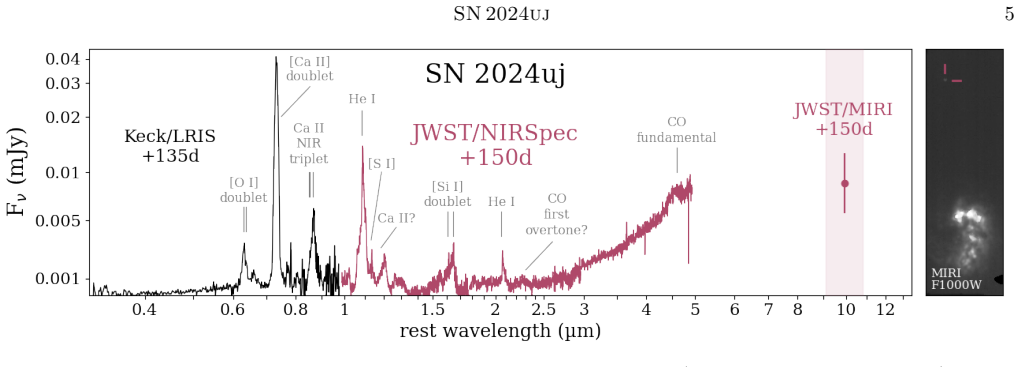
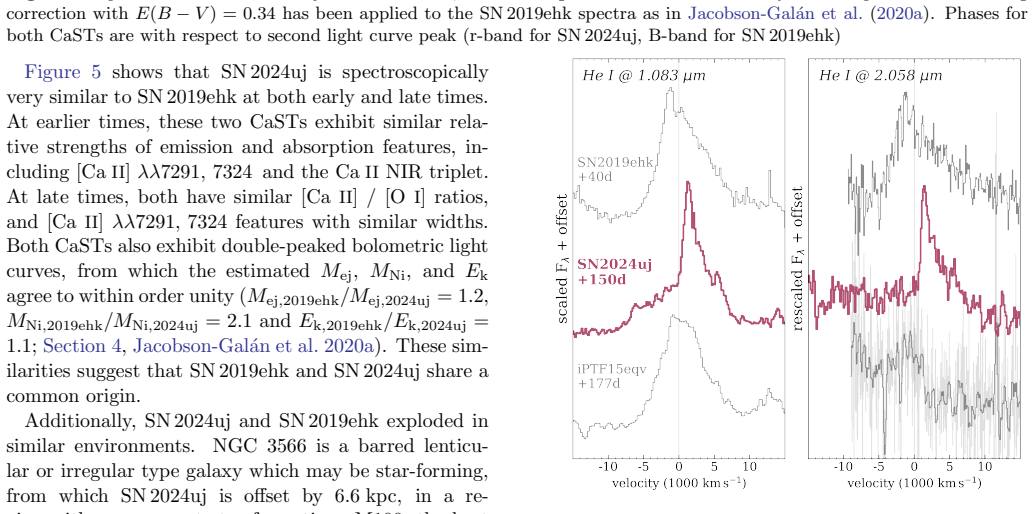
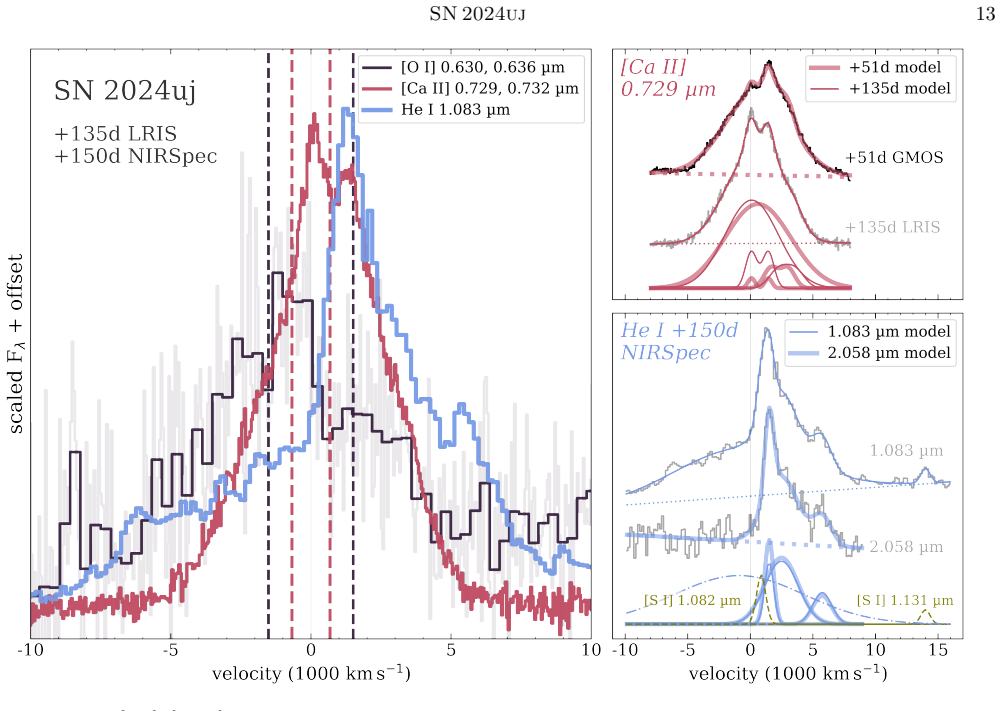
The +150 d JWST/NIRSpec spectrum reveals highly asymmetric, multicomponent He I at both 1.083 and 2.058 μm extending to ≳+5000 km/s with a strong narrow peak at +1500 km/s. This helium overlaps central [Ca II] and [O I], implying mixing difficult to produce in a massive star explosion. Given the remote environment, early forbidden Ca, mixed He/Ca/O ejecta, and possible companion signature, the observations favor a thermonuclear origin for SN 2024uj involving at least one low-mass, partially He-rich WD.
What carries the argument
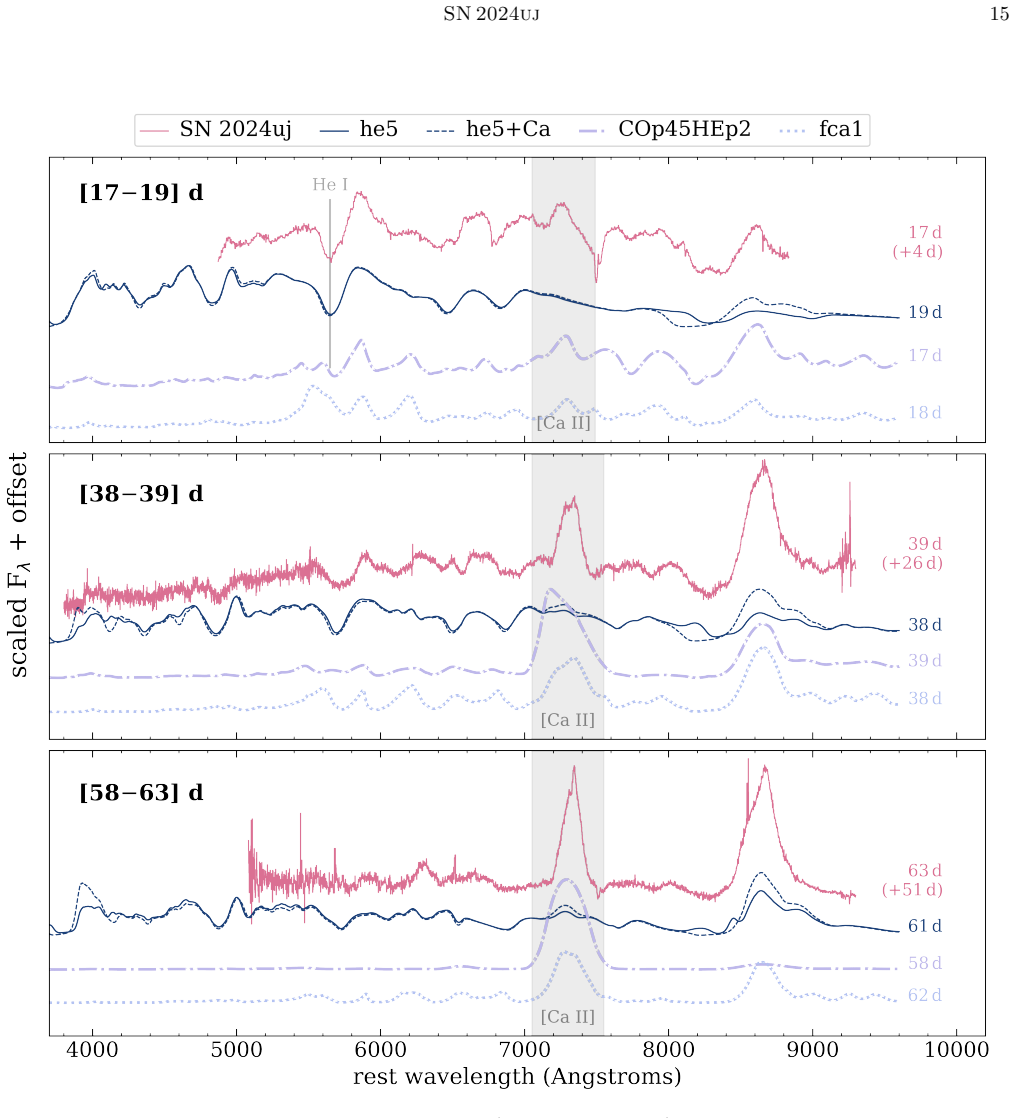
Radiative-transfer models that compare massive stripped helium-star explosions against thermonuclear white-dwarf scenarios and demonstrate that only the latter produce the observed early forbidden calcium emission.
If this is right
- Helium distributed throughout the ejecta with an offset concentration implies interaction with a shocked companion.
- Molecular CO and a rising mid-infrared continuum indicate dust formation extending beyond the near-infrared.
- The observed degree of He/Ca/O mixing is difficult to achieve in core-collapse events but expected in thermonuclear ones.
- Remote location combined with these spectral features strengthens the case for white-dwarf progenitors in other calcium-strong transients.
Where Pith is reading between the lines
- Repeated JWST observations of additional calcium-strong transients could test whether most members of the class share the same thermonuclear channel.
- The narrow helium peak offset from center may become a practical observational signature for detecting ejected companions in future events.
- Some early-time spectra classified as Type Ib could later reveal calcium-strong behavior and require reclassification as thermonuclear if mixing signatures appear.
Load-bearing premise
Current radiative-transfer models of massive stripped helium stars are complete enough that they cannot produce early forbidden calcium emission even with boosted surface calcium.
What would settle it
Updated radiative-transfer calculations of a massive stripped helium star that successfully reproduce the early [Ca II] emission with standard surface abundances would remove the main evidence against a core-collapse origin.
Figures
read the original abstract
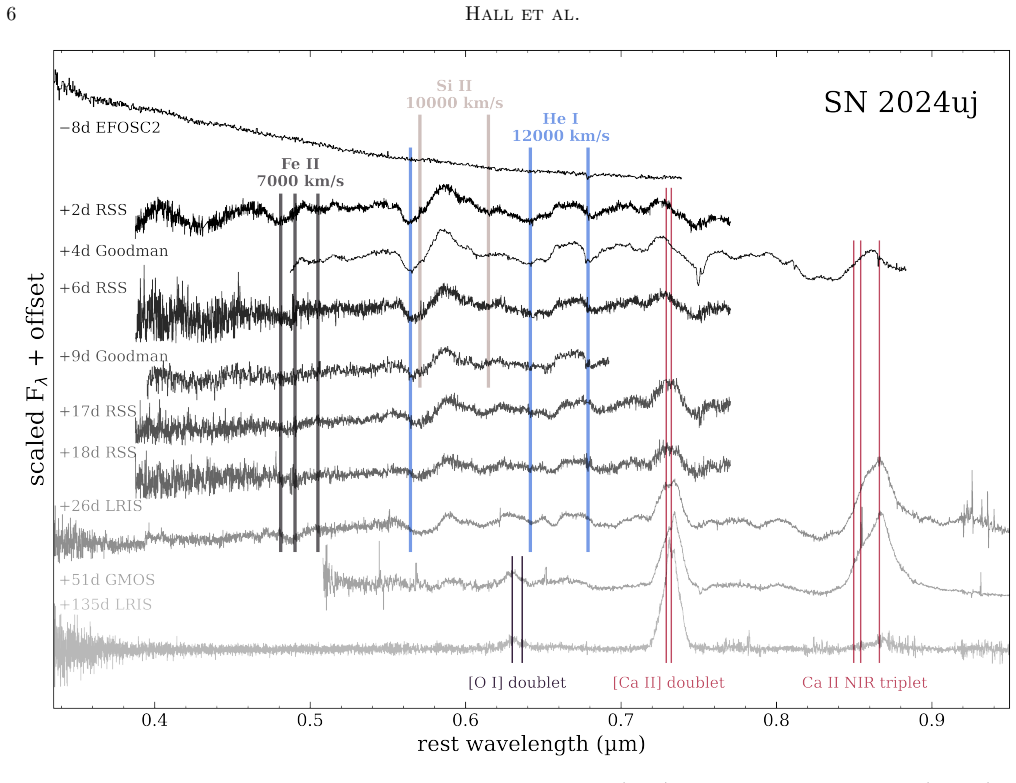
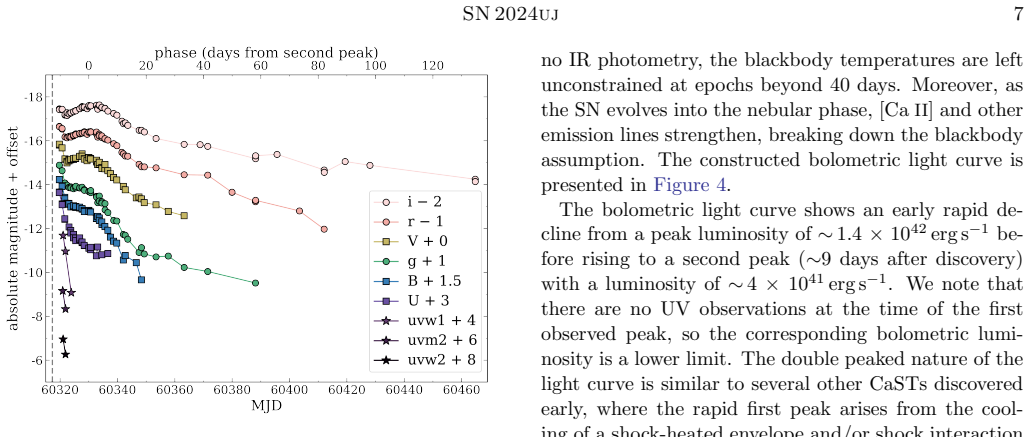
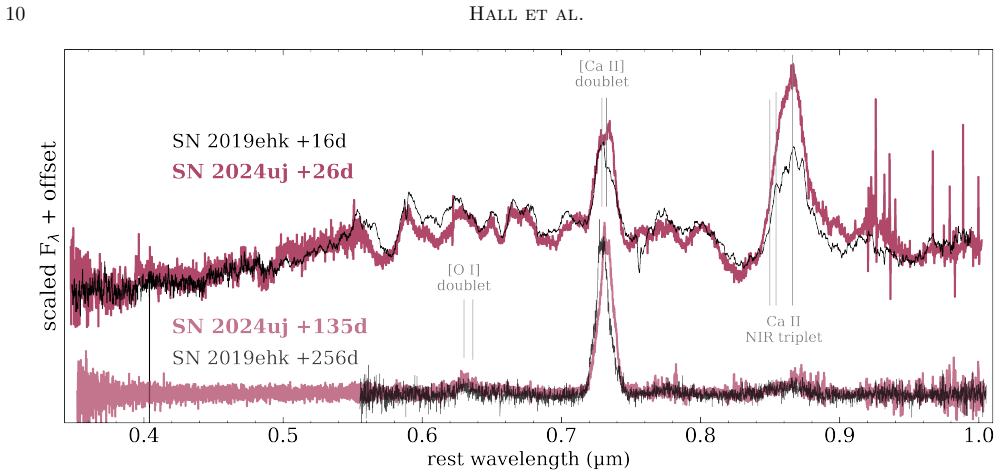
We present the first JWST observations of a Calcium-Strong Transient (CaST), SN 2024uj, a rare class of supernovae (SNe) with observable properties that are consistent with both thermonuclear explosions of white dwarfs (WDs) and the core collapse of massive stars. SN 2024uj is offset by $\sim6.6$ kpc from its host and exhibits a double-peaked light curve consistent with shock cooling of nearby circumstellar material. At early times, its optical spectra resemble those of normal SNe Ib, but strong [Ca II] $\lambda\lambda$7291, 7324 emission emerges between $+$2 and $+$17 days after maximum light. Radiative-transfer models of a massive stripped He star cannot reproduce this early forbidden Ca emission, even with artificially enhanced surface Ca, whereas it arises naturally in thermonuclear scenarios. The $+$150 d JWST/NIRSpec spectrum reveals highly asymmetric, multicomponent He I at both 1.083 and 2.058 $\mu$m. The He extends to $\gtrsim+$5000 km/s, with a strong, narrow peak at $+$1500 km/s, indicating that He is distributed throughout the ejecta with a concentration offset from center. This He distribution overlaps central [Ca II] and [O I], implying a degree of mixing difficult to produce in a massive star explosion. The He peak might further trace interaction with a shocked, ejected companion in a thermonuclear system. The NIRSpec spectrum also shows molecular CO emission and a rising continuum that, together with a 10 $\mu$m photometric detection, indicates dust emission extending into the mid-infrared. Given the remote environment, early forbidden Ca, mixed He/Ca/O ejecta, and possible companion signature, we favor a thermonuclear origin for SN 2024uj involving at least one low-mass, partially He-rich WD.
Editorial analysis
A structured set of objections, weighed in public.
Referee Report
Summary. The manuscript presents the first JWST observations of the calcium-strong transient SN 2024uj. It reports a remote offset of ~6.6 kpc, double-peaked light curve, early optical spectra resembling SNe Ib with strong [Ca II] λλ7291,7324 emission emerging +2 to +17 days, and a +150 d NIRSpec spectrum showing highly asymmetric multicomponent He I at 1.083 and 2.058 μm extending to ≳5000 km/s with a narrow peak at +1500 km/s, overlapping central [Ca II] and [O I], plus molecular CO and mid-IR dust. The authors conclude that radiative-transfer models of massive stripped He stars cannot reproduce the early forbidden Ca even with artificially enhanced surface Ca, while thermonuclear scenarios do so naturally, and combined with the mixed He/Ca/O ejecta and possible companion signature, favor a thermonuclear origin involving at least one low-mass, partially He-rich WD.
Significance. If the model-based discriminator holds, the result strengthens the case for a thermonuclear channel for at least some CaSTs and demonstrates the diagnostic power of early-time forbidden Ca and nebular He kinematics. The JWST nebular spectrum provides new constraints on ejecta mixing and asymmetry that are difficult to obtain from ground-based data alone.
major comments (1)
- [model comparison discussion (near abstract claim)] The central claim that radiative-transfer models of a massive stripped He star cannot reproduce the early [Ca II] emission (even with artificially enhanced surface Ca) while thermonuclear models produce it naturally is load-bearing for the favored progenitor interpretation. The manuscript provides no details on the specific code, progenitor mass, explosion energy, density profile, or the precise implementation of the 'artificially enhanced surface Ca' (e.g., thin surface layer vs. outward mixing of explosively synthesized Ca). Without these, it is not possible to evaluate whether the test exhaustively rules out core-collapse scenarios with more realistic Ca mixing profiles.
Simulated Author's Rebuttal
We thank the referee for their thorough review and for highlighting the importance of transparency in our model comparisons. We address the major comment below and will revise the manuscript to incorporate additional details.
read point-by-point responses
-
Referee: [model comparison discussion (near abstract claim)] The central claim that radiative-transfer models of a massive stripped He star cannot reproduce the early [Ca II] emission (even with artificially enhanced surface Ca) while thermonuclear models produce it naturally is load-bearing for the favored progenitor interpretation. The manuscript provides no details on the specific code, progenitor mass, explosion energy, density profile, or the precise implementation of the 'artificially enhanced surface Ca' (e.g., thin surface layer vs. outward mixing of explosively synthesized Ca). Without these, it is not possible to evaluate whether the test exhaustively rules out core-collapse scenarios with more realistic Ca mixing profiles.
Authors: We agree that the manuscript would benefit from greater specificity on the radiative-transfer modeling to allow readers to fully evaluate the comparison. The claim is based on exploratory calculations performed with a standard 1D radiative-transfer code for a representative 3-4 solar mass stripped He-star progenitor with explosion energies of ~1e51 erg and standard density profiles; the artificial Ca enhancement was implemented as a thin surface layer with mass fraction ~0.01. In the revised manuscript we will expand the relevant section (near the abstract claim and in the discussion) to explicitly state the code, progenitor parameters, energy, density assumptions, and the precise implementation of the surface Ca enhancement. We will also note the limitations of this test and that it does not exhaustively rule out all possible core-collapse mixing scenarios, while still highlighting that the early forbidden Ca is difficult to produce without fine-tuning. revision: yes
Circularity Check
Model comparison to prior radiative-transfer calculations; no parameter fitting or self-referential derivation from SN 2024uj data
full rationale
The paper presents new JWST and optical observations of SN 2024uj and interprets the early [Ca II] emission, He distribution, and environment as favoring a thermonuclear origin. The load-bearing step is a comparison to existing radiative-transfer models of stripped He stars (which fail to reproduce the Ca feature even with enhanced surface Ca) versus thermonuclear models (which succeed). No equations, fitted parameters, or self-citations reduce this comparison to a tautology within the present work; the models are treated as independent external benchmarks. This yields a low circularity score consistent with normal use of prior calculations on fresh data.
Axiom & Free-Parameter Ledger
Reference graph
Works this paper leans on
-
[1]
2024, Monthly Notices of the Royal Astronomical Society, 527, 11970, 10.1093/mnras/stad3776
Aamer, A., Nicholl, M., Jerkstrand, A., et al. 2024, Monthly Notices of the Royal Astronomical Society, 527, 11970, 10.1093/mnras/stad3776
-
[2]
Arnett , W. D. 1982, , 253, 785, 10.1086/159681
-
[3]
2024, The Astrophysical Journal, 975, 203, 10.3847/1538-4357/ad6608
Ashall, C., Hoeflich, P., Baron, E., et al. 2024, The Astrophysical Journal, 975, 203, 10.3847/1538-4357/ad6608
-
[4]
M., & Banerjee, D
Ashok, N. M., & Banerjee, D. P. K. 2003, Astronomy & Astrophysics, 409, 1007. https://www.aanda.org/articles/aa/abs/2003/39/aah4263/aah4263.html
2003
-
[5]
Astropy Collaboration , Robitaille, T. P., Tollerud, E. J., et al. 2013, A&A, 558, A33, 10.1051/0004-6361/201322068
-
[6]
Astropy Collaboration , Price-Whelan, A. M., Sip Hocz, B. M., et al. 2018, aj, 156, 123, 10.3847/1538-3881/aabc4f
-
[7]
2025, The Astrophysical Journal, 983, 101, 10.3847/1538-4357/adc00a
Baer-Way, R., Chandra, P., Modjaz, M., et al. 2025, The Astrophysical Journal, 983, 101, 10.3847/1538-4357/adc00a
-
[8]
Bildsten, L., Shen, K. J., Weinberg, N. N., & Nelemans, G. 2007, The Astrophysical Journal, 662, L95, 10.1086/519489
-
[9]
M., Giardino, G., Sirianni, M., et al
Birkmann, S. M., Giardino, G., Sirianni, M., et al. 2022, in Proceedings of SPIE , Volume 12180, Vol. 12180, eprint: arXiv:2208.12686, 121802P, 10.1117/12.2629545
-
[10]
Blondin, S., Dessart, L., Hillier, D. J., Ramsbottom, C. A., & Storey, P. J. 2023, Astronomy & Astrophysics, 678, A170, 10.1051/0004-6361/202347147
-
[11]
A., Hachinger, S., & Kerzendorf, W
Boyle, A., Sim, S. A., Hachinger, S., & Kerzendorf, W. 2017, Astronomy & Astrophysics, 599, A46. https://www.aanda.org/articles/aa/full_html/2017/03/aa29712-16/aa29712-16.html
2017
-
[12]
Breeveld , A. A., Curran , P. A., Hoversten , E. A., et al. 2010, , 406, 1687, 10.1111/j.1365-2966.2010.16832.x
-
[13]
Brown, T. M., Baliber, N., Bianco, F. B., et al. 2013, Publications of the Astronomical Society of the Pacific, 125, 1031, 10.1086/673168
work page internal anchor Pith review doi:10.1086/673168 2013
-
[14]
Buckley, D. A. H., Swart, G. P., & Meiring, J. G. 2006, in Proceedings of SPIE , Volume 6267, Vol. 6267, 62670Z, 10.1117/12.673750
-
[15]
Burgh, E. B., Nordsieck, K. H., Kobulnicky, H. A., et al. 2003, in Proceedings of SPIE , Volume 4841, Vol. 4841, 1463--1471, 10.1117/12.460312
-
[16]
Burrows, D. N., Hill, J. E., Nousek, J. A., et al. 2005, Space Science Reviews, 120, 165, 10.1007/s11214-005-5097-2
work page internal anchor Pith review doi:10.1007/s11214-005-5097-2 2005
-
[17]
2022, JWST Calibration Pipeline , Zenodo, 10.5281/zenodo.7041998
Bushouse, H., Eisenhamer, J., Dencheva, N., et al. 2022, JWST Calibration Pipeline , Zenodo, 10.5281/zenodo.7041998
-
[18]
1984, The Messenger, 38, 9
Buzzoni, B., Delabre, B., Dekker, H., et al. 1984, The Messenger, 38, 9. https://ui.adsabs.harvard.edu/abs/1984Msngr..38....9B
1984
-
[19]
Böker, T., Beck, T. L., Birkmann, S. M., et al. 2023, Publications of the Astronomical Society of the Pacific, 135, 038001, 10.1088/1538-3873/acb846
-
[20]
Callan, F. P., Collins, C. E., Sim, S. A., et al. 2025 a , Monthly Notices of the Royal Astronomical Society, 539, 1404, 10.1093/mnras/staf539
-
[21]
P., Holas, A., Morán-Fraile, J., et al
Callan, F. P., Holas, A., Morán-Fraile, J., et al. 2025 b , NLTE spectral modelling for a carbon-oxygen and helium white-dwarf merger as a Ca -rich transient candidate, arXiv, 10.48550/arXiv.2503.12105
-
[22]
R., Cook, D., & Vreeswijk, P
Cao, Y., Kulkarni, S. R., Cook, D., & Vreeswijk, P. 2015, The Astronomer's Telegram, 8428, 1. https://ui.adsabs.harvard.edu/abs/2015ATel.8428....1C
2015
-
[23]
A., Chugai, N., Milisavljevic, D., & Fransson, C
Chandra, P., Chevalier, R. A., Chugai, N., Milisavljevic, D., & Fransson, C. 2020, The Astrophysical Journal, 902, 55, 10.3847/1538-4357/abb460
-
[24]
Chen, C., Sun, N.-C., Xi, Q., et al. 2025, SN 2025coe: A Triple - Peaked Calcium - Strong Transient from A White - Dwarf Progenitor , arXiv, 10.48550/arXiv.2510.00135
-
[25]
Clemens, J. C., Crain, J. A., & Anderson, R. 2004, in Proceedings of SPIE , Volume 5492, Vol. 5492, 331--340, 10.1117/12.550069
-
[26]
Crawford, A., Pritchard, T. A., Modjaz, M., et al. 2025, The Astrophysical Journal, 989, 192, 10.3847/1538-4357/adea3a
-
[27]
2024, Transient Name Server Classification Report, 2024-521, 1
Davis, K., Arunachalam, P., Foley, R., & Kwok, L. 2024, Transient Name Server Classification Report, 2024-521, 1. https://ui.adsabs.harvard.edu/abs/2024TNSCR.521....1D
2024
-
[28]
De, K., Fremling, U. C., Gal-Yam, A., et al. 2021, The Astrophysical Journal, 907, L18, 10.3847/2041-8213/abd627
-
[29]
De, K., Kasliwal, M. M., Cantwell, T., et al. 2018, The Astrophysical Journal, 866, 72, 10.3847/1538-4357/aadf8e
-
[30]
De, K., Kasliwal, M. M., Tzanidakis, A., et al. 2020, The Astrophysical Journal, 905, 58, 10.3847/1538-4357/abb45c
-
[31]
M., Ashall, C., Hoeflich, P., et al
DerKacy, J. M., Ashall, C., Hoeflich, P., et al. 2023, The Astrophysical Journal Letters, 945, L2, 10.3847/2041-8213/acb8a8
-
[32]
2024, The Astrophysical Journal, 961, 187, 10.3847/1538-4357/ad0b7b
---. 2024, The Astrophysical Journal, 961, 187, 10.3847/1538-4357/ad0b7b
-
[33]
M., Ashall, C., Baron, E., et al
DerKacy, J. M., Ashall, C., Baron, E., et al. 2026, The Astrophysical Journal, 997, 179, 10.3847/1538-4357/ae1f87
-
[34]
Dessart, L., & Hillier, D. J. 2015, Monthly Notices of the Royal Astronomical Society, 447, 1370, 10.1093/mnras/stu2520
-
[35]
Dessart, L., Hillier, D. J., Sukhbold, T., Woosley, S. E., & Janka, H.-T. 2021, Astronomy and Astrophysics, 656, A61, 10.1051/0004-6361/202141927
-
[36]
J., Woosley, S., et al
Dessart, L., Hillier, D. J., Woosley, S., et al. 2015. https://ui.adsabs.harvard.edu/abs/2015MNRAS.453.2189D/abstract
2015
-
[37]
Dessart, L., Kotak, R., Jacobson-Galan, W., et al. 2025, An optical to infrared study of type II SN2024ggi at nebular times, arXiv, 10.48550/arXiv.2507.05803
-
[38]
Dessart, L., Yoon, S.-C., Aguilera-Dena, D. R., & Langer, N. 2020, Astronomy and Astrophysics, 642, A106, 10.1051/0004-6361/202038763
-
[39]
Dimitriadis, G., Maguire, K., Karambelkar, V. R., et al. 2023, Monthly Notices of the Royal Astronomical Society, 521, 1162, 10.1093/mnras/stad536
-
[40]
2022, The Astrophysical Journal, 927, 199, 10.3847/1538-4357/ac5257
Dong, Y., Milisavljevic, D., Leja, J., et al. 2022, The Astrophysical Journal, 927, 199, 10.3847/1538-4357/ac5257
-
[41]
2023, Monthly Notices of the Royal Astronomical Society, 526, 279, 10.1093/mnras/stad2705
Ertini, K., Folatelli, G., Martinez, L., et al. 2023, Monthly Notices of the Royal Astronomical Society, 526, 279, 10.1093/mnras/stad2705
-
[42]
Evans, P. A., Beardmore, A. P., Page, K. L., et al. 2007, Astronomy and Astrophysics, 469, 379, 10.1051/0004-6361:20077530
-
[43]
---. 2009, Monthly Notices of the Royal Astronomical Society, 397, 1177, 10.1111/j.1365-2966.2009.14913.x
-
[44]
Filippenko, A. V. 1982, Publications of the Astronomical Society of the Pacific, 94, 715, 10.1086/131052
-
[45]
V., Chornock, R., Swift, B., et al
Filippenko, A. V., Chornock, R., Swift, B., et al. 2003, International Astronomical Union Circular, 8159, 2. https://ui.adsabs.harvard.edu/abs/2003IAUC.8159....2F
2003
-
[46]
Foley, R. J. 2015, Monthly Notices of the Royal Astronomical Society, 452, 2463, 10.1093/mnras/stv789
-
[47]
Foreman-Mackey, D., Hogg, D. W., Lang, D., & Goodman, J. 2013, pasp, 125, 306, 10.1086/670067
-
[48]
Fryxell, B., Olson, K., Ricker, P., et al. 2000, 10.1086/317361
-
[49]
Gal-Yam, A., Ofek, E. O., & Shemmer, O. 2002, Monthly Notices of the Royal Astronomical Society, 332, L73, 10.1046/j.1365-8711.2002.05535.x
-
[50]
2019, Astronomy and Astrophysics, 630, A76, 10.1051/0004-6361/201935537
Galbany, L., Ashall, C., Höflich, P., et al. 2019, Astronomy and Astrophysics, 630, A76, 10.1051/0004-6361/201935537
-
[51]
Gehrels, N., Chincarini, G., Giommi, P., et al. 2004, 10.1086/422091
-
[52]
Harris, C. R., Millman, K. J., van der Walt, S. J., et al. 2020, nat, 585, 357, 10.1038/s41586-020-2649-2
-
[53]
2014, HEAsoft : Unified Release of FTOOLS and XANADU
HEASARC . 2014, HEAsoft : Unified Release of FTOOLS and XANADU
2014
-
[54]
A., Templeton, M., Terrell, D., et al
Henden, A. A., Templeton, M., Terrell, D., et al. 2016, VizieR Online Data Catalog: AAVSO Photometric All Sky Survey (APASS) DR9 (Henden+, 2016), VizieR On-line Data Catalog: II/336. Originally published in: 2015AAS...22533616H. https://ui.adsabs.harvard.edu/abs/2016yCat.2336....0H
2016
-
[55]
2016, Astronomy and Astrophysics, 594, A116, 10.1051/0004-6361/201629178
HI4PI Collaboration , Ben Bekhti, N., Flöer, L., et al. 2016, Astronomy and Astrophysics, 594, A116, 10.1051/0004-6361/201629178
-
[56]
Monthly Notices of the Royal Astronomical Society , volume =
Hillier, D. J., & Dessart, L. 2012, Monthly Notices of the Royal Astronomical Society, 424, 252, 10.1111/j.1365-2966.2012.21192.x
-
[57]
M., Jørgensen, I., Allington-Smith, J
Hook, I. M., Jørgensen, I., Allington-Smith, J. R., et al. 2004, Publications of the Astronomical Society of the Pacific, 116, 425, 10.1086/383624
-
[58]
Hosseinzadeh, G., Bostroem, K. A., & Gomez, S. 2023, Light Curve Fitting, v0.8.0, Zenodo, 10.5281/zenodo.7872772
-
[59]
2019, in American Astronomical Society Meeting Abstracts, Vol
Howell , D. 2019, in American Astronomical Society Meeting Abstracts, Vol. 233, American Astronomical Society Meeting Abstracts \#233, 258.16
2019
-
[60]
Hunter, J. D. 2007, Computing in Science and Engineering, 9, 90, 10.1109/MCSE.2007.55
-
[61]
2017, Monthly Notices of the Royal Astronomical Society, 468, 4642, 10.1093/mnras/stx834
Inserra, C., Nicholl, M., Chen, T.-W., et al. 2017, Monthly Notices of the Royal Astronomical Society, 468, 4642, 10.1093/mnras/stx834
-
[62]
2025, Transient Name Server AstroNote, 21, 1
Jacobson-Galán, W. 2025, Transient Name Server AstroNote, 21, 1. https://ui.adsabs.harvard.edu/abs/2025TNSAN..21....1J
2025
-
[63]
Mapping 3-D Explosive Nucleosynthesis with Type II Supernova Infrared Emission Lines
Jacobson-Galán, W. V., Dessart, L., & Vartanyan, D. 2026, Mapping 3- D Explosive Nucleosynthesis with Type II Supernova Infrared Emission Lines , arXiv, 10.48550/arXiv.2605.18951
work page internal anchor Pith review Pith/arXiv arXiv doi:10.48550/arxiv.2605.18951 2026
-
[64]
Jacobson-Galán, W. V., Foley, R. J., Schwab, J., et al. 2019, Monthly Notices of the Royal Astronomical Society, 487, 2538, 10.1093/mnras/stz1305
-
[65]
V., Margutti, R., Kilpatrick, C
Jacobson-Galán, W. V., Margutti, R., Kilpatrick, C. D., et al. 2020 a , The Astrophysical Journal, 898, 166, 10.3847/1538-4357/ab9e66
-
[66]
Jacobson-Galán, W. V., Polin, A., Foley, R. J., et al. 2020 b , The Astrophysical Journal, 896, 165, 10.3847/1538-4357/ab94b8
-
[67]
V., Margutti, R., Kilpatrick, C
Jacobson-Galán, W. V., Margutti, R., Kilpatrick, C. D., et al. 2021, The Astrophysical Journal, 908, L32, 10.3847/2041-8213/abdebc
-
[68]
V., Venkatraman, P., Margutti, R., et al
Jacobson-Galán, W. V., Venkatraman, P., Margutti, R., et al. 2022, The Astrophysical Journal, 932, 58, 10.3847/1538-4357/ac67dc
-
[69]
V., Dessart, L., Kilpatrick, C
Jacobson-Galán, W. V., Dessart, L., Kilpatrick, C. D., et al. 2025, The Astrophysical Journal, 994, L14, 10.3847/2041-8213/ae157a
-
[70]
Jakobsen, P., Ferruit, P., Oliveira, C. A. d., et al. 2022, Astronomy & Astrophysics, 661, A80. https://www.aanda.org/articles/aa/full_html/2022/05/aa42663-21/aa42663-21.html
2022
-
[71]
2017, in Handbook of Supernovae (Springer), 795--842, 10.1007/978-3-319-21846-5_29
Jerkstrand, A. 2017, in Handbook of Supernovae (Springer), 795--842, 10.1007/978-3-319-21846-5_29
-
[72]
Jerkstrand, A., Smartt, S. J., Fraser, M., et al. 2014, Monthly Notices of the Royal Astronomical Society, 439, 3694, 10.1093/mnras/stu221
-
[73]
2021, ApJ, 923, L8, doi: 10.3847/2041-8213/ac375f
Jiang, J.-a., Maeda, K., Kawabata, M., et al. 2021, The Astrophysical Journal Letters, 923, L8, 10.3847/2041-8213/ac375f
-
[74]
Jones, D. O., Foley, R. J., Narayan, G., et al. 2021, The Astrophysical Journal, 908, 143, 10.3847/1538-4357/abd7f5
-
[75]
Kasliwal, M. M., Kulkarni, S. R., Gal-Yam, A., et al. 2012, The Astrophysical Journal, 755, 161, 10.1088/0004-637X/755/2/161
-
[76]
S., Maeda, K., Nomoto, K., et al
Kawabata, K. S., Maeda, K., Nomoto, K., et al. 2010, Nature, 465, 326, 10.1038/nature09055
-
[77]
Kleiser, I. K. W., & Kasen, D. 2014, Monthly Notices of the Royal Astronomical Society, 438, 318, 10.1093/mnras/stt2191
-
[78]
Kobulnicky, H. A., Nordsieck, K. H., Burgh, E. B., et al. 2003, in Proceedings of SPIE , Volume 4841, Vol. 4841, 1634--1644, 10.1117/12.460315
-
[79]
Kumar, S., Baer-Way, R., Ravi, A. P., et al. 2026, A multiwavelength view of the nearby Calcium - Strong Transient SN 2025coe in the X - Ray , Near - Infrared , and Radio Wavebands , arXiv, 10.48550/arXiv.2601.19018
-
[80]
V., et al
Kwok, L., Dessart, L., Filippenko, A. V., et al. 2024 a , JWST Proposal. Cycle 2, 6591. https://ui.adsabs.harvard.edu/abs/2024jwst.prop.6591K
2024
discussion (0)
Sign in with ORCID, Apple, or X to comment. Anyone can read and Pith papers without signing in.