VLBI Tracking of the JUICE Mission: Two Years of Cruise Phase Operations and Performance Analysis
Pith reviewed 2026-07-02 02:19 UTC · model grok-4.3
The pith
VLBI tracking sessions over two years of a spacecraft cruise demonstrate enhanced capabilities for precision orbit determination and health monitoring.
A machine-rendered reading of the paper's core claim, the machinery that carries it, and where it could break.
Core claim
More than 100 VLBI tracking sessions conducted during the cruise phase capture the spacecraft across different orbital regimes. The resulting Doppler residuals and scintillation data demonstrate that VLBI networks provide enhanced capabilities for deep space mission support, specifically through improved precision in orbit determination and spacecraft health diagnosis, while offering Southern Hemisphere coverage as a complement to conventional tracking systems.
What carries the argument
VLBI tracking sessions that measure Doppler residuals and solar wind scintillation patterns from the spacecraft signal to support orbit determination.
If this is right
- VLBI networks supply Southern Hemisphere coverage and geometric diversity that improves overall orbit determination for deep space missions.
- The additional data from VLBI sessions enables more reliable spacecraft health diagnosis during cruise phases.
- Scintillation pattern analysis from the sessions supports space weather forecasting as a byproduct of the tracking.
- The approach serves as a valuable complement to existing tracking infrastructure for missions with complex trajectories.
Where Pith is reading between the lines
- Similar VLBI campaigns on other outer planet missions could provide independent cross-checks on long cruise trajectories.
- Routine inclusion of such sessions might allow earlier identification of trajectory deviations or anomalies.
- The scintillation data could be tested against independent solar wind models to refine forecasting applications.
Load-bearing premise
The VLBI tracking sessions across different orbital regimes provide representative data sufficient to characterise performance and demonstrate enhanced capabilities beyond traditional infrastructure.
What would settle it
A side-by-side comparison of orbit solutions and diagnostic accuracy using only traditional tracking versus adding the VLBI data that shows no measurable improvement in either quantity would falsify the demonstration of enhanced capabilities.
Figures
read the original abstract
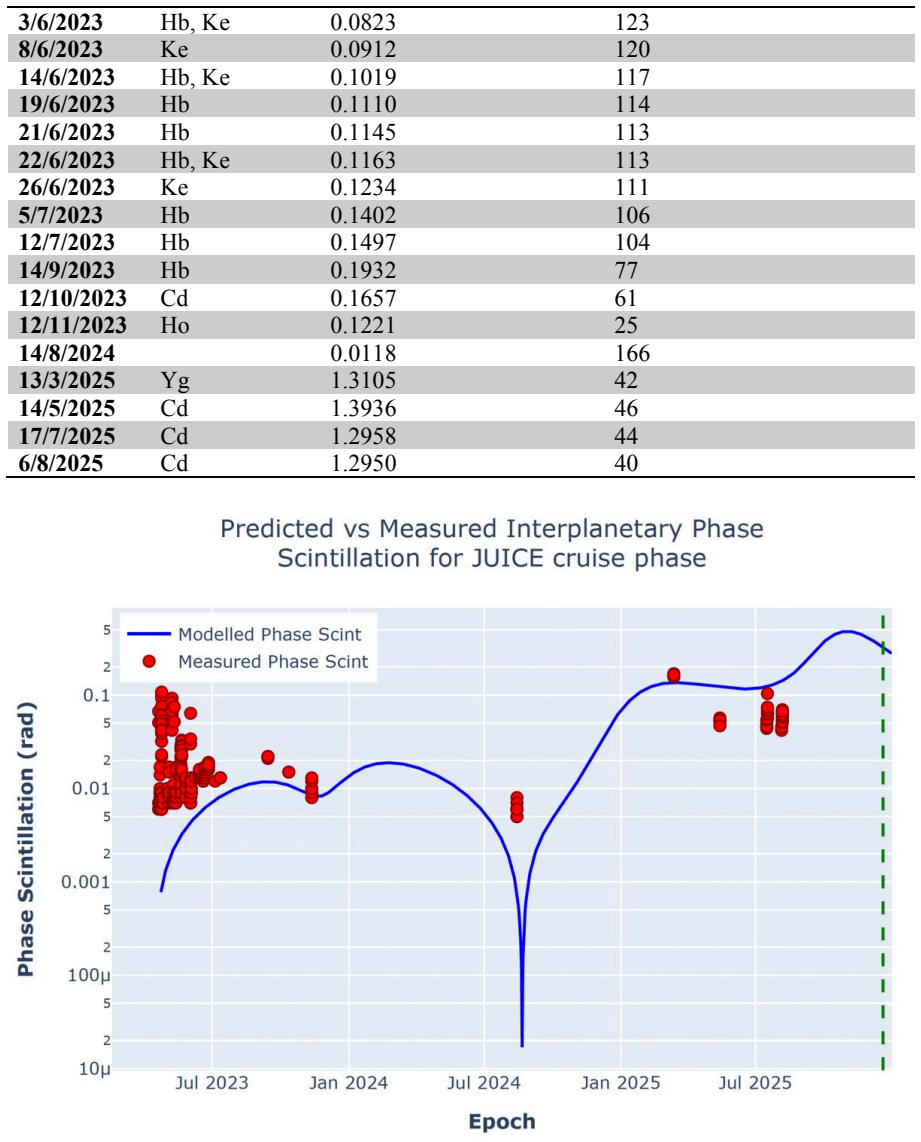
The JUpiter ICy moons Explorer (JUICE) mission, launched by the European Space Agency (ESA) in April 2023, represents one of the most ambitious deep space exploration endeavours targeting Jupiter's icy moons. This paper presents results from the Very Long Baseline Interferometry (VLBI) radio telescope tracking conducted by the University of Tasmania during the first two years of JUICE's cruise phase operations. We have conducted over 100 tracking sessions capturing the spacecraft across different orbital regimes as JUICE progresses through its complex cruise trajectory towards Jupiter. Our analysis focuses on three key areas: Doppler residual characterisation, mission performance indicator extraction, and solar wind scintillation pattern analysis (including space weather forecasting). UTAS measurements demonstrate the enhanced capabilities that VLBI networks provide for deep space mission support, particularly for precision orbit determination and spacecraft health diagnosis. The results showcase the UTAS VLBI array as a valuable complement to traditional tracking infrastructure, offering Southern Hemisphere coverage and enhanced geometric diversity for deep space missions.
Editorial analysis
A structured set of objections, weighed in public.
Referee Report
Summary. The manuscript reports results from over 100 VLBI tracking sessions of the JUICE spacecraft conducted by the University of Tasmania during the first two years of cruise phase. Analysis focuses on Doppler residual characterisation, extraction of mission performance indicators, and solar wind scintillation patterns (including space weather forecasting). The central claim is that these UTAS measurements demonstrate the enhanced capabilities of VLBI networks for deep space mission support, particularly precision orbit determination and spacecraft health diagnosis, positioning the UTAS array as a valuable complement to traditional infrastructure due to Southern Hemisphere coverage and geometric diversity.
Significance. If the reported observations hold and include robust quantitative validation, the work would document VLBI performance across multiple orbital regimes for a major deep-space mission and illustrate the practical value of additional geometric baselines. The large number of sessions (>100) provides a substantial observational dataset for an operational tracking study.
major comments (2)
- [Abstract] Abstract and performance analysis sections: the claim that the measurements 'demonstrate the enhanced capabilities' of VLBI for precision orbit determination is not supported by any direct quantitative comparison (e.g., formal orbit uncertainties, residual RMS, or covariance reduction) between VLBI-augmented solutions and standard two-way Doppler/range tracking from DSN or other baselines.
- [Analysis sections] Doppler residual characterisation and performance indicator sections: the manuscript describes the analysis areas and data collection but supplies no specific quantitative results, error bars, validation methods, or statistical metrics that would allow evaluation of the claimed performance improvements or diagnostic value.
minor comments (2)
- Clarify the exact orbital regimes sampled and the criteria used to select the >100 sessions so that readers can assess representativeness.
- Ensure all figures display axis labels, units, and any error estimates; add a table summarizing key session statistics (duration, SNR, residual statistics) if not already present.
Simulated Author's Rebuttal
We thank the referee for the constructive review. We address each major comment below, indicating where revisions will be made to improve the manuscript.
read point-by-point responses
-
Referee: [Abstract] Abstract and performance analysis sections: the claim that the measurements 'demonstrate the enhanced capabilities' of VLBI for precision orbit determination is not supported by any direct quantitative comparison (e.g., formal orbit uncertainties, residual RMS, or covariance reduction) between VLBI-augmented solutions and standard two-way Doppler/range tracking from DSN or other baselines.
Authors: We agree that the abstract claim would be strengthened by direct quantitative comparisons. Our study focuses on characterizing VLBI Doppler residuals from the UTAS array across >100 sessions and deriving associated performance indicators and scintillation metrics. However, we lack access to the complete DSN two-way Doppler and range datasets required to compute comparative orbit solutions or covariance reductions. We will revise the abstract and performance sections to more accurately describe the demonstrated VLBI contributions (e.g., residual statistics and geometric diversity) without overstating orbit-determination improvements, and we will add explicit quantitative residual metrics and validation details already present in our figures. revision: partial
-
Referee: [Analysis sections] Doppler residual characterisation and performance indicator sections: the manuscript describes the analysis areas and data collection but supplies no specific quantitative results, error bars, validation methods, or statistical metrics that would allow evaluation of the claimed performance improvements or diagnostic value.
Authors: We will expand the text in the revised manuscript to explicitly quote the numerical residual RMS values, error bars, statistical distributions, and validation approaches (including consistency checks against expected solar-wind models) that are shown graphically. This will make the quantitative content of the Doppler characterisation and performance-indicator sections fully self-contained and evaluable. revision: yes
- Direct quantitative comparison of VLBI-augmented versus DSN-only orbit solutions is not feasible because the authors do not have access to the full proprietary DSN tracking dataset for JUICE cruise phase.
Circularity Check
Purely observational reporting; no derivation chain or fitted predictions present
full rationale
The paper reports results from >100 VLBI tracking sessions on JUICE, covering Doppler residuals, performance indicators, and scintillation analysis. No equations, first-principles derivations, parameter fits, or predictions are described that could reduce to inputs by construction. The central claim of 'enhanced capabilities' is presented as an interpretation of the observational data rather than a derived result. No self-citations, ansatzes, or uniqueness theorems are invoked in a load-bearing way. This matches the default expectation of a non-circular empirical report.
Axiom & Free-Parameter Ledger
Reference graph
Works this paper leans on
-
[1]
Overview of the coordinated ground-based observations of Titan during the Huygens mission,
O. Witasse et al., “Overview of the coordinated ground-based observations of Titan during the Huygens mission,” Journal of Geophysical Research: Planets, vol. 111, no. E7, 2006, doi: 10.1029/2005JE002640
-
[2]
Venus Express radio occultation observed by PRIDE,
T. M. Bocanegra-Bahamón et al., “Venus Express radio occultation observed by PRIDE,” A&A, vol. 624, p. A59, Apr. 2019, doi: 10.1051/0004-6361/201833160
-
[3]
D. A. Duev et al., “Planetary Radio Interferometry and Doppler Experiment (PRIDE) technique: A test case of the Mars Express Phobos fly-by,” A&A, vol. 593, p. A34, Sept. 2016, doi: 10.1051/0004-6361/201628869
-
[4]
Observations and analysis of phase scintillation of spacecraft signal on the interplanetary plasma,
G. Molera Calvés et al., “Observations and analysis of phase scintillation of spacecraft signal on the interplanetary plasma,” A&A, vol. 564, p. A4, Apr. 2014, doi: 10.1051/0004- 6361/201322925
-
[5]
Planetary Radio Interferometry and Doppler Experiment (PRIDE) of the JUICE Mission,
L. I. Gurvits et al., “Planetary Radio Interferometry and Doppler Experiment (PRIDE) of the JUICE Mission,” Space Sci Rev, vol. 219, no. 8, p. 79, Dec. 2023, doi: 10.1007/s11214-023- 01026-1
-
[6]
Implementing the PRIDE technique for the JUICE mission at the University of Tasmania,
O. J. White, G. Molera Calvés, and J. Edwards, “Implementing the PRIDE technique for the JUICE mission at the University of Tasmania,” Proceedings from 23rd Australian Space Research Conference, pp. 53–64, 2025, doi: 10.48550/arXiv.2509.02888
-
[7]
T. M. Bocanegra-Bahamón et al., “Planetary Radio Interferometry and Doppler Experiment (PRIDE) technique: A test case of the Mars Express Phobos Flyby - II. Doppler tracking: Formulation of observed and computed values, and noise budget,” A&A, vol. 609, p. A59, Jan. 2018, doi: 10.1051/0004-6361/201731524
-
[8]
A. T. Deller, S. J. Tingay, M. Bailes, and C. West, “DiFX: A Software Correlator for Very Long Baseline Interferometry Using Multiprocessor Computing Environments,” PASP, vol. 119, no. 853, p. 318, Feb. 2007, doi: 10.1086/513572
-
[9]
Difxcalc - Calc11 for the DiFX Correlator,
D. Gordon, W. Brisken, and W. Max-Moerbeck, “Difxcalc - Calc11 for the DiFX Correlator,” presented at the New Horizons with VGOS, Dec. 2016, pp. 187–192
2016
-
[10]
Spacecraft VLBI and Doppler tracking: algorithms and implementation,
D. A. Duev, et al., “Spacecraft VLBI and Doppler tracking: algorithms and implementation,” A&A, vol. 541, p. A43, May 2012, doi: 10.1051/0004-6361/201218885
-
[11]
G. Molera Calvés et al., “High spectral resolution multi-tone Spacecraft Doppler tracking software: Algorithms and implementations,” Publications of the Astronomical Society of Australia, vol. 38, p. e065, Jan. 2021, doi: 10.1017/pasa.2021.56
-
[12]
P. Kummamuru et al., “A monitoring campaign (2013–2020) of ESA’s Mars Express to study interplanetary plasma scintillation,” Publ. Astron. Soc. Aust., vol. 40, p. e013, 2023, doi: 10.1017/pasa.2023.12
-
[13]
J. Edwards, G. M. Calvés, J. Morgan, and M. Cheung, “An Analysis of a Coronal Mass Ejection Leading Edge by Means of Multi-Spacecraft-in-Beam Phase Scintillation,” Dec. 03, 2025, arXiv: arXiv:2512.04337. doi: 10.48550/arXiv.2512.04337
-
[14]
L. Gisolfi, et al. “Open-Source High-Fidelity Orbit Estimation for Planetary Science and Space Situational Awareness Using the Tudat Software”, IAC, 2025, https://arxiv.org/html/2510.23179
-
[15]
Observations of the interplanetary plasma,
W. I. Axford, “Observations of the interplanetary plasma,” Space Sci Rev, vol. 8, no. 3, pp. 331–365, Jul. 1968, doi: 10.1007/BF00184740
-
[16]
An Improved Solar Wind Electron Density Model for Pulsar Timing,
X. P. You, G. B. Hobbs, W. A. Coles, R. N. Manchester, and J. L. Han, “An Improved Solar Wind Electron Density Model for Pulsar Timing,” ApJ, vol. 671, no. 1, p. 907, Dec. 2007, doi: 10.1086/522227
discussion (0)
Sign in with ORCID, Apple, or X to comment. Anyone can read and Pith papers without signing in.