Partial Skeleton Visibility for Action Recognition: A Constrained Field-of-View Approach
Pith reviewed 2026-07-02 14:43 UTC · model grok-4.3
The pith
A hypergraph model with visibility gating recognizes actions accurately even when many skeleton joints are missing due to limited field of view.
A machine-rendered reading of the paper's core claim, the machinery that carries it, and where it could break.
Core claim
PartialVisGraph builds highly expressive hypergraphs by introducing learnable virtual hyperedges that form a soft incidence matrix to capture high-order dependencies. It then uses the Single-Head Sample-Adaptive Transformer to adaptively aggregate joint features onto hyperedges while explicitly incorporating a visibility prior that gates information flow from occluded joints. This approach enables robust action recognition under constrained field-of-view conditions on NTU RGB+D benchmarks.
What carries the argument
Learnable virtual hyperedges forming a soft incidence matrix in a hypergraph framework, paired with a Single-Head Sample-Adaptive Transformer that incorporates an explicit visibility prior to gate feature propagation.
If this is right
- Consistently achieves state-of-the-art accuracy under partial visibility with gains up to 68.8% on severe FoV restriction subsets.
- Remains superior to baselines on full-visibility settings as well.
- Establishes rigorous evaluation protocols with realistic FoV simulation on NTU RGB+D 60 and 120.
- Offers a pathway toward deployable skeleton-based action understanding in unconstrained environments.
Where Pith is reading between the lines
- The visibility prior mechanism could potentially apply to other graph neural network tasks involving incomplete data.
- Testing on real-world egocentric or crowded scene videos would verify if simulated FoV training transfers directly.
- The hypergraph construction might improve performance in other skeleton-related tasks like pose estimation under occlusion.
Load-bearing premise
That the visibility prior and virtual hyperedges learned from simulated FoV data will generalize to real constrained field-of-view scenarios without domain-specific adjustments.
What would settle it
Running the model on a dataset of real egocentric videos with actual limited field-of-view and checking if the reported accuracy gains over baselines hold.
Figures


read the original abstract
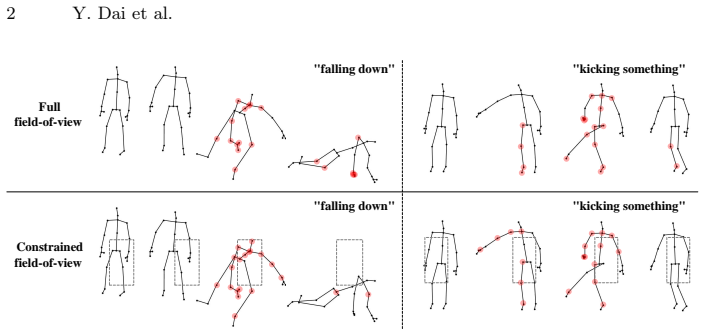
Skeleton-based action recognition has achieved remarkable success by exploiting joint coordinates and their topological connections, yet prevailing methods overwhelmingly assume complete and clean skeleton inputs. In real-world deployments, such as egocentric vision, crowded surveillance, wearable devices, or edge robotics, limited field-of-view (FoV) frequently causes substantial joint visibility dropout, leading to severe performance degradation that existing models are largely unprepared to handle. To bridge this critical yet underexplored gap, we introduce PartialVisGraph, a novel hypergraph framework tailored for robust skeleton action recognition under constrained FoV. We first construct highly expressive hypergraphs by introducing learnable virtual hyperedges that form a soft incidence matrix, capturing flexible high-order dependencies beyond conventional pairwise graphs. We then propose the Single-Head Sample-Adaptive Transformer, which adaptively aggregates joint features onto hyperedges while explicitly incorporating a visibility prior. This prior selectively gates information flow, preventing occluded or out-of-view joints from corrupting reliable feature propagation. We further establish rigorous evaluation protocols with realistic FoV simulation benchmarks on NTU RGB+D 60 and 120. Extensive experiments demonstrate that PartialVisGraph consistently achieves state-of-the-art accuracy under partial visibility, with gains of up to 68.8\% on subsets with severe FoV restrictions compared to recent strong baselines, while remaining superior on full-visibility settings. Our approach offers a principled and practical pathway toward deployable skeleton-based action understanding in unconstrained environments.
Editorial analysis
A structured set of objections, weighed in public.
Referee Report
Summary. The manuscript introduces PartialVisGraph, a hypergraph framework for skeleton-based action recognition under constrained field-of-view (FoV) conditions that cause joint visibility dropout. It constructs expressive hypergraphs via learnable virtual hyperedges that form a soft incidence matrix to capture high-order dependencies, and proposes a Single-Head Sample-Adaptive Transformer that adaptively aggregates features while incorporating an explicit visibility prior to gate information from occluded joints. The work establishes FoV simulation benchmarks on NTU RGB+D 60/120 and reports state-of-the-art accuracy under partial visibility (gains up to 68.8% on severe restrictions) as well as superiority on full-visibility settings, positioning the method as a pathway to deployable systems in unconstrained environments.
Significance. If the performance claims are substantiated beyond the current simulated benchmarks, the paper would make a meaningful contribution by addressing a practical gap in skeleton action recognition for real-world settings such as egocentric vision, surveillance, and robotics. The combination of hypergraph modeling with virtual hyperedges and an explicit visibility prior offers a distinct approach to incomplete skeleton data. Establishing simulation protocols is a useful step, though the overall significance depends on whether the method generalizes beyond the authors' particular synthetic masking protocol.
major comments (2)
- [Evaluation protocols] Evaluation section (and abstract claims): The central performance assertions, including up to 68.8% gains and the 'practical pathway toward deployable' conclusion, rest entirely on simulated FoV benchmarks on NTU RGB+D 60/120. No experiments validate the visibility prior or learnable virtual hyperedges against real-world constrained FoV data (e.g., actual egocentric camera dropout, body self-occlusion geometry, or multi-person crowding), which directly undermines the generalization assumption highlighted in the stress-test note.
- [Abstract] Abstract and method description: The reported gains lack accompanying details on baseline implementations, statistical significance across runs, or ablation studies that isolate the contribution of the Single-Head Sample-Adaptive Transformer versus the soft incidence matrix. Without these, it is impossible to determine whether the improvements are robust or arise from the specific simulation protocol.
minor comments (1)
- [Methods] The description of the soft incidence matrix and visibility prior would benefit from explicit equations or pseudocode in the methods section to clarify how the gating is implemented.
Simulated Author's Rebuttal
We thank the referee for the constructive feedback. We address the two major comments point by point below, providing our responses and indicating planned revisions where appropriate.
read point-by-point responses
-
Referee: [Evaluation protocols] Evaluation section (and abstract claims): The central performance assertions, including up to 68.8% gains and the 'practical pathway toward deployable' conclusion, rest entirely on simulated FoV benchmarks on NTU RGB+D 60/120. No experiments validate the visibility prior or learnable virtual hyperedges against real-world constrained FoV data (e.g., actual egocentric camera dropout, body self-occlusion geometry, or multi-person crowding), which directly undermines the generalization assumption highlighted in the stress-test note.
Authors: We agree that all reported results rely on our proposed FoV simulation protocol rather than real captured data with partial visibility. No public datasets currently provide ground-truth skeleton sequences under controlled real-world FoV dropout (egocentric cameras, self-occlusion, crowding). The simulation is constructed from geometric camera models to approximate these effects, and the paper positions the benchmarks themselves as a contribution. We will revise the abstract and conclusion to explicitly state that claims are conditioned on the simulation protocol and to add a dedicated limitations paragraph discussing the gap to real-world deployment. This addresses the concern without overstating generalization. revision: partial
-
Referee: [Abstract] Abstract and method description: The reported gains lack accompanying details on baseline implementations, statistical significance across runs, or ablation studies that isolate the contribution of the Single-Head Sample-Adaptive Transformer versus the soft incidence matrix. Without these, it is impossible to determine whether the improvements are robust or arise from the specific simulation protocol.
Authors: The full manuscript contains an experimental setup section that specifies baseline re-implementations (using official code where available, with hyper-parameters matched to the original papers), reports mean accuracy and standard deviation over five random seeds, and includes ablation tables (Section 4.3) that separately disable the learnable virtual hyperedges, the soft incidence matrix, and the visibility prior gating. We will expand the abstract by one sentence to reference these elements and ensure the main claims are qualified by the supporting experimental evidence already present in the paper. revision: yes
Circularity Check
No significant circularity; method and benchmarks are independently defined
full rationale
The paper introduces distinct architectural elements (learnable virtual hyperedges forming a soft incidence matrix, Single-Head Sample-Adaptive Transformer with explicit visibility prior) and new evaluation protocols (FoV simulation benchmarks on NTU RGB+D 60/120). No equations or claims reduce by construction to fitted parameters, self-definitions, or self-citation chains. Central performance claims rest on empirical comparisons rather than tautological redefinitions. The reader's assessment of score 2.0 is consistent with the absence of load-bearing circular steps.
Axiom & Free-Parameter Ledger
Reference graph
Works this paper leans on
-
[1]
Pattern Recognition110, 107637 (2021)
Bai, S., Zhang, F., Torr, P.H.: Hypergraph convolution and hypergraph attention. Pattern Recognition110, 107637 (2021)
work page 2021
-
[2]
In: 2023 International Joint Conference on Neural Networks (IJCNN)
Banik, S., Gschoßmann, P., García, A.M., Knoll, A.: Occlusion robust 3d human pose estimation with stridedposegraphformer and data augmentation. In: 2023 International Joint Conference on Neural Networks (IJCNN). pp. 1–8. IEEE (2023)
work page 2023
-
[3]
In: Pro- ceedings ofthe 26thannualinternational conference on machine learning.pp
Bengio, Y., Louradour, J., Collobert, R., Weston, J.: Curriculum learning. In: Pro- ceedings ofthe 26thannualinternational conference on machine learning.pp. 41–48 (2009)
work page 2009
-
[4]
Chan, W., Tian, Z., Wu, Y.: Gas-gcn: Gated action-specific graph convolutional networks for skeleton-based action recognition. Sensors20(12), 3499 (2020)
work page 2020
-
[5]
In: Proceedings of the Computer Vision and Pattern Recognition Conference
Chen, Y., Guo, J., Guo, S., Tao, D.: Neuron: Learning context-aware evolving representations for zero-shot skeleton action recognition. In: Proceedings of the Computer Vision and Pattern Recognition Conference. pp. 8721–8730 (2025)
work page 2025
-
[6]
In: Proceedings of the IEEE/CVF international conference on computer vision
Chen, Y., Zhang, Z., Yuan, C., Li, B., Deng, Y., Hu, W.: Channel-wise topology refinement graph convolution for skeleton-based action recognition. In: Proceedings of the IEEE/CVF international conference on computer vision. pp. 13359–13368 (2021)
work page 2021
-
[7]
In: Proceedings of the AAAI conference on artificial intelligence
Chen, Z., Li, S., Yang, B., Li, Q., Liu, H.: Multi-scale spatial temporal graph convolutional network for skeleton-based action recognition. In: Proceedings of the AAAI conference on artificial intelligence. vol. 35, pp. 1113–1122 (2021)
work page 2021
-
[8]
In: Proceedings of the 31st ACM International Con- ference on Multimedia
Chen, Z., Wang, H., Gui, J.: Occluded skeleton-based human action recognition with dual inhibition training. In: Proceedings of the 31st ACM International Con- ference on Multimedia. pp. 2625–2634 (2023) 16 Y. Dai et al
work page 2023
-
[9]
In: European conference on computer vision
Cheng, K., Zhang, Y., Cao, C., Shi, L., Cheng, J., Lu, H.: Decoupling gcn with dropgraph module for skeleton-based action recognition. In: European conference on computer vision. pp. 536–553. Springer (2020)
work page 2020
-
[10]
In: Proceedings of the IEEE/CVF conference on computer vision and pattern recognition
Chi, H.g., Ha, M.H., Chi, S., Lee, S.W., Huang, Q., Ramani, K.: Infogcn: Repre- sentation learning for human skeleton-based action recognition. In: Proceedings of the IEEE/CVF conference on computer vision and pattern recognition. pp. 20186– 20196 (2022)
work page 2022
-
[11]
In: European Conference on Computer Vision
Choi, H., Moon, G., Lee, K.M.: Pose2mesh: Graph convolutional network for 3d human pose and mesh recovery from a 2d human pose. In: European Conference on Computer Vision. pp. 769–787. Springer (2020)
work page 2020
-
[12]
In: European Conference on Computer Vision
Do, J., Kim, M.: Skateformer: skeletal-temporal transformer for human action recognition. In: European Conference on Computer Vision. pp. 401–420. Springer (2024)
work page 2024
-
[13]
In: Proceedings of the IEEE/CVF International Conference on Computer Vision
Do, J., Kim, M.: Bridging the skeleton-text modality gap: Diffusion-powered modality alignment for zero-shot skeleton-based action recognition. In: Proceedings of the IEEE/CVF International Conference on Computer Vision. pp. 12757–12768 (2025)
work page 2025
-
[14]
In: Proceedings of the 30th ACM international conference on multimedia
Duan, H., Wang, J., Chen, K., Lin, D.: Pyskl: Towards good practices for skeleton action recognition. In: Proceedings of the 30th ACM international conference on multimedia. pp. 7351–7354 (2022)
work page 2022
-
[15]
In: Proceedings of the AAAI conference on artificial intelligence
Feng, Y., You, H., Zhang, Z., Ji, R., Gao, Y.: Hypergraph neural networks. In: Proceedings of the AAAI conference on artificial intelligence. vol. 33, pp. 3558– 3565 (2019)
work page 2019
-
[16]
Computers, Materials & Continua83(1) (2025)
Gao, Y., Duan, X., Dai, Q.: Skeleton-based action recognition using graph convolu- tional network with pose correction and channel topology refinement. Computers, Materials & Continua83(1) (2025)
work page 2025
-
[17]
In: Proceedings of the IEEE/CVF International Conference on Computer Vision
Hao, X., Li, H.: Perspose: 3d human pose estimation with perspective encoding and perspective rotation. In: Proceedings of the IEEE/CVF International Conference on Computer Vision. pp. 8110–8119 (2025)
work page 2025
-
[18]
Semi-Supervised Classification with Graph Convolutional Networks
Kipf, T.N., Welling, M.: Semi-supervised classification with graph convolutional networks. arXiv preprint arXiv:1609.02907 (2016)
work page internal anchor Pith review Pith/arXiv arXiv 2016
-
[19]
In: Proceedings of the IEEE/CVF international conference on computer vision
Lee, J., Lee, M., Lee, D., Lee, S.: Hierarchically decomposed graph convolutional networks for skeleton-based action recognition. In: Proceedings of the IEEE/CVF international conference on computer vision. pp. 10444–10453 (2023)
work page 2023
-
[20]
In: European conference on computer vision
Li, S.W., Wei, Z.X., Chen, W.J., Yu, Y.H., Yang, C.Y., Hsu, J.Y.j.: Sa-dvae: Im- proving zero-shot skeleton-based action recognition by disentangled variational au- toencoders. In: European conference on computer vision. pp. 447–462. Springer (2024)
work page 2024
-
[21]
In: European Conference on Computer Vision
Li, Z., Chang, X., Li, Y., Su, J.: Skeleton-based group activity recognition via spatial-temporal panoramic graph. In: European Conference on Computer Vision. pp. 252–269. Springer (2024)
work page 2024
-
[22]
In: Proceedings of the Computer Vision and Pattern Recognition Conference
Liu, H., Liu, Y., Ren, M., Wang, H., Wang, Y., Sun, Z.: Revealing key details to see differences: A novel prototypical perspective for skeleton-based action recognition. In: Proceedings of the Computer Vision and Pattern Recognition Conference. pp. 29248–29257 (2025)
work page 2025
-
[23]
IEEE trans- actions on pattern analysis and machine intelligence42(10), 2684–2701 (2019)
Liu, J., Shahroudy, A., Perez, M., Wang, G., Duan, L.Y., Kot, A.C.: Ntu rgb+ d 120: A large-scale benchmark for 3d human activity understanding. IEEE trans- actions on pattern analysis and machine intelligence42(10), 2684–2701 (2019)
work page 2019
-
[24]
Liu, Z., Zhang, H., Chen, Z., Wang, Z., Ouyang, W.: Disentangling and unifying graph convolutions for skeleton-based action recognition. In: Proceedings of the Partial Skeleton Visibility for Action Recognition 17 IEEE/CVF conference on computer vision and pattern recognition. pp. 143–152 (2020)
work page 2020
-
[25]
In: European Conference on Computer Vision
Ma, N., Zhang, H., Li, X., Zhou, S., Zhang, Z., Wen, J., Li, H., Gu, J., Bu, J.: Learning spatial-preserved skeleton representations for few-shot action recognition. In: European Conference on Computer Vision. pp. 174–191. Springer (2022)
work page 2022
-
[26]
In: Proceedings of the IEEE international conference on computer vision
Martinez, J., Hossain, R., Romero, J., Little, J.J.: A simple yet effective baseline for 3d human pose estimation. In: Proceedings of the IEEE international conference on computer vision. pp. 2640–2649 (2017)
work page 2017
-
[27]
Mehak,S.,Kelleher,J.D.,Guilfoyle,M.,Leva,M.C.:Actionrecognitionforhuman– robot teaming: Exploring mutual performance monitoring possibilities. Machines 12(1), 45 (2024)
work page 2024
-
[28]
In: Proceedings of the IEEE/CVF conference on computer vision and pattern recognition
Pavllo, D., Feichtenhofer, C., Grangier, D., Auli, M.: 3d human pose estimation in video with temporal convolutions and semi-supervised training. In: Proceedings of the IEEE/CVF conference on computer vision and pattern recognition. pp. 7753– 7762 (2019)
work page 2019
-
[29]
Pattern Recognition53, 130–147 (2016)
Presti,L.L.,LaCascia,M.:3dskeleton-basedhumanactionclassification:Asurvey. Pattern Recognition53, 130–147 (2016)
work page 2016
-
[30]
Visual Intelligence2(1), 27 (2024)
Rajendran, M., Tan, C.T., Atmosukarto, I., Ng, A.B., See, S.: Review on syner- gizing the metaverse and ai-driven synthetic data: enhancing virtual realms and activity recognition in computer vision. Visual Intelligence2(1), 27 (2024)
work page 2024
-
[31]
Cyborg and Bionic Systems5, 0100 (2024)
Ren, B., Liu, M., Ding, R., Liu, H.: A survey on 3d skeleton-based action recogni- tion using learning method. Cyborg and Bionic Systems5, 0100 (2024)
work page 2024
-
[32]
In: Proceedings of the IEEE conference on computer vision and pattern recognition
Shahroudy, A., Liu, J., Ng, T.T., Wang, G.: Ntu rgb+ d: A large scale dataset for 3d human activity analysis. In: Proceedings of the IEEE conference on computer vision and pattern recognition. pp. 1010–1019 (2016)
work page 2016
-
[33]
In: Proceedings of the IEEE/CVF conference on computer vision and pattern recognition
Shi, L., Zhang, Y., Cheng, J., Lu, H.: Skeleton-based action recognition with di- rected graph neural networks. In: Proceedings of the IEEE/CVF conference on computer vision and pattern recognition. pp. 7912–7921 (2019)
work page 2019
-
[34]
In: Proceedings of the IEEE/CVF conference on computer vision and pattern recognition
Shi, L., Zhang, Y., Cheng, J., Lu, H.: Two-stream adaptive graph convolutional networks for skeleton-based action recognition. In: Proceedings of the IEEE/CVF conference on computer vision and pattern recognition. pp. 12026–12035 (2019)
work page 2019
-
[35]
IEEE Transactions on Industrial Informatics19(10), 10288–10298 (2023)
Shi, W., Li, D., Wen, Y., Yang, W.: Occlusion-aware graph neural networks for skeleton action recognition. IEEE Transactions on Industrial Informatics19(10), 10288–10298 (2023)
work page 2023
-
[36]
IEEE Transactions on Cir- cuits and Systems for Video Technology31(5), 1915–1925 (2020)
Song, Y.F., Zhang, Z., Shan, C., Wang, L.: Richly activated graph convolutional network for robust skeleton-based action recognition. IEEE Transactions on Cir- cuits and Systems for Video Technology31(5), 1915–1925 (2020)
work page 1915
-
[37]
CAAI Artificial Intelligence Research3(9150042), 1 (2024)
Sun, F., Chen, R., Ji, T., Luo, Y., Zhou, H., Liu, H.: A comprehensive survey on embodied intelligence: Advancements, challenges, and future perspectives. CAAI Artificial Intelligence Research3(9150042), 1 (2024)
work page 2024
-
[38]
IEEE transactions on pattern analysis and machine intelligence45(3), 3200–3225 (2022)
Sun, Z., Ke, Q., Rahmani, H., Bennamoun, M., Wang, G., Liu, J.: Human action recognition from various data modalities: A review. IEEE transactions on pattern analysis and machine intelligence45(3), 3200–3225 (2022)
work page 2022
-
[39]
Part-based Graph Convolutional Network for Action Recognition
Thakkar, K., Narayanan, P.: Part-based graph convolutional network for action recognition. arXiv preprint arXiv:1809.04983 (2018)
work page internal anchor Pith review Pith/arXiv arXiv 2018
-
[40]
Advances in neural information pro- cessing systems30(2017)
Vaswani,A.,Shazeer,N.,Parmar,N.,Uszkoreit,J.,Jones,L.,Gomez,A.N.,Kaiser, Ł., Polosukhin, I.: Attention is all you need. Advances in neural information pro- cessing systems30(2017)
work page 2017
-
[41]
IEEE Access10, 41403–41410 (2022) 18 Y
Wang, Q., Zhang, K., Asghar, M.A.: Skeleton-based st-gcn for human action recog- nition with extended skeleton graph and partitioning strategy. IEEE Access10, 41403–41410 (2022) 18 Y. Dai et al
work page 2022
-
[42]
In: Proceedings of the AAAI conference on ar- tificial intelligence
Yan, S., Xiong, Y., Lin, D.: Spatial temporal graph convolutional networks for skeleton-based action recognition. In: Proceedings of the AAAI conference on ar- tificial intelligence. vol. 32 (2018)
work page 2018
-
[43]
In: European Conference on Computer Vision
Yan, T., Zeng, W., Xiao, Y., Tong, X., Tan, B., Fang, Z., Cao, Z., Zhou, J.T.: Crossglg: Llm guides one-shot skeleton-based 3d action recognition in a cross- level manner. In: European Conference on Computer Vision. pp. 113–131. Springer (2024)
work page 2024
-
[44]
In: Proceedings of the 28th ACM international conference on multimedia
Ye, F., Pu, S., Zhong, Q., Li, C., Xie, D., Tang, H.: Dynamic gcn: Context-enriched topology learning for skeleton-based action recognition. In: Proceedings of the 28th ACM international conference on multimedia. pp. 55–63 (2020)
work page 2020
-
[45]
Journal of Advanced Computational Intelligence and Intelligent Informatics27(5), 790–800 (2023)
Yu, Q., Dai, Y., Hirota, K., Shao, S., Dai, W.: Shuffle graph convolutional net- work for skeleton-based action recognition. Journal of Advanced Computational Intelligence and Intelligent Informatics27(5), 790–800 (2023)
work page 2023
-
[46]
In: Proceedings of the IEEE/CVF international conference on computer vision
Yun, S., Han, D., Oh, S.J., Chun, S., Choe, J., Yoo, Y.: Cutmix: Regularization strategy to train strong classifiers with localizable features. In: Proceedings of the IEEE/CVF international conference on computer vision. pp. 6023–6032 (2019)
work page 2019
-
[47]
In: European Conference on Computer Vision
Zheng, Q., Yu, Y., Yang, S., Liu, J., Lam, K.Y., Kot, A.: Towards physical world backdoor attacks against skeleton action recognition. In: European Conference on Computer Vision. pp. 215–233. Springer (2024)
work page 2024
-
[48]
In: Proceedings of the IEEE/CVF conference on com- puter vision and pattern recognition
Zhou, H., Liu, Q., Wang, Y.: Learning discriminative representations for skeleton based action recognition. In: Proceedings of the IEEE/CVF conference on com- puter vision and pattern recognition. pp. 10608–10617 (2023)
work page 2023
-
[49]
In: Proceedings of the IEEE/CVF International Conference on Computer Vision
Zhou, Y., Xu, T., Wu, C., Wu, X., Kittler, J.: Adaptive hyper-graph convolution network for skeleton-based human action recognition with virtual connections. In: Proceedings of the IEEE/CVF International Conference on Computer Vision. pp. 12648–12658 (2025)
work page 2025
-
[50]
arXiv preprint arXiv:2211.09590 (2022)
Zhou, Y., Cheng, Z.Q., Li, C., Fang, Y., Geng, Y., Xie, X., Keuper, M.: Hypergraph transformer for skeleton-based action recognition. arXiv preprint arXiv:2211.09590 (2022)
-
[51]
In: Proceedings of the IEEE/CVF conference on computer vision and pattern recognition
Zhou, Y., Yan, X., Cheng, Z.Q., Yan, Y., Dai, Q., Hua, X.S.: Blockgcn: Redefine topology awareness for skeleton-based action recognition. In: Proceedings of the IEEE/CVF conference on computer vision and pattern recognition. pp. 2049–2058 (2024)
work page 2049
-
[52]
In: Proceedings of the IEEE/CVF Conference on Computer Vision and Pattern Recognition
Zhu, A., Ke, Q., Gong, M., Bailey, J.: Part-aware unified representation of language and skeleton for zero-shot action recognition. In: Proceedings of the IEEE/CVF Conference on Computer Vision and Pattern Recognition. pp. 18761–18770 (2024)
work page 2024
-
[53]
In: Proceedings of the IEEE/CVF Conference on Computer Vision and Pattern Recognition
Zhu, A., Zhu, J., Bailey, J., Gong, M., Ke, Q.: Semantic-guided cross-modal prompt learning for skeleton-based zero-shot action recognition. In: Proceedings of the IEEE/CVF Conference on Computer Vision and Pattern Recognition. pp. 13876– 13885 (2025)
work page 2025
discussion (0)
Sign in with ORCID, Apple, or X to comment. Anyone can read and Pith papers without signing in.