LLM-Guided ODE Discovery and Parameter Inference from Small-Cohort Aggregate Data
Pith reviewed 2026-07-02 16:12 UTC · model grok-4.3
The pith
An LLM-guided agent discovers consistent ODE structures and refines parameter distributions from population summary statistics alone.
A machine-rendered reading of the paper's core claim, the machinery that carries it, and where it could break.
Core claim
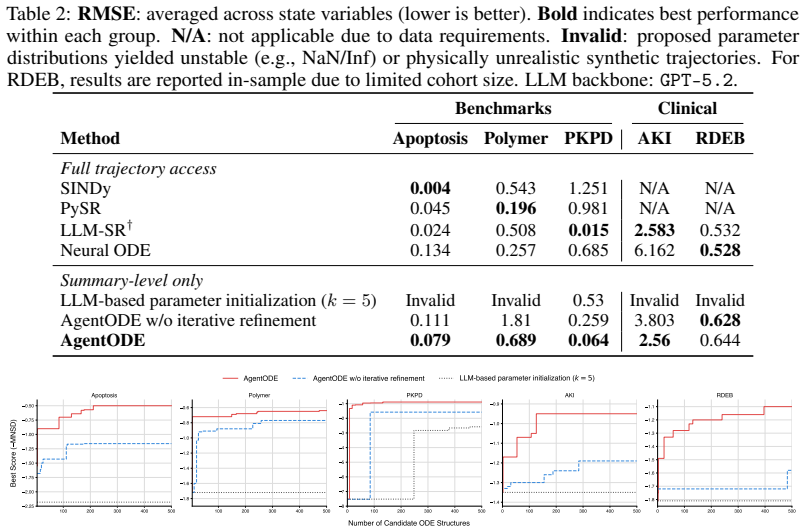
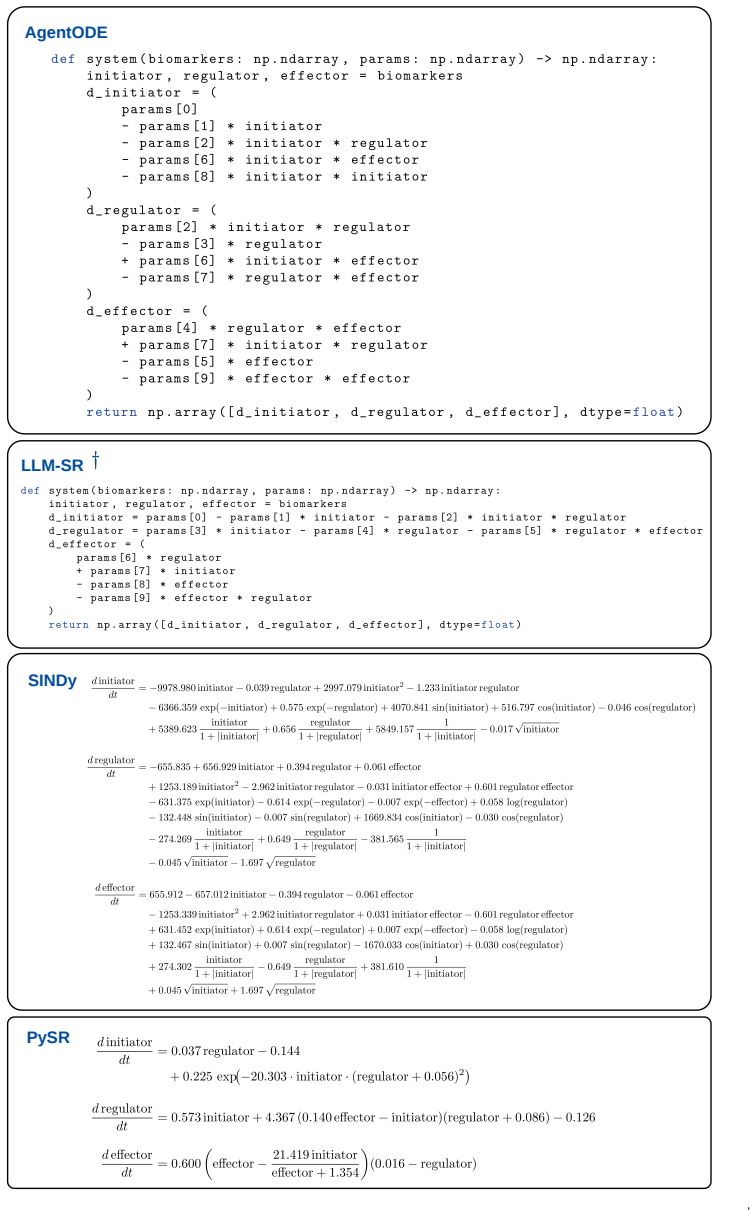
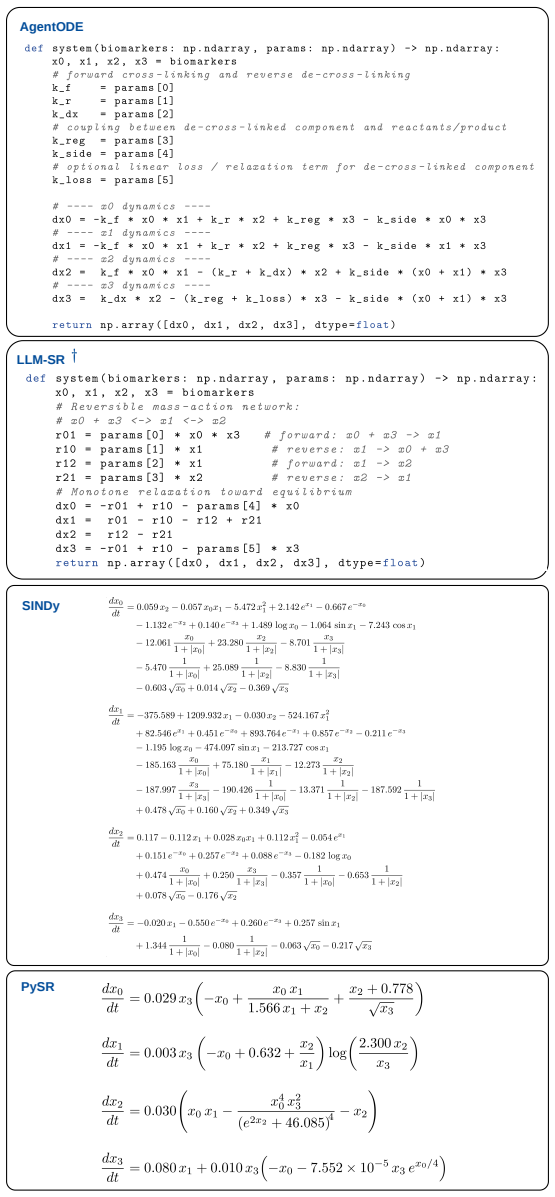
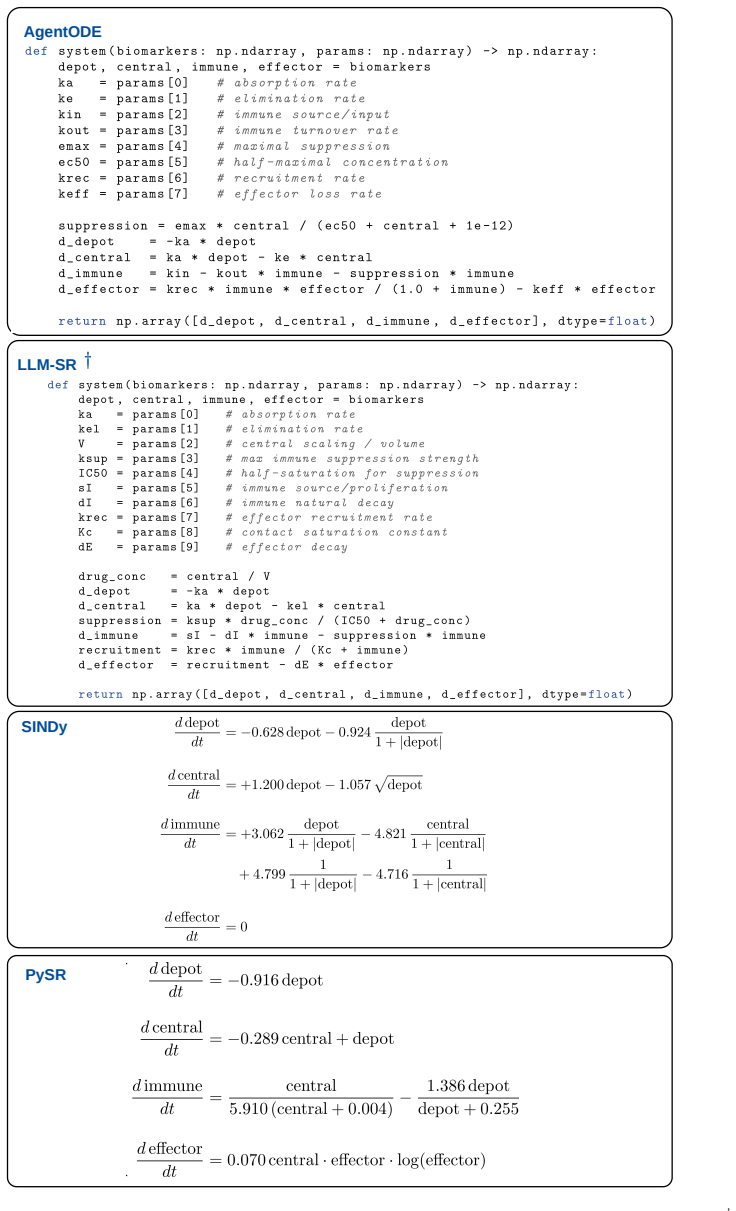
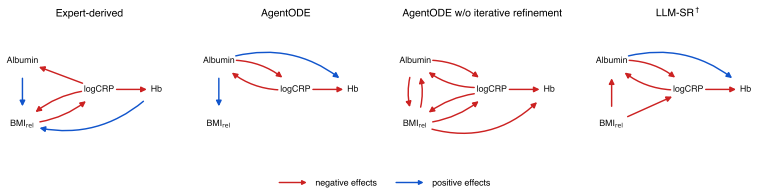
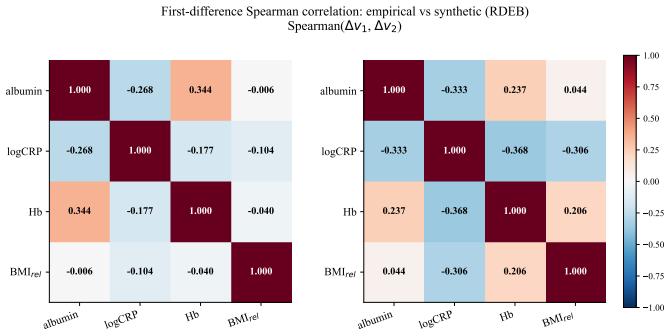
AgentODE recovers functionally consistent ODE structures across all settings, and experiments on RDEB demonstrates that in sparse and noisy data settings reasoning from summary statistics promotes mechanistically principled structure discovery, whereas baselines with individual-level data access recover implausible structures despite better predictive performance.
What carries the argument
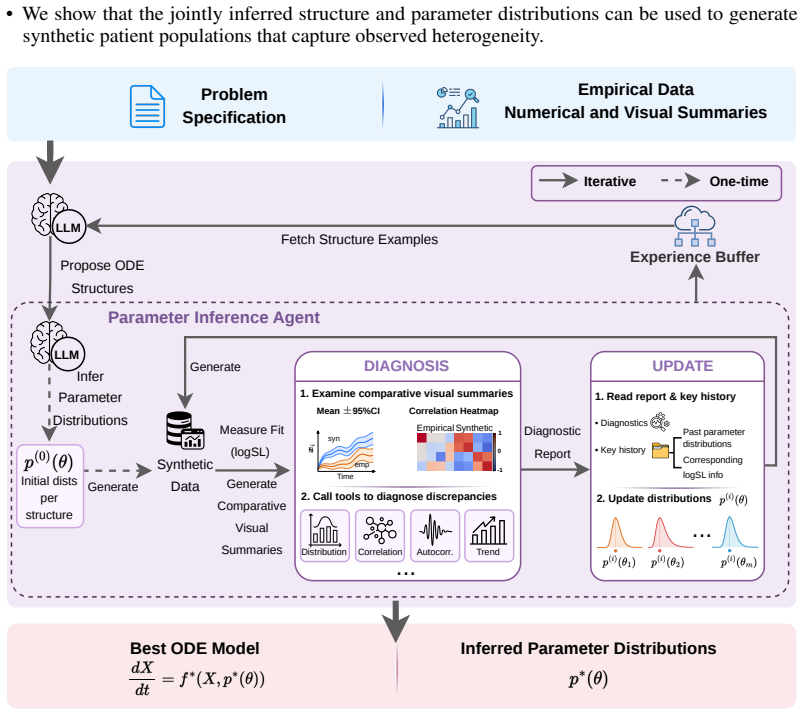
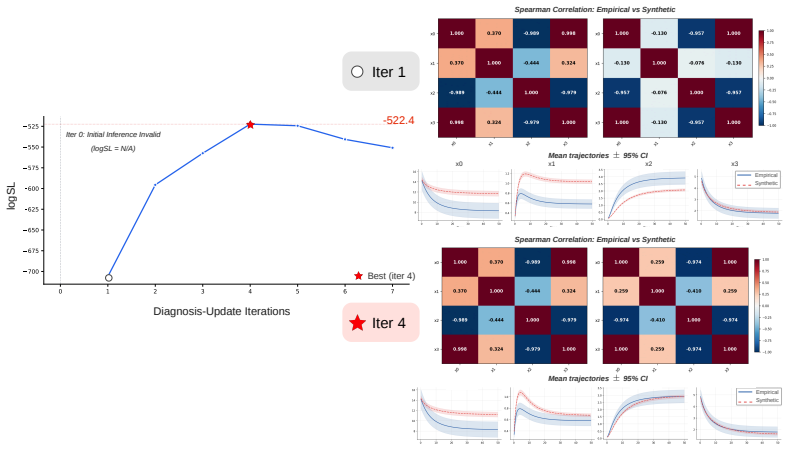
AgentODE, an end-to-end framework in which an LLM proposes candidate ODE structures and a tool-augmented inference agent iteratively refines parameter distributions through a diagnosis-update loop operating solely on population-level summary statistics.
If this is right
- Mechanistic ODE modeling becomes possible for rare diseases under privacy constraints that block individual records.
- Structure discovery can favor functional consistency over predictive accuracy when data are sparse and noisy.
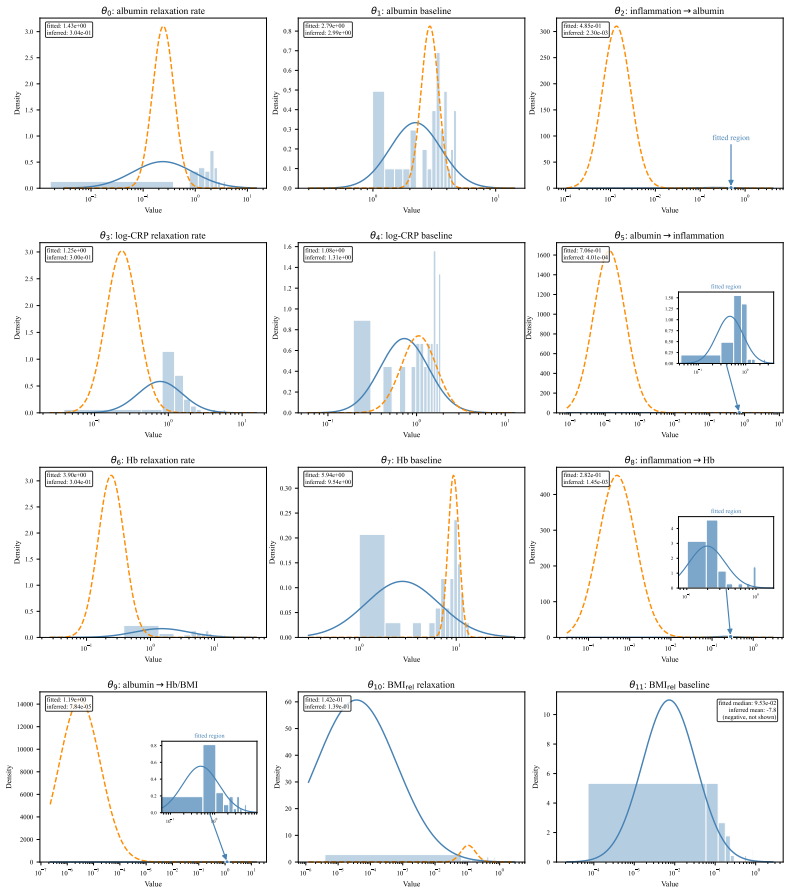
- Parameters can be treated as distributions to capture heterogeneity using only group averages.
Where Pith is reading between the lines
- The approach could extend to other domains that publish only aggregate statistics, such as public health or ecology.
- Systematic tests on additional synthetic systems with known dynamics would quantify how much information summary statistics retain for structure recovery.
- The diagnosis-update loop might be adapted to other model classes beyond ODEs when only summary data are available.
Load-bearing premise
An LLM can generate functionally consistent ODE candidates and the inference agent can iteratively refine parameter distributions accurately from aggregate statistics without any individual-level data.
What would settle it
Apply the full AgentODE pipeline to synthetic data generated from a known ground-truth ODE, supply only the resulting population summary statistics, and check whether the recovered structure is functionally equivalent to the known true equations.
Figures
read the original abstract
Mechanistic modeling via ordinary differential equations (ODEs) provides interpretable descriptions of complex dynamics and enables inference of underlying mechanisms, which is particularly valuable in clinical settings. However, in rare diseases, both the structure and parameters of the model are typically unknown, while individual-level data is scarce, noisy, heterogeneous, and subject to privacy constraints. In such settings, population-level summary statistics provide a practical privacy-preserving data representation, while capturing heterogeneity further requires modeling parameters as distributions rather than fixed values. Yet no existing method jointly discovers ODE structure and refines parameter distributions solely from summary statistics. We present AgentODE, an end-to-end framework that addresses this gap. An LLM proposes candidate ODE structures, while a tool-augmented inference agent iteratively refines parameter distributions through a diagnosis--update loop, operating on population-level summary statistics alone. We evaluate AgentODE on three benchmark problems across different fields and two clinical datasets, including the rare disease recessive dystrophic epidermolysis bullosa (RDEB), with only 231 observations across 46 patients. AgentODE recovers functionally consistent ODE structures across all settings, and experiments on RDEB demonstrates that in sparse and noisy data settings reasoning from summary statistics promotes mechanistically principled structure discovery, whereas baselines with individual-level data access recover implausible structures despite better predictive performance. AgentODE opens new possibilities for mechanistic modeling of rare diseases directly from population-level summary statistics, where data scarcity and privacy constraints have traditionally limited such analyses.
Editorial analysis
A structured set of objections, weighed in public.
Referee Report
Summary. The paper introduces AgentODE, an end-to-end framework for discovering ODE structures and inferring parameter distributions from small-cohort aggregate (population-level summary) data. An LLM proposes candidate ODE structures while a tool-augmented inference agent iteratively refines parameter distributions via a diagnosis-update loop using only summary statistics. The approach is evaluated on three benchmark problems from different fields plus two clinical datasets, including RDEB (231 observations across 46 patients). The central claims are that AgentODE recovers functionally consistent ODE structures across settings and that, on RDEB data, reasoning from summary statistics yields more mechanistically principled structures than baselines given individual-level data access (despite the latter having better predictive performance).
Significance. If the empirical claims hold, the work addresses a genuine gap in mechanistic modeling under privacy constraints and data scarcity typical of rare diseases. Enabling ODE structure discovery and distributional parameter inference directly from aggregate statistics could open analyses that are currently infeasible. The reported contrast between summary-statistic and individual-level regimes on RDEB is potentially important if the plausibility metric and experimental controls are robust.
major comments (2)
- [Abstract and §4] Abstract and §4 (RDEB experiments): the claim that baselines recover 'implausible structures' while AgentODE recovers 'mechanistically principled' ones is load-bearing for the main contribution, yet the manuscript provides no explicit, reproducible criterion or quantitative score for mechanistic plausibility versus predictive performance. Without this, the comparative conclusion cannot be evaluated.
- [§3] §3 (AgentODE framework): the description of the diagnosis-update loop operating solely on population-level summary statistics is central to the novelty, but the text does not specify the exact form of the summary statistics used, the distance or likelihood function inside the update step, or how the LLM-proposed structures are validated for functional consistency before parameter inference begins.
minor comments (2)
- [Abstract] The abstract states recovery of 'functionally consistent' structures on all benchmarks but does not define the term or report the quantitative metric used; this should be stated explicitly in the main text with a reference to the relevant table or figure.
- Table or figure reporting benchmark results should include both predictive error and the functional-consistency metric side-by-side for all methods to allow direct comparison.
Simulated Author's Rebuttal
We thank the referee for their constructive comments, which help clarify key aspects of the presentation. We respond to each major comment below and indicate where revisions will be made.
read point-by-point responses
-
Referee: [Abstract and §4] Abstract and §4 (RDEB experiments): the claim that baselines recover 'implausible structures' while AgentODE recovers 'mechanistically principled' ones is load-bearing for the main contribution, yet the manuscript provides no explicit, reproducible criterion or quantitative score for mechanistic plausibility versus predictive performance. Without this, the comparative conclusion cannot be evaluated.
Authors: We agree that the distinction between mechanistically principled and implausible structures would benefit from an explicit, reproducible criterion. The original assessment drew on qualitative expert review of biological consistency for the RDEB case. In the revision we will add a dedicated subsection in §4 that defines a scoring rubric (e.g., alignment with known disease pathways, sign consistency of inferred rates, and parameter-range feasibility) together with inter-rater reliability statistics. This will make the comparison with predictive performance metrics fully evaluable. revision: yes
-
Referee: [§3] §3 (AgentODE framework): the description of the diagnosis-update loop operating solely on population-level summary statistics is central to the novelty, but the text does not specify the exact form of the summary statistics used, the distance or likelihood function inside the update step, or how the LLM-proposed structures are validated for functional consistency before parameter inference begins.
Authors: We accept that the current wording in §3 leaves these implementation details underspecified. The summary statistics are the cohort means and standard deviations of each observed variable at the recorded time points. The update step minimizes a weighted Euclidean discrepancy between these observed moments and the corresponding moments obtained by integrating the candidate ODE. Functional consistency is checked by attempting forward integration over the observation window and rejecting any structure that produces numerical divergence or trajectories whose sign pattern contradicts the data. The revised §3 will include explicit formulas, the precise discrepancy measure, and pseudocode for the validation step. revision: yes
Circularity Check
No circularity: framework claims rest on external LLM/agent behavior and empirical evaluation, not self-referential definitions or fits
full rationale
The paper presents AgentODE as an LLM-proposed ODE structure generator plus a tool-augmented agent that iteratively updates parameter distributions from population summary statistics. No equations, derivations, or parameter-fitting steps are described that reduce the claimed outputs (functionally consistent structures, mechanistically principled discovery) to the inputs by construction. The central claims are evaluated on benchmark problems and the RDEB clinical dataset via reported experimental outcomes rather than by re-deriving fitted quantities. No self-citation load-bearing steps, uniqueness theorems, or ansatz smuggling are indicated in the provided material. This matches the default expectation of a non-circular methods paper whose validity hinges on external reproducibility of the LLM/agent loop and the reported metrics.
Axiom & Free-Parameter Ledger
Reference graph
Works this paper leans on
-
[1]
Journal of Rare Diseases Research & Treatment , volume=
Design and analysis of clinical trials for small rare disease populations , author=. Journal of Rare Diseases Research & Treatment , volume=. 2016 , publisher=
2016
-
[2]
Nature , volume=
Statistical inference for noisy nonlinear ecological dynamic systems , author=. Nature , volume=. 2010 , publisher=
2010
-
[3]
Proceedings of the National Academy of Sciences , volume=
The frontier of simulation-based inference , author=. Proceedings of the National Academy of Sciences , volume=. 2020 , publisher=
2020
-
[4]
Scientific Reports , volume=
Using large language models to suggest informative prior distributions in Bayesian regression analysis , author=. Scientific Reports , volume=. 2025 , publisher=
2025
-
[5]
LLM-SR : Scientific equation discovery via programming with large language models
Llm-sr: Scientific equation discovery via programming with large language models , author=. arXiv preprint arXiv:2404.18400 , year=
-
[6]
Feature engineering for machine learning and data analytics , pages=
Feature-based time-series analysis , author=. Feature engineering for machine learning and data analytics , pages=. 2018 , publisher=
2018
-
[7]
IEEE Transactions on Knowledge and Data Engineering , volume=
Highly comparative feature-based time-series classification , author=. IEEE Transactions on Knowledge and Data Engineering , volume=. 2014 , publisher=
2014
-
[8]
Physical review letters , volume=
Permutation entropy: a natural complexity measure for time series , author=. Physical review letters , volume=. 2002 , publisher=
2002
-
[9]
Physica A: Statistical Mechanics and its Applications , volume=
Detecting long-range correlations with detrended fluctuation analysis , author=. Physica A: Statistical Mechanics and its Applications , volume=. 2001 , publisher=
2001
-
[10]
2018 , publisher=
Forecasting: principles and practice , author=. 2018 , publisher=
2018
-
[11]
2016 , publisher=
Systems biology: a textbook , author=. 2016 , publisher=
2016
-
[12]
science , volume=
Systems biology: a brief overview , author=. science , volume=. 2002 , publisher=
2002
-
[13]
SIAM review , volume=
The mathematics of infectious diseases , author=. SIAM review , volume=. 2000 , publisher=
2000
-
[14]
PloS one , volume=
Lessons learned from quantitative dynamical modeling in systems biology , author=. PloS one , volume=. 2013 , publisher=
2013
-
[15]
Nature Reviews Molecular Cell Biology , volume=
Linking data to models: data regression , author=. Nature Reviews Molecular Cell Biology , volume=. 2006 , publisher=
2006
-
[16]
Proceedings of the national academy of sciences , volume=
Discovering governing equations from data by sparse identification of nonlinear dynamical systems , author=. Proceedings of the national academy of sciences , volume=. 2016 , publisher=
2016
-
[17]
Artificial Intelligence Review , volume=
Interpretable scientific discovery with symbolic regression: a review , author=. Artificial Intelligence Review , volume=. 2024 , publisher=
2024
-
[18]
2014 , publisher=
Mixed effects models for the population approach: models, tasks, methods and tools , author=. 2014 , publisher=
2014
-
[19]
Advances in Neural Information Processing Systems , volume=
Data-driven discovery of dynamical systems in pharmacology using large language models , author=. Advances in Neural Information Processing Systems , volume=
-
[20]
LLM4Ed : Large language models for automatic equation discovery, 2024
Llm4ed: Large language models for automatic equation discovery , author=. arXiv preprint arXiv:2405.07761 , year=
-
[21]
arXiv preprint arXiv:2602.12259 , year=
Think like a Scientist: Physics-guided LLM Agent for Equation Discovery , author=. arXiv preprint arXiv:2602.12259 , year=
-
[22]
LLM-ODE: Data-driven Discovery of Dynamical Systems with Large Language Models
LLM-ODE: Data-driven Discovery of Dynamical Systems with Large Language Models , author=. arXiv preprint arXiv:2603.20910 , year=
work page internal anchor Pith review Pith/arXiv arXiv
-
[23]
The eleventh international conference on learning representations , year=
React: Synergizing reasoning and acting in language models , author=. The eleventh international conference on learning representations , year=
-
[24]
Gpt-4 technical report , author=. arXiv preprint arXiv:2303.08774 , year=
work page internal anchor Pith review Pith/arXiv arXiv
-
[25]
Nature , volume=
Mathematical discoveries from program search with large language models , author=. Nature , volume=. 2024 , publisher=
2024
-
[26]
Advances in neural information processing systems , volume=
Reflexion: Language agents with verbal reinforcement learning , author=. Advances in neural information processing systems , volume=
-
[27]
1989 , publisher=
Distributed genetic algorithms for function optimization , author=. 1989 , publisher=
1989
-
[28]
1986 , publisher=
Robust statistics—the approach based on influence functions , author=. 1986 , publisher=
1986
-
[29]
Advances in neural information processing systems , volume=
Tree of thoughts: Deliberate problem solving with large language models , author=. Advances in neural information processing systems , volume=
-
[30]
Proceedings of the 61st annual meeting of the association for computational linguistics (volume 1: long papers) , pages=
Plan-and-solve prompting: Improving zero-shot chain-of-thought reasoning by large language models , author=. Proceedings of the 61st annual meeting of the association for computational linguistics (volume 1: long papers) , pages=
-
[31]
Advances in neural information processing systems , volume=
Toolformer: Language models can teach themselves to use tools , author=. Advances in neural information processing systems , volume=
-
[32]
Advances in neural information processing systems , volume=
Neural ordinary differential equations , author=. Advances in neural information processing systems , volume=
-
[33]
Universal Differential Equations for Scientific Machine Learning
Universal differential equations for scientific machine learning , author=. arXiv preprint arXiv:2001.04385 , year=
work page internal anchor Pith review Pith/arXiv arXiv 2001
-
[34]
Advances in Neural Information Processing Systems , volume=
Symbolic regression with a learned concept library , author=. Advances in Neural Information Processing Systems , volume=
-
[35]
Annual review of statistics and its application , volume=
Approximate bayesian computation , author=. Annual review of statistics and its application , volume=. 2019 , publisher=
2019
-
[36]
The 22nd international conference on artificial intelligence and statistics , pages=
Sequential neural likelihood: Fast likelihood-free inference with autoregressive flows , author=. The 22nd international conference on artificial intelligence and statistics , pages=. 2019 , organization=
2019
-
[37]
Nature machine intelligence , volume=
Stop explaining black box machine learning models for high stakes decisions and use interpretable models instead , author=. Nature machine intelligence , volume=. 2019 , publisher=
2019
-
[38]
International conference on machine learning , pages=
Automatic posterior transformation for likelihood-free inference , author=. International conference on machine learning , pages=. 2019 , organization=
2019
-
[39]
Scientific data , volume=
MIMIC-IV, a freely accessible electronic health record dataset , author=. Scientific data , volume=. 2023 , publisher=
2023
-
[40]
British Journal of Dermatology , volume=
Natural history of growth and anaemia in children with epidermolysis bullosa: a retrospective cohort study , author=. British Journal of Dermatology , volume=. 2020 , publisher=
2020
-
[41]
British Journal of Dermatology , pages=
Systemic inflammation in recessive dystrophic epidermolysis bullosa: a five-year longitudinal study , author=. British Journal of Dermatology , pages=. 2026 , publisher=
2026
-
[42]
Nature Reviews Disease Primers , volume=
Epidermolysis bullosa , author=. Nature Reviews Disease Primers , volume=. 2020 , publisher=
2020
-
[43]
LLM-SRBench : A new benchmark for scientific equation discovery with large language models, 2025
Llm-srbench: A new benchmark for scientific equation discovery with large language models , author=. arXiv preprint arXiv:2504.10415 , year=
-
[44]
Interpretable Machine Learning for Science with PySR and SymbolicRegression.jl
Interpretable machine learning for science with PySR and SymbolicRegression. jl , author=. arXiv preprint arXiv:2305.01582 , year=
work page internal anchor Pith review Pith/arXiv arXiv
-
[45]
arXiv preprint arXiv:2004.08424 , year=
Pysindy: a python package for the sparse identification of nonlinear dynamics from data , author=. arXiv preprint arXiv:2004.08424 , year=
-
[46]
Adam: A Method for Stochastic Optimization
Adam: A method for stochastic optimization , author=. arXiv preprint arXiv:1412.6980 , year=
work page internal anchor Pith review Pith/arXiv arXiv
-
[47]
Meta-Harness: End-to-End Optimization of Model Harnesses
Meta-Harness: End-to-End Optimization of Model Harnesses , author=. arXiv preprint arXiv:2603.28052 , year=
work page internal anchor Pith review Pith/arXiv arXiv
-
[48]
Science , volume=
Agentic AI and the next intelligence explosion , author=. Science , volume=. 2026 , publisher=
2026
-
[49]
Bioinformatics , volume=
Structural and practical identifiability analysis of partially observed dynamical models by exploiting the profile likelihood , author=. Bioinformatics , volume=. 2009 , publisher=
2009
discussion (0)
Sign in with ORCID, Apple, or X to comment. Anyone can read and Pith papers without signing in.