Cosmology from HI galaxy surveys with the SKA
Pith reviewed 2026-07-02 06:37 UTC · model grok-4.3
The pith
SKAO-MID HI surveys can detect several million galaxies to measure baryon acoustic oscillations and redshift-space distortions.
A machine-rendered reading of the paper's core claim, the machinery that carries it, and where it could break.
Core claim
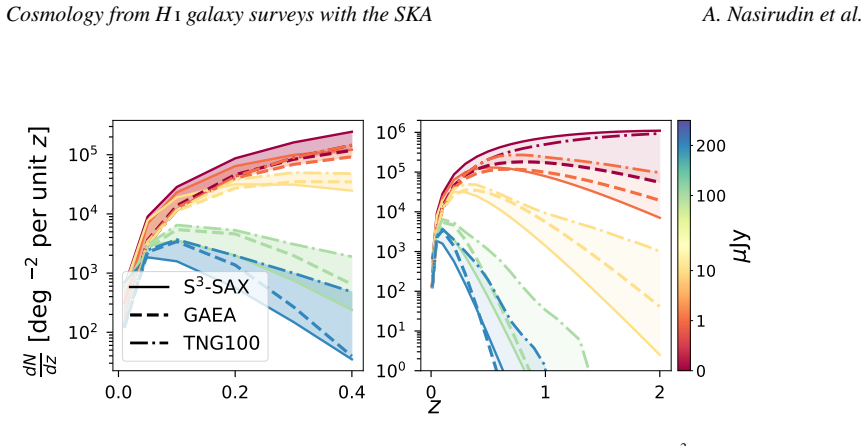
With SKAO-MID, large wide-field surveys of several million HI-containing galaxies will become feasible, resulting in catalogues of sufficient size to measure large-scale structure observables such as baryon acoustic oscillations and redshift-space distortions. Predictions for galaxy number counts versus redshift are given along with corresponding forecasts for cosmological observables, with uncertainty in the HI mass function bracketed by several different modelling methods.
What carries the argument
Galaxy number counts versus redshift derived from different HI mass function models, used to forecast the precision reachable on baryon acoustic oscillations and redshift-space distortions.
If this is right
- Radio surveys sample a broader portion of the halo mass function than optical surveys over similar areas.
- Luminosity distances can be obtained via the Tully-Fisher relation in addition to redshift-space distortions.
- Multiple modelling methods produce a range of predictions that can be compared once data arrive.
- The resulting catalogues are large enough to measure both baryon acoustic oscillations and redshift-space distortions.
Where Pith is reading between the lines
- Combining these radio catalogues with optical surveys could tighten constraints on the growth rate of structure.
- Tully-Fisher distances from the same galaxies would offer an independent check on distance-redshift relations.
- Improved HI mass function measurements from the surveys themselves would narrow the current prediction spread.
Load-bearing premise
The redshift evolution of the HI mass function can be bracketed by a small set of different modelling methods.
What would settle it
Comparison of the actual number of HI galaxies detected in an early SKAO-MID survey against the predicted number counts from the models.
Figures
read the original abstract
The 21cm line from neutral hydrogen is expected to be a ubiquitous (albeit faint) tracer of galaxies in the late Universe. With SKAO-MID, large wide-field surveys of several million HI-containing galaxies will become feasible, resulting in catalogues of sufficient size to measure large-scale structure observables such as baryon acoustic oscillations and redshift-space distortions. While optical galaxy surveys over comparable areas are generally deeper, radio surveys of this kind have a number of other advantages, such as broader sampling of the halo mass function and the possibility of measuring luminosity distances via the Tully-Fisher relation. In this chapter, we provide predictions for the galaxy number counts versus redshift that will be achievable with a wide-field HI galaxy survey on SKAO-MID, along with corresponding forecasts for cosmological observables. Given the substantial uncertainty in the HI mass function with redshift, we bracket our predictions using a handful of different modelling methods.
Editorial analysis
A structured set of objections, weighed in public.
Referee Report
Summary. The manuscript forecasts the number counts of HI galaxies versus redshift achievable with wide-field surveys on SKAO-MID, along with corresponding predictions for cosmological observables including BAO and RSD. It emphasizes that surveys of several million galaxies will be feasible and addresses the dominant uncertainty in the redshift evolution of the HI mass function by bracketing results across multiple independent modeling methods.
Significance. If the forecasts are robust, the work is significant for SKA planning and for establishing the complementarity of radio HI surveys to optical ones via broader halo-mass sampling and Tully-Fisher distances. Explicit credit is due for the bracketing strategy that directly confronts the main modeling uncertainty rather than relying on a single prescription.
major comments (1)
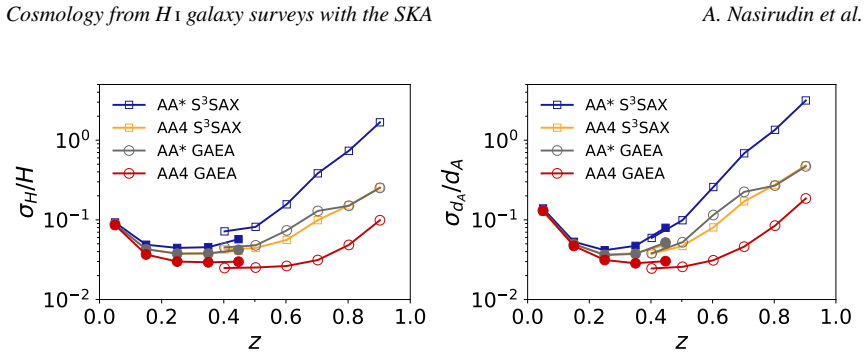
- [Abstract and §3] Abstract and §3 (forecasts section): the central claim that the resulting catalogues will be 'of sufficient size' to measure BAO and RSD rests on the number-count predictions; while multiple HI mass-function models are invoked to bracket uncertainty, the manuscript should report the range (min/max or 1σ envelope) of predicted number densities and the corresponding variation in the forecasted BAO/RSD error bars in a single table or figure so that the robustness of the 'sufficient size' conclusion can be assessed directly.
minor comments (2)
- The specific modeling methods (e.g., references or functional forms) used to bracket the HI mass function should be named explicitly in the methods or results section rather than described only as 'a handful of different modelling methods.'
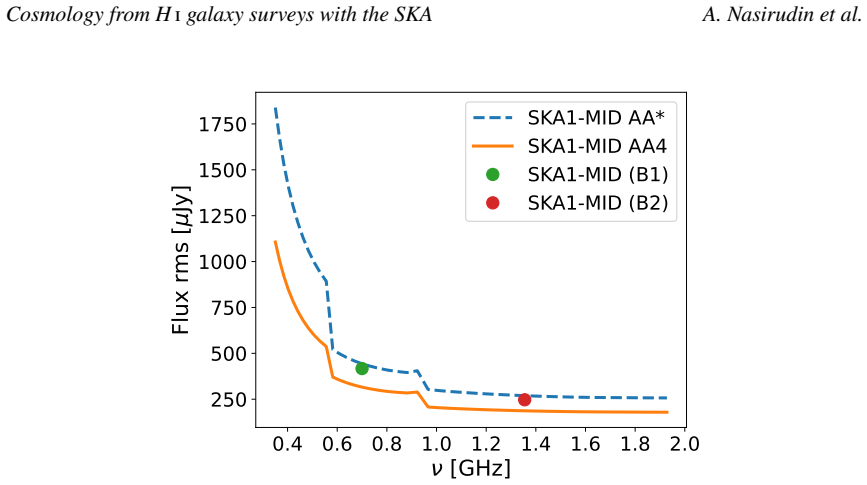
- Figure captions or the text should state the assumed survey area, integration time per pointing, and flux limit so that the number-count predictions can be reproduced or compared with other forecasts.
Simulated Author's Rebuttal
We thank the referee for their positive assessment of the manuscript and for the constructive suggestion. We address the single major comment below.
read point-by-point responses
-
Referee: [Abstract and §3] Abstract and §3 (forecasts section): the central claim that the resulting catalogues will be 'of sufficient size' to measure BAO and RSD rests on the number-count predictions; while multiple HI mass-function models are invoked to bracket uncertainty, the manuscript should report the range (min/max or 1σ envelope) of predicted number densities and the corresponding variation in the forecasted BAO/RSD error bars in a single table or figure so that the robustness of the 'sufficient size' conclusion can be assessed directly.
Authors: We agree that a consolidated presentation of the bracketing range would make the robustness of the 'sufficient size' claim more transparent. In the revised version we will add a new table in §3 that tabulates, at representative redshifts, the minimum and maximum predicted number densities across the set of HI mass-function models together with the corresponding min/max forecasted BAO and RSD error bars. This table will be referenced from both the abstract and the main text. revision: yes
Circularity Check
No significant circularity; forecasts conditional on external models
full rationale
The paper is a forecast study that computes expected galaxy number counts and cosmological observables (BAO, RSD) for future SKA-MID surveys. It explicitly flags the dominant uncertainty in the redshift evolution of the HI mass function and addresses it by bracketing results across multiple independent modelling methods drawn from prior literature. No derivation step reduces by construction to its own fitted inputs, no self-citation chain is invoked to establish uniqueness or forbid alternatives, and the central feasibility claim rests on survey specifications and standard large-scale structure observables rather than any self-referential renaming or ansatz smuggling. The work is therefore self-contained against external benchmarks.
Axiom & Free-Parameter Ledger
Reference graph
Works this paper leans on
-
[1]
and et al
Braun, R. and et al. , title =. 2024 , month = oct, date =
2024
-
[2]
Multiwavelength consensus of large-scale linear bias , volume=
Pan, Hengxing and Obreschkow, Danail and Howlett, Cullan and Lagos, Claudia del P and Elahi, Pascal J and Baugh, Carlton and Gonzalez-Perez, Violeta , year=. Multiwavelength consensus of large-scale linear bias , volume=. Monthly Notices of the Royal Astronomical Society , publisher=. doi:10.1093/mnras/staa222 , number=
-
[3]
and Pettorino, Valeria and Camera, Stefano and Martinelli, Matteo
Casas, Santiago and Carucci, Isabella P. and Pettorino, Valeria and Camera, Stefano and Martinelli, Matteo. Constraining gravity with synergies between radio and optical cosmological surveys. Phys. Dark Univ. 2023. doi:10.1016/j.dark.2022.101151. arXiv:2210.05705
- [4]
-
[5]
2019 , eprint=
Anticipated Performance of the Square Kilometre Array -- Phase 1 (SKA1) , author=. 2019 , eprint=
2019
-
[6]
2015 , publisher=
Advancing Astrophysics with the Square Kilometre Array (AASKA14) , author=. 2015 , publisher=
2015
-
[7]
First results from the IllustrisTNG simulations: the stellar mass content of groups and clusters of galaxies. , keywords =. doi:10.1093/mnras/stx3112 , archivePrefix =. 1707.03406 , primaryClass =
work page internal anchor Pith review Pith/arXiv arXiv doi:10.1093/mnras/stx3112
-
[8]
First results from the IllustrisTNG simulations: the galaxy color bimodality
First results from the IllustrisTNG simulations: the galaxy colour bimodality. , keywords =. doi:10.1093/mnras/stx3040 , archivePrefix =. 1707.03395 , primaryClass =
work page internal anchor Pith review Pith/arXiv arXiv doi:10.1093/mnras/stx3040
-
[9]
First results from the IllustrisTNG simulations: matter and galaxy clustering
First results from the IllustrisTNG simulations: matter and galaxy clustering. , keywords =. doi:10.1093/mnras/stx3304 , archivePrefix =. 1707.03397 , primaryClass =
work page internal anchor Pith review Pith/arXiv arXiv doi:10.1093/mnras/stx3304
-
[10]
First results from the IllustrisTNG simulations: radio haloes and magnetic fields
First results from the IllustrisTNG simulations: radio haloes and magnetic fields. , keywords =. doi:10.1093/mnras/sty2206 , archivePrefix =. 1707.03396 , primaryClass =
work page internal anchor Pith review Pith/arXiv arXiv doi:10.1093/mnras/sty2206
-
[11]
First results from the IllustrisTNG simulations: a tale of two elements - chemical evolution of magnesium and europium. , keywords =. doi:10.1093/mnras/sty618 , archivePrefix =. 1707.03401 , primaryClass =
work page internal anchor Pith review Pith/arXiv arXiv doi:10.1093/mnras/sty618
-
[12]
Computational Astrophysics and Cosmology , keywords =
The IllustrisTNG simulations: public data release. Computational Astrophysics and Cosmology , keywords =. doi:10.1186/s40668-019-0028-x , archivePrefix =. 1812.05609 , primaryClass =
-
[13]
Diemer, Benedikt and Stevens, Adam R. H. and Forbes, John C. and Marinacci, Federico and Hernquist, Lars and Lagos, Claudia del P. and Sternberg, Amiel and Pillepich, Annalisa and Nelson, Dylan and Popping, Gergö and Villaescusa-Navarro, Francisco and Torrey, Paul and Vogelsberger, Mark , title =. 2018 , month =. doi:10.3847/1538-4365/aae387 , url =
-
[14]
Simulating the joint evolution of quasars, galaxies and their large-scale distribution
Simulations of the formation, evolution and clustering of galaxies and quasars. , keywords =. doi:10.1038/nature03597 , archivePrefix =. astro-ph/0504097 , primaryClass =
work page internal anchor Pith review Pith/arXiv arXiv doi:10.1038/nature03597
-
[15]
Yahya, S. and Bull, P. and Santos, M. G. and Silva, M. and Maartens, R. and Okouma, P. and Bassett, B. , title =. Monthly Notices of the Royal Astronomical Society , volume =. 2015 , month =. doi:10.1093/mnras/stv695 , url =
-
[16]
and Cunnington, Steven and Harper, Stuart E
Spinelli, Marta and Carucci, Isabella P. and Cunnington, Steven and Harper, Stuart E. and Irfan, Melis O. and Fonseca, Jos \'e and Pourtsidou, Alkistis and Wolz, Laura. SKAO H \, i intensity mapping: blind foreground subtraction challenge. Mon. Not. Roy. Astron. Soc. 2021. doi:10.1093/mnras/stab3064. arXiv:2107.10814
-
[17]
The hierarchical formation of the brightest cluster galaxies. , keywords =. doi:10.1111/j.1365-2966.2006.11287.x , archivePrefix =. astro-ph/0606519 , primaryClass =
-
[18]
Improving Cosmological Distance Measurements by Reconstruction of the Baryon Acoustic Peak
Improving Cosmological Distance Measurements by Reconstruction of the Baryon Acoustic Peak. , keywords =. doi:10.1086/518712 , archivePrefix =. astro-ph/0604362 , primaryClass =
work page internal anchor Pith review Pith/arXiv arXiv doi:10.1086/518712
-
[19]
2026 , publisher =
Tommaso Ronconi and author2 and author3 and author4 and author5 , title =. 2026 , publisher =
2026
-
[20]
Cosmology with Phase 1 of the Square Kilometre Array Red Book 2018: Technical specifications and performance forecasts. , keywords =. doi:10.1017/pasa.2019.51 , archivePrefix =. 1811.02743 , primaryClass =
-
[21]
The History of the Square Kilometre Array (SKA) - Born Global
The History of the Square Kilometre Array (SKA) - Born Global. arXiv e-prints , keywords =. doi:10.48550/arXiv.1212.3497 , archivePrefix =. 1212.3497 , primaryClass =
work page internal anchor Pith review Pith/arXiv arXiv doi:10.48550/arxiv.1212.3497
-
[22]
Constraints on the evolution of the relationship between HI mass and halo mass in the last 12 Gyr
Constraints on the evolution of the relationship between H I mass and halo mass in the last 12 Gyr. , keywords =. doi:10.1093/mnras/stx1178 , archivePrefix =. 1608.00007 , primaryClass =
work page internal anchor Pith review Pith/arXiv arXiv doi:10.1093/mnras/stx1178
-
[23]
On the spatial distribution of neutral hydrogen in the Universe: bias and shot-noise of the H I power spectrum. , keywords =. doi:10.1093/mnras/stx1599 , archivePrefix =. 1609.05157 , primaryClass =
work page internal anchor Pith review Pith/arXiv arXiv doi:10.1093/mnras/stx1599
-
[24]
Philosophical Transactions of the Royal Society of London Series A , keywords =
Challenges to the CDM cosmology. Philosophical Transactions of the Royal Society of London Series A , keywords =. doi:10.1098/rsta.2024.0022 , archivePrefix =. 2406.12106 , primaryClass =
-
[25]
In the Realm of the Hubble tension $-$ a Review of Solutions
In the realm of the Hubble tension-a review of solutions. Classical and Quantum Gravity , keywords =. doi:10.1088/1361-6382/ac086d , archivePrefix =. 2103.01183 , primaryClass =
work page internal anchor Pith review Pith/arXiv arXiv doi:10.1088/1361-6382/ac086d
-
[26]
An accurate measurement of the baryonic Tully-Fisher relation with heavily gas-dominated ALFALFA galaxies. , keywords =. doi:10.1051/0004-6361/201628410 , archivePrefix =. 1602.09087 , primaryClass =
work page internal anchor Pith review Pith/arXiv arXiv doi:10.1051/0004-6361/201628410
-
[27]
Tully-Fisher relations from an HI-selected sample. , keywords =. doi:10.1111/j.1365-2966.2008.13424.x , adsurl =
-
[28]
An improved Tully-Fisher estimate of H _ 0. , keywords =. doi:10.1093/mnras/stae1925 , archivePrefix =. 2408.03660 , primaryClass =
-
[29]
A Generalist, Automated ALFALFA Baryonic Tully-Fisher Relation. , keywords =. doi:10.3847/1538-4357/accb53 , archivePrefix =. 2212.08728 , primaryClass =
-
[30]
DESI DR2 results. II. Measurements of baryon acoustic oscillations and cosmological constraints. , keywords =. doi:10.1103/tr6y-kpc6 , archivePrefix =. 2503.14738 , primaryClass =
work page internal anchor Pith review Pith/arXiv arXiv doi:10.1103/tr6y-kpc6
-
[31]
Measurements of the Hubble Constant: Tensions in Perspective. , keywords =. doi:10.3847/1538-4357/ac0e95 , archivePrefix =. 2106.15656 , primaryClass =
-
[32]
The HI content of dark matter halos at $z\approx 0$ from ALFALFA
The H I content of dark matter haloes at z 0 from ALFALFA. , keywords =. doi:10.1093/mnras/stz1118 , archivePrefix =. 1805.00934 , primaryClass =
work page internal anchor Pith review Pith/arXiv arXiv doi:10.1093/mnras/stz1118
-
[33]
Extending cosmological tests of General Relativity with the Square Kilometre Array
Extending Cosmological Tests of General Relativity with the Square Kilometre Array. , keywords =. doi:10.3847/0004-637X/817/1/26 , archivePrefix =. 1509.07562 , primaryClass =
work page internal anchor Pith review Pith/arXiv arXiv doi:10.3847/0004-637x/817/1/26
-
[34]
Monthly Notices of the Royal Astronomical Society , volume =
Chen, S -F and Howlett, C and White, M and McDonald, P and Ross, A J and Seo, H -J and Padmanabhan, N and Aguilar, J and Ahlen, S and Alam, S and Alves, O and Andrade, U and Blum, R and Brooks, D and Chen, X and Cole, S and Dawson, K and de la Macorra, A and Dey, A and Ding, Z and Doel, P and Ferraro, S and Font-Ribera, A and Forero-Sánchez, D and Forero-...
-
[35]
HI galaxy simulations for the SKA: number counts and bias
HI galaxy simulations for the SKA: number counts and bias. Advancing Astrophysics with the Square Kilometre Array (AASKA14) , year = 2015, month = apr, eid =. doi:10.22323/1.215.0021 , archivePrefix =. 1501.03990 , primaryClass =
work page internal anchor Pith review Pith/arXiv arXiv doi:10.22323/1.215.0021 2015
-
[36]
and Patel, Prina and Santos, Mário G
Bull, Philip and Ferreira, Pedro G. and Patel, Prina and Santos, Mário G. , title =. The Astrophysical Journal , abstract =. 2015 , month =. doi:10.1088/0004-637X/803/1/21 , url =
-
[37]
and Staveley-Smith, Lister , year=
Meyer, Martin and Robotham, Aaron and Obreschkow, Danail and Westmeier, Tobias and Duffy, Alan R. and Staveley-Smith, Lister , year=. Tracing Hi Beyond the Local Universe , volume=. doi:10.1017/pasa.2017.31 , journal=
-
[38]
Planck 2015 results - XIII. Cosmological parameters , DOI= "10.1051/0004-6361/201525830", url= "https://doi.org/10.1051/0004-6361/201525830", journal =
-
[39]
I - Corrections to fundamental observables
The extragalactic distance scale. I - Corrections to fundamental observables. , keywords =. doi:10.1086/191029 , adsurl =
-
[40]
Obreschkow, D. and Heywood, I. and Klöckner, H.-R. and Rawlings, S. , title =. The Astrophysical Journal , abstract =. 2009 , month =. doi:10.1088/0004-637X/702/2/1321 , url =
-
[41]
Obreschkow, D. and Klöckner, H.-R. and Heywood, I. and Levrier, F. and Rawlings, S. , title =. The Astrophysical Journal , abstract =. 2009 , month =. doi:10.1088/0004-637X/703/2/1890 , url =
-
[42]
Monthly Notices of the Royal Astronomical Society , volume =
Duffy, Alan R. and Meyer, Martin J. and Staveley-Smith, Lister and Bernyk, Maksym and Croton, Darren J. and Koribalski, Bärbel S. and Gerstmann, Derek and Westerlund, Stefan , title =. Monthly Notices of the Royal Astronomical Society , volume =. 2012 , month =. doi:10.1111/j.1365-2966.2012.21987.x , url =
-
[43]
Monthly Notices of the Royal Astronomical Society , volume =
Diemer, Benedikt and Stevens, Adam R H and Lagos, Claudia del P and Calette, A R and Tacchella, Sandro and Hernquist, Lars and Marinacci, Federico and Nelson, Dylan and Pillepich, Annalisa and Rodriguez-Gomez, Vicente and Villaescusa-Navarro, Francisco and Vogelsberger, Mark , title =. Monthly Notices of the Royal Astronomical Society , volume =. 2019 , m...
-
[44]
Model-independent measurement of the matter-radiation equality scale in DESI 2024. , keywords =. doi:10.1103/yqm1-ybbv , archivePrefix =. 2505.16153 , primaryClass =
-
[45]
The Open Journal of Astrophysics , keywords =
Measurement of the power spectrum turnover scale from the cross-correlation between CMB lensing and Quaia. The Open Journal of Astrophysics , keywords =. doi:10.33232/001c.136891 , archivePrefix =. 2410.24134 , primaryClass =
-
[46]
Cosmology with photometric redshift surveys. , keywords =. doi:10.1111/j.1365-2966.2005.09526.x , archivePrefix =. astro-ph/0411713 , primaryClass =
-
[47]
The WiggleZ Dark Energy Survey: probing the epoch of radiation domination using large-scale structure. , keywords =. doi:10.1093/mnras/sts431 , archivePrefix =. 1211.5605 , primaryClass =
work page internal anchor Pith review Pith/arXiv arXiv doi:10.1093/mnras/sts431
-
[48]
Measurement of the matter-radiation equality scale using the extended baryon oscillation spectroscopic survey quasar sample. , keywords =. doi:10.1093/mnras/stad1867 , archivePrefix =. 2302.07484 , primaryClass =
-
[49]
Elemental Abundances in Milky Way-like Galaxies from a Hierarchical Galaxy Formation Model
Elemental abundances in Milky Way-like galaxies from a hierarchical galaxy formation model. , keywords =. doi:10.1093/mnras/stu1752 , archivePrefix =. 1407.7867 , primaryClass =
work page internal anchor Pith review Pith/arXiv arXiv doi:10.1093/mnras/stu1752
-
[50]
Tracing the quenching journey across cosmic time. , keywords =. doi:10.1051/0004-6361/202349045 , archivePrefix =. 2401.06211 , primaryClass =
-
[51]
H$_2$-based star formation laws in hierarchical models of galaxy formation
H _ 2 -based star formation laws in hierarchical models of galaxy formation. , keywords =. doi:10.1093/mnras/stx889 , archivePrefix =. 1611.09372 , primaryClass =
work page internal anchor Pith review Pith/arXiv arXiv doi:10.1093/mnras/stx889
-
[52]
The influence of environment on satellite galaxies in the GAEA semi-analytic model. , keywords =. doi:10.1093/mnras/staa2370 , archivePrefix =. 2003.12757 , primaryClass =
-
[53]
The rise of active galactic nuclei in the galaxy evolution and assembly semi-analytic model. , keywords =. doi:10.1093/mnras/staa1716 , archivePrefix =. 2002.10576 , primaryClass =
-
[54]
Galaxy assembly and evolution in the P-Millennium simulation: Galaxy clustering. , keywords =. doi:10.1051/0004-6361/202452029 , archivePrefix =. 2409.02194 , primaryClass =
-
[55]
Galaxy assembly, stellar feedback and metal enrichment: the view from the GAEA model
Galaxy assembly, stellar feedback and metal enrichment: the view from the GAEA model. , keywords =. doi:10.1093/mnras/stw1318 , archivePrefix =. 1512.04531 , primaryClass =
work page internal anchor Pith review Pith/arXiv arXiv doi:10.1093/mnras/stw1318
- [56]
-
[57]
Euclid preparation. I. The Euclid Wide Survey. , keywords =. doi:10.1051/0004-6361/202141938 , archivePrefix =. 2108.01201 , primaryClass =
-
[58]
The Completed SDSS-IV extended Baryon Oscillation Spectroscopic Survey: Large-scale structure catalogues for cosmological analysis. , keywords =. doi:10.1093/mnras/staa2416 , archivePrefix =. 2007.09000 , primaryClass =
-
[59]
Data Release 1 of the Dark Energy Spectroscopic Instrument
Data Release 1 of the Dark Energy Spectroscopic Instrument. arXiv e-prints , keywords =. doi:10.48550/arXiv.2503.14745 , archivePrefix =. 2503.14745 , primaryClass =
work page internal anchor Pith review Pith/arXiv arXiv doi:10.48550/arxiv.2503.14745
-
[60]
Modeling Luminosity-Dependent Galaxy Clustering Through Cosmic Time
Modeling Luminosity-dependent Galaxy Clustering through Cosmic Time. , keywords =. doi:10.1086/503602 , archivePrefix =. astro-ph/0512234 , primaryClass =
work page internal anchor Pith review Pith/arXiv arXiv doi:10.1086/503602
-
[61]
Baryon acoustic oscillations. Dark Energy , year = 2010, editor =. doi:10.48550/arXiv.0910.5224 , adsurl =
work page internal anchor Pith review Pith/arXiv arXiv doi:10.48550/arxiv.0910.5224 2010
-
[62]
Probing Dark Energy with Baryonic Acoustic Oscillations from Future Large Galaxy Redshift Surveys
Probing Dark Energy with Baryonic Acoustic Oscillations from Future Large Galaxy Redshift Surveys. , keywords =. doi:10.1086/379122 , archivePrefix =. astro-ph/0307460 , primaryClass =
work page internal anchor Pith review Pith/arXiv arXiv doi:10.1086/379122
-
[63]
On the Robustness of the Acoustic Scale in the Low-Redshift Clustering of Matter
On the Robustness of the Acoustic Scale in the Low-Redshift Clustering of Matter. , keywords =. doi:10.1086/518755 , archivePrefix =. astro-ph/0604361 , primaryClass =
work page internal anchor Pith review Pith/arXiv arXiv doi:10.1086/518755
-
[64]
Clustering in real space and in redshift space. , keywords =. doi:10.1093/mnras/227.1.1 , adsurl =
-
[65]
The Halo Occupation Distribution: Toward an Empirical Determination of the Relation between Galaxies and Mass. , keywords =. doi:10.1086/341469 , archivePrefix =. astro-ph/0109001 , primaryClass =
work page internal anchor Pith review Pith/arXiv arXiv doi:10.1086/341469
-
[66]
Large-scale galaxy bias. , keywords =. doi:10.1016/j.physrep.2017.12.002 , archivePrefix =. 1611.09787 , primaryClass =
work page internal anchor Pith review Pith/arXiv arXiv doi:10.1016/j.physrep.2017.12.002 2017
-
[67]
The Open Journal of Astrophysics , keywords =
The halo model for cosmology: a pedagogical review. The Open Journal of Astrophysics , keywords =. doi:10.21105/astro.2303.08752 , archivePrefix =. 2303.08752 , primaryClass =
-
[68]
The DESI Experiment Part I: Science,Targeting, and Survey Design
The DESI Experiment Part I: Science,Targeting, and Survey Design. arXiv e-prints , keywords =. doi:10.48550/arXiv.1611.00036 , archivePrefix =. 1611.00036 , primaryClass =
work page internal anchor Pith review Pith/arXiv arXiv doi:10.48550/arxiv.1611.00036
-
[69]
IAU Colloquium 131: Radio Interferometry
The Hydrogen Array. IAU Colloquium 131: Radio Interferometry. Theory, Techniques, and Applications , year = 1991, editor =
1991
-
[70]
Can a multi-tracer approach improve the constraints on the turnover scale at low redshift?. , keywords =. doi:10.1088/1475-7516/2025/10/071 , archivePrefix =. 2507.11823 , primaryClass =
discussion (0)
Sign in with ORCID, Apple, or X to comment. Anyone can read and Pith papers without signing in.