Human-Machine Collaboration on Generative Meta-Learning: Model and Algorithm
Pith reviewed 2026-07-02 15:42 UTC · model grok-4.3
The pith
Aligning generated data distributions to human beliefs about target physics reduces generalization risk under distribution shift.
A machine-rendered reading of the paper's core claim, the machinery that carries it, and where it could break.
Core claim
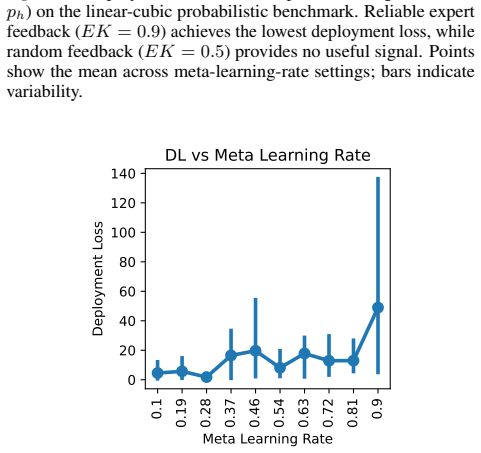
Generative Meta-Learning with Human Feedback (GMHF) uses a Conditional Neural ODE to generate trajectories and an RL agent to iteratively adjust their latent physical parameters according to human feedback, steering the meta-learner toward the target distribution; theoretical bounds show that this alignment reduces generalization error, and empirical tests on the Duffing oscillator show deployment loss falling as feedback reliability rises while data divergence shrinks, with the pattern holding in a non-dynamical probabilistic model as well.
What carries the argument
GMHF framework that couples a Conditional Neural ODE generative digital twin with an RL agent refining latent physical parameters from human feedback to minimize divergence from the target.
If this is right
- Generalization error bounds tighten when generated data is aligned with human beliefs about target physics.
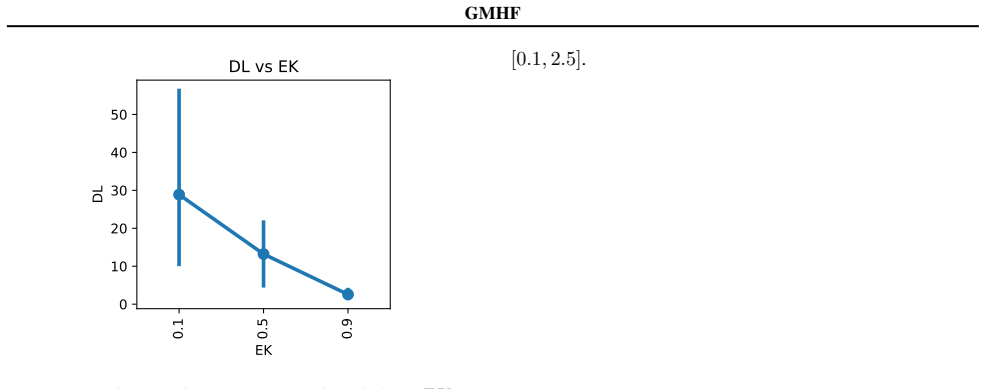
- Deployment loss decreases substantially as expert feedback reliability increases.
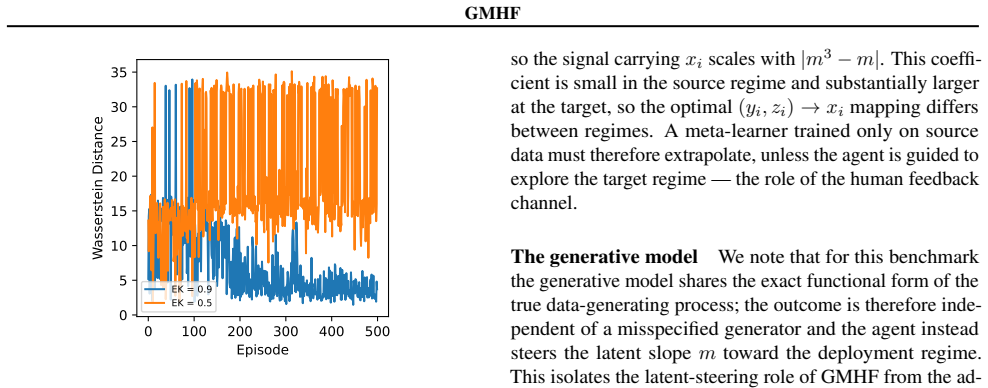
- Divergence between generated and target data decreases under reliable feedback, confirming the divergence-minimization mechanism.
- The same steering mechanism works on non-dynamical probabilistic models, not only ODE systems.
Where Pith is reading between the lines
- The framework suggests human input could substitute for missing target samples in other sequential or dynamical modeling tasks.
- If feedback can be obtained from multiple experts, the RL component might average or weight inputs to further stabilize alignment.
- The bounds imply that even partial human knowledge of target physics can yield measurable risk reduction without full domain data.
Load-bearing premise
Human expert feedback reliably and accurately represents the unobserved target domain physics or distribution.
What would settle it
In the Duffing oscillator experiments, if higher simulated expert reliability does not produce lower deployment loss or reduced divergence between generated and target data, the risk-mitigation claim fails.
Figures


read the original abstract
Generalizing machine learning models to environments that differ from their training distribution remains a critical hurdle, particularly when data from the target domain is entirely or partially unavailable. We propose Generative Meta-Learning with Human Feedback (GMHF), a novel framework that bridges this domain gap by leveraging expert intuition to guide data synthesis. Grounded in a theoretical analysis of generalization error, we derive bounds demonstrating that aligning the distribution of generated data with human beliefs regarding the target physics significantly mitigates risk. GMHF operationalizes this insight by employing a Conditional Neural ODE (cNODE) as a generative digital twin, coupled with a Reinforcement Learning (RL) agent. The agent iteratively refines the latent physical parameters of the generated trajectories based on feedback, effectively steering the meta-learner toward the unobserved target distribution. Empirical validation on a nonlinear Duffing oscillator shows that GMHF substantially reduces deployment loss as expert reliability increases, and that the divergence between generated and target data falls under reliable feedback, directly corroborating the divergence-minimisation mechanism predicted by our theory. Further experiments on a non-dynamical probabilistic model confirm that the framework extends beyond ODE-governed systems, establishing human-AI collaboration as a rigorous catalyst for robust generalisation under distribution shift.
Editorial analysis
A structured set of objections, weighed in public.
Referee Report
Summary. The paper proposes Generative Meta-Learning with Human Feedback (GMHF), a framework that uses a Conditional Neural ODE (cNODE) as a generative digital twin paired with an RL agent. The agent refines latent physical parameters of generated trajectories based on human expert feedback to steer the meta-learner toward an unobserved target distribution under domain shift. Theoretical generalization error bounds are claimed to show that aligning generated data distributions with human beliefs about target physics mitigates risk via divergence minimization. Empirical results on a nonlinear Duffing oscillator are reported to show reduced deployment loss and data divergence as expert reliability increases, with further validation on a non-dynamical probabilistic model.
Significance. If the claimed generalization bounds hold without hidden parameter dependence and the human-feedback assumption is validated, the work could meaningfully advance human-AI collaboration for robust generalization in data-scarce target domains by providing a mechanism to synthesize aligned data. The extension beyond ODE systems is a positive broadening. However, the current absence of any derivations, explicit equations, error bars, or real-human experiments substantially reduces the assessed significance.
major comments (3)
- [Abstract] Abstract: the claim that generalization error bounds are derived showing risk mitigation from alignment with human beliefs is unsupported, as no equations, proof sketches, or derivations appear in the manuscript; without them it is impossible to verify whether the bounds are independent of unstated assumptions on feedback accuracy or reduce by construction.
- [Empirical validation] Empirical validation section: the Duffing oscillator experiments parameterize expert reliability synthetically rather than collecting real human feedback on an unobserved dynamical system; this leaves the load-bearing assumption (that human beliefs serve as a reliable proxy for the true target distribution) untested and prevents the reported loss reductions from corroborating the theoretical risk-mitigation claim.
- [Theoretical analysis] Theoretical analysis: the divergence-minimization mechanism is asserted to ground the RL updates via cNODE latent parameters, yet no explicit connection is shown between the algorithm, the human feedback signal, and the stated generalization bounds; this circularity risk means the central claim that reliable feedback reduces deployment loss cannot be evaluated from the provided material.
minor comments (2)
- No error bars, number of trials, or statistical significance tests are reported for the deployment-loss and divergence results.
- The manuscript does not discuss sensitivity of the bounds or empirical outcomes to violations of the human-feedback closeness assumption.
Simulated Author's Rebuttal
We thank the referee for their constructive comments. We address each major point below, clarifying the theoretical claims and indicating revisions where the manuscript presentation requires strengthening.
read point-by-point responses
-
Referee: [Abstract] Abstract: the claim that generalization error bounds are derived showing risk mitigation from alignment with human beliefs is unsupported, as no equations, proof sketches, or derivations appear in the manuscript; without them it is impossible to verify whether the bounds are independent of unstated assumptions on feedback accuracy or reduce by construction.
Authors: We acknowledge that the submitted manuscript did not include explicit equations or proof sketches in the main text, making verification difficult. The bounds follow standard domain-adaptation arguments: target risk is upper-bounded by source risk plus a divergence term between the generated distribution and the target; human feedback is modeled as reducing this divergence. The bound depends on achieved divergence rather than assuming perfect feedback accuracy. We will insert a concise proof sketch and the explicit bound expression in the revised main text. revision: yes
-
Referee: [Empirical validation] Empirical validation section: the Duffing oscillator experiments parameterize expert reliability synthetically rather than collecting real human feedback on an unobserved dynamical system; this leaves the load-bearing assumption (that human beliefs serve as a reliable proxy for the true target distribution) untested and prevents the reported loss reductions from corroborating the theoretical risk-mitigation claim.
Authors: The synthetic parameterization was used to isolate the effect of feedback reliability on divergence and deployment loss, directly testing the mechanism predicted by the theory. We agree that real-human experiments on an unobserved system would provide stronger corroboration of the proxy assumption. In revision we will add an explicit limitations paragraph noting this gap and outlining the requirements for future real-human validation. revision: partial
-
Referee: [Theoretical analysis] Theoretical analysis: the divergence-minimization mechanism is asserted to ground the RL updates via cNODE latent parameters, yet no explicit connection is shown between the algorithm, the human feedback signal, and the stated generalization bounds; this circularity risk means the central claim that reliable feedback reduces deployment loss cannot be evaluated from the provided material.
Authors: The RL reward is defined directly from the human feedback score, which serves as a surrogate for the divergence term appearing in the generalization bound; policy-gradient updates on the cNODE latent parameters therefore minimize that term. We will add the explicit reward definition and the chain of equalities linking the update to bound reduction in the revised theoretical section to remove any ambiguity. revision: yes
- Real human feedback experiments on an unobserved dynamical system were not performed; such experiments lie outside the scope and resources of the present theoretical and simulation study.
Circularity Check
No circularity: theory derives bounds from alignment assumption; experiments test synthetic reliability separately
full rationale
The provided abstract and context present a generalization-error bound derived from the premise that alignment with human beliefs reduces risk, followed by separate empirical tests on Duffing oscillator and probabilistic models that vary expert reliability synthetically and measure loss/divergence reduction. No equations, self-citations, or fitted parameters are quoted that would make any prediction equivalent to its inputs by construction. The central claim rests on an external assumption about human feedback accuracy rather than reducing to a self-referential definition or renamed fit. This is the normal case of a self-contained derivation whose validity hinges on untested assumptions, not on circular structure.
Axiom & Free-Parameter Ledger
axioms (1)
- domain assumption Human expert feedback reliably indicates the target domain distribution or physics
Reference graph
Works this paper leans on
-
[1]
A theory of learning from different domains , author=. Machine learning , volume=. 2010 , publisher=
work page 2010
-
[2]
Invariant risk minimization , author=. arXiv preprint arXiv:1907.02893 , year=
work page internal anchor Pith review Pith/arXiv arXiv 1907
-
[3]
Experimental evidence of effective human--AI collaboration in medical decision-making , author=. Scientific reports , volume=. 2022 , publisher=
work page 2022
-
[4]
On lower bounds for statistical learning theory , author=. Entropy , volume=. 2017 , publisher=
work page 2017
-
[5]
Towards Out-Of-Distribution Generalization: A Survey
Towards out-of-distribution generalization: A survey , author=. arXiv preprint arXiv:2108.13624 , year=
-
[6]
Out-of-Distribution Generalization in Time Series: A Survey
Out-of-Distribution Generalization in Time Series: A Survey , author=. arXiv preprint arXiv:2503.13868 , year=
work page internal anchor Pith review Pith/arXiv arXiv
-
[7]
Frontiers of Information Technology & Electronic Engineering , volume=
Diffusion models for time-series applications: a survey , author=. Frontiers of Information Technology & Electronic Engineering , volume=. 2024 , publisher=
work page 2024
-
[8]
Medical image analysis , volume=
A survey on active learning and human-in-the-loop deep learning for medical image analysis , author=. Medical image analysis , volume=. 2021 , publisher=
work page 2021
-
[9]
Advances in neural information processing systems , volume=
Neural ordinary differential equations , author=. Advances in neural information processing systems , volume=
-
[10]
Artificial Intelligence Review , volume=
Human-in-the-loop machine learning: a state of the art , author=. Artificial Intelligence Review , volume=. 2023 , publisher=
work page 2023
-
[11]
Modelling and analysis of Parkinsonian gait , author=. Nonlinear Dynamics , volume=. 2023 , publisher=
work page 2023
- [12]
-
[13]
On First-Order Meta-Learning Algorithms
On first-order meta-learning algorithms , author=. arXiv preprint arXiv:1803.02999 , year=
work page internal anchor Pith review Pith/arXiv arXiv
-
[14]
Structural health monitoring based on sensitivity vector fields and attractor morphing , author=. Philosophical Transactions of the Royal Society A: Mathematical, Physical and Engineering Sciences , volume=. 2006 , publisher=
work page 2006
-
[15]
Fractal and Fractional , volume=
Heart rhythm analysis using nonlinear oscillators with duffing-type connections , author=. Fractal and Fractional , volume=. 2023 , publisher=
work page 2023
-
[16]
Machine learning for healthcare conference , pages=
What clinicians want: contextualizing explainable machine learning for clinical end use , author=. Machine learning for healthcare conference , pages=. 2019 , organization=
work page 2019
-
[17]
Abstract in the Organization for Human Brain Mapping Annual Meeting , year=
Conditional neural ode for longitudinal parkinson’s disease progression forecasting , author=. Abstract in the Organization for Human Brain Mapping Annual Meeting , year=
-
[18]
Proceedings of the 29th ACM SIGKDD conference on knowledge discovery and data mining , pages=
Conditional neural ODE processes for individual disease progression forecasting: a case study on COVID-19 , author=. Proceedings of the 29th ACM SIGKDD conference on knowledge discovery and data mining , pages=
-
[19]
2017 IEEE/RSJ international conference on intelligent robots and systems (IROS) , pages=
Domain randomization for transferring deep neural networks from simulation to the real world , author=. 2017 IEEE/RSJ international conference on intelligent robots and systems (IROS) , pages=. 2017 , organization=
work page 2017
-
[20]
Advances in neural information processing systems , volume=
Deep reinforcement learning from human preferences , author=. Advances in neural information processing systems , volume=
-
[21]
Advances in neural information processing systems , volume=
Latent ordinary differential equations for irregularly-sampled time series , author=. Advances in neural information processing systems , volume=
-
[22]
Continuous control with deep reinforcement learning
Continuous control with deep reinforcement learning , author=. arXiv preprint arXiv:1509.02971 , year=
work page internal anchor Pith review Pith/arXiv arXiv
-
[23]
Journal of Machine Learning Research , year =
Antonin Raffin and Ashley Hill and Adam Gleave and Anssi Kanervisto and Maximilian Ernestus and Noah Dormann , title =. Journal of Machine Learning Research , year =
discussion (0)
Sign in with ORCID, Apple, or X to comment. Anyone can read and Pith papers without signing in.