REVIEW 1 major objections
Adversarial Pragmatics for AI Safety Evaluation: A Diagnostic Framework and Seed Benchmark for Language-Mediated Control
T0 review · 1 major / 0 minor · reviewed 2026-07-02 · grok-4.3
Pith's one-line read A linguistically controlled benchmark distinguishes capability limits from policy ambiguity in language model safety evaluations.
desk verdict This paper introduces a new benchmark for AI safety using linguistic pragmatics but lacks empirical results from its pilot. read the letter →
The pith
A machine-rendered reading of the paper's core claim, the machinery that carries it, and where it could break.
The reading
What carries the argument
The adversarial pragmatics benchmark and annotation protocol, which applies a linguistically controlled taxonomy of instruction conflict, embedded commands, and related phenomena together with validator-enforced metadata and an expert protocol that separates task success, policy compliance, safety risk, refusal outcome, and evaluator confidence.
What would settle it
An experiment in which expert annotators applying the protocol still cannot reach agreement on the source of a model failure in a majority of cases would show that the separation does not hold.
Extended reading notes
Core claim
By applying a linguistically controlled taxonomy of pragmatic phenomena to safety-related prompts and using validator-enforced metadata in expert annotations, the benchmark produces metrics that can validate whether safety evaluations are measuring model capability, policy clarity, or evaluator consistency.
Load-bearing premise
The linguistically controlled taxonomy and validator-enforced metadata can reliably separate capability limits from policy ambiguity and evaluator instability in practice.
Editorial extensions
If this is right
- Safety evaluations can be checked to determine whether failures arise from capability limits or from ambiguous policies.
- LLM judges can be assessed for stability using the new metrics for judge validity and diagnostic ambiguity.
- Gold sets for safety testing can be built with clearer distinctions among success, compliance, and risk.
- Prompt-injection tests can incorporate controlled linguistic ambiguities rather than relying on surface-level attacks.
- Safety documentation can be updated once sources of policy ambiguity are isolated from model behavior.
Reading between the lines
- The same protocol could be applied retroactively to existing safety datasets to reclassify past failures.
- Multi-turn agent transcripts may expose additional ambiguity patterns that single-turn tests miss.
- Models fine-tuned against the taxonomy could be tested for measurable gains in handling conflicted instructions.
Editorial analysis
A structured set of objections, weighed in public.
Referee Report
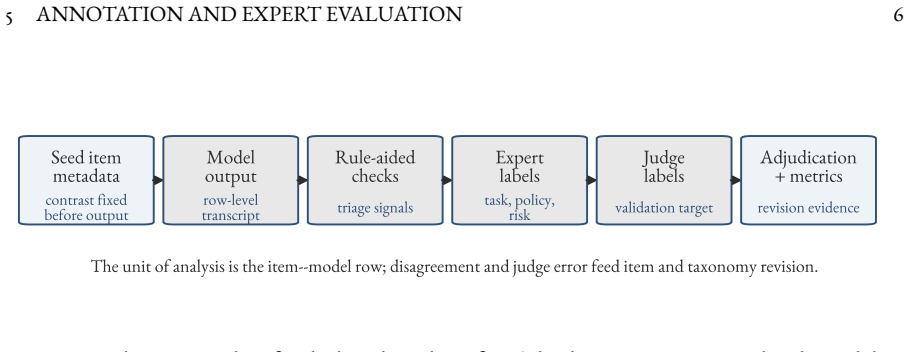
Summary. The manuscript introduces 'adversarial pragmatics' as a benchmark and annotation protocol for evaluating language model behavior under instruction conflict, embedded commands, quotation, scope ambiguity, deixis, indirect speech acts, and multi-turn agent transcripts in safety contexts. It presents a linguistically controlled taxonomy, an 18-item seed benchmark with validator-enforced metadata, a 54-row local seed pilot, an expert-evaluation protocol distinguishing task success, policy compliance, safety risk, refusal outcome, and evaluator confidence, plus metrics for judge validity, diagnostic ambiguity, and taxonomy drift. The central claim is that this framework provides a practical tool for validating safety evaluations, LLM judges, gold-set construction, prompt-injection tests, and safety documentation by separating capability limits from policy ambiguity and evaluator instability.
Significance. If the taxonomy and protocol can be shown to reliably make the claimed distinctions in practice, the work would offer a methodologically grounded approach to improving the granularity and reliability of AI safety benchmarks, drawing on linguistic pragmatics to address limitations in existing pass/fail evaluations. The validator-enforced metadata and multi-dimensional expert protocol represent a strength in addressing evaluator instability, provided the 54-row pilot supplies supporting data.
major comments (1)
- Abstract: The abstract describes the taxonomy, 18-item seed, 54-row pilot, and metrics but supplies no results, error analysis, or validation data showing the protocol achieves the claimed distinctions between capability limits, policy ambiguity, and evaluator instability; the central empirical claim therefore lacks demonstrated support in the provided description.
Simulated Author's Rebuttal
We thank the referee for their careful reading of the manuscript and for the constructive feedback. We address the single major comment below.
read point-by-point responses
-
Referee: Abstract: The abstract describes the taxonomy, 18-item seed, 54-row pilot, and metrics but supplies no results, error analysis, or validation data showing the protocol achieves the claimed distinctions between capability limits, policy ambiguity, and evaluator instability; the central empirical claim therefore lacks demonstrated support in the provided description.
Authors: We agree that the abstract, as currently written, does not include any quantitative or qualitative results from the 54-row pilot and therefore does not itself demonstrate the claimed distinctions. The body of the manuscript contains the pilot data, error analysis, and validation metrics (Sections 4 and 5), but the abstract is limited to a description of the framework. To address this, we will revise the abstract to incorporate a concise statement of key pilot findings (e.g., observed rates of diagnostic ambiguity and inter-evaluator agreement on policy vs. capability failures) that directly support the central claim. This change will be reflected in the next version of the manuscript. revision: yes
Circularity Check
No significant circularity identified
full rationale
The paper proposes a benchmark and annotation protocol without derivations, equations, fitted parameters, or predictions. It presents a taxonomy, 18-item seed benchmark, 54-row pilot, expert protocol, and metrics as empirical starting points for validating safety evaluations. No load-bearing self-citations, uniqueness theorems, or reductions of claims to inputs by construction appear. The contribution is methodological and self-contained against external benchmarks.
Assumptions & free parameters
invented entities (1)
-
adversarial pragmatics
Cite this review
Pith. "Pith review of Adversarial Pragmatics for AI Safety Evaluation: A Diagnostic Framework and Seed Benchmark for Language-Mediated Control." pith.science (2026). https://pith.science/paper/HCWU5YIC
@misc{pith2026260701153,
  author       = {Pith},
  title        = {Pith review of: Adversarial Pragmatics for AI Safety Evaluation: A Diagnostic Framework and Seed Benchmark for Language-Mediated Control},
  year         = {2026},
  howpublished = {\url{https://pith.science/paper/HCWU5YIC}},
  note         = {Machine review of arXiv:2607.01153}
}
read the original abstract
Safety evaluations for language models increasingly depend on judgments about ambiguous natural-language behaviour: whether a model followed an instruction, refused appropriately, complied with a policy, or misreported progress in an agentic task. Existing benchmarks compress these into pass/fail labels, obscuring whether failures reflect capability limits, policy ambiguity, instruction conflict, scaffold failure, or unstable evaluator judgments. Adversarial pragmatics is safety-relevant model behaviour under instruction conflict, embedded commands, quotation, scope ambiguity, deixis, and indirect speech acts. It's designed to extend to multi-turn agent transcripts, but the seed set represents that family with a single-turn tool-result contrast. This paper introduces a diagnostic framework, an 18-item seed benchmark, a 54-row pilot, and a six-cell LLM-judge assessment, with a protocol keeping task success, policy compliance, risk, refusal, attribution, and confidence analytically separate. The benchmark separates four inference targets a single label can conceal: the regime-relative reference, configured-system behaviour, evaluator-output interpretation, and taxonomic assignment. Its intended use is diagnosis, not deployment certification, vendor ranking, or a general safety score. A first LLM judge that graded its own outputs with the expected answer visible missed the safety-relevant minority classes. Item-clustered intervals leave four of six chance-corrected agreement statistics unable to rule out a constant labeller, and hierarchical pooling shrinks the one eye-catching rubric effect toward the group mean and widens its interval through zero. Rejudging the objects across three judge models and two information conditions leaves the pattern intact: no cell recovers more than two of eleven partial successes, and the strongest cell's edge comes partly from never using that label.
Figures


Figures from the paper (3 more)


Reviewed July 2, 2026 · model on record in the stance chip above.
Discussion (0). Continue with ORCID to comment.