Brownian ratchets and pumps universally simulate many-body active dynamics
Pith reviewed 2026-07-02 04:25 UTC · model grok-4.3
The pith
Any local active dynamics in spin systems can be simulated by many-body Brownian ratchets or pumps
A machine-rendered reading of the paper's core claim, the machinery that carries it, and where it could break.
Core claim
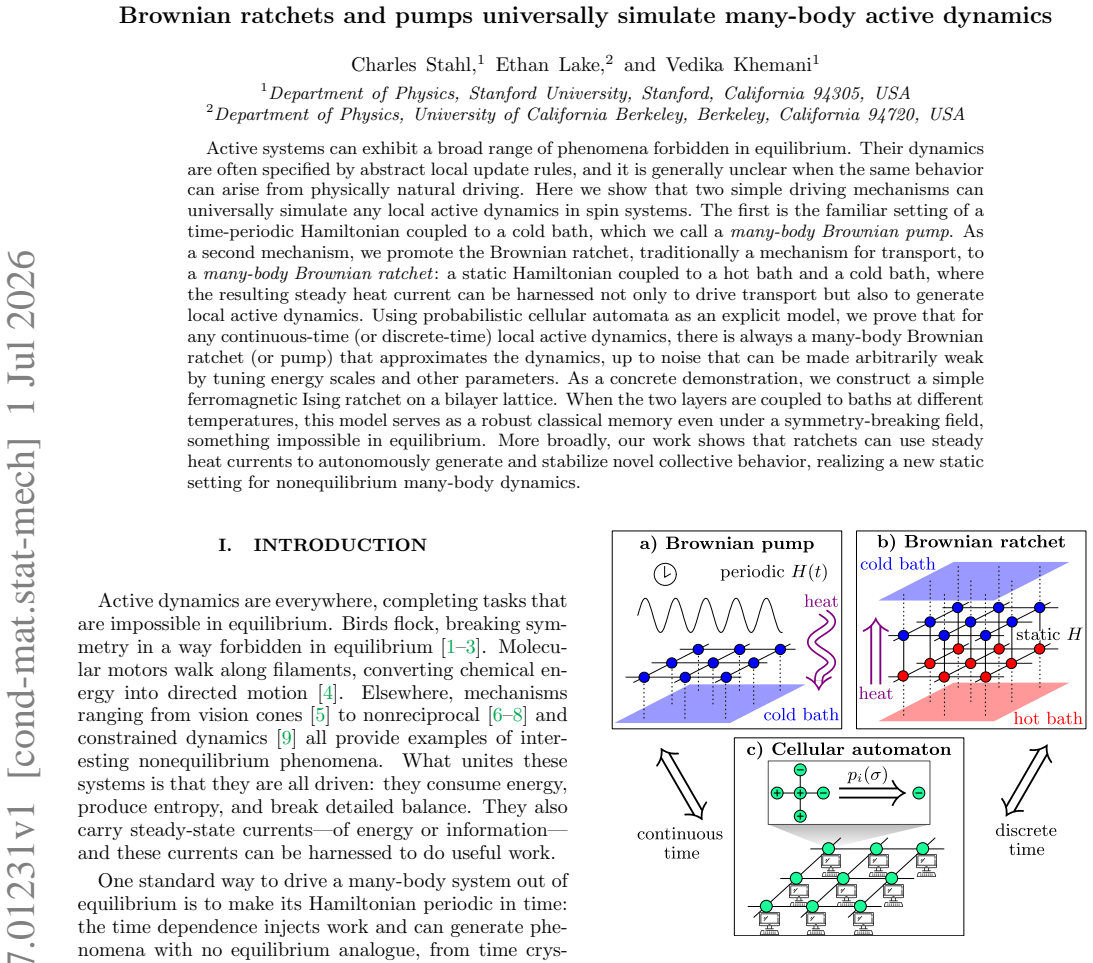
For any continuous-time or discrete-time local active dynamics, there always exists a many-body Brownian ratchet or pump that approximates the dynamics, with noise made arbitrarily weak by tuning energy scales and other parameters. This is established by mapping the target dynamics to probabilistic cellular automata and constructing explicit ratchet or pump Hamiltonians that realize the same update rules via heat currents or periodic driving.
What carries the argument
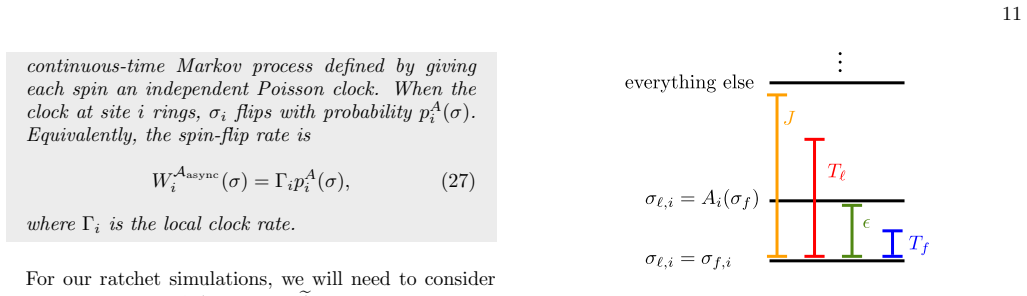
The many-body Brownian ratchet: a static Hamiltonian coupled to baths at different temperatures, where the steady heat current is harnessed to generate and stabilize local active dynamics in spin systems, extending the traditional transport role of ratchets.
If this is right
- Steady heat currents from temperature differences can autonomously generate and stabilize novel collective active behavior without external time-dependent driving.
- Ratchets can realize robust classical memories in spin systems that remain stable even under symmetry-breaking fields, unlike any equilibrium counterpart.
- Any local active dynamics becomes physically realizable through either periodic driving with a single bath or static driving with two baths.
- Nonequilibrium many-body dynamics gains a new static setting where ratchets use heat flow to produce activity on demand.
Where Pith is reading between the lines
- The construction suggests that observed active phenomena in physical or biological systems could often arise from hidden temperature gradients or periodic drives rather than abstract rules alone.
- The bilayer Ising example implies that similar ratchet designs could stabilize other nonequilibrium phases, such as directed motion or pattern formation, in lattice models.
- Tuning energy scales to control noise levels may allow experimental realization in systems like colloidal particles or magnetic layers where baths at different temperatures are accessible.
Load-bearing premise
That any local active dynamics can be exactly represented or approximated by probabilistic cellular automata, and that energy scales can be tuned independently to suppress noise without destroying the target dynamics.
What would settle it
Constructing or observing a specific local active dynamics for which no finite many-body ratchet or pump exists that approximates it with noise that can be made arbitrarily small by parameter tuning.
Figures
read the original abstract
Active systems can exhibit a broad range of phenomena forbidden in equilibrium. Their dynamics are often specified by abstract local update rules, and it is generally unclear when the same behavior can arise from physically natural driving. Here we show that two simple driving mechanisms can universally simulate any local active dynamics in spin systems. The first is the familiar setting of a time-periodic Hamiltonian coupled to a cold bath, which we call a "many-body Brownian pump." As a second mechanism, we promote the Brownian ratchet, traditionally a mechanism for transport, to a "many-body Brownian ratchet": a static Hamiltonian coupled to a hot bath and a cold bath, where the resulting steady heat current can be harnessed not only to drive transport but also to generate local active dynamics. Using probabilistic cellular automata as an explicit model, we prove that for any continuous-time (or discrete-time) local active dynamics, there is always a many-body Brownian ratchet (or pump) that approximates the dynamics, up to noise that can be made arbitrarily weak by tuning energy scales and other parameters. As a concrete demonstration, we construct a simple ferromagnetic Ising ratchet on a bilayer lattice. When the two layers are coupled to baths at different temperatures, this model serves as a robust classical memory even under a symmetry-breaking field, something impossible in equilibrium. More broadly, our work shows that ratchets can use steady heat currents to autonomously generate and stabilize novel collective behavior, realizing a new static setting for nonequilibrium many-body dynamics.
Editorial analysis
A structured set of objections, weighed in public.
Referee Report
Summary. The paper claims that any local active dynamics (continuous- or discrete-time) on spin systems can be approximated by a many-body Brownian ratchet (static Hamiltonian coupled to two baths at different temperatures) or Brownian pump (time-periodic Hamiltonian coupled to a single cold bath), with the approximation error made arbitrarily small by tuning energy scales and other parameters. The central result is proved explicitly for probabilistic cellular automata (PCA) as a model of local active dynamics; a concrete bilayer ferromagnetic Ising ratchet is constructed that realizes a robust classical memory under a symmetry-breaking field, which is impossible in equilibrium.
Significance. If the reduction from arbitrary local master equations to PCA preserves the ability to independently suppress noise via energy-scale tuning, the result would establish a concrete physical mechanism for realizing arbitrary active many-body dynamics using only standard ratchet or pump driving. The explicit PCA construction and the bilayer Ising demonstration are strengths; the latter provides a falsifiable example of nonequilibrium stabilization of memory.
major comments (2)
- [Abstract] Abstract and final paragraph: the universality claim is stated for arbitrary continuous-time local active dynamics (general local master equations), yet the proof is given only for the PCA subclass. The reduction step from a general local Markov chain to an approximating PCA is not shown; it is therefore unclear whether discretization or approximation errors introduced in that step can be decoupled from the energy barriers used to suppress noise to arbitrarily small levels.
- [Abstract] The noise-suppression argument relies on independent tuning of energy scales. If the PCA reduction introduces residual transition-rate errors whose magnitude scales with the same energy parameters used for noise control, the 'arbitrarily weak' guarantee fails for the general case even if it holds inside the PCA subclass.
minor comments (1)
- The bilayer Ising construction is presented as a 'robust classical memory'; explicit bounds on the memory lifetime or error rate under the symmetry-breaking field would strengthen the claim.
Simulated Author's Rebuttal
We thank the referee for their careful reading of the manuscript and for highlighting these important points regarding the scope of the universality claim. We address each major comment below.
read point-by-point responses
-
Referee: [Abstract] Abstract and final paragraph: the universality claim is stated for arbitrary continuous-time local active dynamics (general local master equations), yet the proof is given only for the PCA subclass. The reduction step from a general local Markov chain to an approximating PCA is not shown; it is therefore unclear whether discretization or approximation errors introduced in that step can be decoupled from the energy barriers used to suppress noise to arbitrarily small levels.
Authors: We agree that the manuscript states the result for arbitrary local active dynamics but provides the explicit construction only for PCA. The reduction from general continuous-time local master equations to PCA is mentioned but not derived in detail. In the revised manuscript we will add an explicit section (or appendix) deriving this reduction: any local continuous-time Markov chain on spins can be approximated to arbitrary accuracy by a discrete-time PCA whose update probabilities and time step are chosen independently of the energy scales that control noise suppression. The discretization error is bounded by a quantity that vanishes as the time step goes to zero and does not depend on the barrier heights, thereby preserving the independent tuning of noise. revision: yes
-
Referee: [Abstract] The noise-suppression argument relies on independent tuning of energy scales. If the PCA reduction introduces residual transition-rate errors whose magnitude scales with the same energy parameters used for noise control, the 'arbitrarily weak' guarantee fails for the general case even if it holds inside the PCA subclass.
Authors: We concur that independence of the approximation error from the energy scales is essential. The added derivation will show that the residual transition-rate error after the PCA reduction can be made smaller than any prescribed ε by adjusting only the discretization parameters (time step and auxiliary degrees of freedom), without altering the energy barriers or temperature differences that suppress unwanted transitions. Consequently the overall error remains arbitrarily small while the noise-suppression mechanism stays intact. revision: yes
Circularity Check
No circularity: existence proof via explicit construction on PCA subclass
full rationale
The paper advances an existence result by constructing many-body ratchets/pumps that realize given local update rules inside the probabilistic cellular automata model, then states that noise can be suppressed by parameter tuning. No equations or steps reduce a claimed prediction to a fitted input by definition, no self-citation is invoked as a load-bearing uniqueness theorem, and the central mapping is presented as a direct construction rather than a renaming or self-referential definition. The derivation therefore remains self-contained against external benchmarks.
Axiom & Free-Parameter Ledger
free parameters (1)
- energy scales
axioms (1)
- domain assumption Active dynamics are local and can be modeled by probabilistic cellular automata
Reference graph
Works this paper leans on
-
[1]
Consider continuous-time PCA dynamicsA async, where individual spins update in continuous time accord- ing to a local rule
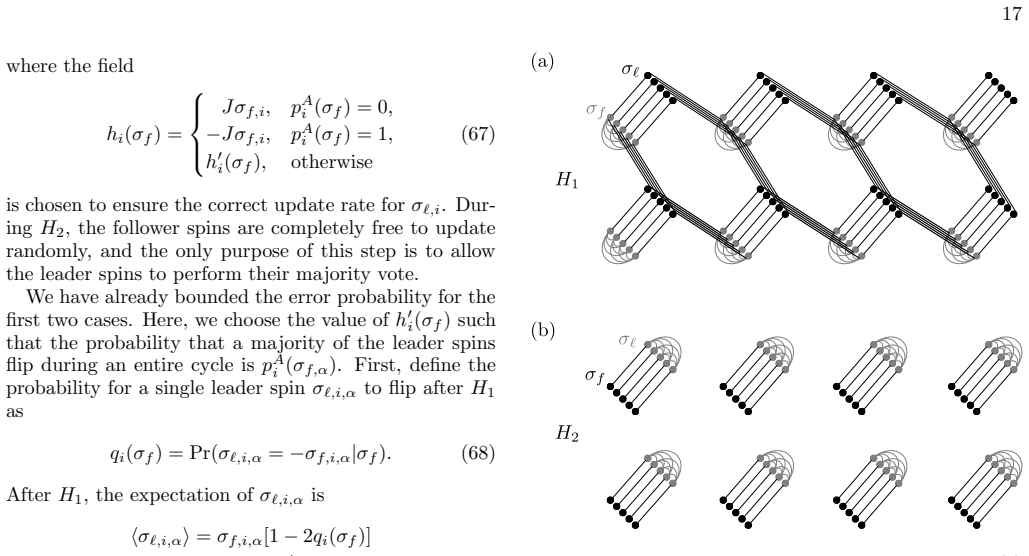
Many-body Brownian ratchets can simulate any continuous-time PCA. Consider continuous-time PCA dynamicsA async, where individual spins update in continuous time accord- ing to a local rule. These are also called asynchronous PCA dynamics because there is no global clock to syn- chronize the individual updates. For any PCA, we con- struct a ratchet systemR...
-
[2]
These are also called syn- chronous PCA rules because all spins update simulta- neously
Many-body Brownian pumps can simulate any discrete-time PCA.Now consider discrete-time PCA dynamicsA sync, where all spins update in paral- lel according to a local rule. These are also called syn- chronous PCA rules because all spins update simulta- neously. For any PCA, we similarly construct a pump Pwith a time-periodic HamiltonianH(t) =H(t+kτ), wherek...
-
[3]
bi- ased
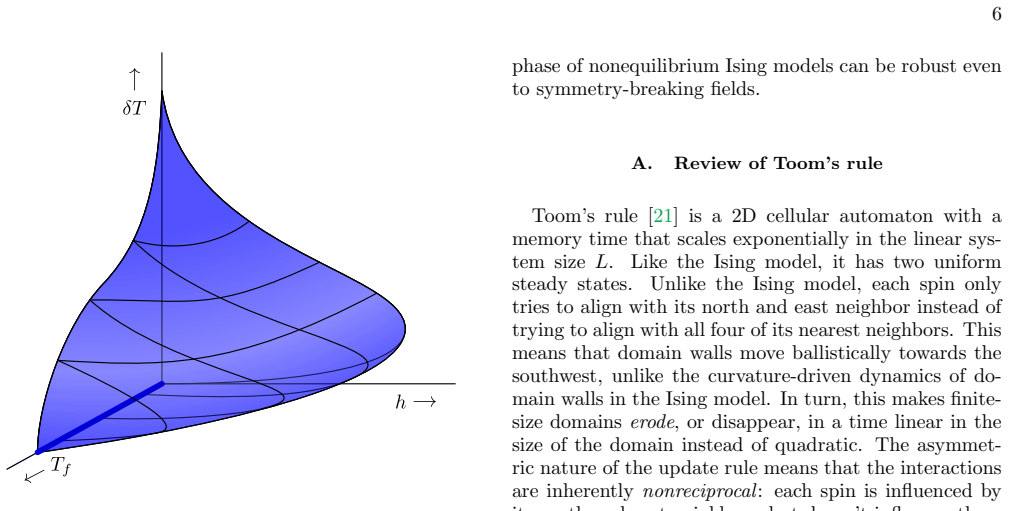
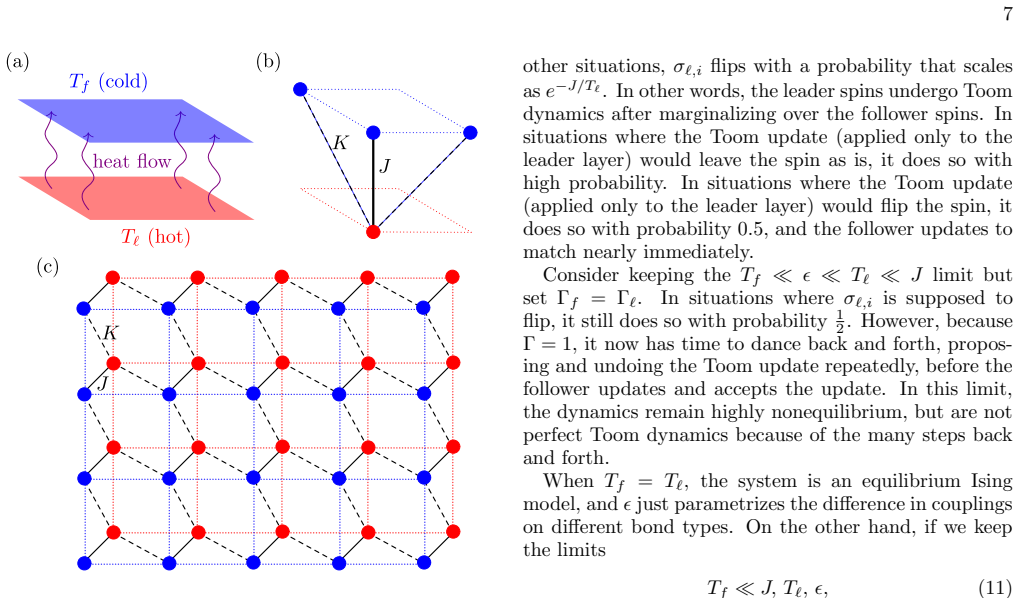
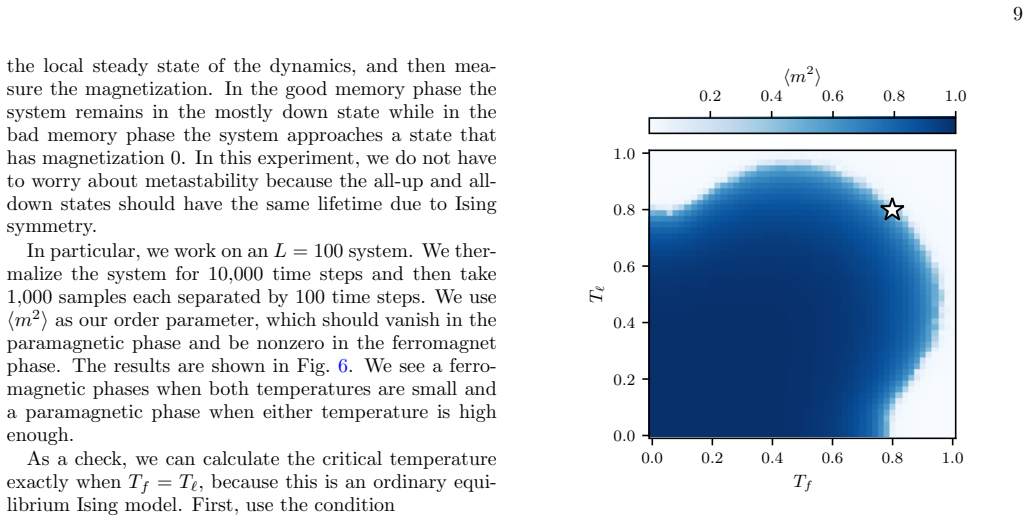
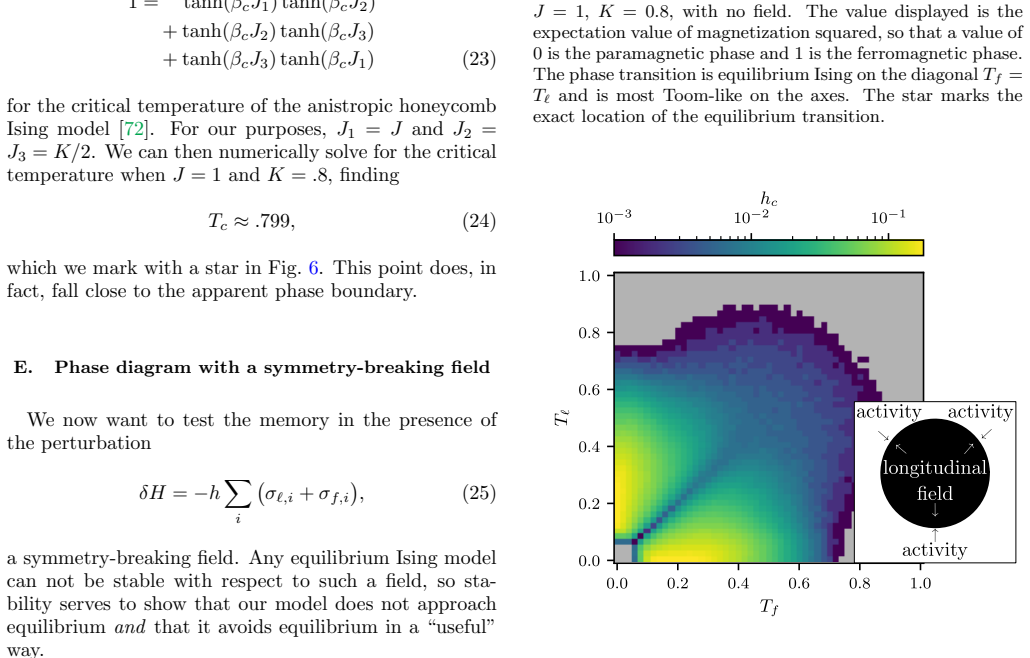
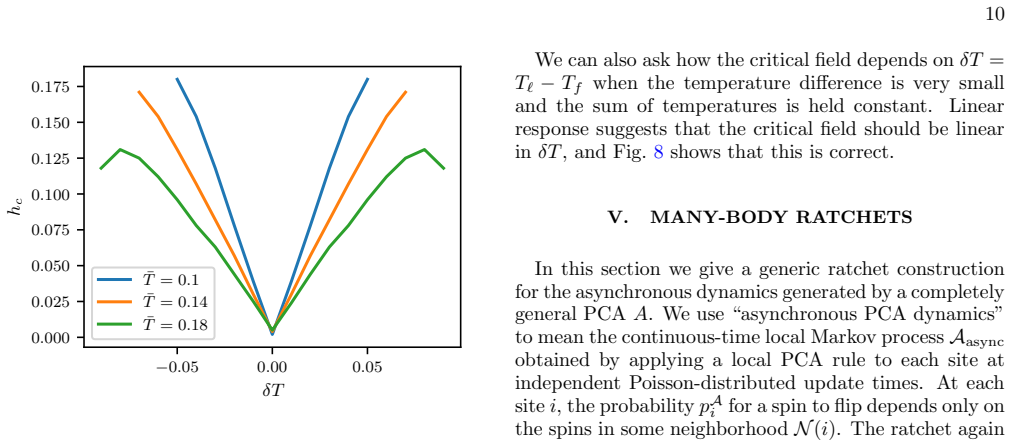
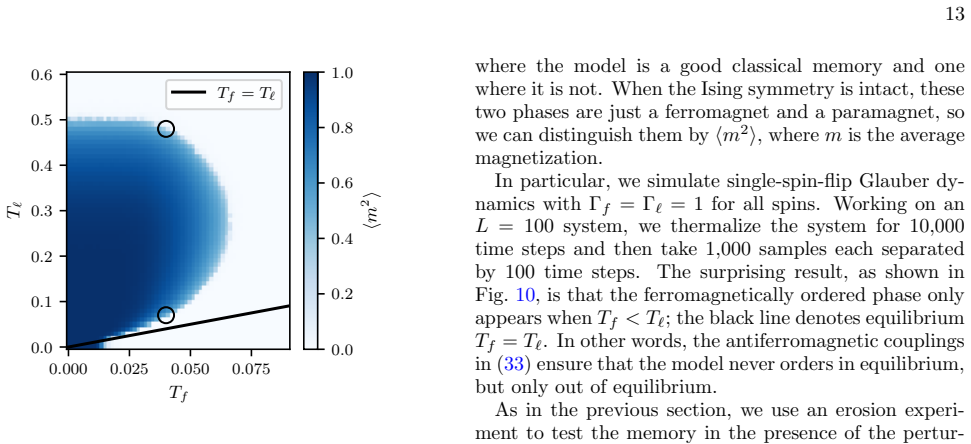
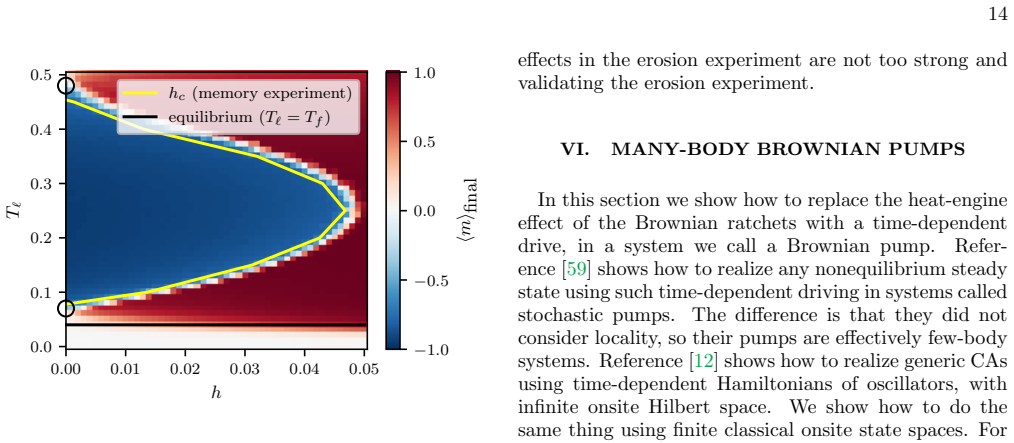
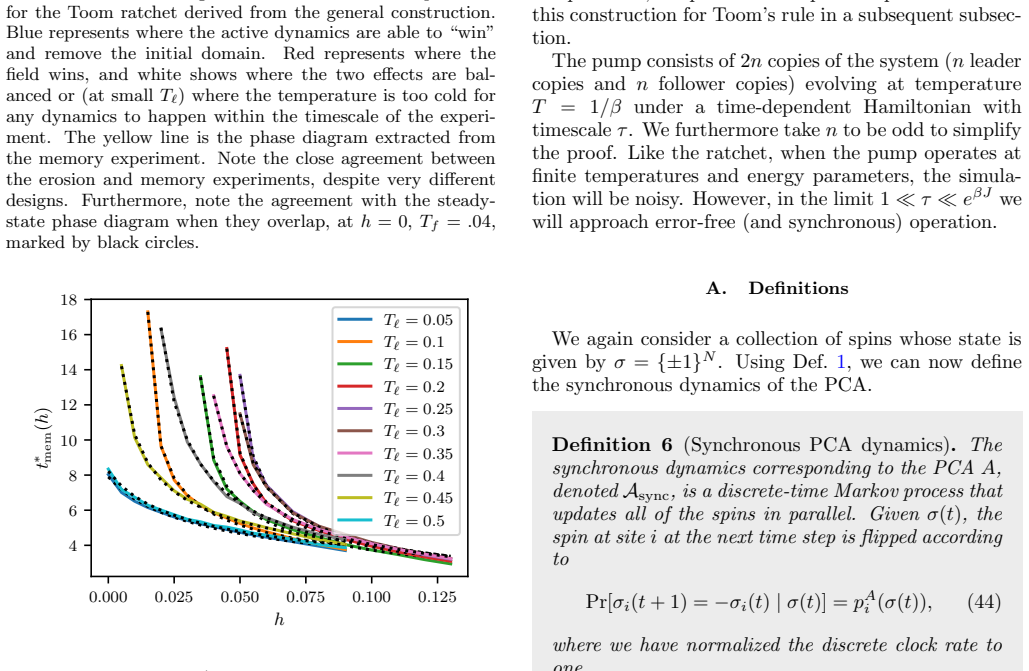
A simple two-temperature nearest-neighbor Ising model can be stable to a symmetry-breaking field.While the constructions behind the previous two general results are not particularly complicated, they do involve multi-spin interactions between spins and (po- tentially all of) their neighbors. For specific examples, simpler Hamiltonians are possible. To ill...
-
[4]
global clock
However, because Γ = 1, it now has time to dance back and forth, propos- ing and undoing the Toom update repeatedly, before the follower updates and accepts the update. In this limit, the dynamics remain highly nonequilibrium, but are not perfect Toom dynamics because of the many steps back and forth. WhenT f =T ℓ, the system is an equilibrium Ising model...
-
[5]
Toner and Y
J. Toner and Y. Tu, Long-range order in a two- dimensional dynamicalXYmodel: How birds fly to- gether, Phys. Rev. Lett.75, 4326 (1995)
1995
-
[6]
Toner and Y
J. Toner and Y. Tu, Flocks, herds, and schools: A quan- titative theory of flocking, Phys. Rev. E58, 4828 (1998)
1998
-
[7]
Toner, Y
J. Toner, Y. Tu, and S. Ramaswamy, Hydrodynamics and phases of flocks, Annals of Physics318, 170 (2005)
2005
-
[8]
Bustamante, D
C. Bustamante, D. Keller, and G. Oster, The physics of molecular motors, Acc. Chem. Res.34, 412 (2001)
2001
-
[9]
S. A. M. Loos, S. H. L. Klapp, and T. Martynec, Long- range order and directional defect propagation in the nonreciprocalXYmodel with vision cone interactions, Phys. Rev. Lett.130, 198301 (2023)
2023
-
[10]
Z. You, A. Baskaran, and M. C. Marchetti, Nonreciproc- ity as a generic route to traveling states, Proc. Natl. Acad. Sci. U.S.A.117, 19767 (2020)
2020
-
[11]
M. Fruchart and V. Vitelli, Nonreciprocal many-body physics (2026), arXiv:2602.11111
-
[12]
Nadolny, C
T. Nadolny, C. Bruder, and M. Brunelli, Nonreciprocal synchronization of active quantum spins, Phys. Rev. X 15, 011010 (2025)
2025
-
[13]
Y.-B. Shi, R. Moessner, R. Alert, and M. Bukov, Hamil- tonian description of non-reciprocal interactions, Nature Physics (2026)
2026
-
[14]
Khemani, A
V. Khemani, A. Lazarides, R. Moessner, and S. L. Sondhi, Phase structure of driven quantum systems, Phys. Rev. Lett.116, 250401 (2016)
2016
-
[15]
D. V. Else, B. Bauer, and C. Nayak, Floquet time crys- tals, Phys. Rev. Lett.117, 090402 (2016)
2016
-
[16]
Machado, Q
F. Machado, Q. Zhuang, N. Y. Yao, and M. P. Zale- tel, Absolutely stable time crystals at finite temperature, Phys. Rev. Lett.131, 180402 (2023)
2023
-
[17]
McGinley, S
M. McGinley, S. Roy, and S. A. Parameswaran, Abso- lutely stable spatiotemporal order in noisy quantum sys- tems, Phys. Rev. Lett.129, 090404 (2022)
2022
-
[18]
J. A. Acebr´ on, L. L. Bonilla, C. J. P´ erez Vicente, F. Ri- tort, and R. Spigler, The Kuramoto model: A simple paradigm for synchronization phenomena, Reviews of Modern Physics77, 137 (2005)
2005
-
[19]
Gupta, A
S. Gupta, A. Campa, and S. Ruffo, Kuramoto model of synchronization: equilibrium and nonequilibrium as- pects, Journal of Statistical Mechanics: Theory and Ex- periment2014, R08001 (2014)
2014
-
[20]
Reimann, Brownian motors: noisy transport far from equilibrium, Physics Reports361, 57 (2002)
P. Reimann, Brownian motors: noisy transport far from equilibrium, Physics Reports361, 57 (2002)
2002
-
[21]
H¨ anggi and F
P. H¨ anggi and F. Marchesoni, Artificial Brownian mo- tors: Controlling transport on the nanoscale, Rev. Mod. Phys.81, 387 (2009)
2009
-
[22]
von Neumann,Theory of Self-Reproducing Automata, edited by A
J. von Neumann,Theory of Self-Reproducing Automata, edited by A. W. Burks (University of Illinois Press, Ur- bana, 1966)
1966
-
[23]
Wolfram, Statistical mechanics of cellular automata, Rev
S. Wolfram, Statistical mechanics of cellular automata, Rev. Mod. Phys.55, 601 (1983)
1983
-
[24]
Gardner, Mathematical games: The fantastic combi- nations of John Conway’s new solitaire game “life”, Sci- entific American223, 120 (1970)
M. Gardner, Mathematical games: The fantastic combi- nations of John Conway’s new solitaire game “life”, Sci- entific American223, 120 (1970)
1970
-
[25]
A. L. Toom, Stable and attractive trajectories in mul- ticomponent systems, inMulticomponent Systems, Ad- vances in Probability, Vol. 6, edited by R. L. Dobrushin (Marcel Dekker, New York, 1980) pp. 549–575, transla- tion from Russian
1980
-
[26]
G´ acs, Reliable cellular automata with self- organization, Journal of Statistical Physics103, 45 (2001)
P. G´ acs, Reliable cellular automata with self- organization, Journal of Statistical Physics103, 45 (2001)
2001
-
[27]
Pajouheshgar, A
E. Pajouheshgar, A. Bhardwaj, N. Selub, and E. Lake, Exploring the landscape of nonequilibrium memories with neural cellular automata, Physical Review Letters 136, 037102 (2026)
2026
-
[28]
E. Lake and S. Ro, Squeezing codes: robust fluctuation- stabilized memories (2025), arXiv:2509.20730
-
[29]
A. M. Turing, On computable numbers, with an appli- cation to the entscheidungsproblem, Proceedings of the London Mathematical Societys2-42, 230 (1937)
1937
-
[30]
R. P. Feynman, Simulating physics with computers, Int J Theor Phys21, 467 (1982)
1982
- [31]
-
[32]
R. Kubo, M. Toda, and N. Hashitsume,Statistical Physics II: Nonequilibrium Statistical Mechanics, 2nd ed., Springer Series in Solid-State Sciences, Vol. 31 (Springer, Berlin, 1991)
1991
-
[33]
Zwanzig,Nonequilibrium Statistical Mechanics(Ox- ford University Press, Oxford, 2001)
R. Zwanzig,Nonequilibrium Statistical Mechanics(Ox- ford University Press, Oxford, 2001)
2001
-
[34]
Grinstein, C
G. Grinstein, C. Jayaprakash, and Y. He, Statistical me- chanics of probabilistic cellular automata, Phys. Rev. Lett.55, 2527 (1985)
1985
-
[35]
Georges and P
A. Georges and P. Le Doussal, From equilibrium spin models to probabilistic cellular automata, Journal of Sta- tistical Physics54, 1011 (1989)
1989
-
[36]
J. L. Lebowitz, C. Maes, and E. R. Speer, Statistical mechanics of probabilistic cellular automata, J Stat Phys 59, 117 (1990)
1990
-
[37]
G´ acs, Probabilistic cellular automata with Andrei Toom, Brazilian Journal of Probability and Statistics38, 285 (2024)
P. G´ acs, Probabilistic cellular automata with Andrei Toom, Brazilian Journal of Probability and Statistics38, 285 (2024)
2024
-
[38]
B. S. Cirel’son, Reliable storage of information in a sys- tem of unreliable components with local interactions, in Locally Interacting Systems and Their Application in Bi- ology, edited by R. L. Dobrushin, V. I. Kryukov, and A. L. Toom (Springer Berlin Heidelberg, Berlin, Heidel- berg, 1978) pp. 15–30
1978
-
[39]
L. D. Landau and E. M. Lifshitz,Statistical Physics, Part 1, 3rd ed., Course of Theoretical Physics, Vol. 5 (Perga- mon Press, Oxford, 1980) revised and enlarged by E. M. Lifshitz and L. P. Pitaevskii
1980
-
[40]
Aharonov and M
D. Aharonov and M. Ben-Or, Fault-tolerant quantum computation with constant error rate, SIAM J. Comput. 38, 1207 (2008)
2008
-
[41]
Dennis, A
E. Dennis, A. Kitaev, A. Landahl, and J. Preskill, Topo- logical quantum memory, J. Math. Phys.43, 4452 (2002)
2002
-
[42]
J. W. Harrington,Analysis of quantum error-correcting codes: Symplectic lattice codes and toric codes(California Institute of Technology, 2004)
2004
-
[43]
N. P. Breuckmann, K. Duivenvoorden, D. Michels, and B. M. Terhal, Local decoders for the 2D and 4D toric code, Quantum Inf. Comput.17, 181 (2017)
2017
-
[44]
A local automaton for the 2D toric code
S. Balasubramanian, M. Davydova, and E. Lake, A local automaton for the 2D toric code (2024), arXiv:2412.19803
work page internal anchor Pith review Pith/arXiv arXiv 2024
-
[45]
Lake, Fast offline decoding with local message-passing automata (2025), arXiv:2506.03266
E. Lake, Fast offline decoding with local message-passing automata (2025), arXiv:2506.03266
-
[46]
Lake, Local active error correction from simulated con- finement (2025), arXiv:2510.08056
E. Lake, Local active error correction from simulated con- finement (2025), arXiv:2510.08056
-
[47]
Quantum Memory and Autonomous Computation in Two Dimensions
G. D¨ unnweber, G. Styliaris, and R. Trivedi, Quantum memory and autonomous computation in two dimensions (2026), arXiv:2601.20818
work page internal anchor Pith review Pith/arXiv arXiv 2026
-
[48]
Pastawski, L
F. Pastawski, L. Clemente, and J. I. Cirac, Quantum memories based on engineered dissipation, Phys. Rev. A 83, 012304 (2011)
2011
-
[49]
B. M. Terhal, Quantum error correction for quantum memories, Rev. Mod. Phys.87, 307 (2015)
2015
-
[50]
Dengis, R
J. Dengis, R. K¨ onig, and F. Pastawski, An optimal dis- sipative encoder for the toric code, New J. Phys.16, 013023 (2014)
2014
-
[51]
Fujii, M
K. Fujii, M. Negoro, N. Imoto, and M. Kitagawa, Measurement-free topological protection using dissipa- tive feedback, Phys. Rev. X4, 041039 (2014)
2014
-
[52]
Herold, E
M. Herold, E. T. Campbell, J. Eisert, and M. J. Kasto- ryano, Cellular-automaton decoders for topological quan- tum memories, npj Quantum Inf1, 10 (2015)
2015
-
[53]
Y. Hong, J. Guo, and A. Lucas, Quantum memory at nonzero temperature in a thermodynamically trivial sys- tem, Nat Commun16(2025)
2025
-
[54]
K. I. Seetharam, C.-E. Bardyn, N. H. Lindner, M. S. Rudner, and G. Refael, Controlled population of Floquet- Bloch states via coupling to Bose and Fermi baths, Phys. Rev. X5, 041050 (2015)
2015
-
[55]
Scarlatella, R
O. Scarlatella, R. Fazio, and M. Schir´ o, Emergent finite frequency criticality of driven-dissipative correlated lat- tice bosons, Phys. Rev. B99, 064511 (2019)
2019
-
[56]
O. R. Diermann and M. Holthaus, Floquet-state cooling, Sci Rep9(2019)
2019
-
[57]
M. T. Naseem and O. E. M¨ ustecaplıo˘ glu, Ground-state cooling of mechanical resonators by quantum reservoir engineering, Commun Phys4(2021)
2021
- [58]
-
[59]
Veness and K
T. Veness and K. Brandner, Reservoir-induced stabiliza- tion of a periodically driven classical spin chain: Lo- cal versus global relaxation, Phys. Rev. E108, 044147 (2023)
2023
-
[60]
Mori, Floquet states in open quantum systems, Annu
T. Mori, Floquet states in open quantum systems, Annu. Rev. Condens. Matter Phys.14, 35 (2023)
2023
-
[61]
Rahav, J
S. Rahav, J. Horowitz, and C. Jarzynski, Directed flow in nonadiabatic stochastic pumps, Phys. Rev. Lett.101, 140602 (2008)
2008
-
[62]
Asban and S
S. Asban and S. Rahav, No-pumping theorem for many particle stochastic pumps, Phys. Rev. Lett.112, 050601 (2014)
2014
-
[63]
O. Raz, Y. Suba¸ sı, and C. Jarzynski, Mimicking nonequi- librium steady states with time-periodic driving, Phys. Rev. X6, 021022 (2016)
2016
-
[64]
P. L. Garrido, A. Labarta, and J. Marro, Stationary nonequilibrium states in the ising model with locally competing temperatures, J Stat Phys49, 551 (1987)
1987
-
[65]
Tamayo, F
P. Tamayo, F. J. Alexander, and R. Gupta, Two- temperature nonequilibrium ising models: Critical be- havior and universality, Phys. Rev. E50, 3474 (1994)
1994
-
[66]
Beyen, C
A. Beyen, C. Maes, and I. Maes, Phase diagram and spe- cific heat of a nonequilibrium Curie–Weiss model, J Stat Phys191(2024)
2024
-
[67]
L´ opez-Lacombaet al., Probabilistic cellular automata with two competing thermal baths, (2006)
A. L´ opez-Lacombaet al., Probabilistic cellular automata with two competing thermal baths, (2006)
2006
-
[68]
Khodabandehlou and C
F. Khodabandehlou and C. Maes, Local detailed balance for active particle models, J. Stat. Mech.2024, 063205 (2024)
2024
-
[69]
H. W. J. Bl¨ ote, J. R. Heringa, A. Hoogland, and R. K. P. Zia, Critical properties of non-equilibrium systems with- out global currents: Ising models at two temperatures, Journal of Physics A: Mathematical and General23, 3799 (1990)
1990
-
[70]
C. H. Nakajima and K. Hukushima, Phase transition of a spin–lattice-gas model with two timescales and two tem- peratures, Phys. Rev. E78, 041132 (2008)
2008
-
[71]
L. F. Gray, Toom’s stability theorem in continuous time, inPerplexing Problems in Probability: Festschrift in Honor of Harry Kesten(Springer, 1999) pp. 331–353
1999
-
[72]
J. M. Swart, R. Szab´ o, and C. Toninelli, Peierls bounds from toom contours, Journal of Theoretical Probability 39, 45 (2026)
2026
-
[73]
Rakovszky, S
T. Rakovszky, S. Gopalakrishnan, and C. Von Keyser- lingk, Defining stable phases of open quantum systems, Physical Review X14, 041031 (2024). 21
2024
-
[74]
Berman and J
P. Berman and J. Simon, Investigations of fault-tolerant networks of computers, inProceedings of the Twenti- eth Annual ACM Symposium on Theory of Computing (1988) pp. 66–77
1988
-
[75]
M. Cook, P. G´ acs, and E. Winfree,Self-stabilizing syn- chronization in 3 dimensions (draft), Tech. Rep. (Tech. report, Boston University, Department of Computer Sci- ence, Boston, MA, 2008)
2008
-
[76]
R. J. Baxter,Exactly Solved Models in Statistical Me- chanics(Academic Press, London, 1982)
1982
-
[77]
Langer, Statistical theory of the decay of metastable states, Annals of Physics54, 258–275 (1969)
J. Langer, Statistical theory of the decay of metastable states, Annals of Physics54, 258–275 (1969)
1969
-
[78]
A. Ray, R. Laflamme, and A. Kubica, Protecting infor- mation via probabilistic cellular automata, Phys. Rev. E 109, 044141 (2024)
2024
- [79]
-
[80]
Bravyi and J
S. Bravyi and J. Haah, Quantum self-correction in the 3d cubic code model, Phys. Rev. Lett.111, 200501 (2013)
2013
discussion (0)
Sign in with ORCID, Apple, or X to comment. Anyone can read and Pith papers without signing in.