Axion Misalignment Across First-Order Phase Transitions
Pith reviewed 2026-07-03 19:42 UTC · model grok-4.3
The pith
When axion mass turns on only inside expanding bubbles during a first-order phase transition, misalignment production splits into regimes that enhance or suppress the dark matter relic density.
A machine-rendered reading of the paper's core claim, the machinery that carries it, and where it could break.
Core claim
When the axion mass is generated during a first-order phase transition and becomes non-vanishing only inside expanding true-vacuum bubbles, the standard picture of misalignment production is qualitatively modified. For rapid transitions the onset of oscillations is delayed until bubble percolation, enhancing the relic abundance. For slower transitions spatial gradients generated by expanding bubbles suppress the effective misalignment angle through the bubble misalignment mechanism. A semi-analytical expression for the relic density provides a unified description of both regimes and accurately reproduces the simulation results, while also modifying isocurvature perturbations and the small-sc
What carries the argument
Bubble misalignment mechanism, in which expanding bubbles generate spatial gradients that suppress the effective misalignment angle, together with delayed oscillations until percolation when mass activates only inside bubbles.
If this is right
- Rapid transitions enhance relic abundance via delayed oscillations until percolation.
- Slower transitions suppress relic abundance via spatial gradients from expanding bubbles.
- Isocurvature perturbations are modified by the same mechanism.
- The small-scale matter power spectrum changes, affecting axion minicluster formation.
Where Pith is reading between the lines
- Axion dark matter parameter space may need re-evaluation in models featuring first-order transitions.
- Distinct signatures in structure formation could appear in future surveys due to the altered power spectrum.
- The semi-analytical formula enables rapid parameter scans without repeated full simulations.
Load-bearing premise
The axion mass becomes non-vanishing only inside expanding true-vacuum bubbles during the first-order phase transition.
What would settle it
A lattice simulation in which the axion mass turns on uniformly rather than only inside bubbles and still produces the reported enhancement or suppression would falsify the claim that bubble confinement drives the modification.
Figures
read the original abstract
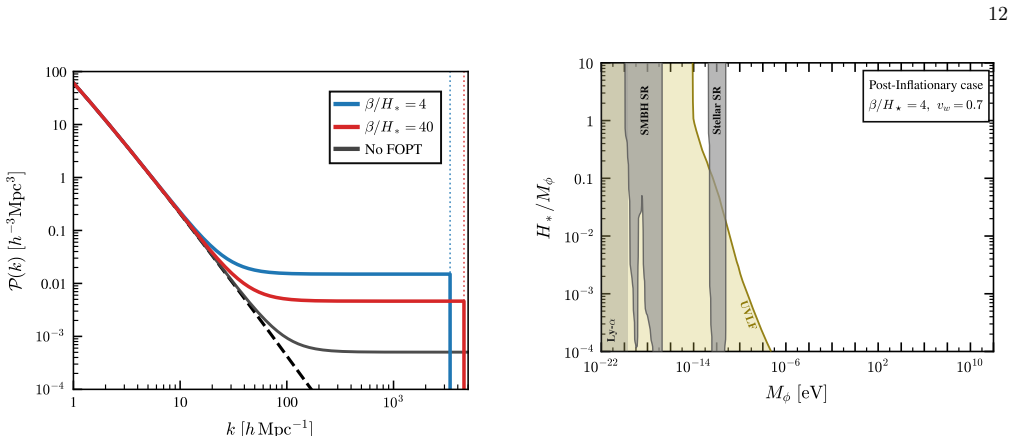
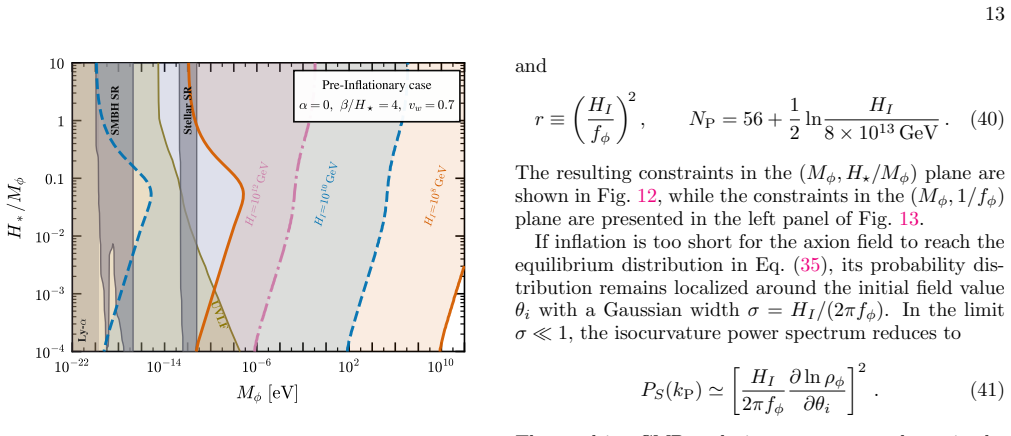
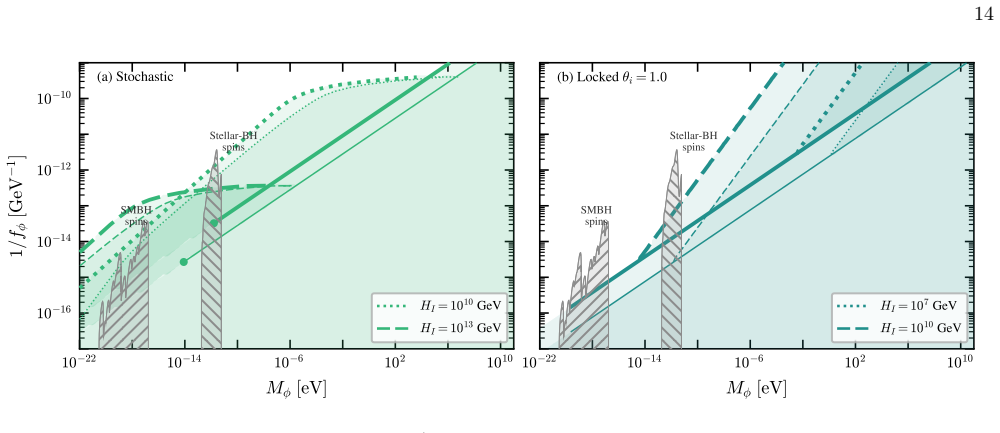
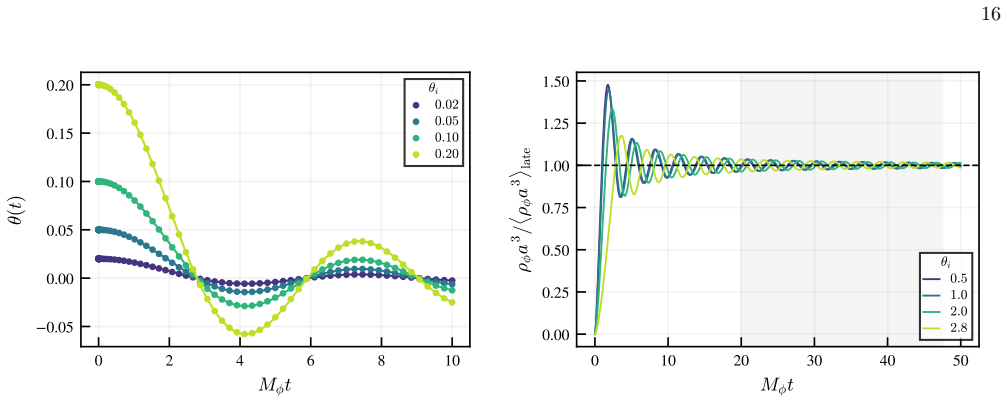
When the axion mass is generated during a first-order phase transition and becomes non-vanishing only inside expanding true-vacuum bubbles, the standard picture of misalignment production is qualitatively modified. Using lattice simulations in an expanding universe, we study dark matter production within such a framework and identify two distinct regimes. For rapid transitions, the onset of oscillations is delayed until bubble percolation, enhancing the relic abundance. For slower transitions, spatial gradients generated by expanding bubbles suppress the effective misalignment angle through the bubble misalignment mechanism. We derive a semi-analytical expression for the relic density that provides a unified description of both regimes and accurately reproduces the simulation results. Finally, we show how this mechanism also modifies isocurvature perturbations and the small-scale matter power spectrum, with important implications for axion minicluster formation.
Editorial analysis
A structured set of objections, weighed in public.
Referee Report
Summary. The paper claims that when the axion mass turns on exclusively inside expanding true-vacuum bubbles during a first-order phase transition, the standard misalignment mechanism is qualitatively altered. Lattice simulations in an expanding background reveal two regimes: rapid transitions delay the onset of oscillations until percolation (enhancing relic density), while slower transitions generate spatial gradients that suppress the effective misalignment angle via a 'bubble misalignment' effect. A semi-analytical relic-density formula is derived that unifies both regimes and reproduces the numerical results; the work also examines consequences for isocurvature perturbations and the small-scale matter power spectrum.
Significance. If the central premise holds, the mechanism offers a qualitatively new channel for axion dark-matter production whose relic density can be either enhanced or suppressed relative to the standard misalignment picture, with direct implications for minicluster formation and isocurvature constraints. The combination of expanding-universe lattice simulations and a unified semi-analytical expression constitutes a concrete, falsifiable advance within the stated framework.
minor comments (2)
- The abstract states that the semi-analytical expression 'accurately reproduces the simulation results,' but the manuscript should explicitly state the fitting procedure, the range of parameters over which agreement holds, and whether any parameters are tuned to the same runs (to address potential circularity concerns).
- Clarify the precise definition of 'rapid' versus 'slow' transitions (e.g., in terms of the ratio of bubble wall velocity to the Hubble rate or the duration of the transition relative to the axion oscillation timescale) so that the two regimes can be unambiguously identified in the text and figures.
Simulated Author's Rebuttal
We thank the referee for their positive assessment of the manuscript, accurate summary of the results, and recommendation for minor revision. No specific major comments were provided in the report.
Circularity Check
No significant circularity detected
full rationale
The provided abstract and context describe lattice simulations in an expanding universe that identify two regimes of axion production, followed by derivation of a semi-analytical relic-density expression that reproduces the simulation results. No quotes or equations are available showing self-definition (e.g., a quantity defined in terms of itself), a fitted parameter from the same data renamed as a prediction, or load-bearing self-citations whose content reduces to the target result. The central premise is stated explicitly as an input assumption about the axion mass, and the simulations plus analytic formula are presented as independent validation steps. This is the normal case of a self-contained numerical-plus-analytic study with no reduction by construction.
Axiom & Free-Parameter Ledger
Reference graph
Works this paper leans on
-
[1]
R. D. Peccei and H. R. Quinn, Phys. Rev. Lett.38, 1440 (1977)
1977
-
[2]
R. D. Peccei and H. R. Quinn, Phys. Rev. D16, 1791 17 (1977)
1977
-
[3]
Wilczek, Phys
F. Wilczek, Phys. Rev. Lett.40, 279 (1978)
1978
-
[4]
Weinberg, Phys
S. Weinberg, Phys. Rev. Lett.40, 223 (1978)
1978
-
[5]
Chikashige, R
Y. Chikashige, R. N. Mohapatra, and R. D. Peccei, Phys. Lett. B98, 265 (1981)
1981
-
[6]
P. Svrcek and E. Witten, JHEP06, 051 (2006), arXiv:hep-th/0605206
work page internal anchor Pith review Pith/arXiv arXiv 2006
-
[7]
A. Arvanitaki, S. Dimopoulos, S. Dubovsky, N. Kaloper, and J. March-Russell, Phys. Rev. D81, 123530 (2010), arXiv:0905.4720 [hep-th]
work page internal anchor Pith review Pith/arXiv arXiv 2010
-
[8]
The type IIB string axiverse and its low-energy phenomenology
M. Cicoli, M. Goodsell, and A. Ringwald, JHEP10, 146 (2012), arXiv:1206.0819 [hep-th]
work page internal anchor Pith review Pith/arXiv arXiv 2012
-
[9]
Preskill, M
J. Preskill, M. B. Wise, and F. Wilczek, Phys. Lett. B 120, 127 (1983)
1983
-
[10]
L. F. Abbott and P. Sikivie, Phys. Lett. B120, 133 (1983)
1983
-
[11]
Dine and W
M. Dine and W. Fischler, Phys. Lett. B120, 137 (1983)
1983
-
[12]
Particle Dark Matter: Evidence, Candidates and Constraints
G. Bertone, D. Hooper, and J. Silk, Phys. Rept.405, 279 (2005), arXiv:hep-ph/0404175
work page internal anchor Pith review Pith/arXiv arXiv 2005
-
[13]
M. Cirelli, A. Strumia, and J. Zupan, (2024), arXiv:2406.01705 [hep-ph]
work page internal anchor Pith review Pith/arXiv arXiv 2024
-
[14]
M. S. Turner, Phys. Rev. D33, 889 (1986)
1986
-
[15]
P. Sikivie, Lect. Notes Phys.741, 19 (2008), arXiv:astro- ph/0610440
-
[16]
D. J. E. Marsh, Phys. Rept.643, 1 (2016), arXiv:1510.07633 [astro-ph.CO]
work page internal anchor Pith review Pith/arXiv arXiv 2016
-
[17]
Vilenkin and A
A. Vilenkin and A. E. Everett, Phys. Rev. Lett.48, 1867 (1982)
1982
-
[18]
T. W. B. Kibble, Nucl. Phys. B252, 227 (1985), [Erra- tum: Nucl.Phys.B 261, 750 (1985)]
1985
-
[19]
Harari and P
D. Harari and P. Sikivie, Phys. Lett. B195, 361 (1987)
1987
-
[20]
E. P. S. Shellard, Nucl. Phys. B283, 624 (1987)
1987
-
[21]
Hagmann and P
C. Hagmann and P. Sikivie, Nucl. Phys. B363, 247 (1991)
1991
-
[22]
R. A. Battye and E. P. S. Shellard, Phys. Rev. Lett.73, 2954 (1994), [Erratum: Phys.Rev.Lett. 76, 2203–2204 (1996)], arXiv:astro-ph/9403018
work page internal anchor Pith review Pith/arXiv arXiv 1994
-
[23]
M. Kawasaki, T. Sekiguchi, M. Yamaguchi, and J. Yokoyama, PTEP2018, 091E01 (2018), arXiv:1806.05566 [hep-ph]
-
[24]
Axions from Strings: the Attractive Solution
M. Gorghetto, E. Hardy, and G. Villadoro, JHEP07, 151 (2018), arXiv:1806.04677 [hep-ph]
work page internal anchor Pith review Pith/arXiv arXiv 2018
-
[25]
M. Buschmann, J. W. Foster, and B. R. Safdi, Phys. Rev. Lett.124, 161103 (2020), arXiv:1906.00967 [astro- ph.CO]
-
[26]
M. Hindmarsh, J. Lizarraga, A. Lopez-Eiguren, and J. Urrestilla, Phys. Rev. Lett.124, 021301 (2020), arXiv:1908.03522 [astro-ph.CO]
-
[27]
M. Gorghetto, E. Hardy, and G. Villadoro, SciPost Phys. 10, 050 (2021), arXiv:2007.04990 [hep-ph]
-
[28]
M. Buschmann, J. W. Foster, A. Hook, A. Peterson, D. E. Willcox, W. Zhang, and B. R. Safdi, Nature Com- mun.13, 1049 (2022), arXiv:2108.05368 [hep-ph]
- [29]
- [30]
- [31]
-
[32]
Hindmarsh, Phys
M. Hindmarsh, Phys. Rev. D45, 1130 (1992)
1992
-
[33]
S. Nakagawa, F. Takahashi, M. Yamada, and W. Yin, Phys. Lett. B839, 137824 (2023), arXiv:2210.10022 [hep- ph]
- [34]
-
[35]
P. Carenza, J. Eby, O. Iarygina, and M. C. D. Marsh, JHEP09, 023 (2024), arXiv:2407.01676 [hep-ph]
-
[36]
I. Garcia Garcia and R. Petrossian-Byrne, JHEP04, 189 (2025), arXiv:2407.09603 [hep-ph]
-
[37]
D. H. Lyth, Phys. Rev. D45, 3394 (1992)
1992
-
[38]
K. J. Bae, J.-H. Huh, and J. E. Kim, JCAP09, 005 (2008), arXiv:0806.0497 [hep-ph]
work page internal anchor Pith review Pith/arXiv arXiv 2008
-
[39]
L. Visinelli and P. Gondolo, Phys. Rev. D80, 035024 (2009), arXiv:0903.4377 [astro-ph.CO]
-
[40]
S. R. Coleman, Phys. Rev. D15, 2929 (1977), [Erratum: Phys.Rev.D 16, 1248 (1977)]
1977
-
[41]
C. G. Callan, Jr. and S. R. Coleman, Phys. Rev. D16, 1762 (1977)
1977
-
[42]
A. D. Linde, Nucl. Phys. B216, 421 (1983), [Erratum: Nucl.Phys.B 223, 544 (1983)]
1983
-
[43]
M. S. Turner, E. J. Weinberg, and L. M. Widrow, Phys. Rev. D46, 2384 (1992)
1992
-
[44]
M. Lewicki, P. Toczek, and V. Vaskonen, Phys. Dark Univ.50, 102075 (2025), arXiv:2412.10366 [astro- ph.CO]
-
[45]
The Growth of Bubbles in Cosmological Phase Transitions
J. Ignatius, K. Kajantie, H. Kurki-Suonio, and M. Laine, Phys. Rev. D49, 3854 (1994), arXiv:astro-ph/9309059
work page internal anchor Pith review Pith/arXiv arXiv 1994
-
[46]
G. D. Moore and T. Prokopec, Phys. Rev. D52, 7182 (1995), arXiv:hep-ph/9506475
work page internal anchor Pith review Pith/arXiv arXiv 1995
-
[47]
Electroweak Bubble Wall Speed Limit
D. Bodeker and G. D. Moore, JCAP05, 025 (2017), arXiv:1703.08215 [hep-ph]
work page internal anchor Pith review Pith/arXiv arXiv 2017
-
[48]
T. Krajewski, M. Lewicki, M. Vasar, V. Vaskonen, H. Veerm¨ ae, and M. Zych, JHEP03, 178 (2025), arXiv:2411.15094 [hep-ph]
-
[49]
A. Ekstedt, O. Gould, J. Hirvonen, B. Laurent, L. Niemi, P. Schicho, and J. van de Vis, JHEP04, 101 (2025), arXiv:2411.04970 [hep-ph]
-
[50]
A. H. Guth and E. J. Weinberg, Nucl. Phys. B212, 321 (1983)
1983
- [51]
-
[52]
Planck 2018 results. VI. Cosmological parameters
N. Aghanimet al.(Planck), Astron. Astrophys.641, A6 (2020), [Erratum: Astron.Astrophys. 652, C4 (2021)], arXiv:1807.06209 [astro-ph.CO]
work page internal anchor Pith review Pith/arXiv arXiv 2020
-
[53]
Navaset al.(Particle Data Group), Phys
S. Navaset al.(Particle Data Group), Phys. Rev. D110, 030001 (2024)
2024
-
[54]
M. Lewicki and V. Vaskonen, (2025), arXiv:2511.15687 [astro-ph.CO]
-
[55]
Vilenkin and E
A. Vilenkin and E. P. S. Shellard,Cosmic Strings and Other Topological Defects(Cambridge University Press, 2000)
2000
-
[56]
M. Fairbairn, D. J. E. Marsh, J. Quevillon, and S. Rozier, Phys. Rev. D97, 083502 (2018), arXiv:1707.03310 [astro-ph.CO]
-
[57]
E. W. Kolb and I. I. Tkachev, Phys. Rev. Lett.71, 3051 (1993), arXiv:hep-ph/9303313
work page internal anchor Pith review Pith/arXiv arXiv 1993
-
[58]
S. Chabanier, M. Millea, and N. Palanque-Delabrouille, Mon. Not. Roy. Astron. Soc.489, 2247 (2019), arXiv:1905.08103 [astro-ph.CO]
-
[59]
V. Irˇ siˇ c, H. Xiao, and M. McQuinn, Phys. Rev. D101, 123518 (2020), arXiv:1911.11150 [astro-ph.CO]
-
[60]
J. Urrutia, J. Ellis, M. Fairbairn, and V. Vaskonen, Astron. Astrophys.702, A109 (2025), arXiv:2504.20043 [astro-ph.CO]
- [61]
- [62]
- [63]
-
[64]
P. W. Graham and A. Scherlis, Phys. Rev. D98, 035017 (2018), arXiv:1805.07362 [hep-ph]
work page internal anchor Pith review Pith/arXiv arXiv 2018
-
[65]
A. A. Starobinsky and J. Yokoyama, Phys. Rev. D50, 6357 (1994), arXiv:astro-ph/9407016
work page internal anchor Pith review Pith/arXiv arXiv 1994
- [66]
-
[67]
T. Tenkanen, Phys. Rev. Lett.123, 061302 (2019), arXiv:1905.01214 [astro-ph.CO]
- [68]
-
[69]
J. Kehayias and S. Profumo, JCAP03, 003 (2010), arXiv:0911.0687 [hep-ph]
work page internal anchor Pith review Pith/arXiv arXiv 2010
-
[70]
Gould, JHEP04, 057 (2021), arXiv:2101.05528 [hep- ph]
O. Gould, JHEP04, 057 (2021), arXiv:2101.05528 [hep- ph]
discussion (0)
Sign in with ORCID, Apple, or X to comment. Anyone can read and Pith papers without signing in.